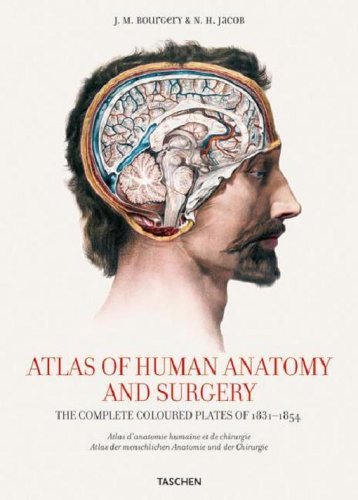
We owe a great debt to Jean Baptiste Marc Bourgery (1797–1849) for his Atlas of Anatomy, which was not only a massive event in medical history, but also remains one of the most comprehensive and beautifully illustrated anatomical treatises ever published in any language. In 1830, having received his doctorate in medicine three years prior, Bourgery began work on his magnificent atlas in cooperation with illustrator Nicolas Henri Jacob (1782–1871), a student of the French painter Jacques Louis David. The first volumes were published the following year, but completion of the treatise required nearly two decades of dedication; Bourgery lived just long enough to finish his labor of love, but the last of the treatise’s eight volumes was not published in its entirety until five years after his death.
The four parts of Bourgery’s treatise cover descriptive anatomy, surgical anatomy and techniques (exploring in detail nearly all the major operations that were performed during the first half of the 19th century), general anatomy and embryology, and microscopic anatomy. Jacob’s spectacular hand-colored, life-size lithographs are remarkable for their clarity, color, and aesthetic appeal, reflecting a combination of direct laboratory observation and illustrative research; the images are to this day unsurpassed in anatomical illustration.
Jean-Baptiste Marc Bourgery, né à Orléans le 19 mai 1797 et mort à Paris en juin 1849, est un médecin et anatomiste français. Il consacra toute sa carrière à la recherche en anatomie, mais ne parvint jamais à une reconnaissance officielle de son travail, qui fut parfois utilisé sans être cité.
This is, without a doubt, one of the most beautiful books I have ever lain eyes on. I've always wanted to improve my skills with drawing, particularly people, and heard anatomy books such as this one are a great starting place. It shows, if nothing else, one man's determination to document what it means to be human (if on a purely physical level) and is an astonishing accomplishment. Each and every page (804 or so of them) have immaculately, painstakingly illustrated images of every muscle, bone, artery, organ you can think to name. The section describing surgery (pages 542 to 636) provides a fascinating insight into how far surgical procedure has progressed in the last almost 2 centuries, though also sheds a great amount of light on the pioneers of such an important then emerging science.
Purchased as a gift for a friend, flipping through the pages makes me want to keep it all to myself. And in an age of digital e-books and Wikipedia, this is definitely one to purchase in "physical form" if you will.. The pages are glossy and perfectly printed, and at times you'll feel the need to take out your trusty magnifying glass to examine further. If you have any interest in anatomy and surgical processes from the mid 19th century.. BUY THIS BOOK!! :)
Най-красивият атлас по анатомия който съм виждал. Изумително е как човек може да нарисува над 700 от тези прекарсни рисунки. Единствения проблем е че означенията са изтрити, но дори само като албум с картини си заслужава всяко левче. Брутален!
This is a landmark medical textbook and was published in 1831, decades before Dr. Henry Gray came out with his eponymous anatomy text.
The paintings are stunning and an enthralling glimpse into the nineteenth century understanding of the body.
This was also around the time anatomy was breaking away from its notorious past of Burk and Hare-type murders, body snatching and grave robbing; and becoming an established medical discipline.
This book helped illuminate the course of anatomy as the bedrock of Western Medicine. Hence, it remains indispensable to a thinking medical man's library.
It should make a great gift for a doctor or a medical student. Anyone with even a transitory interest in the human body and the history of Western Medicine should find the pictures entrancing.
The text of the book is in french, however, and I would not recommend it for a college anatomy course as modern standardized anatomical terminology is not used. Plus our understanding of anatomy has changed, so Gray's Anatomy will continue to be the preeminent reference on the subject.
Note: In a strict sense, this cannot be termed a coffee table book but it serves pretty much the same purpose due to the stunning pictures.
Has enough description to paint a clear picture of what an extensive and groundbreaking work this is and then lets the work itself do the talking.
An astonishing look at the human body anatomised part by part. I never realised how the tongue anchored the way it does, the complexity of muscles joints and ligaments or how small some of the organs are compared to my prior understanding.
The very best (and ickiest) bit is at the back where there are pictures of early surgery without anaesthetic. After seeing the invasiveness of the techniques, it makes me glad to live in modern times.
This extrodinary collection of anatomical illustrations is truly breathtaking. The entire human body is deconstructed and detailed, creating a work that holds both scientific accuracy and artistic splendor.
It is in the face of such great works that we are humbled, for we become aware of how little we truly know about our own (physical) existance.
Amazing anatomical illustrations and fascinating historical surgical illustrations from the 1830s-1850s. I can’t even imagine how much work must have gone into drawing and reproducing these in those times.
A masterpiece of surgery and anatomy encompassing the work of Bourgery, both terrifying and terrific. Purchased it as a gift for a certain body-obsessed maniac I fool around with in the morgue and went through it in two sittings.