

What do you think?
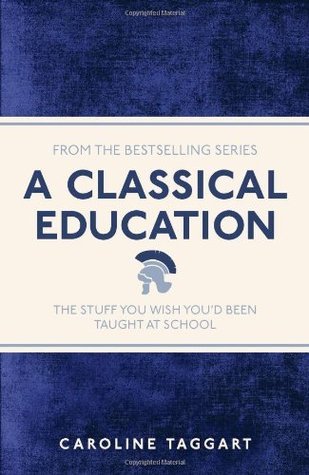
A Classical Education: The Stuff You Wish You'd Been Taught at School
How many times have you wished that you'd been taught Latin at school? Or that your history stretched all the way back to Greek and Roman myths and legends? Or perhaps you wish you knew all about the great inventions and medical developments that have made our world what it is today? A Classical Education provides all of these classical facts that modern schooling leaves out and many more. Perfect for parents who wish to teach their children and for those who would like to learn or relearn the facts themselves, A Classical Education is informative and educational, but in a completely accessible way.
192 pages, Paperback
First published June 11, 2009
About the author
Caroline Taggart
78 books128 followersI was an editor for 30 years before Michael O’Mara Books asked me to write what became I Used to Know That. I think its success took everyone by surprise – it certainly did me – but it led to my writing a lot of other books and finally, after about three years, feeling able to tell people I was an author. It's a nice feeling.
Until recently the book I was most proud of was The Book of London Place Names (Ebury), partly because I am passionate about London and partly because, having written ten or so books before that, I finally felt I was getting the hang of it.
Now I have to confess I’m really excited by my first venture into continuous narrative. For A Slice of Britain: around the country by cake (AA) I travelled the country investigating, writing about and eating cake. From Cornish Saffron Cake to Aberdeen Butteries, I interviewed about 25 people who are baking cakes, biscuits and buns that are unique to their region, part of their heritage – and pretty darned delicious. The Sunday Times reviewed it and described me as ‘engaging, greedy and droll’, which pleased me enormously.
Until recently the book I was most proud of was The Book of London Place Names (Ebury), partly because I am passionate about London and partly because, having written ten or so books before that, I finally felt I was getting the hang of it.
Now I have to confess I’m really excited by my first venture into continuous narrative. For A Slice of Britain: around the country by cake (AA) I travelled the country investigating, writing about and eating cake. From Cornish Saffron Cake to Aberdeen Butteries, I interviewed about 25 people who are baking cakes, biscuits and buns that are unique to their region, part of their heritage – and pretty darned delicious. The Sunday Times reviewed it and described me as ‘engaging, greedy and droll’, which pleased me enormously.
Ratings & Reviews
Friends & Following
Create a free account to discover what your friends think of this book!
Community Reviews
Displaying 1 - 30 of 229 reviews

September 19, 2019
Well... it’s interesting but it only covers the essentials of Classical Greek and Roman. There is little depth. However, don’t see that as too much of a criticism, to go into any sort of depth in the ‘essentials’ would have increased the weight of this a hundred-fold.
Enjoyable but you’ll probably know a great deal already, I certainly did and my education was a long way from anything that could be considered classical.
Enjoyable but you’ll probably know a great deal already, I certainly did and my education was a long way from anything that could be considered classical.

August 18, 2013
This is basically "Classical Studies for Lads." It provides a very breezy, jokey, and superficial account of classical history, mythology, philosophy and etymology of some common phrases. It is also often inaccurate in the details. It's written from a very British perspective, and I honestly had more trouble making sense of her analogies to modern references than I did the classical stuff. It's not a bad book for a neophyte, but it's a light meal for anyone with a passing knowledge of the subject.

February 17, 2018
achilles was a bottom, caroline
April 20, 2022
I really enjoyed this whistlestop tour (only 4 hrs in audio form) of all things Ancient Greece and Rome: language, literature, history, the Gods, philosophy, politics, and culture. I also didn't expect to regularly laugh out loud, a combination of the author's witty delivery and the great wry narration by Bill Wallis.
Most of the reviews seem to be by people who already know this stuff complaining that the book could only be enjoyed by a neanderthal who lives under a rock. Well, I guess that must be me ;) It's a short book, admittedly, but I appreciated that and found it a good jumping off point to take anything of interest further by myself.
Most of the reviews seem to be by people who already know this stuff complaining that the book could only be enjoyed by a neanderthal who lives under a rock. Well, I guess that must be me ;) It's a short book, admittedly, but I appreciated that and found it a good jumping off point to take anything of interest further by myself.

January 7, 2016
This book gives very basic background information on:
Greek/Roman mythology and history;
Where and how it has had influence on modern sciences.
-The information was somewhat useful for me as I didn't really understand the different ideas until now.
-This book isn't a book to rely on in the sense of authenticity of its historical facts.
However it was an enjoyable read for a non-fiction. The humour was intertwined well with the text, as it had me laughing in places I didn't expect.
Greek/Roman mythology and history;
Where and how it has had influence on modern sciences.
-The information was somewhat useful for me as I didn't really understand the different ideas until now.
-This book isn't a book to rely on in the sense of authenticity of its historical facts.
However it was an enjoyable read for a non-fiction. The humour was intertwined well with the text, as it had me laughing in places I didn't expect.

August 1, 2010
This book starts out kind of slow. It starts out by talking about the classical languages. I won't be able to remember any of it, I read it though. The next chapter is much better going into brief detail about the Greek Pantheon. I love to learn about the Greek Gods and Goddesses and Ms. Taggart throws in a tad bit of humor within this section to keep you reading. The next chapter covers events happening in Crete and include some pretty funny asterisk (comes from the Green for little star, see I am learning) comments. The next chapter is also a bit stiff going into Ancient Greek history but she keeps it light and quick in order to keep the reader interested. She covers everything Alexander the great to some of the great Greek historians. Continuing in this manor the author goes over the history of Ancient Rome, this chapter was more interesting and compelling that the one on Greece surprisingly but I always liked to learn about Cesar and such.
I will leave the rest of the chapters for you to discover but each one gets better and funnier than the last. I loved this nice mix of facts and humor that Ms. Taggart created. The following chapters will take a look at some literature (my favorite), the arts, and a few other things I will leave to you. I enjoyed this brief informative jaunt through history. You probably will too.
I will leave the rest of the chapters for you to discover but each one gets better and funnier than the last. I loved this nice mix of facts and humor that Ms. Taggart created. The following chapters will take a look at some literature (my favorite), the arts, and a few other things I will leave to you. I enjoyed this brief informative jaunt through history. You probably will too.
February 4, 2018
This is a good book. At a bit under 200 pages, with quite large text, you're obviously not going to get a full classical education per se, but what you will get is a knowledge of what constitutes a classical education. Which is a big deal. Now that you know who Socrates was, or how democracy started, or how Rome became a dictatorship, you know where to look if you want to learn more. You're no longer in the dark about these subjects, which were usually reserved for the privileged.
The author writes in a casual, jokey style. It's as if you were being told a great, long story by your grandpa, with his encyclopaedic knowledge, after he's had two beers. It helps to keep you enjoying the book, and I'm sure some subjects would be dull without it. Other subjects, mythological and historical stories principally, are exciting and fascinating enough in their own right, and an absolute joy to read.
The author only really gets in the way twice: when she calls Plato "pompous" (are you kidding me?) and when she dedicates a third of the mere paragraph on Pythagoras to a quip about how he "probably wasn't a barrel of laughs" while neglecting to mention that he's the guy who basically invented music (nothing fun about music then is there?). But I digress...
If you're interested enough to read this far, you'll like the book.
The author writes in a casual, jokey style. It's as if you were being told a great, long story by your grandpa, with his encyclopaedic knowledge, after he's had two beers. It helps to keep you enjoying the book, and I'm sure some subjects would be dull without it. Other subjects, mythological and historical stories principally, are exciting and fascinating enough in their own right, and an absolute joy to read.
The author only really gets in the way twice: when she calls Plato "pompous" (are you kidding me?) and when she dedicates a third of the mere paragraph on Pythagoras to a quip about how he "probably wasn't a barrel of laughs" while neglecting to mention that he's the guy who basically invented music (nothing fun about music then is there?). But I digress...
If you're interested enough to read this far, you'll like the book.

October 6, 2013
I thoroughly enjoyed this book. At first I thought it would be a boring book about the pros and cons of a classical education when the reality was quite different. It's a very easy and fast read.
The author had a very jovial way of getting the different aspects of what a classical education includes (for example, Greek Mythology etc). She spoke about all the different players in Greek, Roman and modern literature, history, architecture and art, to name a few.
I was always found Greek Mythology, particularly, very interesting. However, Caroline Taggart managed to show me just how incestuous, among other things, the gods of Greek Mythology were. I laughed at their antics as well as finding myself thinking just how weird they all were.
I would definitely recommend others to read this book especially if you want a concise account of classical education that helps to demystify this area of education.
The author had a very jovial way of getting the different aspects of what a classical education includes (for example, Greek Mythology etc). She spoke about all the different players in Greek, Roman and modern literature, history, architecture and art, to name a few.
I was always found Greek Mythology, particularly, very interesting. However, Caroline Taggart managed to show me just how incestuous, among other things, the gods of Greek Mythology were. I laughed at their antics as well as finding myself thinking just how weird they all were.
I would definitely recommend others to read this book especially if you want a concise account of classical education that helps to demystify this area of education.

May 27, 2016
Stumbled on this in the children's books section at my local library...?
It's a light, humorous survey of ancient Greece and Rome suitable for anyone who feels nervous or embarrassed about not having had a classical education.
Unfortunately, if you have any familiarity with ancient cultures whatsoever, this book isn't going to do much for you.
And I do mean any familiarity whatsoever.
Heard of Socrates, Plato, Aristotle? The Parthenon? Hercules? Homer? Marcus Aurelius, Cicero, Julius Caesar?
If you have even a vague sense of these, and why they are famous, this book won't do a whole lot for you. It does touch on many additional people and topics of interest, but there is too much packed into a slim volume for any of it to be memorable.
It's a light, humorous survey of ancient Greece and Rome suitable for anyone who feels nervous or embarrassed about not having had a classical education.
Unfortunately, if you have any familiarity with ancient cultures whatsoever, this book isn't going to do much for you.
And I do mean any familiarity whatsoever.
Heard of Socrates, Plato, Aristotle? The Parthenon? Hercules? Homer? Marcus Aurelius, Cicero, Julius Caesar?
If you have even a vague sense of these, and why they are famous, this book won't do a whole lot for you. It does touch on many additional people and topics of interest, but there is too much packed into a slim volume for any of it to be memorable.

February 6, 2023
Concise, humorous and useful. A lot of interesting facts crammed into a small book. One to keep around for pub quizzes and dip into to refresh my knowledge!

July 4, 2024
a light little summer read
May 10, 2021
Impressively covers a great deal in a short and entertaining read.

May 20, 2016
But I was taught this stuff in school!
It was fun to listen about ancient Greece and Rome again. I have a feeling though, that for someone who wasn't already acquainted with Greek mythology and other ancient topics, would potentially find the rundown of ancient topics quite boring, despite the amusing writing style. So if you know nothing about ancient Greece, try reading something short in original, if not instead, then at least alongside this book.
It was fun to listen about ancient Greece and Rome again. I have a feeling though, that for someone who wasn't already acquainted with Greek mythology and other ancient topics, would potentially find the rundown of ancient topics quite boring, despite the amusing writing style. So if you know nothing about ancient Greece, try reading something short in original, if not instead, then at least alongside this book.

November 25, 2016
I wike it.

November 18, 2020
Published in 2009, this was Taggart’s short and lighthearted book on Greek and Roman history, with a concentration on bits which are particularly relevant to modern life. After a somewhat slow start rehearsing the meanings of common Latin phrases, I found myself bouyed along by Taggart’s humour and light touch.
I didn’t do much history at school, dropping it well before GCSE. I did study Latin for year, after which the school stopped offering it and I was transferred to Home Economics instead. And I’m not a big reader of the ancient classics.
All of this meant that much of the content of this book was stuff I knew once a long time ago, or have a cultural awareness of without really knowing the background. As a result, I found this light-hearted recap quite fun... but those who are better read than me might well find it very lacking!
I didn’t do much history at school, dropping it well before GCSE. I did study Latin for year, after which the school stopped offering it and I was transferred to Home Economics instead. And I’m not a big reader of the ancient classics.
All of this meant that much of the content of this book was stuff I knew once a long time ago, or have a cultural awareness of without really knowing the background. As a result, I found this light-hearted recap quite fun... but those who are better read than me might well find it very lacking!

April 27, 2026
No kidding, Miss Caroline!! (In response to the sub-title)
The appreciation I have for being given access to this work...I love people who don't hoard books and side-eye anyone trying to take off with one by bribing them with blueberry basque (cough definitely not me nuh uh)
I know most of the information in here. It's not that deep, but that's the point, I'm pretty sure. Got a nice time finally connecting timelines and names with families. The selection of latin phrases is helpful in essay writing as well. Not sure my American teachers appreciated me using them, though. Apparently it doesn't count as conventional English nowadays.
For shame, for shameee.
Would recommend for anyone interested in a surface level look at classical terms. Wouldn't be a good choice if you're doing classical studies, however, in which case you'll be better off with Lattimore and Jaeger.
The appreciation I have for being given access to this work...I love people who don't hoard books and side-eye anyone trying to take off with one by bribing them with blueberry basque (cough definitely not me nuh uh)
I know most of the information in here. It's not that deep, but that's the point, I'm pretty sure. Got a nice time finally connecting timelines and names with families. The selection of latin phrases is helpful in essay writing as well. Not sure my American teachers appreciated me using them, though. Apparently it doesn't count as conventional English nowadays.
For shame, for shameee.
Would recommend for anyone interested in a surface level look at classical terms. Wouldn't be a good choice if you're doing classical studies, however, in which case you'll be better off with Lattimore and Jaeger.

March 15, 2020
Very well narrated audio version, and it was nice to be made to feel better about not knowing much about any of what the book teaches because of it having been removed from the school curriculum. But I think I will need to keep trying to find other material to engage with, because listening to the brief summaries and naming of all these Greek Gods an Godesses and Roman Emperors (and no Empresses) still felt a bit like flicking through a copy of the equivalent of Hello magazine in a foreign country. I'm sure seeds were sewn though.

April 22, 2024
A great surface-level introduction to the classics that I'd recommend to anyone burdened with a modern government-run-school education. Don't expect any deep dives, and be wary of Taggart's sarcastic humor being occasionally over-burdensome, but the value of this book far outweigh the negatives for anyone lacking a basic understanding of Greco-Roman history and culture and its impact on our world today.
December 11, 2018
Whether you are digging into classical civilisations (history, politics, literature, religion etc) for the first time or using this as a refresher it is humorous, chatty, just detailed enough, and certainly factual. It's an excellent companion and will help yo know your Sophocles from your Cicero, Your Marcus Aurelius from your Euripides.

May 26, 2023
What a fantastic introduction to everything related to the Classics; from the history, the language, the architecture, the myths and philosphy.
As an introduction it is very high level, and does miss some of the details related to the classics and the breezy jokey way of writing was not my favourite way of detailing some of the education this period has to offer. However, the bibliography at the back of the book has gone straight into my good reads "to read" list, and I did indeed learn a thing or too.
Overall, I will be picking up more books from this series, to see what else I am missing out on in my general knowledge.
As an introduction it is very high level, and does miss some of the details related to the classics and the breezy jokey way of writing was not my favourite way of detailing some of the education this period has to offer. However, the bibliography at the back of the book has gone straight into my good reads "to read" list, and I did indeed learn a thing or too.
Overall, I will be picking up more books from this series, to see what else I am missing out on in my general knowledge.
August 17, 2015
This funny, humorous book by Caroline Taggart is a must if you are interested in A Classical Education. Here you get the most important information on the classical world, described in an easy way and with a lot of humour. I really loved it. We get a look at the classical Gods, the emperors, the philosophers, writers, architectural features, the sciences and much more. Here you find the background to a lot of features in our present world, be it language, characterisations, architecture, mythology and so on.
It is divided into chapters covering Languages, Religion and Mythology, Crete (this is a detour!), Ancient Greek History, Roman History, Classical Literature, Architecture and Art, Maths, Science and Inventions, Philosophy and the 'Liberal Arts' and the Games.
Here a few teasers. I start with Hercules.
"So after gods and monsters come superheroes, and other bits and pieces of mythology that have lingered on into our culture and vocabulary. People still talk about a Herculean task, which might mean as little as doing the washing-up after a dinner party. The original twelve Labours of Hercules were rather tougher.
To kill the Nemean Lion; to kill the Lernaean Hydra; to capture the Hind of Ceryneia; to capture the Erymanthian Boar; to clean out the Augean Stables; to get rid of the Stymphalian Birds; to capture the Cretan Bull; to tame the Horses of Diomedes; to capture the Girdle of Hippolyta; to capture the Oxen of Geryon; to capture the Apples of the Hesperides; and to capture Cerberus.
The tasks might not sound that challenging, but when you read what it really is, I agree that we talk about a super hero when speaking about Hercules.
The introduction to Alexander the Great reads as follow:
"Reflecting on how little many of us accomplish in life, Tom Lehrer once said that 'when Mozart was my age he had been dead for two years.'
If that idea upsets you, don't read this section."
Can't talk about the Roman world without mentioning Caesar.
"...Caesar, disgusted by this breach of trust, put Ptolemy's sister Cleopatra on the Egyptian throne instead. Pausing only to have an affair with her (see the play by George Bernard Shaw, in which she smuggles herself into his presence rolled in a carpet), Caesar went off to win a quick battle in Asia Minor -after which he declared, Veni, vidi, vici ('I came, I saw, I conquered') - and a few more in other outposts of the empire. He then returned to Rome to be assassinated."
"One other thing before we leave Caesar: he found time to reform the calendar. (The foot note says: If you want something done, ask a busy person, they say.)
On Livy, a historian living from 59 B.C. to AD 17, Ms Taggart writes, among other things:
"...Personally I could never get on with him, not because I am a stickler for historical accuracy but because he had a Henry-James-like attitude to the length of sentences and paragraphs and by the time you came to the verb at the end you had lost all trace of the noun at the beginning, though I realize that this opinion may well put me in the minority and that a modern translation might have a few more full stops in it."
I have to check next time I read Henry James! About the Roman way of organising their armies.
"The structure of the army was brilliant, too - with the possible exception of calling a unit of eighty men a century, which was surely somebody's idea of a joke. Six centuries made a cohort and ten cohorts made a legion - which therefore consisted of 4800 men under normal circumstances. It sounds formulaic, but in fact the subdivision into small units made it very flexible: soldiers marched and went into battle in strict formation, but each century could be redeployed quickly if conditions changed. It certainly scared the hell out of the Ancient Britons, whose idea of battle formation was to paint themselves blue and run around like lunatics."
She also gives us the opportunity to shine at dinner parties with a few favourite lines. From Aristotle;
'Probable impossibilities are to be preferred to improbable possibilities'. However, as Ms Taggart says; "Perhaps best to wait till everyone is a bit pissed, though." And a last one: "So, a tough cookie, Seneca. And just in case you are still being invited to dinner parties, I rather like: 'If one does not know to which port one is sailing, no wind is favourable.'" I like these two!
At the end is this final words:
The 1959 film Ben-Hur won elven Oscars, a feat that was unequalled until Titanic came along nearly forty years later. And why was the Titanic so named? Because she possessed titanic strength, an attribute of the Titans of Greek mythology, who existed even before the gods. As I said almost 200 pages ago, the classics really are everywhere.
Cut."
Just a few of a lot of funny and educational information on the cradle to our civilisation. It does not hurt to be repeated and reminded when we think we are on top of civilisation today. There were people, long before us, who had already thought about it and gave us the hints.
I just love these kind of books and the humour and references makes it a very entertaining read. I have another one to go; Pandora's Box.
Review from my blog thecontentreader.blogspot.com
It is divided into chapters covering Languages, Religion and Mythology, Crete (this is a detour!), Ancient Greek History, Roman History, Classical Literature, Architecture and Art, Maths, Science and Inventions, Philosophy and the 'Liberal Arts' and the Games.
Here a few teasers. I start with Hercules.
"So after gods and monsters come superheroes, and other bits and pieces of mythology that have lingered on into our culture and vocabulary. People still talk about a Herculean task, which might mean as little as doing the washing-up after a dinner party. The original twelve Labours of Hercules were rather tougher.
To kill the Nemean Lion; to kill the Lernaean Hydra; to capture the Hind of Ceryneia; to capture the Erymanthian Boar; to clean out the Augean Stables; to get rid of the Stymphalian Birds; to capture the Cretan Bull; to tame the Horses of Diomedes; to capture the Girdle of Hippolyta; to capture the Oxen of Geryon; to capture the Apples of the Hesperides; and to capture Cerberus.
The tasks might not sound that challenging, but when you read what it really is, I agree that we talk about a super hero when speaking about Hercules.
The introduction to Alexander the Great reads as follow:
"Reflecting on how little many of us accomplish in life, Tom Lehrer once said that 'when Mozart was my age he had been dead for two years.'
If that idea upsets you, don't read this section."
Can't talk about the Roman world without mentioning Caesar.
"...Caesar, disgusted by this breach of trust, put Ptolemy's sister Cleopatra on the Egyptian throne instead. Pausing only to have an affair with her (see the play by George Bernard Shaw, in which she smuggles herself into his presence rolled in a carpet), Caesar went off to win a quick battle in Asia Minor -after which he declared, Veni, vidi, vici ('I came, I saw, I conquered') - and a few more in other outposts of the empire. He then returned to Rome to be assassinated."
"One other thing before we leave Caesar: he found time to reform the calendar. (The foot note says: If you want something done, ask a busy person, they say.)
On Livy, a historian living from 59 B.C. to AD 17, Ms Taggart writes, among other things:
"...Personally I could never get on with him, not because I am a stickler for historical accuracy but because he had a Henry-James-like attitude to the length of sentences and paragraphs and by the time you came to the verb at the end you had lost all trace of the noun at the beginning, though I realize that this opinion may well put me in the minority and that a modern translation might have a few more full stops in it."
I have to check next time I read Henry James! About the Roman way of organising their armies.
"The structure of the army was brilliant, too - with the possible exception of calling a unit of eighty men a century, which was surely somebody's idea of a joke. Six centuries made a cohort and ten cohorts made a legion - which therefore consisted of 4800 men under normal circumstances. It sounds formulaic, but in fact the subdivision into small units made it very flexible: soldiers marched and went into battle in strict formation, but each century could be redeployed quickly if conditions changed. It certainly scared the hell out of the Ancient Britons, whose idea of battle formation was to paint themselves blue and run around like lunatics."
She also gives us the opportunity to shine at dinner parties with a few favourite lines. From Aristotle;
'Probable impossibilities are to be preferred to improbable possibilities'. However, as Ms Taggart says; "Perhaps best to wait till everyone is a bit pissed, though." And a last one: "So, a tough cookie, Seneca. And just in case you are still being invited to dinner parties, I rather like: 'If one does not know to which port one is sailing, no wind is favourable.'" I like these two!
At the end is this final words:
The 1959 film Ben-Hur won elven Oscars, a feat that was unequalled until Titanic came along nearly forty years later. And why was the Titanic so named? Because she possessed titanic strength, an attribute of the Titans of Greek mythology, who existed even before the gods. As I said almost 200 pages ago, the classics really are everywhere.
Cut."
Just a few of a lot of funny and educational information on the cradle to our civilisation. It does not hurt to be repeated and reminded when we think we are on top of civilisation today. There were people, long before us, who had already thought about it and gave us the hints.
I just love these kind of books and the humour and references makes it a very entertaining read. I have another one to go; Pandora's Box.
Review from my blog thecontentreader.blogspot.com
January 15, 2021
If you're looking to sound cultured and pretentious in the playground then this is the perfect read.
A very brief overview of Ancient Greek and Roman history and how their practices have influenced our society today (with very little development on our behalf)
A very brief overview of Ancient Greek and Roman history and how their practices have influenced our society today (with very little development on our behalf)

June 14, 2020
I listened to this as an audio book. Very entertaining!

January 19, 2020
A witty rundown on things classical (i.e. Latin, Roman Empire and ancient Greece). It could have been more complete, that would get at least another star out of me.
An interesting short read featuring things many of us have already either heard or read of before, such as etymology, mythology, theology and art. Including basic facts about the most prominent historical figures from the realms of politics and various sciences.
An interesting short read featuring things many of us have already either heard or read of before, such as etymology, mythology, theology and art. Including basic facts about the most prominent historical figures from the realms of politics and various sciences.
December 13, 2020
A fun informative book.

January 19, 2021
Short and easy. It touches base on all the obvious things in our lives that have clear ties to that of the classical era. The perfect place to start for those lovers of all things Roman/Greco - be it columns of buildings to exciting stories of Gods and Heroes.
I listened to the audiobook which sheds a comedic touch over some of the stiffer content, which I appreciated.
I listened to the audiobook which sheds a comedic touch over some of the stiffer content, which I appreciated.

October 12, 2023
Dit was echt een leuk boek tbh, echt grappig geschreven. Nu voel ik me trouwens ook super slim enzo vraag me alles over de grieken en romeinen😼.

August 17, 2020
Found it valuable and felt lucky that I've actually been taught most of this stuff back in school.

August 9, 2023
It does what it said it would & its pretty funny about it:) a good read all in all.
July 20, 2023
Interesting idea for a book that doesn't work.
The interesting parts could have been condensed into about 10 pages. The rest was a futile attempt to be witty and accessible but just distracted from the content.
The constant brackets referencing other pages may work in a paperback version but didn't on the Kindle.
I made it to the end. Am I any wiser or more knowledgeable? Well I know not to pick up a book by this author again.
The interesting parts could have been condensed into about 10 pages. The rest was a futile attempt to be witty and accessible but just distracted from the content.
The constant brackets referencing other pages may work in a paperback version but didn't on the Kindle.
I made it to the end. Am I any wiser or more knowledgeable? Well I know not to pick up a book by this author again.
Displaying 1 - 30 of 229 reviews