Jump to ratings and reviews
Rate this book

Big Ideas Simply Explained

The World War I Book: Big Ideas Simply Explained

Rate this book
Discover the key battles, tactics, technologies and turning points of the First World War - the epic conflict that was supposed to be "the war to end all wars".Combining authoritative, exciting text and bold explanatory graphics The World War I Book explores the historical background to the war, its causes, all of key events across the major theatres of conflict, and its aftermath.Using the original, graphic-led approach of the series, entries profile more than 90 of the key events during and surrounding the conflict - from the growing tensions between Europe's major powers to the assassination of Archduke Franz Ferdinand, the German invasion of Belgium, the endless slaughter in the trenches, the American entry into the war, the Russian Revolution, the Armistice, and the creation of the League of Nations.Offering a uniquely compelling, accessible, and immediate history of the war, The World War I Book shows how certain key battles, individual leaders, political and economic forces, and technological advances influenced the course of the conflict, and the decades that followed.

336 pages, Hardcover

Published March 7, 2024

130 people are currently reading
390 people want to read

About the author

D.K. Publishing

9,071 books2,080 followers
Dorling Kindersley (DK) is a British multinational publishing company specializing in illustrated reference books for adults and children in 62 languages. It is part of Penguin Random House, a consumer publishing company jointly owned by Bertelsmann SE & Co. KGaA and Pearson PLC. Bertelsmann owns 53% of the company and Pearson owns 47%.

Established in 1974, DK publishes a range of titles in genres including travel (including Eyewitness Travel Guides), arts and crafts, business, history, cooking, gaming, gardening, health and fitness, natural history, parenting, science and reference. They also publish books for children, toddlers and babies, covering such topics as history, the human body, animals and activities, as well as licensed properties such as LEGO, Disney and DeLiSo, licensor of the toy Sophie la Girafe. DK has offices in New York, London, Munich, New Delhi, Toronto and Melbourne.

Source: Wikipedia.

Ratings & Reviews

What do you think?
Rate this book

Friends & Following

Create a free account to discover what your friends think of this book!

Community Reviews

5 stars
23 (43%)
4 stars
25 (47%)
3 stars
4 (7%)
2 stars
1 (1%)
1 star
0 (0%)
Displaying 1 - 10 of 10 reviews
Profile Image for Philip.
1,780 reviews115 followers
August 16, 2024
LONG ONE; SORRY...

Kudos to DK for branching out from their trademark "Eyewitness" picture books with this new "Big Ideas Simply Explained" series. While also featuring attractive, graphics-heavy layouts...


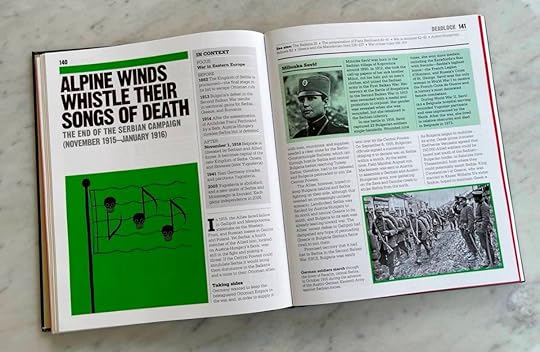
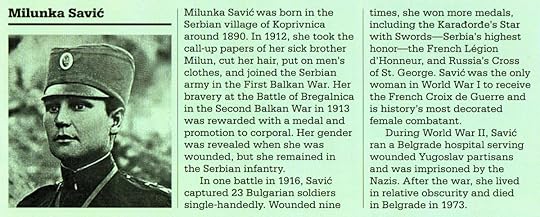
...this (and I assume all the other titles*) is both literally and figuratively heavier** than the usual DK books; offering 300+ content-rich pages that lay out the entire war chronologically, battle-by-battle and political-action-by-political-action; interspersed with topical coverage of such issues as the aerial bombing of civilians, military medicine, aircraft technology and use of mechanized vehicles, etc. It also provides lesser but no less fascinating detail on the smaller campaigns in Africa (both East and West), Italy, the Caucasus, Arabia, Asia (which tied in nicely with an earlier read, The Battle Of Penang), etc.; as well as side-bar portraits of various key figures, including - among many others - Milunka Savić…and HOW HAVE I NEVER HEARD OF MILUNKA SAVIĆ?? This real-life "Mulan" took the place of her tubercular brother and served as a man in the Serbian army until her gender was revealed during treatment for the first of an eventual nine wounds. Anyway - read the below, and check out this short clip (or any of the others) on YouTube - https://www.youtube.com/watch?v=yBtHf... - to learn more about this amazing woman, considered the "most decorated female combatant in history."


But back to the book: there is really just so much here that was new and interesting (and generally shocking) to me, it's hard to organize it into a coherent review - so I'll just list a few things I found particularly fascinating and/or just previously hadn't realized:
- The book does a great job highlighting how the war influenced - or was influenced by - other events around the world, including the Armenian Genocide (with 600,000 to a million deaths), the Easter Rising in Ireland, the Great Influenza (usually but erroneously called the "Spanish flu," and which ultimately killed between 50-100 million worldwide), the fight for Arab independence, etc. And while I knew a bit about the Bolshevik Revolution that pulled Russia out of the war, I'd never even heard of the subsequent Russian Civil War, where the "White" Russians fought the "Reds" to the tune of yet another 10 million casualties, most of whom were civilians, (and yes, the numbers throughout this book - whether casualties, length-in-days of specific battles, amount of munitions fired in a given period, or pretty much ANYTHING - are just staggering to the point of becoming almost meaningless).

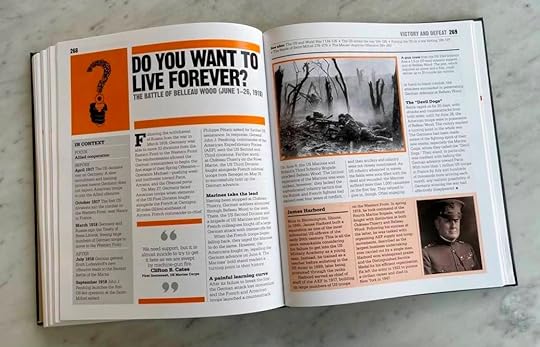
- Aside from Milunka, there was a whole bunch of other people I had never (or only slightly) heard of before - big names like Ataturk, Haig and Luttendorf; but also "minor" figures like New Zealand's Harold Gillies, the father of modern plastic surgery; Daniel Daly, the Marine most famous for his "come on you bastards, do you want to live forever?" line at Belleau Woods (see page photo above)- but who by that time had already won TWO Medals of Honor for his earlier actions in China and Haiti (and who then received a third nomination for Belleau Woods); and Flora Sandes, a British ambulance driver who rather than return to England also joined the Serbian army, and became the only British female uniformed combatant to serve in WWI.

- Fun with terminology: WWI saw the first stormtroopers ("Sturmtruppen" - and why are Germans the best at coming up with new words: this one, "blitzkrieg," "schadenfreude…"?), as well as the first tanks - so called because they were nicknamed "water tanks" during development, so as to keep them a secret from the enemy, (their original, official name at the time was the totally lame "landships;" also, early tanks were considered "male" or "female," based on whether they were armed with a full-sized cannon or just a machine gun).

- Speaking of tanks: The war not only saw the world's final large cavalry charges, but the spring of 1918 saw the first tank-on-tank combat, which later played such a big role in WWII. The same period also saw the introduction of the Paris Gun, an absolute beast of a cannon (256 tons, 69 ft. barrel) that shelled Paris from a full 35 miles away, launching 234-lb. shells so high (26 miles) that they had to take the spin of the earth into account when plotting their trajectory; and which being fired from so far away fell silently if inaccurately on an unsuspecting Paris, causing more psychological than physical damage.

- Underground warfare: Endless miles of tunnels were dug by both sides, largely for mining purposes; not only did many collapsed, but they occasionally dug into enemy shafts where they engaged in hand-to-hand underground combat - pretty much the worse thing a claustrophobe like me can imagine.
The book starts with a nice overview of pre-war conditions (German and Italian frustration with their relative lack of overseas colonies, 50 years of pretty much unbroken smaller wars on the continent, etc.); and then concludes with a similar review of post-war issues (the continuing Spanish Flu; impact of the lack of marriage-age men across Europe; the sad fate of the millions or war widows, who received little support and general condemnation if they even considered remarrying; and finally the ominous rise of Hitler and Mussolini).

Towards the end, the book starts to lose steam - or at least exhaustion sets in - as it becomes a seemingly endless slog of battle after battle, covering and recovering the same terrain…but then that was the war itself. Overall, though, this was a riveting read, although it took me about two months to get through, a couple pages at a time. Highly recommended for anyone who wants a comprehensive but non-textbook overview of the Great War - although I have to question the "Big Ideas Simply Explained" tagline, since a lot of this was fairly dense, at least for my old brain.

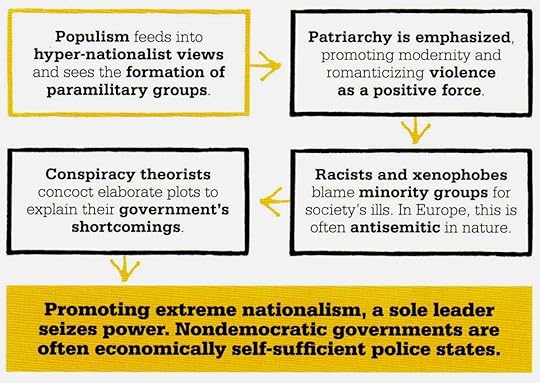
FINAL NOTE: And okay, I'm sorry to get all political again - but intentional or otherwise (the book was just published this year), this chart on the rise of Fascism is one of the best descriptions I've seen on the "MAGAmerican" rise of Donald Trump:


Anyway - this book? All the stars.
____________________________________

* Sadly, while I really enjoyed this book, with the exception of the similar "World War II" book, I have ZERO interest in any of the other titles in this series, which sound much more academic than popular - Astronomy, Biology, Black History, Economics, Feminism, Islam, Law, LGBTQ+ History, Math, Philosophy, Politics…I mean, like, NO interest; it sounds like those nightmares where I'm back in high school.

** ONLY complaint is that the binding is too weak to support the weight of this large book - and so it's best read flat on a table, since at least with this fairly new library copy, the front cover had almost completely separated by the time I was finished.
Profile Image for Kate.
1,134 reviews44 followers
July 20, 2024
I found this to be a very interesting and engaging read! While the format really gives flexibility in how you can read it, I read it from cover to cover. Thr shorter titled sections definitely make it easier to read bits snd pieces at a time though. I have always felt like US History courses very loosely covers World War I in comparison to other events (and to be fair, the US wasn't officially a part of the war for a very large percentage, yet were still involved with it earlier on). It was fascinating to learn about it in depth and make the connections of how much of what transpired during World War II was a direct result or built upon the first war. The book goes into a lot of detail on military strategy of the various individuals battles, but still condensed down to make it readable for the average person if they are interested in historical nonfiction reads. It was intriguing to see how all of the countries fit into the war landscape and I was especially interested in this time period as my great grandfather immigrated to the United States from Austria (though Austria-Hungary at the time) with his family, just a few years prior to WWI. I definitley will be reading the World War II book in this series and will likely check out others on topics I'm interested in too.
Profile Image for Meaningless.
89 reviews1 follower
November 23, 2025
My review of this book got deleted? Was some points I talked about, some dicey issues about the WW1 too controversial to deal with in a review? If so, okay! A watered down (and slightly better written) review then.

I hyped myself into reading this after reading DK's other Big Ideas Simply Explained (BISE) book, The Sherlock Holmes Book, which sets place in the decades leading up to the Great War, the last page of this book - to my utter bewilderment - ends by talking about (author of Sherlock Holmes) Conan Doyle's turn to spiritualism, which it turns out was a global movement, too, as people try to cope with the destruction. This unintended full circle made this reading journey deeply special to me :')
What's more, Overly Sarcastic Productions (OSP) posted a video talking about the time between the two Great Wars the very next day I finished this book! This whole atmosphere makes this reading path feel like it's part of a bigger whole, a spiritualism, perhaps.
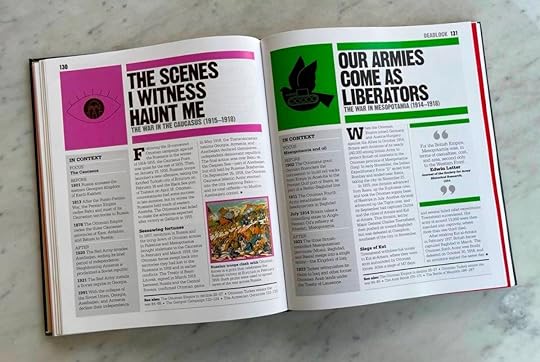
YouTube videos from other creators, like from Crash Course or OverlySimplified, greatly enhanced this reading experience by making up for the lack of mapping - there are 16 maps on 16 pages out of the roughly 227 pages the make up the bulk of the body of text, which is about 5% of it - and add a dramatized characterization of these historical figures.
The maps can be lacking by omitting some important names of villages or other locations described on the same pages, though their quality and quantity gets the job done satisfactory overall.

Historians say, "history is written by the victors," and this is apparently true of this book, as DK Publishing is a UK/Britain based publishing company, with the bulk of the writers being either Americans or Britons - the same Ally victors of the war. This one-sided perspective is blatant from the way its written, though they still do a good job of covering the roles of the Central Powers and other Axis countries outside Western Europe and North America.

What I think was really important about this book are the things it addresses. There are some really dark and messed up parts of the war that aren't discussed enough, which I'll reframe from stating here out of fear of being deleted, but you can easily see by glossing through the book.
World War 1 and its cultural moment makes up roughly 25% of the 20th century phenomena, with the second war making up a further 25% of it. I learned to appreciate the global, and localized major cultural changes in technology, governance, politics, military tactics, and science.

Because this book drilled constantly this fact, I'LL NEVER FORGET that Salonika is now named Thessaloniki, ahahaha.

I'd recommend this to most people, to fully immerse themselves in the images, diagrams, and illustrations. I appreciate our current times more after reading this catastrophic event that took place a lil' over a century ago.
As this book liked to point out, "hell is mud."

now time to read its sequel...
This entire review has been hidden because of spoilers.
Profile Image for F.H.
63 reviews1 follower
April 11, 2025
“Cavell declared: “Patriotism is not enough. I must have no hatred or bitterness for anyone.""

What I liked about this book:

1- It's very informative and explains the events of WW1 in a simple, clear way—perfect for readers with little or no background on the topic.

2- It covers all aspects of the war, not just the battles, but also how it affected literature, medicine, and more.

Areas that could be better:

1- I needed more maps.

2- It would’ve been helpful to have a dedicated section with pictures of the key figures and their brief bios—something easy to flip back to when I forgot who’s who.

5/5 starts.
Profile Image for Andrea Engle.
2,063 reviews61 followers
September 21, 2024
This succinct book explains World War I through a series of vignettes on everything from “The Powder Keg of Europe” to “A Scandalous Failure of Justice” … thorough and fact-based … ideal introduction to the subject …
Profile Image for Xander D..
1 review
December 21, 2025
GOOD MORE THAN BUT NEEDS MORE INFORMATION WHAT OR WHAT HAPPENS
This entire review has been hidden because of spoilers.
2,159 reviews22 followers
May 18, 2024
A surprisingly effective reference to cover one of the major historical events of history. This work follows a chronological path, but it offers digestible analyses of key personnel, events and actions from the foundations and road to conflict, to the actual battles to the aftermath of the war. Solid illustrations and picture help with the material. A good starter for those wanting, or needing, to learn about World War I. Certainly a must-checkout from the library and/or a bargain book store buy.
Profile Image for Heidi.
903 reviews
September 12, 2024
What a wonderfully comprehensive and readable book about all aspects of WWI. Reading this aloud to my middle son as part of his year long WWI unit study was magnificent. I highly recommend this book as well as the series in general as we have read one other title so far. If you are interested in knowing lots of information about WWI (or any other topic included in the series) this is the book for you. I am about to place a purchase request for the WWII book with our library in hopes that we'll be able to read that next year.
8 reviews
June 15, 2024
Amazing storyline and overall battle review. Recommended if you are first getting into learning about the Great War.
Displaying 1 - 10 of 10 reviews

Can't find what you're looking for?

Get help and learn more about the design.