Jump to ratings and reviews
Rate this book

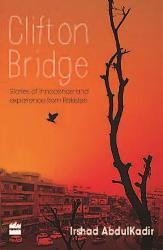
Clifton Bridge: Stories of Innocence and Experience from Pakistan

Rate this book
A collection of intriguing, illuminating tales about contemporary Pakistan and the people who inhabit the country

A Talibanized mujahideen’s love child with his Christian lover is being brought up by a Hindu vegetable vendor. A globe-trotting professor and a mushaira-loving Urdu editor cope with cultural and ideological barriers in a tale of star-crossed lovers. The first and second wives of a businessman hatch a diabolic plot to prevent their husband from taking a new wife. A painter’s unusual bond with his dead mother plays havoc with his personal life.

In Irshad Kadir’s début collection of stories, these and other tales, set in modern Pakistan, represent the diversified social cluster of the country and puncture the unidimensional idea of it in the non-Pakistani imagination. These tales explore themes of ambition, iniquity and individual yearnings. The characters range from feudal landowners and conscience-stricken Taliban to metropolitan beggars, frustrated housewives and women defiantly striking out on their own. Violence in pastoral surroundings, a providential encounter on the Net or in a Victorian market, the vagaries of an unequal love bond or a rare moment in a Karachi slum – Clifton Bridge: Stories of Innocence and Experience from Pakistan offers a fascinating glimpse into contemporary Pakistani society and of the people who inhabit it.

216 pages, Paperback

First published January 1, 2013

2 people are currently reading
123 people want to read

About the author

Irshad AbdulKadir

4 books1 follower
Irshad AbdulKadir is a graduate of Cambridge University and a barrister at law. He is also a lecturer in legal studies, specializing in common law traditions and reasoning. Several articles written by him on socio-economics, governance and politics have appeared in newspapers and journals. He is noted too as a theatre critic and a civil rights activist as well. His book Clifton Bridge: Stories of Innocence and Experience from Pakistan is the first publication of his fictional work.

Ratings & Reviews

What do you think?
Rate this book

Friends & Following

Create a free account to discover what your friends think of this book!

Community Reviews

5 stars
3 (6%)
4 stars
14 (32%)
3 stars
19 (44%)
2 stars
5 (11%)
1 star
2 (4%)
Displaying 1 - 12 of 12 reviews
Profile Image for Anum Shaharyar.
104 reviews520 followers
January 27, 2022
I’m half tempted to never write a review for this book again. Stress on the word ‘again’ because I’d already written and saved half of it and then promptly forgot about it right before I sent my laptop for repairs and IT GOT DELETED. Only someone who’s lost a significant portion of written material to a stupid mistake will be able to relate to the frustration that is a re-write. And of course you never remember exactly what you wrote, so you’re stuck in that awkward position where you want to write what you’d already mentioned, except now you have no memory of them. Which is why this book had been gathering dust in a corner for weeks until finally, moaning and groaning, I dragged it out.

Admittedly, I wouldn’t have been so against the idea of reviewing this if it had been a great collection of stories, but it’s really not. I get what the author was trying to do, by featuring characters from all sorts of religious/financial/social backgrounds, but I just didn’t care about them enough to feel invested. And while I’ve a strong sense of awareness about my casual indifference to short stories, I’ve read enough really good ones to know that quality can always convince me. With this collection, I wasn’t convinced at all.

Composed of ten entries, it’s pretty sad that the first one was the best out of the ten, because the quality steadily declined from there. In All in the Family, a man marries twice, with the stereotypical rivalry between both wives rearing up almost instantly. But what makes this tale interesting is that it mostly focuses on the women in the relationship, and gives them both agency in their lives. When their wayward husband’s intention to marry a third time becomes known, the wives are forced to figure out how to work together to protect their own interests, culminating in an ending I really didn’t see coming, which pleased me greatly, and made me hopeful for the rest of the series.

Daud knew that there was no love lost between the women, but managed to avoid taking sides. The feud worked to his advantage as both women fought to hold his interest.

Even the second entry could have maybe sustained my interest, given its focus on a ragtag family of beggars and thieves. A young boy named Peeru, growing up hungry and beaten on the streets, becomes the accidental caretaker of the street kids who become part of his temporary family. With one girl assaulted and another sold into child prostitution, Peeru finally takes things into his own hands when his ‘father’ tries to sell the kidneys of the youngest member of this family. This story might possibly have the best ending of all in this collection, raising lots of questions about poverty and desperation and the grey spaces between right and wrong. Unfortunately, the distance that the writing maintains detracts from feeling any emotions for anyone involved. In fact, it might be this minimalism in the writing that is the undoing of the whole series. Tales that could have been great for handling depth completely lack the expert touch which can draw the reader in, leaving everything very cold and detached.

This trend continues in the third story Sultana, where a husband is unable to deal with his wife’s sudden rise to fame after she discovers that she can sing well. I’m not sure how much this is based on reality in terms of the marital relationship, since it seems to imply a certain similarity to Pakistan’s own most famous ghazal singer Madam Noor Jehan. I didn’t quite know how to deal with the treatment of how a woman who is ambitious will ignore her family, since it seems to reek of misplaced misogyny, but I’m unable to provide a succinct review since I have, frankly, forgotten most of the plot already. All I know is that if the treatment of the subject matter had been well done, I would definitely have remembered, since in the hands of a Pakistani author that would have been a rare thing indeed.

It struck him that a transition had taken place. Sultana was no longer just a housewife but a rather more significant entity.

I think primarily the whole problem with this series can be summed up using one of my most-used labels: great idea, but bad execution. Even the fourth story in this entry, Queen’s Entry, which might get the most points for inclusivity (features a Muslim terrorist having an affair with a Christian girl, whose illegitimate child is then raised by a Hindu vegetable seller) can’t survive the treatment. This plot could make a great drama serial, with lots of material to work with, but it was severely empty of any actual feeling. Even though I loved the ending, cliché and all, in the hands of an expert storyteller it could have been something brilliant.

So even when the author was trying to make a point, or say something worth discussing, it would get lost in the bad writing. Through the fifth story, The Misfits (featuring two men, the son of a wealthy businessman and the businessman’s assistant, both caught in a corrupt world and horrified by it), AbdulKadir tried to show how good people could get caught up in the system, but was unable to properly create the sort of three dimensional characters who would elicit sympathy from the readers.

“Some are fully compromised; some partly so. There’s no way round it. If you want to work in this environment, you’ll be tainted sooner or later.”

This inability to breathe life into these characters is a damn shame, because the sixth story Through the Lattice tackled so many important issues. Assault, classism, marital rape, society’s expectations, and how well-educated women can be perceived to have loose morals all were touched upon fleetingly. What’s sad is not only the fact that it’s not well written, but also that the author seeks to only describe but never to criticize or censure. As a reflection of the society we live in, this particular entry is very good, but because it never goes out of its way or even mildly implies that these certain traditions or ways of thinking or being are wrong, I’m not sure how well I rate them. In fact, the author makes sure to never offer any commentary on his own, although you could argue that with his seventh entry, A Touch of Humanity, he redeems himself slightly. Featuring a widowed women involved in a slowly budding relationship over the internet, I was pleasantly surprised to find such a controversial topic being made the focal point of a story: online connections and widows are not really the forte of most Pakistani authors. Of course the fact that it’s not well written brings the whole thing crashing down on its head, but I’m glad that even if it’s not the best piece of writing, there is still someone out there willing to experiment.

Of course, then the tone of the stories change altogether, giving me whiplash with its back and forth between writing complex female characters and then resorting to subtle sexism. The eighth entry Two is an odd number features a marriage gone wrong, but seems to subtle imply continuously that it is the wife’s fault for that happening. Of course, I might have gotten the vibe all wrong, and it’s possible that the story did indeed feature the husband as being equally culpable, but about the only thing I remember is that when the couple are about to end up together again after their period of separation, we find out that the woman has gotten divorced while the man is a widower. These sort of conscious decisions writers take with their characters where stereotypes are bound to creep in (widower: deserving of sympathy; divorcee: incapable of maintaining her marriage) piss me off, because unconscious biases always come into play, and I don’t need that kind of subtle hinting, even if the writer didn’t mean it. Of course I know people argue that no writer thinks that much, but readers definitely read between the lines, which means I hold all authors to a higher standard of responsibility.

When leaving for London, she told Stefan that she understood his commitment to his beliefs but was not sure she was cut out for the part.

By this point I had already pretty much lost all interest, and the last two entries were so completely forgettable that the series finished on a complete low. I remember nothing at all from the second last tale Missing Person, and from Unfinished Mural all I remember is that it’s about an artist slowly going crazy. So a story you don’t remember and a story that makes no sense aren’t exactly the bang one wants to end with. Coupled with the fact that there is blatant misuse of ellipsis throughout the dialogues in these stories, which, why?! Why does everyone seem to speak in broken phrases with long, wonky pauses in between? It makes no sense.

“I saw the law being broken every day. Judges’ orders ignored, terrible crimes committed unchecked by citizens against citizens … abduction, rape, murder … of men, women, children … white-collar criminals patronized by top people … security agencies in cahoots with militants … and we are order by big guns to protect them in the courts of law.”

Basically, there’s some attempts at good stuff, but nothing remarkable enough to recommend. I think my barometer for stories that I think are ‘just okay’ is to see how long I remember them. If I come back to them later, even as a vague memory, it must mean that the story did something right. With this collection, I not only didn’t think about any of the stories, I ended up having to make an actual effort to remember what had happened in which entry. Definitely doesn’t age with grace, and not recommended.

***

I review Pakistani Fiction, and talk about Pakistani fiction, and want to talk to people who like to talk about fiction (Pakistani and otherwise, take your pick.) To read more reviews or just contact me so you can talk about books, check out my Blog or follow me on Twitter!

***

ORIGINAL REVIEW:

What is it with all this sub-par Pakistani fiction I've been reading? So disappointing. Review to come.
Profile Image for Sidra.
116 reviews24 followers
August 7, 2016
I bought this book because the title seemed interesting and also because I haven't read short stories in a long time. Anyhow, the book comprises of ten short stories all set in modern day Pakistan. The stories are all very different from each other and equally interesting. This book however does not make you ponder and is not really something meaningful to read yet it's a wonderful book to indulge in if you're looking for a light and casual read.
25 reviews12 followers
April 18, 2018
A chest of beautifully narrated short stories which takes the reader into the lives of a myriad of Pakistani natives from varied backgrounds, cast under different circumstances. The stories give us an idea about how diverse the Pakistani demographic is. Sometimes pleasant, sometimes melancholy, heart-wrenching and even mildly surprising, these stories make for an easy read.
Personal favorite : 'Diva'
Profile Image for Faaiz.
238 reviews2 followers
June 25, 2015
This is the second book I've read that was written by a Pakistani. In some ways, it is very similar - the prose, the style of writing, the language however it's an improvement. This is a book of 10 short stories. Overall, I liked it but did not love it. Some stories were definitely better than others.

I think the author does a fair job at highlighting the various forms of religious, social, political and economic diversities in Pakistani society. From businessmen to beggars to Hindus to extremist Muslims, there is no doubt that the author had about everyone in mind. Did he execute the interactions between the different classes and aspects of society well? In some cases he does it better than others - Queen's Garden is one such story that was really good because of how members of different religions and classes interacted with each other.
A mujahid's child with his Christian lover is being brought up by a Hindu vegetable vendor
That sounds really interesting and thankfully, it was well written and well executed. It displayed Pakistan's rich cultural diversity. Readers will appreciate that.

Some stories could have been better. I felt they ended prematurely and didn't give the reader enough of an idea where the characters were headed. Clifton Bridge and Diva were such stories. With Diva I had really high expectations because it was based on an interesting premise and it was going quite good but it ended suddenly and with not enough direction regarding the characters. I was disappointed. I felt a similar reaction with Clifton Bridge.

A Touch of Humanity and Two Is an Odd Number were stories centered around a romantic theme. They were short, sweet and heartfelt. I felt that they were relevant in today's Pakistan.

The Misfits was a cliched story involving a rich and corrupt politician and his family who lived a life of great luxury and extravagance. His son returning from Harvard is appalled at how his father's position and rank within the bureaucracy is elevated seemingly overnight. This is AbdulKadir's longest story. Since he's a lawyer, this story is filled with redundant judicial mambo-jumbo. It's not a bad story in itself, it just adds nothing new to the other novels out there depicting how corrupt Pakistani bureaucracy is. Because of its lack of ingenuity it didn't have that much of a profound effect on me. Readers however will appreciate the radical contrast of Pakistani socio-economic setting when comparing it to other stories in the book like Clifton Bridge.

Through the Lattice is a story of how a woman seeks empowerment in a rural and backward village after being punished for crimes in which she was the victim. It depicts the change of thinking in women in Pakistan. It feature an interesting dialogue between the protagonist and her Aunt which shows the reader the different evolving viewpoints of women.

Unfinished Mural is a vivid and dark tale of a person haunted by the death of his mother and the profound effects of such tragedy. It features a Bohemian theme with the appropriate hippy characterization.

All In the Family is the type of story most Pakistanis are familiar with. It involves polygamy, black magic and a cold blooded murder for the quest of fortunes. I like the fact that the women the character marries get together to plot his murder.

Missing Persons was the most disappointing story for me. When I picked this book, I had hoped that there would be a story on homosexuality in Pakistan. Imagine my surprise when there was. I wasn't expecting it.
The thing is it wasn't centered on the character facing this issue which frustrated me. No one writes about such an issue. I wanted to know more about that character's story - how he handles being gay, his choices, their repercussion and whether he finds meaning and love in his life. That would have truly set this story apart and in turn the book.

All in all, it's an okay book. I found the prose a bit stiff and often boring. The book often left me wanting more - better characterizations, more details. However, it wasn't entirely awful.
Queen's Garden, Through the Lattice, Two is an Odd Number and A Touch of Humanity were the highlights of this book.
Profile Image for Tikuli.
Author 4 books23 followers
January 28, 2016
I read the book as part of the Brunch Book Challenge. A neat collection depicting life from various perspectives. The stories are simple and yet they leave you with a thought. Some stories are better than the others. Set in modern day Pakistan, the characters come from different backgrounds and provide a realistic glimpse of the country's people and culture which is very similar to ours and that is one reason one could connect well. I loved 'Queen's garden'. At some point I felt that a few of the characters lacked depth and the stories had abrupt endings, maybe it was meant to be that way. Overall a nice one time read.
Profile Image for Syed Umr Iftikhar Ahmed.
25 reviews14 followers
March 12, 2013
Short stories which take the reader on an epic journey of Pakistani society. From the rich to the poor; each story ends in a way which leaves one pondering on a lot of things.
While reading some these stories I felt, maybe, I have read them before; but the truth was, I read them in the eyes of people I come across daily.
A really nice and fascinating book.
4 reviews3 followers
March 7, 2016
I generally always like anything by South Asian authors but this book was nearly a waste of time. it was semi well written but 75% of the stories sucked. short stories are a hard genre which shouldn't be attempted if there's no story to it. the stories came across more like uninteresting portraits more than anything else.
Profile Image for Vikas Datta.
2,178 reviews142 followers
August 29, 2014
A stunning kaleidoscope of life in contemporary Pakistan - up and down the social scale, and dealing with aspirations, needs and greed of various sections, with some stories that will long linger in your memories and thoughts much even after you finish the book. The writer has a definite touch and I look to reading further of his works
2 reviews3 followers
March 6, 2019
The stories shake the very core of your existence. Totally relate-able being a Pakistani and that too Karachiite. You keep reading one story after another and do not want it to end.
Displaying 1 - 12 of 12 reviews

Can't find what you're looking for?

Get help and learn more about the design.