Twenty-one years after his wife and daughter were murdered in the bombing of a plane over Scotland, Alan Tealing, a university lecturer, still doubts the official version of events surrounding that terrible night. Obsessed by the details of what he has come to call The Case, he is sure that the man convicted of the atrocity was not responsible, and that he himself has thus been deprived not only of justice but also of any chance of escape from his enduring grief.
When an American intelligence officer, apparently terminally ill and determined to settle his own accounts before death, arrives on his doorstep with information about a key witness in the trial, Alan decides to act. He travels to Australia to confront the witness, whose evidence he has always disbelieved.
Will this encounter end only in more distress and disappointment? Or might it lead to the truth for which Alan has waited so long?
James Robertson (born 1958) is a Scottish writer who grew up in Bridge of Allan, Stirlingshire. He is the author of several short story and poetry collections, and has published four novels: The Fanatic, Joseph Knight, The Testament of Gideon Mack, and And the Land Lay Still. Joseph Knight was named both the Scottish Arts Council Book of the Year and the Saltire Society Book of the Year in 2003/04. The Testament of Gideon Mack was long-listed for the 2006 Man Booker Prize. And the Land Lay Still was awarded the Saltire Society Book of the Year Award in 2010. Robertson has also established an independent publishing imprint called Kettillonia, which produces occasional pamphlets and books of poetry and short prose, and he is a co-founder and the general editor of the Scots language imprint Itchy Coo, which produces books in Scots for children and young people. He lives in rural Angus.
This is the weakest of the four books I've read by Robertson, but that's hardly a criticism as the first three were all amazing.
If you're interested, I think 'To Be Continued...' is the best of his works. It's a disgustingly underrated novel which I'm careful to recommend to all my book-loving friends.
Alan Tealing’s wife and child died in a plane that was bombed over Scotland twenty one years before. In time two men are caught and there is a trial. One is sentenced, the other acquitted. But Alan is not convinced the convicted Khalil Khazar is the right person or that the truth has come out. His resistance to accepting this decision does not endear him to family members and others. Alan’s main aim is to find the truth so he can then move on. He goes over every detail trying to find way out of his grief. Interspersed with the search for the truth are details from the time when Ian had his wife and child. Some of these moments are so tender and heartbreaking. The type of little moments memory often recalls or how incidents around take on other meanings. One such incident was when Alan was on the bus watching another man and his little girl playing a game with the newspaper. He is so enthralled by their game he ends up turning the page of his own newspaper in time with them. Then the child asks a question of her father that brings back emotions so deep he cannot cope. Another part I liked was when Alan first finds out his family are on the plane that was bombed. ‘Something lurched in Alan’s heart, like a mad dog throwing itself against a door when the bell rings.’ Having a dog that does exactly that with our doorbell, I could only think what an apt description of the terror and shock he must’ve felt at the time. When an American Intelligence officer comes to Alan with information about the whereabouts of a key witness from the trial, Alan feels he has no choice but to act. That decision leads him to Australia Will he eventually find the truth? Or lies and disappointment? You will have to read the book to find out. I found this book an interesting read and towards the end there was no way I was going to put it down. Does it end the way I expected? Maybe not. But perhaps that is not such a bad thing. It is a thought-provoking novel that will have you thinking about how often we judge by where people come from. The ending will also make you think. I’d be very interested to read another book by this author.
There are sometimes in life that we search for answers and other times when we search for questions – the right questions to ask to make sense of the senseless.
Professor Alan Tealing is in the latter group. The plane that carries his wife and young daughter explodes in mid-air over Scotland – not unlike the tragedy at Lockerbie – and a Mideast suspect is tried and found guilty. Yet Alan knows in his heart that justice has not been served. When a retired and deathly ill American stranger – likely CIA – shows up at his door in an attempt to get right with his God before death, Alan gains the impetus he needs to confront the sole witness on whom the conviction hinged.
“Sometimes you set off and you draw a map as you go. You’re looking for some end point but you don’t know what or where it is. And other times you do know, and it’s a question of how you get there. The narrative is how you get to the right destination.” So says the CIA agent but it could be Alan’s narrative as well. How do you get to what you’re searching for? How do you know when the narrative is invented or off-course?
Certainly you can rearrange the pieces of the narrative. But eventually, it imprisons you for the crime of not being able to believe. Alan Tealing has gone 18 years trying to get to the truth. He is, in a very tangible way, the eponymous Professor of Truth, even though truth “is not pure and separate. It is dirty and decayed and has frayed edges, and holes and tears in it.” Still, Alan must keep on his quixotic quest for truth, although he alienates many people around him.
To arrive at peace, Alan must literally face the fire; his personal narrative starts and ends with fire. Only then can there be clearing, can the narrative make sense, and can he come back from the living dead. This is a beautifully written novel that raises philosophical questions in a framework that keeps the story engaging and provocative. In many ways, it’s a roadmap to the mental and physical lengths we go to discover the meaning in an unfathomable loss.
Great title. It has a clean, business-like allure; and yet it’s slightly teasing. And the book isn’t long: you can see right away it deals with the truth in only 257 pages.
Two hundred and fifty seven great pages. It’s the sort of book where you have to slow yourself down because you don’t want to get to the end too fast. It’s a psychological study and a thriller and a detective story and it’s topical and political, too. And also, of course, based on a true and terrible tragedy.
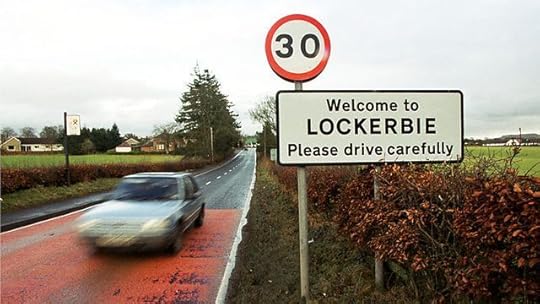
On 21st December, 1988, when transatlantic Pan Am flight 103 dropped out of the sky onto the Scottish border town of Lockerbie, I was working behind a hotel bar in another Scottish coastal resort about 120 miles north. It was nearly Christmas and the atmosphere was slightly festive.
The atmosphere changed as news gradually filtered through – this was before TV screens in every pub, before smart phones and i-pads, so word of a disaster came via human beings. Someone came in and said something bad had happened, a big plane crash. It had to be big because fire fighters and police from our part of Scotland had been sent for, and we were a long, long way away.
I recall a little shiver and beginning to wonder whether anyone I knew would be involved. Later, when more details came through, I wondered whether I knew anybody on their way from London to America, by plane. I didn’t. So it was from a merciful emotional distance that I identified mostly with the people of Lockerbie – especially relatives of the eleven who died when the main fuselage of the plane destroyed their houses like a thunderbolt. Lockerbie was such a quiet little place – almost, in my mind, a non-place.
I couldn’t identify with the people on the plane because they were all dead. When it comes to tragedies, you need a survivor – that’s the person you identify with, just like in films. But there were none. Everybody on the plane died, and some of them were children, and nobody knew what had happened, only that it had been sudden and final. Such things didn’t happen in Scotland.
Years later, we would drive on the A74 past Lockerbie (the regular route to my former home in England) just as we had done for years; but now we invariably thought about all those people and what had happened. Lockerbie was no longer the name of a village: it was an event, like Bannockburn.
Investigations into what had happened went on for years. In the end a Libyan was charged and we saw American families on TV, arriving in Edinburgh for the trial, people whose lives had been changed forever. Eventually, Abdelbaset al-Megrahi, was found guilty and imprisoned, but the resolution was obscure. He had pleaded not guilty, and in any case, we knew he was only an agent, not the moving force behind the deed. Not everybody thought he had even done it. He appealed. His appeal was thrown out. Even then, there were rumblings about the validity of the evidence. And when the Scottish government let him go home to Libya because he had terminal cancer and was not expected to live long, various people were enraged. When terrible things happen, we need someone to blame.
There was never a clear story about how the bomb (because there was certainly a bomb) was planted and detonated. Security, when you travelled by plane, got much tighter, and there was increased interest in luggage and what it might contain. I felt disinclined to fly to the States, and when my kids did, I was worried. Needlessly, in my case.
It is no secret that James Robertson is one of those who believes Abdelbaset al-Megrahi was set up, that he was wrongly charged and imprisoned for planting the bomb on the plane. In this novel, the late Megrahi becomes Khalil Khazar. Some of the circumstances are changed; others conform precisely to the facts. The narrator and central character Alan Tealing (the ‘professor of truth’) is a man whose wife and daughter died in the crash. Lockerbie is not mentioned and nor are any real names of people or places involved. The account is fictionalized – further proof, if any were needed, that the title is intended to tease.
Alan Tealing can’t accept the verdict that Khazar was the bomber, and this novel is about his attempt to get to the bottom of the story – to find the ‘truth’. He has dedicated his life to it for years: in his job at the university (also unnamed) he researches literature. At home, he researches the plot behind the plane crash. Attempting to get to the bottom of a story is, in another sense, the business of every novel. That subtext is never forgotten.
It’s a clean, clear, expertly handled sequence of events. ‘Now’ is balanced against flashbacks of ‘then’ beautifully. The story line is understated and at the same time wholly compelling, with (at times) a terse humour that lends robustness. For example, when Nilsen, the CIA agent, visits Alan Tealing to give him a piece of information – the clue from which all else follows – it emerges that Nilsen is dying, imminently. He has come armed with faith in the salvation of his immortal soul, and a scrap of paper with an address. Tealing does not share his faith:
I did not want his respect or his admiration. ‘The only thing I’ve ever felt an allegiance to,’ I said, ‘is the truth.’ ‘That’s a slippery substance, truth,’ Nilsen said. ‘Not where you’re going.’
The novel goes on to deal with several kinds of truth, not least the holiness of the heart’s affections. Yes, it’s a love story too. Once I began reading, I could not put it down. And it passed the ultimate test: when I got to the end, I went straight back to the beginning and read it again.
The Professor of Truth is in many ways like an old-style novel, though less cluttered with description. I was reminded of Robert Louis Stevenson, and the best of John Buchan. The style is marginally (but pleasingly) formal. The first-person narrator is supposed to be English (but I felt sure he was Scottish – something to do with an absence of contractions and precision of consonants: ‘A memory occurs, or perhaps there is something on the news, and it is there for me to pick up and hold.’)
The action commences in the present. But although this is essentially a literary novel, it quickly moves into simple past, avoiding the relentless present-tense of so many contemporary writers. It references The Count of Montecristo at least three times, if not more. Again, this places it in a conscious tradition, a tradition where narrative is dramatic, and where an answer to the central question is both expected and provided.
I found my second reading as rewarding as the first. The theme of truth is never heavy: it’s playful, in fact. A couple of tiny details struck me as not ‘true’ when I met them again. I didn’t believe Emily, the American wife who died on the plane, had two brothers, for example. Or that her father, or one of the brothers, wouldn’t have flown to Scotland immediately after the crash.
Such niggles were minuscule and more than offset by a heightened awareness of structural parallels second time around. For example, there’s the neat balance between the immolation of Tealing’s family on the plane and his own near-death in a bush fire; there’s a fine set of connections between the several anti-heroes; and then there’s Tealing’s role as narrator of his own story and also as academic expert on another minor novelist.
No story is true: ‘You cannot feel what another person feels. You cannot even imagine it, however hard you try.’ This is Tealing’s observation in the prologue. And he’s right: identifying with others is an experience of fiction, even when the events themselves are facts. Telling the truth is not the same as professing to tell it.
Nevertheless, there is emotional and intellectual truth when a story is fully realized; there is the point when you know the author has become part of something bigger than himself, and has taken you with him. All novels are about truth, and all novels are fiction. The best ones make you believe in them totally, to such an extent that you’re changed by the experience. You feel as if you’ve been someone else, and somewhere else, for a little while. That’s how it is with this book.
I haven’t even mentioned the ending. It’s brilliant. Brilliant.
A compelling novel, taking as its base the bombing of the Pan Am plane over Lockerbie, Scotland in 1986, and one man's quest for the truth, seeking for 21 years to find out who really bombed the plane that blew up his wife and daughter. A literary thriller not only about the bombing and the mechanizations of security services, but the elusiveness of truth, and its meaning. And a thank you to Andy Marr whose review of another of Robertson's books brought me to him at all!
On December 21, 1988, almost exactly twenty-five years ago as I write, Pan American flight 103 from London to New York was brought down by a bomb and crashed over the small town of Lockerbie, Scotland, killing all 259 people aboard and eleven more on the ground. Although others may have been implicated, only one man was convicted of planting the bomb, a Libyan national who was released several years later on compassionate grounds; he died of prostrate cancer in 2012. His death may well have been the trigger for Scottish author James Robertson's imaginative and morally profound novel; it is certainly the event with which it opens. Not that Robertson mentions real names: the airline, places, and foreign countries involved are left anonymous, and the convicted bomber, his presumed accomplice, and the chief witness are given pseudonyms. But as every detail that Robertson does give—even down to the date, time, and 38-minute duration of the flight—are precisely the same as the Pan Am crash, he is clearly not trying to disguise his intended subject.
Or rather, not his subject. For although he goes into the crash and subsequent investigation in detail, his focus is on aspects of such a story that are not put to rest by a simple verdict. Do law enforcement agencies ever bend the facts to fit a politically expedient narrative? Can vengeance be exacted against a scapegoat who may not in fact be guilty? Is there such a thing as true closure? What happens when a man's grief turns to an obsession that prevents him from leading a meaningful life? When truth is found, will it stand out like a pristine shining object, or will it be a tarnished affair of accident and compromise?
Alan Tealing is a Lecturer in English at a new university in an old Scottish town (I imagine Stirling). After losing his American wife and six-year-old daughter in the bombing, he devotes his research skills to following the case in every aspect. But some things at the trial convince him that they have got the wrong man, and he takes his doubts public. As the book opens, he is giving a television interview proclaiming that the death of the convicted bomber will change nothing. But it does change something. It brings to his door a former CIA/FBI operative named Nielsen who needs to make peace with his own conscience before dying. What he tells Alan will send him off to Australia, where the novel reaches its climax in the midst of a series of devastating bush fires. The antipodean leap from the first part, entitled "Ice," to the second, "Fire," is the one weak point in an otherwise superb novel, requiring that the reader shares Alan's obsession enough to follow even the slimmest of clues. But his encounters with the two principal people he meets there will propel the story into new depths, and open him to disasters other than his own. The action climax is magnificently handled, but even more magnificent is the quiet settling that follows it, so much more meaningful than a pat solution to some mystery or conspiracy theory. A truly fine book.
Alan Tealing is an English lecturer whose wife and only daughter were killed in a terrorist attack - the bombing of a plane, bound for New York, over Scotland - twenty-one years ago. A man called Khahil Khazar was convicted of the attack and died in prison: however, during Khazar's trial Tealing became convinced he was innocent, and since then he has been campaigning for the real culprit to be found, even though the other relatives - including his late wife's parents - are content to accept the official verdict. His work on what he calls 'the Case' has made him a self-confessed 'professor of truth', although he often feels no closer to solving the mystery than when he started his research. This changes when he receives a visit from an American intelligence officer, in the late stages of cancer and looking to right the wrongs of his life. He gives Tealing one small, but potentially crucial, piece of information: the current address of the star witness in the Khazar trial. So begins a journey that might just lead to the resolution of this life-long search, or may result in even more unanswered questions...
From my holiday notebook: Interesting and extremely well-written, but in the end rather unremarkable, story of a man's search to uncover the truth of what really happened to his wife and daughter, who were killed in a terrorist attack. What kept me interested in this was the strength and intelligence of the narrative voice: the story itself was quite slow-moving and towards the end I realised there obviously wasn't going to be any neat conclusion to the mystery. Very well-told but I don't have a great deal more to say about it than that.
Additional notes: I'm aware the above sounds more like a negative review than a positive one, but I really don't have much to add to it. I will admit that I was initially a little disappointed that this was a straightforward, serious piece of fiction rather than a story with an element of the strange or fantastical - like Robertson's The Testament of Gideon Mack, which I loved. Another comparison I had in mind before I started reading was Paul Auster's The Book of Illusions, which is also about an academic whose family have been killed in a plane crash. Instead, this is more of an exploration of the elusive nature of 'the truth', and the need for resolution and closure following a tragedy, than a plot-driven story. My favourite parts were the protagonist's interactions with other characters, particularly Nilsen and Parroulet's wife, and I enjoyed the way it was written more than the story itself.
I won an advance copy of this book in a Goodreads giveaway.
I picked this book up in a little second-hand bookshop in Edinburgh, without ever having heard of it. All I can say is that it has been a very long time since a novel made me think about the story even when I wasn’t reading the book. This is one of the books that might change my view to life and the world.
Alan Tealing is a lecturer in English Literature, whose life has effectively been on hold since the murder of his wife and daughter, when a bomb exploded on a plane they were travelling on. Of course, this novel is about the, barely disguised, events of the Lockerbie bombings and of a man who has become obsessed with 'The Case'. In fact, Alan Tealing is long past the point of being able to move on or get on with his life, or any of the other suggestions which have been thrown at him. To the parents of his American wife, he is seen as a European bleeding heart liberal; because he feels that the man accused of the crime was not guilty and that there has been a cover up. He has even argued with his own parents, and the families of other victims. So, when an American knocks on his door one snowy day and offers him the address of a witness, he has to go and seek the truth.
This is a novel of two halves and I found the first half of the book extremely moving and poignant. The second part is slightly less satisfying somehow, although I found it kept my interest throughout. Although the blurb on the book calls it an, "intense political thriller", I felt it fell more into the category of literary fiction than a thriller. It has interesting themes - how does one person deal with a world event that impacts upon them personally, what do you do when the people close to you ask you to stop what has become an obsession and how do you deal with such overwhelming grief and move on? This is a troubling, thought provoking and intense read.
It is impossible not to read this is a fictionalisation of the Lockerbie bombing in 1988, and about Dr. Jim Swire. He lost a daughter on the plane and has since become a prominent seeker of truth in the case, convinced that the Libyan Megrahi, convicted for planting the bomb, was innocent (Megrahi died a few years ago). There is of course a disclaimer saying that all characters are fictional, but there is no denying the parallels between Swire and Alan Tealing, as he is called in the novel, or between Megrahi and his fictional counterpart Khazar.
The first chapters of the novel read like a thriller. Years after the bombing, on a dark and snowy night, the grieving Tealing, whose wife and daughter were on the plane, receives a visit from a mystery man. He is CIA or some such, dying of cancer ("the kind that kills") and wants to get some things off his chest. After a lot of annoying philosophising, he confirms Tealing's conspiracy theory and gives him an address to the witness whose testimony convicted Khazar.
The writing is excellent and the story engaging, but there is something a little off-putting about these re-tellings of real events. Robertson's own viewpoint is clear, and while I have no clue whether he is right or not, I couldn't fully enjoy the novel when feeling I was being hit on the head with his version of the truth. That is often the case for me when reading novels based on real people and events, and shouldn't discourage anyone else from reading this. I may seek out Robertson's other works.
A lecturer in English literature loses his wife and six-year-old daughter in an aeroplane explosion over Scotland. A man stands accused of orchestrating the act of terrorism, yet all evidence against him seems to have been fabricated to make the crime fit the person, rather than collated and judiciously applied - like jigsaw pieces - to prove beyond doubt that he is the missing piece of the puzzle. The sole witness for the prosecution: a taxi driver who claims to recognise the accused but only after several unsuccessful attempts, and only on the promise of an immense sum of money in exchange for his testimony. Twenty-one years later, a retired CIA operative, dying of cancer, has truths to spill before leaving this world. A Vietnamese woman - exiled from her homeland during war only to face worse horrors - is the only hope the lecturer, now a professor, has of ever finding out the truth about who killed his wife and child, and why.
The main character, Alan Tealing, has strong parallels to Robertson's wonderful creation Gideon Mack. This time, rather than being a minister without faith, the protagonist is a professor of English literature who secretly believes that all fiction is futile. Once again, faith - both lost and found - plays a key role in the plot. Also like The Testament of Gideon Mack, this novel is an example of focused storytelling, unlike 'And the Land Lay Still', which - sandwiched between two shorter, more coherent books - sprawled to an unnecessary length due to often-irrelevant and frequently dull tangents. The Professor of Truth is distilled storytelling at its finest. Robertson never gives away too much, sticking to the axiom that good writing should begin in the writer's imagination and finish in the reader's.
Although this is a work of fiction, its story parallels the Lockerbie disaster (which happened over Scotland in the late 1980s) and its aftermath. Like Arthur Miller with The Crucible, James Robertson uses fiction to make the reader question too-convenient 'truths' proposed to tidy up a situation that is anything but tidy. He does so with mastery of his craft. The plot is tight, realistic and pacy, its characters unique. No clichés or pointless tangents here. Even characters who play minor roles in the plot are imbued with idiosyncrasies that bring them and the story to life.
This book is about the effect of an atrocity like the Lockerbie bombing, and people will draw their own inferences and resonances from that.
But it is about much more than that. It is about how people cope with grief. It is about the narratives that we come to believe. It is about the narratives that governments set before us when we have to deal with an atrocity. It is about why we believe or disbelieve what governments tell us, and why it is that governments find it necessary to lie to us.
And it is about individuals dealing with extraordinary events, both badly and well, depending on your point of view. It is by no means an easy read, but it is one from which you will benefit because you will learn something about other people and, most importantly, yourself. It will help you to understand your own view of the world.
My practice is never to read reviews until I have read the book!
In this case I am glad I stuck true to this as I didn't know the background, and that it was based so closely on the events of 1988. However this did not matter. The style of writing was so easy and comfortable to read, I raced through the book (albeit short) in record time (for me).
I felt I was Alan Tealing, walking through the awful events of the bombing, the aftermath, the obsession to find a truth. Brilliant writing and for me, the section about the plan going down had to be reread a couple of times as it was so wonderfully (if that is the word) written. I will read more of his books.
I got into James Robertson books from reading The Fanatic and The Testament of Gideon Mack, which stuck with me and kept me thinking about them even though they didn't seem like amazing literature on the first read. Both of them interested me based on their subject. The Professor of Truth, on the other hand, is I think the best James Robertson I've read so far in terms of being well written. It is compelling and smart and sweet, and a very quick read in the sense that you do not want to stop reading it until you've finished.
I received this book through the Goodreads first read programme. That has in no way affected my review
The Professor of Truth was not what I expected before I read it. I had expected a psychological and political thriller. Instead I got an in-depth look at the consequences of disaster, a look into one man's desperate grief, and to see that everyone has suffered and survived (or not) their own personal tragedies.
Clearly, the basis of the book is the Lockerbie bombings, though this is never mentioned. I don't claim to be an expert in the matter. I do not have a personal stake in the matter. But I have always been interested in it, and I do believe that Al-Megrahi may have been wrongfully convicted. But that's neither here nor there, other than to say I recognise this story. I can pick out characters that seem to be based on real people, places that are not named but can be placed, events that may really have happened. I'm not sure what this brought to my reading of the story. I don't know if someone who knew little or nothing of Lockerbie, or who believed Al-Megrahi was guilty would take the same things away from the book as I did.
But, while based on reality, this is fiction. And in fiction we can get into the minds of people. And the protagonist, Alan's, mind is not a happy place. He cannot get over the terrible, tragic loss of his wife and daughter, the only things that brought colour and meaning to his life. He functions, keeping up his job and acquaintances, but really all he wants is to find out who really killed his wife and daughter. This book is about that journey.
The first half of the book, focuses on one conversation that may finally lead him to the truth. That conversation is interrupted by the tangents of Alan's memories. Memories of life before the bomb, memories of what his family meant to him, memories of how he experienced the tragedy. This is an intense look into raw, bleeding, unhealing grief. He doesn't want to be pitied. He doesn't want to be defined by his loss - but he allows the loss to define him. The second half of the book is about what he does with the information he receives. This is when he finally stops being passive and starts reacting to events, taking control.
Alan is not the only person in the book who has suffered loss and tragedy. Everyone he has a substantial conversation with has a tragedy in their past, and all have dealt with it in different ways. I recognised some of those coping mechanisms. I've used them myself.
More than a quest for the absolute truth, The Professor of Truth is about our perception of the truth. Our own truth and other peoples. It is about listening to others, and hearing their stories before we judge them. When you get to know someone, you might discover some surprising things about their histories.
Alan Tealing lost his wife and daughter when their plane was destroyed by a terrorist bomb 21 years prior to the main action of this story. Alan is convinced that Khalil Khazar, the man convicted of the bombing, was a patsy, set up to take the fall for reasons that Alan cannot quite understand, but Alan has no doubt that Khazar was not guilty.
Alan spends his entire life after the bombing doggedly seeking the truth. He is obsessed, and his relationships with his family members suffer; he has only one real friend. Alan, though, is determined to find the truth.
This novel does not offer a lot of excitement, action, or even mystery. It's more the story of Alan himself and his life than the mystery of who actually carried out the bombing, but it's also an extended existential question: will the truth really make us free? If Alan finally gets the truth he seeks, is it going to be what he wants? Will it really make a difference? That is the question that the novel asks, and it does, though not explicitly, answer it.
This is a beautifully written novel. The author, James Robertson, is a writer's writer: he knows how to tell a story, how to create realistic characters, and just how to write well. This is, if one had to pen a label on it, a literary novel, and a literary novel in the best sense of the term. Writers of the quality of Robertson are rare, and he is able to make this slow, sedate story very enjoyable.
I was very excited to receive this book as part of Goodreads Firstreads and am grateful to the author, publisher and to Goodreads.
The novel is a thought-provoking and even troubling read, as it's themes ask the reader to question the 'truths' that we, the public, can be told; the story would undoubtedly be moving and poignant for any reader. Although not quite a thriller, the novel is contemporary, haunting and unique, and provokes the reader to think about many aspects that we cannot control in the world we live in.
One of the novel's best elements was the character development; characters have unique and interesting depth, creating an emotional connection between the events of the story and the reader. James Robertson's writing style is original and simply excellent, which certainly helped me become gripped and stay gripped throughout. I enjoyed the pace of the plot, and the ambiguity of it; there are some unexpected twists which add to the poignancy of the themes.
Although I have read some mixed reviews of this novel, I would certainly recommend it to anyone who is looking for a novel with depth, and I commend the author on his evident hard work in creating this gripping and emotive read.
In this book, Alan Tealing was married to Alice and they had a daughter who was named Emily. Emily and Alice were going on a vacation to Scotland. They were on the plane to Scotland, but there was a bomb and they "died" on the plane over Scotland.
I think the book is wonderful I just don't like that it took a little while for it to get started. Anyways, my favorite character was Ted Nilsen because he lives his life the way he wants to because he knows he doesn't have very long and tomorrow is not promised. This book describes the details very well. In other words, the book has great sensory details. Like I said before, the book takes a little while to get started, but once it does it grips you and keeps you at the edge of your seat.
I'd rate this book 5 stars. It was loaded with details and descriptions. If I were you and I liked reading semi-long books, I'd be running to my car or the library to go check this book out!
Fictional account of a professor's quest for the truth 18 years after the downing of an aircraft over Lockerbie, Scotland, killing his wife and daughter...I felt like I should look up accounts of the actual accident to verify the historical events. His search is based on feeling that the eventual trial and guilty verdict of one man was trumped up flimsy evidence to assuage the calls for justice from the public and victims' families. Interesting concept....
Definitely not my usual pick of book and not what I expected this book to be (if you reach the end) but I really liked it. Im a big fan of “to be continued” so i gave this a go and loved it.
Pacy, quick to read, really interesting perspective of the Lockerbie bombing. The main character should get out more though, touch some grass, maybe have a greggs or a cigarette? Some fun stuff.
Tout d'abord, je remercie Babelio, sa Masse Critique et les éditions Métailié. Je n'avais pas d'attentes particulières avec ce roman mais la 4ème de couv' promettait quand même quelque action. Quelle ne fut ma déception en tournant la dernière page. Ma lecture fut laborieuse et sans éclat. Le style de l'auteur m'est apparu lourd et lent. Ce roman est, en un mot, déprimant. Vingt ans ont passé depuis l'attentat ayant coûté la vie à sa femme et sa fille ainsi qu'à tous les passagers et membres d'équipage d'un vol Heathrow - New York. Les cendres sont froides, les pistes d'enquête depuis longtemps effacées. D'ailleurs un "coupable" a été jugé et a reçu "la" sanction censée apaiser la douleur des familles des victimes. Alors si Alan Tealing ne croit pas en la thèse officielle, s'il emplit toute sa (non)vie dans la recherche des véritables coupables, c'est, en effet, l'occasion pour l'auteur de parler des thèses conspirationnistes lors de la survenue de tels événements, de la manière dont les enquêtes officielles sont menées, de la pression médiatique qui veut des réponses rapides et fortes, et de l'instrumentalisation de l'horreur des attentats par les politiques pour justifier certaines décisions belliqueuses. L'auteur soulève le problème majeur de l'accommodation de la vérité au service de la politique d'un pays. Action - réaction. Un attentat est malheureusement souvent un coup de pouce dont les gouvernements se délectent pour avoir l'excuse d'aller chercher des poux dans un pays étranger... C'est ce cynisme qui est mis en avant dans le biais de la ténacité d'Alan à vouloir la seule et unique vérité. Mais ce roman est avant tout une histoire de deuil. Si, dès la première tétée, nous sommes tous des morts en sursis, la vie qui stoppe sa course prématurément pose irrémédiablement les bases d'une souffrance amplifiée et complexe pour ceux qui restent. Comment accepter cette injustice? Comment rebondir après un tel traumatisme? La mort est la cessation physique et corporelle de l'existence mais ceux qui partent survivent dans le coeur des vivants. Vivant est le maître mot. Faut-il tourner la page tout en honorant et chérissant le souvenir des disparus? Peut-on tourner la page quand il n'y a pas de corps physiques sur lesquels se recueillir? Persister à chercher une vérité quelle qu'elle soit, n'est-ce pas le meilleur moyen de rester bloqué sur un palier de l'échelle du travail du deuil, telle que présentée par la psychiatrie? Cette réflexion sur le deuil aurait été captivante si la personnalité de base d'Alan avait été tout autre. De longs passages analyse le passé et le tempérament d'Alan. Il se dit volontiers "imposteur", se laissant porter par la facilité de ses capacités intellectuelles, il n'est pas volontaire à sortir de sa zone de confort, et ce, depuis tout petit. C'est un homme de bibliothèque, un intellectuel solitaire, frileux devant les risques. Renoncer à son enquête, c'est aborder un inconnu qu'il rejette. Sans remettre en cause la douleur du décès de sa femme et de sa fille, je n'ai pas éprouvé d'empathie ou d'admiration pour ce personnage. Même si le sentiment d'enfermement dans la souffrance est très bien décrit et ressenti. Les épreuves nous forcent à évoluer, à rebondir, à nous remettre en question. En situant les événements vingt ans après les faits, l'auteur insiste donc sur la longueur mais, par là même, révèle une incapacité à aller de l'avant et installe un auto-apitoiement traduit par de longs paragraphes lourds au lieu de mettre l'accent sur une volonté réelle de vérité. Sans empathie et sans action véritable, j'avoue que ce roman m'a malheureusement ennuyée malgré les thèmes très intéressants abordés. Dommage!
This novel is a thinly-disguised story related to the Lockerbie bombing plane disaster (which occurred in December 1988). However, it focusses on the anguish of a family man who lost his wife & daughter in the incident although somewhat obtusely, as there is absolutely no direct mention made of this specific fact in the book, as even the places and names of concern are deliberately avoided. However, the darkness and coldness of that day in December permeate the story and are testament to this author's skill in portraying the protagonist's agony. James Robertson is profoundly sensitive and detailed in showing the feelings and mental perplexities of this family man and his search for answers. The storyline is somewhat slow-paced and roundabout in its unfolding and yet I found myself, as the reader, drawn in to the story and unable to put the book down, hoping and willing him to find some answers to his anguish. This book was published in 2013, and of note, it is only recently (in 2020) that the 'bomb-maker' for this disaster was identified and brought to justice.
A fascinating story that explores the meaning of truth. Alan’s wife and young daughter are killed on an international flight when a bomb explodes and 219 people onboard are killed. He follows the case to ensure that justice is served. When a man is captured and convicted of the crime, Alan has doubts about the man’s guilt. As the years go by Alan is told by friends and family that he should stop questioning the verdict especially once the convicted man dies in prison. But Alan does not stop his questioning and research into the case. Alan is confronted by a stranger at his home who has information about the case. The stranger leaves Alan with a clue that takes him on a journey to Australia…enough said and if you haven’t already, please read this book.
JAMES Robertson is a master story teller and I am always blown away by his writing. I’d been putting off reading this one, as the theme didn’t appeal - the Lockerbie bomber and the possible miscarriage of justice - where was the fiction to be found in this? But in fact it’s a wonderful story about grief and how this widower copes - or doesn’t cope - with it. Felt very true to life and was quite uplifting. Recommended
I don't know if I can explain my five stars. 1) I was captivated and could not put it down. 2) It is a true hero's journey, inner and outer. 3) The outcome was unexpected and so believable. 4) Alan, the hero, stayed true to himself while being emotionally, mentally, physically, and even spiritually flexible. 5) He endured and was changed by his baptism by fire. 6)It is expertly written. 7) There are love interests. 8) The book is staying with me. 9) Yes, five stars!
A thinly veiled novelisation of the Lockerbie plane tragedy. The titular character is conducting his own investigation into the bomb and when visited by a mysterious secret service character known as 'Flynn' his suspicion is confirmed. The final 50-60 pages in Australia is terrific. A thriller, psychological study and meditation on truth all in one.