The other Ashe book I've read, Camelot And The Vision Of Albion, was much more of a personal manifesto than this general survey, though both acknowledge a debt to Robert Graves. Here, rather than the hem hem 'idiosyncratic' White Goddess it's, as you might expect from the title, Greek Myths. Meaning the presentation is broadly chronological, each chapter opening with the legend, before a commentary discusses sources, facts and variants. As such, the spine inevitably comes from Geoffrey of Monmouth, who plays the long-dead Little Alex Horne to Ashe's Greg Davies, setting up the whole thing then semi-fondly berated for his various fuck-ups. Ashe's overall conclusion is that Geoffrey was working from something, though perhaps not the Homer-like epic he suggests, and that where possible he did work with the facts he had, albeit often massaging and tidying them, which is also why his History peters out once it runs into as unassailable an authority as Bede.
The real spell of the book, though, is less in any explicit thesis than its ability to have things all ways without jarring. Ashe is a smart man, able to read the historical and archaeological evidence, and too honourable to try twisting it to fit, which can sometimes result in bathos, as when, after a section on giant legends, the commentary begins with the deeply 1066 line "The real megalith-builders were not particularly large." He can also recognise the wriggling of his predecessors, sometimes wryly - "Holinshed. who does not accept the notion, makes a distressed attempt to deal with it" - and elsewhere with exasperation, as when he notes modern glosses that recent historians have unthinkingly applied to something like the purported discovery of Arthur's grave at Glastonbury. I noticed very occasional slips - while his scepticism of Constantine's devotion to Christianity is fair, suggesting that only being baptised towards the end of his life was a sign of that is anachronistic - but these are very much the exception.
And along the way, as well as pulling together the strands of the big picture, he digs out so many wonderful little nuggets! I'm sure I already knew that Totnes was supposedly where the Trojans landed, and had forgotten it because I don't like to encourage Totnes, but I was surprised at how large the British-Israelite theory of Britain as descended from the Lost Tribes looms, given I've only really encountered this before in the work of noted historian Robert Rankin. And I had no idea whatsoever about Claudia Rufina, the only Brit in the Bible, and possibly sister to second pope Linus (which would be one in the eye for Breakspear). The notion of Cimmerians as Cymry is also raised, which historically turns out not to work, but still provided me with much amusement at the notion of Conan being very Welsh. And Picts, of course, was not their own name, being derived from their skin art and the same root as 'pictorial'. King Lear (or Leir) as mythic founder of Leicester was new to me too, though that did also come up in Once And Future while I was slowly making my way through this. I knew that in his story's original form it had a happy-ish ending (a rare mis-step for Gaiman) - but not that Goneril had the spelling Gonorilla, which manages to sound even more STD while also suggesting a royal ape (and her nephew Cunedagius similarly sounds like something unpleasant downstairs). I was also amused to register my own reaction when after being fine with all the tales of magic, talking severed heads and giants, I was entirely unable to stomach the origin story for Bath because pigs can't get leprosy.
One area where the book does falter is in never entirely knowing how far to include Ireland, in part because of difficulty aligning the mythic chronologies, so that one side of the story rather comes and goes. Still, in between familiar bits like the monstrous Fomorians raiding from Tory Island, which for ages I assumed was just Pat Mills being typically subtle, I was amused to learn how the land was reputedly populated by Noah's son Bith with his shipmates Fintan and Ladra. Who had fifty women between them until Ladra died from excessive sexual activity, which sounds heroic, except then the other two reapportioned the women, so really Ladra was a bit of a lightweight.
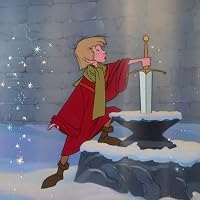
The heart of the book, though, was always going to be Arthur. Here even the structure breaks down a little under his sheer legendary gravity, so we get the Welsh Arthur, Geoffrey's, and then the proper version after the romancers have ramified it. Inevitably this is something of a less trippy reprise of Camelot And The Vision Of Albion; elsewhere Ashe has been very willing to poke fun at some of the more obviously stupid legends (his scepticism regarding ley lines and the Glastonbury zodiac is particularly entertaining), but Arthur is different. Ashe is fully aware that at most the evidence supports a pretty good war-leader in the twilight of Roman Britain, and can even show how late parts of the myth must have developed - so Excalibur can't have been thought irretrievable when Richard I gave Tancred of Sicily a sword supposed to be Arthur's, say. But deep down, in exactly the sort of separate dominion I mock when the idea is applied to Jesus rather than Arthur, Ashe also knows full well that it's all true, or ought to be, and more and better besides.
After that, inevitably, the book, like Geoffrey, rather loses momentum; Arthur's successors, the rise of the English and the likes of Beowulf all have too tough an act to follow. But as a survey and a synthesis that manages to yoke the horses of history and legend together, it's still an impressive piece of work.