Jump to ratings and reviews
Rate this book

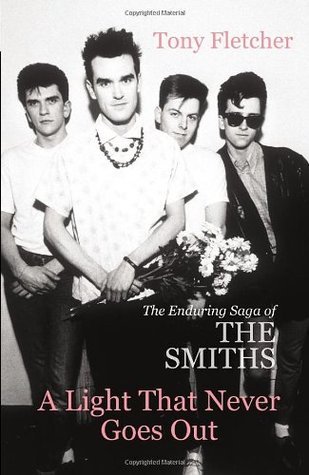
A Light That Never Goes Out: The Enduring Saga of the Smiths

Rate this book
To this day, they were, their fans believe, the best band in the world. Critics and sales figures told a similar story. Yet for all their brilliance and adoration – their famously energetic live shows routinely interrupted by stage invasions – The Smiths were continually plagued by their reticence to play the game, and by the time of 1987’s Strangeways Here We Come , they had split.

Tony Fletcher’s A Light That Never Goes Out – part celebration, part paean – moves from Manchester in the nineteenth-century to the present day to tell the complete story of The Smiths. The product of extensive research and unprecedented access, it will serve to confirm The Smiths as one of the most important and influential rock groups of all time.

704 pages, Paperback

First published January 1, 2012

177 people are currently reading
2319 people want to read

About the author

Tony Fletcher

32 books63 followers
Tony Fletcher is the author of seven non-fiction books and one novel.  His biography of drummer Keith Moon  has been named in many a Best Music Book list, and his biography of R.E.M., updated in 2013 as Perfect Circle,  has been published in over half a dozen countries.   A Light That Never Goes Out: The Enduring Saga of The Smiths was published in the UK by William Heinemann in September 2012, and by Crown Archetype in the USA in December 2012, with paperback editions following in the corresponding months of 2013. A memoir of his South London schooldays,  Boy About Town , was published in the UK by William Heinemann in July 2013, and is now available as a paperback in both the USA and UK through Windmill Books/Cornerstone Press.

Fletcher gained his entry into music journalism by founding a fanzine at his London school in 1977; by the time Jamming! ceased publication in 1986, it was selling 30,000 copies a month. Along the way he interviewed the likes of Pete Townshend, Paul McCartney, Paul Weller and U2, as well as dozens of up-and-coming, predominantly independent post-punk acts.

A contributor over the years to a multitude of magazines, newspapers, radio and television shows, primarily in the UK and USA, Fletcher now lives with his family on a mountaintop near the village of Woodstock in New York State. There he runs, skis, maintains his web site www.ijamming.net, serves on his local school board, and plays Hammond B-3 and Rickenbacker in the Catskill 45s, a group that only performs songs from 45 calendar years ago.

Ratings & Reviews

What do you think?
Rate this book

Friends & Following

Create a free account to discover what your friends think of this book!

Community Reviews

5 stars
387 (31%)
4 stars
577 (46%)
3 stars
217 (17%)
2 stars
37 (3%)
1 star
11 (<1%)
Displaying 1 - 30 of 138 reviews
Profile Image for Lawrence.
174 reviews7 followers
November 9, 2012

It’s almost twenty years since I read Johnny Rogan’s seminal tome, Morrissey and Marr: The Severed Alliance. In those pre-internet days, before the Smiths were an “institution” worthy of the covers of such traditionalist music papers as Mojo and Uncut, Rogan’s tell all biography was a revelation. Up until then, verything I’d read about my beloved band had been assembled in snippets – an NME article here, a music encyclopaedia entry there. The fact that Morrissey called down a fatwa on the author only made the content seem more scandalous, and probably a little more believable too.

Two decades later, and as Tony Fletcher points out in the forward to his own book, there’s been little else to compete, other than Simon Goddard’s excellent trainspotter guides, Songs that Saved Your Life and Mozapedia, and more fan-orientated books like All Men Have Secrets. However, despite the paucity of books on The Smiths, there has been a shedload of magazine cover stories in the above-mentioned magazines, and the webisphere thrives with numerous comprehensive sites, some sublime, most ridiculous. Given the closed nature of Morrissey’s inner circle, and the very pubic nature of Joyce and Rourke’s legal issues with their ex-bandmates (or should that be employers?) I really had to wonder if there was much more to uncover.

So what does A Light That Never Goes Out: The Enduring Saga of The Smiths offer? To a newcomer, it is an excellent and comprehensive history of the band, and to anyone who has read all of the above, not a lot more. Given the time that has passed since Rogan’s (apparently tell-all) book, there seems little else to tell. There’s no new scandals (other than Marr – older and wiser, no doubt - being far more forthright on the bands’ drug use) and precious new information for those already initiated into the cult of Morrissey and Marr. Yes, the band was appallingly badly managed from the get-go. Yes, Morrissey had an increasingly annoying habit of failing to show for important appointments. Yes, Andy Rourke got fired for being on the gear and Craig Gannon got hired and fired with little in the way of acknowledgement or recompense. And that’s pretty much the story, retold once more.

Tony Fletcher – an engaging and unfussy writer – is constantly at pains to point out just how young Marr was, and what a prodigy he was, with constant references to his age. (And, to this now-37 year old reviewer, it is quite amazing to consider that Marr wrote The Queen is Dead when he was only 23, and that the first two songs the duo wrote together were Reel Around the Fountain and Suffer Little Children.) Marr is clearly the hero of the book, and Morrissey remains something of an enigma throughout – he’s certainly far less of a ‘character’ or engaging presence than in Rogan’s book. (One interesting point of omission is that of Morrissey’s personal relationships. For all the people who want to “out” Morrissey, it’s quite incredible that no one has ever come forward to dish any dirt of Morrissey’s personal relationships, or lack thereof.) Another issue – and this is a problem of most rock biographies – is that the time spent on the formation of the band is hugely out of proportion to the latter part of their career. Both Marr and Morrissey view Strangeways … as their masterwork, and Fletcher seems to agree, yet the sole chapter devoted to this album flies by far too quickly.

Whilst being a very thorough history of what actually happened, the frustrating thing about this book is that it’s far less enlightening about the more nebulous nature of the band, and what made them such a phenomenon and why the immediately attracted such a fanatical following. Perhaps more oral history with the bands’ fans might had aided in this endeavour? Or close access to Morrissey’s inner circle. I’m really not sure. This is an engaging read, and I’d certainly recommend it, but I still feel the definitive history of The Smiths is yet to be written.
Profile Image for Sparrow ..
Author 24 books28 followers
Read
January 8, 2014
The Smiths were the greatest rock band of all time -- the greatest white one, anyway. This is obvious to me, but apparently not to everyone. And their music is not "depressing"! It's funny.

The Smiths were REALLY working class. They had sullen parents & went to terrible schools. Apparently, all of Morrisey's wisdom derived from one book his mother gave him -- "The Collected Works of Oscar Wilde" -- when he was 17. He is no doubt the most introverted guy ever to be a major rockstar. Compared to him, Jim Morrison was a linebacker for the Pittsburgh Steelers. Morrissey is the kind of person with three friends, and he addresses his songs to them. The painful intimacy of their music emerges from this truth.

And Johnny Marr was young! He was 19 when The Smiths started, but with musical ideas that had never been heard in rock. Marr's harmonic intelligence rivaled Mozart's (and he was born on Halloween!)

Apparently, The Smiths were not named for Patti Smith, though Steven Morrissey and Johnny Marr were both big Patti fans. Had she already married Fred "Sonic" Smith, making them literally "The Smiths," by 1984? I must research this.*

The Smiths were ethnically Irish, even more so than The Beatles. A keening Celtic flute music underlies their melodies. Another reason they were the greatest band is that they set out to be the greatest band. They modeled themselves on Motown, churning out "hit songs" -- with secret messages -- in a factory-style. Johnny and Morrissey both had an encyclopedic knowledge of pop music, which they marshaled for their songs of yodeling desperation.

Manchester and Liverpool, just 30 miles apart, had markedly different temperaments: Liverpool cheerful and silly, Manchester gray and paranoid. Perhaps the difference is that Liverpool is a port. Being on the sea always gives one hope. The Smiths' couplet "Manchester/So much to answer for" is unforgettable, and apt.

Morrissey went from being the world's worst rock critic to the world's greatest rock star -- which is a logical transition. What is a song but an essay with three-quarters of the words removed? Morrissey had a talent for cruel epigram, but couldn't connect his thoughts. A song frees a writer from the need for syntactical connections.

A minor figure in this book, Pete Shelley, resembles me. Peter Campbell McNeish renamed himself after the poet Shelley, and in high school I changed my first name to Flaubert. (The result: "Flaubert Gorelick.") Pete Shelley was the lead singer for the Buzzcocks, a Manchester punk band which influenced our heroes. (One of the pleasures of "A Light That Never Goes Out" is the liberal use of the magical word "Mancunian" -- meaning "a person from Manchester." Why doesn't America have such words? Instead of the bulky term "Los Angeleno" why don't we say "Lasgelian"?)

The main difference between Johnny Marr and Morrissey is the difference between music and words. Johnny had musical notes running around his brain which he needed to express, in the form of pop singles. Morrissey carefully crafted lyrics, which he wanted the whole world to hear. Once a single (the most crucial being "Shakespeare's Sister") came out, the guitarist forgot about it completely, while the lyricist scanned the musical charts, hoping it would reach Number One.

Why don't we read some of the lyrics to "Shakespeare's Sister"? Here they are:

I thought that if you had
An acoustic guitar
Then it meant that you were
A protest singer.
Oh, I can smile about it now,
But at the time it was terrible...

No one writes lyrics like Morrissey!

The Smiths were much more political than I ever noticed. (The radical bite of their lyrics is slightly untranslatable into American.) They were friends with real Leftist musicians like Billy Bragg and The Communards (who were Maoists), and performed at political events like the Red Wedge.

Too bad The Smiths never made a Christmas album; they might have destroyed Christmas once and for all.

*Patti & Fred married in 1980.
Profile Image for Tosh.
Author 14 books777 followers
October 17, 2012
Over the years i have heard or read all the tales in this book, via mostly British music magazines - but the author Tony Fletcher tells the tale very well. Fletcher interviewed Johnny Marr and their bass player Andy Rourke, but sadly not Morrissey or Mike Joyce. Perhaps they didn't want to dwell in the past again, or maybe due to legal issues still on the table.

Nevertheless The Smiths were a perfect band at a very specific and important time in pop music history. in the land of the 'New Romantics," The Smiths were truly romantic about their upbringing and their home town of Manchester. But not only that, Morrissey via his lyrics and visual sense, captured all the great aspects of 1950's and 1960's British culture. Listening to The Smiths and purchasing and studying the album graphics, one can get an incredible education on artists, books, and film culture from that era.

Also The Smiths are probably the last band that actually had the work load of some band from the 60's. Their existence was very short (little bit over four years) yet they produced four studio albums, one live albums, and many many b-sides and singles. Being a Smiths fan at the time of their existence was a lot of fun - a lot of trips to the record store. Remarkable music, incredible personalities (and Morrissey to this day is a fantastic pop music figure) and this book exposes or conveys the inner-relationships of this band. It could be a tale of any band really, because it is always a family type relationship. It goes sour, because that is the nature of the human beast. Some bands go through drummers like a leaky pipe, but The Smiths seemed to use and lose managers on a regular basis. On one level it was their downfall - career wise, but then there is a special brilliance about this band that didn't use logic. Morrissey is the genius of the moment, and i think for a long time, Marr understood and appreciated that. What's kind of surprising to me is the after-life of Johnny Marr. It seems like he does everything except to be a permanent member of a band. One would think he would start over with another singer or songwriter partner - but he seems to be drifting. But that maybe over due to his future solo album and tour.

For me the best book on Morrissey/Smiths is "Mozipedia" by Simon Goddard, but this is an essential read for the fans, and again, Fletcher is a good skilled journalist, and I think The Smiths breaking up was a good move in the long run. I know there are people who will disagree with me, but I actually like the Solo Morrissey better then The Smiths! And I love The Smiths. Go figure! The book will be out this December in the U.S. and its published by Random House.
Profile Image for Rachael.
Author 43 books81 followers
November 15, 2012
The Smiths, one of the seminal bands of the 1980s indie/alternative rock scene, broke up in 1987. Yet it’s not hard to find their faces and names splashed across British music magazines today. I’m grateful—it gives fans like me something to cling to, gives us some assurance that the band we love will not be forgotten.

But their continued press presence sparks this question from my husband.

“Why are they still on the cover of magazines?” he asks, shaking his head. “They broke up 25 years ago!”

Oh, I don’t know—maybe it’s the 4 albums (plus a live album and three compilations) and 70 songs in 52 months, and the legions of fans who can’t stop listening.

For those who can’t quite understand where The Smiths fit into musical history and why they’re still relevant today, we have Tony Fletcher’s A Light That Never Goes Out.

This book is a must-read for fans of The Smiths. But anyone interested in the 1980s post-punk scene, even if they are not Smiths fans, will find a lot to like about this book.

Fletcher starts with an overview of Manchester history. This is important, as it sets the stage for the unique sounds that came out of that place in the 1970s-1980s—besides The Smiths, we have Joy Division, New Order, and James. By the time Morrissey and Marr meet on p. 191, readers are not only steeped in Mancunian history but also the history of Morrissey and Marr’s childhoods. Fletcher examines their formative school years and musical (and in Morrissey’s case, literary and cinematic) influences.

It’s not surprising that Morrissey and Marr are the focus of this book. The general public sees these two dominant personalities as The Smiths, and this book feeds into that perception. Readers get a background of Andy Rourke (especially since he and Marr were good pals before the band formed) and Mike Joyce, but in much smaller amounts than Morrissey and Marr. However, I cannot think of a person who would read this book hoping to get an extensive biographic history of Rourke and Joyce.

This book abruptly ends with The Smiths break-up: it is a biography of The Smiths after all, and why go beyond that “death”? That means that readers looking for more of the salacious details that occurred after the break-up (such as the royalties lawsuit by Mike Joyce against Morrissey and Marr) will not find them here. However, Fletcher addresses the royalty agreement that gave Morrissey and Marr much more of the proceeds than Rourke and Joyce.

This book was a real eye-opener for me. I have not read Severed Alliance by Johnny Rogan that came out shortly after the band broke up. The 25 years that have passed since the band split lends a smart perspective to Fletcher’s book.

I am quite familiar with The Smiths’ music—I’ve been listening to Morrissey and The Smiths for nearly 20 years. But I came to them first as a Morrissey solo fan and then later back-filled my playlist with Smiths material. I’m more likely to follow the latest Morrissey news than I am to dig into information on The Smiths. So in terms of fandom, there are many who know much more than me regarding The Smiths so maybe some of Fletcher’s information will not be as revealing.

Facts that stood out to me:
• The Smiths pretty much were without management for nearly the entirety of their existence.
• Johnny Marr, only in his early 20s, took on not only the role of guitar prodigy and songwriter, but also many managerial roles defaulted to him.
• Marr was (and probably still is) a workaholic. He makes Gene Simmons look lazy.

I got a good sense of why The Smiths disbanded. I always thought it was a Morrissey-Marr disagreement, knowing Morrissey’s less-than-stellar reputation and his lack of people skills. But in reading this book, you realize the break-up is inevitable. The output of The Smiths was purely amazing. Add in tours and publicity demands, and it’s no wonder they suffered burnout, with Marr suffering the most. When Marr said in early 1987 that he wanted to take a break, the other members interpreted this as him wanting out. He disputes that today, but the stage was set. I was really surprised to learn that when he said he wanted a break, Morrissey aligned with the rhythm section to basically treat Marr as an outcast. Morrissey and Rourke and Joyce, an alliance at the end? Who would have thought?

People who know me know that I’m a huge Morrissey fan. I have never adored another musician as much as I adore Morrissey. I know every lyric to every song. My mind brims with Morrissey trivia. But I have never viewed him with rose-colored glasses. His faults are well-documented, and he often frustrates me in his isolation. He does not come across well in this book (though it’s Marr who is probably the most gracious). It’s not a surprise that he refused to participate in interviews (Fletcher had access to Rourke and Marr, and it shows). We’re left with other people’s perceptions of Morrissey, and he can’t refute them. I would have loved to have heard Morrissey’s perspective on these years, but I think the chances are better that a leprechaun will show up with a pot of gold in my backyard.

You don’t have to be a Smiths fan to enjoy this book (though it will be a richer read if you have some interest). The book speaks to anyone interested in 1980s British music, the culture of England in the 1980s, or how a band comes together and generates massive creative output. I have never read a book about a band before, so learning about the inner workings of a musical group intrigued me.

As a writer, I enjoyed learning about the creative process, especially from Morrissey’s angle. He found much inspiration in old movies and musical acts, and he wasn’t afraid to blatantly rip off lines and lyrics. I might have to look for inspiration in similar places!

This book is long, more than 600 actual reading pages (more if you read all the notes). Fletcher is careful about including every detail, and he takes his time setting the stage. I normally am not a big fan of long books (it’s the editor in me), but I did not think this book contained any superfluous information. The short chapters make for a fast read.

I did have a hard time keeping straight all the names in the book. Fletcher mentions a lot of people—friends of the band, music company officials, the band’s entourage, etc. A list of key figures in either the front or the back of the book would have been a helpful guide. If I were to read it again I probably would keep a running list for myself.

I am so glad that I read this book. I’m listening to The Smiths albums with a new ear. I’ve been listening to them for almost 20 years and it’s good to know that I can continue to discover new things about their music.

While some people may scoff at lines in the book such as “The meeting at 384 Kings Road that May afternoon would turn out, as we know now, to be one of the great initial encounters of modern music” (p. 193), Smiths fans know the truth. Fletcher’s book allows us to delight in that truth, to embrace again the burning brightness that was The Smiths.
Profile Image for Anna Kļaviņa.
816 reviews208 followers
December 15, 2015
Morrissey and Joyce refused to give interview(s) for this book, and because of that the story can't be complete. Not that author wasn't trying. At times, methinks, he was trying too much. :/

<
The Smiths were a beautiful thing and Johnny left it, and Mike has destroyed it. 
Morrissey


Profile Image for DC Merryweather.
61 reviews6 followers
May 29, 2013
Reading this biography did at least re-invigorate my interest in the Smiths, and one interesting thing that both the book and the YouTube videos of their early gigs at the Hacienda help underscore is the notion that the Smiths emerged seemingly fully formed. Lyrically and musically, some of their earliest songs are amongst their strongest and most affecting, in my opinion. But reading of how they pretty much hit the ground running made me wonder if they don't dispel Malcolm Gladwell's 10,000-Hour Rule (ie the amount of time required to practice at something before you can master it). I mean, yeah, Johnny Marr played in other bands before the Smiths, and there's Morrissey's fevered letter-writing activities, but it doesn't seem to be the equivalent of, say, the Beatles' slog through the Hamburg and Cavern years.
Anyway, the story of the Smiths is similar to that of many successful (short-lived) bands, the Beatles included: formation/early struggles (though, as I've mentioned, the Smiths' time in obscurity was exceedingly short); fame, fame, fatal fame; pressures/legal-wrangles; split. And although Tony Fletcher's writing about the actual music isn't much to shout about (there are already plenty of books that concentrate on that, to be fair), he gives a straightforward and even-handed soup-to-nuts account of the band's history and their effect culturally, interviewing most of the main players with the exception of - naturally - Morrissey, and - strangely - drummer Mike Joyce.
So many great little details are scattered throughout, especially about Morrissey and Marr's pre-Smiths days and their early gigs. And even if it does eventually become an all-too familiar tale of rock'n'roll excess, money disputes and clashing egos, there is always Mozzer's increasingly frequent bouts of casual vindictiveness and his - how does it go? - deviance, truculence and unreliability to keep things interesting.
734 reviews16 followers
February 6, 2013
630 page biography of the English band The Smiths--not bad for a band that only made four studio albums in their brief existence in the mid-1980s. I was fifteen when I bought "Meat is Murder" and needless to say, I fell for The Smiths hook like and sinker. I still cherish my light blue "Hatful of Hollow" t-shirt! I already knew a fair amount about the band, but Tony Fletcher's book really delves into their early days--the actual band doesn't start until we near page 200. After reading this, it just makes me sad that Morrissey and Johnny Marr didn't make a few different choices--had a real manager, been on a record label they wanted to be on other than Rough Trade, egos been held in check...the band could have continued on. Sure, Morrissey made some decent records [I love "Viva Hate" as much as if it was The Smiths] and Marr joined another of my favorite bands from the era [The The] for two albums...it wasn't the magic of The Smiths. Fletcher's book exposes all their foibles, problems & petty disagreements whilst also discussing the glorious music in tremendous detail. Smiths fans unite over this one!
Profile Image for Kerry Dunn.
907 reviews41 followers
December 25, 2013
Wow! This was an exhaustive history of The Smiths! Exhaustive but never exhausting. In fact it was compelling throughout! The main focus is on the relationship between Johnny Marr and Steven Patrick Morrissey and it traces their individual lives from childhood, to the fateful day that Marr knocked on Morrissey's door looking for someone to write songs with, to the formation and eventual dissolution of the Smiths. Morrissey does not come out looking so good, but is there anyone in the world that doesn't believe that Morrissey is a complete diva? Although this book paints a vulgar picture of him (pun intended), I have no doubt that it's completely accurate. Marr comes out looking a lot better, but he has his moments of petulance and assholery too. The detail in this book is staggering and includes not just the personal histories, band drama, and tour chaos, but also very interesting dissections of the songs and albums of The Smiths. There is also a ton of information on Manchester and the music scene there, as well as the bands that both influenced the Smiths and were their contemporaries. It's all fascinating and actually inspired me to keep a Spotify playlist of all songs mentioned in the book. From You're the One by The Marvelettes to Metal Guru by T Rex to Puppet on a String by Sandie Shaw to Billy Bragg's cover of Jeane to Kimberly by Patti Smith to Work is a Four Letter Word by Cilla Black my playlist grew to over 60 songs. If any of you are on Spotify feel free to subscribe to my playlist, simply titled A Light That Never Goes Out.

The only reason for the four stars rather than five is because despite how much information is here there are some things the author alludes to that he then never elaborates on and I found that a little frustrating. The book ends almost right when the Smiths does and I wouldn't have minded reading a little bit more about what happened after the band broke up. How do things stand today, over twenty years later?

I would recommend this book to any Smiths fan, but also to any music fan. It's a compulsive read about the music industry and band dynamics and the things that can catapult a band into the spotlight but also break down their spirits until they can't go on.

And it's interesting to think about what would have happened if only the Smiths had a capable manager from the beginning instead of trying to manage themselves!
Profile Image for Tom Schulte.
3,409 reviews75 followers
March 24, 2013
A penetrating and detailed look at the quick rise and sudden disintegration of the Smiths over 633 pages. The book reveals Moz to be a petulant, self-centered, and insecure deal-breaker that while outspoken in criticism could brook no dissent or conflicting opinion. The focus is on the close and special Morrissey-Marr relationship, both artistic and business. The context tells much of the story of British post-punk pop, as well. Details on the albums, their recording and individual songs and sessions will be of interest to Smiths fans while the greater work has much to offer any music enthusiast.

Hear my interview with author Tony Fletcher from Outsight Radio Hours episode 695.
Profile Image for Abby.
601 reviews104 followers
January 9, 2013
4.5 stars. Really fantastic, comprehensive portrait of one of the most influential pop bands in history. The book is a doorstopper (over 700 pages!) but I tore through it in a few days. I'm sure it helps that I've loved The Smiths since I was a teen, but you don't have to be a die-hard Smiths fan to enjoy this book. There are some really great stories in here about the band's origins and rapid rise to fame as well as their shattering break-up, and Fletcher does an excellent job locating them in geographical, historical and cultural context. It's always entertaining to read about Morrissey's ridiculous antics and hilarious interviews (quite a few of which are available on YouTube, I binged on them while reading this book), but what I liked best about this book was the story of the music itself -- I gained an even deeper appreciation for Morrissey & Marr's brilliance through Fletcher's skillful descriptions of their craft. There are some Smiths songs that I have heard so many times I didn't think it was possible to hear anything new in them anymore. But in the process of reading this book and listening to the songs with Fletcher's analysis in mind, I discovered new layers of literary and musical references in old favorites and fell in love with them all over again. It's still hard to comprehend how many amazing songs they recorded in such a short span of time. If you ever felt that the Smiths wrote "the songs that saved your life," then you must read this book.

p.s. one minor annoyance that prevents me from giving this book 5 stars -- the map of Manchester that shows the reader where the band members lived and grew up, as well as other key Mancunian locales (like the Hacienda and Salford Lads Club) was tucked a few chapters away from the section in which those locations were first described, and there was nothing in the text to direct readers to this helpful resource at the point when it would have been most relevant. But that's a minor quibble with an otherwise thoroughly enjoyable read.
Profile Image for Chris Huff.
19 reviews2 followers
February 23, 2013
I know a few people will want to read this book so I wanted to share my thoughts. Overall, I really enjoyed it but found several aspects disappointing. First, I appreciated that Fletcher attempted to put the band in a larger socio-economic context and to provide a lengthy overview of what 3 of the 4 bands members did before The Smiths formed. the problem is that he never convinced me that this was a necessary step in the story he tells later, which makes the 200 pages he uses before getting to the fateful meeting between Morrissey and Marr in May 1982 all the harder to read. Second, he consistently brings up the poor financial decisions made by (mostly) Morrissey but ends the book without discussing the obviously conclusion to this issue, the trial in the 1990s in which Morrissey's greed and dismissive view of the band's rhythm section gets aired and resolved. This is all the more confusing given that Morrissey refused to be involved in the project, so Fletcher didn't have to worry about upsetting him. These criticisms aside the 400+ plus pages about the band's run are fascinating and worth the effort.
Profile Image for Misha.
926 reviews8 followers
February 22, 2013
This was definitely focused on the business side of The Smiths and the scene they emerged from and within. I enjoyed reading about all of the other musicians and bands they knew/crossed paths with: Billy Bragg, Aztec Camera, James, New Order, Matt Johnson of The The, etc. The relationship between Johnny Marr and Morrissey is fascinating and when Fletcher quotes from each of them I was hooked.

I realized overall how little I knew about them. Hell, I didn't know until I read this that "Louder Than Bombs" was a comp! They accomplished an amazing feat, like many bands, at a young age and in a short time span.

Definitely worth reading but oh how I wish Morrissey or Marr would write their memoirs already.
Profile Image for Paul Ransom.
Author 4 books3 followers
July 13, 2021
As a long-time Smiths fan it was always likely I would enjoy Fletcher's detailed account; and thus I did. What makes this bio readable is its discipline. Its avoids flights of poetic overstatment or attempts at profundity in favour of a clear structure and an attempt to place Morrissey, Marr, Joyce & Rourke into a musical, cultural and socio-political context. The result is a rivetting and textured journey through the short and tumultuous career of an English (Mancunian) institution. If anything, I loved the songs even more after I read this book; and that's saying something.
Profile Image for Julia.
344 reviews9 followers
February 11, 2025
If my brother were still alive today, he'd take this book out of my hands. "you're not reading that. You don't even like the smiths." To be honest, he's mostly right. I found them a bit damp. I'd rather extract the dark from the light, than drown in the darkness. But, in the 80s when I heard "How Soon Is Now," echoing from my brother's turntable in his bedroom amidst the others, I thought to myself, "now that's divine." It's the anonymous feeling the music evokes: not the words. I read this, because I'm interested in how they thought for themselves. But in the introduction Fletcher hints that he's going to go into the ins and outs of the commercial side of their business, including their law suits. That's a step too far and of no interest to me, though I cannot speak for anyone else. In the first chapter, not cutting to the chase, Fletcher describes the history of Manchester. I suppose he's done this to frame Morrisey and Marr in a hardened factory, life was incredibly difficult so this was where the music sprang from. But it made me think that this is a book my dad would be interested in: not one about the smiths. I picked through until roughly pg 100.. No offence to the author, he's obviously a fan of them and wanted to express that, and there will be people who gel with this.
Profile Image for Allan Heron.
403 reviews1 follower
August 6, 2021
A thorough look at the rise of The Smiths which helped me build a real context around their rise and fall.

The scope of the book is rigidly limited to The Smiths career, so whilst post-band activities may be mentioned in passing, none are pursued in depth. I am sure they can be pursued elsewhere.

It was only midway through the book that it occured to me that this was the same author who did the excellent biography of Keith Moon. This sits nicely alongside that.
Profile Image for Lewis Blackmore.
3 reviews
July 9, 2025
Excellent book, a proper page-turner. The Smiths will always be up there as one of the very best for me and this book just added even more credence to that.
Profile Image for Chris.
39 reviews
May 24, 2025
One of the best biographies I’ve read, especially in the pop culture space. Well-researched, occasionally wry, with the right sentiments in the right places despite not ultimately coming off as too sentimental or fawning. A fair portrait of a complicated band that did something complicatedly beautiful.
Profile Image for Arjun.
Author 6 books85 followers
February 22, 2013
I'm not a huge fan of these kinds of books. In some ways, i don't want to know how the sausage is made. Much like I didn't want to know about the relationship between Gordon Lish and Raymond Carver, I hesitated before diving into this book and what you get is the story of a runaway train that ends in a trainwreck. A trainwreck that was avoidable, surely, and you didn't even need hindsight to see it coming. So, yes, while the train was speeding down the track, it created some of the most incredible and memorable music of the 80s (and to me, perhaps all time) but what you really get out of this, in the end, is how young they were, and how many mistakes were made because of their youth (and that is hindsight) and the regret of how it all ended, and then, knowing now, the legal troubles, the awful way some band members (ie: the rhythm section) were treated, all a result, really, of these kids playing great music and being a bit bullheaded and not having someone to just nudge them properly. Ever. As a fan, it left me feeling sad. The melancholy that pervades the last few chapters, knowing how this ends, sensing the wreck as the band implodes, stupidly, is a bit gruesome. But of course, a part of The Smiths appeal is that they are done. They started "fully formed" and ended unformed, in haze of depression and misunderstanding and pettiness and just boys finally growing up and needing, perhaps, some space, and not knowing that's all they needed until much much later. The Smiths, really, is about momentum, positive or rising momentum, as well as negative momentum, and how it is impossible to stop momentum, because that is your life. And you are not in control of it.
Profile Image for Sharon Burgin.
205 reviews7 followers
May 12, 2013
At 698 pages, this is a big book. It was a daunting read, so I put it off. Why did I do that? Once I started it, I didn’t want to put it down.

I grew up with The Smiths’ music, but I wasn’t one of their greatest fans. But after reading this book I listen to the music in a different way.

Unlike Paul Brannigan’s biography of Dave Grohl (This is a call), Tony Fletcher is a very sympathetic author. He doesn’t name drop for the sake of it or show off. As he says at the start of the book he doesn’t start at the formation of the band and ‘then making repeated forages into the past to explain their musical and lyrical influences’, he starts with a mini history lesson of Manchester and then introduces the band members as they appear in the history. This logical flow shows how their upbringing influences their music rather than confusing the reader with flashbacks.

Fletcher has aimed his book at fans and the 'casual reader' alike. He discusses not only Morrissey, but the rest of band as well.

Even when discussing the merits of drummers and their abilities and how they pull the group and music together, Fletcher keeps the story alive. You are always picking up interesting snippets that affects the way you listen to music. e.g. You start listening for the drumbeat.

A book to be highly recommended.
Profile Image for Patrick.
303 reviews12 followers
January 26, 2013
I'm a casual Smiths fan (I think maybe 2/3 of their output is really good, and all of their albums, with the exception of The Queen is Dead, are weighed down with dull material), and these 650 pages about the Smiths are about as much as someone like me will ever need. Fletcher has clearly done his homework, and without getting interviews with Morrissey and Joyce, I don't think anyone will come up with something more comprehensive. He's a much bigger fan than I am (he seems to think they are the best band since the Beatles) and that comes through with the importance he attaches to events in their career and to the songs themselves, but he's willing to call Morrissey out when he's being devious, truculent, and unreliable (and, as Tom Schulte notes in his review here, "petulant, selfish, and insecure"), and when the rest of the band is blowing off their responsibilities as well. I particularly liked 192 pages Fletcher spends describing the history of Manchester and the Morrissey and Marr families before Morrissey and Marr ever met because those help to explain the songs as much as or more than anything that came after.
Profile Image for Spencer Warner.
72 reviews1 follower
May 11, 2018
This book was pretty good, especially the first part which spent a large amount of time describing the effects of punk and its various subsidiaries. Perhaps I'm being slightly harsh in a 3* rating, and it is spawn mainly out of the fact that at times whole chapters were dedicated to song structures and mixing desks. Other people would find this mouth-watering, but as a music fan with the technical ability of a gnat it was somewhat lost on me.
As a big (if not a long standing) Smiths fan, the book is incredibly enlightening as to the relationship and dynamic of the group and anyone that has any interest in this magnificent band could do worse than to read this. Parts of it I really enjoyed.
Profile Image for Gordon Fingland.
12 reviews
August 9, 2016
This is the first book that i have had to give up on, it goes off on too many unnecessary tangents, it may be a rewarding read once you get to the main story but sadly i didn't get there, almost 200 pages in i was not entertained and was not hooked. Morrissey's autobiography was superb and i look forward to Johnny Marr's book too but this was a disappointing read, i didn't need to know Ireland or Manchester's full history, there is background info that is relevant or can be documented in much, much less words ..sorry because i really like The Smiths and wanted to enjoy this but alas couldn't..
Profile Image for Matt Kelly.
180 reviews12 followers
October 7, 2012
I would be very surprised if this wasn't now the best Smith's biography available. Written by an experienced music journalist who is also a fan of the band, it doesn't shy away from criticism where it's due. While not giving too much background information on Joyce and Rourke, it does split remaining parts of the book fairly evenly between Morrissey and Marr, where some Smith bio's have concentrated more on one or the other. One of the greatest music partnerships,creating some of the most beautiful music ever made, this book does justice to the great band!
Profile Image for Albert.
49 reviews
January 15, 2013

A Light That Never Goes Out did a very good job of telling the story of The Smiths. I'm not a big fan of The Smiths or that whole genre of music, but I found the story very interesting. I am a fan of biographies of the music industry and found Tony Fletcher quite capable of catching the essence of the band and laying it all out for the reader to take in. I'm looking forward to reading his biography of Keith Moon!

A Good Reads Giveaway recipient.

Profile Image for The American Conservative.
564 reviews266 followers
Read
August 29, 2013
'A Light That Never Goes Out is simply weak on sources, which consist mostly of interviews with peripheral figures and a few quotes from Johnny Marr in which he seems utterly uninterested in rehashing his group from 30 years ago. The lack of Morrissey���s involvement in this project is crippling.'

Read the full review, "Manchester Heroes," on our website:
http://www.theamericanconservative.co...
Profile Image for Blake Nelson.
Author 27 books402 followers
September 17, 2013
Fun to remember all those great Smiths songs. Also didn't realize how young they were at the time. (Barely in their twenties.) Which I guess explains why the Smiths were so annoying as people. They screwed over EVERYONE they had contact with. A trainwreck really, in terms of how to conduct a band. And yet: all those gorgeous songs. Really glad I read this. Really glad I didn't know anything about them when I was a superfan back in the day.
Profile Image for McCutcheon.
30 reviews
December 8, 2012
Brilliant, with the intense detail and easy reading that I've come to expect from Tony's books. I write Tony, instead of the more formal Mr. Fletcher because he is a good friend. But this isn't back scratching- to be sure. If you are a Smith's fan, and you like to read (and the Smiths being a very literary band I'm sure you do) this is a must have.
Profile Image for Ben Richmond.
182 reviews2 followers
February 9, 2013
Maybe I'm just not into musician hagiography anymore, which this book attempts to avoid, but can't help indulging somewhat. At 700 pages or whatever, the author's little narrative ticks get sort of distracting, and Fletcher struggles to pace the book effectively.
Displaying 1 - 30 of 138 reviews

Can't find what you're looking for?

Get help and learn more about the design.