Thomas Harding is a bestselling author whose books have been translated into more than 20 languages. He has written for the Sunday Times, the Washington Post and the Guardian, among other publications.
He is the author of HANNS AND RUDOLF which won the JQ-Wingate Prize for Non-Fiction; THE HOUSE BY THE LAKE, which was shortlisted for the Costa Biography Award; and BLOOD ON THE PAGE which won the Crime Writers’ Association “Golden Dagger Award for Non-Fiction”. For all his books, reviews and updates, go to thomasharding.com and follow him on X/ twitter @thomasharding
Fascinating and at times deeply disturbing but a book that will stay with me for a long time.
This is my second book by the author Thomas Harding having read and really enjoyed The House by the Lake I decided to try another of his books and this one sounded fascinating.
While attending his great uncle’s funeral in 2006 Thomas Harding discovers that Hanns Alexander, whose Jewish family fled to Britain from Nazi Germany in the 1930s, was responsibable for hunting down and capturing the notorious and ruthless commandant of Autwitz Rudolf Höss at the end of World War Two. In this engaging account based on archival materials, family letters, tape recordings, and interviews with survivors, Harding takes us through the two men's lives and we lean a great deal about both and their backgrounds. This was probably the most fascinating part of the book for me as I thoroughly enjoyed reading the early life's of these two men and their families.
I loved the fact that the writing is clear and concise and Harding has a story to tell and does so in a fashion that is easy to follow and entertaining for the reader. I had come across Höss in a number of accounts before and while I knew he was a a monster this books enlightens us to his early career and his family which was new material for me. Hanns Alexander a German Jew living in England Is the other protagonist of this book and his early life and family and how he became a Nazi Hunter makes for entertaing reading. The book contains Family trees, photos and maps which for me is really important when reading books on historical figures.
This was just the book I needed to take me out of my reading slump and while I may have read a great deal about this period in history I still find something new and educational in every book I pick up. A book that entertained, educated and at times make me gasp out loud is the reason this one gets the 5 * treatment from me.
A wonderful bit of writing here. This builds a picture of both Rudolf Hoess and Hanns Alexander, the man who hunted down the former Auschwitz Kommandant. Both men are shown to be real human beings, and it is the portrayal of Hoess as a man playing with his children in the shadow of the gas chambers which is so especially chilling. Far better that he be shown in this way, rather than as some kind of bogeyman. The book displays the lives of the two men in parallel, allowing the history to unfold and making use of as many sources as possible. The epilogue is, in my opinion, especially moving. Obviously not an easy read due to the subject matter but well worth it.
Thomas Harding was at his great-uncle Hanns’ funeral in 2006 and found out that he had tracked down Rudolf Höss, the commandant of Auschwitz, at the end of WWII and was largely responsible for bringing him to justice. Amazing but true. Hanns Alexander didn’t like to talk about the war and Harding therefore had no idea about his great-uncle’s feat and decided to write this absorbing, well-researched book. It’s really a dual biography and the alternating chapters of the two men and their involvement in WWII works well. Even though the author is related to Hanns, I thought he approached the subject matter in a very even-handed way, not portraying Rudolf Höss as an evil monster but rather, giving us measured and thoughtful insights into his simple upbringing, his early adulthood including his involvement in WWI as a young teenager and on to WWII and his eventual appointment as the commandant of Auschwitz.
I am always interested in reading about the socio-political climate of the 1930s and the lead up to WWII and the subsequent indifference most of the Nazis show to the horrors they committed. When Höss has been captured and is awaiting trial he is assessed by a psychologist and a psychiatrist and the dialogue is enlightening. ‘At the time there were no consequences to consider. It didn’t occur to me that I would be held responsible. You see, in Germany it was understood that if something went wrong, then the man who gave the orders was responsible.’
One of the psychologists goes on to ask him about his feelings towards his Jewish victims. Höss explains that it was just assumed that the Jews were to blame for the economic and social hardships in Germany and that this came from the newspapers as well as the military, who declared that they had to protect Germany from the Jews….'You can be sure that it was not always pleasant to see those mountains of corpses and smell the continual burning,’ he continued, ‘but Himmler had ordered it and had even explained the necessity and I never really gave much thought to whether it was wrong.’ Höss added, ‘The problem itself, the extermination of Jewry was not new – but only that I was to be the one to carry it out, frightened me at first. But after getting the clear direct order and even an explanation with it – there was nothing left but to carry it out.’
The psychologist’s notes state ‘In all of the discussions Höss is quite matter-of-fact and apathetic, shows some belated interest in the enormity of his crime, but gives the impression that it would never occur to him if somebody hadn’t asked him. There is too much apathy to leave any suggestion of remorse and even the prospect of hanging does not unduly distress him….’
I have focussed largely on Rudolf Höss but it was also very interesting to read about the Alexander family, their emigration / escape to London in the mid-1930s and how Hanns and his twin brother Paul became ashamed of their German roots and what the Germans had done and felt compelled to contribute to the Allied cause.
This is an entertaining and absorbing addition to body of work around the holocaust. Strongly recommended.
This is the story of two men: Hanns Alexander and Rudolf Höss (alternately spelled Hoess or Höß), one a German-born Jew and British soldier; the other the Commandant of Auschwitz. Rudolf Höss (I’ll use this book’s spelling) is not to be confused with Rudolf Hess, Deputy Führer to Hitler who claimed to be suffering from amnesia while awaiting trial at Nuremburg.
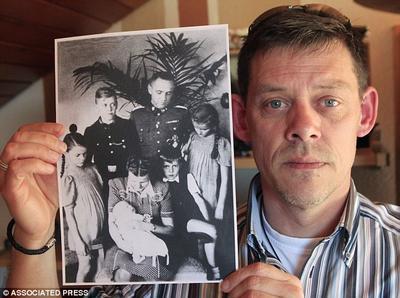
As a bit of an aficionado of WWII biographies and memoirs, I didn’t find this book particularly gripping unto itself. I watched the documentary Hitler’s Children (which I highly recommend), and (after realizing my Höss/Hess Rudolf confusion) wanted to learn more about the grandfather of Rainer Hoess (pictured with a Höss family portrait below), who, with the books author, visits Auschwitz to see where his father grew up and to confront his past in the film.
The story of the lives of Rudolf Höss and Hanns Alexander are interesting. Hanns ultimately was the one who captured Höss. Hanns, one of a pair of identical twins, is likable, a bit of a prankster, with plenty of innocence to be lost as the impact of the war and the betrayal of his country encroach in on his world. However, what I felt was a bit lacking in the book (or perhaps was left to the reader’s imagination) was the mind-boggling juxtaposition of the insulated environment (both mentally and physically) Höss created for his family literally adjacent to the site where mass murder was engineered and carried out.
Höss, more so than others with similarly appalling credentials, brought this sort of callused mentality of efficiency and logistics to what he did. It was Höss who suggested they find an alternative to the Einsatzgruppen methodology of lining up and shooting prisoners because it was detrimental to Nazi soldier morale. Likewise, he was the one who instructed the soldiers to tell the jews entering the gas chambers to keep track of their clothes as it helped to keep them calm, which (again) was easier for the soldiers to handle psychologically.
I certainly recommend this as a companion piece to Hitler’s Children.
"Hanns and Rudolf: The True Story of the German Jew Who Tracked Down and Caught the Kommandant of Auschwitz" by Thomas Harding is a well researched and documented account of two men's lives. We learn about Rudolf Hoess, commander of the Auschwitz concentration camp, the man responsible for millions of deaths, from his childhood to the rise within the SS, his running of the camp, his life in hiding and his capture. Hanns Alexander, a Berlin Jew who fled to London with his family, joined the British Forces and then went on to capture Hoess. The book is very informative and gave a great account of what the people behind the names might have been like. Either lives are incredible and Harding has done a great job at venturing an educated guess at looking into the minds of these two people. Having read several books of similar themes I found this book to be shining with its credibility and objectivity.
Hanns and Rudolf: The True Story of the German Jew Who Tracked Down and Caught the Kommandant of Auschwitz, by Thomas Harding, is a brilliantly written and well-researched book.
This non-fiction account of two men whose lives converge, told through the eyes of the author, whose uncle was Lieutenant Hanns Alexander. Hanns was a Jewish German, and also the son of an immigrant family who fled Germany for England. They had to turn over all of their holdings in order to gain exit visas.
Rudolph Hoss (not to be confused with Rudolf Hess) was a farmer, a man who enjoyed the earth and farming. Farming eventually became far removed from his life, and it eluded him once he joined the "Schutz-Staffel" (SS), under the suggestion of Heinrich Himmler.
The author refers to the two men by their given name, and I shall do the same. Their personal lives are depicted throughout the pages, regarding their childhoods, their families, their adult lives and their aspirations.
One thing that struck me was the dedication to Judaism within the Alexander family. And, cemented within that, is the family Torah, the "Alexander Torah".
Within rotating chapters detailing the lives of both Hanns and Rudolf, the reader gains an intense perspective of their backgrounds, their personal lives, their goals and their individual quests in the name of country and war.
Hanns' life takes dramatic turns once he is in England. He wants nothing more than to be viewed as "English as possible" and wants to gain citizenship. He joins the British Army, and is told that once he serves his enlistment time, he would gain citizenship. This enlistment leads to more than he could ever imagine.
The pages are infused with compelling documentation, letters, forms, photographs, testimonies, and portions of Rudolf's own journal entries. From all of the intense documentations, one is given perspectives that are unimaginable, concerning Rudolf's rise to Kommandant, not only Kommandant, but Kommandant of Auschwitz.
Rudolf writes forthrightly concerning the atrocities he is involved with, and this reader could see how his initial attitude of concern for Jews eventually turns into one of pure evilness and lack of caring and concern for humanity. How he went from a man who was repulsed by witnessing camp murders (yet, stood there watching as if it was a normal fact of life, to save his reputation), to a man whose attitude changed dramatically. He became a man possessed with death and destruction, and a man who had no remorse or concern for his implementation of the gas chambers.
He had a hand in the design and was witness to the first gassings, he programmed the entire operation, employing not only his power, but whatever was available in order to incorporate destruction and horrific atrocities. He oversaw over one million individuals exterminated at the hands of the Nazis. He was the master planner, and created the extermination program that existed, including the procedures, schedules, structures, and instructions. He was fearless, merciless and steadfast in his pursuit to please his superiors.
Hanns moved up through the ranks, and his Lieutenant status saw him eventually given the status of respect he desired. He took part in the Normandy Landing. In 1945 he was afforded a role on the newly formed War crimes Investigation Team for England, based in a Brussels suburb. This position took him to Bergen-Belsen concentration camp where he saw the remains of unspeakable acts of genocide, after liberation.
His reputation fostered, he was given the job as an interpreter, taking notes from interviews and witness statements in German and then transcribing them into English. he interviewed several high-ranking individuals affiliated with Auschwitz, and other individuals from the SS. He untiring efforts garnered information that proved that certain SS members knew that gassings/exterminations occurred at Auschwitz.
The war crimes trial began with the trial of Josef Kramer and forty four other people. Hanns could see, after a few days of trial testimony, Hanns knew in his heart of hearts that there were others who were conspirators or who headed the exterminations of the Jews.
The War Crimes Group was created, and those involved, including Hanns, were trying to locate SS high ranking officials through their intelligence experise. In 1946, he looked over the list of war criminals, and Rudolf's name was next. He began investigating and searching for Rudolf. He was relentless in his investigation and searching. He left no stone unturned, every name was interviewed and interviewed again. On March 10 1946, Rudolf was found and was taken to prison.
From there, the rest is history. Rudolf confessed to murdering over two million individuals. He was hanged at Auschwitz, in the same spot where Jews were hung.
Hanns and Rudolf is an incredibly compelling book, reading like a spy story of sorts. It is intense, written brilliantly and with extreme accuracy, through the dedication of exhaustive research in all of its formats. Harding has done humanity an amazing tribute to the tirelessness of Hanns and his efforts to right the wrongs through justice being done.
Harding has also shown the world a side of Rudolf that is invaluable for historical purposes. The reader is taken on a journey of a man who controlled his emotions, controlled the deaths of Jews, and who controlled Auschwitz with a firm hand.
I knew the book would be intense and filled with horrific situations and events. Yet, I read it, and within the pages of depictions of Auschwitz and the lack of humanity within the walls of electrified fences, I was chilled to the bone reading about some of the circumstances, and more chilled and horrified at how Rudolf seemed to slough off the atrocities as if they were nothing of importance.
Harding's efforts are to be applauded. Hanns and Rudolf: The True Story of the German Jew Who Tracked Down and Caught the Kommandant of Auschwitz is a work of extreme brilliance and Thomas Harding is masterful in the telling. From the opening page, describing Hanns' funeral, to the last page, I was captivated and involved in reading the relaying of history, and inhaling the familial dynamics, especially of the Alexander family. Hanns and Rudolf belongs on every book shelf, personal or otherwise. It is books such as this that will keep history alive, and will keep it not only for this generation, but generations past, and generations in the future. It is an invaluable historical resource.
I want to thank Leah Johanson, from Simon and Schuster for the Advanced Uncorrected Proof of Hanns and Rudolf. I am grateful to have received it, and to have read it. Thank you!
The author of this absorbing book was surprised to discover, at his great-uncle's funeral, that his relative was the man who tracked down war criminal Rudolf Hoss. In this engaging work, he tells the story of two men's lives in an honest and sympathetic manner. Harding parallels their biographies - Rudolf Hoss, born in 1901 in Baden-Baden, whose father had decided he would join the priesthood, but who joined the army to fight in WWI at the age of fourteen and who was a Commander at just sixteen years old; an odd mix of family man and committed National Socialist. Hanns Alexander, meanwhile, was born in 1933 to a rich and influential family, his father, an eminant doctor, was initially reluctant to even consider leaving Germany until the danger became too great. Luckily, Dr Alexander was visiting his married daughter in London when it became evident that he was to be arrested and the family managed to finally meet up again in England. When war broke out, both Hanns and his twin brother Paul were determined to enlist.
This work takes us through the war years, where Hoss recalled how Himmler gave him personal orders to Auschwitz to become, "a site of mass annihilation." Zyklon B provided a cheap and quick method of killing hundreds of people at a time. Later, Hoss chillingly recalled how solving the problem of the mechanism for mass murder meant that, "now my mind was at ease." As the war neared its end, the Allies created a database of alleged war criminals and the Commandant of Auschwitz was high on that list. However, the British war crimes response was not seen as of major importance until British troops entered Belsen. Hanns Alexander was chosen for the first ever war crimes investigation team, first as an interpreter and later as a war crimes investigator. When Hanns arrived at Belsen his shock, rage and purpose was palpable - he knew that what happened in the concentration camps could easily have happened to him had he stayed in Germany. Hanns vowed to hunt down missing war criminals, especially Kommandant Hoss. How Hoss was tracked down and what happened to him at the close of the war is unveiled, often reading more like a thriller than a factual account.
The author has really managed to write a book which is immensely readable, interesting and sympathetic to all the people he writes about; which, frankly, is more than Hoss deserves. His complete inability to realise what he was accountable for is truly shocking; his crimes almost defy belief. This, however, is an important book - it is a thrilling story of justice and the search for a man trying to evade capture, an account of how people forced to leave their country started again and the biography of two very different men. It is Rudolf Hoss's normality which shocks you when you consider even a small number of the crimes he perpetuated. It is Hanns Alexander's normality which shows you how resourceful and brave people can be when their cause is just. An excellent book and highly recommended.
Hanns and Rudolf by Thomas Harding is a fascinating historical and personal account of the lives of Hanns Alexander a German Jews who captures Rudolf Hoss, the notorious commandant of Auschwitz. This is no dry historical tome, however, but the personal story of the lives of the two men, told in parallel. The subject of the book is harrowing in the extreme. The author, Thomas Harding, writes with a sensitive pen, yet does not shy away from the atrocities presided over by Hoss. It does, however, attempt to paint as accurate a picture as possible of the man, his family, his rise in the Nazi machine and the scope and scale of his work. It also shows the plight of the German Jews from the perspective of those who fled Germany in time to avoid persecution and settled in England. Hanns and his brother join the British Army and in due course become British Nationals. WWII and the holocaust should never be lost from the world’s conscience and this is an excellent way of ensuring the story will continue to be told.
When it comes to books on the Holocaust, I generally prefer memoirs by the victims who kept their faith and helped others survive, but this book, which traces the lives of Rudolph Hoss, Kommandant of Auschwitz, and Hanns Alexander, a German-born Jew who escaped to England, joined the Allies, and ended up a Nazi hunter, was still very good. It might even make a good introduction to the subject for someone, the kind of book to be assigned in high school or college. By focusing on two individuals, it makes the period understandable. It’s by no means the only book a person should read on the Holocaust, but it’s a good springboard for beginners and adds depth to those of us already well-read on the subject.
The book alternates between the two men’s lives, so you see Hoss as a soldier in the First World War, his involvement in the “volkish” groups in the 20’s, and his rise through the ranks of the Nazi party. In parallel, you see the Alexander family’s rise to prominence in the 20’s and their scramble to escape once Hitler came to power. Hanns’ and Hoss’ stories merge after the war when Hanns uses his fluent German and his hatred for the Nazis to track Hoss down and bring him to justice. Hanns’ methods were sometimes ruthless, but I suppose that’s the only way to catch a Nazi on the run.
The part of the book that really made my blood run cold was the description of Hoss figuring out the most efficient means of extermination, ie the crematoria. There’s been plenty of discussion on the History Group boards about how anyone could be so evil. The answer, of course, is complicated, and probably beyond our understanding, but I think it’s significant that once the mass killings started, Hoss could no longer sleep with his wife. When he silenced whatever natural compassion was within him in order to kill, his personal impulse for love went along with it.
As I said before, this is not THE definitive book on the Holocaust, but then perhaps, no such book can exist. For general history, there are plenty of excellent documentary films – a picture’s worth a thousand words – but for the human experience, this book, as long as it’s supplemented with some books by Orthodox Jewish survivors and stories of righteous gentiles, is a fine addition to anyone’s Holocaust education.
Disclaimer: I received this book for free through the History Book Club on Goodreads. Thank you, Simon and Schuster
The subtitle of this book is The German Jew and the Hunt for the Kommandant of Auschwitz. The author, Thomas Harding, is a journalist and the great nephew of one of the protagonists, Hanns Alexander, a German Jew whose family (mostly) escaped from Germany before WWII, when Hanns was 19. Harding decided to investigate his relative, who was the man that tracked down the Kommandant of Auschwitz, Rudolf Höss, and brought him to justice.
This is a fascinating book and Harding has done a brilliant job of making it a very human story despite the inhuman things done by Höss and his SS colleagues at the camp. He goes into the childhoods and upbringings of both men, so making them real rather than hero and monster, which would not be half so interesting or important. As it is, we see both men as real people. Once in captivity, Höss was willing to tell all and did so with no emotion; he was later diagnosed as a psychopath with little or no empathy for his victims. Strangely, however, he was absolutely devoted to his wife and children, and wrote a touching letter to them a week before he was hanged – at Auschwitz, a stone’s throw from his former villa – how appropriate.
Hanns Alexander was a twin but had other siblings as well. His father was a successful doctor and they were wealthy while in Berlin, living in an enormous flat in Kaiserallee, a trendy central location. When they fled Germany, however, they were allowed to take almost no money out of the country, so lost almost everything.
Hanns joined the British Army, later applied to go to officer school, then, as a Lieutenant, was picked at the end of the war to join the UK’s fledgling Nazi hunters group, owing to his knowledge of Germany and fluent language skills. As a Jew himself, Alexander worked with a passion to catch the men who had devastated his home country and exterminated his fellow Jews, criss-crossing Germany in the snow to find witnesses and track down the fleeing Nazis.
Extensively researched, well written and based on a fascinating theme, this double biography will grip you from beginning to end, even though you know the ending.
This is a well written book, but the subject matter makes it a hard book to read. It is a sad but true story of the brutality of men. It is necessary that we as humans do not forgot this part of our history. This book made me rethink what I know of the holocaust. There is no happy ending here.
Simon & Schuster sent me a free copy of the book as part of a History Book Club read.
Hanns Alexander was Thomas Harding's great uncle and he knew nothing of his relative's Nazi hunting exploits until attending his funeral. He tells the story of both men through two chronological biographical narratives until the two men finally meet in 1946. Both stories are interesting and compelling, and give helpful human stories to understanding the madness and evil of the Nazi regime.
I was engrossed from start to finish.
5/5
More info....
SUNDAY TIMES BESTSELLER WINNER OF THE JQ WINGATE PRIZE 2015 SHORTLISTED FOR THE COSTA BIOGRAPHY AWARD
The true story of the Jewish investigator who pursued and captured one of Nazi Germany's most notorious war criminals.
Hanns Alexander was the son of a prosperous German family who fled Berlin for London in the 1930s.
Rudolf Höss was a farmer and soldier who became the Kommandant of Auschwitz Concentration Camp and oversaw the deaths of over a million men, women and children.
In the aftermath of the Second World War, the first British War Crimes Investigation Team is assembled to hunt down the senior Nazi officials responsible for the greatest atrocities the world has ever seen. Lieutenant Hanns Alexander is one of the lead investigators, Rudolf Höss his most elusive target.
In this book Thomas Harding reveals for the very first time the full, exhilarating account of Höss’ capture. Moving from the Middle-Eastern campaigns of the First World War to bohemian Berlin in the 1920s, to the horror of the concentration camps and the trials in Belsen and Nuremberg, it tells the story of two German men whose lives diverged, and intersected, in an astonishing way.
Praise....
"Thomas Harding has shed intriguing new light on the strange poison of Nazism, and one of its most lethal practitioners... Meticulously researched and deeply felt." (Ben Macintyre The Times, Book of the Week)
"Fascinating and moving...This is a remarkable book, which deserves a wide readership." (Max Hastings The Sunday Times)
"A gripping thriller, an unspeakable crime, an essential history." (John Le Carré)
"This is a stunning book...both chilling and deeply disturbing. It is also an utterly compelling and exhilarating account of one man's extraordinary hunt for the Kommandant of the most notorious death camp of all, Auschwitz-Birkenau." (James Holland)
"Only at his great uncle’s funeral in 2006 did Thomas Harding discover that Hanns Alexander, whose Jewish family fled to Britain from Nazi Germany in the 1930s, hunted down and captured Rudolf Höss, the ruthless commandant of Auschwitz, at the end of World War Two. By tracing the lives of these two men in parallel until their dramatic convergence in 1946, Harding puts the monstrous evil of the Final Solution in two specific but very different human contexts. The result is a compelling book full of unexpected revelations and insights, an authentic addition to our knowledge and understanding of this dark chapter in European history. No-one who starts reading it can fail to go on to the end." (David Lodge)
"In this electrifying account, Thomas Harding commemorates (and, for the tired, revivifies) a ringing Biblical injunction: Justice, justice, shalt thou pursue." (Cynthia Ozick)
"Its climax as thrilling as any wartime adventure story, Hanns and Rudolf is also a moral inquiry into an eternal question: what makes a man turn to evil? Closely researched and tautly written, this book sheds light on a remarkable and previously unknown aspect of the Holocaust - the moment when a Jew and one of the highest-ranking Nazis came face to face and history held its breath." (Jonathan Freedland)
"Absorbing ... Thomas Harding narrates, in careful, understated prose, the story of how his great uncle Hanns Alexander hunted down the man who vaingloriously identified himself as ‘the world’s greatest destroyer’: Rudolf Höss, the Bavarian-born Kommandant of Auschwitz.Harding balances with scrupulous care the stories of the pursuer and the pursued … Le Carré is quite correct. The last section of Harding’s book does indeed read like a gripping thriller." (Miranda Seymour Spectator)
"An extraordinary tale deriving from meticulous research – the story of how a young Jew after 1945 almost single-handedly hunted down the Kommandant of Auschwitz." (Frederick Forsyth)
"A highly readable detective story … This is really a book about the world of Hanns Alexander…[and it is] well worth reading ... Harding has researched it thoroughly." (Richard Overy Sunday Telegraph)
‘Fascinating. As awareness of the full horror of these dark years continues to advance, this book fills a unique and vital role.’ Lyn Smith
‘A remarkable book: thoughtful, compelling and quite devastating in its humanity. Thomas Harding’s account of these two extraordinary men goes straight to the dark heart of Nazi Germany.’ Keith Lowe
‘A fascinating, well-crafted book, entwining two biographies for an unusual and illuminating approach to the history of the Third Reich, its most heinous crime and its aftermath.’ Roger Moorhouse
fascinating story of hoss one of the worst nazis was captured. and story of hans a german jew serving with the british who is doing all to get Hoss. a must read.
What an outstanding and moving book on WWII! So very well written. As I read my eyes teared up due to my own family history with family lost at Auschwitz. Don't wait run and read this book! I highly highly recommend it to all! It truly is that good!
Quando comecei a ler este livro admito que esperava uma coisa completamente diferente. Não é mau, fala de uma história verídica mas há partes demasiado longas e descritivas.
An interesting read. Not so much because of the actual pursuit of Rudolf Hoss (done and dusted in 10 pages or so, tops), but for the light it shone on the man who spent several years facilitating the murder of over two million people, and what happened to those who were fortunate to escape while they could.
Harding approaches this in a very even-handed way (despite being related to the Hanns in the title, and despite the obvious tendency to do otherwise when dealing with such a brutal killer as Hoss), even referring to Hoss as 'Rudolf' throughout.
This familiarity helps build up the picture of two relatively unspectacular men, who both get drawn into the hell of the holocaust - Hanns Alexander as a Jew who is forced to leave Germany with his entire family, and Hoss, who goes from being a man who just wants to work the land, to work with animals, to being one of the most sinister butchers of the twentieth century. Two "normal" men, who take radically divergent paths.
There was nothing amazing in terms of revelations of concentration camp life. Hoss lived with his family the other side of the wall from the camp in which he was busy murdering millions, but went about his work with the detachment of the average man toiling away in an office cubicle eight hours a day.
I thought the epilogue was particularly interesting. It features Harding (Hanns was his great uncle) and Hoss's grandson and his daughter in law, on a visit to Auschwitz. Hoss is full of revulsion for this demonstration of his grandfather's crimes, insisting that, if he knew where he was buried (he was buried in an unmarked grave after execution) he would happily piss on his grave.
This reminded me of one of the most emotionally stirring things I've ever seen on television. I saw Hoss on a documentary recently, at Auschwitz, meeting a group of Israeli students, and a holocaust survivor. Hoss could barely look people in the eye. One of the students asked him what he'd do if he could go back in time, and meet his grandfather. Without thinking, he said "I'd kill him". The holocaust survivor hugged him, the students applauded and cried.
Hopefully future Hanns and Rudolfs won't be quite so different.
I received this book through Goodreads' First Reads program. This is a great book, showing two opposing perspectives on the Holocaust. The structure of this book is easy to follow--one chapter from Rudolf's point of view, then one from Hanns', and then one from Rudolf's, and so on and so forth. The things you already know about will be familiar to you, but the more personal view of the two men is unique to this book.
What I particularly liked about it was how the author takes a very balanced, unbiased view of both men. Hanns was not painted as a saint, nor were his good qualities emphasized over his bad ones or vice versa. He was just a human being who did his best to help see justice done. Rudolf wasn't particularly vilified, either. Harding doesn't paint the child Rudolf, who hadn't yet done anything, as a monster or a sociopath, and he doesn't try to tell you that Rudolf was an abusive husband or father, either. At the same time, he doesn't apologize for any of the many evil things Rudolf did or try to cover them up. The result is a very realistic look at how very human evil is, which is more powerful than trying to paint him as dark and sinister even as a toddler.
The impression I was left with was of two human beings, one of whom chose to do the right thing and the other of whom chose to do many very wrong things, rather than caricatures in the mold of traditional heroes and villains. It's probably one of the most honest biographies or historical accounts I've ever read, and I enjoyed it immensely. Highly recommended!
A gripping dual biography of both Rudolf Höss, the commandant of Auschwitz and Hanns Alexander, who hunted down Nazi war criminals first on his own and then by official assignment. The book is very well-written and well organized. Harding remains objective throughout, making for a clear and precise story and letting the atrocities and flaws of the characters speak for themselves.
The story’s hero, Hanns Alexander, is not presented as a hero; upon reading the book I doubt Alexander ever viewed himself as one, and he refused to tell his story to his children. The book’s villain, Rudolf Höss, is not presented as a villain, just a self-centered sycophant doing his job, a job that required him to murder millions of innocents. Harding is good at presenting these nuances and ambiguities. While no one can doubt that Höss was a murderous war criminal guilty of horrible crimes and atrocities, Höss never saw himself as such, and often had at least some sort of qualms about his work; but of course, not enough qualms to actually put a stop to the evil he was without a doubt guilty of perpetrating.
Harding’s style is gripping, and brings the events of the time period to life. He places the reader at at the heart of the story, and at the heart of the story’s tragedy. The story is a little choppy and lacking in detail at parts, but never loses its drama.
I received this book free through the History Book Club on Goodreads.
Received as an ARC from the publisher. Started on 8-22-13; finished on 8-27-13. The title tells the story. Well-written. Has all the action and plot of a novel, except this is unfortunately true. The chapters alternate between the hunter and the hunted, explaining their upbringing and their military experiences, and the events that bring them together. Hanns Alexander's younger relatives never knew about his Nazi-hunting during WWII until his funeral in 2006. The author is his great-nephew and spent 6 years researching and writing this book. A remarkable geneaology study and a warning to "never forget" man's inhumanity to man.
Hanns and Rudolf is a book that normally I would not tackle. The subject matter - regarding the Holocaust - would have been the main reason that I would have avoided reading it.
What happened to innocent people in Germany was one of the most evil and horrendous crimes against humanity ever known. So often in the past when I decided to read a book on the Holocaust - I was moved too deeply after finishing the selection so that it affected me long after the book’s completion. I remember watching Meryl Streep in Sophie’s Choice and being upset and irritable for a full week and attributing my strange mood to the power of that film and choice. Books and films do matter and do have a major impact.
So when our group was offered this opportunity to discuss this book as a selection - I pondered whether to accept this offer. Would this be the kind of selection that would be too upsetting to our group members? I decided to afford the opportunity to the group members and let the discussion unfold.
The book cleverly told the story of two protagonists - Hanns Alexander and Rudolf Hoess - who also became each other’s adversaries. Hanns was the hunter and Rudolf was the hunted. However, though Rudolf was hung in the process - Hanns lived on with the memories of what part he played in the capture of Hoess and his execution - long after Rudolf was buried in an unmarked grave.
A tattered copy of Hoess’s memoirs was part of Hanns Alexander’s belongings and according to the author - it had had much use. Neither man forgot the other for the remainder of their lives.
The author paralleled both men and set up two life stories woven into one, showing the reader how each man made different decisions and how the effects of these decisions determined their lives and their ultimate futures. In one instance, a man prospered and enjoyed his life after the war - in the other - the man was imprisoned and hung. Yet despite their many differences - both Hanns and Rudolf were in many ways bookends of each other. And the reader discovered much to their shock what average men are capable of.
The Holocaust was not engineered by serial killers or psychopaths - but by normal, sane men and that was and continues to be the most chilling part of the book. Of course, the backdrop of the book was Auschwitz and the various concentration camps and the horrific details of those camps were captured in the story line. These details were grizzly, upsetting and sad. The reality was obviously much, much worse.
In many ways, the book is not just a tribute to a great uncle and family member - Hanns Alexander - but also a book honoring those innocents who were not as fortunate as Hanns and lost their lives during the Holocaust. This book remembers them too and gives them all a memorial and a name.
"And to them will I give in my house and within my walls a memorial and a name (a "yad vas hem")... that shall not be cut off."
(Isaiah, chapter 56, verse 5)
Thomas Harding did an admirable job in maintaining a neutral position when writing this book and accomplished much more than he could have imagined. The book had quite an impact on me. At the same time, Mr. Harding remembered his great uncle and the innocent victims of the Holocaust and in telling this story - we also remembered Hanns Alexander and those who perished and in a small way - we also understood Rudolf Hoess better.
Disclaimer: I received this book for free through the History Book Club on Goodreads. Thank you, Simon and Schuster.
The author has gone back into the early childhood and adult years to give a little insight into the character of Höss. Most of the men in powerful positions during the Nazi era were the same age and I wonder if there is any correlation between their possible involvement in live warfare during WW1 and their propensity to commit acts of savagery without any sense of wrongdoing. That isn't an excuse of course, but we are talking about normal men from everyday walks of life, who ordered and committed atrocious acts of cruelty upon their fellow human beings. Although Höss was given the assessment/title of psychopath (in this book) by a medical professional I would argue that the person diagnosing him was probably not impartial enough for that title to be definitive without further assessment by other professionals. Deeming him a person with psychopathic tendencies makes it easier for the lay person to accept that someone, or any person, would help create and perfect a killing system of such proficiency the likes of which has never been seen before and I hope never is again. Instead of accepting the reality that the majority of the people in charge were just Tom, Dick and Harry's and nice girls from next door. What I admired most about the way the author described Hanns Alexander was the way he didn't hide the anger. He didn't try to be diplomatic or hide what he really felt. Hanns wore his anger on his sleeve. These criminals took his home, his city and some of his family. Why wasn't anyone looking for justice for the victims? Forgotten during the war, despite reports of mass murder, and forgotten after the war, because punishing the criminals didn't take precedence over post-war power struggles. So Hanns ended up acting like a vigilante to get the information he wanted and he let his anger control his actions. None of us can say how we would react to seeing the horrors and live evidence of the suffering in the aftermath of the liberation. The writing suffered now and again from the literal translation, which was evident in the sentence structure. Aside from that this book is a powerful reminder that some of the perpetrators were actually hunted down and punished. Unfortunately the reality is that only a few received their dues and the majority of the murderers were allowed to live a full life, unlike their many victims. Historical accounts like this should serve as a reminder never to forget. I received a copy of this book via NetGalley.
This was a finely written harrowing true story of the Kommandant of Auschwitz and the man who went on the trail to ferret him out after World War ll. Rudolph Hoess, originally wanting to be a farmer, went on to become the most sadistic brutal murderer in history. He alone was responsible for the killing of over two million people. By contrast Hanns Alexander, was raised in a very elite prosperous Jewish family that managed to escape Germany before Hitler's horrendous plan went into effect. Becoming a British soldier, he eventually was put on the team that went on to capture and arrest those responsible for the death camps.
The author, the grandson of Hanns, did a wonderful job of portraying these two men, their families, and the path they chose to living their lives in a most horrendous time. I found it and have always found it difficult to comprehend the total lack of anything close to human emotion displayed by these evil men and women who watched. gladly participated, and did nothing to prevent the torture and murder of over six million people. I have to wonder if it was possible that so many psychopaths could have congregated into one unit. It continues to me to be a nightmare and a huge stain on what we think is humanity.
If you are at all interested in the Holocaust and what was done to people in the name of the government, then this is a must read.
This is not the sort of book I typically read, but it locked me in from the beginning. You have the stories of two men that had very different beginnings and endings based on the paths they chose to walk.
One man starts life living carefree and ends up narrowly escaping the horrors that the Jewish population would have to endure in Nazi held areas, eventually hunting those responsible for these acts and finally settling into what we would consider a normal life. The other man has a hard go of it from the beginning and for me he developed a sick logic that would lead him to blindly spearhead the most heinous of events in human history.
For me, this book illustrates just how narrow a line we walk in our lives. One tiny slip can lead one to spiraling into an abyss of pain and horror…one man went all the way down while the other managed to hang on to his humanity even in his dark moments. The history presented by the author was beautifully done and boldly reveals lessons that humanity still need to learn based on some of the current events unfolding now.
I think that this book should be required reading for older students when the holocaust is covered in class; I have made this a required read in my household.
John le Carre apparently described this book as 'a gripping thriller' - I'm not sure he read the same book...
The account spends long periods describing the parallel periods of Hanns' & Rudolf's life. The vast majority of it is not about the hunt nor the capture of Höß.
The book does give insight into Höß's brutal upbringing and possible reasons for his inability to recognise the inhumanity of his later actions. It's particularly chilling the contrast between Höß's home life and the work he carried out during the day.
Overall an interesting read and a valuable insight into the man who admitted responsibility for the murder of over 3 million at Auschwitz, however it's not all it's cracked up to be.
An interesting story, well told. Provides a good introduction to Auschwitz for those who, like me, don't know very much about it. Overall a solid, but not spectacular, book.
Two disparate sons of 20th-Century Germany: after World War II, Hanns became the hunter who dedicated his life to bringing Rudolf to justice. Hanns Alexander was cosmopolitan, affluent, urbane, urban (Berlin) and liberal Jewish. Although he and his twin brother were the class cut-ups, they could look forward to stepping into the family's banking business as adults. The other, Rudolf Hoess, was small-town (Baden-Baden), Catholic, conservative, and destined to become a Priest.
But then Rudolf's hated and feared father died, and after that Germany was plunged into the Great Depression. The Nazi Party came to power in 1933 and the whole country was upended, tossing these two young men into very different life courses than they could possibly have imagined as boys. In the course of a very few years the Alexander family had to give up its German holdings and escape as refugees to the U.K. Rudolf at first was drawn to an agrarian reform movement, but later took up with the Nazis and advanced so well he was made commandant of Auschwitz, the most hated and feared of all the Third Reich's death camps.
Author Thomas Harding, a descendant of the Alexander family, narrates his story precisely and factually, without excessive background or stylistic glitz. The result is a relatively fast, and very absorbing nonfiction book that anyone who has an interest in this period should pick up and read. HANNS AND RUDOLF is one of those "international best-sellers" truly worthy of the name.
Bem este livro foi muito bem contado através do sobrinho de Hanns, que só depois da morte do seu tio-avô, descobriu o seu passado. Hanns e Rudolf partilham a mesma nacionalidade mas foram para caminhos distintos, onde mais tarde se cruzam graças a consequências e escolhas da vida.
Rudolf Höss foi o comandante do Campo Concentração Auschwitz e ainda teve um papel fulcral no campo concentração Belsen, um homem maléfico mas para os amigos e familiares mais próximos, era um brincalhão e um homem simples que adorava de conviver.
Já Hanns fugiu para Inglaterra por não concordar com a política da alemã, que manteve firmemente nas convicções de anti-semitismo e racismo, algo que ele não partilhava a mesma opinião. Ao longo do tempo que esteve em Inglaterra, foi aprendendo a cultura e a língua inglesa até que resolveu alistar-se para o exército britânico, por sentir que devia contribuir algo para o seu país adotivo e “destruir” o nazismo.
Ao longo dos capítulos foi revelado fotografias das personagens principais e a descrição do seu trajeto até o após guerra, que pessoalmente foi uma montanha russa de emoções e poder observar a humanidade foi corrompida pela política, o ódio e a ignorância.
Recomendo ler este livro se gostam deste tipo de temática, um livro de não-ficção e que ao longo dos anos o autor, Thomas Harding, fez uma investigação exaustiva da história do seu falecido tio-avô, Hanns, que resultou de descobertas surpreendentes.
Due vite a confronto e la linea della Storia a separarle. Due vite contro: Rudolf e Hanns, il comandante e il soldato ebreo anglo-tedesco che gli da la caccia dopo la disfatta. Due vite legate a spirale con i loro lati in ombra e i loro sentimenti di luce. Rudolf e Hanns: chi insegue chi? e sempre lei, la Storia, che insegue tutti con i suoi 'perché' ora inafferrabili, ora agghiaccianti. Cercare di descrivere l'infanzia di Hoss è encomiabile, ma mai efficace. Come lo sforzo di 'vederlo' fanciullo, questo mostro. Che poi, 'fanciullo' e 'mostro' sono parole che non stanno bene insieme, che a me personalmente fanno pensare altri scenari esplicativi e ahimé giustificativi...un po'. Cercare in Rudolf il fanciullo che gioca coi figli nella villa distante poche centinaia di metri dai forni, dopo aver guardato i suoi sottoposti trucidare uomini e donne e bambini...ah! basta, così è troppo. Non si finirà di leggere su questo tema, se ne smetterà di scrivere prima o poi?
Piccolo dis-appunto sull'edizione che ho in mano, piena di refusi e forse tradotta non proprio magistralmente. Comunque i fatti e i documenti ci sono tutti e qualcosa di più.



 I decided to try another of his books and this one sounded fascinating.