I think that Once Upon a Tower is something quite unlike most of the other historical romances I’ve ever read. In fact, I almost hesitate to call it a romance, even though the hero and heroine DO get their HEA and have to go through hell to get it. I can also see why the book has received mixed reviews because some of it makes for uncomfortable reading. That doesn’t mean that stories have to be comfortable to be enjoyable – far from it, but in Once Upon a Tower I think that some of the issues that Ms James has touched on are almost too … realistic to qualify as romance.
That isn’t necessarily a condemnation – it’s just my way of trying to explain my reasons for saying that in some ways, the book didn’t feel like a romance.
Rather, it’s a story about the pitfalls into which a young, inexperienced couple can easily fall when their relationship has no solid foundation other than a strong physical attraction and when they allow their expectations and attitudes towards their marriage to be informed by too many outside influences, past experiences and present examples. And because of that the story is - at its heart – an honest and timeless one.
Gowan Stoughton, Duke of Kinross, is twenty-two and inherited his title at the age of fourteen. He’s every inch the duke he was brought up to be, aware of his own consequence and what is due to him, but also incredibly mindful of his duty to the position and his responsibilities to those who depend on him. He’s a great believer in using every moment of every day – a major influence appearing to be his grandmother who spent her time running the ducal households, visiting tenants and filling her life with duty. Both his parents drank to excess and Gowan’s dedication to his role is as much to prove to himself and others that he is not like his father as it is to do with the fact that running a number of large estates and business concerns takes a lot of time. Gowan is a workaholic, and realising that one of his major duties is to ensure the succession, decides it’s time to find himself a wife. As he has to travel to Brighton on business, he decides to kill two birds with one stone and stop off in London to cast about him for a potential bride. Unusually for historical romance, Gowan is a virgin; he was betrothed in the cradle (to a lady who has since died) and believed it would dishonour both him and his fiancée if he were to take a mistress or to engage a courtesan. He has also been so busy setting to rights the estates his father almost ran into the ground that he hasn’t really had either the time or the inclination for dalliance.
But when he meets Lady Edith (Edie) Gilchrist for the first time, those inclinations change. She is the daughter of a good friend of his so it’s simply a matter of asking and receiving – and the morning after their meeting, they are engaged.
The thing is, he has fallen for Edie under a misconception. At the ball at which they met, Edie was unwell, and therefore spent most of the evening zoned out and gave the impression of being a very serene young lady who didn’t have very much to say for herself, whereas in reality she isn’t like that at all. Gowan has to leave the morning after the ball, so they don’t meet again for a while; although fortunately, when they do see each other again, each very much likes what they see and they’re both practically – to use the vernacular – gagging for it.
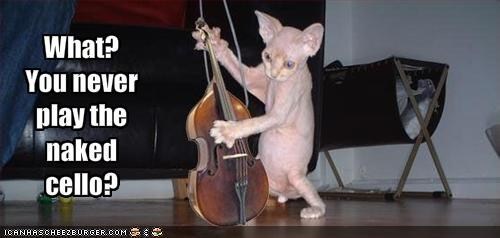
But what we learn about Edie during Gowan’s absence tells us already that things are going to be far from smooth sailing for the young couple. For one thing, Edie’s passion is the ‘cello. She’s a very talented musician and playing the instrument is practically the only thing in her life. She practices for five hours a day, and given Gowan’s work ethic and the work that is entailed in running a large household, it’s clear that there is going to be conflict ahead about that.
And then there is the fact that Edie’s father and step-mother are dreadfully unhappy in their marriage. At the root of the problem is the fact that Layla is unable to have children. She feels she has let her husband down and that he is no longer interested in her, so she behaves outrageously, taking up smoking cheroots and flirting with every man within a 50-mile radius. As a result, Edie’s father has become increasingly cold towards her which of course drives Layla to behave even more outrageously , and, being fairly close to her step-daughter in age, Layla treats Edie as a confidant rather than a daughter, and isn’t at all shy about talking about her marital difficulties.
Immediately after their wedding, Gowan returns to his usual pattern of existence; to his ledgers and his interminable discussions with stewards and solicitors, something which both astonishes and annoys Edie to no small degree, and I can’t say as I blame her. A bride of one day and she’s expected to sit in a carriage with her new husband and a bunch of strangers who occupy all his attention. Furthermore, it seems he never has a moment alone (apart from going to the bathroom!); he works solidly all day, apart from mealtimes, when he’s attended by a butler, a sommelier and several footmen – so that the only time he has for Edie is when they’re in bed. To her credit, she does point out this fact during their journey when she asks to speak to him privately – pointing out that ‘privately’ means without the servants within earshot. But Gowan has become so entrenched in his routines and his ways that he fails to see anything odd about spending the journey back to Scotland working when he has his new bride with him.
The biggest conflict in the story, though, is the one that is born in the marital bed. I thought the author’s depiction of first-time sex in this story was probably one of the most realistic I’ve ever read in a romantic novel. There are any number of well-endowed heroes who bring their virginal ladies to multiple orgasms during their first time together, and any number of virginal ladies who are able to accommodate their lusty stallions with a minimum amount of discomfort. Here, Ms James puts what may possibly be a more realistic spin on that whole “this is never going to work!” situation as Edie, while having been more than eager for Gowan’s lovemaking, actually finds it doesn’t work very well at all, and that intercourse with her hung-like-a-horse Scotsman is very painful. Believing that things won’t always feel like that, she is still optimistic about the next night – but when it’s just as bad, she resorts to faking it, having been previously told by a tipsy Layla- in a moment reminiscent of Meg Ryan’s famous “diner” scene in When Harry Met Sally - that sometimes it’s something a woman needs to do. The trouble is, once Edie has lied to Gowan in that way, she can’t stop, especially given that he tells her how important it is to him that she is finding the experience pleasurable as well as he. She knows it’s wrong, but can’t bear to disappoint him. Edie tries over the ensuing days to tell him the truth – but is thwarted at almost every turn by the fact that some servant or other is forever intruding upon them.
I think that Edie’s reticence was very realistic – even in our enlightened times, bedroom problems can be a difficult subject to broach, and we have a plethora of books, websites, sex-therapists and any number of options for help. So it makes sense that a sheltered, well-bred young woman in the Regency period would find the whole subject embarrassing and difficult to talk about, especially with the man involved whom she does not yet know very well.
After a few days, Gowan begins to sense that all is not well. While he believes that Edie is finding pleasure in his bed, he can’t help but realise that she is not as carried away by passion as he is, noticing that she is often “not there” when they’re in bed and wondering whether she’s running through scores in her head while he’s making love to her. He becomes angry with himself at his constant craving for her, thinking that she doesn’t feel for him with the same intensity he feels for her, and angry at what he sees as her self-possession around him. He’s walking around in a permanent state of seething lust, yet she is completely unaffected.
Or so he thinks, because of course, Edie has just the same thoughts as he does. She believes he is only willing to spend time with her in bed and has no idea that he can’t be in a room with her without wanting to throw her down and shag her senseless.
Things are already on the ropes as both Gowan and Edie are unable to talk to each other and resolve these misconceptions. Even worse, Gowan begins to believe that he can never compete with Edie’s true love - her ‘cello, as it’s only when she’s playing that he sees any real passion in her. The breaking point arrives when, having imbibed several glasses of champagne, Edie is finally able to let herself go sufficiently to achieve an orgasm. Naturally, Gowan notices the difference, having already realised that the experience of lovemaking hasn’t been anywhere near as earth-shattering for Edie as it has been for him – and the anger and frustration that have been building up inside him for days boil over. He is utterly devastated and completely humiliated, not least because he works out that Edie hasn’t kept their marital issues to herself and has confided in Layla, who, he thinks has probably told her husband, a very influential man in the circles in which Gowan moves.
It’s true he says a couple of harsh things to Edie at this point, but in my opinion, they’re completely deserved. She is distraught, trying to explain to him how awful she felt about lying to him, but too embarrassed to tell him how she really felt.
After he’s stormed out, having told Edie that he wonders now whether he ever really fell in love with her or with the image of the perfect bride he’d built up in his mind, Edie decides to move into the tower where she can practice to her heart’s content while she waits for her father to arrive to take her back to London.
In the weeks Gowan is away – having travelled to some of his distant estates – Edie somehow wins over the entire household of Craigievar and when Gowan returns, his staff all treat him like a leper! They believe he has used his wife ill and have taken her side, although I don’t know what she did to deserve their loyalty other than languish and play her ‘cello. Gowan has grown up with them and has treated them fairly all his life, yet they turn against him at a moment’s notice. I wouldn’t have blamed him if he’d sacked the lot of them!
I really didn’t like the ending. Gowan, for all his stuffiness, is a bit of a sweetie on the quiet, and has to endure even more humiliation at the hands of his in-laws when he returns with the intention of trying to save his marriage by having a long-overdue and frank conversation with his bride.
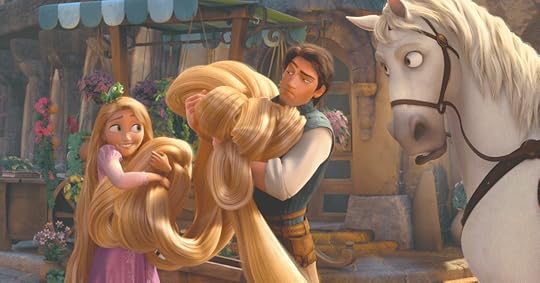
Gowan is thrown from his horse on the ride home, has a couple of broken ribs, a dislocated shoulder and possibly a fractured wrist, but he doesn’t want to lose any time on his thirty hour ride by resting up. When he reaches Craigievar, Layla tears into him over his treatment of Edie, accusing him of destroying her confidence and making her feel like a failure as a woman. He takes it all without protest until finally, driven to his own defence, he raises his voice to her, only to be set upon and punched in the face by Gilchrist. Bruised, broken and soundly berated, Gowan tries to talk to Edie, but she won’t admit him to her tower, so later (and here’s where that whole Rapunzel thing comes in) he risks life and limb to climb up to the window (a climb which we’ve been told has caused major injury and death to all the others who had tried) . It would have been a hard enough climb had he been in the picture of health, but with his injuries, it’s almost suicidal.
Of course, the pair are at last able to talk honestly, admit their insecurities, their culpability for the situation they’ve found themselves in - and at last have earsplitting, multi-orgasmic, hot monkey sex.
I’ve written a pretty long review here, which is odd given that I have very mixed feelings about the book. I think one of my major problems with the story stems from the fact that I really couldn’t empathise with Edie at all. I’m a musician, so I love books with musical heroes and heroines, but I couldn’t relate to this one. Gowan was far from perfect – his workaholism, his inability to see that he needed to adapt to the different rhythms of married life as much as did his bride, his rather unyielding demeanour – all served to make him come across as rather a dry stick at times. But he did genuinely love Edie and was grateful for his good fortune in finding a woman of her beauty, grace and –he’d thought – passion. He was the one who actually tried to adapt by changing his schedules so that she could fit in her ‘cello practice, while I didn’t really see Edie doing anything for him to make his life easier.
In terms of the ending, I’ve read novels sometimes where I’ve felt that the hero/heroine hasn’t grovelled quite enough for the things they’ve put their beloved through, but in this case I felt that the grovelling was far too one-sided. Gowan may well have left Craigevar in a fit of wounded-male pique, but the longer he was away, the more he realised how much he loved Edie and that he was prepared to do anything to get a second chance with her. But I don’t think he deserved the treatment he received at the hands of his staff, his in-laws and Edie herself (at first). It’s true that they both admitted their errors when they had their talk, but Gowan still did the bulk of the grovelling.
There’s a whole sub-plot I haven’t yet mentioned, which is to do with Gowan’s much younger half-sister, Susanna – but this review is long enough already, and to be honest, I felt as though it was superfluous.
Once Upon a Tower is a really difficult book to rate. I think it has a lot to recommend it in terms of its execution – Ms James is a very experienced writer, after all – and I think the concept was a good one.
BUT.
I can’t say that I felt I was fully engaged by the book. I never felt as though I’d been drawn in to the story, and I never really connected with either of the protagonists. There were places where I felt the story really dragged and I wasn’t left with that feeling of “oh no, it’s over” when I finished it.
This is one of those times when I’m going to rate the book according to how much I enjoyed it, even though I think it had more merit in terms of the subject matter than my rating would seem to indicate.