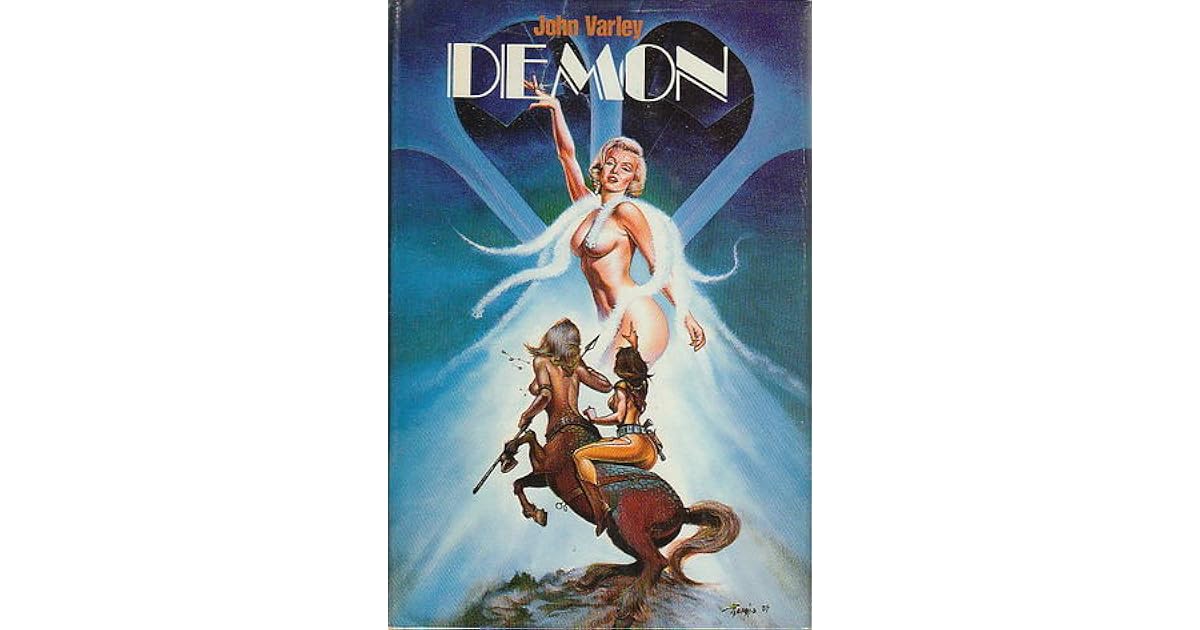
I review all three books here (Titan, Wizard and Demon).
Ah, Varley, what am I to do with you?
First and foremost, this trilogy is highly enjoyable, if quirky and eccentric in some places. Varley has a strong sense of how people work and his wisdom in his understanding of human interaction plays well in building a strong plot, and several subplots that add to the story's attractiveness. I thoroughly enjoyed reading these books when the came out, and I thoroughly enjoyed listening to them when I found them on Audible.com. They have some language and promiscuity issues, and my prudish mind will never think it is all right to mate with animals, no matter how liberated the person finds him/herself, but if one can handle these side distractions to a very memorable story, then one will be the richer from the experience. Here are quick, probably inadequate one-paragraph summaries of each book:
Titan: Scirocco Jones and the Ringmaster (a NASA ship) arrive at the moon Titan and are immediately attacked and swallowed up by...something. Shortly thereafter we find out that Titan is alive and run by a being called Gaea, a mad, god-like creature. After several adventures they meet face-to-face with Gaea and become her employees and all ends well.
Wizard: Varley adds Chris and Robin to the cast of human characters. Both have debilitating ilnesses and have come to Titan to seek medical cures. There they find an alcoholic Scirrocco Jones and her faithful sidekick, Gabby, considering the first careful steps toward overthrowing the mad Gaea. We also find that Scirocco has been given an added responsibility: she must approve every Titanide (the name given to the lovely Centaur-like creatures that make Titan their home) pregnancy, which is why she is probably alcoholic. Chris is an unremarkable figure, but Robin is a member of a sect of women who hate men and consider them all sex fiends. Robin consider Christians to be the worst, probably because they (Robin's sect) style themselves as witches and practice magic, and we all know what conservative Christians think about that (disclaimer: I AM a conservative Christian). At any rate, they have several adventures (required by Gaea before she will cure then), in the company of Scirocco and Gabby, Robin has her eyes open to the true nature of males (both bad and good), and something bad happens to Gabby which turns Scirocco into the enemy of Gaea. Robin and Chris are healed and Chris remains on Titan, but wants to be made into a Titanide.
Demon: Twenty years or so later, and Earth is in the throes of its fifth nuclear war, a protracted war the we find out has been started and is kept going by the machinations of Gaea. Connall, a weightlifter from Earth immigrates to Titan with the express purpose of killing Scirocco, but instead after a pretty nasty encounter with her, decides to serve her instead. Robin and her daughter Nova show up on Titan with a male child (as in "still in swaddling clothes") after having been kicked out of the coven because Robin had that male baby (which means she must have had intercourse with a man -- a horribly heinous sin in their culture). They both fall from riches to rags overnight and Nova is extremely bitter while Robin (who hasn't had sex with a man since Chris in the previous book) is just perplexed. They meet up with their old friends Scirocco and Chris. Scirocco is no longer a lush, and Chris has begun the slow change from human to Titanide. It is shown in his long floppy ears and horse's tail. Connall becomes Robin's lover while Scirocco decides to take on Gaea, the first step being the cleaning up of the city Bellanzona, a cess pool of human misery. She is successful, though only after draconian steps are taken. She raises an army that marches upon Gaea, who has now descended into such madness that she surrounds herself with the trappings of human movies, watching them continuously almost to the exclusion of everything else. The child Adam may be Scirocco's replacement in the near future if Scirocco doesn't watch herself. Adam is kidnapped, Chris goes along with him to try to counteract the influence of the mad Gaea and a nice little war ensues where we find out that Gaea is not the world, Gaea is just the woman at the controls (to understand, RAFO). Scirocco is successful but only with help from a secret and mysterious friend, who invites her to share godship after Gaea is gone, which she rejects. Scirocco is released to follow her ow path for as long as she wishes, without special protection.
So why do I hint at a dislike for this story? Well, a couple of reasons. Now, Varley is compared to Heinlein in many reviews, and I can see why, although I would add that the comparison is apt only if we compare him to the Old Heinlein, not the young Heinlein. One of that earlier author's main signatures is his cynicism for any kind of spirituality. Varley is a bit more subtle but just as vicious as the Old Heinlein (the younger Heinlein had honest places for spiritual men--See THE MOON IS A HARSH MISTRESS to find that one of his characters on the right side is a padre--and that's just one example). In this book are lots of characters such as a resurrected Martin Luther, Pope John, even Gautama Buddha and Sidhartha (forgive the spelling if I do not have it right). They are all evil minions of the deranged self-proclaimed goddess of Gaea, not to mention that they are all, well, ridiculous characters. There is not one single person who says, "Yes I belive in an Other Reality, and by the way, I am also a good person. You can see so by my actions." Not a Christian, a Buddhist, a Muslim, or even a plain theist, nada, zip, zero. Varley either makes fun of this part of the human property set, or ignores it all together. Even Frank Herbert recognized that part of humanity and what it might do for us, though he minimized it somewhat. I found that rather objectionable in a story that features so many slurs on my chosen faith. He didn't even recognize that sometimes the spiritual does some good.
Second, and finally, he gives me the strong sense that he can find very little good in humans to write home about. More importantly, his alien creatures were far more noble, insightful, kindly, beautiful of spirit than any human being and that made me just a bit angry. Only one human being had the guts to stand up and make the human condition better on Titan and that happened only because the author-god would not have had a story if he hadn't.
In concluding, I have tried reading other of Varley's works, and couldn't get past the first twenty pages or so. I suppose he lightened up on this trilogy to make another point or two about human happiness and human love. Nevertheless, until he finds a better balance point between the phenomena and the noumena, between mere physics and metaphysics, he is off my plate for the nonce.