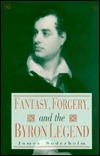
Byron was―to echo Wordsworth―half-perceived and half-created. He would have affirmed Jean Baudrillard's observation that "to seduce is to die to reality and reconstitute oneself as illusion." But among the readers he seduced, in person and in poetry, were women possessed of vivid imaginations who collaborated with him in fashioning his legend. Accused of "treating women harshly," Byron "It may be so―but I have been their martyr. My whole life has been sacrificed to them and by them." Those whom he spell bound often returned the favor in their own writings tried to remake his public image to reflect their own.
Through writings both well known and generally unknown, James Soderholm examines the poet's relationship with five Elizabeth Pigot, Caroline Lamb, Annabella Milbanke, Teresa Guiccioli, and Marguerite Blessington. These women participated in Byron's life and literary career and the manipulation of images that is the Byron legend.
Soderholm argues against the sentimental depictions of biographers who would preserve Byron's romantic aura by diminishing the contributions of these women to his social, sexual, and literary identity. By restoring the contexts in which literary works charm or bedevil particular readers, the author shows the consequences of Byron's poetic seductions during and after his life.
An enlightening read for any Byron enthusiast — discusses the multilayered legend of Lord Byron, and how it was constructed and reconstructed, sometimes curated and projected, yes by Byron himself but also — and this was most interesting — by the women in Byron's life. An interesting read on how perceptions of Byron and his personal and poetical legend were interpreted, written and projected by five important women in Byron's life: his friend Elizabeth Pigot, his mistress and author Lady Caroline Lamb, his wife Annabella Milbanke, his last love Teresa Guiccioli, and Lady Blessington, who "recorded" Byron's conversations. The involvement and role of these five women in the creation of many perceptions of Byron and his legend as discussed in this book was most interesting and appreciated.
Read this for a class on forgery. Mostly, the author was trying to convince the reader that forgery of spirit is just as bad as actual physical forgery. Just not as interesting.