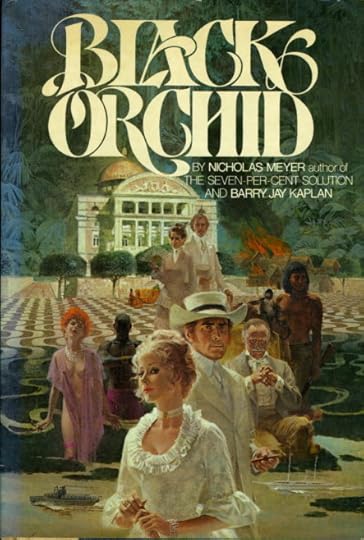
"A travel-worn soldier of fortune, Harry Kincaid was no stranger to exotic ports of call. He had negotiated the drawing rooms of Victorian London, the opium dens of Shanghai, the wild saloons of the Mississippi, and more. But nothing in his odd career had prepared him for the splendor and decadence of Manaus." — Manaus. A city of splendor and decadence at the turn of the century, 1,000 mile up the treacherous Amazon river, deep in the deadliest jungle known to man.
This magi city actually existed, boasting fabulous mansions, prostitutes with diamond fillings in their teeth, its leading citizens rubber monopoly billionaires.
Into this world comes Kincaid, the adventurer with an incredible mission. Only one person can stop him, Dolores, the beauty, daughter of the city's most powerful family, who loves Kincaid but yearns to betray him.
Nicholas Meyer graduated from the University of Iowa with a degree in theater and film-making, & is a film writer, producer, director and novelist best known for his involvement in the Star Trek films. He is also well known as the director for the landmark 1983 TV-Movie "The Day After", for which he was nominated for a Best Director Emmy Award. In 1977, Meyer was nominated for an Adapted Screenplay Academy Award for adapting his own 1974 novel, The Seven-Per-Cent Solution, to the screen.
In addition to his work on Star Trek, Meyer has written several novels, and has written and/or directed several other films.Most notable being the 1983 made-for-television anti-nuclear movie The Day After.
Meyer wrote three Sherlock Holmes novels: The West End Horror, The Canary Trainer, and The Seven-Per-Cent Solution. The latter was Meyer's most famous Holmes novel and the project for which he was best known prior to his Star Trek involvement. It was also adapted into a 1976 film, directed by Herbert Ross, for which Meyer wrote the screenplay.
Fascinating when I first read this book and heard of these events--40 years ago--Black Orchid created its own personal mythology throughout my life. If you know nothing of the theft of rubber trees from the Manaus area of Brazil, this is a tale to discover. Upon re-reading, however, with the blush of youth gone, many miles and cultures behind me, and re-reading while on a riverboat down the Amazon, the luster has tarnished somewhat.
I now find the writing a bit theatrical. Being on the Amazon for the past week, I now realize that--to put it bluntly--the author is full of shit in many respects. I envision him writing from his apartment overlooking Central Park in New York City via the assistance of much research and background reading, but no experience. In other respects, the novel can be boiled down to being called a bodice ripper.
Endings are always tricky, but this one galled me in that there was no ending. The authors left our hero and heroine in an old-fashioned three-reel serial cliffhanger and followed simply with an epilogue. Too many threads frayed and dangling? Or the publisher moved up the deadline? After a hundred pages of river pursuit, they didn't wish to expend another fifty to wrap up the story?
Therefore, we have an unfinished, theatrical, romance-adventure novel. Its star fades upon second glance. I still give it 3 stars for the place it has occupied in my life the past 40 years and the stories that I have managed to extract from it over the years.
I largely agree with the review by James. This starts promisingly enough, with an American mercenary and his British sidekick on a secret mission to steal rubber tree seeds out of 19th-century Manaus, thus breaking the Peruvian/Brazilian rubber monopoly. And for the first 60 pages or so, it reminded me strongly of some of the better adventures of Martin Cruz Smith. But at some point, as James points out, it becomes harder and harder to suspend disbelief. It's as if, having deftly set the stage, the authors (note my use of the plural) didn't quite know what to do next. So they decided to throw in everything they could think of. Thus, during the river chase, we have piranha and army ants and hostile tribesmen...and overwrought sex scenes, which are shoehorned in whenever possible. Sometimes less is more. I didn't have any particular problem with the ending, perhaps because by that time I was about ready for it to end. I don't want to sound too harsh. There is good writing in here, but somehow it just didn't quite jell all the way.
Two other observations: 1) I understand that Nicholas Meyer is the headliner here, and deservedly so, but since his co-author, Barry Jay Kaplan, is credited both on the cover and the back of the novel, there is no reason for Goodreads to completely ignore him; Kaplan should get his due; 2) it's amazing how often this title has been used and re-used. A cursory search of Goodreads turned up 264 hits.