Discover the tiny, fascinating world of nurse logs in this first book in an illuminating picture book series that explores how even the smallest habitats play big roles in nature.
Once there stood a giant fir tree that stretched to the sun. One stormy day, a great gust came. The tree creaked, and cracked, and collapsed! And the tree’s new life as a nurse log began...
When old trees fall to the forest floor, they can take centuries to decompose, becoming home to all sorts of organisms along the way. These nurse logs are unique ecosystems that support hundreds of rare and important plants, creatures, and fungi. They provide nutrients for tree seedlings, hideaways for animals, shelters in the winter, and protection from the elements. With snappy text and lush illustrations, this book invites curious readers to step into a tiny ecosystem that’s truly like no other.
Author-illustrator Amy Hevron lives in Seattle, Washington. She draws inspiration from wildlife, nature, and travel. Amy is a two-time winner of the Portfolio Honor Award from the Society of Children's Book Writers and Illustrators.
With her February 2024 ecology themed picture book Log Life, author and illustrator Amy Hevron's text and accompanying artwork celebrate and describe the life of a so-called nurse log, and how when a large fir tree is blown down and collapses during a storm, the resulting log then presents a myriad of opportunities for both simple and complex life forms for centuries to come (penned simplistically but educationally, and in my opinion best suitable for children from the age of five to about eight, both for reading aloud and also of course for independent perusals as well). But just to point out that I do think readers and listeners older than eight might well be wanting and even needing more detail and coverage and thus find Log Life just a bit too on the surface (I know that my inner child above the age of eight is definitely asking for and wanting more textual depth and that both my inner child and even more so my older adult reading self do not really find the storybook format of Log Life all that endearing and in particular consider how Hevron textually makes many of her featured animals and fungi quite anthropomorphic rather off-putting and as such also kind of diminishing the science value of Log Life).
And yes, even the author's note at the end of Log Life and the suggestions for further reading will probably not be presenting enough information to satisfy older readers either (although they do in my opinion give a pretty decent point of departure for further research), but that for the above mentioned four to eight year olds, Log Life features a very nicely educational and engaging introduction to what is basically the biological and ecological life cycle of a fallen log (but yes, once more I do have say that in order for children to totally enjoy Log Life, they will have to also find sufficient reading pleasure and joy not just with Amy Hevron's presented facts but also with her anthropomorphism).
Finally, Hevron's accompanying pictures for Log Life, they feel like woodgrain textures and combine acrylic paints, markers and coloured pencil (both delightfully mirroring and often also visually expanding on the featured text). But to be honest, I would alongside of the artwork also want photographs and do find it a trifle visually disappointing that Amy Hevron only uses her illustrations in Log Life and not a combination of artwork and photography.
So three stars for Log Life and definitely recommended (but yes, if Hevron's text did not make her animals and her fungi so often and annoyingly talk like humans and utter snarky, often sarcastic asides and remarks, my rating for Log Life would certainly be higher, would definitely be four stars).
Knocking another shelf book into the read category, though H had to be persuaded to finish (I don't think it's the time scale that scared her even if it goes 1,000 years; I think she wanted me to reread the Yolen dinosaur library books instead). A very colorful and friendly look at what happens when a giant fir tree falls, becoming a nurse log habitat that supports a whole ecosystem that eventually raises another grand fir.
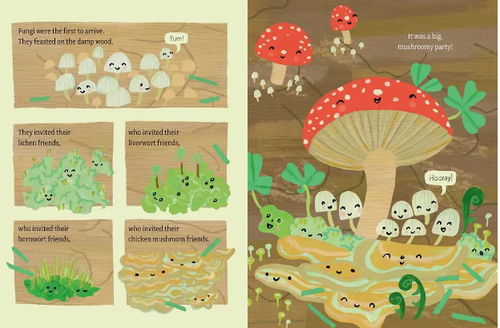
H's favorite part was the mushrooms and fungi colonizing in the beginning.
Such an interesting narrative nonfiction book about how a tree continues to live after it has fallen and becomes a log. I love how the author-illustrator seamlessly incorporates labeling the illustrations throughout the book. Includes Back Matter.
I am so thrilled to read a narrative story about nursery logs as they just don’t get the recognition they deserve. I really wanted to give this five stars, but my master gardener brain is wondering why there was no mention of how seeds get planted in a nursery log during the story.
Log life introduces readers to tiny habitat s in the Pacific Northwest where giant evergreen trees can live up to 1,000 years before they fall in the forest. It takes hundreds of years for these trees to decompose, but while decomposing they become habitats for a number of plants and animals. They will become nurse logs.
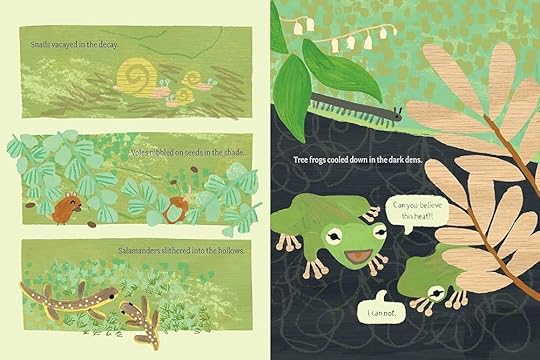
Nurse logs feed and house creatures from insects to birds and rodents, snails, frogs and salamanders. One giant tree feeds an entire system for decades.
Illustrations entertain and educate about plant and animal life. It is a hopeful book as it shows how one tree can fall, but still offer so much life. In fact, new fir trees can sprout and begin their cycle for the next thousand years. Various animals are featured at the end in a two-page spread that readers will study again and again. Young readers may play at finding and identifying each type of animal in the early pages.
A page about nurse-log habitats is included. Complete with selected sources and additional reading sources, this is a non-fiction treasure to own!
Highly recommended for any fan of non-fiction books and kids who love ecology, animals and forests.
Back in another life, I was an assistant biologist for several wildlife management agencies and one of the best way to help wildlife in forest is to leave the fallen logs, otherwise known as nurse logs. They not only add important nutrients back to the soil, they provide food for insects and homes for critters. Just think of all the times Winnie-the-Pooh and pals hid in a hollow log. As shown on the cover, baby trees will sometimes start to grow atop of nurse logs, the log providing perfect food for the budding tree. This wonderfully illustrated and informative book shows all this and more about the life that continues when a log falls. It has taken humans a log time to understand that most of the time the best thing we can do for nature is leave it alone and this book does a great job of showing you why. A great book for Earth Day and budding environmentalists.
Reading voraciously sometimes takes you down unusual pathways. There are many books about dendrology (look it up!) and the other myriad florae in the world. However, this is the first book I’ve ever read that tells what happens after a tree falls.
The simple pictures take you through this fallen king’s afterlife as it becomes home to everything from moss to mountain lions. Seeds take root and grow into other living things. Creatures feed on this growth and predators feed on the prey. Animals take shelter in the cold and shelter under new growth in the summer. Faunae chew up food, spit out seeds that in turn become new growth.
The cycle continues and renews itself and it’s marvelous to read. The illustrations are created with a child’s-eye view in mind. So small tots will find this very accessible.
Brief summary: This book is a narrative nonfiction that educates young readers about the life cycle of a giant fir tree that falls to the ground and transforms into a nurse log. As the log slowly decays in the forest, it becomes a source of nourishment for fungi, plants, insects, animals, and birds throughout the first year until it completely decomposes many decades later.
Comments: I had never heard of the term "nurse log" before and found it fascinating to learn about what happens to a fallen tree.
The illustrations were created using acrylic, marker, and pencil on Bristol board and then digitally collaged.
The back sections are More About Nurse-Log Habitats, Selected Sources, and Additional Reading.
A fascinating look at several centuries in the life of a nurse log. This is a beautiful cycle-of-life tale, and a tribute to the real "giving" trees. With wonderful illustrations by the author.
Set in the Pacific Northwest, Log life introduces readers to the habitat created when a huge evergreen tree falls to the forest floor. The resulting nurse log provides nutrients and shelter for a variety of fungi, plants and animals, over hundreds of years, even allowing another evergreen tree to grow in the place of the original. The illustrations are beautiful and educational. There are additional pages about nurse log habitats, sources and additional reading. This is a book young kids will enjoy coming back to over and over again. Great for homes and classroom libraries.
This is a very interesting and educational story with very nice illustrations. It’s about fallen trees that become nurse logs for tiny life in the forest. When a tree falls to the ground in the forest, it becomes food and shelter for anything from fungi to birds and animals, and the cycle continues. There is extra information in the back of the book on the page called More about Nurse-Log Habitats.
This book is one of the finalists in the Washington State Book Awards under the Picture Books category. I enjoyed this book with its' different page orientations and beautiful illustrations. The message of how even a tree stump plays a vital role in the echo system of the forest was enlightening and endearing. This book has some stiff competition but win or loss hopefully by being in the finalist category more readers will get to know about it. I recommend this book for adults and kids.
With bright, cheerful illustrations and engaging language, author-illustrator Hevron makes the concept of succession accessible to the youngest kids. Effortlessly spanning thousands of years to show how nurse logs contribute to the ecosystem and the next generation of trees, this book is a fun read that can be enjoyed in the classroom or at story hour.
The book paints a nice simplistic picture of the life of a fallen tree as a nurse log. The illustrations are delightful and designed to get and keep a child’s attention. Therefore language used in the book is plain and straightforward. Therefore, the lesson presented by this book is easy for a child to understand, as well as memorable.
This is a perfect picture book. Interesting, exciting, adorable, and full of facts... I just can't explain how much I love it. Pick up this book, head out on a hike, and have story time in the woods.
Very informative about nurse logs which I was unfamiliar with. The illustrations covered the whole page and gave the words that extra punch. We do not have another book like this in our library but it makes me want to find more.
3.5 stars. The book is well-written and the science about nurse logs is correct. Unfortunately, the illustrations are cartoonish enough to take away from the book (for me). Children's book but good info for adults, too.
I really love the message of this book, showing the lifecycle of a decaying log. We see a lot of fallen cottonwood trees here on the plains in Colorado and talking about this with my daughter has been something I always teaching her.
Lovely introduction to nurse logs specifically and, more deeply, to nature's regeneration. Cute pictures share all the delights of animals, plants and fungi that use a nurse log. Amy Hevron, as usual, has a wonderfully deft touch -- I love that she shares the number of years since the tree fell, from Year 1 to Year 1000. The book ends of course where it began, demonstrating nature's perfectly long cycles. A great resource for a forest unit. Restores your sense of hope.
Love the artwork! Lots of animals and fungi introduced in a fun way. Could be a good starting point for conversations with littles about the differences in plants and animals and how people are different, too.
Read for my ECE final science project. I absolutely loved this picture book. It presented the information in a fun and engaging way. The illustrations are also cute. Young children will definitely love this book. I already ordered every other book in the tiny habitats series to read for fun.
Love everything about this nonfiction book in the Tiny Habitats series, particularly the timeframe. This book tells the story of the life of a nurse log and fir tree over the course of 1000 years!