‘I submit to you, Joe Barrow, that the reason you keep being in time is that you are in time, this week, in the musical sense. The city is playing a song, and you have a part in it.’
Joe Barrow is a very small cog in the mechanism of a really big city that never was.
Cahokia City is the result of an alternative path in the history of the North American continent, one where Anopa tribes were never conquered by illegal immigrants from Europe and established their own independent state and city in the heart of the American heartland, across the Mississippi river from the tiny village of St. Louis, which was a church, a gas station and a general store, clustered under dripping oak trees.
By the early spring of 1922, Cahokia has already become a member of the union with full rights and a mixed population where a takouma is a person native to the continent, a taklousa is a person a African ancestry and a takata is a person of European descent. The Anopa names might sounds like a needless affectation at the start, but the reader will soon get the hang of the native culture. The rest of the Union followed a path very similar to what we know from ‘real’ history: industrial boom, transcontinental railway, Prohibition, Civil War, World War I and Jazz. There are some deviations though: an independent Mormon state, a state in the South controlled by former slaves, Alaska still under Russian settlement, etc.
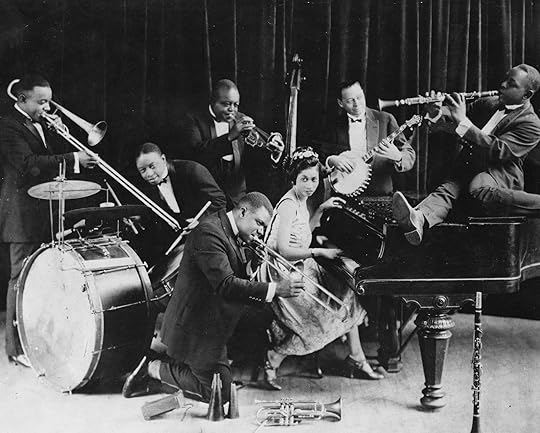
This carefully researched cultural landscape would have been probably the most fascinating part of this alternative history novel, if I was not already a big fan of the noir genre and of jazz history and musical expression. These three rich intertwined threads [history, crime, music] produced what will probably crack the top three of my 2024 reads and led to a rise in my enthusiasm for Spufford after only my second novel by him.
‘Sometimes, symbols move solid objects; sometimes they act on flesh and blood. If you don’t pay attention to what things mean, you miss a piece of the puzzle. Without the meaning of things, without the stories people tell about them – that people believe about them – you can’t understand events, Detective. You can’t understand this city.’
Joe Barrow and his partner Drummond are sent to investigate a gruesome murder on the roof of one of the three high rise administrative buildings in Cahokia downtown area. A clerk in the Land Development office has been ritually disembowelled, his still beating heart cut out in a ritual eerily reminiscent of ancient Aztec offerings.
The chief of Police assigns the two detectives to investigate the murder before the city explodes in racial riots, fanned by the yellow press and by the local Ku Klux Klan cell. Barrow and Drummond are comrades who returned together from the Flanders trenches. Barrow, of half-takouma and half-taklousa ancestry, has been convinced by the full takata Drummond to join the police in order to get enough money [from bribes and other perks of the job] for a farm in California. Joe Drummond had given up a promising career as a jazz pianist and composer in order to be with his friend.
The remark about the power of symbols, of rituals and beliefs, is made by the nominal king of the city and Sun-god, leader of the powerful Hashi clan. His sister is goddess of the Moon and his brother the Catholic bishop of the majority takouma population, converted initially by Jesuits coming from Mexico. Once Cahokia joined the union, an important number of European immigrants came to the city, bringing with them not only useful skills and technology but also racism and protestant fundamentalism. The wife of the victim, soon revealed to have been a low rank member of the KKK, explains:
‘We shouldn’t have come here,’ she said. ‘Savages and papists and foreigners and drinkers, and people so mixed up you can’t even tell what they are.’
The story may be written as alternative history, but recent events have amply proven that the lessons of real history have not been learned by our generation:
‘Show me a believer, in pretty much anything, and I’ll show you somebody someplace else who’s making bank. It’s a law of the universe, is what it is.’
The conspiracy is not so hard to guess, not even the main suspect in the murder that set fire to the powder keg of Cahokia politics. The real question is what can one man caught in these turbulent times do, all alone in the city. A couple of side quests, one of a romantic nature and one of artistic expression as Joe falls in love with an unreachable woman and gets invited to play with a visiting band, provide a welcome alternative to the grim revelations of the inquest.
‘What is being attempted here is a repetition of the strategy that worked in Texas and in California, last century, and in Hawaii only twenty or so years ago. Make trouble; demand outside intervention to restore order; when you get it, make sure that the order that is restored conveniently wipes away native power and native property rights. All in line with the great unspoken principle of American history, Detective. Which is, if it’s worth having, the red man shall not be allowed to keep it.’
Somebody is manipulating Cahokia politics for their own interests. It may be a captain of industry, it may be some adept of Manifest Destiny or just a rabid Klan leader, but all the signs point in the direction of a carefully orchestrated murder designed to bring turmoil to the city streets. Joe Barrow, with minimal help and even with some suspicious blocks from his partner Drummond, doggedly follows the leads from the mansions of the powerful Hashi family to the warren-like labyrinth of old takouma slums, from the new streets of German immigrants and gin-runners, to the red district and jazz clubs of the taklousa district.
As we follow him we also learn a lot more about the history of the city, about the Hashi family and about the vibrant, exotic and more than a little dangerous street life of Cahokia ... with a small and feeble glimpse of something else:
‘This will hurt,’ she said. ‘But then, in my opinion, almost everything real does.’
‘That’s a very gloomy philosophy,’ he said, for something to say.
‘True, though, don’t you find? Love hurts. Loss hurts. Failure hurts. Success hurts. Responsibility hurts.’
‘... Music doesn’t hurt.’
>>><<<>>><<<
I’m not sure what else I can reveal without major spoilers. I found this novel much livelier, more gripping that my previous book by Spufford [ Golden Hill ] probably helped along by the noir/hardboiled plot and by the explosive final chapters. Even the prose seems more accessible, less ‘high-brow’ and intricate, probably because I really like to read about the Native American cultural heritage and the way it might survive the onslaught of dominant consumer culture.
Cahokia is not a dying, but a living culture. A living culture lives. Of necessity therefore it changes, grows and adapts as its habitat encourages or even requires those changes. In such circumstances, syncretism is not a defect, is not an impurity. It is an inarguable sign of evolutionary success. Cahokia is not what it was in 1650, in 1750, in 1850? Neither is English-speaking America ...
Are there lessons we can learn from this exercise in alternative history? Yes, but events in late 2024, with elections both in the US and now in Romania, show hatred and suspicion ascendant while common sense, decency and kindness are ignored.
Your best protection from those who would set us at odds with each other is to shake off fear. To lay aside suspicion. To forswear hatred. To recall that we are neighbours, in a metropolis where red and white and black have lived together in trust and confidence for fifty years. Don’t let fear guide your steps this morning, neighbours!’
>>><<<>>><<<
Since I mentioned I am Romanian, I was half proud, half annoyed that Spufford mentions repeatedly the name of Lazar Edeleanu, a Romanian chemist born very very close to my own birthplace [we have an oil industry museum in town]. Spufford changes his ethnicity to German/Jewish/maybe some Romanian blood, because the research that is relevant to the story was commercialized by a company that Edeleanu set up in Germany. He discovered and manufactured phenylisopropylamine , later popularized as benzedrine.
The best half-hidden Easter Egg of the story is spelled out in the Acknowledgements section by the author, for those readers who are not already familiar with the name Kroeber.
Professor of anthropology Alfred Kroeber is one of the characters in the book. He is a real scientist and his research is important to the plot, but his inclusion among all the fictional characters is because his daughter Ursula Kroeber Le Guin, born in 1929, became a great American writer and creator of worlds. This book is dedicated to her memory.