Russell Jacoby (born April 23, 1945) is a professor of history at the University of California, Los Angeles (UCLA), an author and a critic of academic culture. His fields of interest are twentieth-century European and American intellectual and cultural history, specifically the history of intellectuals and education.
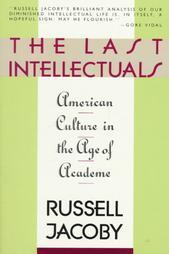
I'm not entirely sure what I think of this book. Certainly, it is beautifully crafted and a great window on parts of mid-twentieth-century American intellectual and cultural life. Jacoby traces the decline of urban bohemia, the rise of suburbia, and the drawing of New Left activists into the academic establishment -- all fascinating topics that he handles deftly. What I'm not so sure about is the central problem of the book.
Jacoby laments the absence (as of 1987) of a younger generation of American public intellectuals. He complains that America may have seen its "last intellectuals" already. But those last intellectuals were virtually America's first intellectuals, too, given Jacoby's strict definition of the term. (The word intellectual itself, as a term of public discourse, is only about 100 years old.) The intellectuals' existence as a class was possible, arguably, in large part because of the very mass media that eventually made them irrelevant. Yet America had an intellectual life, after a fashion, before they came along; it seems possible that it still has an intellectual life, after a fashion, now that they are aging. At any rate, it seems possible that the most effective sort of public intellectual, given contemporary conditions, might look quite different from the intellectual of the 1930s or 1950s.
Perhaps, given the intellectuals' conspicuous failure during Vietnam, this is a good thing. I'm actually not sure. I am sure that Jacoby underestimated the significance of what he might see as ersatz intellectuals -- media figures, often right-wing, with enormous daily audiences by the end of the 1980s. In other words, by looking for a familiar kind of thinker, he missed the real story of the American public mind during the time.
For someone of my generation (born in the 1960s) this was a fascinating read about the intellectual giants that passed out of history in the 1950s, who were not academics but were "public intellectuals." It is an interesting story, how demographics, and other social trends drove a professionalization of intellectual pursuit in the universities that had the effect of making their writing unreadable by the public. Social commentary on the Left for the most part disappeared into scholarly journals as the Left conquered academe. Ultimately leading to the triumph of the Right in social comment evinced by The New Criterion, Commentary, City Journal, etc.
The book explains the catastrophe of bad writing people in my generation who went to college in the 1980s were subjected to by the "tenured radicals."
This book really gets at many of the problems in academia. I disagree with many of Jacoby's assumptions and premises (especially that intellectuals need to be Marxists or leftists), but he incisively dissects some of the problems afflicting professors and universities. A motif is that intellectuals have abandoned writing for the public and have taken enclave in universities for the prospect of tenure, salary, and reputation. I find nothing wrong with that goal, but the problem is in pursuit of tenure, intellectuals are forced to specialize into sub/micro-fields of disciplines that fade into irrelevance, toe the orthodoxy, etc. While the chapter on the decline of the bohemian lifestyle is breathtaking, I find nothing glamorous, virtuous, or sustainable about it. The "gentrification of intellectuals" is fine with me. However, the problems that Jacoby touches on are critical in relation to the drive for tenure.
Conservatives often decry leftists professors that have overtaken universities and academe. That rallying cry is not inaccurate; there are many universities with substantially more liberal professors than conservative professors, as measured by party affiliation. There are mentions that there is no American left and that is exemplified by the professor profession. Instead of becoming and retaining a strong left identity, they ensconce themselves into a specialized profession and write technical books and articles for each other, instead of educating the public like good leftists. The mention that there is no American left rings quite true; American liberals are not leftists like their European counterparts, who are Socialists. American liberals are left of center, at best.
Jacoby dedicates two chapters to the presence of leftists and Marxists at universities, concluding that they have subsumed themselves under the university structure. The focus on Marxism is petulant but a tenet of the book. I was hoping for analysis on conservatives in academe, but the first 200 pages are devoid of that.
I am disappointed by the lack of analysis concerning think tanks. Perhaps their place is more prominent today, but the scholars and authors who are employed and funded by think tanks with certain ideological purposes are certainly necessary in Jacoby's analyses.
This book is rich with many themes, ideas, and examples. It jumps from comparing mid-century New York and non-New York intellectuals to lamenting the decline of independent intellectualism and the dearth of public intellectuals in the current day. The current day for Jacoby is the 1980s, but I would disagree with Jacoby on this contention. I believe there are public intellectuals strongly entrenched in the United States. They do not have to be full-time professors; many of them are authors/columnists for the major newspapers and magazines, and they make many television appearances. Steven Pinker, Paul Krugman, George Will, Fareed Zakaria, Christopher Hitchens, etc. Public intellectualism might not be valued in the way that Jacoby wishes it were, but I believe public intellectualism is alive and well. I also am of the belief that an intellectual need not be an extremist ideologue like Chomsky, but Jacoby gives clear preference to the leftists.
Many parts of the books are excellent, disputable, informative, and provocative. I would love to see a contemporary study by Jacoby on this same topic, as it has been a generation since this was published.
The language is not only lucid, but it Jacoby's trenchant criticisms of certain people, ideas, and trends are hilarious.
I stopped reading this book. The book isn't bad yet it is out of date. Maybe Jacoby needs to put out a new edition that takes the Internet into consideration. Easier said than done, I know.
Considering this book’s central preoccupation, it’s astounding that Susan Sontag is only mentioned once, and James Baldwin not at all (I also happen to be writing a dissertation chapter about them, which drew me to this book in the first place). Both writers eschewed academia in favor of public audiences, started their careers in literary criticism at New York Trotskyist publications, and brought the postwar culture of the public intellectual well into the 80s (Sontag even played herself as a caricature of the figure of the public intellectual). This study also practically ignores shifts in U.S. consumer culture, the depoliticization (or counterrevolution) of the 80s, and the wholesale destruction (not evaporation) of the U.S. Left. I agree that a culture of homegrown public intellectuals no longer exists in the United States, but I would not lay the blame on sellout academics. Rather, I think broader social and political forces are at play (Chomsky’s Manufacturing Consent comes to mind).
This is a good book to deter undergraduates from pursuing a career in academia.
Jacoby argues that academia has become a world noxiously subsisting in and for itself. The pursuit of tenure discourages academic freedom and honesty, and the quality of scholarship has homogenized and declined as a result. In writing exclusively for each other, scholars often wind up writing about topics and voicing opinions that are more likely to gain the approval of their peers (which is necessary for the sake of Money and Security). In addition, with dissertations that take forever, and with its being looked down upon to write for the public (e.g. only lowly journalists do that), academics have little time or motivation to address a general audience. Hence, universities have sucked up would-be public intellectuals, and our public discourse has obviously suffered.
He also had a fascinating chapter on how suburbs helped eradicate thriving intellectual, creative city hubs like Greenwich Village, which also led to the demise of writers, artists, public intellectuals.
Though Jacoby did not directly address it, the "man of letters" has probably also vanished due to the rise of specialization, the decline of the liberal arts, and the brain-cell-killing gender-race-class-obsessed interpretational framework that college students are taught to apply to everything. This last bit is, ironically, the effect of Marxist theories... theories which you can tell Jacoby feels pretty tenderly toward. He also asserts that there are so few leftist professors in universities that conservatives are ridiculous for getting into a tizzy over them, and that leftists becoming so thoroughly institutionalized has come at the cost of their power and effectiveness; but the doings of today make me question that. Maybe Jacoby was naive. Or maybe things were that different in the 80s. I wonder how he would revise his opinions based on the present condition of higher education.
Jacoby was so nostalgic for those lost days of the old-fashioned leftist as the revolutionary, the bohemian radical, the alienated, creative, critical intellectual that I appreciated seeing where some of today's old-school liberals may be coming from, and I scratched my head at how political connotations can change so vastly over just a few generations. When Jacoby criticized modern Marxist scholars, which was frequent and hilarious, and often achieved simply by quoting them—the donut/tire idea!—it was always from a place of disappointment with them, and as if he were giving them a strict reprimand, showing them where they were messing up so that they could improve in the future. The whole book is suffused with Marxist sympathies. However, I appreciated his perspective, the history, etc.
I didn't find his criticism of conservatives too compelling. He devotes one section of one chapter of it, so it's not a focus of his book, at all. However, one of his arguments made me pause, and I did need to struggle with it. Jacoby pointed out that conservatives tend to celebrate the "man of letters" and "object to academic entrepreneurialism and its language," right along with him; but at the same time, they get upset when a professor of biology, say, proclaims his opposition to the Vietnam War, as if he knows what he's talking about. Stay in your field of specialization. Leave opinions on war to those trained for it. So, conservatives seem to hate the jargon-y academic specialist but also to defend him.
Based on what I've read, however, conservatives argue that specialists tend to suffer a particularly dangerous strain of ignorance: professional deformation, which is the tendency to view all disciplines through the lens of one's specialization. When a biologist views theology or a doctor views public policy, this "expert" may arrive at imprudent or incorrect conclusions, skewed by the habit and training of his mind. The liberal arts education is crucial to counterbalance this intellectual tendency. So when conservatives celebrate the man of letters, they mean it. When they object to the professor of biology making authoritative proclamations about something he knows nothing about, conservatives also mean it. Two sides of the same coin. They're not celebrating specialists or "experts" so much as being wary of the danger of "professional deformation."
I did not give this book five stars because Jacoby gives you his main thesis right from the start, then spends time developing it from different angles, but does not provide further "wow" moments of insight. And his prose sometimes bugged me—too punchy and conspicuous, as if he worked really hard to make his sentences "vigorous," maybe too hard. Though this is 100x preferable to fluff. And some of his shots at conservatives were outright dishonest, implying sneakily that their idea of "traditional scholarship" was to study ideas like certain races have lower IQs, and poverty is the result of this, rather than systemic flaws. Really? That is what conservatives like Kirk and Buckley want students to study? Those are low blows, and cliched; it made me lose some trust in him.
Otherwise, the core valuable lesson I drew from Jacoby's observations is that when the twin forces of Money and Security become more important than Truth, you're a goner. To retain your freedom as an intellectual or artist: be contentedly impoverished and have an additional source of income.
Jacoby’s The Last Intellectuals starts with a clearly stated premise: public intellectuals have declined with suburbanization of the U.S. and the academicization of writing. With such a clear thesis, one could expect a book to have a clear and rigorous argument, but here Jacoby, much like the public intellectuals he is discussing, is much looser. That is not to say that the book is not enjoyable—it is. There are insightful discussions of suburbanization’s effects on writing as an industry, the “long march through the academies” as well as capsule criticism on Mumford, Velben, Mills, Jacobs, and a few other key early 20th century public intellectuals as well as more incisive commentary on William Buckley, David Harvey, and Marshall Berman.
The book suffers from two key problems: the first is that amount of material covered limits Jacoby’s rigor in any given area, and often Jacoby proffers opinions as explanations, and the second is that the book is quite dated now as many areas of discussion are even more sharply divided. The long march through the academy that Jacoby bemoaned in the likes of Harvey and Wallerstein that happened with the professionalization of the New Left is long over. Their ideological children will be unlikely to find stable employment in the Academe as there just isn’t as much of it left. This has forced some leftist intellectuals back out into the open world, but not nearly enough and in panoply of current voices, they are but drops in the sea. While the first concern is a limitation of Jacoby’s choice of topic and presentation, the second is a function of time.
Still the simple premise and the complicated conclusions drawn from it are worth the time of this book. Indeed, one would be so lucky if Jacoby or someone who listened to him were to pick this back up and complete what has happened since the mid-80s and how much more accelerated what Jacoby was discussing has become.
An account of the eclipse of public intellectuals in America. Jacoby is persuasive when connecting changes in post-WW2 physical and cultural American geography to the quality and impact of academic scholarship and writing in general. His chapter on the decline of bohemia is absolutey enthralling and enlightening. Most convincing, perhaps, is his contention that the University system itself discourages radical thinking and lucid prose -- better for one's career to tow the line, fit in, thank colleagues abundantly, and employ outrageous jargon in the useless (and scarcely circulated) sub-discipline periodicals of one's discipline, than to explore contentious public issues. Independent public intellectuals, according to Jacoby, cease to exist when they become career professors, for the only way to achieve tenure is to embrace the insularity of one's discipline. What disturbs the author the most is how professionalized and bureaucratized the New Left intellectuals became after joining the establishment (although, he doesn't suggest an alternative, other than poverty).
Unfortunately, the trends Jacoby identified in 1987 have continued uninterruptedly. This book is scathing, caustic, and perfectly delightful --a sight for sore-academic eyes...
The basic point is the loss of 'public intellectuals' to academic intellectuals, the latter group seldom writing for the public as they have become hyper specialized and deterred from writing for the public. At the same time, the internet age has bred tens of thousands of bloggers, youtube videographers, alternative media, etc., which may be displacing the dominant attention of society away from main stream (televised) media and any past idea of public intellectuals. Talk radio seems to have survived as it is easily converted to the new 'podcast' format, while the old tech of TV media suffers, being clipped and copied by online videos and streaming. Overall, while the voice of a few prominent public intellectuals has been lost to the disorganized cornucopia of mass internet noise, it is possible that the greater quantity of conversation and idea dissemination may yield superior ideas, the problem for the 21st century is filtering the noise to distill better intellectual products.
This treatise on the disappearance of the public American intellectual holds up quite well despite the passage of time since its publication (mid-80's). The arguments are sound and still valid, for the most part. Jacoby's enthusiasm for his topic does lead to the odd no-longer-relevant tangent and a dated reference or two but with no great harm done to the over-arching thesis.
some of the ideas in this book seems to remind me of the warnings by many of the political scientists Samuel P. Huntington Stephen F. Cohen Stephen Walt
Enjoyable but uneven, and basically falls apart in the back half.
The opening of the book is pretty provocative: As of the 70s, the public intellectual is dead, and no one noticed. We start with a superb mapping of the "American Bohemia" of the 1910s-1940s, almost exclusively in New York City. Hard to deny the powerful clusters of thinkers that seemingly lived in between spaces in America at that time. From there, Jacoby has a very novel read of the flight of Bohemia into two directions: the university and The Beats. Jacoby's analysis of The Beats as the last rites of Bohemia, literally dramatizing their flight from the metropolis to the highway system, felt like a genuinely fascinating read on the hard-to-pin-down literary movement.
Where this book gets lost is in academia. Something is interesting about the idea that academia professionalized the public intellectual and, in doing so, defanged them. The Marxists found full-time work at the university, and with that their influence fell to nil. But this gets lost in asides about the New Left's impertinence, the professional mediocrity of professors, and charting administration bloat. All of which is true, but it is kind of endless and most importantly looses focus on the actual subject of the argument
The strangest part is in the last 50 pages that kind of ticks through contemporary (at the time of the book's writing: 70s and 80s) public intellectuals and gives 1-2 sentence summations of their work and why it is insufficient. I understood the thesis of the book to not be literally true-that there are no public intellectuals, but the genuine reversal in the final 50 pages to "actually there are many public intellectuals, they're just not very good" undermines the foundations of this project. The handwaving of New Journalism and the New York Review of Books is probably the most egregious. No mention of Davenport, Kenner, Didon, Wills. Strange, almost anti-mention of Sontag. The ignoring of Bladwin is maybe the most embarrassing.
It's hard to deny that the public intellectual's star started to wane shortly after World War II. And what's left for the rest of the 20th century was a confused, multipolar and often rigid, byzantine collection of writers. It seems to me more symptomatic of conditions that have not ended but limp along in undead ways. This book eviscerates Marshall Berman, but I think the author could've been helped by his theory that the conditions that created Modernism are largely still in place, still moving forward, even if in a trance. How to shock us out of that trance and throw off the conditions that made it possible seemed to be the question of the day. That wasn't asked with the same vigour and grace as it was in the 30s, but maybe because more worlds were possible then?
What this all means for the present, or more importantly, the future, is left unasked in this book. Which is to say The Last Intellectual is more symptomatic than prescriptive of the world it's trying to see.
"He's a New York Jewish intellectual Communist crackpot"---Woody Allen, BANANAS "I respect intellectual socialists. I have no use for socialist intellectuals".---James Connolly
Don't be fooled by those right-winger wackos who bitch about "tenured radicals". American leftist intellectuals in academia are about as revolutionary as teddy bears. To discover why read THE LAST INTELLECTUALS, Russell Jacoby's scathing indictment of a whole generation who traded in the barricades for the university gown. Jacoby does not guilt-trip American intellectuals for choosing to ensconce themselves in academia. He accuses them of liking it. Jacoby does not ignore the material reasons for the decline of public intellectuals---grounded in the working class and serving as the national conscience--- in America since the Sixties, from high rents to the McCarthyite purges of universities and their chilling effect on public discourse. (One notable exception is or was the New York Jewish intellectuals, from Susan Sontag to Irving Howe. Gentrification and defections to the right extinguished that torch by the Eighties.) The real turning point, however, came with the collapse of the New Left and the turn in theory from class struggle to language. Discourse became the new buzzword on campus, particularly after Foucault. "If you can't take over General Motors you can take charge of the English Department". Is there any tuning back? In case you were wondering, Russell Jacoby has been snug as a bug in a tenured position at UCLA for decades. Physician, heal thy self.