

What do you think?

The FUTURES Series
The Future of Songwriting
"An endlessly inventive mind and generosity of spirit that alone should give us hope." - The Wire
Throwing Muses frontwoman and critically acclaimed solo artist Kristin Hersh meditates on the future of her craft in this wry, existential and passionate addition to Melville House’s new series, FUTURES.
Over a long, hot Christmas in Australia, Throwing Muses frontwoman and critically acclaimed solo artist Kristin Hersh considers her future as a songwriter.
Is it possible to create music and not show off about it? How can artists establish and refine a following without becoming part of the commercial problem? And just how many times is it healthy to watch It's A Wonderful Life in 3 weeks?
In The Future of Songwriting, Hersh chooses to interrogate these questions through philosophical dialogue. From in-depth conversations with a comedian friend about the similarities between songs and jokes, via a fruitful visit to Sydney's 'bone museums', to a revelation from an acupuncturist in New Orleans, she delivers a fierce, funny and existential meditation on the art of the song – and its future.
Throwing Muses frontwoman and critically acclaimed solo artist Kristin Hersh meditates on the future of her craft in this wry, existential and passionate addition to Melville House’s new series, FUTURES.
Over a long, hot Christmas in Australia, Throwing Muses frontwoman and critically acclaimed solo artist Kristin Hersh considers her future as a songwriter.
Is it possible to create music and not show off about it? How can artists establish and refine a following without becoming part of the commercial problem? And just how many times is it healthy to watch It's A Wonderful Life in 3 weeks?
In The Future of Songwriting, Hersh chooses to interrogate these questions through philosophical dialogue. From in-depth conversations with a comedian friend about the similarities between songs and jokes, via a fruitful visit to Sydney's 'bone museums', to a revelation from an acupuncturist in New Orleans, she delivers a fierce, funny and existential meditation on the art of the song – and its future.
128 pages, Paperback
Published March 12, 2024
About the author
Kristin Hersh
16 books155 followersKristin Hersh (born August 7, 1966) is an American singer, songwriter and author.
(from Wikipedia)
(from Wikipedia)
Ratings & Reviews
Friends & Following
Create a free account to discover what your friends think of this book!
Community Reviews
Displaying 1 - 22 of 22 reviews
April 26, 2024
A thrilling dip into Kristin Hersh’s stream of consciousness. If you love her songwriting and storytelling, this book doesn’t exactly explain those things, but offers a thoughtful perspective on nothing less than the role of art in society and what it means to be human — while also capturing funny-sad moments that made me laugh in the moment then left vivid images in my memory. Brilliant.
May 7, 2024
You ever read a book and it turns out to be exactly what you needed to read? This was that book for me just now. I spent the last two weeks slogging through a book by a famous (in indie film circles) actress, where the conceit was that you (the reader) are in the seat next to her on a plane. However, this thematic device gets abandoned at points and randomly reappears, never quite gelling with the stories being told, and it was not worth the time and effort.
Kristin Hersh's latest book is short, sweet and very non-contrived. Basically the diametric opposite of the last book I read. It's smart, funny, and makes you think about art, music, comedy and life. It is the anti-ego (in a "should they even look at me?" way), whereas the last book I read was all ego (in a "hey, look at me, I'm weird!" kinda way).
If you've read KH's other books, you will recognize the tone and persona, because it's real and constant and not a put-on. She's a genuine soul, and generous to share with us her many talents and creative projects.
If I had started reading it when I didn't have work, a funeral and a plane to catch all in a three day span, I probably would have finished it in one night because I didn't want to stop reading.
Kristin Hersh's latest book is short, sweet and very non-contrived. Basically the diametric opposite of the last book I read. It's smart, funny, and makes you think about art, music, comedy and life. It is the anti-ego (in a "should they even look at me?" way), whereas the last book I read was all ego (in a "hey, look at me, I'm weird!" kinda way).
If you've read KH's other books, you will recognize the tone and persona, because it's real and constant and not a put-on. She's a genuine soul, and generous to share with us her many talents and creative projects.
If I had started reading it when I didn't have work, a funeral and a plane to catch all in a three day span, I probably would have finished it in one night because I didn't want to stop reading.
January 4, 2026
All Kristin Hersh wanted throughout this entire book was for this one loserly male comedian to think she was clever and it shone through violently in every page. She was also allergic to conjunctions and pronouns (Was evidently too deep and profound and raw to bother with them) which made every sentence insanely annoying to read. I think she was also kind of trying to be patti smith a bit but unfortunately she wasn’t interesting enough to be her and was just generally a bit worse than patti smith at writing and all other things so this did not work out for her. She managed to come off simultaneously as aggressively communist about songwriting and yet also endlessly righteous and superior about being a songwriter. She was so sniffy at times about being paid to be a musician, as if it was somehow insulting to the authenticity of her craft to receive compensation/recognition for working and being able to make a living off it, which like lowkey fuck you girl because i would kill to be able to do that right now. I also think that her rejection of all forms of ego/acknowledgement of the artist in the process of music-making completely dismisses incredible artists whose notability largely comes not just from their songwriting itself but from how they present it: take lady gaga, chappell roan, madonna etc who use their songs to make incredible performance art/visual art, and whose image is part of what makes their music important. This book pissed me off enough that I wanted to give it 1 star just because of how many sentences in it made me want to hit my head against a wall but it did occasionally make a valid point and thus I generously granted it its second star. (Edit: i changed my mind, upon reflection i am not generous enough to grant it two stars) And to think i spent $16.75 on this at Unity Books. Girl whatever.
December 9, 2024
I agree with quite a bit of it but holy hell this author keeps thinking that only working class people make good music. Not true. Definitely the motivation behind wanting to become an artist is because you want to make art, and not a guise for a want of popularity, but that doesn't mean that real artists don't become popular. Some artists have fame and fortune because they've worked hard and continue to - they just also got more fame along the way. Some underground/indie artists are underground for a reason lol. But there were a lot of things in this book I agreed with, and art isn't a commodity, but you know if a great album sells millions of copies that doesn't instantly make the album shit by default of having economical value. Also it was weirdly written and not really in a good way.

January 6, 2025
I love Kristin Hersh’s songwriting- I own everything she’s ever produced musically - but have never got on as well with her books and this one especially so.
The underlying thesis - that so much of what is produced commercially is product not music - I’m totally on board with, but her elliptical writing style which works so well in songs, makes for a frankly tedious read for the most part. There is a lot of recording of inconsequential conversations which meant the real meat of the book was maybe only 15%. A shame.
The underlying thesis - that so much of what is produced commercially is product not music - I’m totally on board with, but her elliptical writing style which works so well in songs, makes for a frankly tedious read for the most part. There is a lot of recording of inconsequential conversations which meant the real meat of the book was maybe only 15%. A shame.
May 30, 2024
I enjoyed this book more by reading it in sips rather than gulps.
January 11, 2026
(would give a 3.5 if i could)
i appreciate that this book doesn’t follow the narrative of “you should do this because that’s what i did.” the conversational aspect shows that we are all trying to figure it out, even people accomplished in their field. do we know what will happen in our futures or the futures of our industries? no, but we do know that the life of our art and the reach of our storytelling is more important than greed, and maybe that’s enough to keep us going.
i appreciate that this book doesn’t follow the narrative of “you should do this because that’s what i did.” the conversational aspect shows that we are all trying to figure it out, even people accomplished in their field. do we know what will happen in our futures or the futures of our industries? no, but we do know that the life of our art and the reach of our storytelling is more important than greed, and maybe that’s enough to keep us going.
July 13, 2026
interesting critique on the music industry, creativity, and being human.
June 27, 2024
p.85 "your landlord is telling you to grow up and the rock star machine that calls you a failure is telling you to grow up and the stack of bills in your mailbox is telling you to grow up and the show-offs are telling you to grow up and the winners are telling you to grow up-"
"jesus, calm down. this is true. but it's all soooooo stupid.”
he nods. "you don't listen”
”that's my secret.”
"jesus, calm down. this is true. but it's all soooooo stupid.”
he nods. "you don't listen”
”that's my secret.”
June 16, 2024
Huge fan of the speculating about the purpose of art while knowing you ultimately know nothing through the lens of Australian dirtbaggery
July 28, 2024
This was kind of an impulse purchase for me. As a songwriter, I’m intrigued by what the future might hold in light of emerging technologies, streaming algorithms, and litigious corporations. Reading the book’s inside flap, it seems like Hersh, being an early adopter of the fan-as-patron model, might be the perfect person to write this book.
After reading the book, I still think Hersh might be qualified to write a book about the future of songwriting, but that’s not what this book is.
Using a meandering conversation with a comedian friend that extends over several days as a jumping off point, Hersh foregoes songwriting for the most part and instead focuses on the role of the creative in an increasingly profit-driven entertainment industry. She pines for a simpler time when it was all about the song, admitting that this time might never have truly existed.
Several inventive metaphors are used to help her argument: Hersh and her comedian friend repeatedly bring up the Jack of Diamonds to indicate the threshold between creativity and spirituality. A blue octopus is mentioned because it is unassuming yet packs a powerful venom in the same way that creatives don’t have to chase after stardom if they simply let the art do its thing organically. Later this idea of venom is changed to medicine after a conversation with an acupuncturist friend. A museum is visited, kites and water guns are purchased, and It’s a Wonderful Life is discussed ad nauseam as a lesson on eschewing Jimmy Stewart’s forced, plastic goals in favor of Donna Reed’s organic, creative ones. Instead of being nourished artistically by the processed, manufactured products force-fed by corporations, we should be “picking our own apples.”
One part that really does work is when Hersh describes being in an accident early in life and how it completely changed her approach to making art: “Nothing changed when I broke, but when you see clearly that you’re a body, sometimes you see clearly that you’re a soul.”
I genuinely didn’t mind Hersh’s use of the conversation as a vehicle for discussing art. It would have been better, however, if she’d had the comedian friend as a chapter, the acupuncturist as another, and then found a few more episodes to use as fodder for discussion. The comedian hang took up a good 85% of the book, and ended up wearing a little thin.
Overall, The Future of Songwriting is pleasant. I’m not sure I would have read it had I known that it’s not about the future or that it’s only indirectly about songwriting. But it was worth the read, if only to learn that a swarm of ladybugs is called a “loveliness.”
After reading the book, I still think Hersh might be qualified to write a book about the future of songwriting, but that’s not what this book is.
Using a meandering conversation with a comedian friend that extends over several days as a jumping off point, Hersh foregoes songwriting for the most part and instead focuses on the role of the creative in an increasingly profit-driven entertainment industry. She pines for a simpler time when it was all about the song, admitting that this time might never have truly existed.
Several inventive metaphors are used to help her argument: Hersh and her comedian friend repeatedly bring up the Jack of Diamonds to indicate the threshold between creativity and spirituality. A blue octopus is mentioned because it is unassuming yet packs a powerful venom in the same way that creatives don’t have to chase after stardom if they simply let the art do its thing organically. Later this idea of venom is changed to medicine after a conversation with an acupuncturist friend. A museum is visited, kites and water guns are purchased, and It’s a Wonderful Life is discussed ad nauseam as a lesson on eschewing Jimmy Stewart’s forced, plastic goals in favor of Donna Reed’s organic, creative ones. Instead of being nourished artistically by the processed, manufactured products force-fed by corporations, we should be “picking our own apples.”
One part that really does work is when Hersh describes being in an accident early in life and how it completely changed her approach to making art: “Nothing changed when I broke, but when you see clearly that you’re a body, sometimes you see clearly that you’re a soul.”
I genuinely didn’t mind Hersh’s use of the conversation as a vehicle for discussing art. It would have been better, however, if she’d had the comedian friend as a chapter, the acupuncturist as another, and then found a few more episodes to use as fodder for discussion. The comedian hang took up a good 85% of the book, and ended up wearing a little thin.
Overall, The Future of Songwriting is pleasant. I’m not sure I would have read it had I known that it’s not about the future or that it’s only indirectly about songwriting. But it was worth the read, if only to learn that a swarm of ladybugs is called a “loveliness.”
May 14, 2025
So much nonsense in this book
September 21, 2024
Hersh muses (my apologies but surely I'm not the only one who couldn't resist) about the future of songwriting (songs, really) with a comedian friend during their time performing in Australia, and toward the end, when she's back in New Orleans. The book is part of the University of Birmingham FUTURES series.
At the time I was reading it, I saw this Instagram Reel on automatically thinking of and singing parts of certain songs when somebody says something like "How bizarre" etc. This happened to me several times: "shimmers" on page 58 (I started hearing this song of hers), "echoey" on page 75 (this song of hers), and even "moon" on page 56 (well, this song of hers).
The main theme is art versus commercialism, and Hersh talks about "good" songs vs "bad" songs, and how the former must come from a certain pure, non-commercialized place--I just don't see how it's ever possible to assign these binary labels to something so subjective. When I was young, I was adamant that some bands/songs were good and others were not, but as I've gotten older, my mindset has shifted. Maybe this says it best, from the August 31, 2024 Why A.I. Isn’t Going to Make Art by Ted Chiang: "Art is notoriously hard to define, and so are the differences between good art and bad art."
Although I found the (short, at least) book at times tedious and solipsistic overall, it wasn't without its merits; for example, when she writes about what it's like playing guitar, describing a single note as "a purity; a line in a painting or a cell in a body, a foundational impulse upon which to grow something" and a chord as "disparate elements shaping each other and creating a new impact together." And I'm always a sucker for symmetry, like the "red lines" and "lines of red" bookending Rebecca Watson’s little scratch; in The Future of Songwriting, her comedian friend steadies a child on a fountain (page 79), and the book ends with her on the beach watching a "small surfboard kid" slipping and an older boy steadying him.
The part "without us trying to goddamn measure it. Like we try to goddamn do to everything" reminded me of "trying to find the perfect equation, truth as a numerical solution" in Cynthia Cruz’s Hotel Oblivion. (I excerpted that line in my review)
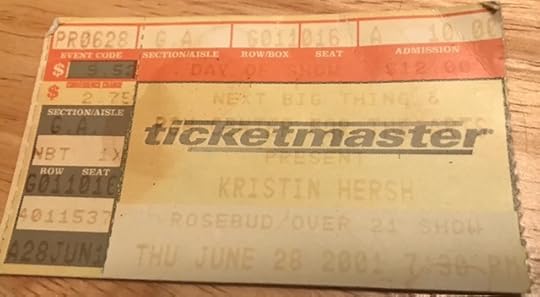
I recently bought a new refrigerator and when removing the magnets, ticket stubs, etc. from the old one, I found this very faded ticket (pic below) from when I saw her in 2001 at Rosebud in Pittsburgh. Something I'll never forget was a pair of loud drunken finance bros (before "finance bros" was the common term) were distracting everyone during this acoustic show. They clearly didn't know her music and must have somehow wound up at the venue as just a place to keep drinking. Fun times!
At the time I was reading it, I saw this Instagram Reel on automatically thinking of and singing parts of certain songs when somebody says something like "How bizarre" etc. This happened to me several times: "shimmers" on page 58 (I started hearing this song of hers), "echoey" on page 75 (this song of hers), and even "moon" on page 56 (well, this song of hers).
The main theme is art versus commercialism, and Hersh talks about "good" songs vs "bad" songs, and how the former must come from a certain pure, non-commercialized place--I just don't see how it's ever possible to assign these binary labels to something so subjective. When I was young, I was adamant that some bands/songs were good and others were not, but as I've gotten older, my mindset has shifted. Maybe this says it best, from the August 31, 2024 Why A.I. Isn’t Going to Make Art by Ted Chiang: "Art is notoriously hard to define, and so are the differences between good art and bad art."
Although I found the (short, at least) book at times tedious and solipsistic overall, it wasn't without its merits; for example, when she writes about what it's like playing guitar, describing a single note as "a purity; a line in a painting or a cell in a body, a foundational impulse upon which to grow something" and a chord as "disparate elements shaping each other and creating a new impact together." And I'm always a sucker for symmetry, like the "red lines" and "lines of red" bookending Rebecca Watson’s little scratch; in The Future of Songwriting, her comedian friend steadies a child on a fountain (page 79), and the book ends with her on the beach watching a "small surfboard kid" slipping and an older boy steadying him.
The part "without us trying to goddamn measure it. Like we try to goddamn do to everything" reminded me of "trying to find the perfect equation, truth as a numerical solution" in Cynthia Cruz’s Hotel Oblivion. (I excerpted that line in my review)
I recently bought a new refrigerator and when removing the magnets, ticket stubs, etc. from the old one, I found this very faded ticket (pic below) from when I saw her in 2001 at Rosebud in Pittsburgh. Something I'll never forget was a pair of loud drunken finance bros (before "finance bros" was the common term) were distracting everyone during this acoustic show. They clearly didn't know her music and must have somehow wound up at the venue as just a place to keep drinking. Fun times!

July 18, 2024
Yikes.
I don't smoke pot, but I imagine this is the type of tirade I'd be thinking of if I did.
I remember Kristin Hersh from her band, Throwing Muses, and one of their songs, 'Me and My Charms'. Which I loved. I hadn't followed her career before or past, but as a songwriter, I was excited to see this book. I love reading about songwriting, and creativity in general - so was super stoked.
Hersh has a...very particular writing style. Which is to get lost in her own monologue and press really hard on trying to answer a question while willfully ignoring culture, privilege, society - I don't know - somewhat everything. She is ardent that only a GOOD song can come from a non-commercial intent. From her lofty stance, she claims that there's a such things as 'good songs' and 'bad songs'. No song ever written for commercial intent could be good.
She does this in a premise of an after-show chat with a fellow comedian. Here they talk in circles, a strange masturbatory dance of commercialism versus art. There are a lot of grand gestures and nods to feminism, but it is truly just an exhausting read.
I definitely think that famous artists have every right to write their tomes on the creative process - but just because you can, doesn't mean it's good (wassup David Byrne and your boring-ass book).
Hersh pretends to reckon with lofty subjects, but just talks in circles. Also - her grand sweeping gesture that only GOOD SONGS are worth anything (hint - hers are...) put a real vile taste in my mouth. To me there is no distinction between a good song and a bad song - a commercial song versus one written born of pain and trauma. I love 'Silver Bells' alongside Cohen's Hallelujah. The best part of waking up is Folgers in my cup. Tom Waits should cover that.
Here she attempts to divide the art from the artist, soul from creation, and good from bad. None of it works. And worse, she does it by judging anyone who attempts a commercial pursuit with their art. It's exhausting, boring, terribly told, and solipsistic af.
But curiously - I then went to listen to some of her other songs.
...Right. Got it.
I don't smoke pot, but I imagine this is the type of tirade I'd be thinking of if I did.
I remember Kristin Hersh from her band, Throwing Muses, and one of their songs, 'Me and My Charms'. Which I loved. I hadn't followed her career before or past, but as a songwriter, I was excited to see this book. I love reading about songwriting, and creativity in general - so was super stoked.
Hersh has a...very particular writing style. Which is to get lost in her own monologue and press really hard on trying to answer a question while willfully ignoring culture, privilege, society - I don't know - somewhat everything. She is ardent that only a GOOD song can come from a non-commercial intent. From her lofty stance, she claims that there's a such things as 'good songs' and 'bad songs'. No song ever written for commercial intent could be good.
She does this in a premise of an after-show chat with a fellow comedian. Here they talk in circles, a strange masturbatory dance of commercialism versus art. There are a lot of grand gestures and nods to feminism, but it is truly just an exhausting read.
I definitely think that famous artists have every right to write their tomes on the creative process - but just because you can, doesn't mean it's good (wassup David Byrne and your boring-ass book).
Hersh pretends to reckon with lofty subjects, but just talks in circles. Also - her grand sweeping gesture that only GOOD SONGS are worth anything (hint - hers are...) put a real vile taste in my mouth. To me there is no distinction between a good song and a bad song - a commercial song versus one written born of pain and trauma. I love 'Silver Bells' alongside Cohen's Hallelujah. The best part of waking up is Folgers in my cup. Tom Waits should cover that.
Here she attempts to divide the art from the artist, soul from creation, and good from bad. None of it works. And worse, she does it by judging anyone who attempts a commercial pursuit with their art. It's exhausting, boring, terribly told, and solipsistic af.
But curiously - I then went to listen to some of her other songs.
...Right. Got it.
January 25, 2025
I wasn’t sure what this would be like, and it was perhaps less technical than I was expecting, though I don’t know why I was expecting that either! Really it was an exploration of art and culture and our place as artists and audiences and how we facilitate those things told through the lens of some very heartwarming conversations with a comedian friend. How do we manifest/communicate art, and does it really have anything to do with the artist? Some really nicely articulated thoughts that felt familiar to me (though a lot more considered) told quite casually in beautiful settings - like having a philosophical chat with your mate really but as a bite sized book.
July 14, 2025
I hadn't read anything by Kristin Hersh before this, but I have to say I'm absolutely taken with her writing style and view of the world. This book is the book I'd always wanted to read about music; telling the truth from the 'insiders' perspective, a musician with a raw energy and drive to create for the sake of creating. I really admire her determination for change, especially where it is desperately needed in the crumbling money-hungry beast of the music industry. I think everyone should read this book, even if they aren't keen on music. I'm already on to her biography now and next I'll read 'Don't Suck Don't Die' and I think you should too!
August 6, 2025
Small but mighty. A rumination on a perplexing topic that me and my partner discuss frequently as musicians. This pocket-sized discussion with a friend touching on something I don't see often in music-related publications. It's not a full answer, it's new favorite :)
January 25, 2026
This is a cautious 3. I’m not sure I took all I could from this book or if some of it’s a bit too spiritual for me to connect to. I really enjoy the running conversation through the book and the slight fantasy element the author writes with. Probably will read again

Read
August 5, 2024I didn’t get it.
August 7, 2025
I forgot I started this one but it was an interesting glimpse into an artists mind and the internal dialogue that comes with creating.

March 29, 2026
good but confusing
May 14, 2026
She puts into words things I’ve felt for years about “working” in the “music industry” 👏 If you hated this book we can’t be friends
Displaying 1 - 22 of 22 reviews