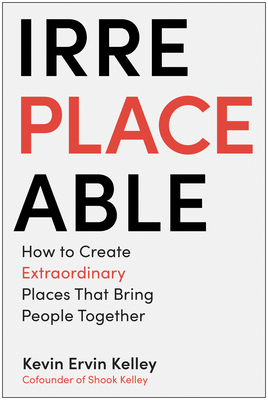
Do we still need physical places like grocery stores, restaurants, and office buildings? Or will the “Replacement Economy” led by the tech titans and retail giants wipe out these venues in their rapid ascent to unicorn status?
What about museums, universities, and performing arts venues? Considering the power of technology today, can’t we replace these relics with faster, cheaper, and more efficient online tools, apps, and AI?
Through engaging storytelling, human behavior insights, and proven design techniques, Kevin Kelley—an attention architect and cofounder of Shook Kelley, a strategic design firm that pioneered the field of “convening”—unfolds why physical places are essential to civil society, business, and community.
In these pages, he reveals what it takes for brick-and-mortar establishments to attract an audience and maintain a competitive edge in our increasingly digital world, whether you’re a:
• Retail leader or institutional manager trying to attract people to your offering while keeping the disruptors at bay • Student of design who values social facilitation over object-oriented design • Concerned citizen worried about the loss of community and civility
Irreplaceable offers a welcomed antidote to the anti-human digital future crushing our main streets and infiltrating every corner of our lives. It provides a comprehensive roadmap for creating human experiences that have the power to convene and bring friends, neighbors, and strangers together in prosocial environments in ways the digital replacements can’t replicate.
This book has absolutely nothing to do with my own former profession within the medical sciences and yet I found it fascinating. I did interact with marketing folks in my career, and I did work for a large corporation that prioritized the bottom line yet had certain departments where “place” was designed to foster creativity and innovation, so I wasn’t completely ignorant of the concepts here. Where it really resonated, though, was in helping me better understand the interplay between creatives and business peoples goals in attracting the public to places such as retail, bars/restaurants, grocery stores, green spaces, etc. The author tells great stories and gives many good examples from his career in retail architecture, which sounds yawn-inducing but wasn’t. I listened to the audiobook read brilliantly by the author. If I was more in this field I’d be better able to determine if it’s a 5 star book, but I’ll go with 4 stars since I’m no expert.
Fantastic storyteller. This is mostly about crafting memorable retail experiences, but holds plenty of lessons for placemakers even if you don't specialize in retail - the practical techniques shared here apply to built environments of all kinds!
I was hooked on this book just reading Kevin Ervin Kelley’s introduction, “Ernie the Tow Truck Driver Meets Kevin the Watcher.” I couldn’t put it down and it’s already a finalist for my 2024 Book-of-the-Year.
This book is absolutely fascinating. Think of the book title as “IrrePLACEable”—and you’ll get this strategic design architect’s big idea: “Something so special it can’t be replaced if lost or destroyed.” I know 20 colleagues who would love this book.
Kelley is an award-winning architect and experience designer. “I’ve spent my life trying to bring people together through the timeless interactions and primal qualities of place.” He adds, “…my job is to make the everyplace places of our lives extraordinary.”
How does he do this? “I’m the guy who pulls up a lawn chair in a parking lot to watch people walk in and out of a steak buffet chain, and I’m the guy who studies consumers buying Fig Newtons in the cookie and cracker aisle of a grocery store. It’s an odd job.”
“Standing around for weeks on end watching people look at Harleys may not be for everyone, and it created an awkward moment when I first met my wife and told her how I spend my days in disguise as a customer. But it’s what I do.” He adds, “But I’m not just a watcher. I’m also a fixer, adjuster, tinkerer, rethinker, and experience designer.”
Consulting with Harley-Davidson, Kelley interviewed people (mostly men) at 30 Harley dealership across the U.S. After seeing Ernie a second time and at a different Harley store, he listened to his story. “Ernie’s desire to ‘hang out’ in the store told me a lot about his needs and wants and how we ought to be rethinking the purpose of the dealership, less as stores and more as clubhouses for wandering souls.” (Ernie already owned two Harleys!)
Kelley and Ernie joked about Harley bikers: “The purchase they sought to acquire was ‘the end of loneliness for midlife-crisis-males-fading-in-strength.’” And speaking of joking, the author’s unusual approach when his team is stuck on solving a client’s problem is to “find the funny.”
He explains “find the funny” in Chapter 9, “Articulate”—one of five parts to his design firm’s “comprehensive system we’ve developed that has allowed our clients to retain or regain their edge over outside influences for the last three decades.” The five parts: Extract, Distill, Articulate, Crystallize, and Maximize.” (The “crystallize” steps—I hope—will be covered in his next book.)
Timely! I’m guessing the author has already sent his book to the new CEO of Macy’s. Read the March 1, 2024, article in The Wall Street Journal: “Macy’s Stores Aren’t Fun Places to Shop. Its New CEO Wants to Fix That. Tony Spring is drawing on his hospitality training to turn around the department-store chain.”
LOL! You’ll laugh when you read that as a kid, Kelley rearranged the furniture, lighting, and music volume in his parent’s home! When he got bored, he took on his classroom and friends’ bedrooms!
He believes that “great things happen at the intersection of commerce and community.” Kelley writes that “…we set out to create a multidisciplinary field called convening, which we define as the art and science of bringing people together around an idea, forum, and experience.”
He cofounded the strategy and design firm, Shook Kelley, in 1992 with his friend and lifelong mentor, Terry Shook. I thought this was insightful: “Terry was good with acres and me inches.” (Where are you on that continuum?) Their firm “helps people connect the dots between strategy and design.”
Who should read this book? All of my camp and conference center friends, pastors and church leaders, university presidents, rescue mission leaders, board members, and then this list of others—as suggested by the author:
“This book is for those who own, manage, design, or inhabit a physical place or human experience as part of their business model or operation. These places include anywhere people convene in the public realm, whether a local grocery store or pub, a religious facility or an office building, a bowling alley or university, or an urban district or zoo. This book is also for parents, teachers, and students wanting to know more about how the environment of a place affects human behavior, social interactions, and our mental health and well-being.”
The book oozes with practical insights (relevant to your space), but let me pause here to apologize to my wife who endured my reading meaty paragraphs to her from almost every chapter! Here’s a taste:
• VISUAL HARMONY vs. VISUAL NOISE. “Ideally we want customers to walk into our venues feeling one way and come out a changed person with more energy and inspiration.” (Is that not the aspiration of every pastor and priest?) • THE 7 LAYERS OF SIGNAGE SYSTEM: Orientation, Evocative, Address, Values, Process, Promotional, Whisper/Nudge. (You’ll see stores and restaurants with new eyes!) About those giant grocery store letters that spell PRODUCE—“First of all, when’s the last time you heard mom and dad telling their kids to ‘Eat your produce!’” • THE THEATER OF SPACE. Must-read: the author’s five guiding principles for “the art and science of scene-making.” Using retail as his example, the first principle is “A Good Retail Scene Has a Beginning, Middle, and End.” Principle 2: “A Good Retail Scene Has a Mini-climax Inside of It.”
THERE’S MORE: • The 10 preliminary questions the design firm asks to get their “observation pumps primed.” • Why only 3 out of 10 clients can do “groundbreaking, breathtaking, and game-changing innovation work.” The other seven? They’ll “do better than where they started but won’t reach the level of excellence they initially desired.” He explains. • Don’t skip the 3x5 card facilitation process, the 3 dials (rate yourself on a scale of 1 to 10), The Place Brand Constitution, and the “6 Tips of the Brand Spears.” • Plus: why you need a Brand Stewardship Committee, and how to inspire team members to become “black belt evangelists” and “shepherds of the brand.” • Creative idea: In what they jokingly called their “civil disobedience workshops,” the firm launched an urban renewal project with “the technique of communicating our big strategic idea in the tight confines of a movie poster.” (Brilliant—worth the price of the book!)
The winners and the losers (Blockbuster and others) are noted in this book including the innovative L.A. shopping center, The Grove (he takes his clients there to observe), Trader Joe’s, and Texas Roadhouse. “Irreplaceable” reminded me of two books: “Growing Weeders Into Leaders” and “The Power of Moments.”
MORE BRILLIANCE! “If you suddenly got hired by your fiercest competitor and were now sitting at their strategy table, how would you recommend they beat your old employer?”
“TOO ENTHUSIASTICALLY." I was intrigued with Kelley’s design observations and recommendations (a list of 21) following his travel to the city of Makati—the financial center of the Philippines. (I’ve been there.) No one except Kelley noted “…this small but curious anomaly: groups of maintenance crews applying a notable amount of hazard-yellow paint all over the place…” He adds, “While they intended to alert the public to potential hazards, they did their jobs too enthusiastically.”
Trust me. You can’t be too enthusiastic about this one-of-a-kind book. It’s a must-read in your lawn chair or your Harley! (And thanks to the publisher for sending me a review copy.)
Every place we go and surround ourselves in, whether it is grocery stores to inspire the next meal we cook, to business districts full of walkable, inviting shops and cafes that can allow us to feel as though we've escaped into a new environment, to museums where we go to expand our understanding, all conspire to spark a certain joy in us.
Kevin is a brilliant and experienced architect, teacher, father, business leader, and now writer who does an extraordinary job in documenting in his book "Irreplaceable", in short form, a framework on "How to Build Your Own Bonfire." With that, it is a moving depiction on how he's elevated brands, mom & pop retail shops, and cities to extract, distill, articulate, and maximize their potential. This book is not just for the creatives, architects, or merchants out in the world, it is for ALL. Kevin shares in a captivating storytelling manner why retail must continue to evolve and spark joy by prioritizing gathering people together.
From a student who studied at UNC Charlotte and seeing the rise of the South End into an inviting, eclectic, and walkable business district with the Light Rail as the beacon of ease of transit, it would not be what it is today without the creativity, determination, and foresight Kevin had. He shares what it took to revitalize a forgotten neighborhood into a bustling economic engine of Charlotte.
Kevin's "Irreplaceable" is a testament that the places we construct must keep many points of view top of mind to therefore inspire guests to forget about the worries of life and offer up a sense of belonging.
Kevin truly cares about "who is going to save everyday places for people to celebrate life on various incomes, for them to make friends, find an end to loneliness, to develop the innate senses of the world, and continue the age-old tradition of interacting with people face-to-face and socializing with friends, neighbors, and other cultures in the irreplaceable theatre of life." I will certainly pick up and read or listen to his book, "Irreplaceable," again.
Kevin Ervin Kelley is an architect by trade, but he focuses less on structure and more about crafting the perception of place by applying his unmatched understanding of the subconscious and behavior. Physical places have been challenged by digital replacements, and without the right strategy, many will disappear. Dedicated to keeping the places so critical to our communities alive, Kelley shares a master playbook on how to create a physical offering that people will crawl through the mud for.
For any business owner or placemaker in battle right now, the actionability of Kelley’s insights are what separates this book. Instead of just being a collection of solutions, Kelley addresses what is often the hardest part head on: identifying the problem. By asking the right questions and implementing clever tactics only known by someone with such unique experience at the intersection of brand, experience, and place, Kelley makes it easier to act with swiftness and conviction.
If you are at all interested in the human-environment dynamic, this is a must read. As a college student, I learned more about marketing and psychology here than ever possible from a course textbook. It fundamentally changed the way I look at the world.
It was absolutely phenomenal. I couldn’t go more than 10 pages without ear marking a concept or a reference I wanted to dig into further. I enjoyed every personal anecdote used to frame up each topic; they doubly served to emphasize the over arching point that the world is a story and how you tell it shapes everything. It completely solidified my decision to move my career in the direction of place creation. While I thought my retail background rooted in business might be a disadvantage, I am reenergized with the notion that it might give me the perfect edge I need to be a bridge between the Creators and the Capitalists. Thank you for writing this book and for sharing your expertise - this book has truly been Irreplaceable!
Overall there are some interesting nuggets in this book, ideas for place making and place keeping. The second half of the book made me feel like this is work and organization can’t do on their own. In order to be successful at creating extraordinary places that bring people together - you need to hire a team of designers, architects, and brand managers to help you achieve success. This felt disheartening to read about in a book that’s title promises a “how to” on place making.
Where was this book when I was in design school?!?! Retail architecture was definitely a taboo subject, but it applies in the real world of dollars and cents.
The author interweaves personal experiences as he and his team navigate the sometime anonymous or dysfunctional landscape of the retail world and brings meaning and significances to it.
This book is a great resource for people in and outside of the design world.
Very interesting book with original ideas and fresh perspective on how to get humans out from behind their computers and into shared spaces. Particularly timely, and needed post covid 19, where it often feels like humans forgot how to talk to one another in public settings.
ideal for anyone interested in design, building shared experiences albeit commercial or housing.
Great book highlighting the life experience of an architect who specializes in creating community-oriented spaces on the behalf of retail establishments. While I wished he got more into the details of how to apply his expertise at the individual level, I found the book very inspiring and insightful. There’s plenty of material in there for me to go back and consider more in-depth.
Overall interesting and well written, but very retail-focused. The design principles adapt to public and offixe spaces as well, but most examples and ideas are centered around retail stores in the US.
this book have several good point about architecture. the minus part is I often found it lost direction (or maybe I am just not interested in business lol)
I really enjoyed the audiobook, read by the author. I find this conversation so interesting, our human need for physical gatherings. Insightful and engaging.
This book is about the inherent power in well-imagined, thoughtfully created spaces and I think "the bonfire effect" [something I got to talk to Kevin about personally] is an extremely valid and essential part of building spaces that foster true community.
We need good, safe gathering places. We need more places where we can meet and learn from each other. We certainly need more books about how to intentionally create those sorts of spaces.
I do wish this book dove deeper into the discussion of how to shape physical spaces in a post-Covid world, how to reimagine and reuse vacant office buildings (especially offices that have quickly proven to be non-essential spaces as remote workforces continue to grow), what sort of spaces we don't need (and what they can be replaced with), and especially: how to make spaces more inclusive for more diverse and historically excluded groups of people. Maybe an updated edition down the line?
Kelley's written a super book on creating extraordinary experiences in retail stores and public spaces. Very pragmatic, with good stories, and real-world experience, IRREPLACEABLE is a keeper.
This was a terrific read. The writing is approachable and fun, without getting hokey, and I feel more connected to the idea of "making everyday places extraordinary."