After fourteen years in prison, Gerald “Stew Pot” Reeves, age thirty-one, returns home to live with his mom in Parkland, a black middle-class neighborhood on Chicago’s South Side. A frightening delinquent before being sent away (his infamies included butchering a neighbor’s cat, torching another neighbor’s garage, and terrorizing the locals with a scary pit bull named Hitler), his return sends Parkland residents into a religiously infused tailspin, which only increases when Stew Pot announces that he experienced a religious awakening in prison. Most neighbors are skeptical of this claim, with one notable exception: Mrs. Motley, a widowed retiree and the Reeves’s next-door neighbor who loans Stew Pot a Bible, which is seen by Stew Pot and many in the community as a friendly gesture.
With uncompromising fervor (and with a new pit bull named John the Baptist), Stew Pot appoints himself the moral judge of Parkland. He discovers that a woman on his block is a lesbian and outs her to the neighborhood, the first battle in an escalating war of wills with immediate neighbors: after a mild threat from the block club president, Stew Pot reveals a secret that leaves the president’s marriage in ruin; after catching a woman from across the street snooping around his backyard, Stew Pot commits an act of intimidation that leads directly to her death.
Stew Pot’s prison mentor, an African American albino named Brother Crown, is released from prison not long after and moves in with Stew Pot and his mom. His plan is to go on a revival tour, with Stew Pot as his assistant. One night, as Stew Pot, Mrs. Reeves, and Brother Crown are witnessing around the neighborhood, a teenager from the block attempts to burn down the Reeves home. He botches the job and instead sets fire to Mrs. Motley’s house. She is just barely rescued, but her house is a total loss and she moves in with a nearby family. Neighbors are sure Stew Pot is behind the fire. The retaliations against Stew Pot continue, sending him over an emotional ledge as his life spirals out of control with grave consequences. Through the unforgettable characters of Stew Pot and Mrs. Motley, the novel provides a reflection on God, the living and the dead, and the possibilities of finding love without reservation.
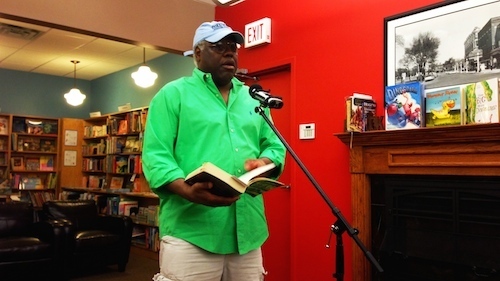
ERIC CHARLES MAY is an associate professor in the Fiction Writing at Columbia College Chicago. A Chicago native and former reporter for the Washington Post, his fiction has appeared in the magazines Fish Stories, F, and Criminal Class. In addition to his Post reporting, his nonfiction has appeared in Sport Literate, the Chicago Tribune, and the personal essay anthology Briefly Knocked Unconscious by a Low-Flying Duck. Bedrock Faith is his first novel.
Bedrock Faith was the group read for February's #ReadSoulLit Readalong. I had never heard of Eric Charles May before, but I am very glad that I picked this one up. Although there are many individual stories to follow, May made it easy to keep up with all of the different characters that are introduced in this very insular community. The Parkland neighborhood felt very recognizable and familiar. Parkland is a sometimes overly close knit community of African American families and individuals that are all trying to live their version of the American dream. However, everyone seems to feel that keeping a close eye on their neighbors private affairs is necessary in order to prevent any disruptions to their little haven and to uphold their community standards.
I found it interesting how May chose to use Stew Pot and his new found religious fervor as a mirror for his former neighbors. Stew Pot was the neighborhood bully/thief/arsenist, who returns from prison with his own special brand of redemption, offers of salvation to his uninformed neighbors, and his unwanted policing of the community. May brought together a unique cast of characters that are familiar, entertaining, yet thought provoking. The personalities of this cast are what you could find in any close community in any part of the country. May made me think about just how quickly any of us can be to pass judgement on people with the thinnest amount of information. He also shines a light on the amount of hypocrisy and self righteousness many carry as shields against their own insecurities.
Although Bedrock Faith is a little over four hundred pages, it was an easy and pretty quick read. Bedrock Faith reads like an entertaining made for television mini series. If you enjoy stories of communities and how people interact with each other, this would be a good book to pick up. The cover is a perfect reflection of what you will get inside.
This rating should be closer to 4,5 stars. Check out the live discussion I did with Musical Tati and Michael Reads on Google Hangout. https://www.youtube.com/watch?v=pvDCi...
Chitchat. Chinwag. Dish the dirt. Call it what you will, it all boils down to one thing: Gossip. We all do it. Who can resist hearing a juicy tale about friends, enemies or better yet, frienemies? Gossip is an ineradicable part of life and in Eric Charles May’s first novel, Bedrock Faith, it is the way of life among the inhabitants of Parkland, a staid African-American neighborhood on the South Side of Chicago. Gossip is an insidious, palpable presence in this surprising, evocative and very funny novel. It wends its way into the ears of everyone in the neighborhood, making the second commandment, “Love thy neighbor as yourself”, impossible.
The story begins with the return of Stew Pot Reeves, the neighborhood miscreant, who has just come home to his mother’s house after a prison stay that was not nearly long enough to suit anyone in Parkland. His name alone draws up images of a wicked brew bubbling while stirred on the fires of hell. As a youth, Stew Pot committed crimes of such devilish offense and with such cunning and creativity that he is something of a local legend. After years of terrorizing Parkland, Stew Pot had finally been nabbed for a crime in a white neighborhood, and had been sentenced to 30 years in prison. His release after serving less than half that time has residents in an uproar and sends the neighborhood gossip machine, always in motion, into hyperdrive.
But the Stew Pot that comes back to Parkland has a new weapon of destruction in his arsenal: Religion. He’s found the Lord big time and is keen to “help” everyone he encounters to “walk in the light.” Stew Pot’s style of evangelism is like none you’ve ever seen before and in its wake all hilarity breaks loose. And this is the trick of May’s novel. The farcical antics that had you laughing pages earlier lead to tragic events that have you shaking your head in disbelief.
Like Mikhail Bulgakov’s The Master and Margarita, May’s novel is a devil-comes-to-town story. Just as Woland, the devil in Bulgakov’s novel, turns Stalinist-era Moscow upside down, Stew Pot wreaks havoc on everyone around him after arriving suddenly from a place all too similar to hell. But by the novel’s end one does not know if Stew Pot is to be pitied or even more reviled. Is he a miserable victim of abuse or a cunning master of deception? May leaves the final impressions of his antagonist up to interpretation in a way that seems to ask the reader, “Well, what would you rather believe?”
At the heart of this fable-like novel is the prim and stately Mrs. Motley, whose family has lived in Parkland for generations. As the first to witness Stew Pot’s return, she immediately does what she sees as her neighborly duty and puts her phone to work, setting the grapevine alight. The news is reported multiple times to imaginative listeners who are ever eager to embellish a tale. Peeking from behind the curtain in her kitchen, Mrs. Motley sees Stew Pot throwing photo albums, records, and women’s clothing into the trash cans behind his house. By the time the retelling of this reaches the rest of Parkland, it has morphed into a story about Stew Pot beating up his mother and running off with her money. Mrs. Motley is repeatedly pulled into Stew Pot’s “messy world” and finds herself the focus of unforgiving neighborhood gossip.
Some things, though, are not be discussed. May’s novel deftly addresses homosexuality and intolerance within an African-American community. Apparently, one had better keep up a facade of conformity if one wants to remain a resident of Parkland.
A chapter entitled “A Baker’s Dozen” towards the novel’s end consists only of 13 rumors about a devastating event. It is difficult to know which of these tidbits to believe. And this where the power of gossip lies, particularly when the information is obtained “on good authority”, as it so often claims to be in Parkland. Perhaps the “faith” of the title is not only the religious variety, but the kind that we put in gossip that is all too often taken as the gospel truth.
I have read to my wife at bedtime for over a decade, and we chose this book the instant it arrived in the mail because Eric Charles May was my MFA thesis advisor, because we had heard and come to love Stew Pot stories heard over the years, and because Eric is wonderful storyteller. Obviously we're a little biased in his favor.
The book, however, exceeded all expectation. May describes Parkland so well, I feel I could find my way around without a map. The characters are so well rounded and believable that we felt outraged with some and rooted for others as if they were long-standing members of our own social circles, and their voices are deftly rendered.
The book opens with Mrs. Motley, who, in many ways, serves as the most balanced character throughout the book. No sooner have we met her than Stew Pot is knocking on her door -- this hoodlum has newly returned from fourteen years behind bars to live in his mother's house next door -- and now he requests to borrow a bible, begging her forgiveness, and explaining that he is a changed man, a disciple of the mysterious Brother Crown who now "walks in The Light." Soon Stew Pot changes from trying make amends to self-appointed judge of every person living on the block, going to questionable lengths to shed light on everyone's secrets. The neighbors turn on him trying to get him sent back to jail, to shame him -- anything to shut him up, but nothing seems to thwart him.
Suspense takes hold, building and accelerating over the course of the book, so that by the time we'd reached the halfway mark, I ended up reading later and later into the wee hours of the morning, anxious for each of the characters we'd come love.
I highly recommend this book. For sake of comparison, if you've read and enjoyed John Kennedy Toole's Confederacy of Dunces, with characters in their set spheres colliding to shape a hilarious movement, you'll find this a pleasurable and more tightly knit read. Well done! One of my top five books!
I read this as part of One Book, One Chicago and I have to say it’s probably the best pick they’ve made in the last decade or so I’ve been participating. That being said, it ran a little long, the characters lacked depth and the ending felt rushed without any real conclusions. 3.75 stars
Bedrock Faith, written by Eric Charles May and published by Akashic Books, is a third-person novel written primarily from the point-of-view of Mrs. Motley, an elderly black woman living in a predominantly African-American, middle-class neighborhood of Chicago. More than ten years prior, Mrs. Motley’s neighborhood, Parkland, was terrorized by a young miscreant named Gerald “Stew Pot” Reeves, until he was arrested for allegedly raping a white woman on the north side. But Stew Pot leaves jail a changed man—the first thing on his agenda is going to Mrs. Motley to apologize for the terror he caused her and to ask, with genuine sincerity, to borrow her bible. But just when it seems like this thug finally wised up and turned a new leaf over, he starts using the bible to condemn the sinners of the neighborhood as a zealot for Christ, forcing one after another out in an effort to purge Parkland of the devil. Using their secrets against them, the block’s denizens dwindle little-by-little and Mrs. Motley is forced to admit that maybe Stew Pot hasn’t changed at all.
Eric May and I go back some ways—I never took his class, but I had every intention to. At Columbia College Chicago, I was a regular character among the students actively committed to making a presence. Eric, himself, was just as present, though he had a much better reason for being there than I did. He was already a writer with a lot of accolades and found just as much meaning in writing as he did in teaching writing. He remembered my name and made casual conversation in the hallway, greeted me whenever we ran into each other, and took time out of each day for a lot of us, like we actually were his students. To this day, people like me who never even took his class remember with a fondness reserved for past friends or mentors. However, thinking about my own mark on that school, I remember all that I hoped to accomplish for legends like Eric, like getting published in the school lit magazine or getting published at all (something I actually like, I mean), but people generally remember me because I wrote some asshole sex stories and framed them in a comedic light. Truth was, I wasn’t really writing for myself back then—just for a quick laugh, and certainly putting no effort into my short stories while I worked on one novel or another in an effort to discover my, “voice.” Always the long form for me, though to this day, I regret never just pushing one good short story to its fullest capability. However, I succeeded well at the business end of writing and started working with a literary magazine publisher before I even graduated, which has given me a bigger name in the Chicago literary scene than I could have earned through the skill of my work alone—though I hope skill had something to do with it. As a result, Eric and I ran into each other regularly—either at a lit event I helped throw or a reading that either one of us might be reading at. The business end of it used to be easier, because I wanted to rub elbows with all the authors that I looked up to. Eric just so happened to be one of those authors.
(Damn, we look good.)
Community. That’s the best way to describe our literary scene and that’s the best way to describe this novel too. May has so many characters that, at first glance, it’s difficult to keep track of them, but he quickly establishes a unique tone for each character in the way they speak or look or how they behave, setting them apart from the other characters by leaps and bounds instead of just letting the mere minutiae differentiate them. But this isn’t a novel about solitary characters—this is, in fact, a novel about community. Each character has thoughts or feelings about every other character in this story, often with story-in-story to explain how those characters grew to become friends or enemies. So long as they interact with someone, even if they never interact with each other, everyone has an opinion on everyone else. It’s this element that makes the story so goddamn real, because it creates a web of interpersonal relationships that you want to follow, since each new event affects each relationship differently. As a result, you can’t help but grow to love Parkland’s citizens (except maybe Stew Pot) and care about what will happen to them as chaos ensues, because you know them better than you know the people in your own goddamn neighbors. I did, anyway.
I was supposed to take a class with Eric May actually, well after I graduated. Columbia College Chicago used to offer story workshop (the method they taught, invented by John Schultz) sessions to alumni and I went out of my way to sign up for Eric May’s workshop session. Only I missed it. Why? I had a date with Heather, a Suicide Girl—those counter-culture, tattooed models who drop trou on the web. I didn’t really care for this girl’s personality much, but she wrote—not all that great, but it’s better than nothing sometimes. Either way, she dragged me off to some Suicide Girl midwest meet-up and it happened to fall on the day of my workshop with Eric. Being one for chaos, I took to the road with this girl instead of following something I actually felt passionate about—I liked her though, because she made me feel like I wrote better than I fucked and I thought I fucked pretty well, but I didn’t like her enough to regret missing that workshop. In fact, we had a terrible time, and if it weren’t for the sex, I would’ve thought it a huge fucking waste. The sex was all right, at least. Though my time with Heather did make for a hell of a story and provided me with sufficient chaos for a while, I yearned for the opportunity to learn about what made a good author’s work stand out. Luckily, Eric and I found plenty of time to fraternize since I worked a press that published one of the first excerpts of this novel, Criminal Class Review. We even had him read at our show: Naked Girls Reading, an event where burlesque dancers stripped into the bare and read stories from our newest publication. Eric May, like the other authors we invited, stayed clothed though.
(I’ve been naked on stage once. That’s a different story though.)
Chaos is what moves this novel forward too. You have to keep in mind—even if everyone in Parkland has a negative perspective on every other person, at least they put up with each other—that is, until Stew Pot comes back. Stew Pot is just that—a mix of elements that stirs trouble up. He doesn’t literally force anyone to leave Parkland—he shows the secrets of his victims to his neighbors, embedding their remaining time there with a deep, overwhelming shame. The premise of this novel is that Stew Pot isn’t actually doing anything illegal—at least nothing that the police can prove, but he is making trouble in a big way, thus acting as an almost invulnerable catalyst of chaos for an otherwise quiet neighborhood. It’s this chaos, that sees no resolution until the end of the novel, that stirs up conflict and continues because May knew what strings he could realistically pull, showing us how not all trouble is the trouble that we expect. With each new chapter, he pushes the limit of Parkland and the worry of his readers further by giving Stew Pot some new crusade and not a damn person can stand in his way, without submitting to the illegal activities themselves that drove Stew Pot to jail in the first place. It’s the Story Workshop chapter on opposites, but everyone is Stew Pot’s opposite—only as the story progresses further, the people of Parkland just start to look uglier and uglier until they’re one in the goddamn same.
I still see Eric Charles May out and about. He recently did an event with the Chicago Center for Literature and Photography, and though it’s not necessarily official, I do have some ties with that organization. He’s also a regular at Reading Under the Influence and has read there a number of times and shown his support. In fact, that’s where I bought his book and where he autographed it for me. “To Ben, Happy reading, and many thanks for carrying on the RUI tradition.” It’s just one small role we all play as we evolve throughout our lives, our communities, and our careers. It didn’t take Eric May to show me that, but seeing him and talking about his novel at the CCLaP event recently really did show me how much things have changed over the years and how, in so many ways, things haven’t changed at all.
(Sheffield’s, on School and Sheffield in Chicago’s Lakeview neighborhood.)
It’s change that makes this novel fantastic—because as it progresses, we not only get to see how people changed as a result of Stew Pot appearing in their lives again, but how they changed as a result of confronting their own secrets they dreaded to share for the first time. Illustrating character evolution can be so contrived, but it’s fluid for May—since he understood who his characters were from the onset and where they were headed by the end. Mrs. Motley’s evolution is, no doubt, the most poignant as she confronts her own mortality and makes distinct effort to admit the truths she neglected to attend to for her whole life. While some characters in the book presume that Stew Pot hasn’t changed, there’s no doubt in the reader’s mind that he changed before the narrative even began—and that his changes to come will be paramount to the novel.
Knowing your characters is one thing, but knowing your setting is another. In addition to having the neighborhood mapped out in words, May doesn’t submit to the audience’s expectation of what a cultural author is supposed to write. The characters speak colloquially, but without an accent or dialect that’s become synonymous with culturally exploitative writing. He lets every audience in and makes this novel a home to themselves, because he writes it truly as he perceives it and not to string the audience along on some exploration into a different world. These are our people and though May claims that this book is meant to capture the African-American middle-class culture, it suitably captures the American culture.
(The Q&A portion of this was awesome, by the way. Check out the podcast.)
There’s nothing I can find in fault about this novel. It ended quickly and in some ways, I don’t feel like everyone’s story was necessarily tied up, but the pivotal characters reached the end of theirs. One could argue that we should see how everyone turns out in the final chapters, but I’ll be blunt—I look forward to May’s next novel, to see if any of them come around again. I already miss them.
This is Eric Charles May debut book, but WOW WEE, WOW WEE, WOW WEE, what and excellent first read by May!!!!1 I Would love to see this book turned into a play or even movie if it followed the book to the letter. The characters were so engaging, raw yet very memorable. From Gerald "Stew Pot" Reeves to Brother Crown.
YES, I RECOMMEND IT but how I wish I could give it five extra stars.
So if you have ever read the works of Tina McElroy Ansa and J. California Cooper, then you will love Eric Charles May.
This book is absolutely delightful and worthy of its many awards. It brings to life an authentic and amusing black, middle-class neighborhood full of gossip and characters engaged in what seems like an eternal game of telephone. May's deft descriptions are on the nose and often hysterical. When the equilibrium of this well-established area is thrown by the return from prison of Stew-Pot, a bad boy on steroids who everyone has a reason to fear, the antics and reactions whip the the neighborhood into a frenzy--even shaking the venerable Mrs. Mosley out of her set-in ways. Be prepared to smile, laugh, shake your head and tisk with the lot of them. A simply great read.
Another book club selection that I probably never would have picked up, but was really glad I did. The story starts out with so many characters that it's hard to keep track, but Stew Pot is so intriguing that I kept reading. Each of the neighbors steps forward into the story (usually when they decide to do something about Stew Pot) and gets some definition. It was a charming and at times uncomfortable trip to a fictional neighborhood in Chicago and it was an easy book to keep reading.
In 1993, after 14 years in prison, Gerald “Stew Pot” Reeves returns to his hometown of Parkland. A fictional neighborhood in the city of Chicago, Parkland is a black, middle-class neighborhood on the South Side. In his teens, Stew Pot reeked havoc on the neighborhood, lighting fires, killing cats, and in general, terrorizing the neighbors. He was eventually imprisoned after being caught stealing from a White home on the North Side. Upon his return, Stew Pot claims to have found God while in prison. His neighbors are skeptical, given his tumultuous past.
Told through 11 books with a different neighbor and their relationship with Stew Pot as the focus, the reader sees the trouble Stew Pot’s newfound faith causes for the residents of Parkland. In the beginning on the novel, in Book One, you don’t how to feel about Stew Pot. We are in Mrs. Motley’s viewpoint and she is very skeptical of him when he gets out of prison. She's a Christian woman who believes in forgiveness but has a healthy dose of skepticism about if he's truly changed. She is the only one who is nice to him though, giving him her bible. We then move on to a few other perspectives of other neighbors, and see more of those who are skeptical or even as far as vehemently opposed to Stew Pot and want him back in prison. Stew Pot went from a boy who was causing trouble and destruction, to a man who has “changed” but is still causing trouble in new ways, all in the name of God. He claims to be bringing people to The Light, but his actions (i.e. outing a neighbors sexuality, accusing another of adultery, publishing a manifesto of neighbors “sins”, disrupting a neighbor’s funeral etc.) have dire consequences.
Further on in the book, Stew Pot’s mentor, Brother Crown, joins him and his mother in “preaching” to the neighborhood. Stew Pot and co continue to irritate the neighbors, to the point that one neighborhood teen decides to exact revenge and force them out of the neighborhood. Instead, he accidentally lights someone else’s house on fire. The residents of Parkland are sure that Stew Pot is behind it, and begin to harass and retaliate against him instead. It makes the reader start to wonder if Stew Pot is the antagonist of the story after all. Where is the morality; where does the line get drawn that actions against him are justified? His life starts to spiral out of control, his mother and mentor leave him to go on a revival tour, he stalks and kills Katie O’Brien, the woman who he had robbed in his teens. He then writes letters to Mrs. Motley that make it look like he has dissociative identity disorder, which was the cause of all the destruction he did. Before getting arrested, he planted poison in his house, killing his mother and mentor (whom she married on the tour). Soon after, he kills himself in prison.
The story ends with Mrs. Motley contemplating life, whether the actions of her and her neighbors contributed to Stew Pot’s demise. What it means to be a Christian, and what it means to be loved and to love someone else in return. Had Stew Pot experienced true love and care in his life, would he have done the things he did? While she had led a happy life, was she ever truly loved? This story is a beautiful reflection on religion, companionship, and how our actions affect those around us.
Review:
I read this for a work book club and was pleasantly surprised with how much I enjoyed it. Set in Chicago, I kept finding myself trying to figure out the locations described, as I am a recent Chicago transplant myself, and live on the South Side.
I found myself intrigued and not wanting to put my Kindle down as we dove deeper into this neighborhood and the conflicts that were arising. This was a fantastic novel of the literary fiction variety. I would recommend to anyone who enjoys this genre!
There is so much to say about the writing in this novel. The book is separated into 11 separate books (sections). While the novel is written in third person, each section is focused on one of the neighbors and their relationship with Stew Pot. I loved this format of doing multiple POV. It was well done so that we could see how everyone’s stories were intertwined with each other, but mostly how they linked with Stew Pot. This was a great way for the book to be both character and plot driven.
The writing is also extremely visually descriptive, and makes the story engaging and very easy to picture. Things are described in heavy detail. Every character, the neighborhood and setting, everything has very intricate illustration. Some of the best writing I have read in a while!
I found the characters to be enjoyable as well, although it did take me a bit to keep them all straight as they’re all referred to as Mrs. This or Mr. That. While Stew Pot is the main adversary, May did a great job in writing some morally grey characters (except for our beloved Mrs. Motley). All of the neighbors have some skeletons in their closet, or ways in which they also are at fault. It made for an interesting us vs them theme when both parties aren’t necessarily “good”. Throughout the book we are made to feel that Stew Pot is “wild” and “crazy”, but as the novel progresses and we see more stories pulled out, it makes you think a lot about if he is truly the “bad guy”. I wouldn’t call him good, by any means, but we see some of the actions and hypocrisy of his neighbors towards him as well, which are questionable at best, and cruel at worst. It leaves it more up to the reader to determine who they think is the antagonist here. Can cruelty and horrible acts against Stew Pot be justified in the name of sending him back to prison or running him out of the neighborhood? Does Stew Pot deserve this treatment as payback for his behavior towards his neighbors? It leaves the reader feeling very ambiguous with this situation. Everything is in shades of grey. Through Mrs. Motley’s reflections, we wonder how much of the actions done by both parties escalated things and led to the destruction of relationships and deaths of multiple people.
The book also touched on religion and Christianity, with Stew Pot being an extreme form of faithful in his new devotion. Seeing how he behaves in his beliefs versus someone like Mrs. Motley, who is also a devout Christian but behaves quite differently than Stew Pot, it provides a realistic picture of how many treat and demonstrate their religion even today. We also see people like Mr. McTeer who is Catholic and very rigid and uncompromising in his beliefs, while also being hypocritical in his actions to what a “good” Catholic should do. While I wouldn’t call this a “Christian novel”, I do think there is a bit of commentary on the Christian religion in this book, and it can provide for great discussion and reflection on what it really means to be Christian (or even just a good person).
Borrow/Buy: Borrow Would I reread: Likely! Would I recommend: To those who like this genre, yes! I know it’s not everyone’s cup of tea, but I greatly enjoyed it!
This entire review has been hidden because of spoilers.
Stew Pot is back on the block in his hometown of Parkland, a middle-class suburb on the South Side of Chicago known as Parkland. He was sent away to prison for fourteen years, but after an early release he is back in town wreaking havoc on his neighbors. When he left as a seventeen year old boy, he was an evil and vindictive set on tormenting his neighbors. Now he returns as a thirty-one year old bible toting, scripture quoting follower of Brother Crown, a religious leader he discovered in prison who "led him to the light." Within nine months of Stew Pot's arrival, the residents of Parkland are confronted scandals, violence, secrets and murder.
Although I found this book to be a page turner, I thought the characters could have been better developed. most of the characters are septuagenarians either working part-time or retired with nothing to do but look forward to the monthly Block Club Meeting. Mrs. Motley, the story's main protagonist, lives a lonely life snooping, gossiping and missing her late husband. Mr. McTeer is a bitter old man who believes everyone is out to get him and wants everything done his way. I would have liked to know what made them that way. Stew Pot is coward who uses religion to bully people. There is no development of any of the characters as the story progresses, so I got the feeling that this story could have been based on real life experiences.
I would recommend the book though because the STORY is well written.
I was a little skeptical of picking this book up. It didn't look like anything I had ever read before and in some degree I was right. It was completely new to me... and I LOVED it!! I fell soo hard for this book. Author, Eric Charles May, describes the south side Chicago hamlet of Parkland so well and in so much detail, that I felt I could have driven there and hung out with the neighbors. Parkland seemed more real to me than my own home town. Hell the neighbors too! Parkland's residents were so lovingly created and so vibrant! There were easily the most realistically flawed and lovable characters I've ever read. I wanted to live on their street!
One wintery morning Parkland residents woke up to find an unwelcome surprise; Stew Pot was out of prison and back in town. Eighteen years of bliss in the neighborhood and now Stew Pot was back, and as a man, not a kid. Stew Pot was the most evil and notorious kid; burning down garages, killing cats, introducing kids to drugs, sleeping around, you name it, he'd done it. Parkland residents decided that they had to do something, but what? This novel tells the story of how these residents try to tackle Stew Pot and get him back in jail. Filled with gossip, rumors, jokes, and musing. This tale will have you enthralled. Soo good! My description doesn't even begin to do it justice. Just read it all ready!
I received this book for free from LibraryThing in return for my honest, unbiased opinion.
This is a straightforward narrative, shifting perspective (though always in third person) among several residents of a middle-class African American neighborhood on Chicago's far south side. (It's much like one of those novels whose story is largely driven by introducing readers to a quirky case of characters in some small town.) A former resident returns to the neighborhood after a long term in prison. He now wreaks havoc in the neighborhood not by criminal activity but by imposing harsh--and very public--judgments on residents of the neighborhood based on his newfound Christian faith. It's good to see a novel about African Americans who defy some of the stereotypes we commonly associate with urban African Americans. (It's also interesting to see that the first-time African American author always tells us, on first meeting with a character, the shade of their skin.) I found the story mostly engaging, though not always entirely believable.
I read this for class and had a chance to sit down to ask the author some questions about his process and thoughts on his work. Eric May seems like a nice, well-meaning man, and he's definitely put a lot of work into his craft. He's a good writer, prose-wise, and he knows how to keep you reading. However, myself and several of my classmates were far less than enthused by how certain groups of people were represented in its pages.
I'm queer, but I'm not someone who needs queer people to have happy endings in every story—if the tone and plot dictate that a person die, suffer, or even just be unhappy for whatever reason, then that's how it should be. What I'm not thrilled with is that, from what I can tell, Eric May chose to make characters gay solely because the problems that come with being a closeted gay person are convenient plot devices. Of course, I'm not accusing May of homophobia—the depictions of queerness themselves are not generally negative. The distressing fact is that they're only there to be exploited for the sake of the story, which, I must emphasize, revolves almost entirely around cis- and heterosexual people. From what I understand, May knows and talked to queer people during the writing of this book; to what extent, I'm uncertain. I don't know if he spoke with or researched people suffering from certain mental illnesses either, which I'll talk about at the end. I don't mean any of what I say with ill intent to him. It would be more beneficial if he took comments like these and considered them for future use—I understand he's working on a sequel. But I can't talk any more specifically without getting into spoilers, so from this point on, I won't refrain from doing so.
I enjoyed large swaths of the book, but I can't recommend it to people who are sensitive to what I've mentioned. I don't think Eric May is a terrible man. He didn't set out to find ways to further stigma or use someone's sexuality as a macguffin, worthy of no further examination. I think he could've put some more thought into how he was utilizing very core aspects of people's identities, and maybe gotten some people outside his circle to read it for sensitivity, if he didn't already. Bedrock Faith is a good story—I just wish it didn't throw some of us under the bus to get where it wants to go.
The day Stew Pot was released from prison Parkland was changed forever. Stew Pot grew up in Parkland and terrorized his neighbors persistently. He spent 12 years in prison after being convicted of breaking and entering. While in prison, Stew Pot found The Light and returned home to help his neighbors also find The Light. Even though he was met with extreme opposition, Stew Pot was convinced that he would convert people or out them for their "sins." Told from the perspective of the neighbors, Bedrock Faith is an engaging and entertaining read. It is long and thorough, but not exhaustive if that makes any sense. It is a wonderfully written novel that transports the reader to the streets of Parkland and the homes of its residents in 1993.
While very descriptive and formal with character references I can't see how this couldn't become an entertaining movie! Stew Pot is the neighborhood menace with a crazed passion and Mrs. Motley seems to be the only one in the neighborhood who, despite much opposition, treats him rather fairly. Follow the Chicago neighbors through a series of entertaining events in which crime arises, true feelings are unwillingly shared, and secrets arise. You'll always, no matter at what point in the novel you are, find yourself trying to figure out what Stew Pot and his retaliatory neighbors have planned next. I'm still wondering what was in the back yard...
Stew Pot captures you from the start. You find yourself not wanting to put the novel down as you meet the characters. I couldn't wait to see what Stew Pot was up to next. I do have to wonder if the neighbors caused some of the problems. Mrs. Montely is truely a Saint. I only rated the book a 4 because I found some areas of the book a little to descriptive. I did receive this book for free through Goodreads First Reads.
Won through LibraryThing Early Review Giveaway. An interesting story about life in a neighborhood and the effects a recently released prisoner has on his neighbors who only remember the terror he caused. Though he claims to have found God, they want nothing to do with him or his radical way of witnessing.
I had to DNF this one. Just wasn't up my alley. Way too much gossip and hearsay. It felt like I was watching an old episode of 227 and AMEN. The story seems character driven. I found the beginning slow and meandering. I feel this novel takes time to build up. Comical writing though. Just not in mood for it I guess. I might return to it in the future.
I really loved the characters and the setting of this book. However, I found the plot twists, especially towards the end of the book, to often be very random and unbelievable. That is why only three stars.
About two years ago, I met Eric Charles May in Chicago's Book Cellar. I recognized him because I had seen his photo in a review of Bedrock Faith. Another author was giving a presentation that night, but after it was done, I approached May to ask for writing advice and to tell him that I planned to read his book. I know that I will run into May again. And when I do, I'll tell him how much I loved Bedrock Faith.
What a terrific book and a real find. Bedrock Faith is a big-hearted story with a genial tone. May is a descriptive writer, who writes lively prose. The book will get readers thinking about a lot of things, especially faith and Chicago. Census figures show that the city is losing its Black middle class. And as a result, Chicago is losing a part of its soul and a lot of what makes it a great place.
Bedrock Faith is written primarily from the point-of-view of Mrs. Motley, a retiree and wise woman. More than ten years prior, Mrs. Motley’s neighborhood, Parkland, was terrorized by a young miscreant named Gerald “Stew Pot” Reeves, until he was arrested for allegedly raping a White woman on the city's North Side. But Stew Pot leaves jail a changed man—the first thing on his agenda is going to Mrs. Motley to apologize for the terror he caused her and to ask, with genuine sincerity, to borrow her Bible. But just when it seems like the thug has wised up and turned a new leaf over, he starts using the Bible to condemn the "sinners" of the neighborhood as a zealot for Christ, forcing one after another out in an effort to purge Parkland of the devil. Using their secrets against them, the block’s denizens dwindle little-by-little and Mrs. Motley is forced to admit that maybe Stew Pot hasn’t changed at all.
Bedrock Faith made me think about an exchange from a completely different milieu from more than a century ago. Irish poet William Butler Yeats urged Irish dramatist and journalist John Millington Synge to go to the Aran Islands, which are off Ireland's West Coast, and to "express a life." As a White person, I was aware of but have never been exposed to Chicago's Black middle class. Bedrock Faith opened a door for me. Not surprisingly, it's a close-knit community, given the history of racism against blacks in Chicago. More significantly, it's a settled and comfortable community. It's a haven and home. And it's a real community. Don't get me wrong, as May doesn't put Parkland on a pedestal. He depicts pettiness, smallness and a host of other failings.
The most significant of which is religious intolerance. And there I have something in common with Parkland and its residents. Stew Pot uses the "faith" he got in prison to poison the community. This is a bit of surprise. The Black churches of Chicago have always struck me as bastions of real faith and real Christianity compared to the hypocrisy of the evangelical churches. I didn't get a sense if May is merely using Stew Pot's sham religion to tell his story of Parkland, leveling a broader criticism or using Stew Pot as a metaphor.
There is another surprise in Bedrock Faith involving homosexuality. Stew Pot the fundamentalist Christian chases a women out of Parkland for being a "lesbianite." And Mrs. Motley discovers the reason why her deceased husband was a distant man. May is neither condemning nor embracing homosexuality, only pointing to its presence in Parkland. Imagine being a minority in a within a minority community.
When notorious neighborhood troublemaker Gerald "Stew Pot" Reeves returns to his mother's house after a stint in prison, the tight-knit Parkland neighborhood in Chicago buzzes with anticipation and worry. Even though he found religion on the inside, his old habits of stirring up trouble haven't been abandoned--instead, they're now tinged with a righteous fervor. Eric Charles May's tale of a year in this community hums with activity, with living, breathing people whom you might meet on the train or on the sidewalk while you walk your dog. It's a remarkable slice-of-life novel.
Some thoughts: + At its core, this novel gives us real people. Whereas some melodramatic fiction draws its characters with bold lines and little depth, May imbues his Parkland residents with depth and variation, just like all of us. Mrs. Motley, the closest thing this ensemble story has to a protagonist, feels conflicted about her position--divided between her loyalty to her friends, her empathy for others (even those who have wronged her), and her own desires (which she often sublimates on the altar of propriety). The minor characters get quick sketches but feel like iceberg tips, moving with momentum of deep, unrevealed mass.
+ When Stew Pot Reeves arrives, the story gives us ominous rumblings, like when a mysterious stranger strolls into town in a Stephen King story. And he does not disappoint. Reeves finds just the right place to twist the knife, making public his neighbor's secrets or prodding them in just the right way. When an author has given me reasons to care for the characters in a novel, their villains lay siege to my gut, making me dread the storm that's coming. And Stew Pot feels like a late-summer flash flood.
+ A big part of what makes the novel work so well is its strong setting. After reading the book, we can't help but feel like we've returned to 1993 and driven through the Parkland neighborhood. We've learned its history as an early community for Black people moving to Chicago from the South just after the Civil War. We've met its residents. I feel like I'm repeating myself a bit, but it's the overwhelming sense I get from the book -- the neighborhood feels real, and it's that reality that gives the events of the novel such weight.
+ As a white reader reading a text about African-American characters, I'm reminded of the many ways our country's ongoing racism shapes the Black experience. While the novel's story isn't about race relations directly (as in something like NATIVE SON), there are several moments throughout the novel where race shapes how the characters think about--and interact with--the people around them. In particular, the police officers bring a level of menace with them that feels palpable, and not unwarranted.
Bedrock Faith stands with the best "slice of life" novels I've read. The characters just work: they're complicated and funny and sad and lonely and heartbroken and joyous. Well worth a look.
** Full disclosure: the author of this novel is a colleague of mine in my department at Columbia College Chicago
Caught up with Eric Charles May's Bedrock Faith at the end of 2021, its year as “One Book One Chicago.” The author created the Black Far South Side neighborhood of Parkland so real that I wanted to drive down I-57 and look for it. Like many middle class neighborhoods, it's full of people taking care of their houses and pushing their children toward success. It's also beset with the typical middle class foibles of intolerance and conformity.
Whether Stew Pot Reeves, returning from prison, ever really intended to behave right, or was even capable of that, is left as an open question. At any rate, the neighbors made it a point never to give him a chance. Mrs. Motley (the author refers to most all his characters by proper last names) is the one trying to be fair, but her efforts tend to backfire and innocent people get hurt in the crossfire. When her house burns down from a firebomb intended for Stew Pot's house, she seems to land on her feet; in fact, since she was so attached to the house and her family heirlooms, I questioned whether the author had glanced over her feelings. But the end of the book has Mrs. Motley come to some realizations about what she wants for her own life. And for her, it's not too late.
The early-1990s story takes place before the internet and social media took over our lives. Neighborhood gossip on the street, and real newspapers like the Sun-Times as well as local TV, were the way news spread. Still around and getting older were the dependable, if rigid, WWII vets like Mr. McTeer, who has a mad crush on Mrs. Motley. Politicians like Alderman Vernon Paiger know everyone and every piece of property in the neighborhood, and maneuver accordingly. Varied colors and genders of cops who patrol the neighborhood come across as very realistic, some of them doing their job and others having racial chips on their shoulders. Older folks are aware the criminal justice system isn't fair, and at times try to shield the youth from it.
The book reads quickly, and the author makes sure we care about the characters. I live in a Black middle class neighborhood on the West Side of Chicago, and at one point lived in Beverly on the far South Side, so the people and places in the book seem even more familiar. Thanks to Eric Charles May for telling a human tale that spotlights a little-examined region and time period.
In summary I found this to be a wonderful book but felt that it dragged in spots and could have been shorter without sacrificing any of its charm and humanity.
I picked this up because it's the One Book/One Chicago selection and it is truly a novel of Chicago. If you live in a big city you know that as much as you feel part of something larger you also know that it is a collection of neighborhoods, which, in turn, can feel like several distinct small towns. Fictional Parkland is very much like a small town where the inhabitants gossip, fight, worship, celebrate and care for one another. Dr. May has gifted us with characters who felt real, authentic and familiar. I got such a sense of place as he walked us through he various sections of Parkland - it's "main drag," its shops and businesses, its places of worship, schools and the homes of the residents.
The themes that I found strongly emerging from this book were: Family - how complicated, unique, disappointing, dysfunctional and supportive it can be. Faith - how it offers so many strength and meaning during the darkest times and yet can be twisted and weaponized by others; how it divides and unites. Community - how it can take the place of family; how it is a double-edged sword of people being in your business for better or worse; how it can drive people away when they feel judged. Home - how a house can be the safest and most comfortable place in the world or a prison of memories. Forgiveness - can one forgive too much? Who do we forgive and who do we hurt when we do that? Is everyone worthy of forgiveness? Always?
It was Mrs. Motley's emotional journey that moved me the most, particularly at the end when she comes to terms with her loneliness and the hurt she's caused (all with good intentions). She is the emotional, geographic and moral center of the book and rightly so. A formidable, flawed and unforgettable woman.
For all of this I was challenged to get through some of the book as it felt like wayyyy too many scenes of Stew Pot's behavior and (mis)deeds. Dr. May's point was made early and sufficiently so much of the middle of the book felt repetitive, and at 430 pages, could certainly have been trimmed.
I am still thinking about this book. I rated it 4-star, but I would give it two separate grades if I could. One for the quality of writing, and another for the book's main idea. The book is very well written. You do not want to rush through; you are not trying to turn the pages before you finish reading and pick at the end. I read it slowly, enjoying the language, savoring each detail, and each of the characters appeared so real! As for the book's main idea, I am still hesitant about my feelings. I think that the book manifests it loud and clear that "once a bad apple always a bad apple." It feels like Stew Pot "was born bad" and acted violently throughout his life because he could not act differently. And I have a problem with that statement. I believe that under life circumstances, a person can become very negative and that their mind might take such a turn that they would constantly think of harming somebody. But it will always be impossible for me to accept that people might be "born that way," and there is no way to change it.
Eric Charles May's "Bedrock Faith" is well put-together and definitely a read I'd recommend. In a 1993 Parkland neighborhood, the drama seems to come from the notorious Stew Pot who apparently found "The Light" while serving time.
One by one, he shakes the Parkland neighborhood by "attempting" to make amends for his childhood follies while simultaneously guiding people to "The Light". This sets the middle-class, gossip-addicted and oftentimes holier-than-thou neighborhood ablaze--literally. Only Mrs. Motley, a kind but lonely woman, is able to see directly past the smoke despite losing her home in the fire.
After Stew Pot is arrested and officially deemed psychotic, Mrs. Motley is put on the spot and in a way she reveals some of the flaws and secrets of Parkland.
It's a juicy read, I'll say.
This entire review has been hidden because of spoilers.