Jump to ratings and reviews
Rate this book

Counterpoints

Four Views on the Historical Adam

Rate this book
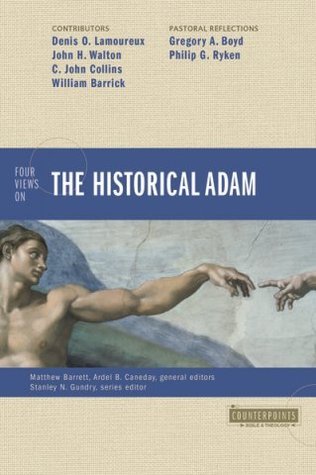
As a part of the Counterpoints series, Four Views on the Historical Adam clearly outlines four primary views on Adam held by evangelicals, featuring top-notch proponents of each view presenting their positions in their own words and critiquing the positions with which they disagree. You will come away with a better understanding of the key biblical and theological issues at stake and of the implications of Adam for contemporary Christian witness and church life. Contributors include Denis O. Lamoureux, John H. Walton, C. John Collins, and William Barrick. Each focuses his essay on answering the following questions: What is the biblical case for your viewpoint, and how do you reconcile it both with modern science and with passages and potential interpretations that seem to counter it? In what ways is your view more theologically consistent and coherent than other views? What are the implications of your view for the spiritual life and public witness of the church and individual believers, and how is your view a healthier alternative for both? Concluding reflections by pastor-scholars Gregory A. Boyd and Philip Graham Ryken highlight the significance of the topic in the faith of everyday believers.

288 pages, Paperback

First published November 26, 2013

72 people are currently reading
644 people want to read

About the author

Ardel B. Caneday

8 books1 follower
Dr. Caneday has served churches in various pastoral roles, including senior pastor. During one pastorate he also taught full-time at Oak Hills Christian College (1984-85). While completing the Ph.D. at Trinity Evangelical Divinity School, he was a Teaching Fellow at the divinity school and later taught at Trinity College (1989-91). Upon completion of the Ph.D. he served as Visiting Professor of New Testament at Grace Theological Seminary (1991-92), and then joined the faculty of University of Northwestern in 1992. He has authored numerous journal articles, many essays in books, a book, and is working on another book. In 2007 he enjoyed a productive portion of a sabbatical as Reader in New Testament Studies at Tyndale House, Cambridge, England. Twice he was been summoned to the White House for briefings by President George W. Bush with evangelical leaders and educators. He enjoys his grandchildren. He is also an accomplished furniture maker.

Ratings & Reviews

What do you think?
Rate this book

Friends & Following

Create a free account to discover what your friends think of this book!

Community Reviews

5 stars
70 (20%)
4 stars
184 (53%)
3 stars
71 (20%)
2 stars
15 (4%)
1 star
4 (1%)
Displaying 1 - 30 of 51 reviews
Profile Image for John.
845 reviews186 followers
July 20, 2016
Lamoureux’s argues that Genesis 1-11 is essentially a myth and not to be taken as anything more than an ancient explanation of origins. It is a manifestation of God stooping down to the scientific level of his audience in a way that means little to us today, as we have advanced scientifically and these first eleven chapters of Genesis will mislead more than they will inform.

It is not that God lies, for Lamoureux repeatedly affirms that God does not, nor cannot lie. His explanation, instead, is that God’s stooping to his audience has left an artifact that has little significance for the modern reader of the Bible. Yet he argues that the rest of the Bible is true—except the other parts of the Bible that refer to an historical Adam. Jesus stooped to his audience too, but poor Paul was just naively assuming Genesis 1-11 is to be taken literally.

So how does Lamoureux come to this unusual interpretation? He believes that we can see evidence of ancient man’s limited and mistaken view of the world in several places in Scripture. One of the first place we see this scientific limitation manifested itself, according to Lamoureux is with the creation of the “firmament” or “expanse” or “vault” as other translations put it. He writes that it is natural and understanding that the ancients would view the heavens as water because they are blue.

So he assumes the text is holding up their unsophisticated science as the way in which the text ought to be interpreted, rather than believe there are other interpretive possibilities and that God is unable to communicate truth in a timeless fashion. Is this not eisegesis that he’s already cautioned against?

Lamoureux also reaches into the New Testament to show how the Bible has an unsophisticated, and thus mistaken view of the world. He argues that Paul, in Philippians 2, has an ancient tri-partite cosmology of heaven, earth, and underworld. Rather than assume the text means exactly what it says, he pursues eisegesis—using the interpretive grid of the “ignorant ancients” to tell us what they really meant and how it is an artifact of ignorance, and shouldn’t be understood for what it says.

He argues that it would be eisegesis for us moderns to cast our figurative interpretation upon the ancients. Well. Perhaps there is another explanation? Perhaps Paul is referring to something entirely different than what Lamoureux would have us think. Perhaps Paul isn’t referring to the material cosmology at all—but the metaphysical cosmology that he wants to ignore. Are there not three worlds in the Bible? Aren’t Heaven, Sheol/Hades, and earth the three metaphysical domains of Scripture? Isn’t this Paul’s point—that Jesus is Lord of All and all will bend the knee to Christ?

John Walton’s essay on origins and Adam is both incredibly insightful and frustrating in his commitment to archetypal interpretation and his tendency to understand Genesis through the lens of ancient near east literature. This dual commitment lends some insight, but it mostly seems to confuse matters and lead Walton’s exegesis away from the text’s authority.

There are many things that are very helpful, but every time he makes an insightful point he overshoots the mark and ends up in what seems a very fanciful and unlikely interpretation of the text. While he believes in the historical Adam his entire view seems to not require his historicity and opens the door wide to all sorts of fantastical interpretations.

Collins’ essay has its strengths, but his exegesis seems driven by a commitment to an old earth, rather than being led there by the text. It is mostly solid, but I view the old earth theory to be a capitulation to scientism, rather than the biblical text.

Barrick’s essay is strong, but requires a thorough-going commitment to the supremacy of Scripture—even against the discoveries of modern science. Without a strong presuppositional approach to the Bible, readers of Barrick’s essay will be unconvinced. This is what the book is really about—presuppositional commitments. If the Bible is supreme, the young earth model and an historical Adam are there and assumed, as the Bible is very clear on this. Even Lamoureux lambasts Collins for his arbitrary reading of “day” as an “age.”

The origins debate, and the historicity of Adam are the material for the larger battle over the authority of Scripture. Much ink has been spilled over this topic as we all know, and I don’t presume to think I will add anything original, or persuasive. But my perspective on these matters was cemented as I read Greg Boyd’s pastoral response. Boyd very articulately, passionately, personally, and persuasively argues that though he is “inclined” to believe Adam was an historical figure, his historicity is not required to be orthodox.

Here one may anticipate I’ve accepted Boyd’s position, but on the contrary, I reject it. His argument is essentially the same as the liberals of J. Gresham Machen’s day—which are the same as today. The message is one of inclusion, rather than exclusion. The message is for understanding and a “broad tent.” The message is for compassion and understanding—for liberty of conscience and so on. The rhetoric is not gospel rhetoric—for doctrinal clarity, but for doctrinal confusion and confessional anarchy.

I won’t go so far as to call those who reject the historical Adam as apostate, or unbelievers, but I do believe they are heterodox, and they teach outside of accepted and established Christian doctrine. Sure, the liberals can argue that the historic Adam has never been a requirement in orthodoxy, but orthodoxy is a definition that has developed progressively in the face of heretical conniving’s. The faithful must defend orthodoxy and those who would test its bounds in each new generation. May this generation draw yet another line in the confessional sand and stand for the historicity of Adam.

I feel bound to note that I am the son of one of the editors of this volume and received the book as a gift from him. My views and conclusions are my own and do not necessarily represent the views of my father.
Profile Image for Josh Pannell.
67 reviews5 followers
December 25, 2013
Review of Four Views on the Historical Adam

Overall, this book was a good read. I have already given summaries on the specific views so this post will only be regarding the book itself. For my review of the 4 views go to peridei.wordpress.com The book begins with an article by Barrett and Caneday on the rise of liberal theology and evolution in the church as well as the reaction of the fundamentalists. This article is very helpful for a fuller understanding of the 4 views and should not be skipped.

Next, the four views are explained. My only complaint is the order in which the views were listed. They seem backwards compared to how the books are normally arranged - conservative to liberal. I wish that Enns had contributed to the book. His understanding of Adam would have been a great 5th view to examine. Though it is closest to Lamoureux’s out of all of them, Collins and Barrick’s views are very similar and so I do not believe this to be a problem. I also wish that Ken Ham had been featured in some way.

After a view is explained the other three authors comment on it. Then, different than other counterpoint books I have read, the first author responds. This is a wonderful inclusion to this book.

The book ends with two articles on the necessity of historical Adam. Boyd argues that “whether or not there was a historical Adam, our faith is secure.” Ryken argues “we cannot understand the world or our faith without a real, historical Adam.”

This book is an essential read for any theological student. The historical Adam is an argument which will only increase in popularity as time progresses. At the end of the day all 4 authors present their views well and contribute to a discussion which not much has been written on at this time.
Profile Image for Austin.
12 reviews11 followers
January 10, 2015
This counterpoints installment by Zondervan is an excellent addition to anyone looking for a serious introduction to the ongoing discussion for the historical Adam. Contrary to most books, the introductory chapter written by two of the editors is an excellent way to begin the book and should not be missed. Each position is set forth by its respective author and is followed by a couple pages from each of the other contributing authors on their objections. Each chapter closes with a reprisal from the contributing author that I found helpful at times, but often suffered from being too expansive and lacking depth due to space restrictions imposed. What follows is a short review of the first 3 chapters: Evolutionary creation by Dennis Lamoureux, Archetypical View by John Walton, and John Collins. Unfortunately I was unwilling to spend time with William Barrick's Young Earth Creationist viewpoint due to a combination of strong disagreement coming into the text, which was ultimately realized in his rather silly objection on Lamoureux's chapter.

To start, I should note that I have previously read John Walton's "The Lost World of Genesis One" and found great plausibility and strength in his main points. With that said, I tried to read Lamoureux with the same fairness.

Lamoureux begins by setting the stage for his position and clearing the ground of any readers potential hostility towards the idea of evolution. Being well versed in the foundations of evolution, I found the first pages unsatisfying because they did not directly contribute to his position. In fact, I would argue that any reasonable reader would come to the discussion ready to dive directly into the discussion at hand. Nevertheless there was a notable moment that precludes the actual discussion: "I believe we should follow the biblical and scientific evidence no matter where it leads." I certainly agree Lamoureux's basis for the conjunction "and," implying that they should be used simultaneously as a logical check and corroboration of each other to extrapolate a clearer view of the truth. While this would certainly be controversial to most, I will leave the discussion for a more appropriate context.

As John Collins (Old-Earth Creationist) points out, the point that God uses physical mechanisms to create life today is an invalid argument. Lamoureux would have to show that the origin of life can be made by physical mechanisms. I cannot answer this objection for lamoureux but I would suppose that Lamoureux would cite scientific literature explaining a number of current hypothesis on the origin of life developing through physical mechanism. The real question is in what capacity is God involved in these yet undiscovered physical mechanisms? This a point undeveloped by Lamoureux in his entire essay. Walton's book even speaks on this by positing the layered cake model but even his discussion never goes beyond loosely stating that God on the top layer provides purpose to the mechanisms utilized by the bottom layer (physical mechanisms). I remain unconvinced.

Moreover another glaring stumble in Lamoureux's contribution was the unsupported statement that: "Real history in the bible begins roughly around Genesis 12 with Abraham." The only support he offers is his position is like "Most other evangelical theologians." Again, I am unconvinced. All three responses take point on this. I would state that after reading Walton’s book, I would agree that Genesis 1-11 doesn't necessarily lack reality, but instead "is reality of a different plane," presumably referencing the functional ontological perspective of the ancient near east. I find Collins response completely inadequate, and Barrick acknowledges this but never responds to the claim. It should be noted that Lamoureux's reprisal does not provide a response.

I found Lamoureux's insistence of accommodation and the contribution of the Message-Incident principle and the concept of phenomenological language from an astronomical perspective to be particularly illuminating. In fact Walton seems to have no major problems with this. I also find that Walton and Lamoureux share conclusions on biological origins of creatures. Both would arrive at the conclusion that creatures were not created de novo. However, focusing on Lamoureux, he could not further his argument because current evolutionary data does not seem to suggest a complete method that they could evolve into the beings they are today. While this limitation is on furthering of lamoureux's viewpoint it does not weaken the fact that it appears that creatures were not created de novo as in the ancient biological perspective.

I found Lamoureux's discussion of Adam's historicity to be illuminating and complements that which I learned from Walton's book but ultimately I could not make the logical leaps that Lamoureux makes. The statement: "Adam is a retrojective conclusion of an ancient taxonomy" is fine, but it should not follow that "Adam never existed." If anything the fact that the genealogies point back to a single individual, and the fact that there is no reason, as walton states, "[To believe] That ancient genealogies included individuals whom they did not believe to exist," should indicate that the there was a single first human created by God. However, I once again takes Walton's position that the account in Genesis 2 does not record the "forming of a single, unique individual" (More on this when I cover Walton's chapter). I am also in wholehearted agreement that just because the origin story of the Adam shares parallels with the ancient near east literature, it does not follow that Adam is not a real person of the past. Walton states, "the forming account may be an accommodation but that does not mean that the role of adam is an accommodation." Moreover I share some of the concerns that both collins and Barrick share on salvation as a whole if we reject the role of adam as both a historical figure and his archetypical role/significance. An explanation on this theological concern is ultimately not addressed by Lamoureux, limits his discussion to possibility of de novo creation of Adam.


Lamoureux attempts to further support his claim that adam is an accommodation by the holy spirit as an "incidental vessel to deliver inerrant spiritual truths," by addressing Jesus reference in Matthew 19:4-6 and Paul's reference in Romans 5:12 and 15. Again, I think Lamoureux is correct on his idea of the Holy Spirit accommodating to the ancient understanding of human origins, but Walton is correct in questing is Jesus is trying to make a theological point. In other-words, it is an accommodations by both parties scientifically, but it is a point of great theological significance with regards to the big picture of salvation. Lamoureux does not address Walton's concern in the rejoiner.


To conclude, both collins and Barrick seem to believe a non-historical adam detracts from the "overarching narrative element of the bible". While I currently take Walton’s viewpoint on the historicity of Adam, I don't believe Lamoureux's methodology leads to the the right conclusion. His critical eye for accommodation in the bible is certainly noteworthy and commendable, but I believe he misses a couple a important theological points, takes a couple logical jumps, and overall his overall all-or-nothing approach to accommodation to be faulty.

A few closing notes:

- Collins contribution on distinguishing three categories of Ancient language and thus dismissing accommodation as a result is weak to say the least. However, his objection that "We have excellent reasons for disputing whether a natural process ... is adequate to produce human beings with their distinctive capacities." I admit that this has always baffled me and I would be curious to do more research as I am sure the lack of comfortableness most likely stems from my lack of knowledge. Overall Collins has a couple good points but it didn't feel like a substantial and complete response to Lamoureux, even though his response was given the most space.

- I must add that I find Barrick's response that adam has no resemblance to rip van winkle or his plea, "For Eve to have evolved out of Adam would have taken millions of years. Adam could not have slept for eons of time while God made the Woman." This is the most absurd and ridiculous objection I've ever heard. Lamoureux properly responded by pointing out that Barrick reveals his commitment to scientific concordism, a practice that cannot be held. While I found this objection laughable I was curious to see lamoureux defend Barrick’s objection on Jesus turning water to wine in Cana. Lamoureux does not address this in the reprisal.

- Also I was highly curious and doubtful when Lamoureux stated that scientific facts in the bible were revealed before their discovery by modern science. However, I found no such discussion or evidence in the text.

In chapter 2 John Walton sets forth his view on Adam as an Archetype. The gist of his argument is founded in Genesis 1 and 2 being read from the ancient near east (ANE) perspective, and in particular, the ANE’s focus on functional ontology. This foundation provided much of the exegesis that allows Adam and Eve to be seen as archetypes.

To further the position of Adam as an archetype in Genesis 2, Walton begins by noting that “Adam” is the Hebrew word for humankind. Presumably the point of this is to identify the significance of the name in the ANE context as an archetypal name and not a personal name to identify the first man (cf 91). He then turns to the verb “Yasar” lacking a material context in “formed from dust” (Gen 2:7). I found his lexical analysis here essential to thoroughly dismiss the material context of the verse, yet I found it wanting after only a quick reference to Zechariah 12:1 is discussed. Again, this is most likely a byproduct of the space requirement imposed of the author. The significance of dismissing the material basis for “yasar” is found in the argument that Genesis 2:7 is not a statement on material discontinuity. Walton goes on to posit: “Adam being formed from dust does not preclude him being born of a women.” I believe this logically follows, but I do not find the dismissal of material context to be as concrete of a claim as I would like. Walton continues by discussing Adam being taken and placed in a garden. Walton points out an interesting possibility that there may be other people around this area (cf. Gen 4.14) but I fail to see how this spoils his incorporation of the origins of death into his hypothetical scenario, with the Tree of Life being the source that allows Adam’s mortal body to achieve immortality. Basically my question is, if there were others around, how did the tree of life not provide others with an antidote of mortality? Several possible responses come to mind but it doesn’t seem to me as if the hypothetical scenario Walton provides at the end of the chapter serves well in this instance. I found the section on “The message of the archetypes in Genesis contrasted to ANE” to be extremely rewarding and enriches the theology behind the archetypal view.

Walton’s contribution in the “Archetypal role of Adam and Eve in the New Testament,” to be another highlight of the chapter. Inside Walton provides some exegetical insight into a couple of passages relevant to the discussion at hand. Of particulars notes are Romans 5:12-14 and First Corinthians 15:45. In Romans, we see the basis of imago dei hominids (Gen 1:27) being subject to death, but not morally responsible for their actions. I find this hard to believe, and as proverbs 18:17 suggests, I look to research what others read from Paul’s statement in Romans 5:13. This is of particular significance in Walton’s argument because it fits his view that Adam may not being the first human on the earth and that others may have come before him. I believe this problem is could be solved by positing Genesis 1:27 and Genesis 2:7 as synoptic, however this would be extremely short sighted and ignorant of the current scientific evidence. We have to use the scientific evidence to check our assumptions that found our interpretations of scripture and anyone who has read the paper “Molecular genetics of speciation and human origin,” should reasonably question assigning two individuals origins of homo sapiens, in light of molecular biology’s contribution to our understanding on genes in the DNA. While unable to rectify the conflict, I do not believe it should be a major stumbling block in the acceptance of Walton’s Archetypal view. Lastly, the issue of First corinthians in Walton’s discussion is the lack of addressing the subject of the toledoth. Previously Walton dismissed the material context of a verse off of one similar passage where the material context was absent. One must wonder what Walton would do to respond to his stance on the toledoth serving as as an introduction to the next time period, and thus resulting in Genesis 2 being an account that follows Genesis 1. This seems logical but as John Collins points out, the archetypal focus “Fails to account for the whole context of the passage.” Here Collins references first Corinthians 15:49, as paul referring to the
*image* of the man of dust being to have parallels to the *image* of God . I see this as a valid literary point, but I would question whether the image is a theological significance for the transmission of sin and the human situation resolved in the “image of the man of heaven.” To be clear I don’t necessarily agree with collins attempt to keep Genesis 1 and 2 complementary AND synoptic, but I do think they should be view as complementary as noted vigorously (cf 127). Also, on the topic of the transmission of original sin, I should note that it seems theologically challenging to suggest that Adam is one of many humans occupying the narrative (The paper “Molecular genetics of speciation and human origin” posits that molecular biology indicates a minimum of 100,000 individuals had to be present during the 30 Million year transition from archaic humans to modern humans). Presuming that the rise of homo sapiens sapiens parallels the creation of humankind in the image of God (this is never defined by any author in the text), one would have to identify where pre imago dei hominids fit into the picture of original sin (Walton basis his claim of non responsibility in Romans 5:12-14), and the nature of original sin by one radiating out onto the rest of the world population and those to follow. Walton basis his claim that there is no claim in the bible to biological/genetic relationships or material discontinuity, and thus indicates that he currently favors a “radiation model.” It should noted that the traditional view of seminal transmission has to be eliminated if one is to accept the evolutionary paradigm that there humankind does not find its headwaters in the material discontinuity and creation of Adam and Eve. This is compounded by the point that Jesus biologically and genetically human, yet he did not inherit sin biologically. Walton notes he is not an expert on the doctrine of original sin, yet I am curious to find a more satisfactory answer to the problem.

The last problem I found with Walton’s hypothetical scenario, is the lack of functional food source until Genesis 2:5-6. The way I read Walton, it seems as if the food sources had to derive from the “regular inundations [of river systems] saturated the ground indiscriminately (thus no food was being grown).” This begs the question of how could any life be supported without a functional food system. As noted before a minimum population of 100,000 necessitates a functional food system. I would be curious on how Walton resolves this, or if I am reading him wrong. Even if Walton does not accept that there was a minimum 100,000 individuals on the earth, his hypothetical scenario fails to support life without a functional food source. If he was to respond that fishing was the method of food, and water came from the river systems, I would be interested in the nutritional viability of a such a strict limited diet, and how migrations of archaic humans were possible over large stretches of land without access to water sources and food sources.

I conclude that the objections given by Lamoureux and Collins provide a great tool to sharpen and clarify your understanding of the archetypal worldview. In them I find no major methodological or exegetical issue that really but Walton’s view as a whole in question. I would note that I would enjoy further research into Collin’s chiastic structure of Genesis 2:4 as a foundation for the synoptic nature of Genesis 1 and 2. I would also be interested in reading up on his views of why it is problematic that Adam is not the first human. However, with all this said, I maintain that I find Walton’s view the most acceptable of the 4 views discussed in this book. Obviously, ongoing research would need to be done to work out the myriad of details and to fine tune the understanding of Adam’s historicity

The only thing that I can say about John Collin’s contribution is that it seems methodologically challenged, and lacking substantial focus. He brings up many great topics to discuss but the discussion suffers from being a mile wide and only an inch deep. This is compensated heavily in the footnotes, which is to be applauded but just reading the book alone does not do justice to Collins argument. I am left with the impression that anyone looking to get a better understanding into Collins view should read his book “Did Adam and Eve really exist.”
Profile Image for Justin.
792 reviews15 followers
June 23, 2017
This book could prompt its own book in response, but in short(ish): I found the essays of varying quality, but reading each of them in conversation was a valuable experience.

Lamoureux has covered this ground better in other places. His hermeneutic is interesting, but he ends up with some leaps in logic. Keeping in mind his thoughts on accommodation, concordism, and the Message-Incident Principle are useful, if only for humility in conversation and respect of various positions. He gets a little off here and there and is bogged down in certain ideas, but he's an important part of the debate.

Walton was the most intriguing. I'd need to read a fuller work by him, but his thinking is fascinating and tight, and he's typically the most precise in his responses to the other essays.

Collins writes well, although he doesn't advance enough of an argument to respond to. He's focused and centered, and seems to have a wise sense of a generous orthodoxy.

Barrick offers the weakest arguments and not accurately engaging with the other three. His call for the primacy of Scripture is necessary, but I'd like to read this line of thinking in a stronger argument, and in one that engages more directly with both the other ideas and the relevant science.

I enjoyed both Boyd and Ryken's pastoral concerns, finding sympathy with the former and much agreement with the latter.

For anyone interested in this debate, this book seems like a good place to start, with the awareness that two of the four main writers don't seem to be at their peak [yes, I almost knocked it down to 3 stars because of that, but my experience with the book was quite enjoyable even if I was throwing up my hands at Barrick at times and wanting to stick in other of Lamoureux's writing at other points.]

Okay, not so short a response....
Profile Image for Matthew Richey.
463 reviews9 followers
April 2, 2018
This is one of the better "views" books I've read. 3 of the 4 authors (the exception being the Young-Earth Creation View by William Barrick) are well-argued, thoughtful, interact well with each other's perspectives, and offer helpful critiques of the others' viewpoints.
Profile Image for Bret James Stewart.
Author 9 books5 followers
May 20, 2019


Four Views on the Historical Adam edited by Matthew Barrett and Ardel B. Caneday provides the views of six contributors. The primary four are Denis O. Lamoureux, John H. Walton, C. John Collins, and William D. Barrick, each of whom is recognized scholar in the field. These contributors will provide their views on creation and especially in regard to whether or not Adam existed. Each author will then critique the view of the other. Following is a pastoral response from established preachers, Gregory Boyd and Philip Ryken, who address the impact of creation belief on the Christian faith. Following is a brief summary of the book.

Summary

The front matter of the book includes information about the individual contributors, abbreviations, and Bible versions that are used in the text.

Next is an introduction by Barrick and Caneday describing the book’s procedures and content. They supply a brief historical overview of beliefs about the creation tale of the Bible, including a number of evolutionary theories, and the historic identity of Adam. They describe the general thesis of each individual contributor that will form the core of the text along with essays critiquing the argument of the primary essay.

Chapter One is “No Historical Adam: Evolutionary Creation View” by Denis O. Lamoureux. He proposes that the Triune God created the universe via an “…ordained, sustained, and intelligent design-reflecting natural process.” The Bible demonstrates an ancient Ancient Near Eastern comprehension of the natural world and does not include modern scientific facts. Adam is an incidental figure in the biblical record who serves to portray spiritual truths rather than literal scientific biological truths. Although Adam never existed, this fact does not impact Christianity. Lamoureux argues that scientific condordism is not a viable theory as the Bible uses phenomenological language to describe things according to their appearance from the human perspective such as the rising and setting of the sun. These experiences do not match what modern science tells us and serve as examples of accommodation on the part of God to match human understanding of the time. He proposes that Adam serves to show biblical truths, especially original sin, and that the arrival of the first evolutionary developed humans to be a theological mystery.

In response to Lamoureux’s argument, John H. Walton believes that evolutionary creation is valid as long as it preserves the orthodoxy of the faith. He supports the view that the Bible reflects an Ancient Near Eastern View of reality rather than the scientific reality we know today as well as accommodation by God to the biblical writers. Furthermore, he argues that the creation texts of the Bible are predominantly about functional rather than merely material purposes in creation(s). He also agrees with Lamoureux that Adam serves an archetypal function but argues that this does not mean that Adam did not actually exist.

C. John Collins has a greater degree of disagreement with Lamoureux’s essay, essentially viewing it as oversimplified approach featuring either-or proposals. He rejects the connection between literalness and historicity. He argues that the view of scientific concordism should be nuanced to allow the legitimate use of historical concordism, and he feels the author gives too much significance to the principle of accommodation on God’s part to an ignorant mankind.

William D. Barrick argues strongly against the incidental or non-existent archetypal conclusion regarding the historicity of Adam upon which original/universal sin relies. He rejects Lamoureux’s reliance upon modern evolutionary theory and claims the creation to have been a one-time act of special creation by God in six days as Genesis holds. He denies that the accommodation principle mentioned above is valid.

Following is a rejoinder by Lamoureux dealing with the primary arguments made by the others. He spends most of his effort defending the accommodation principle and the valid use of the modern (scientific) understanding of the cosmos.

Chapter Two is “A Historical Adam: Archetypal Creation View” by Walton. He maintains that Adam was a historical figure. Despite this, he believes that Adam serves an archetypal function in the Bible in that he represents all humanity, especially in Genesis 2 regarding his creation. Walton asserts that Genesis 2 is not making biological truth claims and, therefore, should not be viewed as treating with scientific data. This archetypal focus is theologically viable, particularly regarding sin and death, and is supported in Ancient Near Eastern literature and culture.

In his response, Lamoureux disagrees with Walton’s functional approach to origins, believing it is too limited as most of the biblical accounts deal with both material and functional purposes. He agrees with Walton’s ideas of ancient science present in Scripture and generally with the archetypal view.

Collins argues that Walton mistakenly asserts that Adam’s creation need not be the same as mankind generally and that Adam need not have been the first man. Genesis 1 and 2 should be viewed as complementary narratives.

Barrick views Walton’s approach to temple theology commendable. The archetypal view is valid in the sense is does not necessitate Adam being non-historical. Since Jesus is understood as a literal and historic figure serving as an archetype, so should Adam. He claims Adam should represent both seminal and federal headship of mankind.

In his rejoinder, Walton claims that the responses are primarily re-castings of the others’ arguments rather than valid and meaningful responses. He spends most of his space dealing with Ancient Near Eastern worldviews and the material creation. He argues against source criticism as a legitimate method for interpretation.

Chapter Three is “A Historical Adam: Old-Earth Creation View” by C. John Collins. He argues that the proper way to view Adam is that he was a historic person. The first man is the source of original sin. Further, he is the progenitor of all mankind. Still, the genre and nature of the biblical record should not be taken too literally in order to account for connections between scientific/historical accounts of creation evidencing an old-earth theory.

Lamoureux agrees that there is an over-arching storyline to the Bible and that Adam is a significant character. However, he argues that this does not necessitate a historical Adam. He believes that Collins’ use of scientific condordism and God-of-the-gaps fails to support the old-earth methodology.

Walton agrees that a historical event is required to bring sin into the world and with the proposal that material human origins and the creation require that God be involved somehow in the process even if His contribution is hidden. However, he disagrees that the Ancient Near Eastern literature should be categorically denied as historic or literal.

Barrick claims that Collins’ view and his own differ primarily in how to date the age of the earth. The historicity of the events should be expanded to the descriptions in the biblical text. Specific time frames sometimes appear in the biblical account, and these should be taken as both literal and important. The old-earth theory fails because it is slave to modern scientific principles that change.

In his rejoinder, Collins clarifies his original proposals about his scientific concordist and God-of-the-gaps stratagems, arguing for a historical rather than scientific concordism. He denies his position over-relies upon current scientific thought.

Chapter Four is “A Historical Adam: Young-Earth Creation View” by William D. Barrick. His argument involves Adam as the seminal and federal head of humanity. Furthermore, Adam’s existence is vital for a number of doctrines. His reality is also important regarding the inspiration and inerrancy of Scripture. He denies the accommodation theory as well as evolutionary theories, claiming the literal six-day creation as portrayed in the Bible is the accurate account.

Lamoureux does not believe that original sin requires a historical Adam; original sin certainly exists, but it came from “behaviorally modern humans about 50,000 years ago.” He rejects the view that no historical Adam results in no need for Jesus. He maintains that modern scientific fact is the proper basis for determining the processes and time frames for creation.

Walton points out that Barrick spends an inordinate amount of effort refuting others’ views rather than supporting his own. Barrick misunderstands the archetypal principle and uses “scare tactics” in his writing. He jumps to conclusions without valid support.

Collins agrees that Adam and the creation are actual events. He thinks Barrick overemphasizes the importance between a literal interpretation of the Bible and historicity. Further, Barrick has unnecessarily tied this idea to inerrancy.

Following is “A Pastoral Reflection Whether of Not There Was a Historical Adam, Our Faith is Secure” by Gregory Boyd. He argues that Adam was probably a historical figure. However, this belief is not vital to the Christian faith. Debates about the reality and person of Adam are acceptable and even positive as they contribute to biblical knowledge, but these debates should not divide scholars or the church.

Next is “A Pastoral Reflection Understand the World or Our Faith Without a Real, Historical Adam” by Philip G. Ryken. He firmly believes in a historical Adam due to hermeneutics, doctrine, and literal, historical narratives confirm this. He agrees with Boyd that belief in a historical Adam is a test of orthodoxy, but he maintains that the understanding of Adam’s personage enriches one’s understanding of God’s Word.

Rounding out the book are name and Scripture indices, a list of books in the series, copyright information, and a page about the publisher.

Conclusion

I rate this book four of five stars. This type of argument-based approach by multiple authors is a helpful overview of the issue at hand as each contributor is representative of the most popular views held by scholars and the public. Those wanting more information regarding a given proposal can follow up with independent research. I do believe the historicity of Adam has important ramifications for the Christian faith in general as well as the presuppositions of the individual.

Profile Image for Jimmy.
1,226 reviews49 followers
March 19, 2014
For the last few years the historicity of Adam has been a topic of controversy and debate within Evangelical academia. It comes at no surprise that Zondervan would come out with a book in their Counterpoint series addressing this topic. Four views are given a hearing in this book represented by Denis O. Lamoureux (Evolutionary Creation View that denies the historical Adam), John Walton (Archetypal Creation View), C. John Collins (Old Earth Creation View), and William D. Barrick (Young Earth Creation View).
Normally I’m cautious about these Four Views book either because I feel better contributors could have been selected or space limitation didn’t allow justice for the complex subject at hand. With these expectations I must say I thought the book did a better job than I expected. I’m happy to see some improvements over the years with this genre. The four scholars selected are highly qualified representative of their respective views. In previous works the format feature the chapters by each school followed by the responses by the other schools; I appreciated that this work also feature a rejoinder to the other schools’ responses, a plus in my opinion in seeing what a counter-rebuttal looks like. I also appreciated the editors’ decision to have two pastoral reflections that discussed what the implication of the discussion of the historicity of Adam means practically for the Christian (although I must say it seems Gregory Boyd’s essay ended up being more on why Christians should welcome those who deny the historical Adam as brothers and sisters in the faith even in our disagreements). The two contributors selected for this part were excellent: Both Gregory Boyd and Philip Ryken are well known for being pastor-scholars. I thought the pastoral reflection also made their contribution to the discussion of which view one should take on the historical Adam question, and these two essays must not be overlooked or dismiss because its pastoral in nature; in particular I had in mind how Ryken’s essay laid out what an historical or non-historical Adam means theologically for the Christian experience and Gospel witness.
I imagine not many will change their views from reading this book and yet I would say this book is still important and worth buying because it provide a concise summary of each perspective’s argument. Never had I read a book in Zondervan’s Counterpoint series in which the contributors footnoted their own work as much as they did in this volume but I appreciated this as helpful for those who want to do further research. One can’t really blame the contributors for footnoting themselves so much since this is a much more complicated subject than most topics in this series since there is immediate question of Adam’s existence and also the undercurrent of one’s understanding of the role of modern science/evolution in interpreting the Genesis 1-3 that formulate one’s conclusion to the Adam question. Really, this book had only one contributor (Lamoureux) who denied the historical Adam while the other three believed in a historical Adam; and yet all three who agreed on Adam didn’t arrive to their conclusion by the same method necessarily given their divergent view of the role of extra-biblical data (Modern cosmology, science, evolution, Ancient Near East studies) in interpreting Genesis 1-3.
Dr. Barrick has one of the most exegetically rich chapters in the book, and readers will appreciate his grammatical and syntactical observation brought out from Genesis 1-2. The contributor with the strongest scientific background is Lamoureux but appeared to be the most exegetically weak, where in the responses the other three contributors harped on him for his take on the Hebrew word Raqia and his misleading translation of this term as “firmament.”
NOTE: This book was provided to me free by Zondervan and Net Galley without any obligation for a positive review. All opinions offered above are mine unless otherwise stated or implied.
Profile Image for Autumn Kotsiuba.
682 reviews18 followers
November 22, 2015
This book is a discussion between four academics on the major views of Adam--evolutionary (Lamoureux), archetypal (Walton), old earth (Collins), and young earth (Barrick).

Lamoureux and Walton did an excellent job of defending their beliefs; Collins had some flaws but was overall interesting, and Barrick...well, let's just say I still have no reason to believe in a young earth (and I was raised young earth; an elder in my church once told me that the bones of dinosaurs were "strategically placed by Satan himself" in order to lead humanity astray. Oy.). Today, I fall somewhere between the evolutionary and archetypal view; I haven't researched the origins of Genesis 1-11 enough to be a staunch advocate of either. One thing I am sure of, though, is that a belief in the historical Adam--despite the cries of many evangelicals--is not necessary to Christian faith.

A great starter into the debate. I added at least five books to my to-read list because of this work.
Profile Image for Alan.
153 reviews
January 26, 2014
This has been a topic that I've always wanted to research specifically but never got around to. After reading it, I now have an excellent foundation for further studies in this topic and a newfound respect for the hermeneutics of the creation story in Genesis that I never quite had before. Personally, I feel Walton (archetypal) and Collins (old earth) made the strongest cases for their views, however Lamoureux (evolutionary creation) made a strong impression on me as well. Sadly, I felt Barrck (young earth) made a very weak case for his view, which in my opinion is already weak. After reading the entire book, I want to read all of their books to hear more about what they have to say. My interest has been heightened ten-fold!
Profile Image for Todd Miles.
Author 3 books169 followers
February 20, 2016
Edited volumes are always uneven, but each of the essays in this book makes a contribution. Even the authors with whom I disagree the most gave insight into their positions and I found their work helpful. This book does not debate the interpretation of the scientific data; it is a book dedicated to the biblical and theological implications of the existence of Adam that focuses on interpretation of biblical texts.
Profile Image for Mike.
52 reviews
July 13, 2014
pretty solid counterpoints entry. The views of the first three authors in the book are probably the best-argued. It is definitely an in-house debate among evangelicals, but a worthy read nonetheless.
Profile Image for Derek Brown.
14 reviews6 followers
April 22, 2016
Late in 2013 Zondervan released another installment in their Counterpoints series–this particular contribution offering different perspectives on the historicity of Adam. Since their inception several years ago, I have appreciated these multiple-view books. Although I usually come to and leave these books holding firmly to one of the views, I am always grateful to learn, first-hand, how proponents of different positions articulate and defend their views. I am also encouraged to think afresh about my convictions and presuppositions, and nuance my own position if necessary.

In the case of Four Views of The Historical Adam, I come to the discussion as a young-earth creationist who believes in an historical Adam.

In this review, I will discuss a few weaknesses in of each contributor’s argument and methodology. I will then discuss one major weakness that afflicted the book as a whole.

Denis O. Lamoureux – Evolutionary Creation View
Lamoureux accepts human evolution as fact and therefore claims that Genesis, while clearly making material and historical claims, is simply wrong. The author of Genesis, like his contemporaries, had an “ancient view” of science and was therefore mistaken in his description of cosmic and human origins. Such a position, Lamoureux claims, does not undermine inerrancy, for God willingly accommodated his revelation to these mistaken ancient viewpoints in order to communicate inerrant theological truths.

One of the most significant weaknesses to Lamoureux’s argument is his attempt carve out a place for inerrancy within his proposal. In order to maintain a commitment to inerrancy, Lamoureux argues that God “accommodated the revelatory process and came to the level of ancient people in order to communicate inerrant, life-changing truths” (41). Because Lamoureux locates inerrancy in the theological truths rather than the incidentals that communicate those truths (e.g., statements in Genesis that speak of God created Adam out of dust of the ground), he is able to affirm emphatically that God does not lie, despite his claim that Scripture makes statements about cosmic and human origins that never really happened.

The problem with this kind of argument is not only its logical incoherence (God cannot lie, yet the Scripture he breathed out contains errors), but the fact that it assumes a mistaken view of accommodation. Historically, accommodation was never defined as God’s accommodation to mistaken human viewpoints. In fact, this view of accommodation was designated as heretical and outside the bounds of an orthodox understanding of Scripture during the post-reformation period. Richard Müller comments,

The Reformers and their scholastic followers all recognized that God must in some way condescend or accommodate himself to human ways of knowing in order to reveal himself. This accommodatio occurs in the use of human words and concepts for the communication of the law and gospel, but it in no way implies the loss of truth or the lessening of scriptural authority. . . . Note that the sense of accommodatio that implies not only a divine condensation, but also a use of time-bound and even erroneous statements as a medium for revelation, arose in the eighteenth century . . . and has no relation to either the position of the Reformers or to that of the Protestant scholastics, either Lutheran or Reformed (Dictionary of Latin and Greek Theological Terms, 19).


Like Rogers and McKim decades before him and like most evangelical non-inerrantists today, Lamoureux departs from the historical understanding of accommodation in order to draw a sharp distinction between the historical incidentals and spiritual truths of a given biblical text. These arguments are not new, but they were definitively answered by John Woodbridge over thirty years ago in his book Biblical Authority (1982) and more recently in a compilation of scholarly articles to which Woodbridge contributed the foreword: Do Historical Matters Matter to Faith: A Critical Appraisal to Modern and Postmodern Approaches to Scripture (2012).

John Walton – The Archetypal Creation View
Unlike Lamoureux, Walton believes in a historical Adam and Eve. But he also believes that the Genesis narrative is more concerned about establishing the archetypal function of Adam and Eve than about giving us a description of their material origins. With this assumption Walton is able to argue that the Genesis text allows for the mechanism of evolution and a pre-adamic race, so long as we recognize that Adam and Eve were historical people who at some point were endowed with the image of God.

The major problem with Walton’s argument is the false dichotomy he drives between functional and material aspects of the Genesis narrative. Why, as Lamoureux and C. John Collins asks in their responses to Walton, must we choose between a functional or material emphasis in the text? I agree with the argument that the Genesis narrative presents Adam and Eve as archetypes of humanity. I also believe there is evidence in Genesis 2 that suggests that Adam and Eve should be viewed as priests serving in God’s temple garden (thank you, G. K. Beale). But this affirmation does not preclude the text teaching that Adam came from the dust of the ground and his wife from Adam’s rib.

Although Walton states repeatedly that he is driven by the text of Genesis in developing his view, it seems obvious that his exegesis is compelled by outside concerns; namely, to account for the so-called fact of evolution. Because of this, I find Walton’s argument the most inconsistent. Better to say, like Lamoureux, that the text tells us how Adam came to be but that it’s wrong than to force a false choice between two clear aspects of the narrative.

C. John Collins – Old Earth Creation View
Like Barrick, I am closer to C. John Collins in my view than with Lamoreoux and Walton. He believes in an historical Adam and views Adam and Eve as the “headwaters” of the human race. What troubles me about Collins, however, is his repeated warning that we we not read the Genesis narrative “too literalistically.” Given the last 40 years of evangelical hermeneutical debate, I find statements like these most unhelpful. What this kind of plea typically means is “let’s not read the text in a way that excludes my view.” Because Collins accepts evidence for an old-earth, he must loosen the Genesis narrative to allow for such evidence.

Collins argues for this approach, in part, by appealing to Francis Schaeffer’s “generosity of spirit” and his desire “for Christians to get along with one another” (169). Collins continues,

This approach also recognizes that a well-functioning Christian has a hierarchy of commitments: he or she will insist more strongly on the tenets of “basic” or “mere” Christianity–say, the Trinity, or the resurrection of Jesus–than on some other matters that are important, but not quite so vital–say, the number of sacraments and their exact effects. If we add into our consideration the literary features of Genesis 1-11, we conclude that the very nature of this biblical material leads to some sort of freedoms and limitations rubric, since the material both resist a strictly literalistic reading and invites recognition of its historical impulse. In practical terms this means that the author’s main goal is to enable us to picture the events he recounts, without getting bogged down in the details (169).


While I am all for Christian unity and for developing a hierarchy of theological commitments that allows believers to fellowship around major doctrines while disagreeing on secondary matters, it appears that Collins makes an illegitimate logical move in this paragraph. He appears to go from a discussion of motivation–a “generosity of spirit” and desire for Christian unity that rightly recognizes a hierarchy of doctrinal commitments–to the hermeneutical conclusion that the literary features of the Genesis narrative allows for freedom within which to form our convictions about human origins. Since the the text “resists a strictly literalistic reading,” legitimate interpretations of the creation narrative can span a wider range than, say, young earth creation.

But isn’t this saying that a generosity of spirit leads us to conclude that the Genesis narrative allows for a generosity of spirit? Because Collins wants to measure out some exegetical room for evangelicals to form their convictions about human origins, he appears unwilling to restrict the Genesis narrative too tightly, regardless of whether or not the text calls for such restrictions.

As a young-earth creationist who shares very little with Lamoureux (see above) in terms of our respective interpretations of the Genesis narrative, I find it interesting that he is one who so strongly criticizes Collins’s handling of the biblical text. In his critique of his argument, Lamoureux reminds Collins that Genesis clearly teaches 24-hour creation days. These claims are wrong, of course, but let’s not play arbitrary games with the text. Collins might point us back to his claim that in Genesis “the author’s goal is to enable us to picture the events he recounts, without getting bogged down in details.” But this is special pleading: the details of the narrative exclude Collins’s view.

William Barrick – Young Earth Creation View
I hold to a young-earth and a historical Adam, so I am sympathetic to Barrick’s arguments. Nevertheless, I agree with Walton that Barrick did not accurately represent Walton’s archetype view in his refutation of it. It did seem as though Barrick set up a strawman in order to show the absurdity of arguing that the Genesis narrative is not making historical claims. Unfortunately, Walton is not claiming that his archetypal interpretation precludes historical realities; he does believe Adam was a historical person. Walton is certainly right when he says, “If one wishes to refute an argument, one must be careful not to misrepresent it” (238). Although he doesn’t mention Walton specifically, Barrick seems to admit to this unintentional misrepresentation in his rejoinder (see page 252).

One Main Weakness – “Science” Left Undefined
A weakness that afflicted each of the contributors–including the editors A. B. Caneday and Matthew Barrett and the pastoral responses from Greg Boyd and Philip Ryken–was their failure to define what they mean by the word “science.” Yet, this is one of the primary issues that drive the entire discussion of origins, human and otherwise.

Because none of the contributors are careful to engage the question of how we should define “science,” readers are left with the impression that the difference between these men has more to do with an unwillingness to recognize obvious, indisputable facts than it does with biblical interpretation. Ryken observes this problem when he writes,

Many are sincere in seeking to understand carefully what the Scriptures do–and do not–claim about human origins. Still, the starting point for most challenges to the special creation of Adam is science rather than Scripture. According to the mainstream scientific consensus (there are dissenting voices, of course), the human race did not being with a single pair but must have started with some larger population. Some Christians think that this emerging consensus gives us the real facts and find it at odds with the Genesis account of human origins. . . . Fortunately, we do not have to choose between biblical orthodoxy and scientific credibility. General revelation and special revelation both tell us the truth. As time goes on, we may hope to understand better how the truth claims of science and Scripture converge (269).

But even here, because Ryken does not approach the foundational problem of how we should define science, readers are allowed to conclude that those who do not accept an evolutionary framework in developing their theology of human origins are simply guilty of ignoring reality for the sake of theological dogma. Because the majority of people in our contemporary setting assume the word “science” denotes a philosophically neutral activity where unbiased practitioners merely relay indisputable public facts to the ignorant masses, any dissent from these “findings” is intellectual stubbornness at best, pathological religiosity at worst.

But years ago it was Berkley law professor Philip Johnson who overturned the idea that contemporary science is a philosophically neutral enterprise. When it comes to human origins, Darwin himself admitted that he was seeking a natural (as opposed to supernatural) explanation for the origin of life. Subsequent articulation and popularization of his theory has continued along these lines while naturalism as a philosophical starting point is assumed to the degree that departure from this starting point (by positing a Creator) implies a departure from science itself. This is why, as Johnson observes, “it is pointless to try to engage a scientific naturalist in a discussion about whether the neo-Darwinist theory of evolution is true” (Darwin on Trial, 123) and why creationists are often labeled “unscientific.”

But for the Christian to accept a definition of science that assumes philosophical naturalism is an unnecessary concession. As Johnson explains with devastating logical force, the Darwinian theory of human origins does not derive from empirical observation. Rather, it is a philosophy about reality that dictates one’s conclusions about various so-called evidences.

A good empiricist insists that conclusions be supported by observation or experiment, and is willing to discard even the most cherished doctrines if they do not fit the evidence. Naturalism and empiricism are often erroneously assumed to be very nearly the same thing, but they are not. In the case of Darwinism, these two foundational principles of science are in conflict. The conflict arises because creation by Darwinist evolution is hardly more observable than supernatural creation by God. Natural selection exists, to be sure, but no one has evidence that it can accomplish anything remotely resembling the creative acts that Darwinists attribute to it. . . . As an explanation for modifications in populations, Darwinism is an empirical doctrine. As an explanation for how complex organisms came into existence in the first place, it is pure philosophy (Darwin on Trial, 117).


Now, someone might argue–like editors Barrett and Candeday, for example–that this particular Four Views was not compiled to deal with questions of scientific methodology but with interpretations of Genesis 1-2. But it is difficult to see how we can separate these two areas of inquiry, especially when (1) it appears that at least two of the contributors accept evolution as indisputable fact and thus develop their interpretation of Genesis accordingly; and (2) a biblical worldview cannot consistently affirm a definition of science that assumes philosophical naturalism. The discussion, by its very nature, requires participants, regardless of speciality, to ponder the philosophy of science question.

Conclusion
While there is certainly some value in this kind of interaction between professing evangelicals who hold to different views of human origins, I do not suspect much progress will be made in this discussion until scholars are willing to engage the foundational question of how science should be defined. This will require more than exegesis and evaluation of ANE documents. Scholars will have to demonstrate awareness of how their worldview generally and their definition of science specifically influences their interpretive work. Until then, we might talk much, but it will mostly be past each other.
Profile Image for Jerry Hillyer.
331 reviews5 followers
June 17, 2014
Title: Four Views on the Historical Adam

Authors:

Denis O. Lamoureux
John H. Walton | BioLogos Forum
C. John Collins | Did Adam and Eve Really Exist?
William D. Barrick | The Masters Seminary
Greg A. Boyd | ReKnew
Philip G. Ryken | Sermon Audio

Publisher: Zondervan

Year: 2013

Pages: 289 (e-book)

Additional Information:

Counterpoints: Bible & Theology Logos Software

General Editors: Ardel B. Caneday | Matthew Barrett

[I was provided with a free e-copy of this book in exchange for my unbiased and fair review. On another note, the government spends too much time worrying about what books I read and get for free. Thank you.]

I have provided plenty of links for you, the reader, to do your own research into this book because I have a particular point of view on this sort of work that may or may not be particularly helpful. To be sure, I read an 'uncorrected proof for review purposes' which is a bit frustrating because page numbers in references appear as (ooo) which is kind of annoying.

The book is laid out in a fairly manageable format. There is a lengthy introduction by the series editors (Barrett and Caneday) which explains the format and lays out some preliminary observations such as historical background, history of debates, and the various points of view that the authors will subsequently take up in the bulk of the text. Next comes the presentation of the four authors' points of view. Each author presents his view which is followed by responses from the other three authors and, finally, a rejoinder from the original author. I'm not sure if there was a reason for the order in which the various views are presented but they seem to follow from the most 'liberal' (Lamoureux) to the most 'conservative' (Barrick) with the two 'fence straddlers' (Walton & Collins; it's probably unfair to call them 'straddlers'; their positions are as robust as the others) resting in the middle of the sandwich. Finally, pastoral reflections are offered (Boyd & Ryken) representing a broad spectrum of opinion of how these various points of view might affect the church. Surprisingly, this is a debate left entire to the male point of view--that is, no women have left their mark on these pages. Not surprisingly, Boyd takes the more 'liberal' post and Ryken the more 'conservative.'

I should start off right away by noting that Lamoureux's point of view holds no sway with me whatsoever. When an author has to continually defend himself against the charge, imagined or otherwise, that he is saying 'God lied' or that 'Scripture cannot be trusted' then there is a serious problem. On the other hand, Lamoureux, out of all the authors, probably holds to the most literal reading of the book of Genesis even though he doesn't believe a word of Genesis 1-11 to represent anything close to a historical record. This is strange. I never cease to be amazed at those who hold to evolution as a means antithetical to pure ex nihilo creation. They always remind us that they find the evidence 'for evolution is overwhelming' (40). What is amazing is that so many equally trained theologians and scientists find the evidence underwhelming. Frankly, I decided a while ago that I will no longer live in fear of evolution or those who teach it. In my opinion God is a big God and doesn't need me to get all worked up about defending him or what he has done. I'm fairly certain Lamoureux is the only author who felt the need to talk about his academic credentials and, to be sure, much of his article is autobiographical--another defense mechanism.

I think the problem, for me, is that Lamoureux believes that Genesis 1-11 is merely indicative of the way God talks to humans. His evidence is that this is how Jesus talked to his disciples: "The Lord himself accommodated in His teaching ministry by using parables" (54). Honestly I think this is a rather poor understanding of why Jesus spoke using parables; furthermore, the parables were not merely "earthly stories [meant] to deliver inerrant heavenly messages" (54). This is a shallow and rather naive way of understanding parables and, to be sure, has nothing to do with the way God talked to people through Genesis. What I find amazing is the utter lack of faith Lamoureux has in Scripture. This is evident in that he really doesn't seem to get that the Holy Spirit had quite a lot to do with the actual final composition of the original autographs and, I would venture to assume, their translation and transmission to future generations. I'm not sure he gets this or if he does if he just rejects it as more unreliable biblical rhetoric. It is hard to tell at times.

At the end of each author's presentation there is a hefty response from the other writers of the book. It's all fairly typical, as one might expect, with this type of book. Of course every author has a point of view, of course he defends it, of course others tear apart his arguments, and of course there's all sorts of moving 'what-a-great-guy-he-is' kind of comments. There is much mutual respect, in other words, except that there is some obvious tension between Lamoureux and Barrick. This is how it goes page after page. Honestly, the four points of view are not terribly difficult to understand and the responses are largely predictable. And even though the book is about four views of the historical Adam when it's all said and done there's really only two: you either believe he was a real, historical figure; or you don't. The book really revolves around the points of view concerning creation mechanisms (and various theories about the 'days' in Genesis) and how these points of view impact readings of later Scripture.

I enjoyed reading the responses from the pastors at the end of the book the most and I enjoyed Greg Boyd's best of the two if for nothing else because I think it captured the spirit of his assignment ('pastoral reflections') the best. Ryken wrote a fine reflection, but I thought he focused less on the pastoral implications and more on the theological implications of whatever view one chooses to adopt.

Every author has something to contribute to the discussion (even though Lamoureux's view, in my opinion, lacks teeth). No one has it perfectly right and no one is absolutely wrong--which is evident by the responses. Frankly, there is a lot of agreement among the authors and this is healthy. It shows that the debate isn't as scary as one might think. It demonstrates that there can be a variety of orthodoxy amongst Christians and that satisfying and healthy debates are indeed possible. It seems to me that any of these men would stand up for one of the others if the debate were to include a die-hard, dyed in the wool atheistic evolutionist. Of this I have no doubt.

The evolution/creation debate is interesting and, sadly, ongoing. There will never be resolution to this discussion this side of the new heavens and new earth. The main question of this book is: does there need to be a real historical Adam in order for the Bible (Lamoureux believes 'real' biblical history starts in Genesis 12) to be true with respect to redemptive history? According to the book, yes and no. Whatever side of the debate the reader happens to side with, this much is true: all of the authors point us to Jesus. We may not necessarily agree with the path they take through Scripture to arrive at Jesus, but they all get there. For this I am glad. At times, however, I do wonder if perhaps we have carried on this debate long enough. It could be that it is time to move on to weightier matters and perhaps see how it is that we can take care of the earth we have been given whether by a Creator or through evolution. That is a different paper altogether.

This is a helpful volume. I don't think it adds anything new to the debate (as far as evidence, one way or the other, is concerned) and those who are well versed in the history and literature of the creation/evolution debate will find the book rather redundant and tired at points. Newcomers to the debate will find this a worthy volume that will help them sort through some of their early questions (about the debate) and develop some clear thinking on certain issues (such as the theological implications of there not being a historical person named Adam). They might even be persuaded to change their minds at certain points. Seasoned readers probably won't find much challenging and will probably only find their a priori arguments bolstered by fresh looks at Scripture (esp. Genesis; I think all four authors contributed some stunning ideas about Genesis even if, again, I didn't happen to agree with all the conclusions they arrived at from the evidence) and repetition of old arguments.

I give this book 3.5/5 Stars and recommend it for readers who are newer to the conversation.

*My page numbers may not align exactly. I read an draft version (.pdf) on my Nook and sometimes the pages and numbering are adjusted later.
Profile Image for Glenn Crouch.
527 reviews19 followers
January 31, 2018
It has been awhile since I last read a "views" style book, back in the early 80s these were very crucial for me as I came out of a very "closed" fundamentalist pentecostal group - back then it was more about Baptism and Millennial Views. So thought it was time to see what some of the more recent volumes are like.

The discussion of the Historical Adam seems to be getting more popular these days given that Theistic Evolution (or Evolutionary Creation) seems to be gaining much ground, and that more recent evolution argues for population origins rather than individual (couple) origins. Whilst I personally lean towards an Old Earth Creation model, I strongly believe and argue for an Historical Adam (and Eve) - so I thought it would be good to see some of the arguments :)

Whilst I did find Collins argument the best, I do tend to like his writings - and thus there maybe a bias there. I don't recall reading anything from Lamoureux or Barrick before - so appreciated getting to read there arguments and replies. I do struggle with both their standpoints, but hopefully have a bit more appreciation for them. I have read some of Walton's other works - and whilst I don't agree with many of his approaches / conclusions, I normally enjoy the journey and learn something. Sadly in this volume I found his essay a bit disjointed - nowhere near the standard I am used to from him.

Anyway this is probably not a bad place to find out more about this current topic.
19 reviews1 follower
January 8, 2021
It's hard to rate a book that involves so many different authors expressing vastly differing points of view... I like the format of this series, with authors setting out the reasons for their position on a controversial topic and then responding to each other's essays. The chapters were pretty dense in this one - some of it definitely went over my head. Each of the viewpoints (no literal Adam/Adam as an archetype/old earth creation/young earth creation) had some arguments that were less than convincing - obviously I have my own opinions but from this book alone, I'm not sure any of the positions struck me as particularly strong. It was helpful for seeing a range of different arguments though, and I'll probably come back to it as a reference book! The best chapter was Gregory Boyd's pastoral reflection, affirming the debate around Adam as an important one, but not a matter that should define 'orthodoxy'. The book's biggest weakness was the absence of input from anyone with a scientific background - some comments from the theologian authors betray at best an ignorance, at worst outright distrust of science. I would have loved to see them affirming that science, just as much as Scripture, is under God's authorship.
Profile Image for Hunter Quinn.
76 reviews6 followers
December 30, 2020
I loved the layout of the book. Four opposing scholars present their understanding on the Adam and Eve narrative. Each scholar presents his view, receives critiques from his opponents, then gives a brief rebuttal. Such a layout gives the reader a solid grasp of the four views in question.

The four views are as follows:

1. No Historical Adam - the Evolutionary Creation View - presented by Denis O. Lamoureux
2. A Historical Adam - the Archetypal Creation View - presented by John H. Walton
3. A Historical Adam - the Old-Earth Creation View - presented by C. John Collins
4. A Historical Adam - the Young-Earth Creation View - presented by William D. Barrick

I deeply appreciated how charitable the scholars behaved toward one another.
473 reviews10 followers
October 14, 2018
Most of these authors have book-length works that explain their views of Adam and the closely related topic of creation generally. This was a nice way to get a sampling in 1 book instead of 4. While it was theoretically interesting to have each author directly respond to the others, I didn't find this to be as insightful as I might have hoped. This was largely redundant with the body of the main essays. I appreciated the generally collegial tone though. The intro and concluding theology essays added more length than value.
Profile Image for Lizandro Guzman.
4 reviews
December 19, 2023
Interesting but it could have been better

Every book on this series address an interesting and very complex topic on Christian faith. Since there as a starting point you will have a really nice book on your hands for sure. Nevertheless, I thing the contributors went so superficially on their proposals and spent so much time on complaining or pointing the “weakness” on their colleagues proposals instead of exploring and sharing solid arguments in order to support their own ideas.
11 reviews1 follower
Read
August 4, 2024
Riveting 4-sectioned testimonial on the historicity of Adam. I landed somewhere in the camp of a young-earth creationist who views the Earth as aged. Essentially, God truly made the Earth 6,000ish years ago but formed it aged to represent millions of years. Also, Adam was specifically made (not a representative). My basis falls on the federal headship Adam bears and the entering of Sin into humanity (it was already present with Lucifer's fall from Heaven). Great read but very jargon-heavy which is to be expected from Ph D folks splitting hairs on empirical historical controversies.
Profile Image for Jake Ruefer.
83 reviews3 followers
February 26, 2020
Tedious. It’s like the written version of a public debate except people can write out what they think so it takes forever. Still learned from it but would not read it again. And if I wasn’t convinced that the earth is old before reading this, I definitely was after reading Barrick (the young earther) talk.
Profile Image for Eric C 1965.
427 reviews41 followers
February 17, 2022
Good arguments, supporting 4 different views on Adam and evolution. John Walton has the most unique position and is convincing but Collins and the old earth view still gets my vote. The other views seem to force literal understanding of scripture that is not warrented or gives too uncritical view of the problems with origin of life scenarios.
Profile Image for J Earl.
2,331 reviews110 followers
March 11, 2017
The Counterpoints Series, of which this is a volume, is designed to present several common viewpoints on an issue, rebuttal from representatives of the other viewpoints, then a pastoral reflection from different perspectives. I liken this series to the Bedford Critical Editions for literature in that they too present different schools of thought using a common work as a focal point.

This volume deals with the question of Adam's historicity. The presentations are quite good (I'm not saying they are necessarily successful at convincing anyone, just that they do a good job of explaining what their view is and why) without requiring a significant theological background. I don't think that my personal view is important for this review but I will say that, while my opinion was not changed, I gained a substantially better understanding of each view.

The pastoral reflections at the end were quite interesting. Where the presentations of each viewpoint were designed to be explanatory the reflections were a bit more application-based (for lack of a better term) in that they address what it means for there to have been or not have been an actual Adam.

I think this would be an excellent introduction to this particular debate for anyone interested. There are footnotes throughout to aid in further research and the format will allow both casual and serious students to refer easily to the volume in the future.

Reviewed from a copy made available by the publisher via NetGalley.
Profile Image for Daniel Crouch.
212 reviews3 followers
November 16, 2018
While the book was a nice survey of positions, it didn't address all the positions or points of disagreement that many readers will hope to find answered in a book of this title
Profile Image for Joshua Rowland.
68 reviews2 followers
April 30, 2019
A welcomed challenge for the reader and a model for respectful interaction among men with stark disagreements on a major topic.
14 reviews
June 8, 2021
Love this book. Played a huge role in my understanding of Genesis as historical narrative rather than it being allegorical. Must read for all Christians!!
2 reviews
September 22, 2021
Super informative!

Where are views that I didn’t even know existed. While I still maintain my original views I found counter argumentations quite compelling.
Profile Image for Brett.
149 reviews31 followers
September 6, 2023
Liked the format. Forced/Enabled you to think critically about the issue.
Displaying 1 - 30 of 51 reviews

Can't find what you're looking for?

Get help and learn more about the design.