

What do you think?

A Giacometti Portrait
When we look at a painting hanging on an art gallery wall, we see only what the artist has chosen to disclose--the finished work of art. What remains mysterious is the process of creation itself--the making of the work of art. Everyone who has looked at paintings has wondered about this, and numerous efforts have been made to discover and depict the creative method of important artists. A Giacometti Portrait is a picture of one of the century's greatest artists at work.
James Lord sat for eighteen days while his friend Alberto Giamcometti did his portrait in oil. The artist painted, and the model recorded the sittings and took photographs of the work in its various stages. What emerged was an illumination of what it is to be an artist and what it was to be Giacometti--a portrait in prose of the man and his art. A work of great literary distinction, A Giacometti Portrait is, above all, a subtle and important evocation of a great artist.
James Lord sat for eighteen days while his friend Alberto Giamcometti did his portrait in oil. The artist painted, and the model recorded the sittings and took photographs of the work in its various stages. What emerged was an illumination of what it is to be an artist and what it was to be Giacometti--a portrait in prose of the man and his art. A work of great literary distinction, A Giacometti Portrait is, above all, a subtle and important evocation of a great artist.
128 pages, Paperback
First published January 1, 1964
About the author
James Lord
15 books8 followersLibrarian Note: There is more than one author in the Goodreads database with this name.
James Lord was an American writer. He was the author of several books, including critically acclaimed biographies of the artists Alberto Giacometti and Pablo Picasso (with whom he became acquainted in Paris during his Army service in the Second World War).
James Lord was an American writer. He was the author of several books, including critically acclaimed biographies of the artists Alberto Giacometti and Pablo Picasso (with whom he became acquainted in Paris during his Army service in the Second World War).
Ratings & Reviews
Friends & Following
Create a free account to discover what your friends think of this book!
Community Reviews
Displaying 1 - 30 of 122 reviews
![Profile Image for s.penkevich [hiatus-will return-miss you all].](https://i.gr-assets.com/images/S/compressed.photo.goodreads.com/users/1735525095i/6431467._UX200_CR0,11,200,200_.jpg)
June 25, 2023
‘It’s gone too far and at the same time not far enough. We can’t stop now.’
If there is any true magic in the world, it is art. In its many mediums, like vibrations of sounds to build a melody, the chess moods of words towards a poem, or the collective brushstrokes to create an image, art captures emotions, narratives and, ultimately, the essence of life in an way that helps us feel more deeply through the abstract imaginings of ideas. While art can be cathartic to create and allow us to open our creative floodgates onto the world, it can also be an arduous task on the soul of an artist concerned about their abilities as a vessel from which beauty can be carried into the world, and such is the struggles of Swiss sculptor and painter Alberto Giacometti in Jame’s Lords A Giacometti Portrait. Chronicling the eighteen days Lord sat as a model for Giacometti for a portrait made with brushes and paints, Lord in turn channels anecdotes of their conversations and his observation on the artist to, in turn, create a portrait of Giacometti in words. Like the way the visuals of a painting is an opening to see into it for so much more, Lord tells us through his book that ‘to see even so little will be to see very much,’ and we are offered what reads like the window into a genius yet self-doubting and tortured artist as he grapples with his techniques ‘to show how things appear to me,’ and ‘explain in visual terms a perception of reality.’ This is a lovely book, one I completed in a single sitting but will certainly turn to again and again for it’s strikingly perceptive looks at artistry and the struggle to create something beautiful.
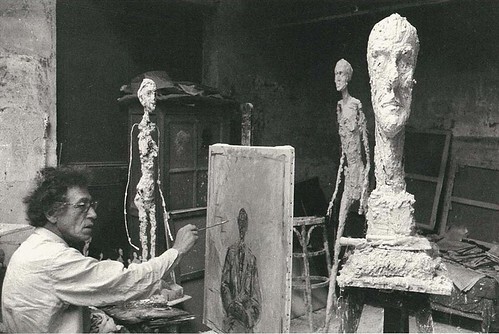
Giacometti working on his portrait of Lord
What began as a promise of a one-day session becomes a mutli-week companionship as Giacometti refuses to be satisfied with his representation of Lord, reworking the head again and again as he confesses self-doubt and dissatisfaction. He finds each attempt ‘by definition an inadequate semblance of what he visualized as an ultimately tolerable representation of reality,’ and frets over what he sees is an impossibility to truly capture anything or even finish. ‘That’s the terrible thing: the more one works on a picture, the more impossible it becomes to finish it,’ he says at times, other times claiming ‘it’s impossible ever really to finish anything,’ and those who have created art will certainly empathize with his struggles against overworking a piece versus not doing enough. I myself certainly don’t count as an artist though I do spend a lot of time painting with oil pastels and have this struggle, feeling something is not complete or adequate but worrying any additional touches will spoil the frail beauty it does capture. I think of Bob Ross episodes where you are in awe at a striking landscape he has done and then Ross says it needs one more tree and crosses the entire canvas with a thick brush stroke. “Noooooo!” you want to shout, it was perfect, now it’s marred by this additional flourish yet, a few minutes later, you see it has now become the best part of the painting and tied it all together in ways moments ago you couldn’t ever dream imaginable. When people talk about narrative tension, perhaps this is the most pure of them, knowing you should trust Bob Ross to pull it off but feeling as gashed and dashed as the painting looks the moment he adds that new line.
‘Giacometti is committed to his work in a particularly intense and total way. The creative compulsion is never wholly absent from him, never leaves him a moment of complete peace.’
There is a certain fatalism to Giacometti, seeming rather gloomy and often destroying his work (there is a moment when Lord finds him in the parking lot tearing up a pile of his drawings). And his statements on how he cannot simply move to another part of a painting before completing the head really resonated with me as that is also my struggle with anything I work on. I write these reviews in one go from the top to the bottom and find the introduction to be the hardest part, but I simply cannot just start working on the body until I finish the intro. To do so always makes the rest feel false to me. It’s like when Giacometti tells Lord ‘everything must come of itself and in its own time. Otherwise, it becomes superficial.’ I read this for my book club and we had a discussion on his complaints about futility and while some found him to be frustrating and thought whiny, I felt it was delivered more as self-deprecating humor and likely said with a half smile and not meant fully serious, the type of jokes that hint at the truth but are softened by being said jokingly. Though that comes as someone who often employs self-deprecating humor as well as a means to grapple with one's own volatile self-reflections. Lord seems to see it as a good window into Giacometti’s feelings about himself as well. ‘This constant expression of self-doubt is neither an affectation nor an appeal for reassurance,’ Lord examines about Giacometti, ‘but simply spontaneous outpouring of his deep feeling of uncertainty as to the ultimate quality of his achievement.’
‘[T]he possibility of reproducing exactly by means of brushes and pigment the sensation of vision caused by a particular aspect of reality. This, of course, is by definition an impossibility and yet for that very reason is endlessly enticing and valid.’
We see Giacometti discuss art and other artists quite frequently as well, often criticizing Cezanne and Picasso (when asked what period of Picasso’s he likes best, Giacometti curtly replies ‘none’). As to his opinions on his own work he responds:
I found great value in his thoughts on creating. ‘On might imagine,’ he tells Lord, ‘that in order to make a painting it’s simply a question of placing one detail next to another. But that’s not it. That’s not it at all. It’s a question of resting a complete entity all at once.’ He asserts that painting is not photography, and that even photography is capturing an impression of reality as opposed to “being” reality, and that art lies in the representation of the impression. He compares different styles of statue busts arguing in favor of the less perfect representations saying ‘the more you struggle to make it lifelike, the less like life it becomes. But since a work of art is an illusion anyway, if you heighten the illusory quality, then you come closer to the effect of life.’ This is an idea I really appreciate, and feel in fiction is how things like satire and magical realism, for example, often examine great truths through caricatures or distortions of reality to shake up the truth and see it from a fresh angle.
Yet we can’t forget Lord in all this, who plays an important role as the model. ‘To be present by helpless, to be involved but removed,’ Lord says ‘made me uneasy,’ and he discusses how a deep relationship between artist and model often forms. I suppose this touches on the idea of the muse, and at times one wonders if the near-refusal to complete the work might be drawing from a desire to keep Lord near for longer. ‘It is often said that artists of great talent are able, and seek, to convey not only the external appearance but also the inner nature of their models,’ Lord writes, and I find this beautiful as it probes the idea that so much more beyond the visual image is contained in a painting.
‘Everything must be destroyed. I have to start all over again from zero.’
A brief but lasting little memoir on a prolonged session with an artist, A Giacometti Portrait is a blunt little gem of portrait of both artist and model. As well as a lovely look at the act of creating and the ideas that go into it. I will certainly pull this down from my shelf in years to come to revisit some of these fantastic lines, and while it is a book about art many of the ideas can be applied to a variety of life’s pursuits.
4.5/5
If there is any true magic in the world, it is art. In its many mediums, like vibrations of sounds to build a melody, the chess moods of words towards a poem, or the collective brushstrokes to create an image, art captures emotions, narratives and, ultimately, the essence of life in an way that helps us feel more deeply through the abstract imaginings of ideas. While art can be cathartic to create and allow us to open our creative floodgates onto the world, it can also be an arduous task on the soul of an artist concerned about their abilities as a vessel from which beauty can be carried into the world, and such is the struggles of Swiss sculptor and painter Alberto Giacometti in Jame’s Lords A Giacometti Portrait. Chronicling the eighteen days Lord sat as a model for Giacometti for a portrait made with brushes and paints, Lord in turn channels anecdotes of their conversations and his observation on the artist to, in turn, create a portrait of Giacometti in words. Like the way the visuals of a painting is an opening to see into it for so much more, Lord tells us through his book that ‘to see even so little will be to see very much,’ and we are offered what reads like the window into a genius yet self-doubting and tortured artist as he grapples with his techniques ‘to show how things appear to me,’ and ‘explain in visual terms a perception of reality.’ This is a lovely book, one I completed in a single sitting but will certainly turn to again and again for it’s strikingly perceptive looks at artistry and the struggle to create something beautiful.
Giacometti working on his portrait of Lord
What began as a promise of a one-day session becomes a mutli-week companionship as Giacometti refuses to be satisfied with his representation of Lord, reworking the head again and again as he confesses self-doubt and dissatisfaction. He finds each attempt ‘by definition an inadequate semblance of what he visualized as an ultimately tolerable representation of reality,’ and frets over what he sees is an impossibility to truly capture anything or even finish. ‘That’s the terrible thing: the more one works on a picture, the more impossible it becomes to finish it,’ he says at times, other times claiming ‘it’s impossible ever really to finish anything,’ and those who have created art will certainly empathize with his struggles against overworking a piece versus not doing enough. I myself certainly don’t count as an artist though I do spend a lot of time painting with oil pastels and have this struggle, feeling something is not complete or adequate but worrying any additional touches will spoil the frail beauty it does capture. I think of Bob Ross episodes where you are in awe at a striking landscape he has done and then Ross says it needs one more tree and crosses the entire canvas with a thick brush stroke. “Noooooo!” you want to shout, it was perfect, now it’s marred by this additional flourish yet, a few minutes later, you see it has now become the best part of the painting and tied it all together in ways moments ago you couldn’t ever dream imaginable. When people talk about narrative tension, perhaps this is the most pure of them, knowing you should trust Bob Ross to pull it off but feeling as gashed and dashed as the painting looks the moment he adds that new line.
‘Giacometti is committed to his work in a particularly intense and total way. The creative compulsion is never wholly absent from him, never leaves him a moment of complete peace.’
There is a certain fatalism to Giacometti, seeming rather gloomy and often destroying his work (there is a moment when Lord finds him in the parking lot tearing up a pile of his drawings). And his statements on how he cannot simply move to another part of a painting before completing the head really resonated with me as that is also my struggle with anything I work on. I write these reviews in one go from the top to the bottom and find the introduction to be the hardest part, but I simply cannot just start working on the body until I finish the intro. To do so always makes the rest feel false to me. It’s like when Giacometti tells Lord ‘everything must come of itself and in its own time. Otherwise, it becomes superficial.’ I read this for my book club and we had a discussion on his complaints about futility and while some found him to be frustrating and thought whiny, I felt it was delivered more as self-deprecating humor and likely said with a half smile and not meant fully serious, the type of jokes that hint at the truth but are softened by being said jokingly. Though that comes as someone who often employs self-deprecating humor as well as a means to grapple with one's own volatile self-reflections. Lord seems to see it as a good window into Giacometti’s feelings about himself as well. ‘This constant expression of self-doubt is neither an affectation nor an appeal for reassurance,’ Lord examines about Giacometti, ‘but simply spontaneous outpouring of his deep feeling of uncertainty as to the ultimate quality of his achievement.’
‘[T]he possibility of reproducing exactly by means of brushes and pigment the sensation of vision caused by a particular aspect of reality. This, of course, is by definition an impossibility and yet for that very reason is endlessly enticing and valid.’
We see Giacometti discuss art and other artists quite frequently as well, often criticizing Cezanne and Picasso (when asked what period of Picasso’s he likes best, Giacometti curtly replies ‘none’). As to his opinions on his own work he responds:
‘I’m the first to think that they’re better than what anyone else does. But then I realize that that has absolutely no relation to what I hope to be able to do, so I conclude that really they’re no good at all.’
I found great value in his thoughts on creating. ‘On might imagine,’ he tells Lord, ‘that in order to make a painting it’s simply a question of placing one detail next to another. But that’s not it. That’s not it at all. It’s a question of resting a complete entity all at once.’ He asserts that painting is not photography, and that even photography is capturing an impression of reality as opposed to “being” reality, and that art lies in the representation of the impression. He compares different styles of statue busts arguing in favor of the less perfect representations saying ‘the more you struggle to make it lifelike, the less like life it becomes. But since a work of art is an illusion anyway, if you heighten the illusory quality, then you come closer to the effect of life.’ This is an idea I really appreciate, and feel in fiction is how things like satire and magical realism, for example, often examine great truths through caricatures or distortions of reality to shake up the truth and see it from a fresh angle.
Yet we can’t forget Lord in all this, who plays an important role as the model. ‘To be present by helpless, to be involved but removed,’ Lord says ‘made me uneasy,’ and he discusses how a deep relationship between artist and model often forms. I suppose this touches on the idea of the muse, and at times one wonders if the near-refusal to complete the work might be drawing from a desire to keep Lord near for longer. ‘It is often said that artists of great talent are able, and seek, to convey not only the external appearance but also the inner nature of their models,’ Lord writes, and I find this beautiful as it probes the idea that so much more beyond the visual image is contained in a painting.
‘Everything must be destroyed. I have to start all over again from zero.’
A brief but lasting little memoir on a prolonged session with an artist, A Giacometti Portrait is a blunt little gem of portrait of both artist and model. As well as a lovely look at the act of creating and the ideas that go into it. I will certainly pull this down from my shelf in years to come to revisit some of these fantastic lines, and while it is a book about art many of the ideas can be applied to a variety of life’s pursuits.
4.5/5

December 4, 2023
.
اگر اندک اندک
رنج را با نور بیامیزم
آیا گامی پیش مینهم؟
فیلیپ ژاکوته
این جستار بیش از هرچیز موید آن رنجی است که ژاکوته از آن دم میزند.رنجی فراخور هر راه و هر قدم.برای من این رنج،خاصه رنج جاکومتی ناگفتنیست و صرفا در آثار او به رخ کشیده میشود.او که در ابتدا در گروه سورئالیستها بود و هم جرگه با برتون،دالی و مکس ارنست؛ از دورهای به بعد خود را ذیل هیچ گروهی نمیدانست و به قول خودش آبسترهترین آثارش نیز به کلی آبستره نبودند و صرفا به بازنمایی محدود میشدند.جدال اصلی او بر سر کنه حقیقت و واقعیت بود که گاهی آن چنان در هم تنیده میشوند که به سختی میشود از هم تفکیکشان کرد.
جاکومتی همدورهی ژنه،مالرو و رفیق نزدیک بکت بود به طوری که درخت نمایشنامهی در انتظار گودو را نیز طراحی و برای اجرا بر روی صحنه آماده کرد.بکت در یکی از نامههایش اینطور نوشته:
جاکومتی مُرد. جورج دوین هم.آه بله، از میان نورهای سرخ مرا به گورستان پرلاشز ببر...سوی چشمانم کم شده و به زودی میمیرم که فقدان چندان بزرگی هم نیست.
ژان ژنه از دیگر دوستانش که بسیار در باب آثار او سخن گفته و حتی جستاری نسبتا بلند هم دربارهی او نوشته، در مصاحبهای میگوید: او به من آموخت که غبار را ستایش کنم.
و همچنین در کتاب << در کارگاه آلبرتو جاکومتی>> این چنین از هنر او دم زده:
این مجسمهها خودمانی هستند.در خیابانها راه میروند.اما در قعر این زمان نیز هستند. سرمنشا همهچیز هستند و دائم در حال نزدیک شدن و فاصله گرفتن.اگر نگاه من سعی داشته باشد تا آنها را رام خویشتن کند یا به آنها نزدیک شود، تا بینهایت از دید من میگریزند.
این کتاب بیهیچ فروکاستی اوی حقیقی را به هنگام آفرینش اثر هنری به نمایش میگذارد و سرخوردگی مفرطاش را از قلم زدن و به همان میزان شور و اشتیاقش را نسبت به این زجر ترسیم میکند. ایو بونفوا دوست جاکومتی که کتابی مفصل هم دربارهاش نوشته، فرآیند خلق هنری را در شعر خود این چنین به تصویر میکشد:
تو باید ویران میکردی و ویران میکردی و ویران میکردی
رستگاری جز به بهایی چنین به دست نمیآید
تو باید تباه میکردی آن چهرهی عریانی را که از درون مرمر برمیخیزد
در هم میشکستی تمامی شکلها را و هرآنچه را زیباست
باید دل میبستی به کمال چرا که جز آستانه نیست
اما باید انکارش میکردی آنگاه که شناخته میشد، فراموشش میکردی آنگاه که جان میداد
منتهای کمال، نقصان است
.
از مقدمهی کتاب
اگر اندک اندک
رنج را با نور بیامیزم
آیا گامی پیش مینهم؟
فیلیپ ژاکوته
این جستار بیش از هرچیز موید آن رنجی است که ژاکوته از آن دم میزند.رنجی فراخور هر راه و هر قدم.برای من این رنج،خاصه رنج جاکومتی ناگفتنیست و صرفا در آثار او به رخ کشیده میشود.او که در ابتدا در گروه سورئالیستها بود و هم جرگه با برتون،دالی و مکس ارنست؛ از دورهای به بعد خود را ذیل هیچ گروهی نمیدانست و به قول خودش آبسترهترین آثارش نیز به کلی آبستره نبودند و صرفا به بازنمایی محدود میشدند.جدال اصلی او بر سر کنه حقیقت و واقعیت بود که گاهی آن چنان در هم تنیده میشوند که به سختی میشود از هم تفکیکشان کرد.
جاکومتی همدورهی ژنه،مالرو و رفیق نزدیک بکت بود به طوری که درخت نمایشنامهی در انتظار گودو را نیز طراحی و برای اجرا بر روی صحنه آماده کرد.بکت در یکی از نامههایش اینطور نوشته:
جاکومتی مُرد. جورج دوین هم.آه بله، از میان نورهای سرخ مرا به گورستان پرلاشز ببر...سوی چشمانم کم شده و به زودی میمیرم که فقدان چندان بزرگی هم نیست.
ژان ژنه از دیگر دوستانش که بسیار در باب آثار او سخن گفته و حتی جستاری نسبتا بلند هم دربارهی او نوشته، در مصاحبهای میگوید: او به من آموخت که غبار را ستایش کنم.
و همچنین در کتاب << در کارگاه آلبرتو جاکومتی>> این چنین از هنر او دم زده:
این مجسمهها خودمانی هستند.در خیابانها راه میروند.اما در قعر این زمان نیز هستند. سرمنشا همهچیز هستند و دائم در حال نزدیک شدن و فاصله گرفتن.اگر نگاه من سعی داشته باشد تا آنها را رام خویشتن کند یا به آنها نزدیک شود، تا بینهایت از دید من میگریزند.
این کتاب بیهیچ فروکاستی اوی حقیقی را به هنگام آفرینش اثر هنری به نمایش میگذارد و سرخوردگی مفرطاش را از قلم زدن و به همان میزان شور و اشتیاقش را نسبت به این زجر ترسیم میکند. ایو بونفوا دوست جاکومتی که کتابی مفصل هم دربارهاش نوشته، فرآیند خلق هنری را در شعر خود این چنین به تصویر میکشد:
تو باید ویران میکردی و ویران میکردی و ویران میکردی
رستگاری جز به بهایی چنین به دست نمیآید
تو باید تباه میکردی آن چهرهی عریانی را که از درون مرمر برمیخیزد
در هم میشکستی تمامی شکلها را و هرآنچه را زیباست
باید دل میبستی به کمال چرا که جز آستانه نیست
اما باید انکارش میکردی آنگاه که شناخته میشد، فراموشش میکردی آنگاه که جان میداد
منتهای کمال، نقصان است
.
از مقدمهی کتاب

September 4, 2022
Giacometti expresses enormous self-doubt about his painterly abilities as he paints James Lord's portrait over 18 days. (It gets pretty comical: "I don't even know how to hold the brush anymore. We'll have to stop.") This is presented as doubt about his overall artistic abilities. But he is much more known for his sculpture than his painting and drawing. Would he express the same doubts specifically about sculpting? At any rate, his doubts don't seem completely off the mark here: the painting is okay, it's not great.
It is always interesting when an artist is so self-critical, particularly when the artist is seen by the world to have some spark of genius. As I read Giacometti's daily lamentations I was reminded of Carlos Kleiber's Tristan und Isolde at Bayreuth in 1976 with the great pianist Sviatoslav Richter in the audience. Richter later wrote, "I fear that as long as I live I shall never hear another Tristan like this one. This was the real thing. Carlos Kleiber brought the music to the boiling point and kept it there throughout the whole evening. There's no doubt he's the greatest conductor of our day." Richter says he went backstage to see Kleiber: "I told him what I thought and he suddenly leapt into the air with joy, like a child: 'Also, wirklich, gut?' [So it was really good?]. Such a titan, and so unsure of himself."
December 31, 2009
Another one of those books to send friends. I'm fascinated by process, and this is a perfect observation of the creative process of one of my favorite artists. The part about looking at the subject, where G tells the story about painting a Japanese man, so intensely that he forgets that he's not Japanese.... I love that: looking and becoming what you see, or part of it.
I used to (re)read the copy I'd send friends so that we could share the words...each of us being in possession of that particular script at some moment...like owning, being in possession of, I suppose "sharing" an object or piece of art with someone you care about deeply. That's when I lived in places that allowed access to buy copies easily. Now, I hardly send it to anyone, only my dearest friends, the ones I know will understand it.
I used to (re)read the copy I'd send friends so that we could share the words...each of us being in possession of that particular script at some moment...like owning, being in possession of, I suppose "sharing" an object or piece of art with someone you care about deeply. That's when I lived in places that allowed access to buy copies easily. Now, I hardly send it to anyone, only my dearest friends, the ones I know will understand it.

May 14, 2018
American writer James Lord became friends with Alberto Giacometti in the years after WWII, and in the early '60s sat for a portrait. This brief memoir recounts the 18 days that Lord spent immobile in Giacometti's Paris studio, while the artist cursed, complained, procrastinated, and gave voice to an incredible sense of self doubt about his abilities and indeed the whole prospect of art. This book provided the inspiration for the recent film "Final Portrait," but it does not contain many of the episodes from the film involving Giacometti's relationship with his wife and mistress. Lord seems too polite to dish the dirt here, but he does provide an indelible portrait of his own of the artistic process.

July 24, 2022
This is the infamous account by art critic James Lord who sat for a painting by Alberto Giacometti with the promise that it would take three hours and it somehow stretched into three weeks. The result is an account of their conversations as he posed for him, with Giacometti discussing his childhood, his art technique as well as Orson Welles-styled snipes at Picasso and The Surrealists.
Unfortunately, Giacometti's frequent lapses into self-doubt are so overwrought after awhile that he comes off as a bit of a whiner, which makes me believe that this would have made a better magazine article for The New Yorker rather than as a full-length book.
My recommendation is that you seek out the movie adaptation (!) Final Portrait, brilliantly directed by Stanley Tucci with Geoffrey Rush delivering an uncanny performance as Giacometti. It's far more entertaining, and anything with Tony Shalhoub in it is cinema gold.
Unfortunately, Giacometti's frequent lapses into self-doubt are so overwrought after awhile that he comes off as a bit of a whiner, which makes me believe that this would have made a better magazine article for The New Yorker rather than as a full-length book.
My recommendation is that you seek out the movie adaptation (!) Final Portrait, brilliantly directed by Stanley Tucci with Geoffrey Rush delivering an uncanny performance as Giacometti. It's far more entertaining, and anything with Tony Shalhoub in it is cinema gold.

Read
June 2, 2026>"but since a work of art is an illusion anyway, if you heighten the illusory quality, then you come closer to the effect of life."
>"but how do you do that?"
>"that's the whole drama."
>"but how do you do that?"
>"that's the whole drama."
January 17, 2010
I read this while in art school about 5 years ago. I give it 5 stars because I am a painter and this is such a brilliant treatise on the working artist. A rare thing to find in words that also succeeds. Giacometti was so fortunate to live where he did and to receive the support from his villagers and country. He was revered, respected, and given the freedom and time to become who he was. I think that is also a major aspect to the artists' life that is overlooked today. We don't support our artists like this any longer.

September 9, 2017
I really loved this - possibly helped by the fact that I read it in an absolutely peng bath

December 28, 2018
A good friend recommended this book in New York recently; and I gather it is a bohemian New York staple, as I saw it in a few bookstores in the East Village, Williamsburg, and Bushwick as well. That being said, my review/analysis may be first-read naive in a few ways.
There are more places where Giacometti is more relatable to me than not, especially his frustration with each piece carrying the hopes of his fulfilment followed by the inevitable downfall of his aspirations, leading into the creation of the next piece. It seems cyclical - and Lord hits the nail on the head with the Sisyphus similitude. He is a fantastic writer. Each sentence is crafted to the point of being its own vignette in one way or another, as if he feels either his subject deserves such a craft or he himself is testing the text's central premise: that a work can be highly evolved but remains necessarily imperfect anyway. The book doesn't conclude satisfyingly, but it's crafted that way on purpose. Giacometti's uncertainty, starting on just page 20-something, only grows and turns into this character in the story, whose existence that much be wrestled with is the primary take-away.
One part that really reflects a quirk of my own I've never seen in another work is the dichotomy that's acknowledged about sitting quietly in public followed by cathartic outbursts of either frustration or the desire for intellectual understanding or sympathy. Lord contextualises this as Giacometti's "suffering," yet I would love to hear another account of this quality.
My thoughts are the head carries someone's entire identity. A body is a body, but a face connotes a soul. It's impossible to paint or draw a soul, which leads into the details Lord expounds upon with this concept of semblances.
If you are looking for a book rich with fascinating ideas about the creative process that extend to any medium, this book is for you. One of my few 5-star books.
There are more places where Giacometti is more relatable to me than not, especially his frustration with each piece carrying the hopes of his fulfilment followed by the inevitable downfall of his aspirations, leading into the creation of the next piece. It seems cyclical - and Lord hits the nail on the head with the Sisyphus similitude. He is a fantastic writer. Each sentence is crafted to the point of being its own vignette in one way or another, as if he feels either his subject deserves such a craft or he himself is testing the text's central premise: that a work can be highly evolved but remains necessarily imperfect anyway. The book doesn't conclude satisfyingly, but it's crafted that way on purpose. Giacometti's uncertainty, starting on just page 20-something, only grows and turns into this character in the story, whose existence that much be wrestled with is the primary take-away.
One part that really reflects a quirk of my own I've never seen in another work is the dichotomy that's acknowledged about sitting quietly in public followed by cathartic outbursts of either frustration or the desire for intellectual understanding or sympathy. Lord contextualises this as Giacometti's "suffering," yet I would love to hear another account of this quality.
My thoughts are the head carries someone's entire identity. A body is a body, but a face connotes a soul. It's impossible to paint or draw a soul, which leads into the details Lord expounds upon with this concept of semblances.
If you are looking for a book rich with fascinating ideas about the creative process that extend to any medium, this book is for you. One of my few 5-star books.
September 3, 2022
Reread it, really fun! This quote is the whole book: When we resumed work on the painting, he immediately announced that it was going very badly again, indeed.
Throw it in the same bucket as I Paint What I Want to See as books about how paintings are less important than painting
Throw it in the same bucket as I Paint What I Want to See as books about how paintings are less important than painting

March 26, 2024
Gustoume no sentido en que foi como ver a Carmen, ou aos seus gustos e inquietudes, a través del.
Quizais algunhas veces sentiuse un pouco repetitivo, pero gustoume como achegamento á figura dun artista coma A. Giacometti.
Quizais algunhas veces sentiuse un pouco repetitivo, pero gustoume como achegamento á figura dun artista coma A. Giacometti.
September 15, 2023
muy bueno, no va a pasar a ser uno de mis favoritos, pero desde luego lo voy a recordar con cariño y estoy segura que en un futuro volveré a leerlo. Bastante real y tranquilizador.
August 8, 2024
Puede que uno de los mejores retratos de artista que haya leido jamás.
March 15, 2024
Es increíble, se lee en una tarde. Que trastornada me sentí

Read
March 31, 2021James Lord sits for a portrait by Giacometti, which becomes the occasion for Lord to write a portrait of the artist. Clever, eh? Lots of good Shlovsky-esque insights abt trying to see things as if for the first time. Lots of good Andre-esque insistence on only being as funky as your last cut.

June 15, 2023
Recently I had the good fortune to attend a showing of a collection of Alberto Giacometti’s work at the Nelson-Atkins Art Museum in Kansas City; one of the finest art museums in the world. I was intrigued by his work and learned that Giacometti is considered an existential artist. Having seen “Final Portrait” starring Geoffrey Rush as Giacometti and Armie Hammer as James Lord which is based on this book, I was intrigued by this artist and his body of work.
Giacometti was one of the most important sculptors of the 20th century. His work was particularly influenced by artistic styles such as Cubism and Surrealism. Philosophical questions about the human condition, as well as existential and phenomenological debates played a significant role in his work. Around 1935 he gave up on his Surrealist influences to pursue a more deepened analysis of figurative compositions. Giacometti wrote texts for periodicals and exhibition catalogues and recorded his thoughts and memories in notebooks and diaries. His critical nature led to self-doubt about his own work and his self-perceived inability to do justice to his own artistic vision. His insecurities nevertheless remained a powerful motivating artistic force throughout his entire life as noted by James Lord in Chapter 17, which coincides with the seventeenth (17th) day he posed for Giacometti:
“I suppose there’s no use in my saying a thing,” I said when we started work together the following afternoon.
“About what?” he asked, then added at once, “Oh, about leaving the picture as it is. That’s out!”
“All right,” I said, “go ahead and demolish it.”
He began to paint. At the beginning he seemed very optimistic. He said, “It’s really rolling along today.” And a little later, “Now I’m doing something that I’ve never done before. I have a very large opening in front of me. It’s the first time in my life that I’ve ever had such an opening.”
Anyone who knows Giacometti at all well has certainly heard him say that he has just then for the first time in his life come to feel that he is on the verge of actually achieving something. And no doubt that is his sincere conviction at the moment. But to a detached observer it may seem that the particular piece of work that provokes this reaction is not radically different from those which have preceded it. Moreover, it will in all likelihood not seem radically different from those that follow, some of which will certainly provoke the same reaction. In short, the reaction is far more an expression of this total creative attitude than of his momentary relation to any single work in progress. He might deny this, but I believe that it is true. Probably, as a matter of fact, it would be vital for him to deny it, because in the earnest sincerity of the specific reaction dwells the decisive strength of all the others, past and to come. If Giacometti cannot feel that something exists true for the first time, then it will not really exist for him at all. From this almost childlike and obsessive response to the nature and the appearance of reality springs true originality of vision.
The plot to this fascinating little book is slim but chockful of insights into Giacometti’s insecurity and artistic genius. In Paris 1964, famed sculptor Alberto Giacometti bumps into his old friend James Lord, an American critic, and asks him to be a model for his latest portrait in his studio for a couple of days. Flattered by the request, Lord complies and is told that only two days are needed to do the portrait. Giacometti lives with his wife Annette and also with his brother Diego at his studio which he also uses as a home. Giacometti also has a favorite muse whom he uses as a model and part time concubine who is the source of some tension in his home.
When the two days pass, Giacometti requests that the sittings with Lord continue for another week. Lord is busy and needs to return to his work back home, though the chance to have his portrait done by Giacometti entices him to stay. He delays his departure accordingly and puts off his writing assignments. Giacometti's progress on the portrait appears to move in starts and stops. Often he is in the habit of simply blanking out the face to start over again. Lord keeps taking photos of the progress, but the progress often is stifled when Giacometti completely rethinks his approach and restarts the portrait from scratch.
The progress on the portrait continues very slowly as one week passes into a second week and a third week. Lord is becoming concerned for the long delays with the portrait and tries to recruit Giacometti's brother to assist him in getting his brother to work a little faster, though his brother completely refuses to do anything like this knowing his brother's prickly temperament. As the portrait painting enters its final stages, Lord eventually departs for his office abroad and reflects on what to him was a firsthand witnessed account of the artistic process of Giacometti's genius of artistry at work.
Giacometti achieved exquisite realism with facility when he was executing busts in his early adolescence, Giacometti's difficulty in re-approaching the figure as an adult is generally understood as a sign of existential struggle for meaning, rather than as a technical deficit.
Giacometti was a key player in the Surrealist art movement, but his work resists easy categorization. Some describe it as formalist, others argue it is expressionist or otherwise having to do with what Deleuze calls "blocs of sensation" (as in Deleuze's analysis of Francis Bacon). Even after his excommunication from the Surrealist group, while the intention of his sculpting was usually imitation, the end products were an expression of his emotional response to the subject. He attempted to create renditions of his models the way he saw them, and the way he thought they ought to be seen. He once said that he was sculpting not the human figure but "the shadow that is cast".
Scholar William Barrett in "Irrational Man: A Study in Existential Philosophy" (1962), argues that the attenuated forms of Giacometti’s figures reflect the view of 20th century modernism and existentialism that modern life is increasingly empty and devoid of meaning. "All the sculptures of today, like those of the past, will end one day in pieces...So it is important to fashion one's work carefully in its smallest recess and charge every particle of matter with life."
Read this book and then see the movie "Final Portrait" and then get your bad ol' self to Kansas City and the Nelson-Atkins Art Museum to see one of the finest collections of this mad genius' work before it leaves. You'll be glad you did. Rock on mes Amigas & mes Amigos. 'Tis a rollicking GREAT reading life!
Giacometti was one of the most important sculptors of the 20th century. His work was particularly influenced by artistic styles such as Cubism and Surrealism. Philosophical questions about the human condition, as well as existential and phenomenological debates played a significant role in his work. Around 1935 he gave up on his Surrealist influences to pursue a more deepened analysis of figurative compositions. Giacometti wrote texts for periodicals and exhibition catalogues and recorded his thoughts and memories in notebooks and diaries. His critical nature led to self-doubt about his own work and his self-perceived inability to do justice to his own artistic vision. His insecurities nevertheless remained a powerful motivating artistic force throughout his entire life as noted by James Lord in Chapter 17, which coincides with the seventeenth (17th) day he posed for Giacometti:
“I suppose there’s no use in my saying a thing,” I said when we started work together the following afternoon.
“About what?” he asked, then added at once, “Oh, about leaving the picture as it is. That’s out!”
“All right,” I said, “go ahead and demolish it.”
He began to paint. At the beginning he seemed very optimistic. He said, “It’s really rolling along today.” And a little later, “Now I’m doing something that I’ve never done before. I have a very large opening in front of me. It’s the first time in my life that I’ve ever had such an opening.”
Anyone who knows Giacometti at all well has certainly heard him say that he has just then for the first time in his life come to feel that he is on the verge of actually achieving something. And no doubt that is his sincere conviction at the moment. But to a detached observer it may seem that the particular piece of work that provokes this reaction is not radically different from those which have preceded it. Moreover, it will in all likelihood not seem radically different from those that follow, some of which will certainly provoke the same reaction. In short, the reaction is far more an expression of this total creative attitude than of his momentary relation to any single work in progress. He might deny this, but I believe that it is true. Probably, as a matter of fact, it would be vital for him to deny it, because in the earnest sincerity of the specific reaction dwells the decisive strength of all the others, past and to come. If Giacometti cannot feel that something exists true for the first time, then it will not really exist for him at all. From this almost childlike and obsessive response to the nature and the appearance of reality springs true originality of vision.
The plot to this fascinating little book is slim but chockful of insights into Giacometti’s insecurity and artistic genius. In Paris 1964, famed sculptor Alberto Giacometti bumps into his old friend James Lord, an American critic, and asks him to be a model for his latest portrait in his studio for a couple of days. Flattered by the request, Lord complies and is told that only two days are needed to do the portrait. Giacometti lives with his wife Annette and also with his brother Diego at his studio which he also uses as a home. Giacometti also has a favorite muse whom he uses as a model and part time concubine who is the source of some tension in his home.
When the two days pass, Giacometti requests that the sittings with Lord continue for another week. Lord is busy and needs to return to his work back home, though the chance to have his portrait done by Giacometti entices him to stay. He delays his departure accordingly and puts off his writing assignments. Giacometti's progress on the portrait appears to move in starts and stops. Often he is in the habit of simply blanking out the face to start over again. Lord keeps taking photos of the progress, but the progress often is stifled when Giacometti completely rethinks his approach and restarts the portrait from scratch.
The progress on the portrait continues very slowly as one week passes into a second week and a third week. Lord is becoming concerned for the long delays with the portrait and tries to recruit Giacometti's brother to assist him in getting his brother to work a little faster, though his brother completely refuses to do anything like this knowing his brother's prickly temperament. As the portrait painting enters its final stages, Lord eventually departs for his office abroad and reflects on what to him was a firsthand witnessed account of the artistic process of Giacometti's genius of artistry at work.
Giacometti achieved exquisite realism with facility when he was executing busts in his early adolescence, Giacometti's difficulty in re-approaching the figure as an adult is generally understood as a sign of existential struggle for meaning, rather than as a technical deficit.
Giacometti was a key player in the Surrealist art movement, but his work resists easy categorization. Some describe it as formalist, others argue it is expressionist or otherwise having to do with what Deleuze calls "blocs of sensation" (as in Deleuze's analysis of Francis Bacon). Even after his excommunication from the Surrealist group, while the intention of his sculpting was usually imitation, the end products were an expression of his emotional response to the subject. He attempted to create renditions of his models the way he saw them, and the way he thought they ought to be seen. He once said that he was sculpting not the human figure but "the shadow that is cast".
Scholar William Barrett in "Irrational Man: A Study in Existential Philosophy" (1962), argues that the attenuated forms of Giacometti’s figures reflect the view of 20th century modernism and existentialism that modern life is increasingly empty and devoid of meaning. "All the sculptures of today, like those of the past, will end one day in pieces...So it is important to fashion one's work carefully in its smallest recess and charge every particle of matter with life."
Read this book and then see the movie "Final Portrait" and then get your bad ol' self to Kansas City and the Nelson-Atkins Art Museum to see one of the finest collections of this mad genius' work before it leaves. You'll be glad you did. Rock on mes Amigas & mes Amigos. 'Tis a rollicking GREAT reading life!

January 5, 2016
A marvelous little tome, which at first glance is about James Lord sitting for a portrait created by his artist friend the painter Alberto Giacometti in 1960. Like a real life Waiting for Godot, it becomes much more; a treatise on the creative arts and the limits of the same; how our creative concepts and dreams are somehow lessened through their own creative process; how the doubts and fears of an artist are much like ours, never truly vanquished and always recurring. In truth it is about life and the creative process.
A lovely timeless little dollop of humanity.
A lovely timeless little dollop of humanity.

Want to Read
September 8, 2015"I’m going to teach A Giacometti Portrait by James Lord. It’s a superb dramatization of how seeking and daring oneself to fail is at the root of creativity. And it’s an argument against the more typical, exclusive over-concern with issues of craft you see in creative writing workshops and in favor of mastering curiosity about the world and one’s materials and metaphors."
–David Biespiel, author of A Long High Whistle, is a professor at Oregon State University.
–David Biespiel, author of A Long High Whistle, is a professor at Oregon State University.

August 28, 2013
A purloined Giacometti. Under the surface of existentialist ennui and banality there is swarming what is truly to be named the repetition, desire, and male hysteria.

November 6, 2017
You get the feeling that Giacometti was playing with James Lord.
July 18, 2019
Fascinating look into the feeling of creative frustration.
September 18, 2020
I enjoyed being part of the process that such a renound artist goes through for a painting. There are many lessons inside this book for anyone in the arts.
August 7, 2022
Phenomenal

December 23, 2022
Makes me wish there was something like this written for every artist I like

June 17, 2023
I thought this was a great little read easily finished in a couple of sittings. Perhaps I finished in one sitting even - I’ve had so little time to jot a few notes - but this one deserves a little something!
It’s an interesting concept - the author (an art critic) being the subject of a painting and writing about it somewhat unbeknownst to the artist (he hints he’s taking a few notes, but doesn’t explicitly let on that he’s writing a book). They are friends before the portrait sitting and they have a relaxed and open way with each other so the reader gets the sense that you are actually getting inside the mind of the artist.
It’s a somewhat humorous mind honestly, chock-full of self-doubt. This artist is quite famous for his sculptures I believe so perhaps the mode of painting was more of a struggle. Or perhaps this is just his way. The book was fun in its ways of describing the sometimes inner agony of the creative process.
Giacometti has work at MOMA and reading this book definitely makes me look forward to going and seeing some of his work in person.
Excerpts -
“Anyway, people themselves are the only real likenesses. I never get tired of looking at them. When I go to the Louvre, if I look at the people instead of at the paintings or sculptures, then I can’t look at the works of art at all and I have to leave.”
“This, I thought, was the true Giacometti, sitting alone at the back of a cafe, oblivious to the admiration and recognition of the world, staring into a void from which no solace could come, tormented by the hopeless dichotomy of his ideal yet condemned by that very hopelessness to struggle as long as he lived to try to overcome it.”
It’s an interesting concept - the author (an art critic) being the subject of a painting and writing about it somewhat unbeknownst to the artist (he hints he’s taking a few notes, but doesn’t explicitly let on that he’s writing a book). They are friends before the portrait sitting and they have a relaxed and open way with each other so the reader gets the sense that you are actually getting inside the mind of the artist.
It’s a somewhat humorous mind honestly, chock-full of self-doubt. This artist is quite famous for his sculptures I believe so perhaps the mode of painting was more of a struggle. Or perhaps this is just his way. The book was fun in its ways of describing the sometimes inner agony of the creative process.
Giacometti has work at MOMA and reading this book definitely makes me look forward to going and seeing some of his work in person.
Excerpts -
“Anyway, people themselves are the only real likenesses. I never get tired of looking at them. When I go to the Louvre, if I look at the people instead of at the paintings or sculptures, then I can’t look at the works of art at all and I have to leave.”
“This, I thought, was the true Giacometti, sitting alone at the back of a cafe, oblivious to the admiration and recognition of the world, staring into a void from which no solace could come, tormented by the hopeless dichotomy of his ideal yet condemned by that very hopelessness to struggle as long as he lived to try to overcome it.”

April 24, 2018
"Giacometti is committed to his work in a particularly intense and total way. The creative compulsion is never wholly absent from him, never leaves him a moment of complete peace... he sometimes talks wistfully of the time when he will be able to stop working forever, when just once he will have succeeded in representing what he sees, in conveying tangibly the intangible sensation of a visual perception of reality. This is, of course, impossible, and he must certainly know it. The very measure of his creative drive is that he should longingly dream of someday being free of it... The experience of posing for Giacometti is deeply personal... The reciprocity at times seems almost unbearable. There is an identification between the model and the artist, via the painting, which gradually seems to become an independent, autonomous entity served by them both, each in his own way and, oddly enough, equally."
A beautifully drawn, intimate picture of what it was like for James Lord to pose for Alberto Giacometti in 1964. A rare perspective on creative genius. A fascinating and entertaining read.
"Through his finger as it moved, his entire being seemed to flow from him into the ideal void where reality, untouched and unknown, is always waiting to be discovered."
A beautifully drawn, intimate picture of what it was like for James Lord to pose for Alberto Giacometti in 1964. A rare perspective on creative genius. A fascinating and entertaining read.
"Through his finger as it moved, his entire being seemed to flow from him into the ideal void where reality, untouched and unknown, is always waiting to be discovered."

September 4, 2022
A required reading for class, and I can undoubtedly say, that this is an inspiration for any artist, of any medium. James Lord sits for the artist Alberto Giacometti over a course of 18 days, and gets know him in his most vulnerable setting of his art studio. They have casual conversations of suicide, murder, followed by extreme wealth and how to hide it. The conversations aren’t alarming as they are out of curiosity and all the while, Giacometti is saying spurts if wisdom about the creative process. My personal favorite being: “What’s essential is to work without any preconception whatever, without knowing what the picture is going to look like” (P.79) while this isn’t the most mystical, it’s the most valuable because it allows you to shed your standards of what you want to create, and just create.
Hopefully I finish more books over the long weekend, but I’m a bit behind in school work. Currently reading Hatchet for something light, Kitchen Confidential for something humorous, and Geek Love for something obscure.
Hopefully I finish more books over the long weekend, but I’m a bit behind in school work. Currently reading Hatchet for something light, Kitchen Confidential for something humorous, and Geek Love for something obscure.

January 5, 2020
An absolutely charming book easy to dip in and out of. The memoir lacks many of the dramatic points of Final Portrait, the film adaptation, and that is to its advantage. It appears more honest in its portrayal of Giacometti. The film portrayed a typical badly behaved male tortured genius, with elements of the Giacometti portrayed in the book. The book, refreshingly, shows a quirky old man who's a good friend, who can be a little affected at times but always knows it. The conversations between Lord and Giacometti are often funny and profound. It's an excellent glimpse into the creative process of Giacometti, and the two talk about art vs. reality, the role of the sitter, the nature of genius, and (hilariously critically) Picasso. By the end of the book I was getting anxiety about the portrait, and was sad when it was completed and the two parted ways. I recommend it especially for Giacometti fans, but I think all art lovers would enjoy it.

September 2, 2020
This is just the kind of book I like, unexpected, quirky, exploring the strange twists and turns of the creative mind. Albert Giacometti was a famous sculptor and painter, who agreed to paint the portrait of writer James Lord, who had a hunch from the start this would be a one-off sitting. And was he right! It took eighteen sittings of ups and downs with Giacometti, agonizing, cursing, berating himself, creating a near masterpiece, then tearing it up and starting all over again and agin. Part of what's so great about this book is seeing it through Lord's eyes, slightly bemused, slightly horrified, and yet always compassionate towards the artist and his muse and wanting this project to be a success. We find out in the afterward that much of the writing was done in slack moments of painting or at night back in his hotel room. This gives a freshness and immediacy to the overall work. A masterpiece!
Displaying 1 - 30 of 122 reviews