Jump to ratings and reviews
Rate this book

Collected Poems of Ted Hughes

Rate this book
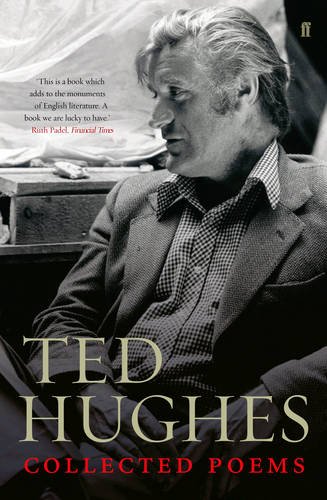
The Collected Poems spans fifty years of work, from Hawk in the Rain to the bestselling Birthday Letters. It also includes the complete texts of such seminal publications as Crow and Tales from Ovid as well as those children's poems that Hughes felt crossed over into adult poetry. Most significantly it also includes small press publications and editions that, until now, remain uncollected and have never before been available to a general readership.

Kindle Edition

First published January 1, 2003

93 people are currently reading
1725 people want to read

About the author

Ted Hughes

373 books726 followers
Edward James Hughes was an English poet, translator, and children's writer. Critics frequently rank him as one of the best poets of his generation and one of the twentieth century's greatest writers. He was appointed Poet Laureate in 1984 and held the office until his death. In 2008, The Times ranked Hughes fourth on its list of "The 50 greatest British writers since 1945".
He married fellow poet Sylvia Plath in 1956, and they lived together in the United States and then in England, in a tumultuous relationship. They had two children before separating in 1962 and Plath ended her own life in 1963.

Ratings & Reviews

What do you think?
Rate this book

Friends & Following

Create a free account to discover what your friends think of this book!

Community Reviews

5 stars
579 (42%)
4 stars
455 (33%)
3 stars
243 (17%)
2 stars
66 (4%)
1 star
26 (1%)
Displaying 1 - 30 of 43 reviews
Profile Image for Julie.
561 reviews312 followers
Read
May 4, 2018
7.5/10

Had The Birthday Letters not been included in this collection, it would have rated 8/10 stars.

For some reason, I didn't learn my lesson about not reading so many poems all-in-a-row. Once again, I sat down with my metaphorical 50-lb bag of Lay's Potato Chips and ate until even the crumbs had been licked clean. This did not result in a stomach-ache, much to my surprise -- the kind of indigestion I suffered reading 50 pounds of Neruda. Perhaps it's that Hughes and I speak the same language: by having a mainline to the cultural references, nothing suffers in translation; nothing has to be worked at, or through. His thoughts are clear, precise; his images shimmer with clarity.

Still, I don't subscribe to the popular opinion that Hughes is the best poet of the 20th century. Let's not go there. But ... he has his good moments, and even his very good moments, especially in the early years, when he lived up to half of Sylvia's avowal that he had "a voice with the thunder of God".

I like Hughes's obsessions: everything that he saw, touched, breathed, he turned into a poem. I think he was born with a pen in hand and didn't drop it until the moment he died. His mad recording of the world around him reminds me of a camera click, click, clicking away a thousand times a second, engraving the very breath of life onto "his spindrift pages" (which leaves a hint as to which poet comes much closer to being the best poet of the 20th century.)

The series of Birthday Letters to Sylvia are, for the most part, drivel. Coming as the penultimate book in this volume, it leaves the collection weak and dissipated. The self-aggrandizing, narcissistic quality of the poems leaves me not liking him very much and I wish that the editor had left the reader with a more positive reflection of Hughes; if one dwells on that series too long, in fact, it will ruin the reader's impression of Hughes altogether, and that would be a shame.

Profile Image for Paul H..
867 reviews457 followers
May 18, 2023
After spending three years reading 1,200 pages of Hughes' collected poems, I have to say, I can't actually recommend them, though a few of the individual books are definitely worth reading.

The path to this curious situation began when I read Birthday Letters and some of his translations a few years back; I was quite impressed, and figured his earlier stuff was likely even better; so instead of buying 20-25 books individually, why not spend $10 and just get everything.

It turns out that his early stuff is indeed quite good, though not as good as Birthday Letters; the quality was always high enough that I wanted to keep reading, and I figured, well, his later work must be where things get really interesting. Alas, this is also not true; his post-1980 work is definitely worse than the 1965-1980 work, though, again, there were always these flashes of brilliance.

In short, it took me quite a bit of effort to learn that Birthday Letters is actually Hughes' best work, lol. I'd say the rest, in order, are roughly as follows:

Birthday Letters, 4.5 (out of 5 stars)
Selected Translations, 4
Wodwo, 4
Flowers and Insects, 4
Hawk in the Rain, 4
Moortown Diary, 4
Crow, 3.5
Season Songs, 3.5
River, 3.5
Primer of Birds, 3
Orts, 3
Recklings, 3
Gaudete, 3
Cave Birds, 3
Remains of Elmet, 3
Prometheus on His Crag, 3
Lupercal, 3
Adam and the Sacred Nine, 3
Wolfwatching, 2.5
Howls and Whispers, 2.5
Capriccio, 2
Rain Charm for the Duchy, 2

In short, you don't need to read Hughes' Collected Poems to get the full effect; I'd say to read Hawk in the Rain, Crow, and Wodwo to get the best of early Hughes, then Moortown Diary and Flowers and Insects for later Hughes. Despite his unevenness, when Hughes is good he's really good, e.g.:

[Poor Birds]

In the boggy copse. Blue
Dusk presses into their skulls
Electrodes of stars. All night
Clinging to sodden twigs, with twiggy claws,
They dream the featherless, ravenous
Machinery of heaven. At dawn, fevered,
They flee to the field.


[Happy Calf]

With all the busyness inside him, the growing
Getting under way. The wind from the North
Marching the high silvery floor of clouds
Trembles the grass-stalks near him. His head wobbles
Infinitesmally in the pulse of his life.
A buttercup leans on his velvet hip.
He folds his head back little by breathed little
Till it rests on his shoulder, his nose on his ankle,
And he sleeps. Only his ears stay awake.


[Last Load]

As the rain begins
Softly and vertically silver, the whole sky softly
Falling into the stubble all round you
The trees shake out their masses, joyful,
Drinking the downpour.
The hills pearled, the whole distance drinking
And the earth-smell warm and thick as smoke.


[Reveille]

No, the serpent was not
One of God's ordinary creatures,
Where did he creep from,
Ths legless land-swimmer with a purpose?

Adam and lovely Eve
Deep in the first dream
Each the everlasting
Holy One of the other

Woke with cries of pain.
Each clutched a throbbing wound -
A sudden, cruel bite.
The serpent's head, small and still,

Smiled under the lilies.
Behind him, his coils
Had crushed all Eden's orchards.
And out beyond Eden

The black, thickening river of his body
Glittered in giant loops
Around desert mountains and away
Over the ashes of the future.


[Spring Nature Notes]

The crocuses too are naked. Space shakes them.
They remind you the North Sky is one vast hole
With black space blowing out of it
And that you too are being worn thin
By the blowing atoms of decomposed stars.


[Peartree]

Yellow and peach pink --
A transluence of late October
Thinner day by day
Reveals what's not there.

And even his worse poems have individual lines or images that are just off-the-charts amazing (these are just a few that I marked):

The scarves of dew, the wet hair of nightfall

The mesh of soft-edged shadows

A sea full of moon-ghost, with mangling waters

And straightened into sun-darkness / like a pillar over Athens

Oceanic windy dawn

The dove came, her voice of thunder / a piling heaven of silver and violet

A calculus / woven by atoms on a lost warp of sunlight

The angler golden to the knees / the steeple at anchor on the river of honey

A frost-frail amethyst

However, the problem with Hughes is that out of his ~1000 or so poems, I'd say not more than ~250 are worth reading even once, and maybe 50 are worth reading more than once, versus the greatest poets (imo, Basho, Buson, Rilke, Holderlin, Mallarme, Eliot, Sappho, Meng Ch'iao, a few others), where the vast majority of their poems reward near-infinite rereading, and their hit-to-miss ratio is very impressive . . . I actually don't think that I actively dislike ANY of Buson's poems? Maybe a few?

So Hughes' inconsistency is a problem, but his repetitiveness is even worse. I get that poets are going to return to the same themes throughout their career (Li Po and wine, Keats and love, Dickinson and mortality, Mary Oliver and, uh, the lake behind her house?), but Hughes is really repetitive.

If you take twenty of W. S. Merwin's books, there's a certain similarity but he also covers the full range of human experience and culture; with Hughes, his published work hits the same handful of themes over and over and over and over again (moors, birds, animals, rivers, chthonic imagery, pagan religion, etc.), at times coming across as a parody or pastiche.

And often Hughes' imagery is weirdly jumbled, a barrage of incoherent mythological images (blood, hair, hooves, antlers, teeth, bones, dung, roots, stones, etc.), the language is overdone, there are too many layers of opacity and metaphors, etc. (We can see this as well in his book on Shakespeare, a cacophonous mess of over-reading.) For example:

And so, Firstman wept on his rock of hunger
And the Mother Of All Things wept.
Her tears fell. Only her tears fell. Nothing could be born.
Only the tears fell, freezing as they fell

Faltering over the earth
Herding towards Firstman 'We love you, we love you.'

They licked at his mouth. They nuzzled his eyes.
They nestled into his hands.

But the Fox grinned in heaven.

Man's cry sharpened. The snow deepened.

Yeah, your guess is as good as mine. Or also:

At the Festival of Unending
In the fleshly faith
Of the Mourning Mother
Who eats her children

The cantor,
The rock,
Sings.

To be clear, this isn't like Hart Crane or whoever, where if you read the poem fifty times you can figure it out; Hughes is just throwing fragments of ideas at the wall and hoping they stick. It's sort of halfway evocative as pure imagery, but does not really 'work' as poetry.

Curiously, much of Hughes' best work was unpublished (during his lifetime), and these poems are collected in various interstitial sections in Collected Poems. These B-sides are mainly impressive because you finally see him addressing something other than "the giddy orgasm of the river" or "the loftiest, spermiest passions" or "the tree of sexual death, sacred with lichens" (all actual lines from his poetry), etc.

The B-sides deal with, you know, everything else -- history, art, love, memory, autobiography, etc., all of the usual things that are addressed in poetry. Obviously Hughes never found a way to collect these disparate works into a coherent whole, but a published edition of his B-sides would be his second or third best book of poetry, I think.

Seeing his uncollected poems helps to explain why Birthday Letters is so good, incidentally; in both cases Hughes gets out of his own way and writes about something deeply personal. In Birthday Letters he is addressing another human being (his deceased wife, Sylvia Plath) and therefore is able to escape his own head; Plath also inspired Hughes' second most interesting work, Crow, which is probably not a coincidence.

Anyway, the best individual poems, i.e. the only ones that I really went overboard in terms of marginalia in my copy of Collected Poems, are, imo (chronological order):

"The Hawk in the Rain"
"The Horses"
"September"
"Wind"
"The Casualty"
"November"
"Reveille"
"Ballad from a Fairy tale"
"Bedtime Anecdote"
"Green Mother"
"As I Came, I Saw a Wood"
"Two Trees at Top Withens"
"Shackleton Hill"
"The Ancient Briton Lay Under His Rock"
"Cock-crows"
"Poor Birds"
"Sheep"
"The Day He Died"
"Sky Furnace"
"Fort"
"Fishing the Estuary"
"Japanese River Tales"
"A Violet at Lough Aughresberg"
"Source"
"The Last of the 1st/5th Lancashire Fusiliers"
"Anniversary"
"Paris 1954"

Then basically everything in Birthday Letters, especially "Moonwalk," "The Bird," and "Daffodils."
Profile Image for Robert.
827 reviews44 followers
October 13, 2013
Ted Hughes is probably the greatest British post-WWII poet and possibly the best of the 20th Century. He would have been significant if he had only ever produced his debut collection, The Hawk in the Rain, in which he rescued nature observation from the Romantics, bringing a post-Darwinian sensibility to foxes, horses, hawks, jaguars and more. Subsequent collections continued this theme with robust, sometimes brutal language deployed to acheive his aims. The a-moral savagery of the Hawk Roosting represents a pinacle of this type of poem which he continued to write late into his career, despite the pessimism of the Monster constantly asked to "repeat that."
Poems about plants and animals are not all he will be remembered for - far from it: he brought us Crow, the Trickster God of Pacific Northwest native American tribes, creating myths for the 20th Century. Taking a contemporary Western cultural mileiu of secular anthropology, humanity viewed through the eyes of animal behaviourists, technology and evolution again, Hughes produces miniature legends of a confused, violent Black Beast and a God that dispairs of him, that encapsulate truths of our contemporary world neatly, many with a twisted, often acidicly ironic kink in their tail feathers.

THIS REVIEW HAS BEEN CURTAILED IN PROTEST AT GOODREADS' CENSORSHIP POLICY

See the complete review here:

http://arbieroo.booklikes.com/post/33...
Profile Image for Ilze.
639 reviews28 followers
May 10, 2008
This is a very valuable book. It not only contains the uncollected work of the poet laureate, but includes poems out of Howls and Whispers of which only a limited number of copies were printed by the Gehenna Press. As widower of Sylvia Plath and Assia Wevill (who both committed suicide), Hughes is able to express anger about what happened but also beauty when he finds himself in nature. Who else would come up with this picturesque phrase for butterflies: “Wings wide open to tight-closed to flat open” – you can see the motion of the insect in the sun – or the “hot stink of fox” that made Hughes famous?! It is the kind of image use that you will find throughout this book. There are critics who believe that some of Hughes’ work is “appalling” (e.g. “Lovepet”), but who can blame them? Anger and unconscious elements do have ugly parts in them.

By contrast, let's not forget the Trees
I whispered to the holly ...
There was a rustle of answer - dark,
Dark, dark, a gleamer recoiling tensely backward
Into a closing nest of shattered weapons,
Like a squid into clouds of protection.
I plucked a spiny leaf. Nothing protested.
Glints twitched, watched me.

...

Trees, it is your own strangeness, in the dank wood,
Makes me so horrifying
I dare not hear my own footfall.
Profile Image for Jim Coughenour.
Author 4 books228 followers
June 3, 2011
I'm astonished every time I settle down with this book. Hughes is my favorite English postwar poet (well, unless you count Thom Gunn). For a couple decades I was prejudiced against him because I read The Savage God at an impressionable age. Then one afternoon I picked up a slim volume of his selected poetry in a Vancouver bookstore. I read his Crow poems; I was transfixed right there in the aisle of Chapters, blocking polite Canadians from browsing. I was floored.

Crow's First Lesson

God tried to teach Crow how to talk.
“Love,” said God. “Say, Love.”
Crow gaped, and the white shark crashed into the sea
And went rolling downwards, discovering its own depth.

“No, no,” said God. “Say Love. Now try it. Love.”
Crow gaped, and a bluefly, a tsetse, a mosquito
Zoomed out and down
To their sundry flesh-pots.

“A final try,” said God. “Now, Love.”
Crow convulsed, gaped, retched and
Man’s bodiless prodigious head
Bulbed out onto the earth, with swivelling eyes,
Jabbering protest —

And Crow retched again, before God could stop him.
And woman’s vulva dropped over man’s neck and tightened.
The two struggled together on the grass.
God struggled to part them, cursed, wept —

Crow flew guiltily off.


Hughes is a savage god.

This collection is edited by Paul Keegan in completely satisfying edition, including The Birthday Letters. Fine stuff. Hughes wrote poetry with hot blood and sharp intelligence flowing through its lines.

Something else is alive
Beside the clock's loneliness
And this blank page where my fingers move.


Profile Image for Laura.
27 reviews9 followers
August 16, 2008
I rate this as one of my best buys of 2008. For your money (£17.99 for the paperback) you get an absolutely enormous tome of work. Even though I have read most of TH's poetry in the individual volumes, I feel that I never fully appreciated them until I read them again in this book.

TH often revisited certain events in his poetry, usually after many years, expanding on themes and emotions. As this collection is so wonderfully edited (Faber) it is easy to link up poems on the same subject but written decades apart. There are some poems which many will be unfamiliar with due to a limited original release.

I ended up reading the whole HUGE book in a few days, so impressive is the style of the work, and I still dip into it from time to time. I feel that Hughes was one of our greatest poets and it is sad that in the public's eyes, perhaps his relationship with Plath overshadows his work, preventing due appreciation for a truly great poet and modern voice.
Profile Image for Xio.
256 reviews1 follower
June 20, 2008
wow wow I am smitten and awestruck. A dear friend was reading some of the poems early saturday afternoon as I lay on his bed watching the light...

This one.

Tractor


The tractor stands frozen an agony
To think of. All night
Snow packed its open entrails. Now a head-pincering gale,
A spill of molten ice, smoking snow,
Pours into its steel.
At white heat of numbness it stands
In the aimed hosing of ground-level fieriness.

It defied flesh and won't start.
Hands are like wounds already
Inside armour gloves, and feet are unbelievable
As if the toe-nails were all just torn off.
I stare at it in hatred. Beyond it
The copse hisses - capitulates miserably
In the fleeing, failing light. Starlings,
A dirtier sleetier snow, blow smokily, unendingly, over
Towards plantations Eastward.
All the time the tractor is sinking
Through the degrees, deepening
Into its hell of ice.

The starting lever
Cracks its action, like a snapping knuckle.
The battery is alive - but like a lamb
Trying to nudge its solid-frozen mother -
While the seat claims my buttock-bones, bites
With the space-cold of earth, which it has joined
In one solid lump.

I squirt commercial sure-fire
Down the black throat - it just coughs.
It ridicules me - a trap of iron stupidity
I've stepped into. I drive the battery
As if I were hammering and hammering
The frozen arrangement to pieces with a hammer
And it jabbers laughing pain-crying mockingly
Into happy life.

And stands
Shuddering itself full of heat, seeming to enlarge slowly
Like a demon demonstrating
A more-than-usually-complete materialization -
Suddenly it jerks from its solidarity
With the concrete, and lurches towards a stanchion
Bursting with superhuman well-being and abandon
Shouting Where Where?

Worse iron is waiting. Power-lift kneels
Levers awake imprisoned deadweight,
Shackle-pins bedded in cast-iron cow-shit.
The blind and vibrating condemned obedience
Of iron to the cruelty of iron,
Wheels screeched out of their night-locks -

Fingers
Among the tormented
Tonnage and burning of iron

Eyes
Weeping in the wind of chloroform

And the tractor, streaming with sweat,
Raging and trembling and rejoicing.

Ted Hughes


Profile Image for Chris.
170 reviews174 followers
December 25, 2013
Ted Hughes, author of The Iron Man (later to changed to “The Iron Giant”), has easily become one of my favorite poets of all time. He takes such a close, hard look at life, and speaks so very honestly and bravely. He does exactly what a poet ought to be doing: speaking passionately, imaginatively, complexly, uniquely, and relatably about life. He doesn’t relish being misunderstood and passed over by the masses, as some poets do. I can keep up with much of it, but not so easily that I get bored.
Probably the most well-known books in this anthology of his collected poetical works are Crow, Wodwo, and Birthday Letters.

Crow is a collection of poems in which a crow, a metaphor or totem for the author, sets out on a carnal, dissective, and visceral probing into the meaning of life and death. The crow often functions as a questioner of life and God, epitomizing the author himself at times; while at other times the crow is the incarnation of life, death, death-in-life, suffering, and an unconscious, bestial absurdity growing into consciousness. This is by far my favorite book of poems in his collected works. The close examination of life in all of its filth, cruelty, danger, and beauty is so incredibly raw and direct, and in some way this ability to stare into the abyss, bordering on morbidity, earns the trust of the reader. “This is how he kept his conscience so pure/ He was black/ (Blacker/ Than the eyepupils/ Of the gunbarrels.)” Brute observation balanced with impassioned, imaginative reportage is what Hughes excels at. His perspective includes the darkest places he’s found on earth, and blends despair and horror with the beauty and awe of a terrifyingly mixed universe into a worldview that preserves the tension and ultimately reveals a gyrating harmony of good and bad which most definitely characterizes human reality. Many of the poems sound like nonsense on first look; but the crude, jutting imagery and phantasmagoric chain of events are mesmerizing. I sense that they are mysterious and profound, even when I don’t fully understand.

My favorite poems from Crow: Crow’s First Lesson, A Kill, The Battle Of Osfrontalis, Examination At The Womb Door (BEST!), Crow’s Account Of The Battle, Oedipus Crow, The Smile, Crow Blacker than Ever, Revenge Fable, Crow and Stone, Lovesong, Two Eskimo Songs: Fleeing From Eternity, I See a Bear, and Crow the Just.

Wodwo, meaning “wildman” in old English, is a collection of miscellaneous poems which includes the eponymous poem “Wodwo.” Their themes are random, which I love this in a book of poems, but the motif of finding one’s way through the universe is still prevalent and masterful. Favorites: Ghost Crabs, Boom, Public Bar T.V., A Vegetarian, Sugar Loaf, Theology, Song Of A Rat, Skylarks, You Drive In A Circle, Pibroch, The Howling Of Wolves, Gnat Psalm, and Wodwo.

Birthday Letters is a collection of poems that Hughes which orbit the theme of his relationship with Sylvia Plath. It was an obviously turbulent liaison for both parties, and I can’t imagine the impact this sort of strain must have had on the children. Plath had battled clinical depression for years with constant follow-up by physicians, especially in her final days. She moved into her own apartment with their two kids when she learned Hughes was having an affair. Probably as a result of her long history battling depression and several botched suicide attempts, and the heartache about Hughes’ infidelity, Plath committed suicide at the age of 30 by sticking her head in an oven and turning on the gas. She died of carbon monoxide poisoning. She had sealed the doors between herself and her sleeping children with wet towels, opened their windows and placed bread and milk in their room. Plath’s history of depression notwithstanding, many still blame Hughes for Plath’s death. An especially committed band of protesters have periodically vandalized and effaced the headstone Ted erected for his wife’s grave because Hughes’ name appears on it (“[they] bite the face off her gravestone”), and each time Hughes had it repaired. Six years after Plath’s suicide, his mistress named Assia Wevill, whom Hughes left Plath for and was only one of several affairs he would develop in his lifetime, killed herself in the same way Plath had, but deepened the wound grievously by asphyxiating along with herself the 4-year-old daughter Hughes and Wevill had together. And the train wreck of Hughes’ life continued when in 2009, 11 years after Hughes’ death, Hughes’ and Plath’s son committed suicide by hanging himself.

The Birthday Poems poems offer a very intimate glimpse of the impetuous and volatile relationship between Hughes and Plath, two emotionally taut and over reactive poets of great genius. Their mental/emotional processes are so inscrutable to the common person (“I had accepted/ The meteor logical phenomena/ That kept your compass steady.”), and it makes some of their struggles appear melodramatic and petty to many onlookers. Add to that Plath’s clinical depression, possibly the by-product of an anxiety disorder, the newly developed/late-adopted drugs and methods to treat anxiety and depression, the pressures of genius and fame (“you will have paid for [fame] with your happiness”), the British post-war economy (“the stink of fear was still hanging in the wardrobes”), and Hughes’ infidelity, and one can better understand the manic states and vitriolic interactions in Plath and Hughes’ history which characterize the poems of Birthday Letters. Some of them are indeed best understood in light of the Hughes/Plath saga, but much can be understood on their own. And some, like many of his poems, can’t be properly understood at all, but must be felt.

To be honest, Birthday Letters does feel a bit mundane in parts and lacked some thrust. Perhaps it functioned more as an autobiography or was simplified as an apologetic for the public, but I felt a significant difference between this and his other poems. It could be he found it to be an exhausting but propitiatory labor, and he felt he owed it to Sylvia, himself, his children and the public not to obscure the events leading to/from Sylvia’s death with his own theatrics. He had, in fact, burnt some entries of Plath’s journal before publishing it to protect the children, so his reserve may still have been motivating him, even though Birthday Letters was published so many years later. The poems are Hughes handiwork to be sure, full of imagination and passion, but they lack a certain boldness, in my opinion, which might be due to being fueled by guilt.

My favorite poems from Birthday Letters are: God Help the Wolf after Whom the Dogs Do Not Bark, Fever, The Gypsy, The Lodger, The Table, Dream Life, The Rabbit Catcher, The Bee God, Being Christlike, Dreamers, Fairy Tale, The Blackbird, Robbing Myself, The Cast, Life After Death, and The Dogs Are Eating Your Mother.

From the stories people tell about the life of Hughes, I’m not so sure I celebrate the poet as I do the poetry. I have no problem snapping off this bejeweled finger from the rot of a despicable man’s life. It is incredible and soul-illuminating. The anthology of collected poems published in 2005 is massive, and I have enjoyed every bit of it. It is cud for a lifetime. Okay, that’s nasty, but…you know what I’m saying.
10 reviews
December 14, 2009
The third part of the poem Out by Ted Hughes, Remembrance Day


The context of this poem is 11th November, Remembrance Day, the day the armistice of the First World War was made in 1918. Ted Hughes’s father and many other Yorkshire men fought in the war taking part in the Gallipoli battle, being one of the few survivors of it. The poem has three separate parts and it is written in 1967, but Hughes has told that when he started to write poetry after 1945, he wrote a great deal about his father’s war experience (Skea 2009). His father was a farmer and a shop-keeper and the poem alludes to farming. Hughes was also an admirer of Wilfred Owen’s First World War poetry (ibid.). Canadian John McCrae’s In Flanders Fields (1915) was a famous First World War poem must also be mentioned as an idealistic war poem which brought poppies as a symbol for the Great War into general consciousness.
Hughes attempts to tear down the entire institution of remembering war and all the violent memories of it. The poem has many forceful metaphors and words. Poppies are usually worn as a buttonhole on the Remembrance Day. Hughes elaborates the flower theme very intensively: the poppy becomes a lifeless canvas puppet (line 4, it is often is made of paper or cloth), then metamorphoses into a sea-anemone (line 19, a flesh-eating animal masquerading as a flower). In addition, the poppy with its red color and a round shape functions as a metaphor for the wound (1), the mouth of the grave (1-2), a searching womb (2) and its habitual use on Remembrance Day is depicted as whoring everywhere (5). Hughes thus feminizes and personifies a rather conventional ornament into predatory femininity or into an abysmal symbol for war and death. The word puppet has a connotation: it can be attributed to a woman in a derogatory manner. It may be that the homeland as a mother who requires sacrifices from its sons also affects the imagery.
The poem starts with a parallelism of the poppy is---the poppy is ((1), then the abrupt turn into female symbolic with womb (2) takes place, making an internal alliterative rhyme with wound (2). There is intensification, a growth into an aposiopesis marked by a dash after maybe a womb searching— aposiopesis means breaking off as if unable to continue (2). Then the image of the flower whoring is presented, and the first part of the poem ends after a caesura (4) with a short cleft statement: It is years since I wore a one.
In the second part of the poem Hughes narrates his father’s war experience, its affect to his mother and to him in a long 60-word sentence.
The “metal” metaphors start to evolve from shrapnel which evolves into plough, iron and anchor, all indicating a general heaviness and a bind to war that extends to the next generation. There is a slight hint of biblical swords into plowshares , although this time the plough does not bring spiritual peace. There is repetition and parallelism in this sentence (gripped me, gripped all his dead, the dead meaning his father’s fallen comrades, lines 7, 8) as well as harsh sounds, a dissonance of r and s (shrapnel, shattered, gripped) as well as assonance of o (no more, outgrow, iron, line 9). You can also detect an alliteration of sh in the shrapnel that shattered and a dactyl of shattered. The mother’s worry about their farming livelihood with his depressed husband is one more allusion to oppressive females, it is in a simile like iron (i.e. the war memories) Hung deeper than refreshing of the ploughs /In the woe-dark under my mother’s eye— (9-11). There is another aposiopesis here.
With a line break in the phrase One anchor/ Holding my juvenile neck into the dunkings of Atlantic Hughes gives emphasis to One anchor (12-13). The element of sea and water is now introduced, the image is not anymore of Hughes’s young father in the First World War, but Hughes’s own young life repressed by the war memories, as if in a danger of drowning.
In the last part, Hughes takes a very thorough farewell of the war by using short, imperative sentences and yet manages to allude hauntingly to Robert Graves’s famous First World War autobiography Goodbye To All That (1929). Hughes makes three parallel goodbyes: to that bloody-minded flower (14), to the cenotaphs on my mother’s breasts (16), to all the remaindered charms […:] (17). Between these imperatives or strong wishes he paraphrases the Bible (Matth.8:22): The dead bury the dead (15). As the paraphrase is more imperative than the original Bible verse, let the dead bury the dead, the effect is nearly as evocative as the strong word bloody-minded. The b and d resonance is heavy in Goodbye to that bloody-minded flower; The dead bury the dead, like spitting the words. A cenotaph is an empty grave (usually with a statue) in the homeland for those who were left in the battlefield or are buried into foreign ground. Carrying such a memento as a brooch or as a necklace or carrying charms for her husband’s survival may have been a habit of Hughes’s mother’s or a general habit. There is again a great deal of harsh dissonance of r and s in cenotaphs on my mother’s breasts (note the plural breasts, usually in singular, it is yet one more female element) and the remaindered charms of my father’s survival.
Then he continues to state: Let England close. Let the green sea-anemone close. The patriotic causes are no good (England) when compared to the violent heritage they create, and the flower must stop eating. As Hughes himself has interpreted the meaning of this poem as a breaking away from the earlier generation and its chagrins and experiences (Skea 2009), I get a sense of some necessary realization of truth or of a needed action, as in the fierce urgency of now (Martin Luther King 2009) or even in Hamlet’s meditation on time and providence, which are always present, whereas the readiness is all (Shakespeare 1996: 710). The poem works as a ritual or as an exorcism of heavy inheritance—and yet it is very skillfully structured and it has many fine details put together artistically. .

References:
Graves 2009. The biography of Robert Graves. Retrieved from http://www.poets.org/poet.php/prmPID/193 7th Nov 2009
John McCrae 2009. In Flanders Fields. Retrieved from http://en.wikipedia.org/wiki/In_Fland... 7th Nov 2009
Martin Luther King 2009. I have a dream. Retrieved from http://www.americanrhetoric.com/speec... 7th Nov 2009
Shakespeare W. 1996. The Complete Works of William Shakespeare. The Wordsworth Editions: Ware.
Skea 2009. The Ted Hughes Homepage: Ted Hughes at the Adelaide Festival Writers' Week, March 1976. Retrieved from http://ann.skea.com/Adelaide.htm 7th Nov 2009


Profile Image for Zara.
4 reviews
May 25, 2015
THE THOUGHT-FOX

I imagine this midnight moment’s forest:
Something else is alive
Beside the clock’s loneliness
And this blank page where my fingers move.

Through the window I see no star:
Something more near
Though deeper within darkness
Is entering the loneliness:

Cold, delicately as the dark snow,
A fox’s nose touches twig, leaf;
Two eyes serve a movement, that now
And again now, and now, and now

Sets neat prints into the snow
Between trees, and warily a lame
Shadow lags by stump and in hollow
Of a body that is bold to come

Across clearings, an eye,
A widening deepening greenness,
Brilliantly, concentratedly,
Coming about its own business

Till, with a sudden sharp hot stink of fox
It enters the dark hole of the head.
The window is starless still; the clock ticks,
The page is printed.
Profile Image for Chad.
27 reviews8 followers
May 13, 2008
I like Ted
but he's dead
nevertheless
this book is well read

This is why I am not a poet!
Profile Image for Pascale Petit.
Author 48 books130 followers
December 29, 2010
A vast tome of a book full of treasures, contains all my favourites plus extra uncollecteds.
Profile Image for Toby.
766 reviews29 followers
May 23, 2020
It's taken me seventeen months at an average rate of about three poems a day, but I have finally read my way through Ted Hughes' collected poems. Coming straight after reading my way through Thomas Hardy's collected poems, the time is now for rather shorter works.

Reading through an entire collection of one poet's work has its advantages - you start to feel yourself into his poetic imagination, you see the recurring themes and the changes of direction. On the other hand you can weary yourself. I read this collected poems before reading Jonathan Bates' biography which felt a bit of a chicken and egg decision. I will appreciate the biography more, knowing the poetry, but I would have also appreciated more of the poetry knowing some biographical context.

With any volume of poetry this size, there are mountains and valleys, peaks and troughs. The danger would be to work out some mathematical average to rate it (3.5 stars maybe. Perhaps 4) but that would seem to do an injustice to the absolute splendour of the best of Ted Hughes work in here. Five stars seems right.

The heights of the collection start straightaway (after the inevitable juvenilia) with the Hawk in the Rain. The title poem of which sets up much of Hughes' style - the Anglo-Saxon rhythms and word-usage ("I drown in the drumming ploughland, I drag up/Heel after hell ...") and the combined lyricism and savagery that looks towards Crow and Moortown Diary. Hawk in the Rain takes on Manley Hopkins and his Windhover, using the language but stripping out the religion and re-assigning the beauty.

We then see some rather mixed collections, where cleverness seems to take over from the lyrical and the experiential. Lupercal and Gaudate did nothing for me. Crow is great up to the point where it begins to feel rather repetitious. Heights are surmounted again with Remains of Elvet (my own personal favourite) and Moortown Diary - contrasting collections which befit contrasting landscapes but again wonderfully combine acute observation of landscape and rural life with the bleak realities that the West Yorkshire moors and a North Devon farming community present to those who cling on to their livelihoods in the face of a harsh climate and brutal nature. The poetry up to his final burst is mostly of high quality until at least, he was cursed by being made poet laureate and produced some of the worst in the collection. Does the Queen read anything produced by her laureates? I can't imagine her making head or tail of this.

Finally we reach the astonishing late poems of Tales from Ovid and Birthday Letters, the latter of which must surely have a claim to be the among the best English poetry of the second half of the Twentieth Century. Added to them, and only available in the collected works are the eleven poems in Howls and Whispers which failed to make the cut in Birthday letters, but are still greatly moving and beautifully written, especially The Offer where Sylvia Plath appears to him in a vision three times in the months after her death. The first of those poems, Paris 1954 seems to take us back to where we began (chronologically and thematically) with the lyrical description of a young man in a Paris café tasting for the first time claret and Gruyère ("He will spend the rest of his life/Trying to recapture the marvel") before the final two lines of the first stanza ("He could never imagine, and can't hear/The scream that approaches him.").
Profile Image for Domhnall.
459 reviews374 followers
March 9, 2018
This is a beautiful edition which, despite its size, is a pleasure to use. In addition to the published books in order of publication, there are a huge number of "uncollected" poems, many of which are excellent. Stories and prose are not included, which in the case of Woodwo (perhaps also other books) are considered by Ted Hughes himself to be an essential part of that work and need to be read alongside the poems. For this reason and for comfort, it is still sometimes more appealing to read from the separate volumes, but that rather depends on how many we can really expect to own. Contents pages, and indices of poem titles and of first lines, make it easy to track poems down; they are especially valuable when reading this collection alongside a biography of the poet, as I did.

To review a lifetime's work by such a major poet would be far too challenging. His nature poetry is stunning, and dominates the collection. In Crow,he has established an extraordinary vehicle for philosophizing which will not be unravelled easily. In Tales from Ovid he has brought to life two dozen ancient stories which are riveting and deeply evocative. In Birthday Letters, he undertakes an examination of his relationship with Sylvia Plath which he worked on for as much as 25 years and only published when close to his death. It is perfectly possible to read through this huge collection, albeit a lot of material to digest, because the style is both beautiful and accessible, but to explore it at all seriously is likely to be an ambitious project.

Profile Image for Ameythist Moreland.
Author 4 books5 followers
April 23, 2024
Excellent. The imagery and turn of phrases are beautiful and haunting. A few of my favorite excerpts (honestly there are so many though, I picked randomly from my list of bookmarks).

The Others:
“She had too much so with a smile you took some.
Of everything she had you had
Absolutely nothing, so you took some.
At first, just a little."

Folktale
“He did not know she had risen out of cinders.
She knew he had nothing.
So they ransacked each other.”

Mayday
“Cuckoo jinked in – sleight of a conjurer –
Dowsed with a hawk-fright crucifix
Over the brambly well of the nest-bird’s eye
And left its shadow in the egg.”


Where shall I put my hand

“All this machinery
Is just lumber
Till you start work.

And when you start –
In no time, it produces
A new world.
Hurry, hurry, my love, my love,
I rest, I rust.

Soon enough I start falling to pieces.”
Profile Image for Claudia.
335 reviews34 followers
April 2, 2018
Great UK poetry of postwar 20th Century. It does feel like it too in my view. This is a great edition containing Hughes' early poetry, letters, et.al. Amazing collection of poetry. I am often amazed at Hughes' capacity to weaving together intertwined complexities to deliver beautiful poetry. The hardships of the author, writing at unforgiving hours, The fish and the pike, the moon and his tale of love and so much more. Worth a read for those of us who haven't yet read him. Outstanding author.
Profile Image for Penn Kemp.
Author 19 books48 followers
April 17, 2023
On Friday the thirteenth 12023 I open
to the poem, “Friday the thirteenth
Prestidigitateur

May find odds and ends, even for you.
Maybe Frigga’s
Two-faced gift.”

Ted Hughes, Collected Poems

as I start reading Euphoria for
Sylvia.
Friday, January 13, 2023

Profile Image for Robbie  Josephs.
14 reviews
May 16, 2021
Got about a 1/5 in but just couldn’t get into it. Maybe one to save for the future.
Profile Image for Tim Chamberlain.
115 reviews19 followers
Read
March 11, 2017
Alas, I've abandoned this one ...

Enjoyed 'Hawk in the Rain' but got my hoof stuck in the cattle-grid of 'Crow' and didn't make it to the undoubtedly rich pastures that lie beyond.

Maybe I'll come back this way one day yet, when I have more time.
Profile Image for Diann Blakely.
Author 9 books48 followers
Read
March 11, 2012
Farrar, Straus and Giroux immediately followed Robert Lowell’s COLLECTED POEMS with a similarly magisterial edition of Hughes's work. Poetry purists may grumble that the timing of the Hughes volume, which coincides with that of the movie SYLVIA, betrays a crass commercialism. It’s important to note, however, that apart from Philip Larkin, Hughes is the most famous poet to emerge from post-war England, and Hughes’ collected work, while sui generis, was in the company of some of that’s best poetry-related books. October saw the arrival of the paperback edition of WINTERING (Anchor Books), Kate Moses’ dazzling fictional rendition of Plath’s last months, told in chapters that correspond to the original ARIEL; Lydia Bundtzen’s THE OTHER ARIEL (University of Massachusetts Press), a more scholarly but infinitely readable and engaging work on the same subject; and HER HUSBAND (Viking), Diane Wood-Middlebrook’s top-flight literary biography of Hughes focused on his years with Plath. Last but hardly least is GIVING UP (St. Martin’s), Jillian Becker’s devastating account of Plath’s last days, which she spent with the Becker family, and her funeral. Among such books, and of particular local interest, is CROW STEERED, BERGS APPEARED, a memoir by Lucas Myers, a graduate of the University of the South. After meeting Hughes in Cambridge and starting a magazine with him, Myers became the future British Poet Laureate’s lifelong friend.

The last has been re-issued by Five Leaves / Richard Hollis Press in England as AN ESSENTIAL SELF: TED HUGHES AND SYLVIA PLATH. Accompanything them are Daniel Huws' MEMORIES OF TED HUGHES: 1952-1963; Daniel Weissbort's TED HUGHES AND TRANSLATION, which is an indispensable addition not only to translators, but all scholars and poets interested in *process*; and also Susan Alliston's POEMS AND JOURNALS: 1960-1969: INTRODUCTION BY TED HUGHES. Before I even noticed a particular journal entry, I saw--and heard--yet another effort at "channelling Sylvia," just as that attempted by Assia Guttman Wevill.

"11 February 1964"

One year ago, in the morning, Sylvia died ...
Sylvia--my poems--some of them modelled on yours (ie [sic] making certain pages & at its beginning (big things) and at the end, somewhere in Paris. P-----why didn't we meet? I am neither as extreme gifted nor as honest as you. We are, in spite of [Hughes's] saying I talked as if I married to him, completely different people. But this stupid propensity to identify me with you--I am nothing beside you. I wish you were alive."

This is the same woman with whom Hughes spent the weekend before Plath's suicide, or attempt-gone-wrong. Despite the use of words such as "abnormal" or other pejorative terms about Plath's mental health in Anne Stevenson's biography, also its memoirs (one was written by Myers), one begins to ask questions about British Bloke Misogyny, not to mention the issue of narcissistic personality disorder. And it's not to Plath I'd say "j'accuse." What kind of man, after all, leaves one woman for another and then makes himself unavailable for 72 hours at a time he knows her to be in extreme distress, to have sex with a third?


Profile Image for Leanna.
142 reviews
July 6, 2010
I was hoping to love Ted Hughes, as I'd heard about his preoccupation with animals and myth, two poetic interests that I share. Also, I've fallen in love with Sylvia Plath this summer, which further piqued my interest in him. After spending some time with his Collected, I think I like his poetry, but am not in love with it. The books "Crow," "Season Songs," "Moortown Diary," and "Birthday Letters" stood out to me the most. Another reason I thought Ted Hughes would be up my alley is because I know he liked and was influenced by Eastern European poets; he wrote an introduction to one of Vasko Popa's collections, and I love Popa. But in many ways "Crow" seemed like an imitation of Popa's style--using a malevolent animal as a protagonist in some sort of how-the-world-was-created poetic series. Crow is definitely an intriguing character--he can be repulsive, destructive, enigmatic. But I wanted more "crowness"--it sometimes seemed like "crow" could have been replaced with any other animal with no repercussions. Also, while the nastiness and outsiderness of Crow intrigued me, I think Popa did it better--his poems, perhaps in their compression, or their more oblique relationship to religion, or perhaps in their sly sense of humor--simply cut me to the quick more.

"Season Songs" and "Moortown Diary" seemed similar to me in that the books compile poems about farmlife. I was totally into the gory stories Hughes told about birthing calves, and the interior lives of sheep, and that kind of thing. Still, while intriguing, it didn't seem all that original to me--there was some sort of Roethkian tone in there, or something, that I felt like I'd heard before.

So, yeah, still mulling Hughes over, but I have to say I was kind of disappointed. I was surprised by a misogynistic tone that popped up now and again, but more than that, I was just a little bored! I think I was hoping he would be wilder. Or maybe I was secretly hoping he'd be more like Plath. Or maybe I missed a more personal tone/presence.

I think I can take away one thing from him, and that's how crazy he can get with some of his animal portraits--he veers away from the more characteristic traits into unusual territory, and I often enjoyed his flexibility in how he chose to describe an animal.

I was really taken with "Birthday Letters" but I want to spend more time with it before I comment. Thoughts TK on that.
Profile Image for Nicky.
4,138 reviews1,113 followers
June 6, 2008
One day, I'm going to read Hughes' Collected Poems alongside Plath's.

The section of most interest to me was "Birthday Letters". I found it the most accessible to start with, and steadily worked through it. Some of those are a punch in the gut! I like the one about when Sylvia had a fever and kept complaining that she was going to die, and the poem says something about if she keeps crying wolf, he won't know when things are really bad.
Profile Image for Chris.
103 reviews30 followers
December 15, 2010
Enduring

Something in you that was not meant to die:
A voice we never knew we had
Uttering out of the bowels of earth
Its taut, Yorkshire vowels,
Its own sturdy music.
Uncompromising in your ambivalences
Half nihilist, half priest,
Carrying nature’s indifference like a crucifix;
Surviving the hell of your passions
And leaving us words so charged,
So lovingly held:
Like sacraments through which we access
Ancient futures.


this was my elegy for TH after his death
1,219 reviews2 followers
August 3, 2015
I received this book as a first read. Hughes wasn't the poet that Plath or other contemporaries were but still wrote some decent stuff. The early poetry was more stream of consciousness style. I enjoyed the later poetry which was more of the storytelling variety. The appendix with notes on the poems was highly informative and added a lot of context. A nice collection to own or gift.
Displaying 1 - 30 of 43 reviews

Can't find what you're looking for?

Get help and learn more about the design.