

What do you think?

The Age of Grievance
From bestselling author and longtime New York Times columnist Frank Bruni comes a lucid, powerful examination of the ways in which grievance has come to define our current culture and politics, on both the right and left.The twists and turns of American politics have become nearly impossible to predict, but the tone is a troubling given. It’s one of grievance. A perilous share of Americans across the full breadth of the political spectrum respond to every big disappointment, every little frustration, every way in which the world doesn’t hew precisely to their liking by deciding that they’ve been wronged, identifying the people responsible for that and raging at the injustice of it all. The blame game is the country’s most popular sport and victimhood its most fashionable garb. Grievance isn’t always and necessarily bad. It has often done enormous good. The United States is a nation born of grievance, in the revolt of royal subjects unwilling to accept a bad deal, and across the nearly 250 years of our existence as a country, grievance has been the engine of morally urgent change. But what happens when all sorts of grievances—the greater ones, the lesser ones, the authentic, the invented—are jumbled together? When grievances become all-encompassing lenses, all-purpose reflexes, default settings? When people take their grievances to extreme and even violent lengths that they didn’t before? A mob storms the US Capitol, rejecting the results of a presidential election and embracing the fiction that it was rigged. Conspiracy theories flourish. Politicians appeal not to our better angels but to our worst impulses, encouraging selfishness instead of selflessness, trading inspiration for retribution. Fox News, the country’s most watched cable news network, and Tucker Carlson, its sneering star, knowingly peddle lies in the service of profit. The Supreme Court loses touch with the country, overturning Roe v. Wade and shrugging off Clarence Thomas’s transgressions. College students chase away speakers and college administrators dismiss instructors for dissenting from progressive orthodoxy. Will Smith slaps Chris Rock. And there’s a potentially devastating erosion of the civility, common ground and compromise necessary for our democracy to survive. How did we get here? What does it say about us, and where does it leave us? Timely, important, and enlightening, The Age of Grievance examines these critical questions and charts a path forward for a nation that may be growing tired of outrage.
290 pages, Kindle Edition
First published April 30, 2024
About the author
Frank Bruni
16 books260 followersFrank Bruni was named restaurant critic for The New York Times in April 2004.
Before that, Mr. Bruni had been the Rome bureau chief from July 2002 until March 2004, a post he took after working as a reporter in the Washington D.C. bureau from December 1998 until May 2002. While in Washington, he was among the journalists assigned to Capitol Hill and Congress until August 1999, when he was assigned full-time to cover the presidential campaign of Gov. George W. Bush. He then covered the White House for the first eight months of the Bush administration, and subsequently spent seven months as the Washington-based staff writer for The New York Times Sunday Magazine.
Mr. Bruni is the author of The New York Times bestseller about George W. Bush called Ambling into History (HarperCollins: hardcover, 2002; paperback, 2003). He is also the co-author of A Gospel of Shame: Children, Sexual Abuse and the Catholic Church.
Before that, Mr. Bruni had been the Rome bureau chief from July 2002 until March 2004, a post he took after working as a reporter in the Washington D.C. bureau from December 1998 until May 2002. While in Washington, he was among the journalists assigned to Capitol Hill and Congress until August 1999, when he was assigned full-time to cover the presidential campaign of Gov. George W. Bush. He then covered the White House for the first eight months of the Bush administration, and subsequently spent seven months as the Washington-based staff writer for The New York Times Sunday Magazine.
Mr. Bruni is the author of The New York Times bestseller about George W. Bush called Ambling into History (HarperCollins: hardcover, 2002; paperback, 2003). He is also the co-author of A Gospel of Shame: Children, Sexual Abuse and the Catholic Church.
Ratings & Reviews
Friends & Following
Create a free account to discover what your friends think of this book!
Community Reviews
Displaying 1 - 30 of 315 reviews

March 23, 2024
I need everyone to read this book, delete at least one social media app from their phones, and chill the hell out.
May 26, 2024
I almost passed on this book. Given the stress of our times, why would I want to read another book about how broken and dysfunctional we are as a country? I mean, talk about banging one's head against a wall. After a short time and a few sample pages, however, I decided to stay with “The Age of Grievance.” I respect Frank Bruni and I wanted to hear what he has to say. I’m very glad I did. It’s a hell of a book that deserves a large audience open to hearing what he's saying.
Before I continue, I will stipulate from the beginning that I agree with Bruni. Not everyone will, of course. I speak for no one else.
Briefly stated, Bruni’s argument is that we have become a culture of non-stop grievance, resentment, and anger. This dysfunction feeds on itself and is fed by people who benefit from its existence for political or financial gain, power, out of an excess of idealism, or simply because grievance gets attention. It takes away our ability to think clearly and act rationally, to be at peace with ourselves or to connect and listen to each other.
Bruni captures it well, I think: I have watched that vast sociopolitical psychosis… degrade some of my friends’ and acquaintances’ mental health as they doomscroll and shitpost (how do we even have these neologisms, let alone these phenomena?) the days away… We’ve lost the ability to control how much of our lives we surrender to grievance and to declare some areas off-limits. In short, with our non-stop tantrums and cries of Foul! and Unfair! and Hurt!, we have made for ourselves “an era of mass immaturity.”
Grievance, Bruni writes, is not in itself a dirty word. There are in the world many righteous grievances and outrages worthy of condemnation. Indeed, “The United States is a nation born of grievance, in the revolt of royal subjects unwilling to accept a bad deal, and we’re hardly the only democracy brought into being by rightly aggrieved people recognizing and refusing to accept inequality and exploitation.”
But: “Not all grievances are created equal," Bruni says, "and not all expressions of grievance raise identical concerns. Some don’t raise any at all. There are wildly disproportionate outbursts, mildly disproportionate outbursts, and ones called defensibly and even commendably to their trigger.”
“Part of what’s so striking about the current state of political play,” he continues, “... is the directness and fierceness of the competition between Republicans and Democrats, conservatives and liberals, people on the right and people on the left, for the Grievance Bowl’s Lombardi Trophy.” It's exhausting -- emotionally, psychologically, culturally -- and corrosive. And both sides -- all sides -- are at fault.
Bruni points to non-stop manufactured outrage on the Right. There’s Trump with his “American carnage” and “stolen election” and, well, just about everything he says. And Sean Hannity seething about illegal aliens getting all the baby formula. And Tucker Carlson making an earnest documentary warning American men that the Elites “want you to be fat, sick, depressed and isolated” (how to treat the threat of the Left’s attack on men and masculinity? Carlson prescribed “testicle tanning,” because of course he does). And DeSantis and Disney, and riots over the removal of Confederate statues, and… need I go on?
As a political strategy, of course, outrage works very well. So well, in fact, that the strategy has been adopted at virtually every level of government, from state legislature to school board. Mac Warner, for example, the Republican secretary of state in West Virginia, set up a “See Something, TEXT Something” program designed to expose the vast number of people voting illegally. Bruni’s response: When I learned of that, I was disgusted: voter fraud is an invented panic. I was impressed: Warner had nonetheless found a clever way to clamber aboard that bandwagon. But I was above all baffled: How do you spot illegal voting? Do you use binoculars, as with bird-watching? “Look, sweetheart, there’s an American goldfinch—and there’s a Honduran migrant with a stack of fraudulent ballots in his backpack!”
Grievance is expressed differently on the Left, but it's just as powerful. We are told to be mindful of what we say, that our words must not be harmful, and that we should be sensitive to one another’s hurts, real and potential, that one’s “feelings” always matter. Laudable goals, to be sure, but some of it goes over the edge. Outrage in academic quarters over language, for example, led Johns Hopkins University in June 2023 to develop a “glossary” for how to talk about LGBTQ matters. A “lesbian,” the reader/researcher is told, is “a non-man attracted to non-men.” Similarly, Stanford University developed an “Elimination of Harmful Language Initiative” with 150 words and phrases to be avoided. Among them: “brave,” “basket case,” “rule of thumb,” and “hip-hip hooray.” Even the Associated Press jumped in, recommending that their reporters avoid “general and often dehumanizing ‘the’ labels such as the poor, the mentally ill, the French…”
The impulse to police language is personal for Bruni. He lost most of his vision in one eye a few years ago and is at elevated risk of going blind in the other. “Every time I stumble across some tsk-tsk about doing away with “blind study” because it’s cruel to me," he writes, "I want to scream. It’s not. It’s a succinct and evocative metaphor—nothing more.”
There is no shortage of truly vile and hateful language, Bruni says, citing the 2017 Unite the Right rally in Charlottesville, Virginia, as one example among others. But: To go by a new cadre of antiracism evangelists, we essentially breathe white supremacist air, and the only real fix would be reinventing and rebuilding our societies from scratch. How is that a sellable, workable action plan? I’m an American football fan, so please forgive the American football metaphor: It moves the goal posts not just dauntingly far downfield but to a whole other end zone in a whole other stadium in a whole different ZIP code. They’re unreachable.
Bruni (himself a columnist for The New York Times) assigns more than a little blame to what he calls the “all-Armageddon-all-the-time news media.” Data analysis has repeatedly shown that opinion pieces draw more clicks than well-researched news reports and analyses, and so media outlets feed the craving. Today’s journalism, he writes, “puts considerably greater emphasis on problems than on solutions, amplifies conflict while shrugging at conciliation…, and takes a five-alarm-fire approach to minor blazes as well as raging infernos. In a crowded marketplace, in a jangled world, five-alarm fires seem to generate the most discussion and garner the most clicks, so our breathlessness can be attributed as much to consumers—without whom we lack the revenue to provide any news, sunny or stormy—as to us.”
Doubtless there are people who will be angered by “The Age of Grievance.” Or offended. They will say that Bruni is insensitive to the sufferings of this group or that, or too far to the Right or Left, or the unwitting victim of some socio-cultural pathology, or an example of precisely what one side or the other is criticizing. However, as Bruni points out, multiple polls and research show that Americans on both the Left and the Right are tired of the divisiveness, of having to be constantly on guard against inadvertently saying the wrong thing, of toxic politics. He offers a number of ideas and suggestions about how to counter the aggrieved spirit of our times. He also acknowledges that it won't be easy. But the problems we face as a nation — as a species — are very real and complex, and none of them can be solved by manufactured anger and performative outrage. If we’ve allowed ourselves to be infantilized as he says, we have to change how we think of ourselves and how we interact with one another.
He offers two quotes I found compelling and useful, if taken seriously. The first is from journalist Krista Tippett: “I don’t actually think we are equipped, even physiologically or mentally, to be delivered catastrophic and confusing news and pictures, 24/7. We are analog creatures in a digital world.” This strikes me as very right. We have no natural defenses against what social media and the internet are throwing at us. Quite the opposite, in fact: our brains evolved to respond first to immediate threats, and when our environment is flooded all the time with threat, we're stuck in a dark and unproductive place. So we must come up with defenses of our own devising.
The second quote is from comedian Chris Rock, who has himself been a victim of the grievance demon: “If everybody claims to be a victim, when the real victims need help, ain’t nobody going to be there to help them, okay? And right now, we live in a world where the emergency room is filled up with motherfuckers with paper cuts.”
This sounds right too. The question is, is the din of grievance too loud for the call for reason to be heard? Bruni offers a number of suggestions about what we might do.
My thanks to Avid Reader Press / Simon & Schuster and Edelweis+ for providing a digital ARC in return for an honest review.
Before I continue, I will stipulate from the beginning that I agree with Bruni. Not everyone will, of course. I speak for no one else.
Briefly stated, Bruni’s argument is that we have become a culture of non-stop grievance, resentment, and anger. This dysfunction feeds on itself and is fed by people who benefit from its existence for political or financial gain, power, out of an excess of idealism, or simply because grievance gets attention. It takes away our ability to think clearly and act rationally, to be at peace with ourselves or to connect and listen to each other.
Bruni captures it well, I think: I have watched that vast sociopolitical psychosis… degrade some of my friends’ and acquaintances’ mental health as they doomscroll and shitpost (how do we even have these neologisms, let alone these phenomena?) the days away… We’ve lost the ability to control how much of our lives we surrender to grievance and to declare some areas off-limits. In short, with our non-stop tantrums and cries of Foul! and Unfair! and Hurt!, we have made for ourselves “an era of mass immaturity.”
Grievance, Bruni writes, is not in itself a dirty word. There are in the world many righteous grievances and outrages worthy of condemnation. Indeed, “The United States is a nation born of grievance, in the revolt of royal subjects unwilling to accept a bad deal, and we’re hardly the only democracy brought into being by rightly aggrieved people recognizing and refusing to accept inequality and exploitation.”
But: “Not all grievances are created equal," Bruni says, "and not all expressions of grievance raise identical concerns. Some don’t raise any at all. There are wildly disproportionate outbursts, mildly disproportionate outbursts, and ones called defensibly and even commendably to their trigger.”
“Part of what’s so striking about the current state of political play,” he continues, “... is the directness and fierceness of the competition between Republicans and Democrats, conservatives and liberals, people on the right and people on the left, for the Grievance Bowl’s Lombardi Trophy.” It's exhausting -- emotionally, psychologically, culturally -- and corrosive. And both sides -- all sides -- are at fault.
Bruni points to non-stop manufactured outrage on the Right. There’s Trump with his “American carnage” and “stolen election” and, well, just about everything he says. And Sean Hannity seething about illegal aliens getting all the baby formula. And Tucker Carlson making an earnest documentary warning American men that the Elites “want you to be fat, sick, depressed and isolated” (how to treat the threat of the Left’s attack on men and masculinity? Carlson prescribed “testicle tanning,” because of course he does). And DeSantis and Disney, and riots over the removal of Confederate statues, and… need I go on?
As a political strategy, of course, outrage works very well. So well, in fact, that the strategy has been adopted at virtually every level of government, from state legislature to school board. Mac Warner, for example, the Republican secretary of state in West Virginia, set up a “See Something, TEXT Something” program designed to expose the vast number of people voting illegally. Bruni’s response: When I learned of that, I was disgusted: voter fraud is an invented panic. I was impressed: Warner had nonetheless found a clever way to clamber aboard that bandwagon. But I was above all baffled: How do you spot illegal voting? Do you use binoculars, as with bird-watching? “Look, sweetheart, there’s an American goldfinch—and there’s a Honduran migrant with a stack of fraudulent ballots in his backpack!”
Grievance is expressed differently on the Left, but it's just as powerful. We are told to be mindful of what we say, that our words must not be harmful, and that we should be sensitive to one another’s hurts, real and potential, that one’s “feelings” always matter. Laudable goals, to be sure, but some of it goes over the edge. Outrage in academic quarters over language, for example, led Johns Hopkins University in June 2023 to develop a “glossary” for how to talk about LGBTQ matters. A “lesbian,” the reader/researcher is told, is “a non-man attracted to non-men.” Similarly, Stanford University developed an “Elimination of Harmful Language Initiative” with 150 words and phrases to be avoided. Among them: “brave,” “basket case,” “rule of thumb,” and “hip-hip hooray.” Even the Associated Press jumped in, recommending that their reporters avoid “general and often dehumanizing ‘the’ labels such as the poor, the mentally ill, the French…”
The impulse to police language is personal for Bruni. He lost most of his vision in one eye a few years ago and is at elevated risk of going blind in the other. “Every time I stumble across some tsk-tsk about doing away with “blind study” because it’s cruel to me," he writes, "I want to scream. It’s not. It’s a succinct and evocative metaphor—nothing more.”
There is no shortage of truly vile and hateful language, Bruni says, citing the 2017 Unite the Right rally in Charlottesville, Virginia, as one example among others. But: To go by a new cadre of antiracism evangelists, we essentially breathe white supremacist air, and the only real fix would be reinventing and rebuilding our societies from scratch. How is that a sellable, workable action plan? I’m an American football fan, so please forgive the American football metaphor: It moves the goal posts not just dauntingly far downfield but to a whole other end zone in a whole other stadium in a whole different ZIP code. They’re unreachable.
Bruni (himself a columnist for The New York Times) assigns more than a little blame to what he calls the “all-Armageddon-all-the-time news media.” Data analysis has repeatedly shown that opinion pieces draw more clicks than well-researched news reports and analyses, and so media outlets feed the craving. Today’s journalism, he writes, “puts considerably greater emphasis on problems than on solutions, amplifies conflict while shrugging at conciliation…, and takes a five-alarm-fire approach to minor blazes as well as raging infernos. In a crowded marketplace, in a jangled world, five-alarm fires seem to generate the most discussion and garner the most clicks, so our breathlessness can be attributed as much to consumers—without whom we lack the revenue to provide any news, sunny or stormy—as to us.”
Doubtless there are people who will be angered by “The Age of Grievance.” Or offended. They will say that Bruni is insensitive to the sufferings of this group or that, or too far to the Right or Left, or the unwitting victim of some socio-cultural pathology, or an example of precisely what one side or the other is criticizing. However, as Bruni points out, multiple polls and research show that Americans on both the Left and the Right are tired of the divisiveness, of having to be constantly on guard against inadvertently saying the wrong thing, of toxic politics. He offers a number of ideas and suggestions about how to counter the aggrieved spirit of our times. He also acknowledges that it won't be easy. But the problems we face as a nation — as a species — are very real and complex, and none of them can be solved by manufactured anger and performative outrage. If we’ve allowed ourselves to be infantilized as he says, we have to change how we think of ourselves and how we interact with one another.
He offers two quotes I found compelling and useful, if taken seriously. The first is from journalist Krista Tippett: “I don’t actually think we are equipped, even physiologically or mentally, to be delivered catastrophic and confusing news and pictures, 24/7. We are analog creatures in a digital world.” This strikes me as very right. We have no natural defenses against what social media and the internet are throwing at us. Quite the opposite, in fact: our brains evolved to respond first to immediate threats, and when our environment is flooded all the time with threat, we're stuck in a dark and unproductive place. So we must come up with defenses of our own devising.
The second quote is from comedian Chris Rock, who has himself been a victim of the grievance demon: “If everybody claims to be a victim, when the real victims need help, ain’t nobody going to be there to help them, okay? And right now, we live in a world where the emergency room is filled up with motherfuckers with paper cuts.”
This sounds right too. The question is, is the din of grievance too loud for the call for reason to be heard? Bruni offers a number of suggestions about what we might do.
My thanks to Avid Reader Press / Simon & Schuster and Edelweis+ for providing a digital ARC in return for an honest review.

February 4, 2025
4.5.
I thoroughly enjoyed this, and agreed with almost every word.
I think a good portion of us would, from both sides of the political divide, as it's hard not to see that we have become an era & a people known for being offended. I appreciate that Bruni made a point of recognizing the good intentions behind a lot (not all) of these viewpoints, but how does the saying go? The road to hell is paved with good intentions?
To summarize: in American culture, a new way of thinking has sprouted from the seeds of these good intentions, where we have this idea that as Americans we are owed not just the freedom to capitalize on all our opportunities, but rather that we are all of us owed the American dream on a platter, and if we don’t have it we are being robbed of something that we are entitled to & that mentality has everyone searching for someone or something to blame for the things we don’t have, and as we move further and further away from personal responsibility and accountability, from all that the age of grievance is born. Bruni pointed out things like how resentment used to be a thing that people aimed to rid themselves of bc of the way that it’s poison had the power to contaminate and corrupt all aspects of our lives, whereas now we almost revel in it. It has become not just a part of our identity but what defines it. This rush to locate and remove every potentially hurtful or traumatic thing has bred a generation that feels entitled to a life free from offense, and where initially we may have simply sought to protect ourselves and each other from harm and unfairness, somewhere along the way intentions mutated & it’s become one giant blame game, where naming and castigating the offender has taken priority over protecting the offended, and little by little our grievances have come to shape who we are and how we live, and the only path away from this is for us to recognize the collective error of our ways and for us all to desire to find and to meet on common ground.
To me all of this makes perfect sense, as I personally don’t consider myself to be part of the oft aggrieved, from my perspective it all has the potential to be quite simple. We all have some choice when it comes to what & how we let things affect us. When we actively hunt for reasons to take offense to something, then we find them, & if we don’t desire to be offended by things or to dwell on offenses, then we won’t. But in a culture that relishes victimhood & celebrates the victimized, grievances are basically currency, & the notion of “live and let live” nothing but a distant memory.
That’s not to say that there aren’t masses and masses of people that have reason to feel mistreated, shit on, & forgotten, as there are no doubt parts of our system that are so deeply broken that one can understand why one might think the only way to make things better is to burn it all to the ground and begin anew. BUT. This is still a democracy, the world’s first true melting pot, & everyone is entitled to their opinions—even shitty ones—& the result of that is that sometimes some of us will inevitably be offended by them. It may be annoying, it may not be pretty, we may feel that it’s universally WRONG, but the right to cause offense is as much a part of our government as the right to take offense, and this idea that some people seem to have gotten, that they are entitled to a life free from offense & have the right to go after anybody who stirs within them the slightest twinge of umbrage or pang indignation, is just as un-american as opposing diversity, or immigration. Free speech is a core American ideal, & we should be teaching our children how to deal with people when we’re faced with clashing ideologies, how to hold our personal values steadfast in the face of dissonance & discord while respecting another’s right to do the same. What we shouldn’t be doing is going after people for not adhering to our personal ideas of what’s right & wrong. Being inclusive is about ensuring everyone is given the same rights, not about forcing a collective morality on a people. Nor should it be about shaming, & condemnation. In this age of micro-aggressions & pronouns, intersectionality & cancel culture, virtue signaling and WOKENESS, our author fears that what initially began with good intentions has now been degraded & corrupted into some obsession with blame, resentment, & bitterness, where acceptance has warped into something wholly antithetical, a climate and culture of gleeful Schadenfreude. One does not fight intolerance with intolerance, we cannot teach tolerance by being intolerant, & we cannot fight hate with hate. All that these things earn us is more hate.
At times it was hard to read Bruni’s words even as I agreed with them because what could be so simple, isn’t. It’s hard to imagine a country and a society that chooses to come together as compatriots, it just seems so far from where we are now that it doesn’t even seem feasible. How can we completely recalibrate an entire people‘s mind? How can we re-teach a generation? How can we backtrack, and then make the choice to go down a different path?
One thing I did appreciate was that Bruni wrote past the point of articulating our societies issues and gave all kinds of ideas and ways in which to implement these ideas. He wasn’t just saying we’re all way too sensitive, he also explained ways that we might learn to be otherwise in a way that’s fair to everyone. I very much appreciated the sentiment overall, but I still have to actively fight feeling jaded, & overwhelmingly weary. Because as the saying goes, where there’s a will there’s a way….the problem is that I question if there’s even a will. Finding common ground is no longer a priority, it’s all about calling people out, & proving the other wrong. One would certainly not be remiss to question whether any living generations are still even within our power to change, have we bred a people that have a capacity for change that monumental?? Or are we simply a society so divided that we are lost to each other, all of us hurtling towards our inevitable reckoning? Are we heading towards a civil war? The end of American supremacy? The crumbling of American democracy? Are we to be the ones that prove to the world that this beautiful, optimistic experiment of a melting pot of people united in their commitment to American ideals is hopeless, & was always destined to fail? God, I sure hope not, but if we have learned anything from this last decade it’s that we are not the immortal colossus of might that we have always believed ourselves to be. Even unsinkable ships sometimes sink if the iceberg is big enough. There is so much at stake here, & we all have so very much to lose.
There were moments that I felt that I could feel his political opinions sullying the otherwise clear and reasonable waters of what was being said, but overall I thought he presented a pretty balanced and fair assessment of the various behaviors contributing to our present cultural identity & I felt in him a genuine desire to see both the flaws & the potential in everyone. I'm glad I picked this up, it feels a bit like a call to action, some flint with which to ignite a spark. It sure made me want to try, to do anything other than give in to the urge to see it as impossible, to just take the easier route and bury my head in the sand. I can feel the compulsion to dismiss Bruni and his entire book as unrealistic & idealistic, to smack a hopeless label on the lot of us and call it a day….but I choose to hope. To hope that we can do better, to hope that most of us want to, to hope that it's possible to find our way back to a place and a time when we were driven by courage, & optimism & a love for our country, when we felt solidarity with our fellow Americans regardless of political party, & when we still possessed antiquated things like a sense of community and nationalistic pride. I have to hope, I just have to, bc the alternative will break my heart.
Here's hoping 🤞🏼🤞🏼
I thoroughly enjoyed this, and agreed with almost every word.
I think a good portion of us would, from both sides of the political divide, as it's hard not to see that we have become an era & a people known for being offended. I appreciate that Bruni made a point of recognizing the good intentions behind a lot (not all) of these viewpoints, but how does the saying go? The road to hell is paved with good intentions?
To summarize: in American culture, a new way of thinking has sprouted from the seeds of these good intentions, where we have this idea that as Americans we are owed not just the freedom to capitalize on all our opportunities, but rather that we are all of us owed the American dream on a platter, and if we don’t have it we are being robbed of something that we are entitled to & that mentality has everyone searching for someone or something to blame for the things we don’t have, and as we move further and further away from personal responsibility and accountability, from all that the age of grievance is born. Bruni pointed out things like how resentment used to be a thing that people aimed to rid themselves of bc of the way that it’s poison had the power to contaminate and corrupt all aspects of our lives, whereas now we almost revel in it. It has become not just a part of our identity but what defines it. This rush to locate and remove every potentially hurtful or traumatic thing has bred a generation that feels entitled to a life free from offense, and where initially we may have simply sought to protect ourselves and each other from harm and unfairness, somewhere along the way intentions mutated & it’s become one giant blame game, where naming and castigating the offender has taken priority over protecting the offended, and little by little our grievances have come to shape who we are and how we live, and the only path away from this is for us to recognize the collective error of our ways and for us all to desire to find and to meet on common ground.
To me all of this makes perfect sense, as I personally don’t consider myself to be part of the oft aggrieved, from my perspective it all has the potential to be quite simple. We all have some choice when it comes to what & how we let things affect us. When we actively hunt for reasons to take offense to something, then we find them, & if we don’t desire to be offended by things or to dwell on offenses, then we won’t. But in a culture that relishes victimhood & celebrates the victimized, grievances are basically currency, & the notion of “live and let live” nothing but a distant memory.
That’s not to say that there aren’t masses and masses of people that have reason to feel mistreated, shit on, & forgotten, as there are no doubt parts of our system that are so deeply broken that one can understand why one might think the only way to make things better is to burn it all to the ground and begin anew. BUT. This is still a democracy, the world’s first true melting pot, & everyone is entitled to their opinions—even shitty ones—& the result of that is that sometimes some of us will inevitably be offended by them. It may be annoying, it may not be pretty, we may feel that it’s universally WRONG, but the right to cause offense is as much a part of our government as the right to take offense, and this idea that some people seem to have gotten, that they are entitled to a life free from offense & have the right to go after anybody who stirs within them the slightest twinge of umbrage or pang indignation, is just as un-american as opposing diversity, or immigration. Free speech is a core American ideal, & we should be teaching our children how to deal with people when we’re faced with clashing ideologies, how to hold our personal values steadfast in the face of dissonance & discord while respecting another’s right to do the same. What we shouldn’t be doing is going after people for not adhering to our personal ideas of what’s right & wrong. Being inclusive is about ensuring everyone is given the same rights, not about forcing a collective morality on a people. Nor should it be about shaming, & condemnation. In this age of micro-aggressions & pronouns, intersectionality & cancel culture, virtue signaling and WOKENESS, our author fears that what initially began with good intentions has now been degraded & corrupted into some obsession with blame, resentment, & bitterness, where acceptance has warped into something wholly antithetical, a climate and culture of gleeful Schadenfreude. One does not fight intolerance with intolerance, we cannot teach tolerance by being intolerant, & we cannot fight hate with hate. All that these things earn us is more hate.
At times it was hard to read Bruni’s words even as I agreed with them because what could be so simple, isn’t. It’s hard to imagine a country and a society that chooses to come together as compatriots, it just seems so far from where we are now that it doesn’t even seem feasible. How can we completely recalibrate an entire people‘s mind? How can we re-teach a generation? How can we backtrack, and then make the choice to go down a different path?
One thing I did appreciate was that Bruni wrote past the point of articulating our societies issues and gave all kinds of ideas and ways in which to implement these ideas. He wasn’t just saying we’re all way too sensitive, he also explained ways that we might learn to be otherwise in a way that’s fair to everyone. I very much appreciated the sentiment overall, but I still have to actively fight feeling jaded, & overwhelmingly weary. Because as the saying goes, where there’s a will there’s a way….the problem is that I question if there’s even a will. Finding common ground is no longer a priority, it’s all about calling people out, & proving the other wrong. One would certainly not be remiss to question whether any living generations are still even within our power to change, have we bred a people that have a capacity for change that monumental?? Or are we simply a society so divided that we are lost to each other, all of us hurtling towards our inevitable reckoning? Are we heading towards a civil war? The end of American supremacy? The crumbling of American democracy? Are we to be the ones that prove to the world that this beautiful, optimistic experiment of a melting pot of people united in their commitment to American ideals is hopeless, & was always destined to fail? God, I sure hope not, but if we have learned anything from this last decade it’s that we are not the immortal colossus of might that we have always believed ourselves to be. Even unsinkable ships sometimes sink if the iceberg is big enough. There is so much at stake here, & we all have so very much to lose.
There were moments that I felt that I could feel his political opinions sullying the otherwise clear and reasonable waters of what was being said, but overall I thought he presented a pretty balanced and fair assessment of the various behaviors contributing to our present cultural identity & I felt in him a genuine desire to see both the flaws & the potential in everyone. I'm glad I picked this up, it feels a bit like a call to action, some flint with which to ignite a spark. It sure made me want to try, to do anything other than give in to the urge to see it as impossible, to just take the easier route and bury my head in the sand. I can feel the compulsion to dismiss Bruni and his entire book as unrealistic & idealistic, to smack a hopeless label on the lot of us and call it a day….but I choose to hope. To hope that we can do better, to hope that most of us want to, to hope that it's possible to find our way back to a place and a time when we were driven by courage, & optimism & a love for our country, when we felt solidarity with our fellow Americans regardless of political party, & when we still possessed antiquated things like a sense of community and nationalistic pride. I have to hope, I just have to, bc the alternative will break my heart.
Here's hoping 🤞🏼🤞🏼

February 10, 2024
Thanks to Frank Bruni, Avid Reader Press/Simon & Schuster, and Net Galley for providing me with an ARC of this book. The Age of Grievance is a smart, well-reasoned discussion of the role that grievance has played and continues to play in the politics and daily lives of Americans. I particularly appreciated the last chapter, where Bruni suggests that humility in our political leaders, journalists, activists, and ourselves, might be the key to future improvement in our grievance-obsessed culture. He concludes that “[i]t’s not too late to turn around,” and I sincerely hope he’s right about that. The Age of Grievance is a thought-provoking read — highly recommend.

August 5, 2024
I can’t disagree with the fundamental argument that we live in an era of grievance driven politics on right and left. But, Bruni goes from decrying the excesses of leftist college students to those of the President of the United States backed by his entire party without an adequate discussion of the difference in degree and kind between these grievances. Overall, a fairly shallow book that relies too much on anecdotes.

November 25, 2024
If we had to choose a moment in time to be born, any time in human history, the vast majority of us would choose today. We live in a wealthier, healthier, and better-educated country with a global economy that has lifted more than a billion people.
So what is all the anger about? How did the majority of us thumb our noses at the democratic tradition of the United States and once again choose a convicted felon with a history of being charged with fraud and sexual abuse cases, someone determined to cause the maximum amount of pain and heartache to so many Americans – from naturalized immigrants to seniors to children (with the elimination of vaccines and through vast cuts in childcare programs)? WHY? WHY?
That question prompted me to read Frank Bruni’s excellent non-fiction book. I did get my answer. The “why” appears to be a toxic cocktail of grievances puffed up beyond all rationale – grievances that are often untrue or at the very least, exaggerated. Add in a highly visible wealth disparity, declining trust in democratic institutions, an “everyone is a victim” mentality, declining trust in our democratic institution (a vast majority of young people now believe our Founding Fathers were villains, not heroes), rapid demographic change, flourishing conspiracy theories, dehumanizing rhetoric against the other party, and a narcissistic electorate.
Add in non-stop 24/7 “news” that repeats lies that appeal specifically to one’s predetermined opinion and revs up the anger to dangerous levels. And social media that uses algorithms to figure out the “hot buttons” of its users and then adds fuel to the fire. Also, add online news that rewards articles that get the most clicks – and those clicks are driven by one-sided, rage-filled “analysis.”
Want an example? Take the redder-than-red stat Wyoming, whose voters got all hot and bothered about pandemic mask mandates, job threats from immigration, and election fraud. The reality: the border is almost 1,000 miles from Wyoming. Its crime rate is the lowest of any state in the West. Its electoral process is incredibly safe. But try to convince most Wyoming voters of those documented facts.
We are caught in an Obsession Olympics, out-victimizing one another, unable to view shades of gray, and in the process, we are destroying our wonderful country. Frank Bruni suggests antidotes to all this with ways to get back on track. While his solutions are reasoned and fair, this voter believes they are also utopian. It will take a charismatic hero to break the chain, and it will – I believe – require reigning in of our “freedom” to post and reward any damn conspiracy theory we choose. And that’s not going to happen. At least, under this “president’-elect, would-be dictator. I know the “whys” now. What I don’t know is whether we will survive what we have wrought through our grievance-soaked society.

September 21, 2024
For me, this book was moderately thoughtful but limited in its perspective, the kind of work that reads better in its moment than over the long term.
The author is a journalist but mainly a columnist, and he’s accustomed to writing brief pieces that explore a topic seriously but not in great depth. The habit of mind created by that career produced a book that tackled big topics but in an episodic fashion; as he tried to write long, he became more repetitive than profound.
The topic at hand is the growing tendency among Americans to feel aggrieved. Bruni is clear-sighted in describing the dynamics of how a mind-set of grievance acts on the human psyche: it thrives in arrogance and a sense of entitlement, it makes people less tolerant and less resilient. It promotes divisiveness and a sense of entitlement. It causes us to lose perspective, the ability to distinguish between large and small grievances, to gain perspective on our woes. It is antithetical to empathy.
Some topics of discussion were more interesting to me than others. I found the chapter on what ails our institutions of higher learning particularly insightful, and I enjoyed his insider glimpses into the blind spots and failings of the news industry, though he simultanously demonstrated some of those blind spots. I thought he did a pretty good job of evenhandedness, spanking both left and right for their excesses while not allowing for false equivalences. There are both qualitative and quantitative differences between the ways grievance acts on the right and on the left.
Bruni makes a good-faith effort toward the end of this relatively short book to point toward a path away from our collective obsession with feeling put-upon, but for me his remedies fell short. Proposing social media algorithms that reward thoughtfulness is a charming notion but unlikely; proposing more bipartisanship in Congress the same. Ranked-choice voting has been demonstrated to be fully effective only when combined with proportional representation, which, considering the constitutional barriers to making such a change in America, is little more than a thought experiment.
Bruni’s catchall antidote is to practice humility and I’d personally love to see humility make a comeback in America. Unfortunately, when it’s practiced by some but not others, the arrogant tend to take home all the spoils, at least over the short term.
The author is a journalist but mainly a columnist, and he’s accustomed to writing brief pieces that explore a topic seriously but not in great depth. The habit of mind created by that career produced a book that tackled big topics but in an episodic fashion; as he tried to write long, he became more repetitive than profound.
The topic at hand is the growing tendency among Americans to feel aggrieved. Bruni is clear-sighted in describing the dynamics of how a mind-set of grievance acts on the human psyche: it thrives in arrogance and a sense of entitlement, it makes people less tolerant and less resilient. It promotes divisiveness and a sense of entitlement. It causes us to lose perspective, the ability to distinguish between large and small grievances, to gain perspective on our woes. It is antithetical to empathy.
Some topics of discussion were more interesting to me than others. I found the chapter on what ails our institutions of higher learning particularly insightful, and I enjoyed his insider glimpses into the blind spots and failings of the news industry, though he simultanously demonstrated some of those blind spots. I thought he did a pretty good job of evenhandedness, spanking both left and right for their excesses while not allowing for false equivalences. There are both qualitative and quantitative differences between the ways grievance acts on the right and on the left.
Bruni makes a good-faith effort toward the end of this relatively short book to point toward a path away from our collective obsession with feeling put-upon, but for me his remedies fell short. Proposing social media algorithms that reward thoughtfulness is a charming notion but unlikely; proposing more bipartisanship in Congress the same. Ranked-choice voting has been demonstrated to be fully effective only when combined with proportional representation, which, considering the constitutional barriers to making such a change in America, is little more than a thought experiment.
Bruni’s catchall antidote is to practice humility and I’d personally love to see humility make a comeback in America. Unfortunately, when it’s practiced by some but not others, the arrogant tend to take home all the spoils, at least over the short term.

December 5, 2024
Frank Bruni's The Age of Grievance in some ways resembles a book-length "Op-Ed" dealing with the fixation on projected insults, injustices & affronts to character, both personal & political. It does so in an articulate & at times even an eloquent manner.
We are told that while:
One of the more telling comments in The Age of Grievance is the author's assertion regarding Donald Trump that "preposterously but cunningly, he cast himself as both martyr & messiah, thus becoming grievance made president."
Frank Bruni provides historical context to the concept of grievance & tribalism, pointing back to the 60s and moving forward to Alan Bloom's The Closing of the American Mind, with the rise of the Tea Party spawning a culture of complaint & Sarah Palin's seeming contempt for knowledge.

With the election of Barack Obama, it is said that the American underclass was less likely to raise a white flag to change & multiculturalism than to raise a confederate flag, further complicating what initially seemed a positive stage of American development.
Beyond that, the author senses a kind of increasing "infantilization of American society", with social media acting as an incubator for anger" and the news media in general "determined to spot the fault lines of gender, race & ethnicity and to etch those lines as boldly as possible".
Constantly holding grievances has coarsened the population and disagreeing on social media can cause "digital stoning", this just one of many memorable turns of phrase within the book. There is in fact a competition in this age of grievance, so heightened at times that the author refers to it as the "Oppression Olympics".
Israel & the oppressed Palestinians are dealt with, as is the Black Lives Matter movement, the precise attribution for Hispanics (Latino vs. Latinex), and some consideration of those who identify as LBGTQ, or perhaps more inclusively as LBGTQIA2S+.
There are also suggestions for combating the culture of grievance and some possible solutions, including small group discussions, enhancing civics instruction within schools & obligatory service for all, as well as attempting to make social media less toxic. To the last idea, the author indicates that we are "still in the larval stages of digital life".

Frank Bruni's The Age of Grievance is a thoughtful statement on a societal compulsion that obviously hinders communication in America & elsewhere, by someone whose career has been both in journalism & academia, with a wealth of references to other books that may expand the reader's vision in the perplexing area of polarization.
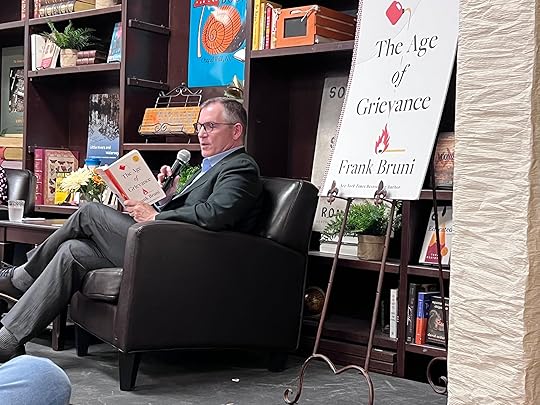
*Within my review are two images of the author, Frank Bruni. **Thanks to my local library for loaning me a copy of The Age of Grievance without any stipulation that I compose a review.
We are told that while:
the stating of grievance can be constructive, what happens when all sorts of grievances, authentic & invented, are bundled together, when they becoming all-encompassing lenses, all-purpose reflexes, when the Internet & social media offer a megaphone for these grievances? Presently, all aspects of life are framed & inflamed by a sense of grievance that involves self-pitying & demonization of "the other", a corrosive animosity of epic proportions.The United States is not alone in its dependence on grievance as the author sees "Brexit" as an act of grievance & the U.K.'s Boris Johnson as a "maestro of grievance".
One of the more telling comments in The Age of Grievance is the author's assertion regarding Donald Trump that "preposterously but cunningly, he cast himself as both martyr & messiah, thus becoming grievance made president."
Frank Bruni provides historical context to the concept of grievance & tribalism, pointing back to the 60s and moving forward to Alan Bloom's The Closing of the American Mind, with the rise of the Tea Party spawning a culture of complaint & Sarah Palin's seeming contempt for knowledge.
With the election of Barack Obama, it is said that the American underclass was less likely to raise a white flag to change & multiculturalism than to raise a confederate flag, further complicating what initially seemed a positive stage of American development.
Beyond that, the author senses a kind of increasing "infantilization of American society", with social media acting as an incubator for anger" and the news media in general "determined to spot the fault lines of gender, race & ethnicity and to etch those lines as boldly as possible".
Constantly holding grievances has coarsened the population and disagreeing on social media can cause "digital stoning", this just one of many memorable turns of phrase within the book. There is in fact a competition in this age of grievance, so heightened at times that the author refers to it as the "Oppression Olympics".
Israel & the oppressed Palestinians are dealt with, as is the Black Lives Matter movement, the precise attribution for Hispanics (Latino vs. Latinex), and some consideration of those who identify as LBGTQ, or perhaps more inclusively as LBGTQIA2S+.
There are also suggestions for combating the culture of grievance and some possible solutions, including small group discussions, enhancing civics instruction within schools & obligatory service for all, as well as attempting to make social media less toxic. To the last idea, the author indicates that we are "still in the larval stages of digital life".
Frank Bruni's The Age of Grievance is a thoughtful statement on a societal compulsion that obviously hinders communication in America & elsewhere, by someone whose career has been both in journalism & academia, with a wealth of references to other books that may expand the reader's vision in the perplexing area of polarization.
*Within my review are two images of the author, Frank Bruni. **Thanks to my local library for loaning me a copy of The Age of Grievance without any stipulation that I compose a review.
April 8, 2024
Frank Bruni, the acclaimed columnist for The New York Times, conducts a thorough analysis of our societal fixation on grievances, permeating both ends of the political spectrum. Grievances hold sway in our tumultuous political landscape, with each faction interpreting dissatisfaction or dissent as personal injury, fueling animosity and resentment. Bruni acknowledges the historical importance of grievances while examining the contemporary fusion of authentic and fabricated ones. Through compelling political, cultural, and personal anecdotes, Bruni invites us to add our measured voice to the conversation. This book would be a valuable catalyst as a community read on the subject of civic engagement. As with other Bruni works thoughtful, compelling and beautifully written.

July 30, 2024
I always appreciate a book that shows me a different way to look at things. In particular, I’m taking the final chapter on humility to heart.

August 8, 2024
The Age of Grievance, which should perhaps have been retitled The Age of Unjustified Grievance, provides what is now increasingly pat social criticism of the obviously deranged dimensions of American politics and culture. Bruni argues Americans have becomes preoccupied by claims to victimization, and these claims have reached a totalizing and existential intensity through the usual escalatory cycle of political battles. He is loathe to entirely dispense with the utility of grievance politics wholesale as he believes such politics can drive progressive/left-liberal social change, pointing to historical examples with the rights and social position of women, minorities, and gays.
Bruni supports his critique of grievance politics with an endless procession of anecdotes cribbed from his life or the news. There is in little in the way of quantitative social analysis other than some references to research performed by economists and sociologists (much of it interesting but fragmentary). Thus, readers are mostly just receptacles for Bruni's considered opinions on the cultural moment. Subsequently, this is likely only to be a useful read for those who have entirely ignored news and news commentary for the last half decade or are especially interested in how Frank Bruni sees the world.
In many ways, The Age of Grievance is an exemplar of the usual NYT op-ed tier sophistry. Spin up silky prose with an air of detached erudition and appear to deliver an incisive and encompassing indictment of American dysfunction (in this case a culture of widespread vindictiveness and self-absorbed emotionality), while actually endorsing the existing values and goals of the current elite (i.e. those like Bruni himself - affluent urban left-liberals/progressives). This is the sort of thing that is obviously going to upset those with different values and goals. It also does nothing to remedy the identified dysfunction. The diagnosis and prescription are unfortunately shallow. Bruni fails to offer enough for those estranged from the elect. It is highly unlikely that whatever the elite of today want will solve all today's ills. It's even possible, if not likely, that today's elite are responsible in some ways for our culture of victimhood. Why would doubling down on the (partial) instigators solve the problem?
There are of course some true and important things being said by Bruni. He is far from the first one to say these things though (as he acknowledges) and some of these true and good things are cliché and seem hollows (i.e. the whole "be humble" conclusion offered in the final chapter). Nonetheless, it is good for those of his ilk and position to counter-signal their own in-group. They have to buy trust with the out-group if conciliation is possible. Although I think many readers of this ilk will not see it as an authentic peace offering in the culture war. However, it is at least working to create space for that possibility from the within the coastal bubble.
The experience of happening upon a talented writer who "gets it" but somehow still manages to be wrong is bemusing (though of course it shouldn't be). I don't how much of this is a function of failures on the part of the writer or that of the audience. I'm inclined to blame both to some extent. Our author has enjoyed a life of privilege in left-liberal, coastal enclaves and holds down two sought-after sinecures, one as a NYT op-ed columnist and another as a professor of public policy at UNC. He is able to demonstrate some ability to rise above his milieu to mildly criticize some of its excesses, but he seems to be somewhat unaware of just how dominant his way of thinking is across American institutions (even ones meant to represent those with values in conflict with his). He also seems a bit incurious about the deep origins of the dysfunction he recognizes. And some of the research he references suggests he curiosity should be piqued. However, his target audience is also the same left-liberal elite or elite-aspirants who are loathe to take kindly to the idea that their contributions to sociopolitical dysfunction may be on par with MAGA-hat-wearing deplorables.
Ultimately, this is an acceptable entry in 21st century American cultural commentary. Bruni's prose is engaging even when his thought slips in sloppiness. It is another great example of a book that should have been an essay though.
Bruni supports his critique of grievance politics with an endless procession of anecdotes cribbed from his life or the news. There is in little in the way of quantitative social analysis other than some references to research performed by economists and sociologists (much of it interesting but fragmentary). Thus, readers are mostly just receptacles for Bruni's considered opinions on the cultural moment. Subsequently, this is likely only to be a useful read for those who have entirely ignored news and news commentary for the last half decade or are especially interested in how Frank Bruni sees the world.
In many ways, The Age of Grievance is an exemplar of the usual NYT op-ed tier sophistry. Spin up silky prose with an air of detached erudition and appear to deliver an incisive and encompassing indictment of American dysfunction (in this case a culture of widespread vindictiveness and self-absorbed emotionality), while actually endorsing the existing values and goals of the current elite (i.e. those like Bruni himself - affluent urban left-liberals/progressives). This is the sort of thing that is obviously going to upset those with different values and goals. It also does nothing to remedy the identified dysfunction. The diagnosis and prescription are unfortunately shallow. Bruni fails to offer enough for those estranged from the elect. It is highly unlikely that whatever the elite of today want will solve all today's ills. It's even possible, if not likely, that today's elite are responsible in some ways for our culture of victimhood. Why would doubling down on the (partial) instigators solve the problem?
There are of course some true and important things being said by Bruni. He is far from the first one to say these things though (as he acknowledges) and some of these true and good things are cliché and seem hollows (i.e. the whole "be humble" conclusion offered in the final chapter). Nonetheless, it is good for those of his ilk and position to counter-signal their own in-group. They have to buy trust with the out-group if conciliation is possible. Although I think many readers of this ilk will not see it as an authentic peace offering in the culture war. However, it is at least working to create space for that possibility from the within the coastal bubble.
The experience of happening upon a talented writer who "gets it" but somehow still manages to be wrong is bemusing (though of course it shouldn't be). I don't how much of this is a function of failures on the part of the writer or that of the audience. I'm inclined to blame both to some extent. Our author has enjoyed a life of privilege in left-liberal, coastal enclaves and holds down two sought-after sinecures, one as a NYT op-ed columnist and another as a professor of public policy at UNC. He is able to demonstrate some ability to rise above his milieu to mildly criticize some of its excesses, but he seems to be somewhat unaware of just how dominant his way of thinking is across American institutions (even ones meant to represent those with values in conflict with his). He also seems a bit incurious about the deep origins of the dysfunction he recognizes. And some of the research he references suggests he curiosity should be piqued. However, his target audience is also the same left-liberal elite or elite-aspirants who are loathe to take kindly to the idea that their contributions to sociopolitical dysfunction may be on par with MAGA-hat-wearing deplorables.
Ultimately, this is an acceptable entry in 21st century American cultural commentary. Bruni's prose is engaging even when his thought slips in sloppiness. It is another great example of a book that should have been an essay though.

April 12, 2025
"To be grounded in truth is, paradoxically, to remain open to the idea that the understanding of truth may need to shift as we learn more and as some of those lessons lay bare our prejudice and ignorance. “You must assume your own and everyone else’s fallibility and you must hunt for your own and others’ errors, even if you are confident you are right,” Rauch wrote. “Otherwise, you are not reality- based.”
The above passage really resonated with me, however, lately I can't help but ask myself, what is even "reality" anymore? I was listening to the current White House Press secretary and some members of Congress speaking about an event that I saw with my own eyes, and the distortion was so bizarre that I got the distinct feeling that I could be trapped in a Kafka novel. Anyway I digress, about this book there are plenty of good reviews out there so I won't belabor the point, the title alone tells us everything we already know, but Mr. Bruni does an excellent job of putting it all down cohesively, all the different reasons why everyone is so aggrieved, and I appreciate that he gives potential ways to fix the problem, however, I think he is more optimistic than he should be. For example, thinking "humility" is something we can hope for from the current crop of politicians at the helm of our government, seems at this time out of the realm of possibility. Also, his potential fix calling for the fixing of our cities and towns in order for all sorts of different people to "get together and get to know one another", I will say that that is the one thing these politicians will not encourage. Politicians know that if people get together they might just see how much we have in common, and perhaps unite based on commonalities leaving grievances behind. How then are the hate spewing, grievance building politicians going to get elected, since that seems to be the driver behind getting into office, nope that's not going to happen.
Enough of the rant, read the book if the topic is of interest, it is a good one.
The above passage really resonated with me, however, lately I can't help but ask myself, what is even "reality" anymore? I was listening to the current White House Press secretary and some members of Congress speaking about an event that I saw with my own eyes, and the distortion was so bizarre that I got the distinct feeling that I could be trapped in a Kafka novel. Anyway I digress, about this book there are plenty of good reviews out there so I won't belabor the point, the title alone tells us everything we already know, but Mr. Bruni does an excellent job of putting it all down cohesively, all the different reasons why everyone is so aggrieved, and I appreciate that he gives potential ways to fix the problem, however, I think he is more optimistic than he should be. For example, thinking "humility" is something we can hope for from the current crop of politicians at the helm of our government, seems at this time out of the realm of possibility. Also, his potential fix calling for the fixing of our cities and towns in order for all sorts of different people to "get together and get to know one another", I will say that that is the one thing these politicians will not encourage. Politicians know that if people get together they might just see how much we have in common, and perhaps unite based on commonalities leaving grievances behind. How then are the hate spewing, grievance building politicians going to get elected, since that seems to be the driver behind getting into office, nope that's not going to happen.
Enough of the rant, read the book if the topic is of interest, it is a good one.

Read
July 16, 2024[4.25] Log it as an eerie coincidence. I finished Bruni’s intriguing deep-dive into societal polarization and unbridled anger only hours before the first assassination attempt of a U.S. presidential candidate in decades. It is rare when I begin a book with my inner voice grumbling, “You probably won’t finish it.” I wondered if a book-length examination of our grievance culture that weaves together some previous newspaper columns would be overdose at a time when I often turn to books as an escape from our tumultuous times. But I soon realized that there were so many enlightening concepts to unpack and ponder that Bruni’s work would not end up on the DNF list.
The book’s promotional blurb and author interviews assert that Bruni takes aim at both sides of the political spectrum. This is a fair assertion, but more admonitions seem to be directed at the MAGA right.
The author doesn’t ignore the reality that addressing grievances has had positive impacts throughout history. Consider the civil rights movement. But he argues that toxic politics, the internet, AI and other forces have fueled an era of “extreme aggrievement.” The danger, he maintains, is that “grievance is the enemy of perspective, proportionality and nuance."
In an interview in the Columbia Journalism Review, Bruni urges the media to avoid using tired playbooks that can lead to oversimplifying complex political issues. “Dicing and slicing political coverage sends this message that we’re in different camps that maybe compete against one another, rather than that we’re all Americans, ultimately in the same boat,” he says.
Bruni skillfully explores the dangers of confirmation bias, stressing the importance of training ourselves to consume “balanced news diets so we resist the temptation to overstuff ourselves with information that feeds our existing biases and misconceptions.”
The book is well-written, thoroughly researched and incredibly timely.
The book’s promotional blurb and author interviews assert that Bruni takes aim at both sides of the political spectrum. This is a fair assertion, but more admonitions seem to be directed at the MAGA right.
The author doesn’t ignore the reality that addressing grievances has had positive impacts throughout history. Consider the civil rights movement. But he argues that toxic politics, the internet, AI and other forces have fueled an era of “extreme aggrievement.” The danger, he maintains, is that “grievance is the enemy of perspective, proportionality and nuance."
In an interview in the Columbia Journalism Review, Bruni urges the media to avoid using tired playbooks that can lead to oversimplifying complex political issues. “Dicing and slicing political coverage sends this message that we’re in different camps that maybe compete against one another, rather than that we’re all Americans, ultimately in the same boat,” he says.
Bruni skillfully explores the dangers of confirmation bias, stressing the importance of training ourselves to consume “balanced news diets so we resist the temptation to overstuff ourselves with information that feeds our existing biases and misconceptions.”
The book is well-written, thoroughly researched and incredibly timely.

June 9, 2024
Books like these tend to suffer from two problems. Firstly, they are of a certain political and social moment and so tend to age quickly. The references and examples become dated and what seems topical and insightful now rapidly seems like yesterday's urgency. Given this one is still new(ish), that's not yet the case. Perhaps in a couple of years things will improve and this will seem like a quaint warning . I suspect, however, it won't.
Secondly, by laying out the evidence for the problemj, the authors of this kind of book can end up with a lopsided affair: heavy on the problems and light on any solution . And often the solutions presented can be so idealistic that the book that presents them can be weighed down by issues they are meant to solve. Some of Bruni's solutions for the grievance wars of recent US politics - such as building parks and public spaces that cross social and cultrual borders to get people of different backgrounds mingling - seem very nice but highly naive. Yet the final section on how greater humility in a political world of strident and dogmatic certainty is, in fact, worth the price of wading through the mire of all the problems the book details.
I suppose the world will see in November 2024 whether the US is prepared to turn away from the toxicity of grievance or if it will embrace it even more.
Secondly, by laying out the evidence for the problemj, the authors of this kind of book can end up with a lopsided affair: heavy on the problems and light on any solution . And often the solutions presented can be so idealistic that the book that presents them can be weighed down by issues they are meant to solve. Some of Bruni's solutions for the grievance wars of recent US politics - such as building parks and public spaces that cross social and cultrual borders to get people of different backgrounds mingling - seem very nice but highly naive. Yet the final section on how greater humility in a political world of strident and dogmatic certainty is, in fact, worth the price of wading through the mire of all the problems the book details.
I suppose the world will see in November 2024 whether the US is prepared to turn away from the toxicity of grievance or if it will embrace it even more.

May 23, 2024
2.5 stars? I love Frank Bruni, I read his newsletter regularly and I happen to agree with the vast majority of his perspectives shared both in that weekly email and in this book. But I just don't know if this needed to be a book.
It's 200+ pages detailing analysis of why and examples of how we're so painfully aggrieved as a society today. He writes about the loss of our ability to connect with those who disagree with us, and how that self-centered single-mindedness (and a whole lot of valid reasons for being aggrieved) feeds destructive cancel culture and this mess of an American political system.
It's a good study of our time. It's interesting. I underlined a lot. But at times it has so many examples of how messed up things are (in both political parties, tho one is more inclined to violence than the other, he notes) that I felt drowned by it all. I wish more time had been spent on the solutions, which are buried at the end, only in the last two chapters. I would also love to know how many times the word "grievance" is written, because I swear it must be as many times as pages in the book.
Anyways. Still a Bruni fan, and these ideas are worth sharing and discussing. But (dare I say it, on Goodreads of all places) articles and newsletters are perhaps a better medium than books for sharing and discussing these ideas at the vast scale needed to enact the change he outlines. Though maybe sitting with the book helps the ideas sink in better? Who knows, maybe I'm just airing my grievance.
It's 200+ pages detailing analysis of why and examples of how we're so painfully aggrieved as a society today. He writes about the loss of our ability to connect with those who disagree with us, and how that self-centered single-mindedness (and a whole lot of valid reasons for being aggrieved) feeds destructive cancel culture and this mess of an American political system.
It's a good study of our time. It's interesting. I underlined a lot. But at times it has so many examples of how messed up things are (in both political parties, tho one is more inclined to violence than the other, he notes) that I felt drowned by it all. I wish more time had been spent on the solutions, which are buried at the end, only in the last two chapters. I would also love to know how many times the word "grievance" is written, because I swear it must be as many times as pages in the book.
Anyways. Still a Bruni fan, and these ideas are worth sharing and discussing. But (dare I say it, on Goodreads of all places) articles and newsletters are perhaps a better medium than books for sharing and discussing these ideas at the vast scale needed to enact the change he outlines. Though maybe sitting with the book helps the ideas sink in better? Who knows, maybe I'm just airing my grievance.

July 30, 2024
For about the first two-thirds, I was feeling like this was going to be a 2-star read for me or 3 stars at best. The first several chapters are just example after example of how grievance has gone out of control in our country over about the past twenty years or so. I started thinking, yeah, buddy, we know, tell us something new.
Then he writes about how social media super-charged grievance and cancelling, which we also already knew.
But the last few chapters really redeemed this book for me. Bruni ties our grievance economy to real violence, including in the halls of Congress. And he makes the bold point that some grievances are more serious than others. He cites, for example, Tucker Carlson’s bizarre obsession with the green M&M. He also quotes someone who implied that her “weird lunch” with her male employer was equivalent to a rape. Microaggressions may be hurtful, but they are not the same as job discrimination, redlining, physical aggression, marriage discrimination, etc. Not long ago, that would have gone without saying. Now it is courageous to say it, and someone will surely complain loudly about how aggrieved it makes them feel to have their grievance belittled.
Bruni also suggests some ways to tone down our culture of grievance. Some of them are simple and personal: get to know your neighbors. Some are harder and political. End gerrymandering. Implement ranked-choice voting. Allow independents to vote in primaries. Make it easier to vote. Fund a national service program that would bring together young people from different parts of our country. Design cities so that people encounter each other more. He cites some governors who have managed to get things done in a bipartisan way: Andy Beshear of Kentucky, Charlie Baker of Massachusetts.
Finally, Bruni urges us to re-learn humility. Neither side of our political divide has all the answers. No advocacy group can be certain that their particular cause should be our most urgent priority. For God’s sake, can we learn to listen to each other again? And can we do it without taking offense at every little thing?
One point I wish that Bruni had touched on a little more is rationality over emotion. Feelings are legitimate, but any good therapist will tell you that they have to be modulated with reason. Too many people nowadays are quite certain that what they feel is the last word on everything. Bruni does cite the excellent work of Jonathan Rauch on this topic in his book The Constitution of Knowledge: A Defense of Truth. But I would have liked to see fewer examples at the beginning of this book and a little more treatment of rationality and truth-seeking at the end.
Like my reviews? Check out my blog
Author of The Saint's Mistress
Then he writes about how social media super-charged grievance and cancelling, which we also already knew.
But the last few chapters really redeemed this book for me. Bruni ties our grievance economy to real violence, including in the halls of Congress. And he makes the bold point that some grievances are more serious than others. He cites, for example, Tucker Carlson’s bizarre obsession with the green M&M. He also quotes someone who implied that her “weird lunch” with her male employer was equivalent to a rape. Microaggressions may be hurtful, but they are not the same as job discrimination, redlining, physical aggression, marriage discrimination, etc. Not long ago, that would have gone without saying. Now it is courageous to say it, and someone will surely complain loudly about how aggrieved it makes them feel to have their grievance belittled.
Bruni also suggests some ways to tone down our culture of grievance. Some of them are simple and personal: get to know your neighbors. Some are harder and political. End gerrymandering. Implement ranked-choice voting. Allow independents to vote in primaries. Make it easier to vote. Fund a national service program that would bring together young people from different parts of our country. Design cities so that people encounter each other more. He cites some governors who have managed to get things done in a bipartisan way: Andy Beshear of Kentucky, Charlie Baker of Massachusetts.
Finally, Bruni urges us to re-learn humility. Neither side of our political divide has all the answers. No advocacy group can be certain that their particular cause should be our most urgent priority. For God’s sake, can we learn to listen to each other again? And can we do it without taking offense at every little thing?
One point I wish that Bruni had touched on a little more is rationality over emotion. Feelings are legitimate, but any good therapist will tell you that they have to be modulated with reason. Too many people nowadays are quite certain that what they feel is the last word on everything. Bruni does cite the excellent work of Jonathan Rauch on this topic in his book The Constitution of Knowledge: A Defense of Truth. But I would have liked to see fewer examples at the beginning of this book and a little more treatment of rationality and truth-seeking at the end.
Like my reviews? Check out my blog
Author of The Saint's Mistress

May 19, 2024
Took me until about halfway through to really grasp the thesis, but once I did, I came to realize that Bruni is on to something. Yes, at one level this is a book that’s basically a compilation of dumb and deranged things people with extreme political beliefs have done in the past handful of years. But the analytical lense Bruni deploys - that much of those deranged things, coming from both sides of the political spectrum, can be viewed as essentially a pissing contest of who is more wronged/oppressed/etc. - is clever.
It might seem like a trite observation that idiots on the left and right do dumb shit. But Bruni proposes that a lot of this dumb shit are not merely acts of political disagreement, but rather a disastrous (and occasionally violent) combination of pity party and temper tantrum.
His writing style is convincing and level headed. His criticisms of both the left and right are blunt and often scathing. There’s some sarcasm and wit sprinkled throughout, and the whole book has an aura of “can you, dear reader, believe how pitiful we are?” but without belittling the undoubtedly serious topics he addresses. Smart and enjoyable through the end.
It might seem like a trite observation that idiots on the left and right do dumb shit. But Bruni proposes that a lot of this dumb shit are not merely acts of political disagreement, but rather a disastrous (and occasionally violent) combination of pity party and temper tantrum.
His writing style is convincing and level headed. His criticisms of both the left and right are blunt and often scathing. There’s some sarcasm and wit sprinkled throughout, and the whole book has an aura of “can you, dear reader, believe how pitiful we are?” but without belittling the undoubtedly serious topics he addresses. Smart and enjoyable through the end.

September 10, 2024
As a non American I have no allegiance to any parties.
That being said this book is a democrat whining and complaining that Republicans are whining and complaining.
It's one of the most vapid and un-self aware things I've listened to in a while. Truely showing the author's contempt and lack of willingness to not strawman at every chance.
If you have trouble with hypocrisy stay away!
Save your time.
As the New York Times review said: "positively beseeching, in fact, but also unabashedly partisan."
Disclaimer. : couldn't finish. Maybe it ends better
It would not let me give 0 stars
That being said this book is a democrat whining and complaining that Republicans are whining and complaining.
It's one of the most vapid and un-self aware things I've listened to in a while. Truely showing the author's contempt and lack of willingness to not strawman at every chance.
If you have trouble with hypocrisy stay away!
Save your time.
As the New York Times review said: "positively beseeching, in fact, but also unabashedly partisan."
Disclaimer. : couldn't finish. Maybe it ends better
It would not let me give 0 stars
This entire review has been hidden because of spoilers.

July 9, 2024
I am disappointed in this book. When an individual does a book that has so much potential as this one I still expect people not to be bias. Shame on me I guess.

June 14, 2026
I honestly don’t know why I read books like this anymore. Each time, it feels like I took a handful of crazy pills and am about to OD. What’s this book? Well, it’s a book about how we live in a time of outrage culture. At first, you kind of think it’s a balanced book, which is fine, but it’s really not. Frank Bruni seems like he’s a leftist, but a “pick me”.
If you don’t know what a “pick me” girl is, here’s the definition I found: A "pick me girl" is internet slang for a woman who seeks male validation by altering her personality to appear low-maintenance, while simultaneously putting down other women.
Frank Bruni is basically that but for republicans. While he does touch on a few things republicans have done to show how ridiculous their outrage is, the majority of this book is focused on the left. Listen, I’m a leftist who got canceled in 2019. I’ve felt the full force of the internet testing my sanity and sobriety, but to even act like it comes remotely close to what the right has been doing over the years (especially the last 1.5 years), is either insanely disingenuous or utterly ignorant, and neither is excusable.
Bruning brings out the greatest hits of “woke” leftists being word police and all that, but it doesn’t hold a candle to what the right is doing. This isn’t even an opinion; it’s objective facts. While you might have college students or online mobs getting mad at people, the right is literally changing laws, arresting people, and banning people from social media platforms for their speech. We’re living in as close to a fascist state as I’ve seen in my 40 years on the planet, and this author has the audacity to dedicate chapters to the height of BLM or gender arguments.
It’s laughably insane watching this author go from talking about January 6th, the multiple people who died as a result, Trump’s violent rhetoric, the violence against left-wing politicians and threats of violence to him talking about how a tiny minority of woke people argue for dumb terms like “houseless” instead of “homeless” and how “blind study” is offensive to blind people. These anti-woke talking points are cherry-picked from the smallest sect of the left, which most people don’t even agree with, after talking about a literal insurrection where people died and the murders or attempted murders of left-wing politicians.
The fact that neither the author nor any publisher recognizes how ridiculous that contrast is, to then make this sound like a “both sides are just as bad” is absolutely mind-blowing.
You’d also think this guy has never even heard of Libs of TikTok, which has independently been the catalyst for more people losing their jobs than any left-wing group on the planet.
My favorite part of the book (ironically) is when the author acts like he had this huge “got ya” moment against some college girl in one of his classes. She said something dumb about pro-lifers being white supremacists because they want white women to stop getting abortions, and then he tells her how Black women get abortions at a much higher rate and she was “speechless”.
First off, this just highlights why all the viral videos of right-wing influencers debating college students are dumb. College kids are often way overconfident in their knowledge of the world but don’t actually have the chops to back it up. Here’s a quick answer as to why Black women have higher abortion rates:
“Black women have higher abortion rates primarily due to significantly higher rates of unintended pregnancies. Public health and reproductive rights organizations point to systemic socioeconomic and healthcare inequities as the root causes, including systemic barriers to accessing effective contraception and quality, affordable family planning services.”
If the college student actually knew about the studies, they wouldn’t have said something so dumb, or someone else in that class would have told Bruni how dumb and ignorant he is. Hell, maybe someone did and he chose to leave that out of the book because it wouldn’t make him seem like the know-it-all he comes across as in his writing.
This book thoroughly annoyed me, and it’s why I’m giving it one star.
Before I go, let me tell you about my second favorite part. It’s when he dedicates time to talking about how journalists' incentives have been skewed by Twitter, as they’re now trying to get engagement and build a brand, rather than being actual journalists. This guy’s no different, with this poorly researched book, as he buries his head in the sand, completely oblivious to what’s happening while our country burns down.
If you don’t know what a “pick me” girl is, here’s the definition I found: A "pick me girl" is internet slang for a woman who seeks male validation by altering her personality to appear low-maintenance, while simultaneously putting down other women.
Frank Bruni is basically that but for republicans. While he does touch on a few things republicans have done to show how ridiculous their outrage is, the majority of this book is focused on the left. Listen, I’m a leftist who got canceled in 2019. I’ve felt the full force of the internet testing my sanity and sobriety, but to even act like it comes remotely close to what the right has been doing over the years (especially the last 1.5 years), is either insanely disingenuous or utterly ignorant, and neither is excusable.
Bruning brings out the greatest hits of “woke” leftists being word police and all that, but it doesn’t hold a candle to what the right is doing. This isn’t even an opinion; it’s objective facts. While you might have college students or online mobs getting mad at people, the right is literally changing laws, arresting people, and banning people from social media platforms for their speech. We’re living in as close to a fascist state as I’ve seen in my 40 years on the planet, and this author has the audacity to dedicate chapters to the height of BLM or gender arguments.
It’s laughably insane watching this author go from talking about January 6th, the multiple people who died as a result, Trump’s violent rhetoric, the violence against left-wing politicians and threats of violence to him talking about how a tiny minority of woke people argue for dumb terms like “houseless” instead of “homeless” and how “blind study” is offensive to blind people. These anti-woke talking points are cherry-picked from the smallest sect of the left, which most people don’t even agree with, after talking about a literal insurrection where people died and the murders or attempted murders of left-wing politicians.
The fact that neither the author nor any publisher recognizes how ridiculous that contrast is, to then make this sound like a “both sides are just as bad” is absolutely mind-blowing.
You’d also think this guy has never even heard of Libs of TikTok, which has independently been the catalyst for more people losing their jobs than any left-wing group on the planet.
My favorite part of the book (ironically) is when the author acts like he had this huge “got ya” moment against some college girl in one of his classes. She said something dumb about pro-lifers being white supremacists because they want white women to stop getting abortions, and then he tells her how Black women get abortions at a much higher rate and she was “speechless”.
First off, this just highlights why all the viral videos of right-wing influencers debating college students are dumb. College kids are often way overconfident in their knowledge of the world but don’t actually have the chops to back it up. Here’s a quick answer as to why Black women have higher abortion rates:
“Black women have higher abortion rates primarily due to significantly higher rates of unintended pregnancies. Public health and reproductive rights organizations point to systemic socioeconomic and healthcare inequities as the root causes, including systemic barriers to accessing effective contraception and quality, affordable family planning services.”
If the college student actually knew about the studies, they wouldn’t have said something so dumb, or someone else in that class would have told Bruni how dumb and ignorant he is. Hell, maybe someone did and he chose to leave that out of the book because it wouldn’t make him seem like the know-it-all he comes across as in his writing.
This book thoroughly annoyed me, and it’s why I’m giving it one star.
Before I go, let me tell you about my second favorite part. It’s when he dedicates time to talking about how journalists' incentives have been skewed by Twitter, as they’re now trying to get engagement and build a brand, rather than being actual journalists. This guy’s no different, with this poorly researched book, as he buries his head in the sand, completely oblivious to what’s happening while our country burns down.

August 17, 2024
Frank Bruni is a long-time journalist, NYT columnist, and, since 2021, a professor of journalism at Duke University. In the Age of Grievance, he writes extensively on how divisive American culture has become on social and political issues in recent decades through the pervasive feeling of grievance (both actual and perceived, and on all sides of the current American political spectrum and hot button sociopolitical issues).
I strongly resonated with the majority of Bruni's points in this book. I especially like this quote from chapter 8, when Bruni talks about writing graciously about a political figure from a different party than his own:
I think we could all practice more humility and civility these days, and practice nonjudgmental and open-minded listening to others' viewpoints. That's why I consciously and consistently read books from people whose political and social viewpoints don't match my own, rather than stay in an echo chamber of feel-good, preaching-the-the-choir views. That's why I don't outrightly and blanketly dismiss people because they've been labeled negatively (rightfully or not), and pompously and self-righteously presume that they can't possibly have anything worthwhile to say (or that my fragile ego can't withstand the presence of a dissenting argument). There are very few people who self-identify as 100% villains and lack any redeeming qualities, and the better we are at recognizing the humanity in others and the common goals we share, the better off we are as a society.
Further reading:
Mistakes Were Made, but Not by Me: Why We Justify Foolish Beliefs, Bad Decisions, and Hurtful Acts by Carol Tavris and Elliot Aronson
The Righteous Mind: Why Good People Are Divided by Politics and Religion by Jonathan Haidt
The Coddling of the American Mind: How Good Intentions and Bad Ideas Are Setting Up a Generation for Failure by Greg Lukianoff and Jonathan Haidt
The Chaos Machine: The Inside Story of How Social Media Rewired Our Minds and Our World by Max Fisher
QAnon and On: A Short and Shocking History of Internet Conspiracy Cults by Van Badham
My statistics:
Book 179 for 2024
Book 1782 cumulatively
I strongly resonated with the majority of Bruni's points in this book. I especially like this quote from chapter 8, when Bruni talks about writing graciously about a political figure from a different party than his own:
To mention [good] qualities at the time of a person's death isn't an act of moral laundering - it's the essence of civility.
I think we could all practice more humility and civility these days, and practice nonjudgmental and open-minded listening to others' viewpoints. That's why I consciously and consistently read books from people whose political and social viewpoints don't match my own, rather than stay in an echo chamber of feel-good, preaching-the-the-choir views. That's why I don't outrightly and blanketly dismiss people because they've been labeled negatively (rightfully or not), and pompously and self-righteously presume that they can't possibly have anything worthwhile to say (or that my fragile ego can't withstand the presence of a dissenting argument). There are very few people who self-identify as 100% villains and lack any redeeming qualities, and the better we are at recognizing the humanity in others and the common goals we share, the better off we are as a society.
Further reading:
Mistakes Were Made, but Not by Me: Why We Justify Foolish Beliefs, Bad Decisions, and Hurtful Acts by Carol Tavris and Elliot Aronson
The Righteous Mind: Why Good People Are Divided by Politics and Religion by Jonathan Haidt
The Coddling of the American Mind: How Good Intentions and Bad Ideas Are Setting Up a Generation for Failure by Greg Lukianoff and Jonathan Haidt
The Chaos Machine: The Inside Story of How Social Media Rewired Our Minds and Our World by Max Fisher
QAnon and On: A Short and Shocking History of Internet Conspiracy Cults by Van Badham
My statistics:
Book 179 for 2024
Book 1782 cumulatively

June 11, 2024
Nailed it.

August 6, 2024
I’m tired of this grandpa

June 13, 2024
An important book that taught me a lot about myself that I did not want to learn. It wasn’t “enjoyable” as much as it was incredibly informative.

March 6, 2025
An extremely good antidote for mindless doomscrolling. I don’t usually go in for books by opinion columnists, but this was a measured look at our era of political communication... I really appreciated the clarity of Bruni’s writing. In particular, his message to liberals of every persuasion (from the progressive wing to the centrists) is a tough-to-swallow-pill: the idea that almost everyone is contributing the the political climate’s rising temperature. But he is fair and non-judgmental about it, speaking candidly about the media / journalism’s failure to promote honest narratives.
The grievance cycle is obviously a systemic problem that isn’t going away anytime soon, but this book provides some great advice about what to do on an individual level to retain your dignity and sanity while still holding to your principles.
The grievance cycle is obviously a systemic problem that isn’t going away anytime soon, but this book provides some great advice about what to do on an individual level to retain your dignity and sanity while still holding to your principles.

June 26, 2024
Required reading!!!!

January 20, 2025
Calling out or calling in.
We need humility of ourselves. We mustn’t create a cosmic drama .
Pathologyzing isn’t healthy.
I adore Ted Lasso. A blissful fool is smarter than us. His unshakable faith in the rest of us. Try a dab of humor.
It’s not too late to turn around.
We need humility of ourselves. We mustn’t create a cosmic drama .
Pathologyzing isn’t healthy.
I adore Ted Lasso. A blissful fool is smarter than us. His unshakable faith in the rest of us. Try a dab of humor.
It’s not too late to turn around.

June 15, 2024
4+++
A timely, thoughtful, very well researched book that should be required reading for everyone nursing grievances, in other words, for everyone.
That being said, I might have DNFed it in the first chapter as Bruni kept citing the excesses of the Right, which are admittedly colorful, while seemingly ignoring their equivalent wrongs on the Left! I persisted, however, due to the very positive review by my Goodreads friend Bruce Katz, which is worth your attention. The author does take the Left to task as the book proceeds, and I would call the overall writing fairly well balanced. Unfortunately, I gotta acknowledge that Trump-style activity does make for interesting reading. I was left with a big desire to chat with the author further!
This will be a definite nomination for my Sunday Philosopers book group.
A timely, thoughtful, very well researched book that should be required reading for everyone nursing grievances, in other words, for everyone.
That being said, I might have DNFed it in the first chapter as Bruni kept citing the excesses of the Right, which are admittedly colorful, while seemingly ignoring their equivalent wrongs on the Left! I persisted, however, due to the very positive review by my Goodreads friend Bruce Katz, which is worth your attention. The author does take the Left to task as the book proceeds, and I would call the overall writing fairly well balanced. Unfortunately, I gotta acknowledge that Trump-style activity does make for interesting reading. I was left with a big desire to chat with the author further!
This will be a definite nomination for my Sunday Philosopers book group.

April 30, 2024
United States Publication: April 30, 2024
Thank you to NetGalley and Simon & Schuster for this advanced reader's copy. In exchange, I am providing an honest review.
We are in the golden age of grievance. Bruce Handy wrote in June 2023, "With anger now the defining emotion of our own times, an in splenetic tribute to the previous century's Roaring 20s, I suggest we dub the current decade the Raging 20s." Frank Bruni concurs. Among many of his insights into this age of grievance is that the aggrieved set our culture wars in motion and escalated them. We are in an era of mass immaturity. (Chapter 2) The groundwork for it was laid through social media platforms, lack of civic studies, the breakdown of government through political partying in-fighting, and the human desire to hold on to a grudge and refuse to cede wrong thinking. Our stubborn hold on cognitive dissonance has fueled this age of grievances. And lest you think Bruni shines the spotlight on the many sins of the Republican party fueling this fire, he swings the spotlight over to the Democratic party as well. Nobody can escape the reality, we are all culpable - regardless of our political leanings, religious or not affiliations, whether we put the toilet paper roll on over or under, etc. (By the way, the only correct way to put on the toilet paper roll is over.)
Bruni traces the history of grievance. From its useful and positive uses to its damaging and dangerous ones. He compares grievance then and now and how it has changed in tone and in action. Grievance then served a larger purpose and got some things done, like forming a new country. Grievance now? It serves no real purpose; all it does is give space for loud voices that have no real complaints, only personal affronts. These loud voices are trying to make national news that can lead to events like January 6, 2021. And terrifyingly, they are succeeding. "Almost no cultural event, no bit of news, no topic of national conversation is roped off from grievance, by which I mean a complaint or concern that should or could be a modest point of dispute, negotiable with businesslike diction and businesslike decorum, but is blown up wildly out of proportion." (Chapter 3)
But, as Bruni gives evidence, the age of grievance has become addicting and dangerous - both physically and mentally. Scientific studies show how and why grievance turns the rational into the irrational, "....brain imaging studies show that harboring a grievance (a perceived wrong or injustice, real or imagined) activates the same neural reward circuitry as narcotics....[and] what your brain wants to do with that grievance - how it both extends the high and brings it to its most satisfying conclusion - is retaliate. To be clear, the retaliation doesn't need to be physically violent - an unkind word, or tweet, can also be very gratifying." (James Kimmel, Jr., lecturer at Yale University School of Medicine, Chapter 3) This leads to a string of revenge and punishment behaviors from the person, or persons, who see themselves as oppressed because of their grievances.
Chapter 4 finds Bruni going waaaaay back to when the grumblings started and how they transformed into grievances. It's noted that in 1835 Alexis de Tocqueville, in Democracy in America, observed a perpetually unsatisfied yearning in Americans, who, he said, "are forever brooding over advantages they do not possess." Now, instead of merely being unsatisfied, we have escalated those yearnings into grievances, and we are looking for someone to blame. He also explores the other contributing factors to this current age of grievance: climate change, increased income inequality, and self-aggrandizing behaviors that lead to widening disparities in all facets of life - income, ethnicity, gender, and sexual preferences, to name a few. The progress America is used to making and enjoying has come to a screeching halt, and with it, the optimism we collectively had. The grievances of this current age "affect how, every day, we interact or fail to interact with one another. They affect the stories we tell about ourselves and our world, ratcheting up the subjectivity of those narratives and corrupting the truth of them. They skew our perspectives. They skew us." (Chapter 8)
So, what to do? How can we, individually, quit participating in this age of grievance? Bruni prescribes a few hopeful remedies at the conclusion of the book. (Chapters 9 and 10) Frank Bruni, himself, is a beacon of hope and optimism, able to loosen the grip on his own cognitive dissonance and see things for what they are, not for what he may perceive them to be. In his gracious way, he leads us down that path as well.
Thank you to NetGalley and Simon & Schuster for this advanced reader's copy. In exchange, I am providing an honest review.
We are in the golden age of grievance. Bruce Handy wrote in June 2023, "With anger now the defining emotion of our own times, an in splenetic tribute to the previous century's Roaring 20s, I suggest we dub the current decade the Raging 20s." Frank Bruni concurs. Among many of his insights into this age of grievance is that the aggrieved set our culture wars in motion and escalated them. We are in an era of mass immaturity. (Chapter 2) The groundwork for it was laid through social media platforms, lack of civic studies, the breakdown of government through political partying in-fighting, and the human desire to hold on to a grudge and refuse to cede wrong thinking. Our stubborn hold on cognitive dissonance has fueled this age of grievances. And lest you think Bruni shines the spotlight on the many sins of the Republican party fueling this fire, he swings the spotlight over to the Democratic party as well. Nobody can escape the reality, we are all culpable - regardless of our political leanings, religious or not affiliations, whether we put the toilet paper roll on over or under, etc. (By the way, the only correct way to put on the toilet paper roll is over.)
Bruni traces the history of grievance. From its useful and positive uses to its damaging and dangerous ones. He compares grievance then and now and how it has changed in tone and in action. Grievance then served a larger purpose and got some things done, like forming a new country. Grievance now? It serves no real purpose; all it does is give space for loud voices that have no real complaints, only personal affronts. These loud voices are trying to make national news that can lead to events like January 6, 2021. And terrifyingly, they are succeeding. "Almost no cultural event, no bit of news, no topic of national conversation is roped off from grievance, by which I mean a complaint or concern that should or could be a modest point of dispute, negotiable with businesslike diction and businesslike decorum, but is blown up wildly out of proportion." (Chapter 3)
But, as Bruni gives evidence, the age of grievance has become addicting and dangerous - both physically and mentally. Scientific studies show how and why grievance turns the rational into the irrational, "....brain imaging studies show that harboring a grievance (a perceived wrong or injustice, real or imagined) activates the same neural reward circuitry as narcotics....[and] what your brain wants to do with that grievance - how it both extends the high and brings it to its most satisfying conclusion - is retaliate. To be clear, the retaliation doesn't need to be physically violent - an unkind word, or tweet, can also be very gratifying." (James Kimmel, Jr., lecturer at Yale University School of Medicine, Chapter 3) This leads to a string of revenge and punishment behaviors from the person, or persons, who see themselves as oppressed because of their grievances.
Chapter 4 finds Bruni going waaaaay back to when the grumblings started and how they transformed into grievances. It's noted that in 1835 Alexis de Tocqueville, in Democracy in America, observed a perpetually unsatisfied yearning in Americans, who, he said, "are forever brooding over advantages they do not possess." Now, instead of merely being unsatisfied, we have escalated those yearnings into grievances, and we are looking for someone to blame. He also explores the other contributing factors to this current age of grievance: climate change, increased income inequality, and self-aggrandizing behaviors that lead to widening disparities in all facets of life - income, ethnicity, gender, and sexual preferences, to name a few. The progress America is used to making and enjoying has come to a screeching halt, and with it, the optimism we collectively had. The grievances of this current age "affect how, every day, we interact or fail to interact with one another. They affect the stories we tell about ourselves and our world, ratcheting up the subjectivity of those narratives and corrupting the truth of them. They skew our perspectives. They skew us." (Chapter 8)
So, what to do? How can we, individually, quit participating in this age of grievance? Bruni prescribes a few hopeful remedies at the conclusion of the book. (Chapters 9 and 10) Frank Bruni, himself, is a beacon of hope and optimism, able to loosen the grip on his own cognitive dissonance and see things for what they are, not for what he may perceive them to be. In his gracious way, he leads us down that path as well.

May 3, 2024
Frank Bruni can write. He is one of the most lucid authors of his generation and that alone is good reason to read this book. Whether you agree with him or not, it is a pleasant and informative read. It flows with insight.
The theme is one of political division defined by grievance, but it goes beyond the typical divide between left and right and speaks to the foundational politics of anger and revenge that fuels both sides of the inevitable debate. We are beyond polarized. Disagreement has disappeared from our discourse. We hate. Nothing short of crushing our opponents will calm us down. Or so we think.
As I read, I couldn’t help but think back to my own parents. Now deceased, both were the children of immigrants, both were born in the 1920s, and both served in the US Navy during WWII. I was born in the 1950s and one of the things I remember most vividly about them is that neither believed in institutional politics. To this day, I have no idea which political party either one affiliated with, and not once would they even admit publicly who they voted for in a presidential election, although both believed in civic duty and were sure to vote in all of them.
To them, WWII and the Cold War that followed were all about ridding the world of tribal politics. Germany and the USSR were both defined by their institutional political parties. They had fought, in their minds, to free the world of such polarized thinking. The beauty of the US political system, to them, was that our politics was built around individuals, not ideologies. What little they spoke about politicians, they spoke about the person, not their agenda.
At one point Bruni speaks of China and muses his astonishment that so many Americans, in years past, already believed that the Chinese economy was bigger than our own, which it’s not. Now retired and living in the Midwest, I lived in China for 14 years working for an American company there. And upon my return I was struck by how laser-focused Americans are on the CCP. The Chinese aren’t. They seldom talk about the Party, but not because they are forbidden to. Their priorities are just elsewhere. As Bruni posed his question it occurred to me that if you asked the question of which economy was bigger to the average Chinese they would simply stare in bewilderment as to why you were asking such an irrelevant question. If forced, I am sure they all would have answered correctly – the US.
One of Bruni’s conclusions is that the current culture of anger, grievance, and revenge prevents any meaningful discussion of the real issues we all face. He’s right. We have forgotten the universal truth that all of reality is a duality. There are two sides to everything. The Chinese call it yin and yang, but the concept has long been built into the American worldview, until recently. Sports is a duality that historically defined the American psyche in a balance of the celebration of both victory and sportsmanship. Now there is only one correct side and a side that must be obliterated.
While the topics are serious and could result in reader melancholy, Bruni does bring a refreshing humor to the discussion. In discussing West Virginia’s absurd attempt to enable everyone to police illegal voting, for example, he writes: “But I was above all baffled: How do you spot illegal voting? Do you use binoculars, as with bird-watching? ‘Look, sweetheart, there’s an American goldfinch – and there’s a Honduran migrant with a stack of fraudulent ballets in his backpack!’” If we stop laughing, we will surely fail.
Bruni is realistic but there is always an underlying optimism of the truly inquisitive mind. I am struggling to remain so. The political strategy used by both sides today is self-reinforcing. As a blogger and writer who often finds myself seeing validity in both sides of every issue, I know firsthand that it is difficult to thread the needle of duality, and if you try, no one will buy your books or read your newsletters. Grievance? I’m sure. Reality is a duality.
Bruni closes the book with a call for humility all around. And I couldn’t agree more. Having lived in the corporate world of business for almost fifty years I believe with all my heart that the key and only criterion for leadership of any kind is humility. One building block of that is acceptance of the Buddhist truth that all of life is suffering. I am not a Buddhist, and I don’t mean suffering in the sense of pain or oppression. I mean suffering in the sense of seeing ourselves in the right perspective, the duality of individuality and the need for collective obligation.
A timely book, superbly written. I highly recommend it, whichever uniform you wear.
The theme is one of political division defined by grievance, but it goes beyond the typical divide between left and right and speaks to the foundational politics of anger and revenge that fuels both sides of the inevitable debate. We are beyond polarized. Disagreement has disappeared from our discourse. We hate. Nothing short of crushing our opponents will calm us down. Or so we think.
As I read, I couldn’t help but think back to my own parents. Now deceased, both were the children of immigrants, both were born in the 1920s, and both served in the US Navy during WWII. I was born in the 1950s and one of the things I remember most vividly about them is that neither believed in institutional politics. To this day, I have no idea which political party either one affiliated with, and not once would they even admit publicly who they voted for in a presidential election, although both believed in civic duty and were sure to vote in all of them.
To them, WWII and the Cold War that followed were all about ridding the world of tribal politics. Germany and the USSR were both defined by their institutional political parties. They had fought, in their minds, to free the world of such polarized thinking. The beauty of the US political system, to them, was that our politics was built around individuals, not ideologies. What little they spoke about politicians, they spoke about the person, not their agenda.
At one point Bruni speaks of China and muses his astonishment that so many Americans, in years past, already believed that the Chinese economy was bigger than our own, which it’s not. Now retired and living in the Midwest, I lived in China for 14 years working for an American company there. And upon my return I was struck by how laser-focused Americans are on the CCP. The Chinese aren’t. They seldom talk about the Party, but not because they are forbidden to. Their priorities are just elsewhere. As Bruni posed his question it occurred to me that if you asked the question of which economy was bigger to the average Chinese they would simply stare in bewilderment as to why you were asking such an irrelevant question. If forced, I am sure they all would have answered correctly – the US.
One of Bruni’s conclusions is that the current culture of anger, grievance, and revenge prevents any meaningful discussion of the real issues we all face. He’s right. We have forgotten the universal truth that all of reality is a duality. There are two sides to everything. The Chinese call it yin and yang, but the concept has long been built into the American worldview, until recently. Sports is a duality that historically defined the American psyche in a balance of the celebration of both victory and sportsmanship. Now there is only one correct side and a side that must be obliterated.
While the topics are serious and could result in reader melancholy, Bruni does bring a refreshing humor to the discussion. In discussing West Virginia’s absurd attempt to enable everyone to police illegal voting, for example, he writes: “But I was above all baffled: How do you spot illegal voting? Do you use binoculars, as with bird-watching? ‘Look, sweetheart, there’s an American goldfinch – and there’s a Honduran migrant with a stack of fraudulent ballets in his backpack!’” If we stop laughing, we will surely fail.
Bruni is realistic but there is always an underlying optimism of the truly inquisitive mind. I am struggling to remain so. The political strategy used by both sides today is self-reinforcing. As a blogger and writer who often finds myself seeing validity in both sides of every issue, I know firsthand that it is difficult to thread the needle of duality, and if you try, no one will buy your books or read your newsletters. Grievance? I’m sure. Reality is a duality.
Bruni closes the book with a call for humility all around. And I couldn’t agree more. Having lived in the corporate world of business for almost fifty years I believe with all my heart that the key and only criterion for leadership of any kind is humility. One building block of that is acceptance of the Buddhist truth that all of life is suffering. I am not a Buddhist, and I don’t mean suffering in the sense of pain or oppression. I mean suffering in the sense of seeing ourselves in the right perspective, the duality of individuality and the need for collective obligation.
A timely book, superbly written. I highly recommend it, whichever uniform you wear.
Displaying 1 - 30 of 315 reviews