

What do you think?
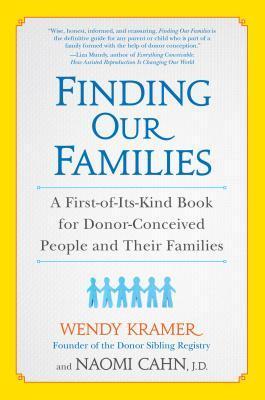
Finding Our Families: A First-of-Its-Kind Book for Donor-Conceived People and Their Families
The first comprehensive book that offers invaluable step-by-step advice for families with donor-conceived children.
Wendy Kramer, founder and director of the Donor Sibling Registry, and Naomi Cahn, family and reproductive law professor, have compiled a comprehensive and thorough guide for the growing community of families with donor-conceived children. Kramer and Cahn believe that all donor-conceived children’s desire to know their genetic family must be honored, and in Finding Our Families , they offer advice on how to foster healthy relationships within immediate families and their larger donor family networks based on openness and acceptance.
With honesty and compassion, the authors offer thoughtful strategies and inspirational stories to help parents answer their own, and their children’s, questions and concerns that will surely arise,
Finding Our Families opens up the lives of donor-conceived people who may be coping with uncertainty, thriving despite it, and finding novel ways to connect in this uncharted territory as they navigate the challenges and rewards of the world of donor conception.
Wendy Kramer, founder and director of the Donor Sibling Registry, and Naomi Cahn, family and reproductive law professor, have compiled a comprehensive and thorough guide for the growing community of families with donor-conceived children. Kramer and Cahn believe that all donor-conceived children’s desire to know their genetic family must be honored, and in Finding Our Families , they offer advice on how to foster healthy relationships within immediate families and their larger donor family networks based on openness and acceptance.
With honesty and compassion, the authors offer thoughtful strategies and inspirational stories to help parents answer their own, and their children’s, questions and concerns that will surely arise,
Finding Our Families opens up the lives of donor-conceived people who may be coping with uncertainty, thriving despite it, and finding novel ways to connect in this uncharted territory as they navigate the challenges and rewards of the world of donor conception.
- GenresParentingNonfiction
288 pages, Paperback
First published November 5, 2013
Ratings & Reviews
Friends & Following
Create a free account to discover what your friends think of this book!
Community Reviews
Displaying 1 - 6 of 6 reviews

February 28, 2014
I picked up "Finding Our Families: A First-of-Its-Kind Book for Donor Conceived People and Their Families" by Wendy Kramer just out of curiosity. It was in a sense pre-research for friends. I found the book insightful and interesting. The stories Kramer includes are compelling and the book is easily organized and formatted in such a way that it is a quick read.
As a child of adoption who never struggled with the stereotypical adopted kid issues such as wanting to find my biological families I will admit the assertion that all donor conceived people will want to find their donor irks me. I don't know what it's like to be in that situation of course, but I do know what it's like when people assume and assert that I should want to know my biological roots; it pisses me off. I am 100% happy with my family. Period. If I did by some happenstance happen to meet my biological relatives I suppose I would say thank you and be on my merry way. Kramer does mention a time or two that some donor conceived people may not want any information, but to me it was said in such an offhand way that it would almost shame those who aren't curious. To me, I found that bothersome.
What I did appreciate was the advice on when and how to tell donor-conceived people they are donor conceived. I agree (and the stories concurred) that early disclosure would be the least traumatic. I think the variety of stories and experienced provided and the scope that Kramer covers was fantastic.
The last thing I appreciated about the book was its accessibility. Anyone could read this book and glean valuable information from it whether they're donor conceived, the parent or relative of someone who's donor conceived, or just a random person (like me) who's curious about the topic.
As a child of adoption who never struggled with the stereotypical adopted kid issues such as wanting to find my biological families I will admit the assertion that all donor conceived people will want to find their donor irks me. I don't know what it's like to be in that situation of course, but I do know what it's like when people assume and assert that I should want to know my biological roots; it pisses me off. I am 100% happy with my family. Period. If I did by some happenstance happen to meet my biological relatives I suppose I would say thank you and be on my merry way. Kramer does mention a time or two that some donor conceived people may not want any information, but to me it was said in such an offhand way that it would almost shame those who aren't curious. To me, I found that bothersome.
What I did appreciate was the advice on when and how to tell donor-conceived people they are donor conceived. I agree (and the stories concurred) that early disclosure would be the least traumatic. I think the variety of stories and experienced provided and the scope that Kramer covers was fantastic.
The last thing I appreciated about the book was its accessibility. Anyone could read this book and glean valuable information from it whether they're donor conceived, the parent or relative of someone who's donor conceived, or just a random person (like me) who's curious about the topic.
May 4, 2026
As a parent, I found myself reading more slowly than I usually do, and that wasn’t because the material was difficult or overly dense. It was more that certain parts made me pause and sit with my own assumptions in a way I hadn’t expected. There were moments where I realized I had approached certain conversations with more certainty than reflection, and this book gently shifts that without making you feel criticized or defensive. The tone plays a big role in that it never feels accusatory, which makes it easier to stay open, even when the ideas being presented are quietly challenging.
What I appreciated most is that it doesn’t try to tell you exactly what to do as a parent. Instead, it creates space for you to think more carefully about how you show up in these conversations, especially around identity and openness. It feels less like a guide you move through once and more like something you return to at different stages, depending on where you and your family are.
There’s also a sense that the book respects the evolving nature of family dynamics in donor conception. It doesn’t assume that one conversation or one approach will be enough, and that felt honest. For me, it became less about finding answers and more about becoming more aware, more attentive, and more willing to listen differently.
Overall, it feels like a book that supports reflection rather than instruction, and I think that’s what gives it its lasting value. It stays with you, not because it tells you what to think, but because it quietly changes how you think about things you may have once taken for granted.
What I appreciated most is that it doesn’t try to tell you exactly what to do as a parent. Instead, it creates space for you to think more carefully about how you show up in these conversations, especially around identity and openness. It feels less like a guide you move through once and more like something you return to at different stages, depending on where you and your family are.
There’s also a sense that the book respects the evolving nature of family dynamics in donor conception. It doesn’t assume that one conversation or one approach will be enough, and that felt honest. For me, it became less about finding answers and more about becoming more aware, more attentive, and more willing to listen differently.
Overall, it feels like a book that supports reflection rather than instruction, and I think that’s what gives it its lasting value. It stays with you, not because it tells you what to think, but because it quietly changes how you think about things you may have once taken for granted.
May 3, 2026
What stayed with me most about Finding Our Families is how it refuses to rush answers. Instead, it creates space for the kind of questions donor-conceived people often carry quietly. It felt less like a book you finish and more like one you return to at different stages of understanding.Finding Our Families: A First-of-Its-Kind Book for Donor-Conceived People and Their Families
May 4, 2026
Reading this from a counseling perspective, I was struck by how usable the language is in real conversations. The book doesn’t stay at the level of theory; it translates complex emotional realities into something people can actually say to one another. That’s rare. It acknowledges the different positions within donor conception parents, donors, donor-conceived individuals without flattening those perspectives into a single narrative. Instead, it offers a kind of bridge. I can easily see this becoming a reference point in sessions, not as something to quote directly, but as something that quietly informs how conversations are approached.
September 8, 2019
This book had a lot of really great information, but I wish it had a section on raising a known-donor child/family. I understand Wendy started the DSR, which is for unknown donors, but I feel this book would be enriched by that information and how it compares/contrast a known scenario. Or perhaps this same large grouping of information but as a known donor scenario.
September 19, 2019
I read this for research into my book series based on articles about private investigators uncovering genetic donor relationships. One of my characters manages to find her donation results. The first question with genetic engineering is the inheritance paradox, and these guys make a good stab at the subject. Kudos for a difficult subject, not the most compelling writing and misses quite a lot.
Displaying 1 - 6 of 6 reviews