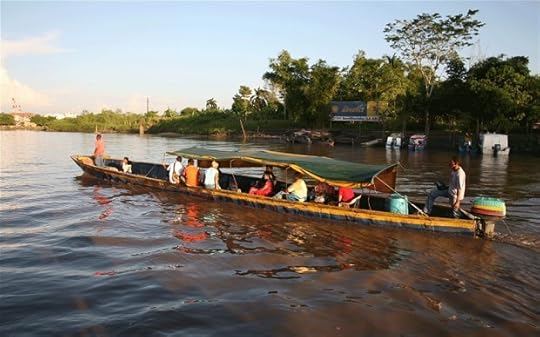
Magdalena, a river that courses through the heart of Colombia, connects a violent past with the country’s uncertain present. British writer Michael Jacobs struggles to reconcile his love for the land and its people with the dangers that both still present.
Determined to eliminate modern conveniences from his journey, he begins traversing the river by tugboat. He makes an exception for a cell phone that maintains a sporadic signal at best, in efforts to keep in touch with his mother suffering from deteriorating health. Jacobs cannot help but notice the irony of his mother’s dementia and his travels through Colombian townships with the world’s highest incidence of early-onset Alzheimer’s.
While navigating the mysterious river and unfamiliar territory—both emotionally and geographically—Jacobs comes across Gabriel Garcia Márquez, whose own faltering memory shows a growing obsession with the Magdalena River of his youth. When Jacobs and his companions are apprehended by FARC guerillas who turn out to be as quirky and affable as they are intimidating, life begins to imitate the magical realism of Márquez’s signature works. Shortly after being released from captivity, the FARC camp is bombed by the Colombian air force, leaving no likely survivors among his oddly likeable captors.
Exploring themes of adventure, endings, and “the utter pointlessness of it all,” Jacobs can only forge onward in his reflection of the mystical river.
3,5 De rivier de Magdalena. Het land Colombia. De schrijver volgt de rivier van monding tot bron doorheen een land dat werd verscheurd door geweld tussen het leger en paramilitairen enerzijds, drugkartels en guerrilla anderzijds. De naweeën zijn nog voelbaar. De schrijver weeft doorheen het boek het verhaal van zijn ouders die beiden dement zijn geworden. Maar de geheugenrover is ook het symbool voor de tallozen vermisten in Colombia. Geen slecht boek maar mist diepgang.
He’s confused me, has Michael Jacobs. I read this and remember when I finished I wasn’t sure what to make of it, I hadn’t enjoyed it as much as I had hoped, couldn’t make up my mind about Jacobs, but for various reasons, I didn’t write up my review at the time. However, then I read Ghost Train Through the Andes, and although it was slow, I thoroughly enjoyed it, and had warmed to Jacobs by the end, and said as much in my review (here). When I looked back on my shelf at the forlorn books waiting to be reviewed, I realised that this was the very same Michael Jacobs.
After a small meeting with Gabriel Garcia Marquez where he reveals an interest in the Magdalena, which causes the old writer to flare briefly like a firefly in the twilight, Jacobs travels up the great river, pondering on the power of memory, in a country that has has a tacit silence on the terror that has torn at it for decades, perhaps in an attempt to forget, as well as the more personal introspection of his mother’s heartbreaking decline into dementia and his fathers death following Alzheimer’s.
The journey up the Magdalena is slow, and winding and the lower part seems to take most of the book. Jacobs explores as much as he can including the fascinating yet sad story of the paisa strain of Alzheimers discovered in the Central Cordillera of the Andes, where twenty five families had been identified with it, all of whom descending from a single Basque who had settled there around 1750. Inter-sped with memories of his father and mother, as Jacobs ponders on the effect of memory and life, he finally makes it to the source of the Magdalena, drinking and washing his face in it’s calm waters. It’s right in the middle of FARC territory and sure enough he crosses paths with the guerrillas. Alongside long tedious lectures on Marxism, they also show a side that seems to want to genuinely boost tourism in the area, despite forcibly detaining people to tell them this. While celebrating carnival (he seems to always time his trips right for this) he learns that two days after he left the army went in to take control of the area, he had narrowly missed a gunfight.
It is a harrowing ending, set amongst the raucousness of carnival, but one that Jacobs captures almost perfectly, and is a poignant ending to what was, despite my misgivings, an interesting journey. (blog review here)
A book from two perspectives, one the journey along the Magdalena, Columbia's main river, the second through his parents history and their decline from Alzheimer's and dementia.
He meets all sorts of people in Columbia, from the FARC revolutionaries, and a chance meeting put him in touch with a group of people who suffer the greatest incidence of early onset Alzheimer's in the world.
I enjoyed the book, and Columbia is a fascinating, if scary place , but didn't feel that I could engage with Jacobs fully.
More akin to a meditation over a changing background than a travelogue (until the final section), I found this elegantly written and thoughtful. Jacobs' deep knowledge of Colombia is complemented by an intellectual humility that lets him guide the reader beyond the obvious initial impressions, but without becoming patronising. The beauty, heat, bustle and friendliness of the country are all palpable through Jacobs' prose, and I liked the interspersing of his own musings, family memories and research interludes, which brings a fascinating additional dimension to the book. The cast of characters that pop up are eccentric and varied, aided by the author's seemingly endless list of (often impressive) friends and acquaintances.
I'd recommend particularly to anyone with an interest in Latin America, Colombia or memory loss.
I was surprised by how engaging this book was. It covers a very specific subject matter and I've bristled previously at books about white men taking an "exotic" journey of self discovery. But this author had a very specific goal and a compelling reason for undertaking it and wrote with the appropriate balance of gratitude and gentleness. And though he is a foreigner, he clearly spent a lot of time not just doing his research, but also building relationships in the country (which paid off time and again as he had friends of friends meeting him in even the tiniest of towns). I read this as I was traveling around Colombia myself and found it to be a good introduction to the politics, people, and significant places in the country.
Read for Booktube-a-thon 2018 for the challenge "read a book about something you want to do", since I want to travel in Spanish-speaking parts of South America.
I generally enjoy travel literature, and I enjoyed reading about the landscape, people, history and politics of Colombia, but the highlights for me were the author's discussions of Alzheimer's, his father's diaries and his mother's dementia. This book was much sadder than I expected, but still a pleasure to read.
This entire review has been hidden because of spoilers.
Weaving together an eventful and, at times, dangerous river journey into the heart of Colombia, with reflections on memory loss and Alzheimer’s may not sound like an obvious combination - but it really works.
The author brings his adventures to life with colorful characters and anecdotes, and you really empathize with his concerns and worries about a mother back home whose mind is deteriorating.
A travelogue with a difference and a really enjoyable read.
As Colombian I loved how the objective perspective between the inherited attitudes of the Colombian people throughout all the journey reflected the core feeling of a country without memory. It is valuable the way he connects his personal and family reflections with the journey, at the end that was his motto and search, but as a selfish lector request I would love to heard more about the robber of memory out of the Alzheimer’s and dementia context as well.
A lovely book combining a fairly standard but well written travelogue intertwined with the writer's family history and the current health worries for his mother back at home.
There is plenty of Colombian historical and political background included but not so much as to turn it into a dry history lesson.
Colombia’s Magdalena River could claim to be the second most important in South America after the Amazon. In some ways it’s more important, if a judgement hinges on the Spanish conquest and its aftermath, since the Magdalena allowed the invaders to reach the Andean regions where the Inca empire reached its northern limits and later great colonial cities like Bogota would be built. It offered access to the continent from Latin America’s northern coastline, readily accessible to the galleons crossing on the trade winds. The river was first penetrated by the Spanish in 1533, from the new Spanish colonial city of Cartagena, which still has its original colonial centre and fortified walls. The native tribes in the hinterland were, as ever, cruelly exploited, their gold treasures robbed and shipped back to Spain.
But the river’s role in linking the coast with the Andes also made it a cultural meeting point from which music like La Cumbia emerged, and which inspired many of Colombia’s Writers, none more so than Gabriel Garcia Marquez. ‘Gabo’ could be said to have made his transition to adulthood on his first journey by riverboat on the Magdalena in 1943, sent by his father to find his fortune in the capital. Although the 15-year old Garcia Marquez cried until dawn on his first night aboard, the journey (in Jacobs’ words) was to provide a ‘treasure trove of future memories’. They were used to full effect in 'Love in the Time of Cholera', in which the love-sick hero spends a melancholy boat trip ignoring the civil war which is taking place and which has obliged the captain to prohibit the passengers’ favourite sport of taking pot shots at the caimans on the river banks.
Michael Jacobs joins the riverboat 'Catalina' at Barranquilla, the port where the Magdalena enters the Caribbean. The first stage of the journey is so tortuous and the boat’s progress so erratic that after seven days he reckons he’s still only an hour’s drive from his starting point. In any event, the riverine journey comes to an end at Puerto Berrio, and Jacobs takes to buses to travel towards the river’s source. The flavour of the trip changes too, as Jacobs becomes immersed in places that are still suffering the violence of Colombia’s paramilitary conflicts.
But another strand of the book, about the predicament of his mother left in England who is suffering from the late stages of dementia, also develops further. Already Jacobs had, in Cartagena, had two brief encounters with the legendary Garcia Marquez, himself in the early stages of the dementia that would soon result in his brother announcing the writer’s retirement. He had, nevertheless, given Jacobs some inspiring words about the Magdalena with which to begin his trip. Then, in Angostura, Jacobs makes an extraordinary visit to a village with a very high incidence of Alzheimer’s disease, where he talks to a world expert in the illness and meets a family in which four children have Alzheimer’s, their father having died of it.
The Magdalena has had a role in Colombia’s various internal wars, notably ‘La Violencia’ of the 1940s and 1950s and more recent guerrilla wars and paramilitary violence, which still stutter on despite active peace negotiations. (I've written about a recent incident here: http://twoworlds.me/latin-america/don...) Leaving Angostura to head further south towards the Magdalena’s source near San Agustin, Jacobs becomes increasingly worried about the prospect of meeting guerrilla groups, particularly the FARC, even though by the time of his journey they had largely given up kidnapping people.
Ascending the mountain range that leads to the river’s source, Jacobs and his companion do indeed meet the FARC, are interrogated and released. Something similar happens on the return journey, where they are commissioned to translate from English an instruction sheet on how to use a rifle sight. This bizarre and no doubt very alarming incident lasted only a few hours, but there is a coda to it: two days later the army obliterated the guerrilla camp, and with it the young combatants with whom Jacobs had begun to empathise.
In turns out then that the ‘Robber of Memories’ has several meanings. Alzheimer’s is of course one. Then the river itself has been called an ‘illusion of memory’ by Garcia Marquez, whose own recollections of it are sadly now confined to his writings. Finally, so many people whom Jacobs meets have had their memories robbed – or rather, repressed – by the armed conflicts and their consequences. Many of his questions about it are met by blank looks, bland comments or by his respondents changing the subject. In the parts of Colombia through which the Magdalena runs, it will probably be several more years before this changes.
The concept for the book is great: a river journey up the Magdalena to explore Colombian history and psyche. The author is vain, though, and tries to make everything that happens to him feel more momentous than it is. Maybe Jacobs was just too old and sentimental by the time he got around to writing this book.
I wish I could write as beautifully as this about my travels.
Jacobs works some magic with his prose as he weaves his travel down the Magdalena river seamlessly with the theme of memory and oblivion. Among it's many monikers, it's river is apparently known by some as the robber of memories. In the first chapter my appetite was whetted after a scene in which Jacobs meets an aged Garcia Marquez in Cartagena, marked by Alzheimers, but snapping back to lucidity to exclaim his deep affection and impressions of the river of his life and dreams.
As Jacobs makes his haphazard journey south, deeper and deeper into Colombia, further and further into danger, higher in elevation, closer to the source, the sense of shrouding fog parallels the decline of his mother's condition as her own clinical forgetfulness worsens across the world in England. The journey is rendered deeply personal for the author. As he witnesses the complicated forms memory and oblivion takes in Colombia, so too is he reminded the same sides of the coin in his personal and family history.
Along the river he meets victims and families thereof of the past, and sometimes not-so-past fraught Colombian history of violence. Deeper into the river, he languidly wanders through forgotten towns that inspired similar locations in Garcia Marquez' 100 years (the most memorable was Mompox, a village that seems to hang on the insistence of its residents' stake in a more glorious past).
At last in the end we reach the source, a land of permanent mist that seems to exist at the seam between our world and the void. Jacobs masterfully crescendos his story toward this point, and after certain dangers his completion of the journey reaches an inflection point and a internal protean choice between remembering and forgetting, between Mnemosyne and the water of Lethe. Which did he choose? I don't remember; moreover does that matter? The fact that I found this not at all overwrought I think is enormous testament to the author's abilities.
Overall, an interesting look at Colombia and the people along the Magdlena. It started out a little slow with a bit too much Garcia Marquez adoration, but once the author got on the river itself, things started to pop. From my own experience, the author is spot on about how the river is an important part of the Colombian psyche. Its huge part of the folklore and music of the nation.
A part of the enjoyment of the book for me was relating what I had read to my wife, who lived most of her life in Colombia. She was able to fill in extra details on places or events mentioned (the nightclub bombing, for example) that helped me enjoy the book even more.
The only part of the book that left me doubting was the very ending and his experiences with the FARC. Even my wife found it just a little hard to believe, but if I've learned anything during my own trips there, its that anything can happen, and the more incredible it sounds, the more likely it is to be true. If anything, the book increased my desire to return to visit the country again.
Travel writing is a difficult thing : one can be successful making it worthwhile (for others to read the writing) by adding humour (like Bill Bryson), or by trying to find another way to look at the trip covered. Here, Michael Jacobs does the latter : The Robber of Memories links his personal experiences with Alzheimer´s disease, the fact of encountering a genetic type of Alzheimer´s in a village near the river Magdalena, the philosphical way to look at oblivion considering the political situation in Colombia (with his encounter with FARC near the end of his trip)and the reality of his trip along the Magdalena. As far as I am concerned, it works perfectly; MJ not only talks about a trip I would like to make myself (as a matter of fact, in the same year=2011 I travelled to Colombia but preferred to avoid the área of San Agustín-Popayán), he also manages to make it a good story everyone can enjoy.
Beautifully written. I love how instead of just being a straightforward travel memoir, this is also a story about family, time, memory and the absolute heartless brutality that is Alzheimer's. I'll always remember the opening anecdote, a story about the author's encounter with the great Gabo himself at a party in Cartagena, the first moment in which the theme of failing memory becomes a painful, inescapable presence. I also love the idea that the lack of memory is not just a narrative thread through the author's life, but also through Colombian history itself. This is definitely a book I'd recommend to anyone who is thinking about traveling through Colombia, or loves "One Hundred Years of Solitude." On a last note, I also thought it was really interesting that Jonathan Franzen's essay about his father's Alzheimer's was listed in the bibliography. Small world.
Michael Jacobs had always dreamed of traveling to the source of Columbia's Magdalena river, and so, one day, the middle-aged Jacobs leaves his home and his ailing mother to set out on a treacherous journey down the Magdalena. During his Columbia voyage, he muses about Alzheimer's and the role of memory. Also, during the voyage, he comes in contact with Gabriel Garcia Marquez and a band of comically welcoming guerrillas. I enjoyed the book. The writing was intelligent and engaging. I liked the connection to Gabriel Garcia Marquez and the references to his books, namely One Hundred Years of Solitude and Love in the Time of Cholera (which also takes place on the Magdalena). The family history that Jacobs included (regarding his own mother and history) was interesting, but at times, less compelling than the main narrative. Certainly, an interesting book and a fresh concept.
Fascinating book about travel in Colombia by an art historian, fluent in Spanish (lives presently in a village in Spain. Jacobs is fascinated by the Magdalena River and by Gabriel Garcia Marquez who was also "obsessed" by the River. Jacobs knows that traveling the River by boat may not be safe (due to continued presence of FARC) but decides to chance it anyway. He is also aware that his mother is ill and dying in England while he is following his dream of exploring Colombia and the River. In one of the odd and funny circumstances - and Jacobs is a funny and very amusing author - he is able to get cell phone calls almost wherever he travels, as remote as it is and as much as he might prefer to have no cell phone connection. This book is interesting, well written, funny - the author comes across both interesting, attractive and frightening people in his travels.
Two things attracted me to this book. First of all I had the pleasure of meeting Michael Jacobs at the Hay Festival in Xalapa, Veracruz this year and secondly my husband and I also traveled ever so briefly on this river and spent two days in Mompox, a magical city in fact we stayed at the same hotel Hostal Doña Manuela.
This book made me relive many very happy moments in Colombia although we travelled there almost 13 years ago, when the FARC activity was much more active than when Michael traveled. We were always very close to them, in fact the day we arrived in Bogotá they had highjacked a plane but fortunately our paths never crossed
A fantastic journey across the Magdalena River in Colombia. Beautiful women, beautiful landscapes, incredible adventures, and all of that intertwined with accounts of Jacobs's ailing parents who died after they lost all their memories to Alzheimer's and dementia. Very intimate, hot, beautiful and fascinating. I loved it!
This was recommended by my part Colombian bibliotherapist Jess from mr b's in Bath. I am glad she did. It brings together disparate themes of memory loss, family history and the progression of life, in travelling the great Magdalena river from mouth to source, taking in many themes and remarkable characters on the way . It is intelligent and well written, giving the expedition a breadth that an ordinary travel account would lack.
Like the unpredictable Magdelena River on which it is largely set, TROM courses along, buffeted, beached and finally reaches a breathtaking pitch... The prose is a little uneven, even square at times, and the ennui that lours over a portion of the journey tends to overstay its welcome. Yet the tale is punctuated with welcome history, some sharp Colombian vignettes and a chilling climax... Both enchanted and bewitched; a strange, graceful spirit permeates the work.
I've been living in Colombia for the last two months. This book isn't necessarily the best intro to learn extensively about the conflict or about victims. That said, his journey up the river is somehow gripping, filled with humor, characters with plenty of personality and a good dose of drama in the book's ending. If you're doing through a list of non fiction about Colombia, I'd say this could still be in the top ten.
Really first rate travel book, or book describing a journey, through Colombia - interesting, enlightening, and if I don't give it more stars it is because it doesn't quite live up to what it tries to do. But if you are interested in Colombia and South America then I'm sure you will find this book a very good read.
There were times when it failed to grip me somewhat, but the passages about his memory worries and coping with his mothers dementia were beautifully written, and his journey in itself was absolutely fascinating to read.
I just couldn't get into this book. Many reviews applauded the poetic writing. I didn't seem to find it captivating like other travel memoirs I've read.