The Pastons of Norfolk left behind them an incomparable picture of life in fifteenth-century England in the earliest great collection of family letters in English. The letters span three generations and most were written during the reigns of Henry VI, Edward IV, and Richard III, in a period of political turmoil, local anarchy, and war abroad and at home. They reveal personal hopes and anxieties, and contain as well as business matters a wealth of information on leisure pursuits, education, and domestic life. The writers express themselves with clarity and vigor that is remarkable at this early date, and the letter illustrate, as no other documents can, the state of the language in daily use immediately before and after the introduction of printing. This modernized selection prepared from the original manuscripts is designed to present the full range of the Pastons' principle concerns.About the For over 100 years Oxford World's Classics has made available the broadest spectrum of literature from around the globe. Each affordable volume reflects Oxford's commitment to scholarship, providing the most accurate text plus a wealth of other valuable features, including expert introductions by leading authorities, voluminous notes to clarify the text, up-to-date bibliographies for further study, and much more.
Norman Davis was born in 1913 at Dunedin, New Zealand. He received his education at Otago Boys' High School and the University of Otago, where he was taught by Professor Herbert Ramsay. He was awarded a Rhodes scholarship to Merton College, Oxford, in 1934 and studied comparative philology. From 1937 to 1938, he lectured in English at the University of Kaunas in Lithuania, and then at the University of Sofia, Bulgaria, 1938–39.
He remained in Bulgaria in the early part the Second World War, as a clandestine member of the Special Operations Executive. He was interned in Italy for a time, then resumed clandestine work from Turkey.
After the war he taught at the universities of London, Glasgow and Oxford. He succeeded J.R.R. Tolkien as the Merton Professor of English Language and Literature at Oxford.
His most significant work was an edition of the medieval letters of the Paston family in three volumes published in 1971. He also edited a popular selection of the letters translated into modern English.
Forget history textbooks; just sift through other people's mail if you want to know the real goings-on of a culture.
In all seriousness, this fascinating collection of letters has convinced me that private correspondence (when it can be got at) is one of the best ways of learning about a specific time period and place. Unfortunately, copies of private correspondence are not always easy to get at, especially the farther back in time one reaches. And, of course, the knowledge gained about the time period will be limited by the correspondents' situation and experiences...and honesty or lack thereof. However, that is precisely what makes the Pastons invaluable: theirs is some of the most extensive and detailed correspondence from Medieval-to-early-Renaissance England still in existence. This particular collection begins with Henry VI still on the throne and ends well into the reign of Henry VII. In other words, it contains letters contemporary to the entire 'span' (the exact dates are still rather vague) of the Wars of the Roses. As landed gentry, the Pastons had connections with all manner of folks, some quite close to the crown. There is casual name-dropping like you would not believe.
To conclude, find within these pages a firsthand account of Henry VI's first meeting with his son Edward of Westminster, Prince of Wales; an example of one of the first usages of the expression 'no bones about it' and other such sayings; discussions about clothes; marriage negotiations; endearments such as 'my sweetheart' and 'my Valentine' (no, really!); complaints about one's children leaving their riding equipment lying around, and much more. A perusal of these letters will also help combat the ridiculous notion that any English prior to 1485 is more or less impossible to understand. In sum, you will find both useful information and hours of entertainment.
In the previous letter, we left John Paston I after hearing from his loyal friend John Damme that his estate is in danger and that some men are plotting against him. Damme said that a man named Partridge and his friends have been saying that Lord Moleyns will overtake the Gresham manor soon, and that a lawyer called John Heydon has been encouraging him to do so. Damme also said that Margaret had received a note that she should disarm the men at Gresham so as to allow an amicable surrender of the estate, a request she promptly refused.
In this letter, which was written almost two months after Damme’s warning, specifically in February 15, 1449, we see that Margaret has been dispossessed and forced to leave Gresham. So much for that crossbow order, I guess. Only if she could send it back. Now Margaret is taking refuge in the manor of Sustead with Damme’s wife.
She begins this letter by mentioning some men named Barow and Hegon who now occupy Gresham, the former seemingly residing there as a supervisor. She decides to communicate with them through her servant Kate, who delivers a message to Barow. This latter says that he would like to meet with Margaret, a request that she accepts granted that he comes to Sustead. The men come by the same afternoon and she keeps them waiting at the gate for some time. When she walks to them, she apologizes for not being able to welcome them inside, a strange apology and insistence on social decorum for the men who took over her estate. I think this shows her observance of hospitality and the Christian doctrine of turning the other cheek. Anyway, Margaret is aware that the men are here to “please her” (17), which means to comfort her, that none of their men back at Gresham were hurt. Margaret doesn’t trust them because she says that she found them “untrue in other things” (17). Here she is establishing the degree of ethos she could extend to these men. She is effectively telling us that we shouldn’t count on anything they say. What follows is one of the most subtle debates in the book. Think about it. You are negotiating with someone who took over your house and has power over you.
Barow seems to be a smart man as he tries to wiggle his way out of the situation. He swears to Margaret that “he had liefer than 40s. and 40 that his lord had not commanded him to come to Gresham,” which I guess means something like I would have rather been given a thousand bucks than taken that order from Lord Moleyns. He is using hyperbole as means of persuasion. This makes for an interesting appeal afterwards when he adds an apology to it saying that “he was right sorry of that that was done” to Paston (17). In short, Barow uses a combination of logos and pathos. Margaret responds with what appeals to her most, empathy, reminding Barow that he is one who “should have compassion” on John because he himself was “disseised” once, i.e. dispossessed (17). After having expressed his sympathy, Barow starts defending his masters, both the Lord of Suffolk and Moleyns, saying that they contrived to take over Gresham based on false information that was given to them. Margaret tells John that she knew who the rat was, but she doesn’t divulge his name in front of the men. The footnote tells us that it was John Heydon. Margaret says that they talked about other things but it would be too tedious and cumbersome to convey all of it in writing now.
Then she begins with matters of the heart, expressing her worry for John and asking him to be careful and always have some trustworthy men around him. She also counsels Damme, who’s seemingly residing with Paston in London at the time, not to come back to his estate until things cool down a bit. She urges John to send her word about how he is doing “for by [her] troth [she] cannot been well at ease in [her] heart … till [she] hears tidings how he don” (19). This tells us how much she loves and cares for John.
Margaret’s narration to the scribe is circuitous. She comes back to the subject of Barow, who told her that most of their belongings at Gresham have been sold. She insists on their lack of credibility as she states that “meseemeth by them they would fain please me” (19). In other words, their goal is just to make her feel better and not simply convey the truth. They tell her that she could have whatever she desires back from Gresham, to which she smartly replies by saying that if she could have indeed had her desire, she would have been still residing there at this very moment. She effectively uses their word against them. “I said nay,” she tells us, “If I might an had my desire I should neither a departed out of the place nor from the stuff that was therein” (19).
Margaret ends her letter on a strange note considering her comforting attempts prior to this discussion of property and capital. She tells Barow that they shouldn’t have sold the Paston’s stuff for even £100. They retort that their stuff wasn’t worth £20, which is something that have definitely angered John upon reading. Perhaps ending on this hostile note betrays Margaret’s agitation and fear, which the letter’s more composed initial attitude was just an attempt to suppress and hold back.
She concludes briefly by telling John that his mother is okay, and that unfortunately no one is saying a kind word about him in this country, something she prays God to amend.
What this letter essentially conveys is Margaret’s sense of religious sentiment (turning the other cheek) and her quick-wittedness when it comes to dialogue and negotiation. She shows skill in providing a keen reply. And she knows when to shush and withhold her knowledge of certain things. We can say that Margaret has an astute sense of differentiation and communicative prowess, despite not being able to write herself.
Next time, thirteen days after this letter was composed, we will hear more developments from Margaret about her situation. See you in letter #10.
WORKS CITED
Davis, Norman, editor. The Paston Letters: A Selection in Modern Spelling. Oxford UP, 2008.
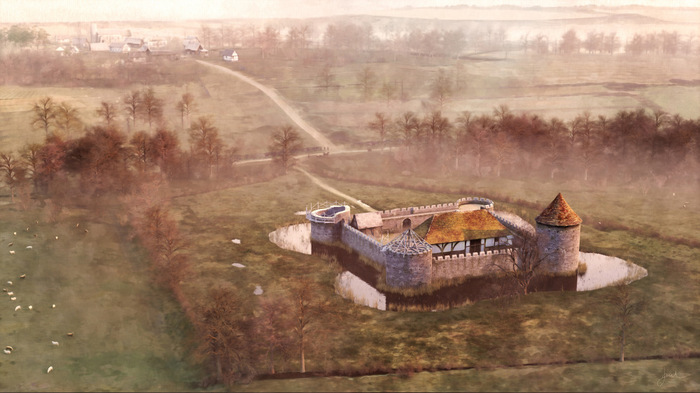
This is Paston. Paston Footprint, developed by David Viner and graphics by James Mindham, 2015-2025. https://www.thisispaston.co.uk/
This collection of letters within 3 generations of the Paston family is a helpful text in understanding the historical realities of normal (though aristocratic) people at this point in history. I found it especially interesting seeing Margaret's perspective and how little she was the weak damsel we often see portrayed in medieval fiction, but was actually running the Paston estate and finances.
This is a wonderful collection of fifteenth-century family letters related to the everyday lives of the Paston family of Norfolk. Many are related to business, but my favourite is the Valentine sent by Margery Brews to John Paston III in 1477: 'RYGHT reverent and wurschypfull and my ryght welebeloved Voluntyne, I recommande me unto yowe full hertely, desyring to here of yowr welefare, which I beseche Almyghty God long for to preserve unto hys plesure and yowr hertys desyre. And yf it please yowe to here of my welfare, I am not in good heele of body ner of herte, nor shall be tyll I here from yowe...' – to which I'm glad to say she received a swift reply.
I would have preferred less intervention in the spelling, capitalisation and punctuation. Thorn has been replaced by 'th' and yogh by 'y' and the modern vowel/consonant distinctions between i/j and u/v have been regularised. None of this seems to be an improvement. Nonetheless, this book is a fascinating insight into everyday life in late medieval/early modern England. A joy to dip into.
Despite this being an abridged edition with modern spelling, this collection of 15th-century family letters was not an easy read, especially at first. When the names started to be familiar and I controlled my impulse to read every footnote, it became much easier.
Most of the letters are written between Margaret Paston (c.1421-1484) and her husband John (1421-1466) and sons John II and John III (two living children with the same name!). They were a landed gentry family, not aristocratic - John I was the grandson of a yeoman farmer whose son William was given a good education by an uncle and became a very successful lawyer and judge, buying various Norfolk estates. John I then extended their holdings with what sounds like some dubious business over a will.
The Wars of the Roses were waging at this time, and I didn't realise how much it involved families like this whose properties were attacked, ransacked, or besieged by rival factions, although well away from the main battles. The attacks may have been more to do with the contested will than the civil wars, but the atmosphere created by the wars meant that this kind of lawless violence went unchecked. Margaret was clearly a very strong and sensible woman, often left literally holding the fort in Norfolk while her husband was negotiating in London and her older sons were trying to ingratiate themselves with the nobility. Meanwhile one of her husband's unmarried sisters was getting involved with an employee that they considered unsuitable, and she had five younger children to think about. Later, there are some sweet letters around Valentine's Day between John III and his eventual wife, who seem to have been much in love.
An interesting insight into landed-elite family life during the Wars of Roses. The edition with modern spelling is helpful. The footnotes add intrigue and another layer of understanding to letters that initially appear superficial. Great primary source.
A glimpse into the lives of a 15th century gentry family via their letters. There’s tragedy, comedy, family fallings out, high politics, business, faith, war, love, and an inordinate amount about the estate of Sir John Fastolf…
A very nice view of daily life in the 15th century through the Paston family letters. Among a lot of comings and goings of the family, the compilation notably includes a description of the bridal cortege of Margaret of York in Bruges as witnessed by one of the sons, an invitation to a mourning relative to come by for New Years' Eve ("it will be very quiet, just family and we will play a little music and play cards" - a casual mention that is the first mention of cardplaying ever), and (I was completely won over by this) a request to the absent husband to "please bring crossbows when you come back, because our men tried to use the longbows to shoot through the windows to pratice for the coming siege and our ceilings are simply too low to do this properly".
Definitely got across the tumultuous background of the time period. However, I grew tired of reading footnote after footnote trying to figure out who each person was and the significance of every place mentioned.
Recommended as part of the Future Learn course England In The Time Of Richard III. Background reading. One of the main sources for history of the period. Very informative.