Jump to ratings and reviews
Rate this book

Bunte Steine #4

Bergkristall

Rate this book
Erstdruck 1845 in der Zeitschrift »Die Gegenwart« unter dem Titel Der heilige Abend.

Konrad und Sanna gehen am Tag vor Weihnachten von ihrem abgelegenen Bergdorf ins dahinterliegende Tal, um die Großmutter zu besuchen. Das Wetter ist schön, und der Gang ist ihnen vertraut. Auf dem Heimweg aber beginnt es plötzlich heftig zu schneien: sie verlieren die Orientierung und suchen in einer Eishöhle Zuflucht. Das ganze Dorf bricht zur Suche auf und rettet die Kinder.

77 pages, Perfect Paperback

First published January 1, 1845

47 people are currently reading
3361 people want to read

About the author

Adalbert Stifter

461 books85 followers
Adalbert Stifter was an Austrian writer, poet, painter, and pedagogue. He was especially notable for the vivid natural landscapes depicted in his writing, and has long been popular in the German-speaking world, while almost entirely unknown to English readers.

Ratings & Reviews

What do you think?
Rate this book

Friends & Following

Create a free account to discover what your friends think of this book!

Community Reviews

5 stars
459 (22%)
4 stars
745 (36%)
3 stars
595 (29%)
2 stars
181 (8%)
1 star
39 (1%)
Displaying 1 - 30 of 277 reviews
Profile Image for Vit Babenco.
1,791 reviews5,836 followers
October 18, 2023
Christmas is an adventurous event… But Rock Crystal is a story of the Christmas misadventure…
And as it was customary at the times everything is romanticized and idealized…
The Catholic Church observes Christmas, birthday of our Saviour, by magnificent and holiest ceremonial. In most places, midnight as the very hour of his birth is solemnized by ritual of great splendor, to which the bells ring out their heartsome invitation through the still darkness of the wintry air; then with their lanterns, along dim familiar paths, from snow-clad mountains, past forest-boughs encrusted with rime, through crackling orchards, folk flock to the church from which solemn strains are pouring, – the church rising from the heart of the village, enshrouded in ice-laden trees, its stately windows aglow.

On Christmas Eve a boy and his little sister walk happily along the mountain trail to visit their granny in the town… Their grandmother, after giving them their presents, sends them home so they could return before the dark… 
“See there, Sanna,” said the lad. “I knew it would snow; remember when we left home, we could still see the sun, as red as the lamp over the Holy Sepulcher in church during Holy Week, and now we can’t see even the faintest ray and there’s only gray fog up there over the tree-tops. That always means snow.”

It’s snowing… Children are very glad… However they lose their way… And instead of descending to the valley they climb higher and higher… Until they find themselves surrounded with crags and ice…    
“Sanna,” said the lad, “we cannot go down any farther because it’s night, and we might fall, or even stumble into a crevasse. Let’s go in under the stones where it’s so dry and warm, and wait there. The sun will come up again and then we’ll run down the mountain. Don’t cry, please don’t cry, you can have all the things to eat that Grandmother gave us to bring along.”

Holidays are for joy but destiny is tricky. And all’s well that ends well.
Profile Image for Orsodimondo.
2,464 reviews2,437 followers
October 9, 2025
UNA PIETRA PER AMICO

description
Friedrich Simony: Gletscherphaenomene.

“C’era una volta…”.
No, non comincia così questa novella.
Ma potrebbe: perché ha molto della fiaba.
Come spiega bene nella postfazione Gabriella Bemporad, specialista in letteratura tedesca e mitteleuropea, il racconto lungo di Stifter è pieno di riferimenti a spunti biografici: il fatto curioso è che, però, Stifter non andò mai così in alto in montagna, non aveva conoscenza diretta dei ghiacciai, ma solo attraverso i racconti e i dipinti dell’amico Friedrich Simony, geografo e geologo e scalatore, come questo qui sotto.
Scritto nel 1845, uscì alla fine dell’anno su un giornale, e fu poi ripreso nella raccolta di racconti “Pietre colorate” pubblicata nel 1853, sei racconti tutti intitolati con un nome di pietra: Granito, Pietra calcarea, Tormalina, Mica, Argilla lattea, e questo Cristallo di rocca, che è sicuramente il migliore del lotto.
Lo stesso Stifter, che insegnava fisica e matematica al figlio del principe Metternich, presso il quale abitava, si dilettava in pittura. Eccone un esempio.

description
Adalbert Stifter: Fattoria.

Corrado, più grande, e Sanna, la sorellina, sono andati a trovare la nonna e stanno tornando a casa per il sentiero che conoscono bene, tre ore di cammino da un piccolo paese all’altro dove vivono.
È la notte di Natale. Il tempo peggiora improvvisamente, la neve ricopre tutto, loro smarriscono la strada, sono costretti a passare la notte in montagna in una grotta simile al palazzo di un re delle Alpi, costruito di smeraldi, zaffiri e cristallo di rocca.
Al mattino vengono trovati dai soccorritori, e gli abitanti dei due paesi, che fino ad allora si erano pacificamente ignorati, adesso fraternizzano.

Riassunta così è un concentrato di edificante melassa ultra zuccherina. Stifter sa condire il racconto con abilità: il paesaggio familiare si trasforma in un regno di mistero fatto di neve, pietra e ghiaccio – altrettanto misteriosa è la grotta dove i due bambini trovano riparo, luogo di possibili insidie ma anche di seduzione – la paura viene tenuta a bada dalla speranza che il nuovo giorno porti alla salvezza.
E con grande semplicità e pulizia di forma, sa muoversi tra realismo e simbologia,
sa coniugare il mito con la verosimiglianza, la favola con l’oggettività, la terra col cielo.

description
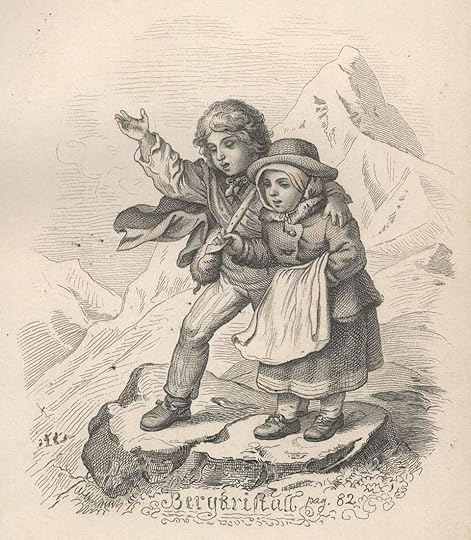
Illustrazione di Ludwig Richter per la prima edizione (1853) della raccolta di novelle “Pietre colorate” di Adalbert Stifter, dove compariva anche il racconto “Cristallo di rocca”.


Le interpretazioni sono fioccate: i moti rivoluzionari del 1848, ai quali Stifter aderì con entusiasmo, per poi staccarsene quasi subito davanti all’orrore per la violenza popolare – e quindi l’intento nascosto sarebbe pedagogico e politico insieme volto alla pacificazione.
Oppure i bambini salvati sono i nuovi valori portati dall’epoca che cambia, da proteggere rispetto alla violenza, e forse anche all’eccesso di passione.
Chi ci vede invece un percorso personale artistico di Stifter che abbandona il romanticismo per sposare il ‘classico’.
Oppure, c’è chi interpreta sottolineando che purezza e innocenza testimoniano il punto di vista di chi ha fede in una grande “creazione”.

description
W. Eugene Smith, The Walk To Paradise Garden, 1946.


Per me il godimento maggiore è derivato da quelle che Gabriella Bemporad sintetizza così:
il giro delle stagioni, l’alternanza delle salite e delle discese, il digradare delle diverse vegetazioni sui fianchi del monte, la convivenza, le une accanto alle altre, delle piccole convenzioni e consuetudini del paesino della valle e delle grandiose, luminose meraviglie delle cime, e, descritti con la stessa esattezza, la stessa voce, lo stesso ‘tempo’, il moto delle costellazioni e la perfetta “costellazione dei chiodi” sulle scarpe dell’abile calzolaio, i grandi silenzi delle solitudini ele modeste parole del commercio e della solidarietà umani, il pauroso, il meraviglioso e il quotidiano contemplati con gli stessi occhi pacati, la fine che si riallaccia naturalmente al principio chiudendo il difficile cerchio dell’armonia…

description
Immagine dal film TV “Cristallo di rocca – Una storia di Natale”, regia di Maurizio Zaccaro, 1999.
Profile Image for Geoff.
444 reviews1,528 followers
February 27, 2014
I've read Rock Crystal three times in the past three years before the last three Christmases, and though I'm not a Christian and I'm only religious in the sense that I believe certain things to be sacred, there is within my being an almost overwhelming feeling of nostalgia associated with that time period between the end of November and the New Year, and I solemnize, if nothing else, that feeling and my family and I try to understand and be grateful for what they have tried to provide me with in this life, and so I try to give something in return to my Mom and my Dad and my sister and brother and now my nephews, even if that something is only meals I help to prepare and time spent- and all in all "time spent" is the greatest gift one person can give to another person in this brief life. This book is a perfect fairy tale that only hints at the supernatural but is all shot through with what one might call magic- small villages in wintry mountains and great floes of ice and snow shafts in the waning light and aurora borealis and the utterly enchanting vision of falling snow (still, to this day as a sad adult, falling snow is the most enchanting thing) and a children's journey, perhaps doomed, but never in this miracle place (the place of fairy tales, where doom is never permanent, and thus is the abiding nature of fairy tales- they are the one place where our dreams outlast doom)- it is a simple Christmas story tinged with something of Hölderlin's poetic admiration of mountains. Rejoice in the tininess of this not-grand tale (a snowflake) and the sweet kindness it contains (the long dreamy sigh of winter will find its spring). It's short and can be read in an hour or so, so read it to your children or children you might know.
Profile Image for David.
161 reviews1,751 followers
February 24, 2010
Who am I kidding? I'm not going to finish this thing. I'll get more enjoyment by just staring at the cover lovingly, stroking it with the tippy tip-tops of my fingers, and saying aloud, 'Pretty!' in the voice of an idiot manchild. This isn't the case of a book deserving a good cover; this is the case of a cover deserving a good book... and this just ain't it.

I should have taken the author's name as sufficient warning. I mean, what the hell does an Adalbert Stifter have to tell me? He sounds like the kind of man who should do surveying for topographical maps or who should teach philology in Vienna while scowling at his students, who watch his old worldy muttonchops -- minute by minute, day by day, fortnight by fortnight -- devour his anemic, skull-like face. That's my impression of an Adalbert Stifter anyway.

Should I admit to you that this book is only seventy-five pages long? And that the typeface is relative large? And that the line spacing is generous? And yet I still couldn't bring myself to finish it?

I had the best of intentions. I would think to myself:

Okay. Now I am really, really, really going to sit down to read Rock Crystal. Yes! I am very pysched about reading a bunch of scrupulous descriptions of the trees, the valleys, the mountains, the shrubs, the streams, the leaves, and the socioeconomic milieu of two Alpine valley communities circa the first half of the 1800s. Won't that be fun? I'm sooooo going to park my keister and enjoy the living shit out of this {allegedly} serene, moving yuletide story of two Hanselesque and Gretelish siblings who get lost in the woods on the way home from visiting their Grams and Gramps. Yes I am. I really am. I completely am. In two minutes I'm gonna go get that book and read the fuck out of it. I can't wait. It's gonna be, like, a totally transcendent experience. Or something. I am having so much fun thinking about all the fun I'm going to have reading about the father's shoemaking business and why the townspeople prefer his shoes to anyone else's. Even Aldo's. Yes. Any minute now I am going find myself so tempted by this beguiling, charming tale of two lost imps that I'll desperately crave a hasty return to those Bohemian villiages. In fact, I'll never want the story to end. Ever! I mean, look at the cover... It's so icy and pretty. It's reminds me of Marlon Brando's crystalline tract home on Krypton in the first Superman movie. Or an Apple store. Something clean, crisp, cool, refreshing. Like a glass of Perrier with a so-thin-you-can-read-through-it slice of cucumber in it. That's what this book is like. And that's why I can't wait to get back to it. I don't even care if I have those two new DVDs waiting to be watched. They're probably not good anyway, right? They're surely not about a pair of Lederhosen-wearing scamps yodeling their way through the Alps on a heartwarming Christmastime trek. What could be better, really? Books like this lift me up to a higher plateau of consciousness. The penthouse of consciousness, you might say. Ten more minutes, and then holy shit... am I ever going to read the fucking fuckety fuck out of that book! I am very, very, very, very excited. Whoohoo! (I wonder if The Biggest Loser is on...)


So -- SPOILER AHEAD -- the kids get lost but, unfortunately, they don't die. (I read the introduction. That's how I know.) Death would have really added something to this novel, I think. Violent death? Even better. This thing was just way too prim, starchy, and antiseptic. I imagined the author wearing a pince-nez and long gloves and using a cigarette holder while he wrote it. It's almost as if a dewy-eyed Hegel (in secret) tried his hand at novel-writing and the manuscript were found long after his death by... I don't know, Susan Sontag or someone who wrote their jacket blurb before they had even bothered to read the damn thing.
Profile Image for Sonja Rosa Lisa ♡  .
5,162 reviews639 followers
October 15, 2024
Die Geschichte ist dank ihrer altertümlichen Sprache nicht so leicht wegzulesen, aber gerade diese für heutige Zeit "veraltete" Sprache hat auch ihren Reiz. Wenn man sich erst einmal daran gewöhnt hat, hat sie einen gewissen Charme.
Zuerst wurde sie 1845 veröffentlicht, aber die Thematik ist leider besonders in der heutigen Zeit (wieder) brandaktuell.
Es geht um Vorurteile, Anderssein und Ausgrenzung.
Profile Image for Hilary .
2,294 reviews491 followers
December 17, 2018
This short story is set in a mountain village high in the Alps. Poetic descriptions of the breathtaking beauty and extreme harshness of the area. The story is quiet and reads like a fairy tale or folk tale. It is a simple story and one best read without knowing much about it. This is the sort of story you expect to read is based on real events, but if it is, it doesn't say.

Why introductions are included that give away the whole plot and ending, I don't know. I never read them first anyway but this edition, just in case you escaped the spoilers in the intro, gives the whole plot on the back of the book too!

Thank you to goodreads friends Booklady and Susan for recommending this wonderful book, and thank you to Susan for pointing out the double spoilers that sandwich this story front and back!
Profile Image for Bren fall in love with the sea..
1,959 reviews477 followers
September 27, 2025
"Rocks, mountains, crystals, bodies of water -- these too are homes of conscious beings."
- Adalbert Stifter, Rock Crystal


Delightful and enthralling. Review to follow.

brought me back to my childhood. Made me think of Christmas day and snowfalls and chocolate and gifts and holidays and sweetness.

Two children are coming back from their Grandmother's house when they get lost high up in the mountains right before Christmas. It's not scary. The story is actually enchanting and the descriptions of the "rock Crystal" mountains and their formations are enthralling. It's a classic I found by chance and quite short. Give it a go maybe around the holidays.
Profile Image for Diane S ☔.
4,901 reviews14.6k followers
March 1, 2015
Beautifully descriptive, simple but wonderful, this short novella tells the story of two children lost in the mountains. The care that Conner takes of his little sister is so incredibly poignant as is the way she listen to absolutely everything he says, the amazing trust she show in her brother. Loved the way all the villagers pulled together to search for the missing children. Much can be read into this story, interpretations of a Christian nature, acceptance into village life and a survival story where young Connor showed love and wisdom beyond his years.
Profile Image for Sandy .
394 reviews
January 2, 2016
In this very unusual story, two children travel a familiar route from their home in an alpine valley to visit their maternal grandparents who live in a neighbouring valley. It is Christmas Eve, and they are bundled off early for the return trip, with pockets and knapsack stuffed with gifts, edible and otherwise, for their siblings and parents.

An unexpected snowfall disorients them and they become completely lost, following the wrong serpentine road up the mountain. They are unable to find the ridge which connects to the next mountain (near their home village) and, after scrambling blindly among huge rocks and over gigantic ice fields, they spend an exhausting sleepless night huddled under a rocky shelter on the edge of the glacier.

Although the reader realizes that this would be a harrowing experience for two youngsters, the hauntingly beautiful description of the natural surroundings inspires a feeling of detachment and calm rather than the expected fear and panic. The surreal and eerie beauty of the environment imparts a sense of awe and wonder. I feel privileged to have experienced, through the senses of the author, a part of the earth which I will never see first-hand - the intense, vast, silent world of ice and sky which is the unchanging reality of the mountaintop.
Profile Image for Ken.
Author 3 books1,251 followers
November 23, 2024
ROCK CRYSTAL, a title out of the NYRB series, is a small (73 pp.!) gem that requires a certain mindset because, well, not a lot happens. Still, if you're into idylls and Christmas stories -- how about the Alps or winter? -- you may find this little foray worth the trip.

Young Conrad and his younger-still sister Sanna are traveling on Christmas Eve morning from their parents' home to their grandparents' home in another valley. All goes well and Grandma sends them home with a few gifts. On the way home, all does not go well. A snowstorm hits. At first the children are delighted because there is no wind (unusual) and the snow is pretty, but soon the landscape changes appearance and before they know it they are lost. Conrad gamely tries to lead Sanna out of danger but only gets them more lost. They wind up on a glacier.

To enjoy the book, you have to slow down your reading at the glacier. It's the essence of the book, really, as Stifter, through translators Elizabeth Mayer and Marianne Moore, engages in some stellar nature descriptions of the glacier, the snow, the mountains, a cave, and the nighttime sky. On a parallel track, he relates what's going on down in the villages where children are receiving their gifts from the Christ child (as opposed to Santa). The contrast is the thing here, because the holy goings-on somewhere below and the holy goings-on up on the glacier are different things entirely. Or are they?

If you can draw lessons from this escapade as well as from the search efforts on Christmas Day, you'll be happy you made the trip. It is unlike any Christmas tale you've ever read, no doubt, and Goethe would be proud (as would Thoreau and Emerson, probably). Not so much exciting as quaint and contemplative. Quick and peaceful. If you're in the mood for such, ROCK CRYSTAL is your book.
Profile Image for Mir.
4,975 reviews5,328 followers
March 12, 2018
Due to the reissue's cover image and the general taste of the selection of friends who had read this, I got the mistaken expectation that this 1)postmodern and 2)actually about rock crystal in at least a metaphorical way. Both of those are not the case.

This book is not like this:


It is like this:


...things beyond anything imagined, things they dare not touch but which, after they have received them as gifts, they will carry about...

This a nice, subtle religious metaphor.

Stifter's prose is quite admirable, although the story itself is nothing out of the way. I'll see what else he wrote.

Scharl's illustrations are also worth the look.

p.s.
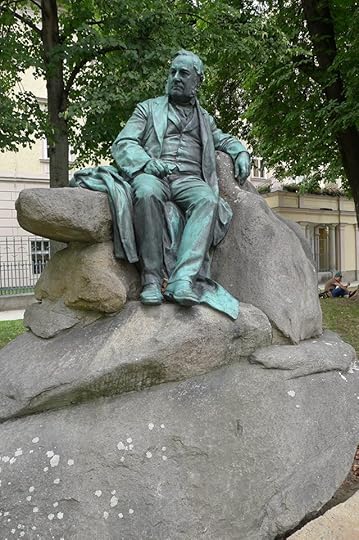
I took a photo of the author, even though I hadn't read him yet at the time.

Profile Image for Amaranta.
591 reviews265 followers
July 1, 2019
Questo breve testo sembra una favola. Ricorda molto cappuccetto rosso, come archetipo generale. Il bimbo, i bimbi in questo caso, che va a trovare la nonna e sulla strada del ritorno incontra difficoltà che alla fine, con un po’ di fortuna riesce a superare.
Quello che colpisce sono le descrizioni di una natura splendida, abbagliante nella lucentezza del bianco, una natura che , seppur causa delle difficoltà in cui i bambini si ritrovano, non riesco a percepire come ostile. I ragazzini hanno freddo, fame, ma riescono a trovare un riparo e godono della bellezza di cieli luminescenti e montagne impervie. Mai il bimbo, fedele guida della piccola sorella, si perde d’animo. E questo rassicura per certi versi il lettore, sa che ci sarà un lieto fine, e segue a cuor un po’ più leggero i piccoli esploratori.
Una lettura piacevole, rinfrescante in questa calura estiva, un autore da seguire in futuro.
Profile Image for Frau Becker.
222 reviews48 followers
December 13, 2025
Ein Meisterwerk. Es passiert nicht viel: Am Weihnachtsabend werden zwei Kinder auf dem Heimweg zwischen zwei Alpendörfern vom Schnee überrascht, verlaufen sich und werden gefunden. Die Kunst dieser Erzählung aber liegt in der Ausgestaltung: Stifter nimmt sich viel Zeit, mehr als zwanzig Seiten benötigt er, um den Schauplatz zu beschreiben, der sich damit in einer ungeahnten Plastizität vor dem Leser eröffnet. Auch in der Beschreibung des Irrwegs der Kinder dominieren Landschaftsimpressionen. Trotz der unmittelbaren Lebensgefahr steht der Erzähler der Natur mit Bewunderung und Ehrfurcht gegenüber, die Kinder treten der Situation mit einer wunderbaren Zuversicht entgegen: Nie dominiert hier Angst oder gar Panik, das vordringliche Gefühl ist Fürsorge füreinander und die Gewissheit, gerettet zu werden. Ihre Rettung stiftet zudem Gemeinschaft zwischen den Einwohnern der Nachbardörfer, die einander bislang zwar nicht mit Ablehnung, aber mit Skepsis begegneten.
Profile Image for Dhanaraj Rajan.
533 reviews363 followers
February 13, 2015
A Confession:

I read this book in a wrong season (just before the commencement of Lent). It is a book for Christmas. And it is a wonderful book for Christmas. I will read it again and again mostly during the Christmas season.

What is it about?

It is about love and Christmas.

Two kids (a brother and a sister) living in one of the Alpine villages go missing on the Christmas eve. As they return from the village of their grandparents, there occurs a heavy snow and they lose the track. They are lost and after a night they are found by the searching group and brought to their village.

This is such a simple premise for a story. But Stifter in writing this story has created a wonderful parable of Christmas. There are many allusions to the Christmas event. For instance, when in the middle of the night the lost kids find a shelter in a cave and they witness a shooting star which brightens up the entire drowsy whiteness with lot of colours. And the next day, we see that small girl explaining to her mother that she saw the Christ child.

What sustains everyone alive? The love. The love that the brother has for his sister and the simple faith of the small girl in her brother's words. And in the middle of the night to keep them alive (sleeping would have resulted in death) the gift of the grandmother - coffee extracts for the mother - comes in aid. The searching party is organized everywhere and the whole village is involved in searching out the mountain. The finding of the children brings joy to the entire village. At this moment everyone realises that each one is connected by the thread of love. And that makes life very joyful. And the backdrop is the Christmas day.

What else one needs to ask for in this short tale? In fact, the narrations of the natural happenings and the nature are just fantastic. That is an added bonus to me.
Profile Image for Lisa of Troy.
1,139 reviews8,189 followers
Want to read
April 26, 2024
Heard of this book from Tristan and the Classics: https://www.youtube.com/watch?v=wBMY3...

This is one of the 10 Classic Books from the German Canon. He describes this book as transcendentalist, and that is one of my core values so I will have to read this!
Profile Image for Alan (the Lone Librarian rides again) Teder.
2,718 reviews257 followers
December 30, 2025
A Perilous Christmas
A review of the NYRB Classics eBook (December 15, 2015) as translated by Marianne Moore & Elizabeth Wolff Mayer with an Introduction by W.H. Auden as first published by Pantheon Books (1945) from the original German language Bergkristall - Der Heilige Abend [Rock Crystal: The Holy Night aka Christmas Eve] (1845) later collected as story #4 in Bunte steine: ein Festgeschenk [Motley Stones: A Celebratory Gift] (1853).

This is a fairy-tale like story of two children trapped by a sudden snow storm as they travel home through a mountain pass in the Swiss Alps from their grandparents village to that of their parents. The two families and two villages are estranged from each other despite the inter-village marriage by the parents of the children. The search for the missing children brings them all together.


Image from the 1853 edition sourced from Wikipedia by Ludwig Richter - This image has been extracted from another file, Public Domain, Link

This is heavily dated by its insistence on Christian imagery and symbolism, but the heart of the story about siblings trusting and supporting each other and the reconciliation of family is a timeless topic regardless. I read quite a few duds in my Christmas themed reading this year, so this was redemptive and a good note on which to end my reading and reviewing year for 2025.

All best wishes to GR friends and follows for the end of the year and the new year to come!

Trivia and Links
Rock Crystal has been adapted for films several times. A complete list of adaptations is listed here. One of the most recent adaptations is the 2004 German language movie Bergkristall and you can see a trailer for it here.

The original German language text and an earlier 1914 translation by Lee M. Hollander are in the Public Domain. You can read the original German at Zeno.org and the Hollander translation at Project Gutenberg. An audiobook narration of the Hollander translation is available at Librivox.
Profile Image for Emmeline.
448 reviews
January 8, 2025
Read in one evening, and much anticipated as a somewhat obscure Christmas classic, I found this enjoyable but a bit slight.

Two children must cross a mountain path from their grandparents' valley to their own on Christmas Eve. A sudden snowstorm comes up and they lose their way and find themselves out on a glacier in the depths of Christmas night.

I do love stories of man (or child) wandering out of civilization and becoming dwarfed by nature and so I loved the actual night scene, as well as the whole denouement. Otherwise this was pretty simple though, more of a short story.
Profile Image for Natalie.
145 reviews67 followers
December 31, 2023
English version can be found below.

-------------------
German Version:

Verschneite Weihnachten was gibt es schöneres!😊❄️ Es handelt sich hier um eine wirklich niedlich Erzählung, allerdings finde ich die Natur- bzw. Bergbeschreibung etwas zu übertrieben. Besonders bevor die eigentliche Geschichte der Kinder losging, also ca. die ersten 30 Seiten. Die die Geschichte der Kinder war aber schön gestaltet und man konnte durch die Naturbeschreibungen auch ihre Gefühle und die allgemeine Situation besser einschätzen und mit ihnen mitfühlen.

Insgesamt: 3,7.
-------------------

English version:

What could be nicer than a snowy Christmas!😊❄️ This is a really cute story, but I think the description of nature and mountains is a little too exaggerated. Especially before the actual story of the children started, i.e. about the first 30 pages. However, the children's story was beautifully designed and the descriptions of nature made it easier to understand their feelings and the general situation and empathize with them.

Overall: 3.7.
Profile Image for Jim Elkins.
361 reviews456 followers
Read
January 4, 2019
Slow Pace and Harmony: Two Qualities Missing from Contemporary Fiction

Beautifully translated, perfectly formed novella. Stifter is the "landscape painter" of German realist novelists, and this little novel begins with a leisurely tour of a mountain range, so that as readers we know our way around. Then two little children get lost in the mountains. It's not meant to be melodramatic: it's the opposite: a potentially maudlin story told with absolute calm and with fastidious and accurate attention to the Alpine landscape. Beautiful and serene.

W.H. Auden makes all these points in his intentionally simple introduction. Stifter means to make a Christian parable, but it is not a parable of redemption. It's about harmony: harmony of people with themselves, with each other, with the landscape. People and mountains are largely silent. A person's regard of another shows how much they understand of that other: the boy of his devoted sister, both the boy and the girl of the mountain.

The pace and the purpose of the story couldn't be farther from the frenetic & hysterical inventions of our current novelists (thinking of McCarthy, Galchen, Baker, et al.).

It is a wonderful tonic. I would read it as a reminder of the fact that the frantic need to invent clevernesses in every line, which has come to seem like nothing other than good writing, is a form of obliviousness to other meanings. And note: the calmness here, and the disinterest in writerly invention, is on an entirely different level from minimalist fiction of the last forty years. Addictions aren't that easy to renounce: this book is from an entirely different cultural moment, one that continues into the later 20th c. in writers like Halldor Laxness.
Profile Image for BJ Lillis.
335 reviews283 followers
December 9, 2021
I read this as part of Motley Stones, the cycle of novellas in which Stifter placed it in 1853, 8 years after its first publication, and I fear that outside of that context—not following immediately on the heels of Tourmaline, as dark, vivid and strange a story as any; not in the light of Motley Stones' preface, with its head-spinning combination of trite 19th-century moralizing and striking insight—this would have been a four star story, or even a three: A sentimental, old-fashioned story, that turns its self-conscious awe of natural phenomena into pat Christmas-eve fable. A story good for a late-night December read by the Christmas tree, only saved from the obscurity it probably deserves by the sentimentalism and nostalgia and vague Central-European inflection that marks the whole season, at least for North Americans raised in Christianity, or whose grandparents were. But that is not how I read it. I read it as part of Motley Stones, a book that can't decide if it is about children and for adults or about adults and for children. A book deeply invested in the beauty and inhumanity of the environment, written over a century before global warming and yet haunted by the question of whether nature is what changes around us, as human lives stay basically the same—or human lives that change, while nature stands steadfastly by. In short, this is a touching, sweet little story about two children at Christmas time. Like so much of the best pre-20th-century literature, it starts slow and picks up almost imperceptibly, until by the end you're gripping the book as hard as the ropes of a toboggan. Stay alert, though—there's something more going on beneath the surface, even if I'm not quite sure what it is that lurks below.
Profile Image for booklady.
2,744 reviews186 followers
December 22, 2016
A dear friend gave me Rock Crystal as a Christmas gift this year and I can highly recommend it as a great Christmas read! Originally published in 1845 it has the sort of timeless feel of a Dickensian classic (albeit without all the characters) and deserves to be better known—why it isn’t truly puzzles me. Perhaps it is because of the author’s unfortunate lack of success and premature demise, but that aside, this little novella is a delight and is going to be stored among my other Christmas treasures to be read annually.

A seemingly simple tale of two children—Conrad and his little sister, Sanna—who are on a visit to their maternal grandmother in a village across the mountain range from their own home. Of course all stories are photographs of a moment in time, where much has happened before, in the history of one family divided by a mountain range, for example, not to mention two villages. When returning home after dark during a heavy snowfall, the children become lost and discover themselves out on a glacier, and unable to get down.

As is often the case, the children teach the adults the value of Life and Love. Quiet, deep and descriptive, Rock Crystal, will not appeal to everyone, especially not those who expect constant thrills, but for those very qualities I was enchanted to savor the experience.

A lovely book, perfect for a family read aloud. Highly recommended! Many thanks to my benefactor!
Profile Image for Andy Weston.
3,211 reviews227 followers
July 13, 2021
This is a wonderful way to spend an hour, engrossed in a seemingly simple tale of two children who get lost in the mountains on Christmas Eve.
It is the 17th Century, and somewhere in the Austrian Alps, where two valleys lie next to each other, surrounded by forbidding peaks, and linked by a solitary lonely path. The weather has been unseasonably warm, and two children set out to visit their grandmother, over the path.
Laden with gifts and food, the children beging their trek home, as ice forms on the puddles, and with snow in the air. An unexpected storm arrives, with the severity not seen in the lives of the villagers.
Written in 1845, this begs to be read in one sitting, with a warming glass in an armchair with a winter fire burning (though I enjoyed it just as much on a humid summer porch). Don't expect a tear-jerking melodrama; such is Stifter's skill this is a gentle and timeless parable about the places people choose to live, and the often strained relationship between man and nature.
Profile Image for Chrissie.
2,811 reviews1,420 followers
November 6, 2022
Free download at Librivox.
Roger Melin narrates. He is also referred to as Greg W.
The version here is translated into English by Lee M. Hollander.

Two kids, a brother and sister going home alone from their grandparents on Christmas Eve, get lost on a glacier up in the Austrian Alps!

This novella has a slow start. The background is being set. We learn how even neighboring villages are separated from each other by rugged terrain and climatic conditions. Each must be self-sufficient, and so it has always been. A church, a school, a shoemaker, a dyer and tannery and small farms typify the villages. All in the village know each other. Most born in any given village stay there their entire lives. The parents of the two children broke away from the norm. They chose a spouse from a neighboring village, and so this is how it came to be that the two grandchildren at Christmas were visiting grandparents across a mountain pass. On the way home it snowed and snowed more and more. That they lost their way is not strange.

The story picks up when the children get lost. The descriptive nature of their experience high in the mountains is both beautiful and frightening. The atmosphere pervading village life is also well drawn. In a way, what is told reads as a fairy tale. We are swallowed up in a mystical, magical bubble from the past. You cannot, should not judge the tale objectively. If you do, it falls apart. That the two children are !

We see how the villages and their respective inhabitants come closer together. With this the author relays a message--both heartwarming and valuable. There is also reference to God and faith.

I like the atmospheric tone of the novel. I am not religious and too much of a realist to find the story credible. Three stars is my rating—I like it, but it did not wow me.

The narration by Roger Melin is better than most at Librivox. He reads well. Keep an eye out for him. Three stars for the audio narration as well as the story itself.
Profile Image for Anna.
381 reviews57 followers
January 7, 2022
Hibernal Hansel and Gretel

This classic gem completes the series of this festive season's winter-journey reads for me, following Tolstoy's Master and Man and Sorokin's The Blizzard. It's a quiet story with scarce plot that derives its power from the carefully crafted writing, rendered exquisitely into English by Marianne Moore and Elizabeth Mayer.

On Christmas Eve, two young siblings get lost on the snowy mountain and are then found by the search party. The fact that they, along with their beautiful mother, are strangers in the village, is not explored in any striking way that creates tension, but only suggested discreetly.

Their night on the mountain feels as if taking place out of measurable time, and the mythical feel is also intensified by the unnaturally constructed, didactic dialogues. Initially a source of delight for the young travelers, the relentless whiteness gradually becomes "voracious snow" and then a "pall of flakes". The sense of foreboding is most effectively given by the subtle and – considering the time of the year the story is set in – anachronistic use of religious symbols. Before they embark on their journey, they could
"still see the sun, as red as the lamp over the Holy Sepulcher in church during Holy Week".

In the same way as the Holy Sepulcher was a place of death and resurrection, the rock crystal becomes the locus of resurrection for the siblings. The hibernal incident restores them to their families, but it also creates connection with the village that now can call them its own.

A wondrous read.
Profile Image for Mikki.
43 reviews88 followers
December 11, 2011
Having finished the book a few days ago, I'm still perplexed by all of the glowing reviews (not just from readers but critics and revered authors). I kept thinking, "maybe it's me… what am I missing?"

Nothing. It's a folktale that tells the story of two villages and one family separated by miles of high mountains and years of living in their enclosed separate worlds.

they cling to what is traditional and to the ancient ways of their forefathers…love their own valley ardently, and could scarcely exist away from it."

There are three things that link the villages: a road that passes through the mountains and two children who travel it regularly between home and grandparents on the other side. But on a snowy Christmas Eve when the children become lost on the mountain we wonder if the villagers are able to close the divide and if so, can they do it within time?

Though there are parts in the beginning that are wonderfully descriptive, when you strip the book of it's gold leaf reviews what you'll find is just a simple parable about humanity and it's commonalities when differences are tested and forced to be set aside.

This would be a perfect little book for a young adult to read on Christmas Eve. I give it a 2.5.
Profile Image for M. Sarki.
Author 20 books238 followers
March 28, 2014
http://msarki.tumblr.com/post/8099536...

Adalbert Stifter suffered from anxiety and depression his entire life. Like so many writers, he depended on the approval of others and despaired over the public indifference to his novels. Obviously, his own character was one that could not overcome this perception regarding his own inadequacies. He took this public refusal of his life’s work so personally that his last act on earth was to unfortunately cut his own throat.

This is a fiction, but all of us bring something of ourselves to the reading of any text, that is, unless we are dumb to the ways of the heart and our own human impulses. What matters to many of us at specific and certain times, for others matters to none. Within the law, I myself am naturally a hardened, cold-blooded murderer. Like a farmer tending to his flock and crops I do what must be done to extricate and eradicate in order to protect the better interest of all I am charged with safekeeping. It helps a human to be hard when it entails a violence unbecoming of a man so closely attuned to nature. Death is simply a matter-of-fact and nothing one needs to dwell on. But when children are involved this sometimes frozen heart of mine thaws to a degree baffling to the ears of those who know me and who hear me babbling in my pleading cries for mercy. And I, who have never been a lover of young children, even my own, rise to their defense and protection like no other. It puzzles even myself this manner in which my overwhelming and compassionate emotions seem to exflunct my long-hardened stance. My posture severely bends in the doubling over of my agony, and I wish the present experience had never occurred or would quickly end.

Much has been praised about this fine little book Rock Crystal. In addition, there have been others who cannot bear the seeming pretense of this labeled prim and human-caring spectacle. I understand this latter position better than my own. But what is important I think to note is how, through our many years, we all do change. Everything looks different from an altered or, it is hoped, an evolved point of view. Our tastes in food, music, and literature are good examples of this, not to mention our specific needs for sex and meaningful relationships. If one lives long enough the important lesson learned is that all of life changes all of the time. It is true that everything is in flux in this world ruled by utter chaos.

What seemed to me at first to be a very brief encounter when taking a peek at the total ninety-six page count actually resulted in more than seven days of reading time. My sessions were only good for a very few pages at each seating. So descriptive were the geographies and social sciences that I struggled at times to absorb them all. It was almost too much. Early on I was asking the author for the point of his story. But it did not take me long to realize in fact that Adalbert Stifter was very good at this craft of writing. I committed to continue in my struggle, and to march on through his text to see what I might see. Unlike a few critical others, the name Adalbert Stifter interests me to no small degree. I have wanted for some time now to read his work just because of that remarkable and mysterious name. I believe in the threat of danger involved in just viewing the face of the name’s own landscape on this page that claims the name of Adalbert Stifter.

Crazy as it sounds, I suspect in some ways this novella may be misconstrued again as a type of Christian tale because it more than once invoked its name. I think it instead makes a statement relatively more inclusive to all humanity and the brilliantly glorious and fantastical wonders of our world. For me, a literary vehicle coursing through the streaming blood that comes from the violent death of one Adalbert Stifter, a gruesome murder bloodied by his own hand, this tale bravely mounts itself in its own way indifferently onto his fiction. And is as well proof of his own denial of a god’s commandment stating thou shan’t kill. Literally, this book was an amazing effort he made in making me see, and for that world of his I entered and that person I am who in this case allowed himself to be written upon, I am quite grateful.
Profile Image for Jim.
2,421 reviews800 followers
January 19, 2015
A simple tale of two children who cross a mountain rane to visit their grandparents for Christmas Eve and return during a fierce blizzard that wipes out all their landmarks. They get lost, wind up in the mountains and crossing a glacier, finally finding a houselike structure of rocks and ice that provides some protection from the cold. There is something mythical about their predicament;
Even though Conrad kept before his mind's eye the fate of the frozen woodsman -- even though the children had drunk all the black coffee in the little vial to keep their blood stirring, the reaction of fatigue would have been too much for them and they would never have been able to fight off sleep, whose seductiveness invariably gets the better of reason, had not Nature bin all her grandeur befriended them and aroused in them a power strong enough to withstand it.
When they are finally safe at home, the little daughter Sanna blurts out, "Mother, last night when we were up there on the mountain, I saw the Holy Christ-child."

There is something so simple and so still about this book, whose co-translator was the poet Marianne Moore.
Author 6 books253 followers
October 11, 2019
A charming little Christmas story you can probably read in about fifteen minutes. Stifter's charm comes from his quiet, tender description of the slight and brief world he creates. The mountain village of Gschaid and the town of Millsdorf on the other side of the ridge are the setting. Conrad and Sanna, the shoemaker's children, get lost in a snowstorm while walking home from visiting their grandmother in Millsdorf. Luckily, it's Christmas Eve so all kinds of humble, happy things happen as they clamber through an icy wilderness towards certain death.
This might be too simplistic and wondrous for some readers. There is little here of ever-pricking socio-political weight and there are certainly no characters that aren't human. There are also no messianic quests or explosions. It might do some some good to read it, though.
Profile Image for Jonathan.
208 reviews71 followers
May 2, 2015
Oh, this book must be so unfashionable these days. The most unfashionable element is probably the detachment; the prose is clear, unemotional, controlled. In an age where everyone wants to express their emotions to everyone all the time then this sort of prose must seem unbearable. However, I imagine that fans of the equally unfashionable Eichendorff and Sherwood Anderson and possibly the more fashionable Kafka would be interested in giving this book a read.

The next unfashionable element is probably the complete lack of cynicism. It is a tale of innocence in what is probably an unrealistically idyllic setting. Innocent maybe, but at no point does it become mawkish.

The plot is simple: two children get lost in the snowy mountains returning from a visit to their grandparents' on Xmas eve. The characters are sketched out with a minimum of detail. The plot and characters are relatively unimportant as the prose is exquisite.

I particularly liked the way Stifter started the story: he describes how Xmas is celebrated in the area; he then describes the mountain region; he then hones in on the village Gschaid; and then on one of the villagers, the shoemaker; and then begins to describe the shoemaker's family life; he then starts the narrative proper.

The blurb on the Pushkin Press copy is a good summary of the book:
In a remote valley, among high mountains, sits a village with a church, a schoolhouse, no roads (merely cartways) and little else. On Christmas Eve the village shoemaker's two children set out, travelling across the hills to visit their grandparents, past the mountains with their giant slabs of crystal ice.

This small fable builds, with quietly mounting power and an intensely felt sense of nature, into something beautiful: full of innocence and deeply conscious of the fragility of life. It is an enduring Christmas tale that movingly rewards each reading.


Enjoy!
Displaying 1 - 30 of 277 reviews

Can't find what you're looking for?

Get help and learn more about the design.