This is not a book for the faint-hearted but if you have a potentially life-changing job interview coming up then 'Winning at Interview' deserves your full attention. Reader feedback consistently says that 'It completely changed the way I think about job interviews'. Uniquely, Alan Jones describes the world of 'job interviews' as it really is, not as we would perhaps like it to be. In this updated, revised 2020 edition you will learn how to get 'in the zone', 'have the conversations with yourself' and articulate your truth with increased confidence. Through close analysis of the 42 questions you must ask yourself, and suggested responses, you will discover how they will provide you with the answer to everything. In a competitive market we all need something to inspire and empower us, and 'Winning at Interview' will do that for you, whether you are a graduate or senior executive, and regardless of your sector or discipline. If you haven't read this book you won't want to be competing with someone who has.
After 30 years as a technical writer, creating user guides and help for software, I took a break, and now want to downshift: something less technical, that I can do well, and that's office-based, but with an easy commute. I expect a pay cut, but I need some remuneration. I've never had problems getting interviews and job offers and foolishly assumed I wouldn't now, especially as I'd be bringing more bang for the employer's buck. How wrong I was. The definition of hubris.
The break was necessary and restorative. At first. Now, I'm getting worried and disheartened.
I've been taking advice, and changed my CV (resumé) and approach. I'm hoping that will turn the tide. - And it did work - see update final paragraph. 😁
This book
Today, I read this on the recommendation of a career coach. It's a clear and easy read, and inexpensive. Mine was updated in 2020, but I can't find that edition on GR.
Key ideas include:
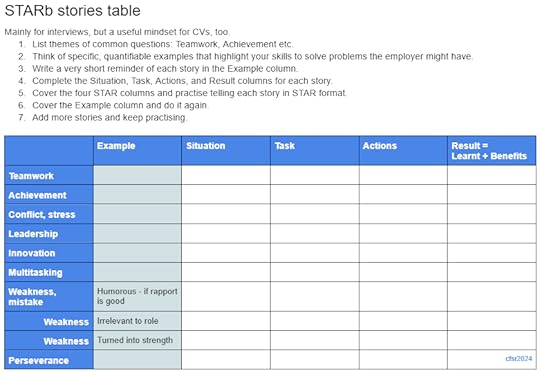
• Think of an interview as a business meeting where you're (primarily) the seller and the other party is (primarily) the buyer. Always refer to the meeting, not the interview. • The waiting room is a research opportunity. • See the process from the employer's viewpoint: what problem do they have that you can solve? (They may not be conscious of it - so research before.) • Take, or make, every opportunity to sell yourself in specific ways. Modesty is your enemy, but don’t oversell or be a “job-beggar”. • Give specific examples for every attribute you want to sell and every problem you want to solve. STAR: Situation, Task, Actions, Result. • All questions are either reasons to hire (sell yourself with examples) or reasons not to (defend yourself - briefly). • It lists 42 common questions with strategies to answer them. Not answers to learn by rote, but ideas and tactics. • “Tell me about yourself...” is a common opener. Aim for four points of ~30 seconds, ending with the most impressive and relevant. • Make sure your greatest strength is one they want, that you can prove, and is fairly recent. • Approaches for your greatest weakness: humour (if the rapport is suitable), something irrelevant (like being a driver but not understanding engines), turnaround (I’ve been accused of too much attention to detail, but I think it’s necessary because…), or something about building on strengths and learning from weaknesses. • How to bridge and reframe difficult questions. Have the confidence to question the question. • The importance of asking questions at the end. • Jobs are made redundant, not people. • Beware of responding too quickly to email. Craft replies. • Prepare, practice, prepare, practice... rinse and repeat.
That list is more simplistic and unoriginal than the book itself.
I will apply some of the ideas to my CV, and if when I have an interview a meeting, I'll be far better prepared.
STAR stories
STAR (Situation, Task, Actions, Result) is a well-known format, but I combined it with the idea of stories (from elsewhere). Think of a recent-ish example of each situation (Leadership, Conflict, Perseverance, Innovation, Teamwork), that is relevant for the job, and split the story into STAR. I found it helpful to do it in a table like this: List other stories in the same way, especially tricky ones involving mistakes or regrets. Read and reread, so you can fluently give examples in STAR format.
Meanwhile
I'm volunteering at a community library. It's wonderful. I’m learning and contributing in a hugely enjoyable and worthwhile way. Volunteering may be about “giving back”, but it also gives back to the volunteers. For example, I’ve had inspirational discussions (Dostoyevsky and Kafka with a teenager), and surprised myself by how much I enjoy playing Scrabble with elderly people, some of whom have memory issues.
Public libraries need support, especially ones that aren't funded by the local authority. See my review of Ali Smith’s excellent book of alternating short stories and essays, Public Library and Other Stories, HERE.
The future
Time will tell if this advice makes a difference for me, so my current 4* rating may change. Wish me luck. 🤞
UPDATE July 2024: It worked! I have never been so prepared for an interview a meeting as I was for the role I've just accepted. Nor have I ever come out of an interview a meeting feeling so positive, and unable to think of anything I could have said differently or better. That made the 4.5 day wait for a response tricky for me (no criticism of my new employer), but I got the result I wanted. I start at the end of the month!