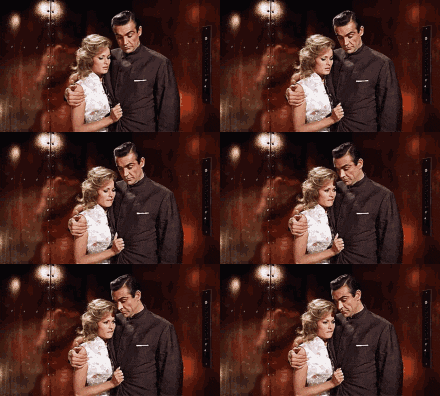
Poisoned by SMERSH's Rosa Klebb, JB collapsed at From Russia with Love's end. A neurologist says it's paralytic tetrodotoxin from fish fugu genetalia. Victims are conscious until asphyxiated. JB's given 1st aid by Rene Mathis. A doctor diagnoses curare poisoning. Cured, JB's sent to Jamaica to investigate Kingston Station head Strangways' disappearance (Live & Let Die) who'd been investigating Julius No, a reclusive Sino-German on reputed dragon lair Crab Key. His hotel room searched, a centipede's put in his bed as he sleeps. With Quarrel's (Live & Let Die) & shell-collector Honeychile Rider's aid JB learns that No, a guano harvester, had his hands amputated & was shot in the chest, but survived with prosthetics, a bad disposition & Russian equipment to sabotage US missile tests. No captures JB & Honey. A flamethrowing armored swamp buggy dragon, incinerates Quarrel. No tortures JB. JB runs an obstacle course, suffers burns, spiders, a giant squid & rescues Honey from being eaten by crabs. No's buried alive by a diverted guano loader. They escape in the dragon buggy.
Librarian Note: There is more than one author in the Goodreads database with this name.
Ian Lancaster Fleming was an English writer, best known for his postwar James Bond series of spy novels. Fleming came from a wealthy family connected to the merchant bank Robert Fleming & Co., and his father was the Member of Parliament (MP) for Henley from 1910 until his death on the Western Front in 1917. Educated at Eton, Sandhurst, and, briefly, the universities of Munich and Geneva, Fleming moved through several jobs before he started writing. While working for Britain's Naval Intelligence Division during the Second World War, Fleming was involved in planning Operation Goldeneye and in the planning and oversight of two intelligence units: 30 Assault Unit and T-Force. He drew from his wartime service and his career as a journalist for much of the background, detail, and depth of his James Bond novels. Fleming wrote his first Bond novel, Casino Royale, in 1952, at age 44. It was a success, and three print runs were commissioned to meet the demand. Eleven Bond novels and two collections of short stories followed between 1953 and 1966. The novels centre around James Bond, an officer in the Secret Intelligence Service, commonly known as MI6. Bond is also known by his code number, 007, and was a commander in the Royal Naval Volunteer Reserve. The Bond stories rank among the best-selling series of fictional books of all time, having sold over 100 million copies worldwide. Fleming also wrote the children's story Chitty-Chitty-Bang-Bang and two works of non-fiction. In 2008, The Times ranked Fleming 14th on its list of "The 50 greatest British writers since 1945". Fleming was married to Ann Fleming. She had divorced her husband, the 2nd Viscount Rothermere, because of her affair with the author. Fleming and Ann had a son, Caspar. Fleming was a heavy smoker and drinker for most of his life and succumbed to heart disease in 1964 at the age of 56. Two of his James Bond books were published posthumously; other writers have since produced Bond novels. Fleming's creation has appeared in film twenty-seven times, portrayed by six actors in the official film series.
Bond. James Bond. When I first started reading the Bond books, I really wasn't impressed by his treatment of women or his skills as a secret agent. But now? Bond is not only the man, he's a whole different kind of man.
After reading Casino Royale, I wondered if this was going to be a stagnant series of stories about a sexist spy that wasn't very good at his job. I'm glad to report that it really isn't. In the first few books, James seemed to blunder around his assignments, grasping at the tits of whatever woman was closest without being terribly remarkable in any definable way.
I originally noticed in Diamonds Are Forever that there was a gentle shift in the character, but in Dr. No you can almost hear the gears clunking into place as he turns a corner. Don't get me wrong, the book is still a product of its time. But for its time? Bond ain't so bad anymore. There are some spoilers below, but this book is old, and I just want to discuss it. You've been warned.
The skinny gist is that M has sent Bond on an easy assignment to get him back in the groove after almost dying in From Russia With Love, and James is a bit resentful because it hurt his pride. He's also getting over the loss of his beloved...gun. Yes, M took his trusty Beretta and replaced it with a Walther PPK. There was weeping and wailing and gnashing of teeth.
However. What seems like a simple vacation to Jamacia turns into the start of what makes Bond movies so goddamn fun to watch. THE DEATH CRAZY TRAP! Ohmygod this one was a doozy. And Bond rose to the challenge in a truly nail-biting race against the clock to get out of a maze designed to kill him. He had to pit his skills, determination, & wits against a genius villain in order to escape in time to save the girl.
Except he doesn't! Yes, in a shocking twist of events, Honey Ryder saves herself. Well done, Mr. Fleming. Another shocker was the way Honey was treated as a character. She was a young orphan on her own who had her nose broken so badly during a brutal rape that it was permanently disfigured. Not only did she survive, but she then went back to the man's house and killed him. Bravo, I say! However, it was Bond's eventual realization that her nose didn't make her less beautiful to him that took the story up a notch for me. He grew. HE GREW! You know they aren't destined to be a couple, but you can tell how much he cares for her as a human being by the close of the book. And that counts for a lot with me.
This was an excellent installment in the Bond series. Highly Recommended.
If you're interested in this as an audiobook, I listened to Blackstone's audiobook version with Simon Vance as the narrator. Good stuff.
Originally published in 1957, the sixth book in the original James Bond series; the one made famous as Ursula Andress comes out of the sea, semi-naked in front of Sean Connery. Its Honeychile Rider (great name!) and James Bond against the hand-less Dr No in Jamaica. Breathtakingly and speedily outdated in so many ways, still a good adventure though! Three of the Stars, 6 out of 12. 2011 read
عبقري آخر مجنون يحلم بالسيطرة على العالم، وتلك المرة من جزيرته المنعزلة الحبكة لا بأس بها، بها بعض الثغرات، ربما بسبب الترجمة المختصرة لنبيل فاروق تصلح كبريك بين عدة كتب دسمة
مستفز ..ثقيل الظل ساحر ..و مسلي ايضا انه العميل البريطاني الخارق البارد..المهندم الممل جيمس بوند صنيعة ايان فليمنج التي تمكنت منه احب الروايات التي تجرى أحداثها في جزر مهجورة منعزلة..و حبذا لو كانت في جاميكا دكتور نو حظت بكل مقومات الرواية الناجحة.. الاكثر مبيعا وقت صدورها عام !1958 لتستولى صرعة بوند على الشباب و تتحول لاول افلام بوند
بطلها رجل صيني غامض يسيطر على ثروات جزيرة بعيدة باستعمال تنين🐉 ؟ و تكنولوجيا غريبة ؟ طيور تشبه البجع مخلفاتها تساوى ثروات؟ عناكب حمراء و سوداء سرطانات بحر محترمة فتاة ذات طباع برية
كل هؤلاء مع عميلنا الذي يقتل مائة و الف بدون ان يبعثر شعره او يتسخ قميصه "بصراحة هنا اضطر يقطع قميصه بنفسه" يدخن عشرات السجائر. .و يجري مئات الامتار كابطال العالم بدون ان ينقطع له نفس يتعامل مع النساء تعامل بغيض...😠 بغيييييض و يدعى في النهاية معرفة كل شيء لكننا سنظل نتقبله كاحدى حقائق الحياة البائسة فهو بوند جيمس بوند
Mr. Incredible: I was wrong to treat you that way. I'm sorry...
Syndrome: See? Now you respect me, because I'm a threat. That's the way it works. Turns out there are lots of people, whole countries, that want respect, and will pay through the nose to get it. How do you think I got rich? I invented weapons, and now I have a weapon that only I can defeat, and when I unleash it...
[Mr. Incredible throws a log at Syndrome, who dodges it and traps Mr. Incredible with his zero-point energy ray]
Syndrome: Oh, ho ho! You sly dog! You got me monologuing! I can't believe it...
- The Incredibles
Dr. Evil: Scott, I want you to meet daddy's nemesis, Austin Powers
Scott Evil: What? Are you feeding him? Why don't you just kill him?
Dr. Evil: I have an even better idea. I'm going to place him in an easily escapable situation involving an overly elaborate and exotic death.
- Austin Powers: International Man of Mystery
Daryl Van Horne: You haven't seen any snowy egrets around here, have you?
Alexandra Medford: No.
Daryl Van Horne: Me either. Not that I'd know a snowy egret if I were pissing on one. You want some lunch?
Alexandra Medford: I think it's a little late in the season.
Daryl Van Horne: For lunch?
Alexandra Medford: No, pissing on birds.
- The Witches of Eastwick
And so we come to Doctor No, Ian Fleming’s sixth James Bond novel, first published in 1958.
While this is another fun adventure with Bond. James Bond, the monologuing evil mastermind bit is taken to almost comic proportions. Doctor No was patterned on the Fu Man Chu stories, but Fleming’s description has no doubt been the source of inspiration, satirical and actual, ever since.
While these can all be read as stand alones, this one does make reference to Bond’s injuries in the prior book, From Russia With Love.
Maybe not one of his best (Fleming received much negative press when this came out) but it is still Bond. And so fun.
** - I went back and watched the 1962 Terence Young film starring Sean Connery and Ursula Andress. Great fun, surprised at many things: the low budget production that nonetheless holds up well, how beautiful was Andress and how young Connery. This was the film that started it all and no wonder it paved the way for so much success over the next few decades.
Update, 8/25/26: My family are obsessive series tv and film watchers. but have never seen all the Bond films in order. World in crisis? Fantasize Bond saving the world AND getting whichever Bond girl wins the lottery, driving off with her in his Aston Martin. So I revisit these reviews for each book of the Ian Fleming series as I watch the film adaptations. Complete escapism. This is the first film, but the sixth book, and both film and movie are pretty cheesy and not well-funded, compared to later ones, but it is decent, for the first film in the franchise, very successful.
RIP, Sean Connery, 10/31/20, aged 90, always the grinning James Bond in our hearts.
Original review, somewhat amended: Dr. No is a film I have seen a couple times in my lifetime and recall enjoying for the sheer entertainment (i.e., Ursula Andress as Honey Ryder, a Swiss actress tanned for some reason as if to appear Jamaican, which fails spectacularly, but who cares).
with Bond fighting spiders and squids to defeat the villain.
So the films are less offensive than the books. In the films Bond is charming, debonair, amusing, but in the books he is edgier, nastier. If you are going to get all picky about it, Fleming and Bond reveal in this book their typical misogyny, racism, colonialism and so on; sure, okay, burn the books, but do that later; come on, let’s say what we like about the book, please! A little positivity here!
The (1958) story: Secret Agent Man James Bond is sent to Jamaica to investigate two missing MI6 operatives, encountering a mysterious, reclusive, cruel, German-Chinese trans-human, Dr. Julius No, making a fortune on a small (fictional) island, Crab Key, off Jamaica. His goal is to disrupt American missile launching at Cape Canaveral. Visiting the small island Bond meets a girl, Honeychile Ryder whom he rescues, then she accompanies him. The assignment of course gets to be a stickier wicket than he anticipated, but don’t worry, things will work out for the couple, whew. I know you'll be happily surprised and relieved to hear that no beautiful white people die in the making of this story.
Things I liked/found amusing/interesting:
*The story is pretty lively—it’s a thriller with fifties pulp foundations—silly, but at key points, especially fu1) when we meet “the girl” and 2) when the action gets going, Fleming earns his money.
*Dr. No is one of the most formidable of Bond nemeses, smart and powerful. As with almost every Bond villain, he is sadistic. For some reason Fleming was particularly interested in torture of various kinds, but here he has Dr. No researching the limits of human capacity to withstand pain and fear. Here Bond and Honeychile face poison centipedes, tarantulas, a basket of poisoned fruit, and so on. Honey is staked naked on the beach, anticipating murderous crabs will slowly eat her alive; Bond is (for no reason other than “scientific inquiry”; why not just kill him?! But then it wouldn’t be an adventure story, would it) forced to go through an obstacle course of tortures in order to escape and conquer his foe. The film thankfully doesn't spend much time on these ridiculous tortures.
*Dr. No gets rich from the (surprisingly) lucrative international market in Roseate-Spoonbill guano (!!)
*Dr. No may be sadistic because he was himself tortured. His hands were cut off when he was discovered stealing from his Chinese boss. He was shot in (apparently) the heart and left to die, but lucky for him, No was born with his heart on the right side, so he survived! ☺ No No? Yes!
*The ludicrously named Honeychile Rider (okay, it’s not as ludicrous as Pussy Galore, but close) is of course supermodel-beautiful, whom Bond finds, conveniently, almost completely naked (she’s wearing a belt with a knife attached) (in the 1962 film Andress is wearing an almost chaste—by today’s standards—bikini) on a deserted beach. Despite the fact that she had been raped years ago, she becomes almost instantly infatuated with her hero Bond, and she becomes his eye candy for the rest of the adventure. Is this side-stepping Honeychile's trauma into the arms of a "sexual healer" Bond offensive? Of course it is, but read on. (And the film ignores this back story, thankfully, and makes her older than the teen she appears to be in the book).
Honeychile's naïve goal, she tells Bond early on, is to get rich in New York City some day as call girl. Lucky Bond, to have met her, eh? Naked girl on a beach, call girl "in training," James? But we also learn Honey killed the rapist by visiting his bed with a tarantula, so she seems to have some useful skills. And so maybe she isn't as simple as I had assumed above. Fleming otherwise depicts her as a female Robinson Crusoe, a nature child, a waif, a naïf. Precursor to sixties love child. (But again, the film thankfully ignores the assault story and the call girl aspirations, and just makes her a fantasy island girl).
*This is Fleming’s second book set in his beloved tropical island, Jamaica. He wrote it at his Goldeneye estate there. The tone of Fleming’s Bond can be violent and nasty, but nowhere else is Fleming as lyrical in describing natural vistas as he is here, basically describing what he can see from his own window overlooking a cliff.
*Honeychile says she has seen and is afraid of dragons. What?! Well, in order to discourage visitors, Doctot No's "dragon" is a flame-throwing, armored swamp buggy.
*Of course to defeat the notorious No, Bond must at the climax of the action wrestle a poisonous squid, and find a way to turn the doctor’s own guano machine on him: Yes, death by bird guano! Nice touch? As I have said before, Fleming’s best writing is in the action sequences: Bond Must. Find. The. Will. To. Survive! Yes! Yes! Yes! He’s alive!
Escapist fun on a tropical island with “exotic” (i.e., not rich white Brits) elements. Ludicrous, silly, weird, and occasionally a little offensive, but nevertheless (for me) pulpily enjoyable. Oh, give me a little credit, it’s not just the scenes with Honeychile Rider! Am I that obvious? One of my favorites so far.
Was this when Fleming started to phone it in? I have enjoyed several of the earlier Bond novels, but this one was full of purple prose and even more cringe-inducing racism and sexism than usual. I mean, this is James Bond we're talking about, who was a misogynistic dick even when cleaned up for Hollywood, but Dr. No is pretty much wall-to-wall racial caricatures, along with a vapid sex kitten of a Bond girl. I know, you're saying "What makes her any different from all the other Bond girls?" Well, usually the Bond girls are double-agents or something, or at least they carry a gun, but Honeychile Rider is just a feral blonde who hangs out naked on beaches. But okay, expecting Ian Fleming to write strong female characters is like expecting Jane Austen to write swordfights.
James Bond is sent to Jamaica to investigate the disappearance of the Kingston station operatives. After wandering around meeting the colorful locals (there will be something here to offend everyone, from the description of Jamaicans as "lazy children" to every single Chinese person being part of the Yellow Horde), Bond makes his way to Crab Key, an island owned by the mysterious Dr. Julius No. Dr. No turns out to be a half-Chinese megalomaniac with prosthetic hands who brags about how totally evil and powerful he is. He rants about how he's King of the World (actually, he's the king of a tiny guano-covered island), then he taunts Bond and his new squeeze for a while before putting them both into ridiculous deathtraps. When this evil "genius" wants to kill someone, he prefers using poisonous centipedes and giant squid as opposed to, say, a bullet. You just know the ceiling lasers and submarine cars can't be far behind.
Dr. No was still fun in all its racist, sexist, cheesy pulpiness, but it lacked the details and thin veneer of plausibility that earlier novels had, and boy has Fleming's writing gone downhill in this one. Go ahead and read it if you are a Bond fan, but it's definitely not Fleming's best work.
I loved this book. Best Bond book yet...possibly the best one of all time, but we'll see. ...
We ended the last book (From Russia With Love) on a cliffhanger. Bond is kicked with a poisoned blade by the evil lady torturer Rosa Klebb.
Now, after months of medical treatment, he's ready to go back to work. The head doctor begs M. to take it easy on Bond, but M. doesn't believe in coddling agents! He sends Bond down to what he thinks will be a relatively easy job in Jamaica. Two Secret Service agents have disappeared, and for some strange reason M. and the Secret Service think that they've run off together. But the secret location is burnt down, I don't know why on earth they wouldn't suspect foul play. O.o Some spies they are! *rolls eyes
The really sad "break-up" scene in this novel is when Bond's told that his beloved Beretta .25 is not adequate and his "wife" of 15 years is taken away from him and replaced with a Walther PPK 7.65 mm and a Smith and Wesson Centennial Airweight Revolver .38 calibre. Bond is so sad to be separated from his true love - his gun. :( Really, you should hear how he goes on about it. I'm kind of worried about what goes on in that brain of his...
ANYWAY, we (the readers) know from the beginning that it's foul play - we witnessed the man and his female spy/secretary get murdered by "Chigroes" (black/Chinese) who then stole all the secrets and burnt the place up; all this is Chapter One.
Bond reunites with Quarrel, his old friend from his adventures in LIVE AND LET DIE. Both Bond and the readers rejoice in seeing this character again.
Evil Doctor No (a half-Chinese, half-German) has bought Crab Key island and rules it like his own private country. He has claws for hands and his eyes are glass!!! Dum, dum, dum! He plans on taking over the world!!! Bwahahahahahaha!
When Bond and Quarrel land on the island, they meet a "Girl Tarzan." one Honeychile Rider. Bond's upset to know that now she's part of this wretched thing, and she'll be in great danger, but he's going to do his utmost to protect her! Dum dum Dum!!!!!
The "girl" tells him there's a dragon on the island! A black and gold dragon with red eyes that breathes fire! Bond doesn't believe her... ...
Wow. This is such an amazing book. I was enjoying it so much! Ian Fleming is such a good author and he just draws you into this story. You can't escape! You don't want to escape! So much adventure! O.O
RACISM: This book is expresses some racism, primarily against the Chinese but against blacks as well. But not even close to the amount expressed in books like LIVE AND LET DIE. But it definitely hasn't gone away.
QUARREL: So good to see this character again, after having an adventure with him in LALD. Bond asks Quarrel to get him into shape like he did last time. Quarrel puts Bond in training, to make him hard and tough so that he can defeat Dr. No! Quarrel also tortures the photographer Miss Chung at Bond's request. This part was a bit scary as I feel Quarrel was enjoying torturing her just a bit too much, but luckily Bond steps in and puts a stop to it before there's too much damage. o.O And then there's of course the fact that
DOCTOR NO: Great villain, crazy, rich, power-mad. Again disability is used as a mark of evil (Disabilities Studies 101) as Dr. No has two claws instead of hands and glass eyes (contacts, actually)! He also has a huge underground wall of glass, an "aquarium" of the sea itself...super-cool. Bond once again psychoanalyzes the villain out-loud to his face...a standard Bond practice. Of course Dr. No give us an amazing, in-depth, chapter-long villain speech that's loads of fun. His diabolical plans to "experiment" on Bond and Honeychile are creepy and scary. Especially since when he sees Honeychile he's like "Oh, I've been waiting for a white woman to experiment on" and you're like: Blergh, this guy is creepy to the max! And you are so afraid for Honeychile. And so is Bond.
HONEYCHILE RIDER: I adored this Bond girl! Absolute best Bond girl so far...and there's been some good ones!
...DESCRIPTION She is 20 with ash-blonde hair and blue eyes. Orphaned at age 5, raised by her black Nanny in the isolation of the jungle/island until her Nanny's death when Honey was 15.
Honey is best friend to all the animals! She loves animals and has been caring for them and playing with them her whole life. She knows SO MUCH stuff about animals and nature and fish and plants and trees. Bond actually LISTENS to her and takes her advice MULTIPLE TIMES in this novel. I was impressed! He must have read my last review of FRWL and decided to take my lecture to heart. Aw. Honey has no formal education, but was taught to read and write by her Nanny, and has read Encyclopedia Britannica Volumes A-T. She's smart, though formally uneducated. At first Bond really underestimates her and treats her like an ignorant child, but he quickly learns that she can teach him a thing or four about life on the islands. She saves his life more than once.
...ANOTHER RAPE SURVIVOR Honey is a rape survivor. This is the 2nd Bond book in which the Bond girl is a rape survivor (the first was Tiffany Case from Diamonds are Forever). At age 16, trying to live on her own after her Nanny's death, she's always getting looked at/hit on by men. But she is always walking around with a snake on her neck and so is mostly left alone. Except for that one persistent creepy guy (there's always one - I mean, even in real life, believe me) who won't take 'no' for an answer and isn't intimidated by her animal friends. She fights him off like a madwoman but he knocks her out and rapes her repeatedly.
When she wakes up she gets a bunch of black widow spiders, walks to his hut, and pours them all over his naked body. It takes him a week to die.
...THE BROKEN NOSE As a result of the rape, Honey has a badly broken nose that is very noticeable. She is deeply ashamed of it. She thinks it makes her ugly. So much so that when she first meets Bond, buck-naked, she covers up her "shameful, ugly" nose instead of her breasts.
Her nose becomes a rather recurring theme/subject in the novel. When Bond first sees it, he's shocked and appalled, thinking that she'd be "the most beautiful girl in Jamaica" if her nose wasn't so deformed. Later, after getting to know her better and learning about the rape, he's sure that she can get it fixed. It's an easy operation. Then she'll be perfect. (I'm quietly boiling inside during all of this.) Even later, he knows that she's convinced that she's "ugly" because of her nose, and there's a scene where he tries to convince her that she's beautiful.
BY THE END OF THE BOOK, Bond loves her broken nose and is actually sad to think she might still want it fixed. :) He likes (I don't want to say, "loves" here - because I don't think he's in love with her) her just the way she is and has come to see her nose as part of her and perfect for her. I liked seeing Fleming put Bond through the many steps and thought processes he has to go through to get to this conclusion. Very enjoyable and heart-warming. Especially since I fully expected Bond to keep on thinking he could "perfect her" with surgery, and was surprised and pleased at him coming to his own conclusions and realizing that she's already perfect. :)
...GIVING BOND A HARD TIME Another reason I really adore Honeychile is her teasing nature with Bond. She is constantly teasing him, challenging him, and generally giving him a hard time. This is done in a loving way, you can tell she really likes him and wants to have sex with him... but she doesn't take any of his crap and she also teases him a lot when she knows she can get away with it.
I thought their back-and-forth banter was really adorable and I loved how cheeky Honey is. The other thing that melts my heart is that Bond lets her tease him. He doesn't blow up at her or lose his temper or "punish" her (God, remember the way he acted with Vesper? It was so disgusting) - instead, he accepts the teasing good-naturedly and teases her right back. He never has the urge to "punish" her or "put her in her place" that he's had in the past with women (most noticeably with Vesper Lynd). I don't know if it's because she's a rape survivor (Bond seems to tread carefully and proceed with caution around women he knows have been abused) or just because she's so much younger than him (she's 20, he's 34). But whatever the reason, he's pretty much the sweetness with her - in a James Bond way, I mean, he's still pretty rough with her in a lot of ways. Including in bed. Not that she was complaining, but I'm just saying ... don't think this means he's not James-Bond-y enough. Sweetness for James Bond is a lot different than sweetness from John Doe.
...BOND AVERTS HIS EYES Most noticeably is how he avoids looking at her when she's naked (which, in this book, is A LOT). He's actually respectful (this was shocking to me) and he averts his eyes a lot. At one point, when they're in a room together and she's getting ready to take a bath, he actually covers up his eyes with his hands. None of this is because of prompting on Honey's part, it's just a super-rare case of Bond being a gentleman. Take a picture of this and frame it, folks, because I doubt we'll be getting this kind of behavior from him again.
Again, is this respectful, friendly, teasing, protective Bond - the Bond I love and rarely get to see - coming out to play because Honey is a rape survivor or because she's 14 years younger than him? I don't know. All I know is that I liked it and wished he'd be more like this with his other women.
...AGE DIFFERENCE In case you're wondering, gentle reader, I have zero problem with the age difference. It doesn't bother me at all.
... "I WANT TO WORK AS A CALL GIRL" Honeychile Rider tells Bond that she wants to become a call girl to make money. Bond's all like, "Excuse me, I don't think I heard you correctly...and I don't think that word means what you think it means..." When finding out that Honeychile really does indeed know what she's talking about, Bond gently and persuasively convinces her that she should use her brain instead of her body. Perhaps working in a Zoo or Museum. This is a touching scene and one that I really enjoyed. Bond impresses me sometimes.
...HONEY CAN TAKE CARE OF HERSELF Over and over again in the novel, Honey proves to be smart, resourceful, and fierce. She is capable of fending for herself. Putting black widow spiders in her rapist's bed as revenge was just the beginning. No spoilers, but by the end of the book, you'll be super-impressed by how self-confident, capable, and kickass Honey is. She rocks. She saves both herself AND Bond at various times in the novel. You go, girl. :)
...HONEYCHILE RIDER SUMMARY I guess, in the end, it's the fact that I really, genuinely believed that Bond had Honeychile's wellbeing and best interests at heart AT ALL TIMES. And it wasn't like he was in love with her... he wasn't. It's extremely clear that they are just going to have a few weeks together and then never see each other again. Despite that, Bond always acts in Honeychile's best interests. He goes above and beyond the call of duty to make sure she's not only physically safe, but to give her psychological security, hook her up with a good job doing something she loves that is non-exploitative, and seeing to her financial needs as well. As far as I was concerned, his only "duty" was her physical safety, so I was impressed and touched when he went the extra ten miles to take care of her in other ways. What a great guy. Many extra points to Mr. Bond for being such a mensch.
... JAMES BOND AS A SERIAL MONOGAMIST Bond (book version) is a one-woman; one-book kind of man. I know in the movies he's sleeping with a woman, and then her sister, and then 2 more women who show up before the end... but in the books he's really faithful. This is my 6th Bond book and he's never slept with more than one woman per book. So there. :p In the movies he's so promiscuous! In the movies he sleeps with 3-4 women per film.
... NO SLUT-SHAMING One of the best and most refreshing things about the Bond books is the absolute absence of slut-shaming. It's as if "sluts" and the concepts of "sluts" don't even exist. Women are just women, whether they've slept with twenty men or are virgins, Bond doesn't care and never comments on it. Nobody cares. It's a complete non-issue. No matter what a woman wears, who (or how many) she's slept with...it's very refreshing to live in a world where not only are women NOT judged for their sexual and wardrobe decisions, but it doesn't even OCCUR to anyone to be judgmental.
On the other hand, when I said "women are just women" this is unfortunately true - you definitely get the impression and message that women are "inferior" to men in a lot of ways. So I'm not in any way saying that the Bond books are feminist - quite the opposite - but I did notice this little ray of light and wanted to share it.
... SIDE NOTES - Amazing, well-written scene of Bond vs. centipede. Stupendous. - Bond drinks both gin and tonics AND bourbon and sodas in addition to his usual martinis, shaken not stirred, in this novel. I want to make it clear, in the books he drinks A LOT and it's a variety of stuff. Not like in the films. - Bond cries in this novel. And he cries in front of a woman. And he has no shame in doing it. Booyah! - Oh, and Bond wears jeans for a good portion of this novel. JEANS. I liked that.
Tl;dr - Best Bond novel so far. Exciting, with a cute relationship, and a capable and fierce Bond girl. Wonderful, crazy, rich, villain with plans on taking over the world. Beautiful writing and descriptions. Adventure-packed with tons of fights and challenges. Bond is a real Billy Badass but actually treats his woman really well in this book. I'm relieved, and made sure to savor every moment because I don't think it'll be happening again any time soon.
UPDATE: 1962 FILM WITH SEAN CONNERY This was a good movie. Not campy and stupid, but an actual exciting spy film.
Honey is not clever and capable like she is in the book. And her nose is definitely not broken and deformed! James Bond saves her over and over - unlike in the book where she saves herself and him numerous times.
Quarrel isn't the tough, efficient man that he is in the book. I was upset that for the whole second half of the film he's seen as a superstitious drunk. Very unkind of them to do.
Bond has sex with three women in the film - only one (Honey) in the book.
While I think Connery is one of the better Bonds, I am just not attracted to him. *shrug
Dr. No happens to be one of my favorite James Bond movies, because it was the first; the Bond villain is Killer-Great. I did not realize that the movies were not in the same order as the books, but here as I read the sixth book, I was startled at some of the similarities and more importantly the differences in the book. I generally favor the book and here too, I find myself impressed with Fleming’s writing of this iconic character. There are of course triggers here. This story transpires in the cultural milieu of the 1950s where certain cultural sensitivities had not yet matured, especially regarding gender and race. If you believe that you might not be capable of reading something of this caliber, do not. There are many other things you might enjoy. Quarrel is a beloved character, but he is not always treated as such. A famous quote from the movie has Bond tell Quarrel, "Fetch my shoes." Good Lord! How freaking ridiculous, but I judge books within their historical milieu. So, I do not allow myself to get angry about it. Honeychile Rider is a great name for a Bond “girl,” and Bond clearly has a soft spot for her, but she too is not held up as a paragon of intellect. Still, I really like this book.
Unfortunately, strict patterns of behaviour can be deadly if they are read by an enemy." - Ian Fleming, Dr. No
It is weird to visit a book that is so well preserved by a film. Maybe it was because it was the first James Bond film, but it has always stuck with me. The book was both more and less interesting. It had some great lines by Dr. No, and Honey Ryder was better developed in the book. But, still, it was hard to read the book and not think of Ursula Andress, the very first Bond Girll on film, walking out of the ocean. Obviously, there is something about these books and films that appeals to reader and viewer (sex, adventure, etc.) that keeps them in print and consistently being imitated and produced. However, as I've aged, I seem to have gravitated more towards John Le Carré's view of the world and away from Ian Fleming's. One has to grow up. But still, I keep coming back. There is still a 14-year old boy that needs to be feed, and sometimes shaken, sometimes stirred.
The doctor is in; and man, is he angry. Doctor Julius No, a wealthy and reclusive man of mixed Chinese and German descent who runs a guano business on the isolated Caribbean island of Crab Key, is James Bond’s suitably formidable antagonist in Doctor No (1958), the sixth of Ian Fleming’s James Bond novels.
Fleming spent much of his career in journalism, but did serve in British Naval Intelligence during the Second World War; and from his time in intelligence work, he could gather how things might go within “Q” branch (quartermaster), and with “M” (the head of MI-6, British foreign intelligence), and, of course, among agents in the field. Fleming lived and wrote in Cold War times, when British and American readers were keenly interested in what might be going on, under the surface of ordinary life, to try to save Western democracy from communist totalitarianism; accordingly, he was in the right literary place at the right historical moment, and he and James Bond cleaned up, all the way to the bank.
What sends Fleming’s iconic secret-agent character to the Caribbean for this particular James Bond novel – even though he’s still recovering from severe injuries incurred during his last mission, as chronicled in the prior Bond novel, From Russia With Love (1957) – is the disappearance of two British intelligence agents in Jamaica: John Strangways and Mary Trueblood. They were dedicated agents, they were good at their work, they were loyal to Great Britain, and they were romantically involved. Spoiler alert: they didn’t just run off to enjoy some jerk chicken and a couple of Red Stripe beers.
It is good to be able to say that, as Bond begins his investigation, he emerges not as merely a gadget-wielding action figure, but rather as a man observant of human character and capable of thinking on his feet. When he arrives in Jamaica and speaks with the island’s acting colonial governor (this is 1958, after all – Jamaican independence is still four years away), and the governor says dismissively that he considers the case closed, Bond understandably asks why.
The Governor said roughly, “Strangways obviously did a bunk with the girl. Unbalanced sort of fellow at the best of times. Some of your – er – colleagues don’t seem to be able to leave women alone.” The Governor clearly included Bond. “Had to bail the chap out of various scandals before now. Doesn’t do the Colony any good, Mr. – er – Bond. Hope your people will be sending us a rather better type of man to take his place. That is,” he added coldly, “if a Regional Control man is really needed here. Personally, I have every confidence in our police.”
Bond smiled sympathetically. “I’ll report your views, sir. I expect my Chief will like to discuss them with the Minister of Defence and the Secretary of State. Naturally, if you would like to take over these extra duties it will be a saving in manpower so far as my Service is concerned. I’m sure the Jamaican Constabulary is most efficient.”
The Governor looked at Bond suspiciously. Perhaps he had better handle this man a bit more carefully. (p. 50)
Assisted by a Jamaican named Quarrel, Bond finds that all the clues he finds are leading him toward Crab Key. While reconnoitering the site, he meets a young woman named Honey, who has her own reasons for being interested in Doctor No’s activities. I’m only going to give you Honey’s first name, because her full name is another of the appalling sexist double entendres in which Fleming liked to indulge when naming the women characters who came to be known as “Bond girls.”
Bond, Honey, and Quarrel soon end up in plenty of trouble on Doctor No’s Crab Key. The island is said to be guarded by a fire-breathing dragon, though the “dragon” is, in fact, simply a tank made up to look like a dragon. My grandparents gave me a “Doctor No Dragon Tank” Corgi toy when I was a small child, and therefore that part of the book brings back fond memories for me. But the way in which Fleming depicts indigenous Jamaicans as credulous people who are easily frightened by the “dragon” stories was disheartening.
A writer of super-spy action thrillers should be able to depict action well, and Fleming succeeds on that count. His prose is appropriately lean and taut in one scene when Bond, Honey, and Quarrel are hiding below the surface of a lagoon, each one breathing, snorkel-style, through a hollow length of bamboo, while Doctor No’s henchmen search for them:
Suddenly Bond cringed. A rubber boot had stepped on his shin and slid off. Would the man think it was a branch? Bond couldn’t chance it. With one surge of motion he hurled himself upwards, spitting out the length of bamboo.
Bond caught a quick impression of a huge body standing almost on top of him, and of a swirling rifle butt. He lifted his left arm to protect his head and felt the jarring blow on his forearm. At the same time, his right hand lunged forward, and as the muzzle of his gun touched the glistening right breast below the hairless aureole he pulled the trigger.
The kick of the explosion, pent up against the man’s body, almost broke Bond’s wrist, but the man crashed back like a chopped tree into the water. Bond caught a glimpse of a huge rent in his side as he went under. (p. 102)
Eventually, Bond and Honey are captured, and are brought before Doctor Julius No. We all know that the archvillain will (a) explain to the hero, in detail, his entire evil plan for world domination, and (b) offer the hero a drink. And yes, one does get to hear Bond ask for “a medium Vodka dry martini – with a slice of lemon peel. Shaken and not stirred, please” (p. 157).
And then there is the zest with which Fleming describes Doctor No.
With his skin “of a deep, almost translucent yellow”, his cheeks “as smooth as fine ivory”, his eyebrows that are “fine and black and sharply upswept as if they had been painted on as make-up for a conjurer”, his “slanting jet black eyes” that are “direct and unblinking and totally devoid of expression”, his mouth that “despite its almost permanent sketch of a smile showed only cruelty and authority” (p. 156), Doctor No is practically a catalogue of Western stereotypes of the “inscrutable” Asian.
As if that’s not enough, Doctor No also has, for hands, “two pairs of steel pincers…on their gleaming stalks” that are “held up for inspection like the hands of a praying mantis.” Fleming sums up Bond’s impressions of his antagonist by writing that “The bizarre, gliding figure looked like a giant venomous worm wrapped in grey tin-foil, and Bond would not have been surprised to see the rest of it trailing slimily along the carpet behind” (p. 156).
Well, goodness gracious me. Sinophobia much, Mr. Fleming? It occurs to me that a scholar of Orientalism, someone like Edward Said, would have a field day with the way in which this Westerner’s description of an Eastern character combines mechanistic and animalistic imagery.
Why the grotesque cultural hostility implicit in Fleming’s description of Doctor No? It occurs to me that in 1957, the Communist regime ruling mainland China still maintained a firmly closed society. Perhaps Fleming’s portrayal of Doctor No reflects Western fears of what was going on behind the Chinese equivalent of Eastern Europe’s “Iron Curtain.”
Whatever the case may be, Doctor No has a very particular set of plans for Bond. In accordance with a time-honoured trope of spy thrillers – one that was cleverly satirized in the Austin Powers spy spoofs – Doctor No is not going to simply kill Bond by having him shot or something. Rather, Bond will be forced to negotiate a series of death-traps that will inflict increasing levels of pain, as Doctor No is curious about how much agony the human body can endure. Perhaps this plot element is part of the reason why a reviewer for Britain’s New Statesman dismissed Doctor No as nothing but “sex, snobbery, and sadism.”
After negotiating one death-trap after another – electric shocks, metal passages that are either freezing cold or burning hot, rooms full of spiders, that sort of thing – Bond is plunged down into the sea off Crab Key. So, then – what is Doctor No’s pièce de résistance, the final element in his plan for engineering Bond’s demise? Sharks, I thought. Surely it is time for some sharks. Sharks with lasers, if we’re lucky.
But no. Instead, behind a wire-mesh fence, Bond sees “two eyes as big as footballs” – the eyes of “the giant squid, the mythical kraken that could pull ships beneath the waves, the fifty-foot-long monster that battled with whales, that weighed a ton or more” (pp. 200-01). Well! Perhaps Fleming had taken the time, four years before, to happen into a London cinema and see Richard Fleischer’s fine 1954 film adaptation of Jules Verne’s 20,000 Leagues Under the Sea. Giant squids were all the rage for quite some time after that.
Will James Bond end up as lunch for a giant squid? Will Doctor No succeed in his plan to hold the U.S. defense establishment hostage by destroying missiles test-launched from Cape Canaveral? Will Bond never get to enjoy some private time with the beautiful Honey? Not bloody likely. After all, Fleming still has other Bond novels to write.
I realize that I’ve spent a large part of this review setting forth what I don’t like about Doctor No – the elements that I see in it of sexism and misogyny, and of various forms of cultural prejudice as well. Why, then, did this book keep me reading as it did, when I bought it in a bookshop at Heathrow Airport in 2009 and read it on my flight from London back to Philadelphia?
Part of the answer, of course, is that Fleming is a born storyteller who weaves his tales with such energy and verve that even a disapproving reader is likely to want to follow each Bond adventure through to the end – knowing, all the while, that upon finishing the book, they may say to themselves, “I can’t believe I just read that thing.” It is the same sort of guilty-pleasure frisson that people nowadays seem to get out of watching Tiger King, with its real-life characters that seem drawn from the gallery of Bond villains.
Indeed, perhaps it is the very transgressive qualities of Fleming’s novels that accounts for their appeal to a wide variety of readers. Even in the late 1950’s, there were abundant signs that the old social order – one that placed white males at the top of the social hierarchy and consigned everyone else to lower social roles – could no longer be taken for granted, or considered to work for “everyone.”
The murmurings of the late 1950’s became shouting in the 1960’s; and against that social and historical context, Fleming’s novels could provide a world in which an old-fashioned alpha-male “man’s man” did things his own way, without hesitation or apology, and prevailed against dangerous and wicked adversaries – in spite of the disapproval of his superiors at MI-6, and while overcoming the aversion or indifference of a succession of beautiful and initially distant women. Perhaps, in a way, Bond was not so much “licensed to kill,” as licensed to drive away unwelcome elements of a changing world – for the duration of a Bond novel, anyway.
And Fleming was good at his work, and good at influencing world popular culture. The book Doctor No was adapted as Terence Young’s film Dr. No (1962), the first film in the entire series; and the film is remarkably faithful to the source novel. It’s as if the filmmakers don’t yet know how to make a James Bond film! We actually see Bond do some investigating, some cop stuff – interviewing witnesses, chasing down leads – rather than just jumping out of exploding helicopters with a jetpack on his back and all that sort of thing.
As of the year 2020, there have been 26 James Bond movies, grossing $14 billion in adjusted dollars – more, I think, than all the ransoms demanded by all the Bond villains ever – with nine different actors playing the character. That is truly what one learns from reading a James Bond novel: that James Bond is unstoppable – if not as a character, then certainly as a cultural force.
M to Bond. ‘There’s a job come up…personnel problem…routine investigation and report …the sunshine will do you good…you can do with a bit of a holiday. Like to take it on?’
And so begins a holiday in hell😉
My first Ian Fleming and James Bond book. The film (remember Ursula as Honey Ryder) also had Sean Connery playing Commander Bond. Bond has been recovering from a poisoning incident from a female Russian agent. M is a tad perturbed that Bond fell for the ploy. He forces Bond to change his much loved gun the Beretta for a Smith and Wesson.
Fleming writes a great story. Action and detailed insights. I didn’t find this book as sexist and ‘of its time’ as many comment about the Bond books. Perhaps I am immune. Will look out for more.
Reading the Bond series is always going to have the baggage of the movie series hanging over it, after all it’s the fourth highest grossing franchise of all time!
I think it’s even more noticeable with this entry in the series, as Dr. No was the first to be adapted. Knowing the different orders of the series feels slightly weird...
Following on from the events of the previous book, Bond is sent to Jamaica in what is deemed an undemanding mission. Bond is tasked with discovering why two MI6 operatives have disappeared.
I really like that Bond has clearly been effected by the previous story, he’s pride has taken a hit. Especially now that he’s been tasked with a mission that has been described as practically like a holiday.
The movie itself sticks pretty faithful to the book with the only slight differences being Dr. No working for a different organisation and the conclusion to that character changes.
You know exactly what your getting with these books, it might not be my favourite - but I’m enjoying working through them in the original publication order.
‘Morning, Armourer. Now I want to ask you some questions.’ M.’ s voice was casual. ‘First of all, what do you think of the Beretta, the .25?’ ‘Ladies’ gun, sir.’ M. raised ironic eyebrows at Bond. Bond smiled thinly.
What fun!
After the last installment of Bond had left me filled with rage for a while, this one was quite a surprise. There is less politicking in this one. Without much concern for with the Cold War as such, this adventure turns to the mysterious Dr. No.
In a way, Dr. No seems to be a break with the previous books:
Bond enters book the having only just recovered from his previous mission, which did not end as planned. Filled with doubt and feeling he needed to justify his 00-status to M, Bond seems somewhat humbled. To aid his recovery, M sends Bond to Jamaica to investigate the seemingly trivial matter of the disappearance of a few people - two diplomats, and two members of the Audobon Society.
And this is where the glorious wackiness of this novel start. Yes, this Bond adventure is based on the topic of birds - bird watching and guano mining.
The mere idea of it had me in stitches. I mean Bond and birds (of the feathered kind)?
All through the book, I was wondering if Fleming was trying to pull our leg, because it is such a break with the previous Bond books.
It goes further: Bond's relationship with Honeychile Ryder, the female lead of this book, is different to the previous books, too. Probably for the first time, Bond is not pursuing her as a love interest. He actually resolves to ensure she gets looked after. It isn't really explained why he does it, but even though his thoughts on their first encounter are cringeworthy (as is his assessment of "beauty"), he actually changes his stance throughout the book.
Colour me surprised, but it seemed that Bond showed some personal growth here. Or was it Fleming? Or still just Bond? I'm not sure I care to know which one it is but I sure enjoyed it while it lasted. (If I remember right, Bond will be back to his old self in Goldfinger...).
It is not just his attitude toward Honey, but he also shows a different attitude towards upper-middle class snobbery. Where in previous books Fleming played on the desirability of the gentleman's club and being a member of a certain social set, he literally has Bond turn his back on them in Dr. No. It is subtle, but very well written.
Of course, the books is still packed with tones of racism and other issues, and Fleming's research is still shocking - the wrong birds, urban myths about centipedes, etc. - but for some reason, it seemed that Fleming tried to actually change this.
So, yes, Bond speaks to Quarrell like he would to a child, but it is also made very clear that he has a lot of respect for him.
And yes, Fleming gets his facts wrong but he's not averse to making up for it: He has Bond change weapons and includes the weapons expert as a character (many thanks to Troy for pointing this out to me during our buddy read). He also puts forth some wrong facts about crabs, only to have Honeychile correct them later on in the story - I would not be surprised if he only learned about his error while writing the book and then chose to include the correction as a twist.
Lastly, let's not forget about the villain of the piece: Dr. No. So far he has been the best Bond villain in the series. He is of a similar ilk to Captain Nemo, and without spoiling the story, let me just say that this comparison is quite appropriate when looking at both his motivations and methods!
If only all Bond novels were like this one.... Bond had enciphered a short signal to M. via the Colonial Office which he had coolly concluded with: ‘REGRET MUST AGAIN REQUEST SICK LEAVE STOP SURGEONS REPORT FOLLOWS STOP KINDLY INFORM ARMOURER SMITH AND WESSON INEFFECTIVE AGAINST FLAME-THROWER ENDIT.’
Again rating the film from 1962. Cannot read the books, they haven't aged at all well.
And in so many ways, neither has the film. Ursula Andress, the most-remembered woman in the cast, plays Honey Ryder (!), and she is the last of three women to find 32-year-old Connery irresistible. (Well DUH.) But her role as eye candy for the straight boys is all she does. Her emergence from the sea in what was for the day a teensy bikini, but for today's audiences might as well be a burqa, led to the current Bond iteration's scene with Halle Berry splashing up out of the sea in, basically, nothin' much. How things have changed in 50 years.
I found myself drooling over the decor. (Hey, the story's ridiculous and the effects are risible, had to look at something!) Midcentury Modern for days! Gorgeous copper-plated doors and beautiful leather-upholstered walls! OOO AAAH. Bond driving that adorable Sunbeam convertible was fun for me too...and the tank with fins! Ha!
So yeah, I give it four camp-stars and enjoy it for what it now is: the birth of a cultural phenomenon, interesting more for what it says about our progress than for any intrinsic merits it has.
Ian Flemings's secret agent James Bond leaves behind the hail & icy sleet of London for the sun of Jamaica in his sixth adventure. From the murder of Strangways in the opening chapter the reader is treated to a fast paced spy story full of fantastic characters & death defying situations. I've been reading and rereading 007's adventures for 45 years & never tire of them. This outstanding novel is published in a new edition by the Folio Society & is enchanced with eight illustrations by Fay Dalton which compliment Fleming's story perfectly. A very lovely Christmas present from my wife & a marvellous addition to my James Bond collection.
Things to be wary of in Ian Fleming's Jamaica: tropical fruit, poisonous centipedes, dragons, Edward Scissorhands's grandfather, black crabs, tarantulas, giant squid, and several tons of guano. By the way, the book was published in 1958 and targeted an audience of straight white men in a society rife with all the -isms, which means that if you--Sensitivity Reader #783--can't manage to read it within this context, why not stick to something published yesterday?
Now, where was I? Honeychile Rider is a surprising delight and I could read a whole book about her pre-Bond life in Jamaica. Things fall slightly flat when Doctor No first opens his mouth as his motivations are standard fare for the time (oh, those Russians). Far more interesting is his interest in human pain and endurance, which carries the book to its rather shitty (I mean this very literally) conclusion. My new reading philosophy seems to be to embrace the absurd, and this one definitely fits the bill.
While I appreciate what these books have done for the genre, they are a bit of an eye roll even for their time period.
Ian Fleming, I'm pretty sure that women have never smelt like a combination of freshly mown hay and sweet pepper, I cannot even imagine what that smells like. That's some imagination!
This book is of course filled with the usual racism and misogyny found in the previous books but that aside there's something compelling about these, the ridiculousness of the plot I guess is enough to keep me turning those pages.
A fun return to the Caribbean with Commander Bond (RN) as he returns to active service following the shocking cliffhanger ending to From Russia With Love. This one features the local islanders using a lot of salty language but, for whatever reason, I guess publishers balked at printing F-bombs in the '50s so there are a lot of [blank]s and [blanking]s.
Exactly, Julius. We all know what was being said.
Two observations from this sixth installment: 1. for the first time we get Bond smirking at a "Bond Girl's" name, in this case Honeychile "Honey" Ryder. In the films this will be matter of course stuff culminating, metaphorically speaking, in Famke Janssen's Xenia Onatopp.
Yes I was tempted to include Alotta Fagina from Austin Powers but that would just be going too far...
2. This time we really do get the villain monologuing not just his Evil Plan but also his whole life story while holding 007 in his lair before putting him in an (ultimately) escapable Death Trap. It actually happened! Of course No thought that Bond would never survive it so he felt free to overshare, but still it really does set the template for Things Villains Should Avoid Doing at all Costs.
Shall I move on to the problematic things run-down? Thanks, Jimmy.
Casino Royale - Misogyny Live and Let Die - Racial pandering Moonraker - Paranoia re: 'Enemies within', particularly post-War Germans and the Soviets Diamonds are Forever - Homophobia From Russia With Love - Sexual Harrassment Doctor No - More Racial Pandering! but this time of the "Yellow Peril" variety.
Well anyway I'm glad I've listened to it, and also glad that the girl isn't just a cipher but a person with an actual tragic, if somewhat fantastical backstory that includes a facial disfigurement caused by a horrible sexual assault in her past. Unattainable and cinematically objectified Ursula Andress she is not, with all due respect to the iconic scenes.
Dr No was the sixth James Bond novel & the first Bond film. Actor Sean Connery turning 90 this month prompted me to revisit this classic once again. I've read Dr No (& all of Fleming's Bond adventures) many time before. I've even listened to other audio versions of this (& all the other novels) by Joanna Lumley, Rufus Sewell, Richard E Grant & others. This unabridged audio version, running almost eight hours, is very well read by Hugh Quarshie. He's an excellent choice as narrator, although I do have one small (& you may think rather pathetic!) complaint. When M talks to Bond early in the book Quarshie addresses him as "O O seven" when it should be "Double-O Seven." A very minor irriatation in an otherwise fine piece of reading. This CD set also contains an excellent interview with Quarshie, in which he discusses the differences between the book & the film as well as the challenges of reading the story. Superb writing from Ian Fleming & possibly the best narration of a James Bond novel that I've ever heard.
In 1956, two years before Dr No was published, Ian Fleming had written a screenplay called Commander Jamaica. It had nothing to do with James Bond, but when the idea was scrapped Fleming adapted it into 007's 6th literary outing. This is one of my favourite Bond novels as it features a wonderful Jamaican setting, an excellent villain in the form of Dr Julius No & the return of the superb Cayman Islander Quarrel who first appeared in Live & Let Die. There are some implausible situations, but Fleming describes things in such wonderful detail that these are easily forgiven. A classic Ian Fleming novel that became a classic James Bond film. What more can you ask for ?
Probably the silliest Bond that I have read so far, with Dr. No being a caricature of a villain, very over-the-top! Fleming must have read some of Sax Rohmer’s Dr. Fu Manchu, another super-villain of the early 20th century (and a character who drew protests from the Chinese embassy and Japanese-Americans for the overt racism).
However, I’ve awarded half a star more than I did for the other Bond novels that I’ve read so far, both for the depiction of Jamaica (a place that Fleming obviously loved) and for the accurate ornithological information. When Fleming describes Jamaica, he does so lovingly—his time spent at his home there, Goldeneye, must have been some of the most peaceful and productive time in his life. Quarrel, Bond’s partner in both this novel and Live and Let Die was based on a Jamaican fisherman who took Fleming shark-fishing.
From reading Andrew Lycett’s biography of Fleming, I know that Fleming was taken on a field trip to a flamingo colony in the Bahamas. This must have started his creative process, beginning with the fictional island of Crab Key, which is also a haven for birds until the advent of the fiendish Dr. No, whose guano-harvesting business is a front for espionage activity. Fleming certainly gets the mangrove habitat and the guano business details right, probably as a result of his travel with two experts on this expedition. Small islands are indeed a haven for colonies of sea birds and their guano has been exploited for fertilizer since the 1800s at least.
I have to also acknowledge Fleming for being willing to change things up on the advice of experts—Bond gets new guns in this story, on the advice of a Bond enthusiast who was also a firearms expert (Geoffrey Boothroyd). As a result, the Armourer in this novel acquires the name Major Boothroyd. Fleming, however, can’t resist one last snark on the matter at the end when Bond cables M: “REGRET MUST AGAIN REQUEST SICK LEAVE STOP SURGEONS REPORT FOLLOWS STOP KINDLY INFORM ARMOURER SMITH AND WESSON INEFFECTIVE AGAINST FLAME-THROWER ENDIT.”
I have ranted about other books where the author has included inaccurate bird information (Dragonfly in Amber, for example), so I will even forgive M for dismissing one of my favourite birds, the Whooping Crane, because of the birdy accuracy of this novel.
"Smith and Wesson ineffective against flamethrower." True. But that doesn't prevent James Bond and Honeychile Rider from besting the mad and ruthless Dr. No.
Best to avoid the Bond series if you're squeamish about creepy, hairy, many-legged scritchy things like tarantulas, centipedes, crabs, and scorpions. Also fearsome sea creatures like piranhas, giant squid, and octopi. The bad guys always find diabolical uses for the uncute members of the animal kingdom.
Dr. No has a more comprehensible plot and and slightly more satisfying ending than the other two Bond novels I've read, so it gets an extra star.
These books were written in the 1950s, so brace yourself for some unapologetic racism and sexism. This one takes place in Jamaica, so it also dishes up a hearty dose of superior colonial attitudes.
Ah, at last the bad guys are really starting to turn into the caricatures I know and love from their movie versions. Metal claws for hands is an awesome touch (no pun intended...well, maybe a little). Doctor No's overly detailed explanation of his operation, as well as his super elaborate method of execution is hilarious. The movies really took that aspect and ran with it. Kudos to them!
Having finished The Big Sleep around 3-4 days, a thought suddenly came to my mind, like, which was the point when I started losing my thing for popular thriller fiction? Of course, I never have stopped reading books from the genre, but stories that will stick with me are getting harder and harder to find (though my recent discovery of Raymond Chandler has made me quite optimistic, will be trying some Le Carré soon).
And I remembered this story and kind of remember the time when I started losing interest. This book was really hard to access at the time when I read it, literally had to sneak it from the school library (I was 12) while a friend gave me a proxy title for some Hardy Boys adventure to save me (sadly, that was my beginning and end with Hardy Boys). And when I read it, it felt quite worthless, to be honest.
But maybe I was too young. But that doesn’t convince me to pick it up again.
Well, I hadn’t seen Sean Connery’s movie, then, though. My mother loves the guy, and I could see why, but that doesn’t change the fact that Ian Fleming’s story practically left me with no impact. If anything, as I said, I was a bit frustrated as to why had I even bothered reading it.
Of course, it had its moments, and the writing was not indecent. If I ever pick up any other James Bond story, it will probably be Casino Royale but I’m quite doubtful about that one as well. As popular as the franchise might be, it’s only recently that the stories ceased to be sexist and misogynist and toxic masculine and whatnot. Now, if you’ve got to use that, at least use it right. Many stories demand those elements. This story doesn’t. It feels like a Mills & Boons novel with less erotic quotient and more espionage quotient.
That did it. Farewell to Ian Fleming and James Hadley Chase also, whose one story (I don’t even remember the name) I started to read one but dnf’ed.
A piece of movie history I stumbled over yesterday. They were doing the casting for Doctor No, the first Bond movie, and Julie Christie, who was just starting to get seriously famous, was suggested to play Honey Rider. Albert Broccoli looked around for alternatives and noticed that Ursula Andress was also available.
Now, if it had been me, I'm afraid I'd have picked Christie in a flash. She was obviously a far better actress, and her rival also spoke with a thick Swiss-German accent. But Broccoli saw more deeply into the situation: Andress had bigger breasts. The voice wasn't important and could easily be dubbed.
If you're thinking of becoming a movie producer, I hope you were listening attentively.
With the séance concluded, we’ll let the shellacking commence. His name is Bond. James Bond. He might drive cars with a speed best reserved for the autobahn, and he might refer to women as girls, and he might have trouble keeping his penis in his pants, and the comma in his hair might be best reserved for a male underwear model by the name of Sergei, who hails from the cold war, and fights crime on the government’s dime. But like any good government agent, he sometimes shows a certain amount of ineptness in the face of impeding danger.
He has too many near-death experiences to list, and his list of conquests might be best reserved for the bathroom stall at the local truck stop. Even if we’re the ones that are supposed to have a good time, it sometimes feels like you’re punching a time clock and staring at a dark spot on the concrete wall while you bide your time waiting to make your grand exit from the funhouse.
I’ve found I like myself better when I don’t read too many Bond books in a row, otherwise your Dr. Yes might turn into DR. NO. You might even be prone to screaming and cold bouts of terror and little green men in dark suits and sunglasses might come to take you away, or toss your body out to sea to swim with the fishes.
Dammit Dennis, I started writing the wrong review. I’m supposed to like this book, and I certainly do. But there are certainly a few problems that have caused me to dig in my heels and question the exact limitations of my sanity. First, the women. I feel like I have the script to the next episode of America’s Next Top Model complete with knife-wielding women and machine gun brasseries. The villains sometimes exhibit a bit of cartoonishness in their evilness, and I found myself dancing away from the swarm of centipedes headed in my direction, most of whom probably had poisonous pincers, or at least the appearance of such. The profuse sweating congregated on my chin, and the sight of myself in a mirror nearly caused me to shed my skin.
But Bond wouldn’t be Bond without a certain amount of male charm and chauvinism that saw its best days in the dark ages. His confidence marches onward without question, and the action plays out at more of a silent movie pace with the screams held on the inside.
My love-hate relationship with Bond continues onward and possibly upward, and I shall let a bit more time pass before I constipate myself with the next installment.
As far as where this book falls within the first six installments of said series, I don’t really feel qualified to make such judgments. But I can tell you I liked it better than FROM RUSSIA WITH LOVE without thinking too terribly hard about it.
James Bond is racist, sexist, misogynistic, you-name-it-ist. He is the antithesis of everything I believe in.
But, but... it's all so ridiculous that you can't help but laugh? I mean, I've started this project with my brother in which we're watching all of the James Bond movies in order, and then I'm reading the book of the same movie, after watching it. (Yes, this means reading the books out of publication order, but I can't stress about everything.) So the first movie is Dr. No from 1962. It's so 1962 it hurts at times.
But in a lot of ways, the movie is toned down, Hollywood-ized, in comparison to the novel of 1958. That's hard to believe. And somehow reading Bond's actions or thoughts or behaviors are even more ridiculous than watching them on the screen by Sean Connery. Let's just say I rolled my eyes a lot. And snorted. And "OMG"ed a bunch.
The movie sticks to the story pretty well, with a few variations - a centipede instead of a tarantula, Honeychile Rider has a facial deformity that was left out of the movie (because Hollywood couldn't bear to disfigure Ursula Andress?), and Honey was, well, in a bikini in the movie which did not exist in the novel. There are some larger variations like an entire underwater fight scene with a squid (A SQUID) that was pretty exciting, but I'm sure it would have been too expensive to film. Or maybe Connery just doesn't like squid.
Bond is such a slimey bastard, isn't he? He's all "Get in that tub before I spank you" and it's all very disconcerting to read. For a character who is known to be so debonnaire, it's shocking just how crude Bond really is (or is capable of being).
Part of this project is to see how Bond has progressed over the years, both in fashion (Connery was sporting some slacks that reached up to his armpit in the movie, Grandpa-fashion), tone, and themes. And, of course, to see how the villains changed and who were the world-threats at the time. It's all very scientific and sociological, this project. And it also involves eating copious amounts of food.