

What do you think?

Камуфлаж
Без никой да знае, от хиляди години две същества се скитат по Земята. Всеки от чуждоземците не подозира за съществуването на другия, но двамата споделят общ спомен за загадъчен потънал предмет – и влечение към дълбините на океана. Единият, наричан изменчивия, оцелява, като се адаптира и приема формата на различни организми. Другият, хамелеонът, просто унищожава всеки и всичко, което заплашва съществуването му.
Но ето, че идва време, когато тайнственият обект е изваден от падината Тонга и призовава двамата да се съберат при него. От много поколения двете същества живеят на Земята. Време е да се срещнат. Но хамелеонът е твърдо решен, че на планетата има място само за един от двамата...
Но ето, че идва време, когато тайнственият обект е изваден от падината Тонга и призовава двамата да се съберат при него. От много поколения двете същества живеят на Земята. Време е да се срещнат. Но хамелеонът е твърдо решен, че на планетата има място само за един от двамата...
320 pages, Paperback
First published August 1, 2004
About the author
Joe Haldeman
439 books2,266 followersBrother of Jack C. Haldeman II
Haldeman is the author of 20 novels and five collections. The Forever War won the Nebula, Hugo and Ditmar Awards for best science fiction novel in 1975. Other notable titles include Camouflage, The Accidental Time Machine and Marsbound as well as the short works "Graves," "Tricentennial" and "The Hemingway Hoax." Starbound is scheduled for a January release. SFWA president Russell Davis called Haldeman "an extraordinarily talented writer, a respected teacher and mentor in our community, and a good friend."
Haldeman officially received the Damon Knight Memorial Grand Master for 2010 by the Science Fiction and Fantasy Writers of America at the Nebula Awards Weekend in May, 2010 in Hollywood, Fla.
Haldeman is the author of 20 novels and five collections. The Forever War won the Nebula, Hugo and Ditmar Awards for best science fiction novel in 1975. Other notable titles include Camouflage, The Accidental Time Machine and Marsbound as well as the short works "Graves," "Tricentennial" and "The Hemingway Hoax." Starbound is scheduled for a January release. SFWA president Russell Davis called Haldeman "an extraordinarily talented writer, a respected teacher and mentor in our community, and a good friend."
Haldeman officially received the Damon Knight Memorial Grand Master for 2010 by the Science Fiction and Fantasy Writers of America at the Nebula Awards Weekend in May, 2010 in Hollywood, Fla.
Ratings & Reviews
Friends & Following
Create a free account to discover what your friends think of this book!
Community Reviews
Displaying 1 - 30 of 423 reviews

May 17, 2016
Camouflage: Species meets The Abyss - not in a good way
Originally posted at Fantasy Literature
How did Joe Haldeman’s Camouflage beat Susanna Clarke’s monumental work Jonathan Strange and Mr. Norrell for the Nebula Award in 2005? Granted, I haven’t read that book, but I have read many glowing reviews from my fellow FanLit reviewers and Goodreads friends. It was also made into a major BBC miniseries and received many accolades. Clarke’s book is incredibly long and filled with dense footnotes that show the depth of research and creative energy, perhaps too much for some readers but showing great effort on the author’s part. It is a major literary work of speculative fiction, and won the Hugo, World Fantasy, Locus, and Mythopoeic awards, and was even nominated for the Man Booker Prize and Guardian Award.
In contrast, who remembers Camouflage now? How many people recommend it to friends as a great science-fiction book? I breezed through the audiobook of Camouflage in just 8 hours, and while it was fast-paced and action-packed, it left almost no impression at all. It is the story of two shapeshifting aliens who have lived on the Earth for millennia: one interested in studying humanity, the other a vicious hunter that thrives on human misery and killing. We have two alternating timelines, showing how these shapeshifters have moved throughout human history, often causing legends of resurrection like Jesus Christ to arise, but always adopting new bodies to remain camouflaged, simply mimicking human behaviors to preserve anonymity.
In the future period set in 2019, Dr. Russell Sutton runs a small engineering firm that handles deep undersea projects. One day Admiral Jack Halliburton walks in with an intriguing proposal — recover a military sub that has gone down in the Tonga trench near Samoa, a project that is code-named Poseidon. But Jack’s real aim is a mysterious ultra-dense metal capsule buried even deeper that he has discovered. And before you can say “deadly shapeshifting aliens” and “deep underseas alien artifacts,” we have a typical techno-thriller, exactly what you can pick up at the racks of your nearest airport bookstore.
It’s not that I don’t like fast-paced entertainment — if this was a book by an unknown author that I picked up in the $1 bargain bin and read on vacation near the ocean sipping a cocktail and enjoying the tropical breezes, I wouldn’t have any complaints. It has lots of interesting details about how the two shapeshifters take different approaches to interacting with humanity. The Changeling is the “good” one that is fascinated by human psychology and academic study, and acquires more scientific degrees than Donald Trump has failed real estate ventures. Meanwhile, the Chameleon can’t get enough of human misery, and gravitates to monsters like Nazi scientist Joseph Mengele. We are never really told why the Chameleon is such a one-dimensional sadist — I guess some shapeshifting aliens just are that way.
As the Changeling moves closer to the present timeline it starts to wonder about its own alien origins and SETI projects, etc., so the Poseidon project has an irresistible allure. Meanwhile, the Chameleon cares little for humanity other than to thrive on killing, death, and misery. Probably the most visceral and emotionally intense part of Camouflage relives the Bataan Death March from the eyes of the Changeling. We see the depravity and inhumanity of man against man. We also get plenty of thriller action as the story converges in American Samoa, where scientists have raised the alien artifact and are trying their damnedest to break through the impossibly hard exterior. Why is it that humans just want to break into things they should probably leave alone? Haven’t they seen all those science-fiction movies about messing with alien artifacts?
But I’ve almost forgotten to mention the gender-bending love story, which I must conclude is the only possible reason that Camouflage also won the James Tiptree Jr. Award, which is dedicated to science-fiction works that explore gender, and that year‘s jurors included Ursula K. LeGuin and Cecilia Tan, whose Circlet Press is devoted to erotic science-fiction and fantasy. I would hate to question their judgement, but I thought the treatment of gender in Camouflage was fairly superficial and mainly an excuse for explicit sexual encounters between the Changeling and regular humans.
I guess it’s notable that while the vicious Chameleon remains exclusively male throughout its many incarnations, frequently as a soldier, the Changeling starts as a male but as it learns more of humanity elects to become female. So is Haldeman suggesting that of the two genders women are less aggressive and more thoughtful? If so, he didn’t really go beyond the surface, though he did seem to relish the Changeling taking on different female personae to seduce Dr. Sutton, who we are told is well known to be a pushover for attractive women.
In the end, if Camouflage were a first novel written by an unknown author and not by Joe Haldeman, renowned SFWA Grand Master, Science Fiction Hall of Fame member, and multiple Hugo and Nebula Award winner, not only would it not have won the Nebula Award, it may well have made the rounds of publisher rejections as so many books do. There are far better books in the science-fiction genre more deserving of the Nebula Award than this.
Originally posted at Fantasy Literature
How did Joe Haldeman’s Camouflage beat Susanna Clarke’s monumental work Jonathan Strange and Mr. Norrell for the Nebula Award in 2005? Granted, I haven’t read that book, but I have read many glowing reviews from my fellow FanLit reviewers and Goodreads friends. It was also made into a major BBC miniseries and received many accolades. Clarke’s book is incredibly long and filled with dense footnotes that show the depth of research and creative energy, perhaps too much for some readers but showing great effort on the author’s part. It is a major literary work of speculative fiction, and won the Hugo, World Fantasy, Locus, and Mythopoeic awards, and was even nominated for the Man Booker Prize and Guardian Award.
In contrast, who remembers Camouflage now? How many people recommend it to friends as a great science-fiction book? I breezed through the audiobook of Camouflage in just 8 hours, and while it was fast-paced and action-packed, it left almost no impression at all. It is the story of two shapeshifting aliens who have lived on the Earth for millennia: one interested in studying humanity, the other a vicious hunter that thrives on human misery and killing. We have two alternating timelines, showing how these shapeshifters have moved throughout human history, often causing legends of resurrection like Jesus Christ to arise, but always adopting new bodies to remain camouflaged, simply mimicking human behaviors to preserve anonymity.
In the future period set in 2019, Dr. Russell Sutton runs a small engineering firm that handles deep undersea projects. One day Admiral Jack Halliburton walks in with an intriguing proposal — recover a military sub that has gone down in the Tonga trench near Samoa, a project that is code-named Poseidon. But Jack’s real aim is a mysterious ultra-dense metal capsule buried even deeper that he has discovered. And before you can say “deadly shapeshifting aliens” and “deep underseas alien artifacts,” we have a typical techno-thriller, exactly what you can pick up at the racks of your nearest airport bookstore.
It’s not that I don’t like fast-paced entertainment — if this was a book by an unknown author that I picked up in the $1 bargain bin and read on vacation near the ocean sipping a cocktail and enjoying the tropical breezes, I wouldn’t have any complaints. It has lots of interesting details about how the two shapeshifters take different approaches to interacting with humanity. The Changeling is the “good” one that is fascinated by human psychology and academic study, and acquires more scientific degrees than Donald Trump has failed real estate ventures. Meanwhile, the Chameleon can’t get enough of human misery, and gravitates to monsters like Nazi scientist Joseph Mengele. We are never really told why the Chameleon is such a one-dimensional sadist — I guess some shapeshifting aliens just are that way.
As the Changeling moves closer to the present timeline it starts to wonder about its own alien origins and SETI projects, etc., so the Poseidon project has an irresistible allure. Meanwhile, the Chameleon cares little for humanity other than to thrive on killing, death, and misery. Probably the most visceral and emotionally intense part of Camouflage relives the Bataan Death March from the eyes of the Changeling. We see the depravity and inhumanity of man against man. We also get plenty of thriller action as the story converges in American Samoa, where scientists have raised the alien artifact and are trying their damnedest to break through the impossibly hard exterior. Why is it that humans just want to break into things they should probably leave alone? Haven’t they seen all those science-fiction movies about messing with alien artifacts?
But I’ve almost forgotten to mention the gender-bending love story, which I must conclude is the only possible reason that Camouflage also won the James Tiptree Jr. Award, which is dedicated to science-fiction works that explore gender, and that year‘s jurors included Ursula K. LeGuin and Cecilia Tan, whose Circlet Press is devoted to erotic science-fiction and fantasy. I would hate to question their judgement, but I thought the treatment of gender in Camouflage was fairly superficial and mainly an excuse for explicit sexual encounters between the Changeling and regular humans.
I guess it’s notable that while the vicious Chameleon remains exclusively male throughout its many incarnations, frequently as a soldier, the Changeling starts as a male but as it learns more of humanity elects to become female. So is Haldeman suggesting that of the two genders women are less aggressive and more thoughtful? If so, he didn’t really go beyond the surface, though he did seem to relish the Changeling taking on different female personae to seduce Dr. Sutton, who we are told is well known to be a pushover for attractive women.
In the end, if Camouflage were a first novel written by an unknown author and not by Joe Haldeman, renowned SFWA Grand Master, Science Fiction Hall of Fame member, and multiple Hugo and Nebula Award winner, not only would it not have won the Nebula Award, it may well have made the rounds of publisher rejections as so many books do. There are far better books in the science-fiction genre more deserving of the Nebula Award than this.

June 16, 2022
"Fuziune de hard SF si antropologie aplicata, derulata cu ritmul si viteza cu care ne-au invatat fratii Wachowsky, regizorii seriei Matrix", spunea Locus despre roman.
Autorul a debutat in SF in 1969, iar cele doua romane care l-au facut celebru, "Razboiul etern" si "Pacea eterna" au luat premiile Nebula. A mai scris nenumarate carti printre care: "Anul razboiului", "Conexiunea Psi", "The Hemingway Hoax" si "A separate war".
In ceea ce priveste actiunea ne aflam in 2019 si il avem in prim plan pe Russel Sutton care in urma unor deziluzii in legatura cu programele de exploatare a planetei Marte decide sa se retraga de la activitatile ce tin de spatiul cosmic ale Guvernului SUA. Russel decide sa se intoarca la prima sa specializare - biologia marina. In acest sens isi infiinteaza o companie "Poseidon Projects" si refuza orice colaborare cu Guvernul.
Intr-o zi insa se trezeste la usa cu un expert in scufundari, Jack Halliburton, care ii propune ceva interesant: sa recupereze din adancuri un obiect straniu, masiv cu un diametru imens. Curand isi vor da seama ca artefactul scos provine din spatiul cosmic. Ce nu stiu cei doi este ca relicva are legatura cu doua creaturi sosite de pe una dintre planetele din roiul de stele pe care il numim Messier 22. Prima creatura este un mutant ce poate lua forma oricui si care se adapteaza invatand totul despre oameni. A doua este cameleonul, o masina insensibila, brutala, de ucis.
Romanul este un SF foarte reusit cu extraterestrii, cu detalii tehnice, scris cu multa fantezie si talent. O sa placa atat celor pasionati de hard SF cat si celor care nu sunt atat de initiati.
Autorul a luptat in Vietnam si acest lucru se reflecta pe tot parcursul romanului, cititorilor fiindu-le pe plac aceste scene detaliate de lupta.
Putem sa intalnim si sa invatam despre: Legea lui Hooke, Algoritmul Wallace - Gollman, Masina von Nenumann, Lama lui Occam, Analiza Zipf, Entropia Shannon si alte lucruri interesante despre spatiu si fizica.
P.S. Mi-a placut si finalul, mi s-a parut oarecum dulce. Baietii o sa-l deteste, desigur. :)
Autorul a debutat in SF in 1969, iar cele doua romane care l-au facut celebru, "Razboiul etern" si "Pacea eterna" au luat premiile Nebula. A mai scris nenumarate carti printre care: "Anul razboiului", "Conexiunea Psi", "The Hemingway Hoax" si "A separate war".
In ceea ce priveste actiunea ne aflam in 2019 si il avem in prim plan pe Russel Sutton care in urma unor deziluzii in legatura cu programele de exploatare a planetei Marte decide sa se retraga de la activitatile ce tin de spatiul cosmic ale Guvernului SUA. Russel decide sa se intoarca la prima sa specializare - biologia marina. In acest sens isi infiinteaza o companie "Poseidon Projects" si refuza orice colaborare cu Guvernul.
Intr-o zi insa se trezeste la usa cu un expert in scufundari, Jack Halliburton, care ii propune ceva interesant: sa recupereze din adancuri un obiect straniu, masiv cu un diametru imens. Curand isi vor da seama ca artefactul scos provine din spatiul cosmic. Ce nu stiu cei doi este ca relicva are legatura cu doua creaturi sosite de pe una dintre planetele din roiul de stele pe care il numim Messier 22. Prima creatura este un mutant ce poate lua forma oricui si care se adapteaza invatand totul despre oameni. A doua este cameleonul, o masina insensibila, brutala, de ucis.
Romanul este un SF foarte reusit cu extraterestrii, cu detalii tehnice, scris cu multa fantezie si talent. O sa placa atat celor pasionati de hard SF cat si celor care nu sunt atat de initiati.
Autorul a luptat in Vietnam si acest lucru se reflecta pe tot parcursul romanului, cititorilor fiindu-le pe plac aceste scene detaliate de lupta.
Putem sa intalnim si sa invatam despre: Legea lui Hooke, Algoritmul Wallace - Gollman, Masina von Nenumann, Lama lui Occam, Analiza Zipf, Entropia Shannon si alte lucruri interesante despre spatiu si fizica.
P.S. Mi-a placut si finalul, mi s-a parut oarecum dulce. Baietii o sa-l deteste, desigur. :)

April 26, 2012
What makes you human?
SF writers have been exploring this question for a long time. One approach has been to use an android - said machine goes on a lengthy quest to emulate its "superior" human creators. Two famous examples are The Bicentennial Man and Other Stories and Data from Star Trek: The Next Generation. Generally, the android starts out more or less niave and incomprehending of human nature and gradually learns to emulate humans more accurately. Emotion and death seem to be characteristics singled out as definining humanity.
Well, that's been done before, so why not do it with aliens instead? In fact, let's have two aliens that try to hide amongst the Earthlings and contrast how that affects them. These aliens are not the same species as each other but they both turn out to be physically much more robust than life from Earth in general, so they survive through a looooong time on our planet and see many changes. Both are looking for others who are also not local...
The story is diverting enough and easy to read. I feel that I should have guessed how the ending would play out but I didn't. A competent but not greatly remarkable book.
SF writers have been exploring this question for a long time. One approach has been to use an android - said machine goes on a lengthy quest to emulate its "superior" human creators. Two famous examples are The Bicentennial Man and Other Stories and Data from Star Trek: The Next Generation. Generally, the android starts out more or less niave and incomprehending of human nature and gradually learns to emulate humans more accurately. Emotion and death seem to be characteristics singled out as definining humanity.
Well, that's been done before, so why not do it with aliens instead? In fact, let's have two aliens that try to hide amongst the Earthlings and contrast how that affects them. These aliens are not the same species as each other but they both turn out to be physically much more robust than life from Earth in general, so they survive through a looooong time on our planet and see many changes. Both are looking for others who are also not local...
The story is diverting enough and easy to read. I feel that I should have guessed how the ending would play out but I didn't. A competent but not greatly remarkable book.

March 30, 2021
This one is a good story of two very long-lived aliens who usually exist under the oceans, though one comes up periodically to monitor humanity's progress and changes. Meanwhile, an ancient artifact had been detected seven miles down, and the Navy becomes involved in a race to recover it. Haldeman creates very believable and convincing characters, both alien and human, and writes his story in a very clear and almost sparse fashion. It's a good science fiction concept told in the style of a suspense/techno thriller, with a tidy conclusion that seems obvious only after you get there. Camouflage is one of his best stand-alone science fiction novels.

July 5, 2019
This was completely brilliant, engaging and thrilling! I love stories with a narrow, character-based focus, and following two non-human life forms as they stumble across time and land, learning all that is good and bad about humanity, was highly fascinating. The two beings clowly narrow in on each other, without their knowledge, being drawn to the same old artifact found in the ocean, each with their own perspective and focus. I hope Haldeman’s other works are as captivating as this was.

May 23, 2013
From my admittedly far from all encompassing experience with Joe Haldeman, he reminds me of a talented handy man struggling with his projects. He can do good work (and has done good work), but for whatever reason, be it old/broken tools, a lack of time or some other reason, he can't seem to complete a project that lives up to the expectations his previously demonstrated skill and talent lead me to have. They start out strong, but end up falling apart by the projects completion.
Camouflage tells the story of two seemingly immortal shape shifting aliens who get bored of their living situation and decide to move to Earth. Eventually, after living on our home world long enough, it becomes apparent that their memory is not as long lasting as their lives, and they begin to question where they came from. Thus begins a sort of coming of age/spy thriller story as both beings, one nice (The Changeling), one less so (The Chameleon), infiltrate human society in an attempt to learn about their origins.
This premise allows for some really interesting directions to be taken with the story. Unfortunately, only a fraction of them are used. Granted, the book isn't even 300 pages long, so not every possibility could be explored, but the problem exists that some of those interesting ideas are briefly teased, and then never heard of again. It's tough to enjoy the actual story when much better ones are hinted at left and right. This problem isn't too bad in the first half of the book, when the setting is frequently changing and giving the reader new things to explore, but in the second half, when the story is tied to a single time period, it really becomes a drag.
One of the story tools Haldeman uses frequently in the book is the time skip. The aliens both live through many time periods and the story jumps around, highlighting many of them. This is, again, a highlight of the book's first half, as not only does it keep things new and exciting, but is also used as a form of social commentary in that we're shown the type of person the aliens observe they'll have to become in order to fit in. It's nothing immensely deep or new, but it's definitely interesting. However, when all the time skipping finally catches up with the "present day" story, the angle loses its luster. The angle of blending in is still used multiple times, but with the story no longer jumping all over the place, these sections become highly repetitious and are placed very close together.
This second-half story stagnation hurts the characters as well. Without the dynamic settings to adapt to, our main character loses what makes him/her/it most appealing. It doesn't help that the main human cast is mostly present for expository purposes. Some well done and interesting exposition, mind you, but nothing more. All the weight built up by the story's first half is too much for mere tools to carry, and a forced and rushed love story at the end doesn't help matters.
To top it all off, the book, despite hovering around only 300 pages, rushes its ending. Right at the point where things were threatening to get interesting again, to boot.
Even with its promising start, somewhere along the line, this project fell apart. It's clear that some tools were overused, others used in the wrong spot and others still in the wrong ways. This seems less an issue of talent, and more an issue of execution. Either way, Camouflage could have used some extra time on the drawing board.
Camouflage tells the story of two seemingly immortal shape shifting aliens who get bored of their living situation and decide to move to Earth. Eventually, after living on our home world long enough, it becomes apparent that their memory is not as long lasting as their lives, and they begin to question where they came from. Thus begins a sort of coming of age/spy thriller story as both beings, one nice (The Changeling), one less so (The Chameleon), infiltrate human society in an attempt to learn about their origins.
This premise allows for some really interesting directions to be taken with the story. Unfortunately, only a fraction of them are used. Granted, the book isn't even 300 pages long, so not every possibility could be explored, but the problem exists that some of those interesting ideas are briefly teased, and then never heard of again. It's tough to enjoy the actual story when much better ones are hinted at left and right. This problem isn't too bad in the first half of the book, when the setting is frequently changing and giving the reader new things to explore, but in the second half, when the story is tied to a single time period, it really becomes a drag.
One of the story tools Haldeman uses frequently in the book is the time skip. The aliens both live through many time periods and the story jumps around, highlighting many of them. This is, again, a highlight of the book's first half, as not only does it keep things new and exciting, but is also used as a form of social commentary in that we're shown the type of person the aliens observe they'll have to become in order to fit in. It's nothing immensely deep or new, but it's definitely interesting. However, when all the time skipping finally catches up with the "present day" story, the angle loses its luster. The angle of blending in is still used multiple times, but with the story no longer jumping all over the place, these sections become highly repetitious and are placed very close together.
This second-half story stagnation hurts the characters as well. Without the dynamic settings to adapt to, our main character loses what makes him/her/it most appealing. It doesn't help that the main human cast is mostly present for expository purposes. Some well done and interesting exposition, mind you, but nothing more. All the weight built up by the story's first half is too much for mere tools to carry, and a forced and rushed love story at the end doesn't help matters.
To top it all off, the book, despite hovering around only 300 pages, rushes its ending. Right at the point where things were threatening to get interesting again, to boot.
Even with its promising start, somewhere along the line, this project fell apart. It's clear that some tools were overused, others used in the wrong spot and others still in the wrong ways. This seems less an issue of talent, and more an issue of execution. Either way, Camouflage could have used some extra time on the drawing board.

May 12, 2026
Camuflaje (Obra escrita en 2004). Género: Ciencia Ficción. Ganadora de los premios Nebula y Locus.
En la cual dos Seres Extraterrestres han vivido en la Tierra durante milenios sin conocer la existencia el uno del otro. El autor (físico y astrónomo) cita bastantes términos técnicos, pero sin que complique la lectura y se necesite el conocer al detalle sus significados.
Mi sentir, el final se desarrolla toda muy rápidamente. Lectura que engancha, atrapa. 3.8/5.0
"Había aprendido que la muerte era la única moneda que los humanos gastaban con absoluta generosidad."
En la cual dos Seres Extraterrestres han vivido en la Tierra durante milenios sin conocer la existencia el uno del otro. El autor (físico y astrónomo) cita bastantes términos técnicos, pero sin que complique la lectura y se necesite el conocer al detalle sus significados.
Mi sentir, el final se desarrolla toda muy rápidamente. Lectura que engancha, atrapa. 3.8/5.0
"Había aprendido que la muerte era la única moneda que los humanos gastaban con absoluta generosidad."

November 8, 2015
As always, Haldeman delivers a pacy, interesting and thoughtful story. Two immortal, shapeshifting beings journey through time in very different ways, experiencing human life and searching for others like them. I've always liked Haldeman's characters and his deft portrayals of war so I found this an enjoyable, if fairly brief read. The story is let down a little however by the sudden (and in my opinion, rushed) ending, and a rather rapid and unconvincing romance that is a key part of the narrative. Both felt like they could have used a few more pages to be fully fleshed out.
Read
June 11, 2018tbh this book was a bit of a trainwreck
(cw sexual assault)
.
.
.
.
.
.
.
all the characters were actively unlikeable. the antagonist has no motivations for being evil, other than just ... being an evil alien? the protagonist is a lazily written womanizing scientist? the other protagonist is also an alien, who like, clichedly "learns to be human" and non-violent ... the mystical maguffin the scientist is researching is very non-mechanically and unsatisfactorily solved -- the alien very suddenly in the last 10 pages of the book manages to make contact with the maguffin and just sort of leaves with it ... the maguffin does emit a coded message halfway through the book, but there's no sudden a-ha moment, no real meat to how the coded message is solved at all ...
this book has everything; a really unnecessarily violent and gleefully written rape scene (by the protagonist, its first time shape-shifting into a human, with the implication that human men do this by instinct), eye-rollingly racist depictions of Japanese WWII atrocities, that gently ambient misogyny that i've complained about in other haldeman books* ... the real stinker in this one is that the scientist recognizes the shape-shifting alien in one of its new forms because he remembers the feel and shape of its vagina across its two female shapeshifted disguises, which is so utterly wild that if this hadn't happened in the homestretch (last 20 pages) would have definitely made me drop the book entirely. the fact that this scene happened and that this book won the james tiptree award is going to fuck me up forever.
i've definitely noticed this particular perspective in a few nebulas so far, where non-americans are flat props, and where women are very aggressively ensorcelled by the genders (no woman goes unremarked for her looks in this one) that makes it very very clear that the book is written by a white dude, for other white dudes. it's bad. don't read it.
* https://www.goodreads.com/review/show...
(cw sexual assault)
.
.
.
.
.
.
.
all the characters were actively unlikeable. the antagonist has no motivations for being evil, other than just ... being an evil alien? the protagonist is a lazily written womanizing scientist? the other protagonist is also an alien, who like, clichedly "learns to be human" and non-violent ... the mystical maguffin the scientist is researching is very non-mechanically and unsatisfactorily solved -- the alien very suddenly in the last 10 pages of the book manages to make contact with the maguffin and just sort of leaves with it ... the maguffin does emit a coded message halfway through the book, but there's no sudden a-ha moment, no real meat to how the coded message is solved at all ...
this book has everything; a really unnecessarily violent and gleefully written rape scene (by the protagonist, its first time shape-shifting into a human, with the implication that human men do this by instinct), eye-rollingly racist depictions of Japanese WWII atrocities, that gently ambient misogyny that i've complained about in other haldeman books* ... the real stinker in this one is that the scientist recognizes the shape-shifting alien in one of its new forms because he remembers the feel and shape of its vagina across its two female shapeshifted disguises, which is so utterly wild that if this hadn't happened in the homestretch (last 20 pages) would have definitely made me drop the book entirely. the fact that this scene happened and that this book won the james tiptree award is going to fuck me up forever.
i've definitely noticed this particular perspective in a few nebulas so far, where non-americans are flat props, and where women are very aggressively ensorcelled by the genders (no woman goes unremarked for her looks in this one) that makes it very very clear that the book is written by a white dude, for other white dudes. it's bad. don't read it.
* https://www.goodreads.com/review/show...

January 27, 2016
-Idea interesante, planteamiento discutible, resultados pobres.-
Género. Ciencia-Ficción.
Lo que nos cuenta. Dos organismos alienígenas con capacidades de camuflaje de distinta naturaleza (uno puede cambiar de forma y disfrutó mucho tiempo en compañía de otros animales e incluso en el mar; el otro puede alterar sus rasgos para parecer cualquier ser humano y a lo largo de la historia siempre ha estado implicado en conflictos bélicos como soldado desde la Edad de Piedra) viven en la Tierra sin ser conscientes el uno del otro y con diferentes formas de relacionarse (o no) con el entorno y otras especies. Cuando uno de ellos descubre la existencia de una nave alienígena que no reconoce, supone que hay otro extraterrestre por ahí, en algún sitio.
¿Quiere saber más de este libro, sin spoilers? Visite:
http://librosdeolethros.blogspot.com....
Género. Ciencia-Ficción.
Lo que nos cuenta. Dos organismos alienígenas con capacidades de camuflaje de distinta naturaleza (uno puede cambiar de forma y disfrutó mucho tiempo en compañía de otros animales e incluso en el mar; el otro puede alterar sus rasgos para parecer cualquier ser humano y a lo largo de la historia siempre ha estado implicado en conflictos bélicos como soldado desde la Edad de Piedra) viven en la Tierra sin ser conscientes el uno del otro y con diferentes formas de relacionarse (o no) con el entorno y otras especies. Cuando uno de ellos descubre la existencia de una nave alienígena que no reconoce, supone que hay otro extraterrestre por ahí, en algún sitio.
¿Quiere saber más de este libro, sin spoilers? Visite:
http://librosdeolethros.blogspot.com....

April 13, 2013
I absolutely loved this book and read it in just one day. It's a pretty quick read for a couple reasons.
First, the story just pulls you in.
Second, the writing is great.
Finally, it's one of those books where you're not seeing the words on the page, you're seeing the things being described.
I love reading Haldeman's books and I really should read this one again. The alien was great, had feelings, and changed. I can still remember some of those earlier incarnations in the '50s or so where 'she' messed up. Great stuff!
If you like sci-fi you really should put this on your to-read list. It's a wonderful stand-alone novel that will introduce you to a great author.
And hey, it won the Hugo or Nebula (can't remember which)!
First, the story just pulls you in.
Second, the writing is great.
Finally, it's one of those books where you're not seeing the words on the page, you're seeing the things being described.
I love reading Haldeman's books and I really should read this one again. The alien was great, had feelings, and changed. I can still remember some of those earlier incarnations in the '50s or so where 'she' messed up. Great stuff!
If you like sci-fi you really should put this on your to-read list. It's a wonderful stand-alone novel that will introduce you to a great author.
And hey, it won the Hugo or Nebula (can't remember which)!

February 16, 2024
Maybe it is just me, but I don't really like Haldeman's writing all that much. This book is sort of a poor man's Predator that is rife with masculinity and some Zadig/Forrest Gump historical stuff did not significantly add to the plot. The characters are two-dimensional and the ending felt rushed and unsatisfactory. There are a few good ideas, but 2006 like 2005 was not a strong year for science fiction as I was not blown away by either Spin that won the Hugo or Accelerando that won the Locus, so I will give it three stars for winning the Nebula based on some of the interesting science.

October 27, 2009
It was great right up until the end, where it felt like the author just decided he was tired of all the intrigue and just killed the book with a contrived showdown that was the most predictable ending that could have taken place. Not that I blame him. The drama that built up in the last quarter of the book with all its identity theft and CIA agents and complex schemes and counterschemes was kind of tiresome, and I probably wouldn't have wanted all of that to continue for much longer. Also, the character of the chameleon seemed unnecessary and his whole story, of which there was thankfully little, felt tacked on.
Still, it was very entertaining, though probably not really deserving of the awards it's gotten. But without having read any other book that would have been up for the 2005 Nebula, I can't say that definitively.
Still, it was very entertaining, though probably not really deserving of the awards it's gotten. But without having read any other book that would have been up for the 2005 Nebula, I can't say that definitively.

January 7, 2013
Humanity, including the Bataan Death March, through the eyes of an immortal shape-shifting alien with superhuman abilities. Why did the author need a second alien, though?

didnotfinish
September 9, 2023If you would like to be bored with occasional bouts of rage, please check this out.

July 24, 2012
I just finished this book and all I can say is that I'm really glad that I happened upon it in a bookstore and bought it. This was a great find!
The basic story is this: two alien life forms have been living on the earth for thousands, if not millions, of years. Both have the ability to alter their physical shape and become other people or beings, even inanimate objects.
The interesting thing that Haldeman does with the premise is have one of the aliens develop layers of thoughts, emotions and attachments to the humans surrounding it. Having experienced commitment to an abusive mental hospital and being a US Marine in the Bataan death march, it understands the horror of being treated badly. It develops a conscience and begins to treat humans with respect and forbearance, with restraint.
Meanwhile, a similar being has existed but remains a remorseless predator. It assisted Dr Mengele in his Auschwitz experiments and, becoming aware of the more restrained being, determines to destroy it so as to remain at the top of the food chain.
This book is well written and I enjoyed the inherent ethics in it. What really thrilled me was seeing an accomplished author since the 1970s still producing thoughtful and stirring work, science fiction which brings back the old feeling that the universe is a pretty cool place and there is hope for things to turn out well. This is an optimistic work which renews the flagging hope that life is a really cool adventure and it could be just beginning...
The basic story is this: two alien life forms have been living on the earth for thousands, if not millions, of years. Both have the ability to alter their physical shape and become other people or beings, even inanimate objects.
The interesting thing that Haldeman does with the premise is have one of the aliens develop layers of thoughts, emotions and attachments to the humans surrounding it. Having experienced commitment to an abusive mental hospital and being a US Marine in the Bataan death march, it understands the horror of being treated badly. It develops a conscience and begins to treat humans with respect and forbearance, with restraint.
Meanwhile, a similar being has existed but remains a remorseless predator. It assisted Dr Mengele in his Auschwitz experiments and, becoming aware of the more restrained being, determines to destroy it so as to remain at the top of the food chain.
This book is well written and I enjoyed the inherent ethics in it. What really thrilled me was seeing an accomplished author since the 1970s still producing thoughtful and stirring work, science fiction which brings back the old feeling that the universe is a pretty cool place and there is hope for things to turn out well. This is an optimistic work which renews the flagging hope that life is a really cool adventure and it could be just beginning...
September 28, 2014
Of Sharks and Chameleons
[Warning: There's some minor spoilers ahead, but I steer clear of the big revelations.]
Haldeman has always impressed me with his mature, hardboiled SF writing, usually careful to keep the conceptual wanderings well in sight of their scientific base-camp. This is a story of two ancient alien visitors, both of whom have learned to pass as human. They're very different creatures, however; the 'changeling', obviously, changes itself -- adapting physically, psychologically, and perceptually to best suit the environment it inhabits -- while the 'chameleon' blends in, hiding in plain sight, without changing itself in any essential way, and seeks out the environments that suit it best. This difference defines the way they see mankind, and provides an interesting guess at how an outside observer might interpret the greatest hits and horrors of the twentieth century.
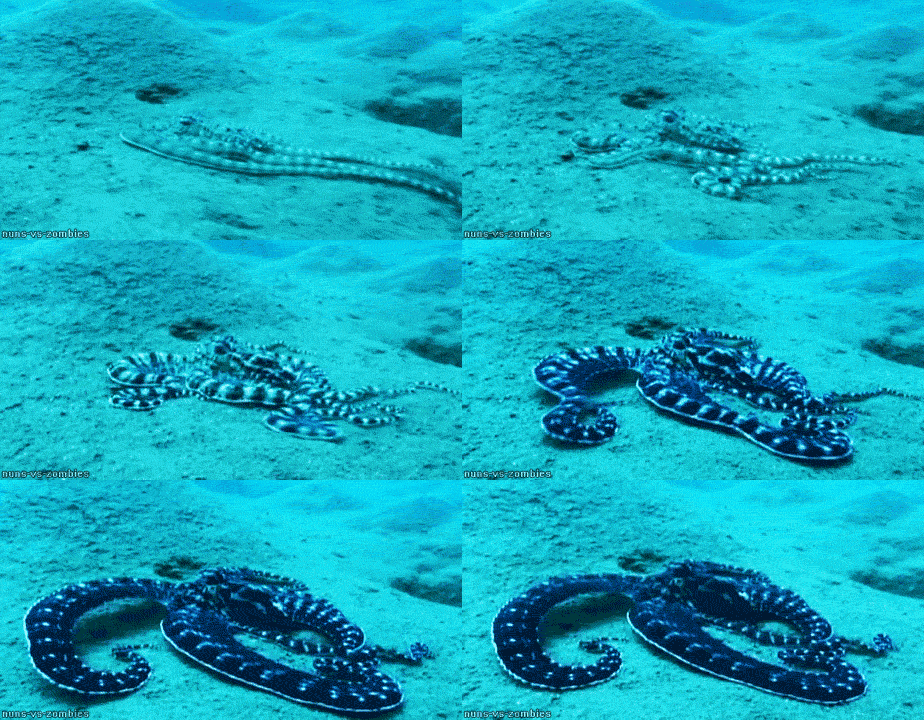
As a group of scientists try to crack a massive metallic egg of alien origin, for fucking eons resting peacefully at the bottom of the ocean with its crab and starfish neighbors, the reader goes back in time. Haldeman follows the shape-shifting 'changeling' alien as it leaves the waters after 10 000 years as a shark, a transition that doesn't go smoothly. It impulsively adopts the form of 'Jimmy', an unfortunate young man out for a late run, who welcomes the still shark-minded visitor to life on dry land and dies horribly. This brand new Jimmy freaks everyone out with his strangeness, and despite possessing a highly adaptive intelligence, bad things happen on the road to understanding the complex emotions and social subtleties.
Wait, the chameleon's the bad guy? Never...

When WWII breaks out, Jimmy switches to simpler subject matter, donning a uniform to join the Bataan death march. Impervious to harm, the 'Changeling' initially experiences a Thanksgiving dinner and the 'execution' of it's human form with the same emotionless curiosity, taking each new event as raw data for processing. But it's mimicry advances with time, and it develops something like an extraterrestrial corollary to feelings. The 'Chameleon' alien, meanwhile, much more skilled at blending in, thanks to a very long career in atrocity going back centuries, has found a place for itself in the Third Reich, finding a like mind in Joseph Mengele.
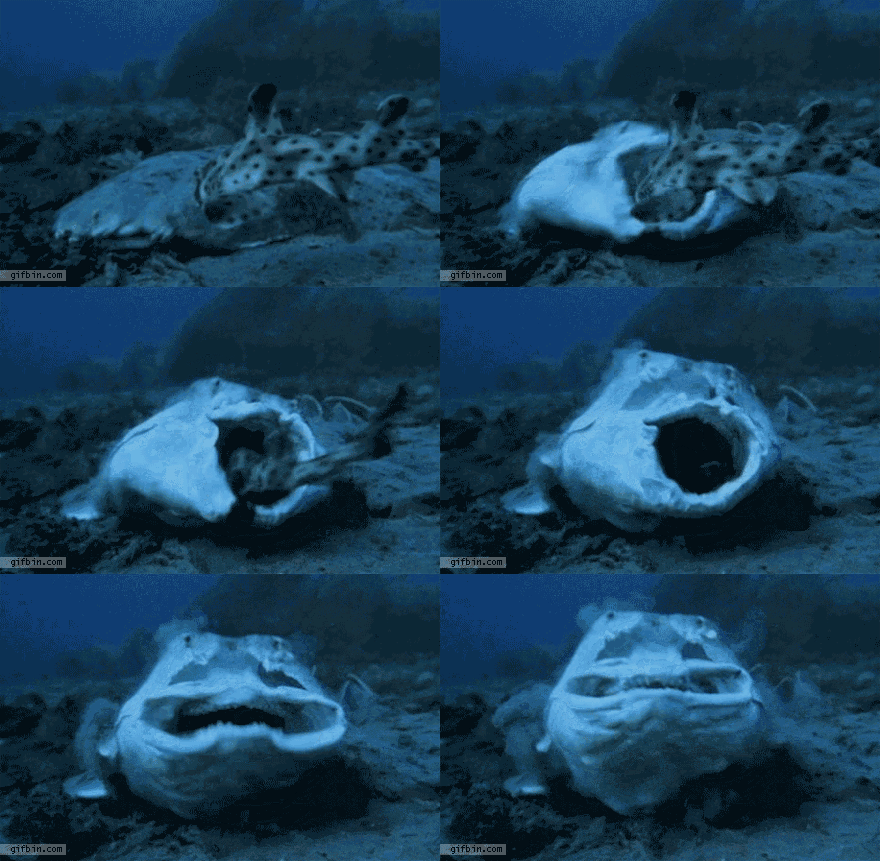
Wait, the shark's the good guy? Never... The shark doing the camouflaging and hoovering is an Angel shark, eating a Horned shark. Sharks are assholes.
As their parallel trajectories through modern history bring them to the near-future that is the story's present day, they converge on the experiments in Fiji. The alien egg, composed of an unknown element with a density near that of Neutronium* (theoretically), continues to mystify and refuses to yield any answers. With both aliens on the island and one of them inextricably linked to the object, answers are near at hand...
The story takes some decidedly strange turns, but remains a fascinating exploration of our very worst characteristics, benefiting from Haldeman's talent for vicious fictional violence. It's also a fast read, as all of his books are, but 'compulsively readable' definitely doesn't mean light entertainment. The narrative arc involving the changeling, as it evolves from a terrifying monstrosity to something almost human, makes for a fascinating and unusual perspective. I've been a fan of Haldeman's work since discovering 'The Forever War'** and its sequels, a story that is amongst the best SF of the 20th Century. Even though I've seen it pop up on 'best of' lists, in general, it seems like his novels don't get the attention they deserve. Unlike much of SF, his solid, pragmatic future-view has aged well, and I could see his influence in recent hard-boiled spec-fic like 'The Expanse' series. This probably isn't one of Haldeman's best novels, but I still highly recommend it.
*P.S.: "Neutronium (sometimes shortened to neutrium[1]) is a proposed name for a substance composed purely of neutrons. The word was coined by scientist Andreas von Antropoff in 1926 (before the discovery of the neutron) for the conjectured "element of atomic number zero" that he placed at the head of the periodic table.[2][3] However, the meaning of the term has changed over time, and from the last half of the 20th century onward it has been also used legitimately to refer to extremely dense substances resembling the neutron-degenerate matter theorized to exist in the cores of neutron stars; henceforth "degenerate neutronium" will refer to this. Science fiction and popular literature frequently use the term "neutronium" to refer to a highly dense phase of matter composed primarily of neutrons."
Since degenerated neutronium is so fucking dense a tablespoon of it outweighs Mt. Everest, I'm guessing that incense contains no neutronium. Also, it's impossible to get to a neutron star, and impossible to isolate. Also, neutronium is composed entirely of neutrons, packed immensely close without the protons and electrons balancing the strong nuclear force and keeping sub-atomic particles at relatively vast distances... so what the fuck are those electrons doing there? Truth in advertising, motherfucker. :-P

**P.S.: I was surprised to learn of Haldeman's popularity as a writer of BD (Euro-comics). In 1988, 'The Forever War' was adapted into BD form with Belgian artist Marvano, and became a huge success. Haldeman and Marvano collaborated on adapting the rest of the novels in the series, and have since gone on to other stories like 'Dallas Bar'.
More Art-book Reviews
More Comic-book Reviews
More Novel Reviews
[Warning: There's some minor spoilers ahead, but I steer clear of the big revelations.]
Haldeman has always impressed me with his mature, hardboiled SF writing, usually careful to keep the conceptual wanderings well in sight of their scientific base-camp. This is a story of two ancient alien visitors, both of whom have learned to pass as human. They're very different creatures, however; the 'changeling', obviously, changes itself -- adapting physically, psychologically, and perceptually to best suit the environment it inhabits -- while the 'chameleon' blends in, hiding in plain sight, without changing itself in any essential way, and seeks out the environments that suit it best. This difference defines the way they see mankind, and provides an interesting guess at how an outside observer might interpret the greatest hits and horrors of the twentieth century.
As a group of scientists try to crack a massive metallic egg of alien origin, for fucking eons resting peacefully at the bottom of the ocean with its crab and starfish neighbors, the reader goes back in time. Haldeman follows the shape-shifting 'changeling' alien as it leaves the waters after 10 000 years as a shark, a transition that doesn't go smoothly. It impulsively adopts the form of 'Jimmy', an unfortunate young man out for a late run, who welcomes the still shark-minded visitor to life on dry land and dies horribly. This brand new Jimmy freaks everyone out with his strangeness, and despite possessing a highly adaptive intelligence, bad things happen on the road to understanding the complex emotions and social subtleties.
Wait, the chameleon's the bad guy? Never...
When WWII breaks out, Jimmy switches to simpler subject matter, donning a uniform to join the Bataan death march. Impervious to harm, the 'Changeling' initially experiences a Thanksgiving dinner and the 'execution' of it's human form with the same emotionless curiosity, taking each new event as raw data for processing. But it's mimicry advances with time, and it develops something like an extraterrestrial corollary to feelings. The 'Chameleon' alien, meanwhile, much more skilled at blending in, thanks to a very long career in atrocity going back centuries, has found a place for itself in the Third Reich, finding a like mind in Joseph Mengele.
Wait, the shark's the good guy? Never... The shark doing the camouflaging and hoovering is an Angel shark, eating a Horned shark. Sharks are assholes.
As their parallel trajectories through modern history bring them to the near-future that is the story's present day, they converge on the experiments in Fiji. The alien egg, composed of an unknown element with a density near that of Neutronium* (theoretically), continues to mystify and refuses to yield any answers. With both aliens on the island and one of them inextricably linked to the object, answers are near at hand...
The story takes some decidedly strange turns, but remains a fascinating exploration of our very worst characteristics, benefiting from Haldeman's talent for vicious fictional violence. It's also a fast read, as all of his books are, but 'compulsively readable' definitely doesn't mean light entertainment. The narrative arc involving the changeling, as it evolves from a terrifying monstrosity to something almost human, makes for a fascinating and unusual perspective. I've been a fan of Haldeman's work since discovering 'The Forever War'** and its sequels, a story that is amongst the best SF of the 20th Century. Even though I've seen it pop up on 'best of' lists, in general, it seems like his novels don't get the attention they deserve. Unlike much of SF, his solid, pragmatic future-view has aged well, and I could see his influence in recent hard-boiled spec-fic like 'The Expanse' series. This probably isn't one of Haldeman's best novels, but I still highly recommend it.
*P.S.: "Neutronium (sometimes shortened to neutrium[1]) is a proposed name for a substance composed purely of neutrons. The word was coined by scientist Andreas von Antropoff in 1926 (before the discovery of the neutron) for the conjectured "element of atomic number zero" that he placed at the head of the periodic table.[2][3] However, the meaning of the term has changed over time, and from the last half of the 20th century onward it has been also used legitimately to refer to extremely dense substances resembling the neutron-degenerate matter theorized to exist in the cores of neutron stars; henceforth "degenerate neutronium" will refer to this. Science fiction and popular literature frequently use the term "neutronium" to refer to a highly dense phase of matter composed primarily of neutrons."
Since degenerated neutronium is so fucking dense a tablespoon of it outweighs Mt. Everest, I'm guessing that incense contains no neutronium. Also, it's impossible to get to a neutron star, and impossible to isolate. Also, neutronium is composed entirely of neutrons, packed immensely close without the protons and electrons balancing the strong nuclear force and keeping sub-atomic particles at relatively vast distances... so what the fuck are those electrons doing there? Truth in advertising, motherfucker. :-P
**P.S.: I was surprised to learn of Haldeman's popularity as a writer of BD (Euro-comics). In 1988, 'The Forever War' was adapted into BD form with Belgian artist Marvano, and became a huge success. Haldeman and Marvano collaborated on adapting the rest of the novels in the series, and have since gone on to other stories like 'Dallas Bar'.


More Art-book Reviews
More Comic-book Reviews
More Novel Reviews
September 10, 2023
My god I did not like it _at all_.
I felt that the premises (a shape shifting alien that can take any imaginable shape and is as well far more intelligent than a person) completely unbelievable, and the character evolution which is another important aspect of the book was not done well at all.
It was written in 2004 but it reminds me of much older SF books, from a time where the genre was new and a cool ideas were enough to make a book stand out, even if the idea needed serious fleshing out and the writing style was suboptimal. I'm surprised it won the Nebula award, especially since it was nominated the same year as Jonathan Strange and Mr. Norrel which I read recently and is not without flaws but IMO with far lesser flaws than this one.
I felt that the premises (a shape shifting alien that can take any imaginable shape and is as well far more intelligent than a person) completely unbelievable, and the character evolution which is another important aspect of the book was not done well at all.
It was written in 2004 but it reminds me of much older SF books, from a time where the genre was new and a cool ideas were enough to make a book stand out, even if the idea needed serious fleshing out and the writing style was suboptimal. I'm surprised it won the Nebula award, especially since it was nominated the same year as Jonathan Strange and Mr. Norrel which I read recently and is not without flaws but IMO with far lesser flaws than this one.

November 5, 2013
Assume that your beloved mum hands you a cupcake with sprinkles. She's beaming with pride. She says, "I won first prize with this recipe!" You eagerly bite in, then quickly turn away in shock. It's like old bread. Turning back, you smile. "It's fantastic, mom!" Except it wasn't.
Unfortunately, this novel isn't either. At least, for me it isn't.
Two aliens are on Earth - the Chameleon and the Changeling. Neither knows about the other, and neither can remember where they came from. They both are genderless - its - and neither can be destroyed or age. They both change identities by reshaping their bodies as if they were digitalized pixels. They are alive for millennia on earth, learning, studying humans and both attend college every 50 years or so. But they are not of the same race. The Chameleon loves murdering and warfare. The Changeling, once it's become human for a few centuries, likes people so much it finds killing repugnant. They both are intensely brilliant geniuses after being human awhile; not so much when fish or other animals.
Then real people discover an engineered artifact deep under the ocean. They bring it up and move it to Samoa. They try to open it, but can't. Soon, the Changeling arrives. It is drawn to the device and suspects it has something to do with where the creature came from. But it can't get close to it. It becomes a woman, then checks out the men scientists studying the space artifact. Through the years, it has learned about seduction. Unexpectedly, something else happens. It falls in love with the scientist it planned to use. However, unbeknown to everyone, the Chameleon is also at the research site, but it's on the hunt. All it wants is to kill the Changeling, but it doesn't know what form the being it considers it's rival for Earth looks like.
There can only be one.......
Sound familiar? Like, maybe, the movies 'Species' and 'Starman' mashed up?
Never mind. I still love you, Joe Haldeman.
Unfortunately, this novel isn't either. At least, for me it isn't.
Two aliens are on Earth - the Chameleon and the Changeling. Neither knows about the other, and neither can remember where they came from. They both are genderless - its - and neither can be destroyed or age. They both change identities by reshaping their bodies as if they were digitalized pixels. They are alive for millennia on earth, learning, studying humans and both attend college every 50 years or so. But they are not of the same race. The Chameleon loves murdering and warfare. The Changeling, once it's become human for a few centuries, likes people so much it finds killing repugnant. They both are intensely brilliant geniuses after being human awhile; not so much when fish or other animals.
Then real people discover an engineered artifact deep under the ocean. They bring it up and move it to Samoa. They try to open it, but can't. Soon, the Changeling arrives. It is drawn to the device and suspects it has something to do with where the creature came from. But it can't get close to it. It becomes a woman, then checks out the men scientists studying the space artifact. Through the years, it has learned about seduction. Unexpectedly, something else happens. It falls in love with the scientist it planned to use. However, unbeknown to everyone, the Chameleon is also at the research site, but it's on the hunt. All it wants is to kill the Changeling, but it doesn't know what form the being it considers it's rival for Earth looks like.
There can only be one.......
Sound familiar? Like, maybe, the movies 'Species' and 'Starman' mashed up?
Never mind. I still love you, Joe Haldeman.

January 19, 2009
This story of shape-changing aliens is narrated in two and a half separate tracks, which do not intersect until near the end. The primary track is from the point of view of "the changeling," an alien who, after spending eons as a sea creature, encounters a human swimmer in the 1930s and becomes human. Over the years he takes different identities and learns about human nature. We also get short snippets of another alien who loves to kill and hurt people and travels to different war zones and catastrophes to make things worse. His personality isn't much developed and we don't know why he is evil. The final line of the story is about some scientists in Samoa investigating a mysterious submerged object. There are several of them and there isn't space to more than sketch in their identities. This is the essential problem with the book -- there is so much backstory, world-building, and character introduction that not much space is spent on plot development or the interaction of the characters.

June 28, 2013
Muy ameno y con ideas muy interesantes. Me encanta la perspectiva del alienígena principal y cómo él mismo no recuerda ni tiene muy claro por qué está en nuestro planeta o desde cuándo.
En muchos libros de CF los alienígenas suelen tener un plan claro y definido (muchas veces pasa por aniquilarnos) pero aqui no; no hay plan, o al menos el libro empieza sin que percibas que hay plan, y en cierto modo hasta te pones del lado del personaje (en unas cosas más que en otras).
En algunos aspectos me recordó a Esfera. Dado que el alienígena observa la humanidad desde muchas épocas y circunstancias hay que puede considerar que el libro tiene un lado antropológico, yo no sé si llego a tanto... el enfoque está bien (sobre todo la visión del alienígena de las guerras) aunque el aspecto donde empieza a interiorizar sentimientos humanos es menos creíble.
Altamente recomendado si te gusta la CF.
En muchos libros de CF los alienígenas suelen tener un plan claro y definido (muchas veces pasa por aniquilarnos) pero aqui no; no hay plan, o al menos el libro empieza sin que percibas que hay plan, y en cierto modo hasta te pones del lado del personaje (en unas cosas más que en otras).
En algunos aspectos me recordó a Esfera. Dado que el alienígena observa la humanidad desde muchas épocas y circunstancias hay que puede considerar que el libro tiene un lado antropológico, yo no sé si llego a tanto... el enfoque está bien (sobre todo la visión del alienígena de las guerras) aunque el aspecto donde empieza a interiorizar sentimientos humanos es menos creíble.
Altamente recomendado si te gusta la CF.
April 8, 2009
Read the prologue and stop right there.
The author, Haldeman, has apparently won several awards for multiple books. This book shouldn't win any awards. Readers should commend Haldeman for the ideas in the prologue. Haldeman needs to return to the drawing board to create a better story.
The rest of the book moves slowly and bores to frustration. I'm usually willing to accept a slow book if the end wows me. Camouflage certainly succeeded on slowness but failed on a worthwhile ending.
As a recommendation on the back cover of Camouflage, Steven King comments that Haldeman is so good he needs to be "locked up in the Fort Knox for science fiction writers". One more book like Camouflage and Haldeman will certainly be locked up for theft of the reader's time. (Zing!)
The author, Haldeman, has apparently won several awards for multiple books. This book shouldn't win any awards. Readers should commend Haldeman for the ideas in the prologue. Haldeman needs to return to the drawing board to create a better story.
The rest of the book moves slowly and bores to frustration. I'm usually willing to accept a slow book if the end wows me. Camouflage certainly succeeded on slowness but failed on a worthwhile ending.
As a recommendation on the back cover of Camouflage, Steven King comments that Haldeman is so good he needs to be "locked up in the Fort Knox for science fiction writers". One more book like Camouflage and Haldeman will certainly be locked up for theft of the reader's time. (Zing!)

August 6, 2012
Haldeman cannot write romance from either a queer or female perspective, and it helps sink the last third of this novel. Marsbound has very similar problems, and it's something I just can't get over.
There are some beautiful ideas here-like many other reviewers have said, the prologue is great, and the depiction of a very alien creature acclimatizing to human society is just fascinating.
And then it gets to the end, which is not only anticlimatic and rushed, but it has this ridiculous romance plot tacked on, and it has to be a STRAIGHT romance, all caps. It wouldn't have bothered me had the first section not been so good.
I recommend reading the first two thirds of this book.
There are some beautiful ideas here-like many other reviewers have said, the prologue is great, and the depiction of a very alien creature acclimatizing to human society is just fascinating.
And then it gets to the end, which is not only anticlimatic and rushed, but it has this ridiculous romance plot tacked on, and it has to be a STRAIGHT romance, all caps. It wouldn't have bothered me had the first section not been so good.
I recommend reading the first two thirds of this book.

December 14, 2011
Joe Haldeman books are what I call easy reads. The storys track fairly fast and there is minimal character development, but enough. Haldeman has a potty mouth sometimes which I don't find offensive but younger readers may not appreciate his vivid language.
All his books are entertaining and easily read. There is not too much complicated plot lines so again easy to read.
Recommended
All his books are entertaining and easily read. There is not too much complicated plot lines so again easy to read.
Recommended

February 13, 2013
Wow! Great book. Great ideas, nicely written, compact (always good).
I had been kind of put off Haldeman by Forever Peace, which is a later book but one that I didn't warm to. But I'm working my way through the Nebula winners that I haven't already read and I'm now thinking I should read some more of his books*.
*Read The Forever War already, obviously.
I had been kind of put off Haldeman by Forever Peace, which is a later book but one that I didn't warm to. But I'm working my way through the Nebula winners that I haven't already read and I'm now thinking I should read some more of his books*.
*Read The Forever War already, obviously.
June 26, 2017
Muy interesante la idea del escritor, me gusto la creatividad con la que la plantea y como planteaba los personajes, a veces algo crudo, pero todo muy relacionado. El final me parecio algo rapido, como mal gestionado.

August 18, 2025
Que increíble libro, no esperaba que fuera tan WOW, recomiendo demasiado muy fácil de leer y entender

October 10, 2018
اورسلا لگویین در پذیرش این کتاب برای جایزه جیمز تیپ تری جونیور متن زیر نوشت که به نظرم در توصیف کتاب کافیه :
"An ageless, sexless entity who can take any form is at first indifferent to gender; as it grows more human, the choice becomes more important to it; it ends up a woman by preference. If gender isn't the central concern of this novel, it's near the center, and the handling of it is skillful, subtle, and finely unpredictable."
موقع خوندنش خیلی لذت بردم
"An ageless, sexless entity who can take any form is at first indifferent to gender; as it grows more human, the choice becomes more important to it; it ends up a woman by preference. If gender isn't the central concern of this novel, it's near the center, and the handling of it is skillful, subtle, and finely unpredictable."
موقع خوندنش خیلی لذت بردم

June 19, 2017
Mediocre Haldeman. There have been better novels about aliens on earth. Try Needle by Hal Clement.

November 10, 2017
Много интересна концепция, опропастена от доста скучноват стил на писане. Толкова стига за книгата.
Displaying 1 - 30 of 423 reviews