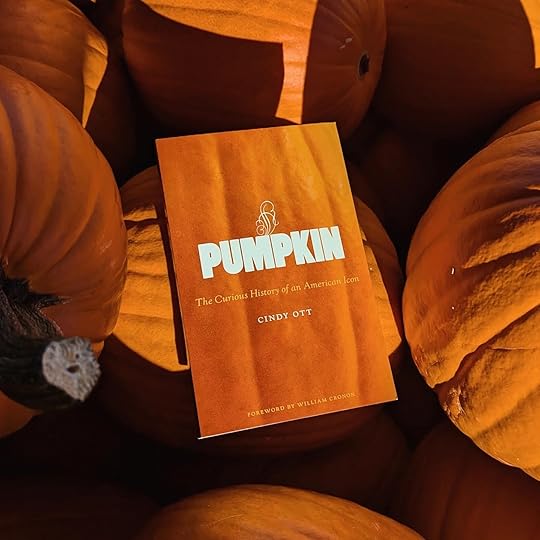
While many cultures eat pumpkin year round, North Americans reserve it for a set of beloved autumn rituals that celebrate the harvest season and the rural past. In a fascinating cultural and natural history, "Pumpkin" shows how Americans have used the pumpkin to connect with nature and our agrarian roots--and, ironically, how this process has revitalized small farms and rural communities.
"After smashing our illusions about the Pilgrims, Ott continues her pumpkin iconoclasm. The pumpkin as symbol comes full circle." --Nina C. Ayoub, "The Chronicle of Higher Education"
"An extraordinary scholar and storyteller, Cindy Ott tracks the culture that altered the very nature of the pumpkin--and in doing so, tells us a revealing story about ourselves. Not to be missed." --Philip J. Deloria, author of "Playing Indian "
Leans on the academic side and the end matter is over a hundred pages long, however this is a very enlightening account of how these orange orbs went from near-worthless food for livestock to cherished American symbols of rural communities and tradition.
A surprisingly interesting book. More than just the history of the pumpkin in America it goes into many social and cultural aspects of the early US. Recommended
I did not enjoy this book. If you'd like to know why, read on. I have a lot of complaining to do.
One of my huge pet peeves about non-fiction work is lack of listed resources. This was one of two ways in which this book did not let me down; Ms. Ott has copious pages of notes and a long bibliography at the end, so that was nice. Also, I always hope to learn something from every non-fiction book I read. In this case, I learned how Libby, the canned pumpkin company, processes and cans pumpkin meat. I want to tour the Libby factory if I ever find myself in Morton, Ill. Other that that, I was horribly disappointed by this book, mostly because I had looked forward to reading it for so long. I mean, I freakin' LOVE pumpkins! They were often in the garden throughout my childhood, I try to grow them every few years, I fell in love with the pumpkin patch on the farm where we farmsit, I make puree from my leftover jack-o-lanterns, I cook them in soup and bread and pie and anything else I can think of! I just love pumpkins.
I did not love this book about pumpkins. I had a difficult time reading it. If I am not mistaken, this was either the author's dissertation or came from her dissertation. I feel her dissertation team let her down terribly and should have suggested a lot more editing. To me, this book read like a first or second draft of an 8th grade research paper. It wandered and rambled, there was no straight line from date to date, even within a paragraph. She'd be discussing something that happened in the 1500's, then jump forward to the 1800's, then back to some random date in the 1600's, all on the same page. This happened with too much regularity but without the benefit of adding perspective to whatever was being discussed. The thing that bothered me most was though she said early on that pumpkin is a fruit, she kept calling it a vegetable. Who DOES that? And WHY? It's a freakin' fruit. If you're going to write a lengthy treatise on the history of the pumpkin, you should probably not give it the misnomer of "vegetable"; that bugged the hell out of me. I was left very confused as to the whole origin of the term "pumpkin"; I got that it started out as a pompion which, supposedly, was European for big, ol' fleshy fruit that can't really be identified (because there were a lot of big, ol', unidentifiable fleshy fruits running around Europe?) though she redefines the term "pompion" a few times, never with the exact same meaning. I was also confused as to how there were pumpkins in Ancient Rome if they're native to the Americas? I'm pretty sure the Ancient Roman pumpkins were the big, ol' fleshy unidentifiable fruits, but that was never actually made clear. Nor was it made clear why there needed to be an excerpt on pumpkins in Ancient Rome, though I think it was her tool to show that pompions had been used since ye olden dayes to poke fun at politicians, though she kept using the term "pumpkin" over "pompion" and thus the confusion. The biggest problem, I felt, was that she's trying to nail down the "idea" and "meaning" of the big, orange pumpkin - she and her resources call these field pumpkins - to the mind and culture of America. The thing is, I didn't buy into what I thought she was trying to sell. She put forth lots of ideas but never seemed to focus on what it was she was trying to say. In addition, I noticed a very strong New England bias and a strong anti-Southern bias making me feel that perhaps she was describing the meaning of pumpkin to the New England culture. She all but said that people in the south don't have such an esteem for pumpkins because they prefer sweet potatoes and because pumpkins don't grow well in the soil of Down There. The book suffers from repetition, and not in that helpful "You need to learn this so I will repeat it" way that Sesame Street employs. Instead, the first two or three chapters told the story of how the pumpkin was native to the Americas, how it was seen as prolific and became a symbol of native agrarianism and had the ability to sustain a populace during starvation time but how everyone else in the whole world (England) thought it was a crass and crude vegetable (it's a fruit) and made fun of it and then after colonists stabilized and became independent, they took on the same air toward pumpkins - they were a nourishing, prolific, gardeny product but were for poor people and farm animals and could only grow in the country and only stupid people liked them. This message was stated over and over in a variety of ways. She kept saying things like, "...yet there was something about the pumpkin that was unlike any of the other natural resources that expanded colonial markets and built colonial cities- something which New Englanders identified. The pumpkin meant something that simple economics could not explain but that would one day make it a valuable commodity. That something was a sense of identity rooted in an agrarian world. Neither corn, tobacco, nor furs carried the pumpkin's symbolic weight." (p. 44) Then she goes on to trash talk the pumpkin again, discussing how it was for poor people and peasant farmers grew it and it was used as a symbol for empty-headedness. This made me dizzy. She talks a LOT about pumpkin pie. New England pumpkin pie. Connecticut pumpkin pie. Oh the joys - and chapters - of pumpkin pie. It's a symbol of America - though, you'll note, the saying is "As American as APPLE pie" - and even though we now only really eat pumpkin pie at Thanksgiving, it's meaningful because it brings us closer together as a nation and it would be unpatriotic not to have pumpkin pie during that holiday. Well, except for in the south, because they're all southern and are still burnt over those damn Yankees winning the war so they eat sweet potato pie in protest. I was irritated by broad generalizations such as, "People craved pumpkin pie because of what it meant"(p. 98) (and what it meant was never solidly defined, just the same hedging about how the Colonials made it their own and there was a recipe for it and take that, England); I doubt people crave pumpkin pie based on its meaning. Yes, I agree that it has become tradition to serve pumpkin pie at Thanksgiving and we all love tradition, but I am also just as sure that people want pumpkin pie because it is delicious. I'm not convinced they're (pies) eaten out of symbolic duty. I didn't see support of her idea that Americans formed an identity of self and culture based on the pumpkin or its pie.
What I think she wanted to say, and probably could have had she just focused, cut out most of the repetition, and got to the point (seriously, if well-edited, this book would have been about 1/2 as long) is that early Americans were impressed by the pumpkin - it's big and showy, a vine can grow exceedingly quickly and at tremendous lengths and will produce a lot of fruit - and it helped sustain them through the first years in their new home. However, much like potatoes and cabbage, once other foodstuffs were readily available, the pumpkin was relegated to simple farm fare. That should have been it for the pumpkin but because of its dichotomous nature, it continued to hold an interest in the public eye, whether as a vehicle for mockery or a symbol of hearty produce and it is something that is uniquely American. New Englanders took this to heart and built their identity around the pumpkin (and probably a few other local things, like landmarks, turkeys, killing off the natives, etc) and it now holds a place of sentimental reverence in the hearts of New Englanders, especially during Halloween and Thanksgiving. The end.
I don't feel that this deep cultural identity centered around the pumpkin is true for the entire American culture. She even admits "the pumpkin's meanings do not resonate with all Americans, of course...such as Southerners who still push aside pumpkin pie for the more regional sweet potato pie, it might have seemed like a Yankee bias" - You think? The whole book is a Yankee bias, regardless of how the American populace obviously values pumpkin, based on pumpkin-related sales from September through November.
There are a lot of typos and mistakes. The final two paragraphs of Chapter 6 are a rambling mess. Chapters 6 and 7 are both subchaptered "1946 to Present" which made it seem like the two chapters should have been combined. I was surprised she never linked pumpkins to magic, aside from pointing out it had been used as a vehicle (literally and figuratively) in the Cinderella fairy tale. All these things made it hard for me to take this book seriously, which is a shame because it's evident there was a lot of research behind the story. However, very little of it was hands-on research, from what I could tell. I didn't get the sense that she's ever grown a pumpkin or even carved a pumpkin, then pureed its innards and made a pie for Thanksgiving. Her work on a pumpkin farm/stand/place may have started the ball (fruit) rolling, but it didn't take her very far.
Again, I think with some more editing and some focus, this would be much more interesting and a lot less confusing. But in the state in which it was published, it was not worth the time it takes to read.
Count me in the group of those utterly obsessed with the autumn season and everything that comes with it: all things harvest, Halloween, apples, pumpkin everything, cinnamon spices, corn mazes, hay rides, and the world in tones of oranges, yellows, and reds. Even my birthday is in October! Everything about this time of year and culture is appealing to me and brings an endless smile to my face. How did pumpkins get to become the spokes figure for the season, though? What is the history of this orange globe? Cindy Ott explores these questions in, “Pumpkin: The Curious History of an American Icon”.
In “Pumpkin”, Cindy Ott brings forth the evolutionary history of the pumpkin through the times and its introduction to America while exploring the social and cultural impact and growth of pumpkins. Each chapter is delegated by a time period chunk with Ott presenting the history of pumpkins during the respective constraints. It is evident that Ott truly researched pumpkins like no other predecessor as “Pumpkin” is filled to the brim with pumpkin facts and information. Readers will certainly walk away educated on the subject.
This is if the reader can pay attention. “Pumpkin” is painfully dry and the writing is not carried by a readable, fast pace. Ott’s angle is more of a commodity study and unless the reader is interested in the agriculture of early American settlers (which is the predominant content of “Pumpkin”); then “Pumpkin” will be a bore.
Ott is guilty of being highly repetitive. Each chapter basically focuses on the same five talking points but in various time periods resulting in “Pumpkin” feeling like no new information is uncovered and thus not memorable. Ott’s transitions from topic-to-topic are choppy and often don’t make sense. Many readers will find the majority of the text to be skim-worthy, at best.
On a positive note, Ott’s actual writing and language game is on-point with a lovely finesse and maturity with words. The idea, thesis, and writing behind “Pumpkin” is there, but the execution is flawed.
“Pumpkin” is interspersed with black-and-white photos related to the subject matter but truly: these don’t add much to “Pumpkin” and fail to elevate the piece. One can truly “take it or leave it”.
It isn’t until the final two chapters of “Pumpkin” in which Ott relates the modern life of pumpkins and its more cultural take; that the text is more accessible and enjoyable. This is how the entire book should have been which would have made for a stronger piece.
Despite the jump in pace at the end of “Pumpkin”; the conclusion reverts back to its previous difficult and dry state without a resounding wrap-up. Neither the finale nor the entirety of “Pumpkin” is compelling or catchy. Ott supplements “Pumpkin” with lengthy annotated notes and a bibliography section.
Sadly, even for pumpkin-lovers, “Pumpkin” is a huge disappointment unless seeking a slow-paced agricultural history of pumpkins. The text is repetitive and lacks any energy or zest leaving the reader without the ability to fully grasp the material. Ott’s attempt is solid and the subject matter is unique but the completed piece is as sad as an exploded pumpkin. “Pumpkin” can be skipped.
This book started out slowly but it was filled with lots of interesting history and factoids... Kind of dragged on at the end but also, the question still persists- where does our love affair for the pumpkin come from?
This was the best book about a single type of plant I've ever read. To hell with people who leave 3,000 word one-star reviews on a book about a fruit that's functionally a vegetable. Go outside nerds.
I wanted to love this book, but am so disappointed in it! I stumbled upon this book while selecting fall/Halloween/Thanksgiving picture books for read aloud time with my three sons and was SUPER pumped to learn about the "curious history of an American Icon", but I read the entire 198 pages just hoping it would actually get good! (The physical book is 323 pages, but the content stops at 198 and the rest is just notes and bibliography.) I LOVE all things fall and while I love doing the read aloud time with my boys, I was excited for a fall-topic book just for me!
In attempt to be succinct, here are my issues: 1) It is extremely obvious this was a thesis or dissertation turned into a book. A poorly written one, at that. There are typos and run-on sentences and awkward transitions. (The back cover says she's an assistant professor of American studies which I find shocking based on how poorly written this book is. I was expecting an undergrad at best! Maybe we need a reprint that's half the length and severely edited.) 2) It is painfully obvious Cindy Ott hates pumpkins/pumpkin pie/family traditions/etc. She's practically screaming "The pilgrams did not eat pumpkins on the first Thanksgiving and you're stupid for associating the jack-o-lanterns or pumpkin pie you enjoy with anything having to do with the origins of America!" She repeatedly reminds us that our idea of The First Thanksgiving is not really how it all went down, but just because there's a popular myth in culture doesn't mean every single person who's going to read this book isn't already aware of that fact. (And clinging to that point is a bit off the topic of a book supposedly just about the history of the fruit!) She has an agenda to prove us all wrong and to tell us what idiots we are. Her negative tone throughout the entire book was a depressing component to a book whose subtitle includes "curious" and "American Icon" both of which are tinged with positivity and light-hearted fun. Sure, correct false ideas, but don't make us feel like a beaten puppy just because we might actually enjoy pumpkins. 3) It was continually shocking to me how much she left out The South. She mentions multiple times that southerners prefer sweet potato pie to pumpkin pie and chooses to not discuss the history of the "American Icon" in the southern half of the US. Her thinking we don't eat pumpkin pie as much is a reason she didn't do her research for down here? She left it out of the book almost entirely? Weird. 4) Generally, her statements are over-arching and all-encompassing. She has clearly done her research, though, don't be confused about that. She's read all the USDA data and agricultural journals that history has to offer! But it's things like this (regarding a Time magazine cover published shortly after 9-11) "In stark simplicity, the cover of the Thanksgiving 2001 issue of Time-two months after the terrorist attacks on the World Trade Center and the Pentagon on September 11--depicted a pumpkin pie with an American flag stuck in the middle of it. During that time of national crisis, the illustration was a poignant reminder of Americans' core values, cultural heritage, and sense of patriotism. When the country faced one of the worst acts of aggression and violence on home soil in its history, IT turned again to Thanksgiving pumpkin pie to provide a sense of well-being and security, much as when Lincoln first declared the nation holiday during the Civil War." IT=America. Did AMERICA turn again to pumpkin pie or did the EDITOR OF TIME turn to pumpkin pie!? GAH! 5) What she had to say could have been done in about 100 pages, saving me precious hours slogging my way through this book. 6) She REPEATEDLY calls it a vegetable, not a fruit.
Lastly, here's what you're probably wanting to know (Spoiler alert!): "Although the pumpkin never provided colonists with surplus wealth or cultural cachet, it always gave them something to eat, and in that lay a story for a new democratic nation. Eating pumpkins signified a family's taking care of itself on its own piece of land, no matter how humble the size, and depending on no one but itself. Growing pumpkins required nothing more than land, honest work, and family." DOESN'T THAT SOUND LIKE THE AMERICAN DREAM IN A NUTSHELL?
"With the pumpkin, the nation's citizens were able to provide for themselves. Making the lowly pumpkin--a vegetable Europeans stigmatized as primitive and rustic--a delicacy and publishing a recipe for it in the first American cookbook was a powerful expression of American pride and independence." PUMPKIN PIE WAS LITERALLY IN THE FIRST AMERICAN COOKBOOK. SURE SEEMS LIKE IT'S BEEN AROUND SINCE OUR BEGINNINGS!
"Yet while some Europeans scorned the pumpkin as rural peasant food and others equated it with hedonism, the vegetable triggered a sense of pride and nostalgia in some early Americans. It did more than fill dinner plates; it communicated a set of assumptions about who Americans were and what American stood for in contrast to Europeans. Although a pumpkin was not a pumpkin in the same way Americans define it today--according to what it looks like, the way most people prepare it, and what it means--these historic uses and definitions nevertheless resonate into the present." SHOCKINGLY, THIS IS THE MOST POSITIVE PARAGRAPH SHE HAS. SHE'S MOSTLY "TO HE!! WITH PUMPKINS!"
"The popularization of Halloween mirrored the development of Thanksgiving and happened at about the same time. In both cases, nineteenth-century Americans reimagined remnants of old rituals to fit their whims and fancies." LIKE 200 YEARS AGO? SEEMS LIKE 2018 TRADITIONS BASED OFF 1818 TRADITIONS GOES BACK FAR ENOUGH. I HONESTLY DON'T CARE OF THE THANKSGIVING WE CELEBRATE EACH YEAR IS "ONLY" FROM 1864 AND NOT THE EARLY 1600s. IT FEELS LIKE SPLITTING HAIRS AS LONG AS YOU KNOW IT'S ORIGINS ARE NOT 1621.
She was going to convince us that 1) pumpkin pie was not on the pilgrams' table at the First Thanksgiving (and oh, by the way, it didn't happened like you think it happened, idiot!) and 2) tell us how it's all a big racket of commercialization nowadays (that kinda sorta helps small farmers) or die trying.
Cultural history, the Legend of Sleepy Hollow, Half Moon Bay - what’s not to love in this incredible exploration of a very special, very complex and very American orange squash. This is a historical monograph / microhistory so it’s not for light reading, but it can be conquered by chapter. 🎃
A fascinating and well-written overview of pumpkin history. Some chapters get repetitive and jump around between time periods, but overall it holds together. It's nice to learn and have fun simultaneously. This is a great book for the season!
This book was something of a missed opportunity. Like some of the other reviewers, I really wanted to love this book, but couldn't. While it shows as more than 325 pages long, more than 100 of those pages are footnotes. It is quite obvious that this is a dissertation turned into a book. Best recipe for pumpkin pie? Not in here. Best pumpkins to plant for the home gardener? Nope, nothing. When to plant or how to plant? Silence.
While the last chapter makes a valiant attempt to make pumpkins relevant to the modern reader, most of this book is a hodgepodge of rather dull facts about Thanksgiving. I like Thanksgiving as much as the next person, but jeez, enough already. The topic of pumpkins calls for a writer of the caliber of Michael Pollan to take this to the next level. This is a factually accurate and well researched book that is overlong and suffers from academic dryness. This is really more of a 3.5 star book than 4.
Wonderfully-eclectic research that marries the cultural history of the pumpkin with the material history of farming across over three centuries. It's engaging and fun and really smart, especially well-versed in the literature of American studies and environmental history in the introduction. At times, some of the intellectual leaps and interpretations of particular poems and paintings could use a bit more explanation, but it's an excellent book that advances the field of environmental history.
This book was so terrible, I couldn't get much farther than 50 pages in. It meanders, it contradicts itself with how it wants to refer to it's main topic and is so dryly academic that it makes itself darn near unintelligible. I'm usually pretty stubborn about giving books a proper chance and finishing them but this was one honestly not worth my time.
Awesome history of not only the pumpkin itself, but our cultural ties to it. Great analysis of the feelings of nostalgia and homespun goodness every fall. Made me appreciate pumpkin farmers and brought back great memories. Anyone who gets half as excited as me when pumpkin coffee and soup starts to be served will love this book!
I found this book to be highly interesting and it kept me engaged almost all the time. It covers the American (US) history of the pumpkin and how people have interacted and related to it since before Europeans firmly settled the North American mainland up through contemporary times. While it may not be 100% comprehensive to some people's tastes, it covers so much more ground than any other book that's been written about pumpkins that it justly could be called the only book published that's actually a history of pumpkins. No, there are no real recipes in this book. Good, because it's a history book! And no, there are no gardening tips in this book either. Good, because it's a history book! Go find a Better Homes & Gardens book if you want those sorts of things. And no, it's not all about Halloween (although there's a lot of Halloween in there!).
I thought the book did a great job of tracking the practical uses and cultural meanings we've subjectively imbued these gourds with over the last few centuries. It's been a moving target and an evolution - one that we generally don't give much thought to.
If you want to know about pumpkins, this book has to be on your list. It's a 4 Star book that gets 5 Stars because because there's nothing else out there like it on the subject. In that sense, it's "essential".
I really enjoyed this book for what it was. It has a very narrow focus. The author is really only looking at a very limited segment of American society when considering the pumpkin's uses and status as an icon. Keeping this in mind there is still a lot of interesting information here.
Everything you need to know about pumpkins. The print is very small is my only complaint but it will stay on my shelf. This book was a gift from my friend Sally.
Yet another PhD dissertation packaged with pretty cover and marketed to the masses...apparently it's a thing, and I keep buying them. I got this for the bibliography, but it was a good read. It even answered a few nagging questions ("WHY can't I get canned pumpkin in Australia? And why don't they distinguish between pumpkins and squashes? And why don't they understand that I can't make a pie out of that thing because it is not orange?"). I have investigated squash origins and always been frustrated at the lack of information. Now I realize we still don't know where these plants came from or how they differentiated into the varieties we know today. Somebody...genetics people...GET ON THIS. My list of theses is getting too frickin' long.
Ott has a point to make about the symbolic nature of pumpkins, but she honestly pushes it a bit far. I love her analyses of art and literature, but she's trying to make the pumpkin the star of the show when more often it's just decoration. Sure, it's symbolic, and that's why it gets used for ambiance. But I don't think people imbue it with ideas about wholesomeness, women's morality, or patriotism to any great extent--when they do, it's with a humorous twist, an appreciation of the absurd. It's always been supremely recognizable, but in a niche way. If she acknowledged that in her thesis (which she restates every second paragraph), I could have taken her more seriously.
Love the pictures, love the many ridiculous quotes about pumpkins and pies. "No man ever plotted treason or formulated dark damnable designs while filling his system with a genuine New England pumpkin pie..."
I received Pumpkin as part of a Goodreads giveaway.
Pumpkin: The Curious History of an American Icon tells the story of, well, the pumpkin, more specifically the cultural status it has achieved in American society. Beginning with the cultivation of gourds tens of thousands of years ago by Native Americans and concluding with modern connotations, Ott's book makes for a fascinating profile of this odd but beloved fruit.
I find food history fascinating, so Pumpkin was a perfect fit for me. The book reads relatively quickly (much of the page count is devoted to endnotes and a bibliography, so the actual text is about 200 pages) and provides a fascinating look at how and why these orange orbs have captured the imaginations of Americans.
If I had a critique, I wish that Ott had explored more of the pop culture impact of the pumpkin in the modern day ("It's the Great Pumpkin, Charlie Brown," Starbucks' cult favorite pumpkin spice lattes, etc.). The two chapters dedicated to the late 20th and early 21s centuries primarily discuss an overview of modern farming practices and "pumpkin festivals" throughout the country. It's interesting, but I think there could have been a lot more done with it.
I won this book in a goodreads giveaway. An impressive thoroughly researched book! Cindy Ott definitely connects the pumpkin to its many different aspects of its symbolism, tracing back the fruit to its origin. Well worth a read if you have an interest in history of the US and the many different faces of the pumpkin. From the term "pumpkin head" to cattle fodder to the age old purity of the family outing to the pumpkin patch, Ott includes it all while pointing out the discrepancies and consistencies. A little repetitive and definitely dense research, this book is obviously the culmination of years of work and is worth every page.
During the reading of this book, I picked gourds at a farm, drank pumpkin spice lattes, purchased pumpkin cereal bars, received a pumpkin from a friend's garden, purchased carving pumpkins from Smart and Final, bought pumpkin chai mix, received a pie pumpkin from Trader Joe's, carved jack-o'-lanterns, drank 4 different types of pumpkin beer and a pumpkin cider, made pumpkin pasties, and saw countless pumpkin icons in the lead-up to Halloween. Cindy Ott describes the history of pumpkins as an American icon, causing a greater appreciation of the fruit, as well as a deeper reflection into why we eat what we eat and when we eat it.
I love pumpkin food, and that's honestly why I read this book in the first place. It seemed like it would be interesting, but really, I would've been perfectly happy with a Cliffs Notes version - there was an ENORMOUS amount of information about pumpkins, and sadly, I had to make myself get through it. The writing was quite dry. If you want to skip the long-form, check out my "quick facts" and my favorite recipe for Pumpkin Pie on The Hungry Bookworm: https://hungry-bookworm.com/2016/10/2...
If ever there was a book I wanted to give five stars before I even opened the cover this was it: an entire book dedicated to the history of the pumpkin! How could this not be five stars? Sadly this is not a five star book, but it was very informative on the history of this magnificent fruit. If passing a pumpkin field doesn’t fill you with nostalgic glee this book is probably not going to sway you, but If you are already obsessed with squash as I am than this is a book you should not miss.
I recieved this book from the goodreads firstreads giveaway. This is an very interesting book about the history of pumpkins in america. I found out that there is a lot of things that I didn't know about pumpkins. It was a pleasure to learn more about the history of pumpkins, and I look forward to reading more by this author. I would recommend this book to anyone.
This is a fascinating look at an object that we Americans indulge in affectionately a couple of important times each year. As “yea, but why?” questions arise during reading, Ott continually offers entertaining and insightful answers. The journey is fun, surprising, and, ultimately, important, as it helps us to see “food” in new and interesting ways.