

What do you think?

Love and Rockets Library #1
Locas 1
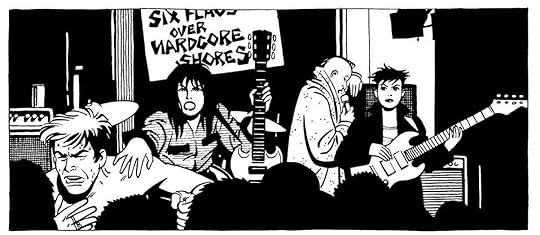
Maggie Chascarrillo es una joven chicana cuya historia comienza a primeros de los 80, durante la eclosión del punk como revulsivo al rock mustio y anquilosado que imperaba en el panorama. Nuestra quinceañera se ve de pronto conectando plenamente con la anarquía, la vitalidad y el idealismo de la movida hardcore, gracias a la cual conoce y se hace amiga de Hopey Grass, otra punkie antiautoritaria. Entre ambas se establecerá una relación temperamental y tumultuosa. A través de sus vivencias conjuntas e individuales, asistiremos a su proceso de madurez como mujeres. Las historietas de Locas funcionan individualmente y por acumulación, creando a través de las vidas de sus protagonistas un exuberante mosaico narrativo. Las capacidades de Jaime Hernandez para caracterizar a sus personajes con detalles psicológicos y culturales, para dotar de dignidad a sus hombres y mujeres de clase trabajadora, crean un universo complejo pero que a la vez respira naturalidad, algo nunca visto en el ámbito del cómic hasta entonces. Su ritmo y su habilidad para componer la acción ponen de manifiesto que Jaime no es sólo uno de los mejores dibujantes que ha dado el medio, sino también un maestro a la hora de contar historias.
"El dibujo de Jaime combina blanco y negro para dar origen a un universo de tonalidades entre ambos. Del mismo modo, sus guiones hablan de los grandes sentimientos humanos pero también de pequeños eventos cotidianos, y están dotados de una increíble fuerza emocional. En definitiva, nos hallamos frente a uno de los autores de cómic más importantes del siglo XX en su momento álgido, y cada una de sus líneas encuentra un perfecto equilibrio entre lo clásico y lo cool." Alan Moore
"El dibujo de Jaime combina blanco y negro para dar origen a un universo de tonalidades entre ambos. Del mismo modo, sus guiones hablan de los grandes sentimientos humanos pero también de pequeños eventos cotidianos, y están dotados de una increíble fuerza emocional. En definitiva, nos hallamos frente a uno de los autores de cómic más importantes del siglo XX en su momento álgido, y cada una de sus líneas encuentra un perfecto equilibrio entre lo clásico y lo cool." Alan Moore
276 pages, Paperback
First published July 30, 2006
About the author
Jaime Hernández
279 books462 followersJaime and his brother Gilbert Hernández mostly publish their separate storylines together in Love And Rockets and are often referred to as 'Los Bros Hernandez'.
Ratings & Reviews
Friends & Following
Create a free account to discover what your friends think of this book!
Community Reviews
Displaying 1 - 30 of 262 reviews

December 31, 2012
I am a huge Beto (Gilbert Hernandez, Jaime's brother) fan, and when I first read this (years ago) after having read a lot of the Heartbreak Soup stories from Beto, I was a little underwhelmed by it. I should say that I have now after many years become very much a fan of Jaime’s art, one of the greats of comics history. And he creates a world of women, centered on Maggie and Hopey, all the Locas girls, that he has sustained for decades.
And from the get-go, Maggie is a strong and funny and completely endearing character. Her friendship with Hopey, and our connection with Penny Century, this is here from the beginning. So this first volume is about the LA Punk scene, the girl band, Maggie working as a Prosolar Mechanic with her heart-throb Rand Race, and just goofing around with the girls, twenty-something fun. (And yeah, she’s a mechanic, awesome, right?). Some light magical realism and science fiction seeps in, a guy with horns, futuristic vehicles. An adventure ensues, Maggie goes missing. . . and this crazy adventure story goes on a (too) long time.
This is good stuff, a terrific world being developed, but as when I first read it, it feels rough at times. I think Jaime is finding his way in this early volume. Sometimes the panels are crammed, often there too many words. It wears me out. The art is strong in most places, but uneven. The clean lines that he will be known for are here, yes, but he is still discovering this to some extent early on.
I’m going to read all of it through again, as much as I can still get my hands on, taking my time with it.
And from the get-go, Maggie is a strong and funny and completely endearing character. Her friendship with Hopey, and our connection with Penny Century, this is here from the beginning. So this first volume is about the LA Punk scene, the girl band, Maggie working as a Prosolar Mechanic with her heart-throb Rand Race, and just goofing around with the girls, twenty-something fun. (And yeah, she’s a mechanic, awesome, right?). Some light magical realism and science fiction seeps in, a guy with horns, futuristic vehicles. An adventure ensues, Maggie goes missing. . . and this crazy adventure story goes on a (too) long time.
This is good stuff, a terrific world being developed, but as when I first read it, it feels rough at times. I think Jaime is finding his way in this early volume. Sometimes the panels are crammed, often there too many words. It wears me out. The art is strong in most places, but uneven. The clean lines that he will be known for are here, yes, but he is still discovering this to some extent early on.
I’m going to read all of it through again, as much as I can still get my hands on, taking my time with it.

February 5, 2021
Maggie The Mechanic collects material from Love and Rockets #0-15, Mechanics #1-2, Anything Goes #2, Love and Rockets Bonanza, and Ten Years of Love and Rockets.
I've been aware of Love and Rockets for ages but never took the plunge. Fantagraphics was having their winter sale so I picked this up in addition to a lot of other things. Actually, it turns out this isn't my first Love and Rockets experience. I must have Anything Goes #2 in my stash because I remembered the part about Maggie enjoying being spanked with a piece of Hot Wheel track. Anyway, this was great shit.
Jaime Hernandez' art wowed me right out of the gate. It reminded me of Alex Toth and romance comics era John Romita with a small touch of Dan DeCarlo. In short, the guy's art is right in my wheelhouse.
As great as the art is, Jaime Hernandez is an even better writer. The characters of Maggie and Hopey felt like real people at the onset. Maggie is a Prosolar rocket mechanic and has a massive crush on Rand Race, best mechanic there is. Hopey is her friend and sometime lover, member of a punk band and all around bad ass.
There are some science fiction elements, like rockets, robots, and even a couple dinosaurs, but the locas are the center of the book. It's no wonder Jaime decided to kick the science fiction stuff to the curb in later books. The human element was by far the most interesting in the book. Not that the rest wasn't interesting, though. Jaime worked all of his interests into it, like super heroes, wrestling, and punk music.
There is a void in my heart after finishing Maggie the Mechanic. Fortunately, there are still about 40 years of material left to consume. Five out of five rockets.
I've been aware of Love and Rockets for ages but never took the plunge. Fantagraphics was having their winter sale so I picked this up in addition to a lot of other things. Actually, it turns out this isn't my first Love and Rockets experience. I must have Anything Goes #2 in my stash because I remembered the part about Maggie enjoying being spanked with a piece of Hot Wheel track. Anyway, this was great shit.
Jaime Hernandez' art wowed me right out of the gate. It reminded me of Alex Toth and romance comics era John Romita with a small touch of Dan DeCarlo. In short, the guy's art is right in my wheelhouse.
As great as the art is, Jaime Hernandez is an even better writer. The characters of Maggie and Hopey felt like real people at the onset. Maggie is a Prosolar rocket mechanic and has a massive crush on Rand Race, best mechanic there is. Hopey is her friend and sometime lover, member of a punk band and all around bad ass.
There are some science fiction elements, like rockets, robots, and even a couple dinosaurs, but the locas are the center of the book. It's no wonder Jaime decided to kick the science fiction stuff to the curb in later books. The human element was by far the most interesting in the book. Not that the rest wasn't interesting, though. Jaime worked all of his interests into it, like super heroes, wrestling, and punk music.
There is a void in my heart after finishing Maggie the Mechanic. Fortunately, there are still about 40 years of material left to consume. Five out of five rockets.

June 26, 2009
most over-rated comic book series ever. while the drawings are good, the writing is absurdly flat. yeah, the girls are cute chicana punk rockers and they're are all kinds of appealing references to bands and movies and stuff, but there's zero psychological depth in the dialogue and you're not ever really given a reason to care about the characters. furthermore, i find the lesbian subtext hokey and not at all believable, as if making the two main characters sleep naked together in the same bed was done for the titilation of the reader, not for any germaine plot point. this device feels like a cheap shot. or maybe i'm getting old and would have liked it a lot more when i was fifteen? i would contend not, though, because i can still read daniel clowes and enjoy him, for the art and the incredible writing.

June 23, 2011
#15 for Jugs & Capes!
(See this review on CCLaP, where it was originally published.)
Oh man I am super psyched to be reading Love & Rockets finally. I'm listening to the band Love & Rockets while I write this review, which seems only fair.
As with so many of the Jugs & Capes books I've been reading and reviewing this year, I knew before I even cracked this one that people have strong opinions about it. All my research leads me to the same conclusion: These are early, early stories by a writer at the wide-eyed-innocent beginning of his illustrious career. He's still finding his footing, he's flailing about a bit; many of the elements of these stories would fall by the wayside as he honed his talents and settled into his stride. Which is all a bit of a relief, really. I mean, I really enjoyed this book, but it's for sure a little rough around the edges.
For those who don't know (are there any left other than me?), Love and Rockets is the name for the extremely prolific work (spanning three decades!) of two brothers, Jaime and Gilbert Hernandez. Each brother has his own subject matter and style, and now that they're basically canonized, Fantagraphics has re-released their work in digestible collections, along with a handy "How to read Love & Rockets" guide to help out the novices. When we were deciding which brother's first book to read for J&C, we had to do a blind vote because we just couldn't decide. As is I'm sure clear, Maggie won.
Jaime's stories center around a group of Latina teenagers in the Southern California suburbs. They're punk rockers and goths, sexpots and graffiti artists, rebels and drunks. Titular Maggie really is a mechanic—a "pro-solar" mechanic, to be exact, meaning she fixes rockets and robots rather than cars. She's also endearingly klutzy, kind of a ditz, and very emotional. Her best friend and maybe possibly sometimes lover is Hopey, a reasonably clichéd angry punk grrl who plays in bands and is in love with Maggie. Then there's a slew of other characters, including Penny Century, a voluptuous stunner who's having an affair with (maybe?) the devil; Izzy, a loopy stoned goth; Rand Race, famous playboy and genius pro-solar mechanic and also Maggie's boss (and love object, natch); Rena Titañon, a retired and presumed dead (but not, obvs) champion Luchador; and on and on.
While I did like these stories, I could tell they were a bit all over the place, and it took me a little while to get into them. The first couple, about Maggie's exploits learning to be a pro-solar mechanic in the remote jungle of Zimbodia, are related through her letters home to Hopey and the other girls, and they're incredibly dense with text and backstory and explanation. This is definitely necessary to get accustomed to this world, but it's also a little overwhelming, and I was worried about having the stamina to real 300 pages of it. But the stories, of course, suck you in, because they're absurd and funny and warm, and even though they're the kind of stories where it's not a question of whether the good guys will win, only when, still they're well told and well plotted, and I was sad when they ended. Apparently this is meant to be the sci-fi version of magical realism, which is neat, but the dinosaurs and aliens and rocketships were far less interesting than seeing the girls get drunk and run around, or even just try to decide what to wear. I guess Jaime came to the same conclusion, because it seems he started phasing out the sci-fi stuff shortly after the issues in this volume.
And so here's the part where I try to do a bit of a feminist reading. First let me say that Jaime passes the Bechdel test on pretty much every page. This is an incredibly female-centric cast, and he does a good job of covering different personalities and body types. I fell a little into the same trap I did with Watchmen , where I was going to bitch that Maggie is such a love-struck flake and therefore presents a reductionist view of women—but I'd be wrong. She's just one of many very varied characters, and although I find her mildly irritating at times, she's definitely true to the character she was created to be.
One thing that did bother me a little was what the (IMO) gratuitous nudity and near-nudity. I have no problem with some cartoon boobs—every single graphic novel we've read in J&C has had at least one page we were all a little embarrassed to have opened to on the subway—but Maggie is practically naked practically all the time. She and Hopey share a bed, and though they're not lovers (in this book, at least), they sleep naked. Maggie even works in little more than underwear—and she's a mechanic, remember? With hot oil and sharp edges and dangerous machinery everywhere! I don't think she'd last a day under the hood of a car, let alone in the guts of a rocket ship, without any pants on. Maybe I'm harping on this too much, but it does seem to me to be a very male view, literally and figuratively, to show two sexy young things who, as soon as the door closes and they're left alone together, start stripping and giggling. It creeped me out a little.
Not that it ruined the reading experience or anything; it was a minor snag in an overall awesome, fun read. I sort of never felt totally awed by this book, which I'd hoped to, given its cult-classic status; but I enjoyed it the whole way through, and I'm definitely eager to read more from the Hernandez Bros.
(See this review on CCLaP, where it was originally published.)
Oh man I am super psyched to be reading Love & Rockets finally. I'm listening to the band Love & Rockets while I write this review, which seems only fair.
As with so many of the Jugs & Capes books I've been reading and reviewing this year, I knew before I even cracked this one that people have strong opinions about it. All my research leads me to the same conclusion: These are early, early stories by a writer at the wide-eyed-innocent beginning of his illustrious career. He's still finding his footing, he's flailing about a bit; many of the elements of these stories would fall by the wayside as he honed his talents and settled into his stride. Which is all a bit of a relief, really. I mean, I really enjoyed this book, but it's for sure a little rough around the edges.
For those who don't know (are there any left other than me?), Love and Rockets is the name for the extremely prolific work (spanning three decades!) of two brothers, Jaime and Gilbert Hernandez. Each brother has his own subject matter and style, and now that they're basically canonized, Fantagraphics has re-released their work in digestible collections, along with a handy "How to read Love & Rockets" guide to help out the novices. When we were deciding which brother's first book to read for J&C, we had to do a blind vote because we just couldn't decide. As is I'm sure clear, Maggie won.
Jaime's stories center around a group of Latina teenagers in the Southern California suburbs. They're punk rockers and goths, sexpots and graffiti artists, rebels and drunks. Titular Maggie really is a mechanic—a "pro-solar" mechanic, to be exact, meaning she fixes rockets and robots rather than cars. She's also endearingly klutzy, kind of a ditz, and very emotional. Her best friend and maybe possibly sometimes lover is Hopey, a reasonably clichéd angry punk grrl who plays in bands and is in love with Maggie. Then there's a slew of other characters, including Penny Century, a voluptuous stunner who's having an affair with (maybe?) the devil; Izzy, a loopy stoned goth; Rand Race, famous playboy and genius pro-solar mechanic and also Maggie's boss (and love object, natch); Rena Titañon, a retired and presumed dead (but not, obvs) champion Luchador; and on and on.
While I did like these stories, I could tell they were a bit all over the place, and it took me a little while to get into them. The first couple, about Maggie's exploits learning to be a pro-solar mechanic in the remote jungle of Zimbodia, are related through her letters home to Hopey and the other girls, and they're incredibly dense with text and backstory and explanation. This is definitely necessary to get accustomed to this world, but it's also a little overwhelming, and I was worried about having the stamina to real 300 pages of it. But the stories, of course, suck you in, because they're absurd and funny and warm, and even though they're the kind of stories where it's not a question of whether the good guys will win, only when, still they're well told and well plotted, and I was sad when they ended. Apparently this is meant to be the sci-fi version of magical realism, which is neat, but the dinosaurs and aliens and rocketships were far less interesting than seeing the girls get drunk and run around, or even just try to decide what to wear. I guess Jaime came to the same conclusion, because it seems he started phasing out the sci-fi stuff shortly after the issues in this volume.
And so here's the part where I try to do a bit of a feminist reading. First let me say that Jaime passes the Bechdel test on pretty much every page. This is an incredibly female-centric cast, and he does a good job of covering different personalities and body types. I fell a little into the same trap I did with Watchmen , where I was going to bitch that Maggie is such a love-struck flake and therefore presents a reductionist view of women—but I'd be wrong. She's just one of many very varied characters, and although I find her mildly irritating at times, she's definitely true to the character she was created to be.
One thing that did bother me a little was what the (IMO) gratuitous nudity and near-nudity. I have no problem with some cartoon boobs—every single graphic novel we've read in J&C has had at least one page we were all a little embarrassed to have opened to on the subway—but Maggie is practically naked practically all the time. She and Hopey share a bed, and though they're not lovers (in this book, at least), they sleep naked. Maggie even works in little more than underwear—and she's a mechanic, remember? With hot oil and sharp edges and dangerous machinery everywhere! I don't think she'd last a day under the hood of a car, let alone in the guts of a rocket ship, without any pants on. Maybe I'm harping on this too much, but it does seem to me to be a very male view, literally and figuratively, to show two sexy young things who, as soon as the door closes and they're left alone together, start stripping and giggling. It creeped me out a little.
Not that it ruined the reading experience or anything; it was a minor snag in an overall awesome, fun read. I sort of never felt totally awed by this book, which I'd hoped to, given its cult-classic status; but I enjoyed it the whole way through, and I'm definitely eager to read more from the Hernandez Bros.

January 14, 2018
Love and Rockets was a seminal thing for in making me fall in love with comics. I'm currently rereading this series and it brings back a lot of memories. I grew up with European comics, but tbh it was really 3 things that blew up my interest in comics: Calvin and Hobbes, Love and Rockets, and Gaiman's Sandman series. Love and Rockets was one of the first series with realistic characters that I connected with. One, I loved the art style, clean, beautiful, really nicely executed that communicates with utter clarity. It has this kind of Archie look to it which was always a style that appealed to me. Two, it has what I consider a punk rock attitude/influence which I like (there is also a straight up heavy music influence in these comics). Three, I think the characters are just awesome, they feel real, and they are interesting because they aren't one-dimensional caricatures imo. They are well-written and developed.
I first read this series in my late teens/early 20s. I think I related more with it at that point as many of the characters were in that age range and Jaime was in that same age when he created those earlier story-lines. Rereading this work is interesting, it is a fully realized world, intermixing the quotidian of life in a CA barrio with touches of magical realism that balances things out super nicely, there is a feeling that anything can happen within the real life world. It makes things exciting and sometimes a bit more unpredictable which I think is a good thing. I should mention the first volume has a much stronger sci-fi influence which has less emphasis as Jaime progressed with his comic over time.
Sometimes the writing is awesome, sometimes average which I feel I perceive a bit more now that I've read more comics. I think this volume has choppier story-lines and the writing is less crisp, but from what I recall things get more defined and refined as the series progresses, but as with any long-running comic there are stronger periods and weaker ones. I'm excited to keep rereading these, I still find magic in them!
I first read this series in my late teens/early 20s. I think I related more with it at that point as many of the characters were in that age range and Jaime was in that same age when he created those earlier story-lines. Rereading this work is interesting, it is a fully realized world, intermixing the quotidian of life in a CA barrio with touches of magical realism that balances things out super nicely, there is a feeling that anything can happen within the real life world. It makes things exciting and sometimes a bit more unpredictable which I think is a good thing. I should mention the first volume has a much stronger sci-fi influence which has less emphasis as Jaime progressed with his comic over time.
Sometimes the writing is awesome, sometimes average which I feel I perceive a bit more now that I've read more comics. I think this volume has choppier story-lines and the writing is less crisp, but from what I recall things get more defined and refined as the series progresses, but as with any long-running comic there are stronger periods and weaker ones. I'm excited to keep rereading these, I still find magic in them!

March 26, 2022
The start of Jaime's magnificent Love and Rockets run (referred to as Locas) starts here. Unfortunately, it's a bit rough out of the gates. Jaime's writing gets better in the second half and subsequent volumes. This is still worth reading, just know that it does get better down the line.

December 15, 2019
Jaime Hernandez Arbeit kann ich nur in Superlativen beschreiben. Ob klare Linien und Stil klassischer Art oder innovative Post=Punk=Stories: alles stimmt bis ins Letzte. Unfassbar gut; dieser Mann ist ein genialer Zauberer mit dem Zeichenstift.
Das komplexe L&R=Universum beginnt hier.
Das komplexe L&R=Universum beginnt hier.

September 27, 2015
I read this because it was part of the Banned Comics Humble Bundle, although this particular volume has not been registered as challenged or banned. That is the case for a later volume of Love and Rockets / Locas / Hernández brothers, so I can't weigh in on that. I do somewhat appreciate being given two first-volumes in these linked series.
I had read The Love Bunglers, something like book #27 in this grouping, and was completely lost. At least this one starts at the beginning but this graphic novel has EVERYTHING. Butts. Lots of butts. The women rarely wear pants. Why? Anyway. Also dinosaurs, girl mechanics, sexually fluid characters ("sisters? we're close." <--line from Rent; they are roommates and sometimes lovers, mostly great friends), a rich man with horns, a superheroine named Penny, robots, islands, jungle adventures, and 80s punk-urban storyline too. I mean everything everything.
Sometimes Maggie is a strong woman who is an amazing mechanic. Other times she is crying over a boy. I'm not sure what to make of it all but I would say I enjoyed it.
I had read The Love Bunglers, something like book #27 in this grouping, and was completely lost. At least this one starts at the beginning but this graphic novel has EVERYTHING. Butts. Lots of butts. The women rarely wear pants. Why? Anyway. Also dinosaurs, girl mechanics, sexually fluid characters ("sisters? we're close." <--line from Rent; they are roommates and sometimes lovers, mostly great friends), a rich man with horns, a superheroine named Penny, robots, islands, jungle adventures, and 80s punk-urban storyline too. I mean everything everything.
Sometimes Maggie is a strong woman who is an amazing mechanic. Other times she is crying over a boy. I'm not sure what to make of it all but I would say I enjoyed it.

June 20, 2020
The Hernández brothers first five years of work (1981-1985) on Love & Rockets collected to together in this volume. A mix of Latino culture, progressive Punk movement, lesbian romancing, mechanics, rockets and love! A very unusual mix, with pretty interesting results! At first I couldn't make out what the story was, and then realised that this is the story, the entire reality itself, with the United States focus point being the relationship between Hopey Glass and Maggie Chascarillo.

A Three Star, 7 out of 12 read. NOTICE - this is one of the weakest collections in the series, there are some genius stories to come later in the series, but you need to read all of these to get the true brilliance of later stories.
2017 and 2015 read
A Three Star, 7 out of 12 read. NOTICE - this is one of the weakest collections in the series, there are some genius stories to come later in the series, but you need to read all of these to get the true brilliance of later stories.
2017 and 2015 read

October 10, 2021
Claro ejemplo de cómic que llevaba años en mi estantería, que compré porque quería empezar con el mundo de locas de Jaime Hernandez, después de haber quedado medianamente satisfecho con la serie Palomar (el primero buenísimo) de su hermano Beto. Y darme cuenta de que Jaime es el fucking master de los hermanos Hernandez. Que disfrute de páginas, de dibujo, de sombras, el blanco y negro le sienta tan bien y la edición de La Cúpula como siempre deliciosa. Muy ochentero-noventero todo, personajes profundos, amor a raudales, tema MECÁNICO de fondo, y latinoamérica por los cuatro costados. Estuve semanas degustanto página a página este primer locas, y ya sé que me voy a pillar de golpe los otros dos, y seguir hasta el Chapuzas de amor y más allá.
En realidad empecé la serie a raíz de cuando salió Chapuzas de amor y recibió tantas alabanzas y críticas.
El tomo se compone de diferentes historias del grupito de Maggie, Hoppey, Izzy, Penny, etc. Las historias en esos mundos latinos y aventureros imaginarios son deliciosas. Cada viñeta, cada página se saborea como nunca.
Que hacía de mi vida sin haber leído esta maravilla.
En realidad empecé la serie a raíz de cuando salió Chapuzas de amor y recibió tantas alabanzas y críticas.
El tomo se compone de diferentes historias del grupito de Maggie, Hoppey, Izzy, Penny, etc. Las historias en esos mundos latinos y aventureros imaginarios son deliciosas. Cada viñeta, cada página se saborea como nunca.
Que hacía de mi vida sin haber leído esta maravilla.

February 16, 2016
A colorful cast of grease monkeys, professional wrestlers, and larger-than-life adventurers getting into a series of uninteresting scrapes.
DNF. I like the black and white art, particularly the surprisingly realistic female characters (males too, I suppose, but that's less remarkable.) Reminds me of Terry Moore's excellent work.
But the walls of microtext and meandering story made me drowsy. A central narrative might have drawn me in but Maggie the Mechanic is kind of an ensemble character study and I didn't care about the characters. They stagger neurotically through their days while I space out and sneak longing glances at the next book in my reading stack. (Oh Saga, Volume 5, how I yearn to turn your glossy, colorful pages, to lose myself in your witty, inventive plot-driven splendor...)
DNF. I like the black and white art, particularly the surprisingly realistic female characters (males too, I suppose, but that's less remarkable.) Reminds me of Terry Moore's excellent work.
But the walls of microtext and meandering story made me drowsy. A central narrative might have drawn me in but Maggie the Mechanic is kind of an ensemble character study and I didn't care about the characters. They stagger neurotically through their days while I space out and sneak longing glances at the next book in my reading stack. (Oh Saga, Volume 5, how I yearn to turn your glossy, colorful pages, to lose myself in your witty, inventive plot-driven splendor...)

January 15, 2014
I enjoyed reading this first collection in the 'Love and Rockets' series. In my opinion, the very best thing about this book is the way the characters have been drawn: they all read brilliantly; they all look brilliant. Surrounded by the early '80s punk scene & whilst also taking some extra-ordinary trips into the sphere of sci-fi, the Mexican-American women, in particular, are portrayed as feisty, sharp & strong; they are clumsy, complex & colourful; they make trouble; they are brave; they have integrity. So, yes, I am quite taken by 'Las Locas' & want to read more of their adventures.
However, in the earlier pages of this first collection I quite struggled to follow the plot & found it difficult to connect character to character, person to place (I don't think it is unreasonable of me to say that Jaime Hernández really does throw the reader in to the deep end which can disorientate readers & did confuse me) & it was not until I reached the second third of the book that I began to feel (near-)sure of the ground upon which I was reading. Nevertheless, I'm most certainly going to read the second collection - The Girl from H.O.P.P.E.R.S.. I hope that it will be much easier to keep on track with the characters in this book as their plots develop since each person I have been introduced to thus far has left a strong impression in my mind & I'm keen for the creator to show & tell me more.
However, in the earlier pages of this first collection I quite struggled to follow the plot & found it difficult to connect character to character, person to place (I don't think it is unreasonable of me to say that Jaime Hernández really does throw the reader in to the deep end which can disorientate readers & did confuse me) & it was not until I reached the second third of the book that I began to feel (near-)sure of the ground upon which I was reading. Nevertheless, I'm most certainly going to read the second collection - The Girl from H.O.P.P.E.R.S.. I hope that it will be much easier to keep on track with the characters in this book as their plots develop since each person I have been introduced to thus far has left a strong impression in my mind & I'm keen for the creator to show & tell me more.

December 7, 2009
I have a much better understanding of why people love Jaime Hernandez's work now. This is an interesting book, with some interesting lumps in its oatmeal-- the early plots are as weak as the characters are strong, and while I understand how Hernandez is trying to build a world that is essentially the sci fi equivalent of magical realism, the sudden invasion of alien assassins in the book combines awkwardly with the ordinary lives of Maggie, Hopey, and friends.
As the stories continue, though, the strength of the characters win out, and the appearance of the occasional robot or super hero doesn't grate so much. The artwork is spectacular throughout, and is really a great model of what semi-realistic black and white art in comics should be.
I'm sure someone has written about the feminist sensibilities in Love and Rockets. This is one of the few books I've seen that easily passes the Bechdel test, probably in every single issue. There's also a mild exploitative streak in the artwork, but it's easily compensated for by the respect Hernandez shows his characters. Yes, they can be flighty or just plain crazy, yes sometimes they pine after handsome boys. They have an integrity and strength to them that deserves commendation, though. These are characters unlike any I've seen elsewhere, especially in comics. That alone makes this book worth reading.
For more on comics, horror, humanity, morality and the world check out The Stupid Philosopher, aka a place where I put my words.
As the stories continue, though, the strength of the characters win out, and the appearance of the occasional robot or super hero doesn't grate so much. The artwork is spectacular throughout, and is really a great model of what semi-realistic black and white art in comics should be.
I'm sure someone has written about the feminist sensibilities in Love and Rockets. This is one of the few books I've seen that easily passes the Bechdel test, probably in every single issue. There's also a mild exploitative streak in the artwork, but it's easily compensated for by the respect Hernandez shows his characters. Yes, they can be flighty or just plain crazy, yes sometimes they pine after handsome boys. They have an integrity and strength to them that deserves commendation, though. These are characters unlike any I've seen elsewhere, especially in comics. That alone makes this book worth reading.
For more on comics, horror, humanity, morality and the world check out The Stupid Philosopher, aka a place where I put my words.

February 4, 2020
I've spent years trying to get into Love & Rockets. I bought the shiny different versions in the early 2000s, and started picking up some of the LOCAS books when they started showing up in stores I worked at.
L&R is an incredibly important part of not-mainstream comics, and I can understand why someone exposed to them early in their comic reading days might love and feel nostalgic for these books. Jaime's art is spectacular from the very first panel, and is consistent. But these early stories are garbage. Unless you, like me, have an affinity for chronology, don't waste your time in this book. It's a succession of barely related stories, amateur attempts at breaking the fourth wall to offer meta commentary, and just aimless writing about screechy, hot, young women, written by someone to whom no one would advise those adjectives. It never feels accurate, especially when they're thrown into sci-fi situations, or Jaime tries to make political statements. It's, like, really, really, really bad writing attached to impeccable art.
I'm going to try and read their some other L&R books and see if I enjoy them more, but this book is less a graphic novel collection of stories than it is a historical documentation of Jaime's early work.
L&R is an incredibly important part of not-mainstream comics, and I can understand why someone exposed to them early in their comic reading days might love and feel nostalgic for these books. Jaime's art is spectacular from the very first panel, and is consistent. But these early stories are garbage. Unless you, like me, have an affinity for chronology, don't waste your time in this book. It's a succession of barely related stories, amateur attempts at breaking the fourth wall to offer meta commentary, and just aimless writing about screechy, hot, young women, written by someone to whom no one would advise those adjectives. It never feels accurate, especially when they're thrown into sci-fi situations, or Jaime tries to make political statements. It's, like, really, really, really bad writing attached to impeccable art.
I'm going to try and read their some other L&R books and see if I enjoy them more, but this book is less a graphic novel collection of stories than it is a historical documentation of Jaime's early work.

August 9, 2017
I was surprised at how different Jamie's art style was in the beginning of L&R. He always had an incredible sense of Black & White. It seems to me his writing got more complex as his art became more stylized.

July 10, 2011
I'd heard about Love & Rockets forever, but was always daunted by how to get into it since there were so many books out and it had such a long history. So I was really glad to discover this newly put together collection that gives each of the major story lines in an easy to read sequential format. That said, I realized once I started reading that I really had no idea what I was in for. I guess I was expecting something much more punk rock, and instead I discovered a surprisingly sweet, and strangely fantastical, slice of life! The artwork is (as I already knew) superb and the main characters feel very much like real people I've known (even if the situations aren't always grounded in reality). I'm not completely sucked in yet, but I'm looking forward to where the story will go in volume 2 of this series.

October 9, 2022
Un universo único, personalísimo, profundo y ligero a la vez. El dibujo es asombroso, resulta sorprendente lo que se puede hacer jugando solo con el negro.

December 27, 2015
I've split this review into two parts. The first is my first impressions, directly after reading. The second part is a few days after finishing - once I had gotten some context.
--------------------------------------------
F I R S T I M P R E S S I O N S
--------------------------------------------
This is a bit out there in terms of plot (dinosaurs protecting an old rocket and a disappearing crew, in a jungle, worked on by a team of mechanics, funded by a tyranical middle-eastern? And that's just chapter 2!) but it provides a voice, if a short-sighted one, for a non-binary subset of latino culture - although I'm still not sure what message the voice is trying to pass on. The constant onslaught of sexism and harassment? The overly sexualised outfits? The interactions between the girls - what are they meant to say?
The art work is at times very crude and dark but the close-ups and long-shots are all gorgeous.
The panel design is also very interesting and if you are reading this electronically try and get it in a format that allows you to navigate panel by panel.
I'm not yet sure what rating to give this. The difficulty comes from neither liking nor really believing the characters, and having the feeling that the outrageous plot is just distracting from the characters themselves but then on the other hand, it is an engrossing world. Mechanics are celebrities of sorts? And it is a very aesthetically pleasing book. I'm not sure what to think.
--------------------------
More to follow..
--------------------------------------------
F I R S T I M P R E S S I O N S
--------------------------------------------
This is a bit out there in terms of plot (dinosaurs protecting an old rocket and a disappearing crew, in a jungle, worked on by a team of mechanics, funded by a tyranical middle-eastern? And that's just chapter 2!) but it provides a voice, if a short-sighted one, for a non-binary subset of latino culture - although I'm still not sure what message the voice is trying to pass on. The constant onslaught of sexism and harassment? The overly sexualised outfits? The interactions between the girls - what are they meant to say?
The art work is at times very crude and dark but the close-ups and long-shots are all gorgeous.
The panel design is also very interesting and if you are reading this electronically try and get it in a format that allows you to navigate panel by panel.
I'm not yet sure what rating to give this. The difficulty comes from neither liking nor really believing the characters, and having the feeling that the outrageous plot is just distracting from the characters themselves but then on the other hand, it is an engrossing world. Mechanics are celebrities of sorts? And it is a very aesthetically pleasing book. I'm not sure what to think.
--------------------------
More to follow..

August 12, 2016
Hmm... I'm going to be frank. I am giving this a higher rating than I would otherwise because I think that the art is incredible, I'm a sucker for magical realism, and Jaime Hernandez and the Hernandez brothers are among the first Chicano artists I've heard about doing comics independently and kicking ass at it.
Unfortunately I think the writing is flat at times, and the friendships between female characters seem a little one-dimensional. I like Maggie as a character because she's complex and interesting, although I wish they developed the other characters as much as they did with her. I've read other Love and Rockets comics where I think maybe the characters are more intriguing and complex. I also think that there are some obvious scenes where this is being written from the speculative view point of a male author, and not a female author (like when a man sneaks into Maggie's window and becomes her lover, WHAT THE FUCK).
Unfortunately I think the writing is flat at times, and the friendships between female characters seem a little one-dimensional. I like Maggie as a character because she's complex and interesting, although I wish they developed the other characters as much as they did with her. I've read other Love and Rockets comics where I think maybe the characters are more intriguing and complex. I also think that there are some obvious scenes where this is being written from the speculative view point of a male author, and not a female author (like when a man sneaks into Maggie's window and becomes her lover, WHAT THE FUCK).

December 29, 2015
I got this as part of the Humble Bundle banned book collection. I was interested to read this as I have seen many recommendations for " Love Bunglers" but had heard that for it to make sense the previous editions needed to be read and of course this is the first. Having got through a lot of graphic novels recently with astounding art ( Sandman etc) this seemed suddenly quite basic but I liked the punk look of the characters which reinforced the portrayal of the strong feisty female character driven plot.I must admit I found the plot quite a struggle to follow which resulted in me not been engaged in the story as much as what I hoped for but it was still an enjoyable read.

Read
November 8, 2023I'm not the kind of reader who longs to see themselves reflected in works of literature. Quite the contrary, my tendency is always to seek the alien and the other. Yet, when I do happen to come across something really good that taps into my background and identity, I'm happy to have found it. Love and Rockets is maybe the most conspicuous example of a work like this. In particular, Jaime Hernandez's Las Locas storyline, whose first few years this volume collects, strikes me as what Gabriel Garcia Marquez might have made if his medium had been comics, and if he'd been reared in the kind of place I was: a Latine neighborhood in the southern California suburbs.
In these stories, Jaime has traced in real time the lives of the two central characters, the titular Locas - Margarita Chascarillo and Esperanza Glass, a.k.a. Maggie and Hopey - from their teenage years until late middle age. The social milieu by which they're surrounded in the imaginary SoCal town of Hoppers is, quite honestly, uncannily similar to the one in which I grew up in the south San Diego of the 80s and 90s. People sometime cordon off Latine-American culture from American culture at large, but somewhat like Maggie and Hopey, I grew up surrounded by teenagers who loved punk rock but also ranchera, cholos who read Camus and Unamuno, and white kids who spoke fluent Spanish. We spent our leisure time wandering around the neighborhood trying to scrounge up the change to get a burrito, hoping to score some beer, playing in garage bands and going to all-ages shows. Tagging was a recreational activity, and doing it didn't mean you were in a gang, though most of the folks in the richer neighborhoods always assumed it did. And, personal success meant finding a regular blue collar gig.
This is essentially the kind of world Maggie and Hopey inhabit, except that Jaime infuses it with just enough of the fantastic and the surreal to make his Las Locas stories excellent examples of magical realism in the vein of Marquez. In the world of Las Locas, Maggie is a mechanic, but while she can fix your car or your blender, she also occasionally gets sent to far-flung third world countries to fix rockets and robots. As often is the case in the real world, these countries are dominated by financial behemoths from the Global North, but in the world of Las Locas, these behemoths are embodied in supervillain-like psychotic billionaires: H.R. Costigan, who has devil horns; and Doctor Beaky, who keeps tiny Chinese twin girls as literal pets. Maggie is of a familiar sort: a gorgeous Latina who attracts men like flies, but is nevertheless wracked by low self-esteem because her curvy brown body doesn't look anything like the cover girls in magazines. Yet, this anxiety is given fantastical form by her friendship with Penny Century, the buxom blond who's lusted after by rich and famous men, and aspires to become a superhero. Maggie finds support in powerful older women like her aunt Vicki Glori and Glori's frenemy Rena Titañon, but the power of these women lies in their being champions in the world of Mexican wrestling.
In many ways, the anchor for all of the wild strangeness that Jaime infuses into these stories is Hopey, the tiny shaven-headed lesbian punk who thinks all of it is bullshit. In this first volume of the collected Love and Rockets, we see the early stages of the lifelong relationship between Maggie and Hopey. They have that distinctive sort of connection that women sometimes have with each other: friends, lovers, and sisters, or some curious blend that transcends them all. They're in many ways polar opposites, but their love for each other makes them almost two halves of a single being.
When I first discovered Love and Rockets as a kid, the bond between Maggie and Hopey was revelatory and formative. I'm half-convinced that it was essential to my developing distaste for misogyny that led me to turn away from the conservative Christianity of my youth. Returning to these stories as a middle-aged guy, I find them just as vibrant and wonderful as I did as a teenager - more so, in fact, because I'm in a better position to see just how insightful its magical realist touches really are.
In these stories, Jaime has traced in real time the lives of the two central characters, the titular Locas - Margarita Chascarillo and Esperanza Glass, a.k.a. Maggie and Hopey - from their teenage years until late middle age. The social milieu by which they're surrounded in the imaginary SoCal town of Hoppers is, quite honestly, uncannily similar to the one in which I grew up in the south San Diego of the 80s and 90s. People sometime cordon off Latine-American culture from American culture at large, but somewhat like Maggie and Hopey, I grew up surrounded by teenagers who loved punk rock but also ranchera, cholos who read Camus and Unamuno, and white kids who spoke fluent Spanish. We spent our leisure time wandering around the neighborhood trying to scrounge up the change to get a burrito, hoping to score some beer, playing in garage bands and going to all-ages shows. Tagging was a recreational activity, and doing it didn't mean you were in a gang, though most of the folks in the richer neighborhoods always assumed it did. And, personal success meant finding a regular blue collar gig.
This is essentially the kind of world Maggie and Hopey inhabit, except that Jaime infuses it with just enough of the fantastic and the surreal to make his Las Locas stories excellent examples of magical realism in the vein of Marquez. In the world of Las Locas, Maggie is a mechanic, but while she can fix your car or your blender, she also occasionally gets sent to far-flung third world countries to fix rockets and robots. As often is the case in the real world, these countries are dominated by financial behemoths from the Global North, but in the world of Las Locas, these behemoths are embodied in supervillain-like psychotic billionaires: H.R. Costigan, who has devil horns; and Doctor Beaky, who keeps tiny Chinese twin girls as literal pets. Maggie is of a familiar sort: a gorgeous Latina who attracts men like flies, but is nevertheless wracked by low self-esteem because her curvy brown body doesn't look anything like the cover girls in magazines. Yet, this anxiety is given fantastical form by her friendship with Penny Century, the buxom blond who's lusted after by rich and famous men, and aspires to become a superhero. Maggie finds support in powerful older women like her aunt Vicki Glori and Glori's frenemy Rena Titañon, but the power of these women lies in their being champions in the world of Mexican wrestling.
In many ways, the anchor for all of the wild strangeness that Jaime infuses into these stories is Hopey, the tiny shaven-headed lesbian punk who thinks all of it is bullshit. In this first volume of the collected Love and Rockets, we see the early stages of the lifelong relationship between Maggie and Hopey. They have that distinctive sort of connection that women sometimes have with each other: friends, lovers, and sisters, or some curious blend that transcends them all. They're in many ways polar opposites, but their love for each other makes them almost two halves of a single being.
When I first discovered Love and Rockets as a kid, the bond between Maggie and Hopey was revelatory and formative. I'm half-convinced that it was essential to my developing distaste for misogyny that led me to turn away from the conservative Christianity of my youth. Returning to these stories as a middle-aged guy, I find them just as vibrant and wonderful as I did as a teenager - more so, in fact, because I'm in a better position to see just how insightful its magical realist touches really are.
December 11, 2024
So this is the beloved “Love and Rockets.” A 40 year publication history, a band named after them, a legion of fans, a documentary. Must be pretty good, right?
Maggie and Hopie are friends, roommates, and occasional lovers. They and their friends occupy this delightfully odd world of punk rock, wrestling, and science fiction.
From what I’ve read/heard elsewhere, these early issues are quite different from the rest of the comics. In these issues, there’s a lot of “rocket” in “Love and Rockets.” There’s futuristic technologies, dinosaurs, superheroes, a man with horns, etc. Apparently that drops out of the latter issues. It’s also quite wordy and a struggle to get through at some points.
All that being said, I can see that this is going to evolve into much more. I’m trusting in the series’ legacy and my comic aficionado friend’s recommendation and plan on sticking with the series.
Maggie and Hopie are friends, roommates, and occasional lovers. They and their friends occupy this delightfully odd world of punk rock, wrestling, and science fiction.
From what I’ve read/heard elsewhere, these early issues are quite different from the rest of the comics. In these issues, there’s a lot of “rocket” in “Love and Rockets.” There’s futuristic technologies, dinosaurs, superheroes, a man with horns, etc. Apparently that drops out of the latter issues. It’s also quite wordy and a struggle to get through at some points.
All that being said, I can see that this is going to evolve into much more. I’m trusting in the series’ legacy and my comic aficionado friend’s recommendation and plan on sticking with the series.

October 13, 2019
Foram largos meses a lutar contra o lettering medonho que infelizmente está presente em quase metade desta maravilha underground que, mais de trinta anos depois, se mantém com frescura notável.
Como todos os bons clássicos, deixa o inequívoco travo a substância artística superior e, como há muito mais volumes a ler, o apetite incrementado para os próximos números.
Como todos os bons clássicos, deixa o inequívoco travo a substância artística superior e, como há muito mais volumes a ler, o apetite incrementado para os próximos números.

February 18, 2020
I’m going to give this 3.5 Stars just because I didn’t like it for the first bit. It was scattered and it took me a while to get into it. Enjoyed it by the end though!

August 17, 2020
My reading schedule has been totally out of whack lately. But Love and Rockets has been a consistent comfort as I lethargically parse through my other books I’m trying to read right now; it’s everything I’ve ever wanted in a comic. If you’re looking for a blend of every genre of comic ever made with a nice dose of punk ascetic and mentality, you would be hard pressed to find something better than this. The Hernandez brothers have my heart in their hands.

May 3, 2018
Love and Rockets is a triumph of representation and a thoughtful deconstruction of latinidad or hispanidad. In place of an affirmation of a mythical and monolithic race we have an exploration across the endlessly heterogeneous demographics of the Americas, spanning across borders, and diving into urban microcosms. In a way it takes the best from adventure serials like Tintín and tempers them with dignity. Conscious of colonial legacies and contemporary structures, Hernandez chronicles a saga that is on the one hand about punks brushing intimately close with power and yet he hands the privileged space of utmost significance to the every day flavors of life on the other.
For all its science fiction flares and adventure, this is not fantasy in any regard. This is pure punk realism. Politics has a space in this Mythos, but Love and Rockets is more than anything about life and human relationships. Expect slow pacing, relationship building, and leisurely strolls down dead ends.
Multi-dimensionality (and I’m not talking about it in the Crisis on Infinite Earths sense of the word) separates this universe from the Marvel or DC universes, bringing us closer to the world-building or Marquez in 100 Years of Solitude. Love and Rockets is a collection of intertwining sagas, separate titles sharing characters but contrasting perspectives. This parallax phenomenon of the Love and Rockets universe show us that, at least there, the person is always more than political.
To borrow the famous argument, the olive tree is planted in the stump of a stronger tree, and its sap runs through, binding it together, and so it grows resiliently. You can feel Steve Ditko and Steranko on every page, imbued with the spirit of Zap Comics, and characterized by Hernandez’s roots and his relationship to the Americas. This is the heart of Love and Rockets.
For all its science fiction flares and adventure, this is not fantasy in any regard. This is pure punk realism. Politics has a space in this Mythos, but Love and Rockets is more than anything about life and human relationships. Expect slow pacing, relationship building, and leisurely strolls down dead ends.
Multi-dimensionality (and I’m not talking about it in the Crisis on Infinite Earths sense of the word) separates this universe from the Marvel or DC universes, bringing us closer to the world-building or Marquez in 100 Years of Solitude. Love and Rockets is a collection of intertwining sagas, separate titles sharing characters but contrasting perspectives. This parallax phenomenon of the Love and Rockets universe show us that, at least there, the person is always more than political.
To borrow the famous argument, the olive tree is planted in the stump of a stronger tree, and its sap runs through, binding it together, and so it grows resiliently. You can feel Steve Ditko and Steranko on every page, imbued with the spirit of Zap Comics, and characterized by Hernandez’s roots and his relationship to the Americas. This is the heart of Love and Rockets.

March 9, 2020
Before starting this I read that vol1 is much different than the rest of Jamie’s Love and Rockets stories, and that new readers should probably start at vol2, but I knew better and, well, starting at vol2 is likely smarter. The b&w art is striking and charming from the first page, but the stories take a while to settle in to the grounded drama I expect the series will be going forward. Once that happens in the back half, this is a delight. Hopey and Maggie and Izzy are such funny, invigorating characters and I’m excited to read more about them and their extended social circle as they age. The 80s LA mexi-punk culture they live in (contemporary to when these were published of course) is conveyed so naturally as well.
The first half of this is a slog, though; it took me weeks to get through it (compared to a single day for the back half). The wobbly inclusion of sci-fi fantasy ideas like dinosaurs and rocket ships (which are thankfully abandoned) feels novel at first, but quickly muddles the character drama. The pages also seem much more dense with text early on, often using 9 panel pages with multiple paragraph-length exchanges in each panel that impinge on the gorgeous art. Some of the women are drawn early on in a leering alt comix style that is off-putting to me, but that becomes more reliably naturalistic in the back half (I know this is an ongoing consideration with Beto’s L&R comics, so maybe it took a bit for Jamie to move away from his bro’s stylistic quirks early on?)
So, it’s a less than perfect intro to this world, but I’m glad to know these characters and their early, uneven stories and excited to read more consistent ones in the future.
The first half of this is a slog, though; it took me weeks to get through it (compared to a single day for the back half). The wobbly inclusion of sci-fi fantasy ideas like dinosaurs and rocket ships (which are thankfully abandoned) feels novel at first, but quickly muddles the character drama. The pages also seem much more dense with text early on, often using 9 panel pages with multiple paragraph-length exchanges in each panel that impinge on the gorgeous art. Some of the women are drawn early on in a leering alt comix style that is off-putting to me, but that becomes more reliably naturalistic in the back half (I know this is an ongoing consideration with Beto’s L&R comics, so maybe it took a bit for Jamie to move away from his bro’s stylistic quirks early on?)
So, it’s a less than perfect intro to this world, but I’m glad to know these characters and their early, uneven stories and excited to read more consistent ones in the future.

April 21, 2022
I have to be honest, I found it quite hard to get into this. Unusually for me, that's because of the science fiction elements. Normally sci-fi is one of my favourite things, but it never quite merged into the rest of the stories, for me... it was like there was a collection of general fiction comics, set around a group of teenagers, and every so often Maggie would travel to another place with her mechanics job, and there'd be a dinosaur, or a rocket ship, and all I could think was "can we please just go back to the other stuff?" I wasn't entirely riveted by all the everyday conflicts, but I preferred them to the rest of it, and a lot of that's down to the central relationship. Maggie and Hopey's friendship (and sometimes romance) is relatable, they're both likeable characters, and when they're both on page at the same time I'm more just more interested than when Maggie's off doing her own thing.

January 30, 2012
I'd forgotten how much fun the Locas are. What strikes me going back and reading them as an adult (rather than the punk teen I was when I first ran across the Locas) is the character development. If Hernandez wrote these characters in a traditional novel format and under a female pen name, these characters would have been as famous as Bridget Jones. Maggie, lovelorn, moody, clumsy, determined Maggie is fully formed character. I love how we see her get fat. It's just another way she seems real.
Hopey is a hoot, but rather than being a one dimensional angry punk, through the incredible art and solid writing, Hernandez reveals her depths.
No wonder Love and Rockets has stuck with me for twenty some years. The characters are terrific.
Hopey is a hoot, but rather than being a one dimensional angry punk, through the incredible art and solid writing, Hernandez reveals her depths.
No wonder Love and Rockets has stuck with me for twenty some years. The characters are terrific.

December 25, 2014
I really had forgotten how fantastic this series is. It's got great diverse characters, science fiction elements, and even fantastic puns (that I missed the first time around). It's the second reread of the year, both of which have made me upgrade the books from 4 to 5 stars. I'm looking forward to starting on the second volume later tonight.
Displaying 1 - 30 of 262 reviews