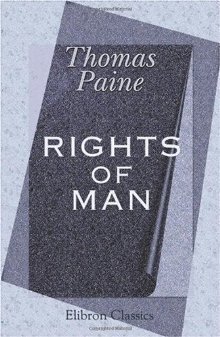
Right before reading this classic defence of universal human liberties, you should read the book to which it is responding. When Thomas Paine published Rights of Man in 1791, he did so as a direct riposte to Edmund Burke’s Reflections on the Revolution in France (1790). The book takes on additional resonance in that historical context; but whether or not you read Burke first, you should certainly seek out this powerful treatise that sets forth well Paine’s enduring belief that any government exists, first and foremost, to defend and protect the rights of its people.
Thomas Paine endures, in the American mind, as a prime exponent of the ideals of the American Revolution. Born in England in 1737, Paine emigrated to the American colonies in 1774 (with a little help from Benjamin Franklin), and dedicated his considerable energies to the patriot cause. His pamphlet Common Sense (1776) persuaded many undecided residents of the 13 colonies to choose the revolutionary side. He accompanied George Washington’s Continental Army on the long retreat from New York City toward Philadelphia, and while on the retreat began The American Crisis, with one of the most stirring introductions in all of American literature: “These are the times that try men’s souls.”
Whether or not he wrote The American Crisis, No. 1 on a drum-head by an army campfire, as the rumours have it, Thomas Paine had a coherent set of convictions regarding the proper relationship between a government and the people it governs, and Rights of Man provides a thoughtful elaboration, in a European context, of the ideas that he set forth for an American audience in Common Sense.
Paine begins by setting forth some general ideas and principles that he will apply to Revolutionary France. He writes that “The duty of man is not a wilderness of turnpike gates, through which he is to pass by tickets from one to the other. It is plain and simple, and consists but of two points: His duty to God, which every man must feel; and with respect to his neighbor, to do as he would be done by” (p. 41).
Having set forth his sense of the fundamental duties of humankind, Paine proceeds to a discussion of natural rights and civil rights:
Natural rights are those which appertain to man in right of his existence. Of this kind are all the intellectual rights, or rights of the mind, and also all those rights of acting as an individual for his own comfort and happiness, which are not injurious to the rights of others. Civil rights are those which appertain to man in right of his being a member of society. Every civil right has for its foundation some natural right pre-existing in the individual, but to the enjoyment of which his individual power is not, in all cases, sufficiently competent. Of this kind are all those which relate to security and protection. (p. 41)
Paine is decidedly skeptical regarding the ways in which governments have traditionally come to power. He says of the traditional sources of governmental power that
They may be all comprehended under three heads:
First, Superstition.
Secondly, Power.
Thirdly, The common interest of society and the common rights of man. (p. 43)
Looking at these three traditional sources of governmental power, Paine adds that “The first was a government of priestcraft, the second of conquerors, and the third of reason” (p. 43).
Clearly, with the reader having choices among those three doors, Paine wants the reader to choose Door Number 3, as the Americans had done during their revolution.
Paine makes clear his agreement with the contract theory of government, stating that a legitimate government is one in which “the individuals themselves, each in his own personal and sovereign right, entered into a compact with each other to produce a government”; and Paine adds that this is the only mode in which governments have a right to arise, and the only principle on which they have a right to exist” (p. 44).
Paine sees the French revolutionary government of his time as just that sort of legitimate government – the same way he saw the United States government that began its official existence on July 4, 1776. Edmund Burke, by contrast, did not agree. The great British parliamentarian responded to the French Revolution by writing Reflections on the Revolution in France, in which he denounced the revolution in terms that reflected his conservative political beliefs. In the process, Burke set forth his belief that the long and stable existence of a form of government – e.g., Great Britain’s constitutional monarchy -- itself constituted evidence in support of continuing that form of government.
Thomas Paine is having none of that. He states that Burke “holds up the English Government as a model, in all its parts, to France”, but then presents the French point of view on the English system – “that the portion of liberty enjoyed in England is just enough to enslave a country more productively than by despotism, and that, as the real object of all despotism is revenue, a government so formed obtains more than it could do either by direct despotism, or in a full state of freedom” (p. 50).
To bolster his argument that Revolutionary France, rather than Tory England, embodies the principles that provide the basis for a good government, Paine includes in Rights of Man the entire Déclaration des droits de l’Homme et du citoyen, the Declaration of the Rights of Man and of the Citizen that was promulgated by France’s National Constituent Assembly in 1789.
Paine takes issue not only with Burke’s thesis, but with the rhetorical tone in which Burke has set forth that thesis. He writes that “There is a general rage running through the whole of Mr. Burke’s book. He writes in a rage against the National Assembly; but what is he enraged about?” In response to Burke’s claims that France, having overthrown the monarchy, has fallen into anarchy; Paine dismissively states that “Alas! It is not the nation of France that Mr. Burke means, but the Court; and every Court in Europe, dreading the same fate, is in mourning” (p. 107). The people, Paine feels, can and should support the Revolution in France; only those who hold illegitimate and tyrannical power over the people need fear it.
While Rights of Man was first published in Great Britain, and for a British audience – something that got Paine tried and convicted in absentia for seditious libel – U.S. readers no doubt appreciated the way Paine viewed the work and results of the Constitutional Convention that took place at Philadelphia from May through September of 1787.
Paine reviews the process through which the United States Constitution was drafted, and then notes approvingly that the Framers “did not, like a cabal of courtiers, send for a Dutch Stadtholder, or a German Elector; but they referred the whole matter to the sense and interest of the country” (p. 153) – knowing that his U.S. readers would take pride in knowing that the U.S. Constitution was indeed ratified by all thirteen states in 1787-88.
Paine then contrasts American republicanism with British monarchism, and saves his most venomous remarks for one element of Burke’s argument that particularly infuriates from – that there is really no such thing as the Rights of Man. In Burke’s system, rights flow down from God, to the King (God’s anointed steward on Earth), to the people; and if the people offend against the King, he can take away their rights; and the reason why we all know that this system is the best for everyone, Burke helpfully informs us, is that like monarchical systems like that of Great Britain have been around for a long time!
Paine, of course, believes that rights do not flow downward from God through the King to the people. Rather, for Paine, rights flow upward from the people to their government, as stated in the Declaration of Independence. Paine finds Burke’s arguments laughable, and not even worth a serious dismissal: “If Mr. Burke’s arguments have not weight enough to keep one serious, the fault is less mine than his; and as I am willing to make an apology to the reader for the liberty I have taken, I hope Mr. Burke will also make his for giving the cause” (p. 158).
Paine then branches off into a variety of subjects – too great a variety, arguably, to fit within the scope of this book. I did find that it was compassionate and forward-looking of Paine to think about “the care of the aged”, as when he remarks that “At sixty [a person’s] labour ought to be over, at least from direct necessity. It is painful to see old age working itself to death, in what are called civilized countries, for daily bread” (p. 200). In a time when benefits for older citizens face the prospect of significant cutbacks here in the United States of America – the country Paine once championed so avidly – his words provide a reminder of the idealism of the nation’s founding era.
It is good that Paine wrote Rights of Man when he did – at a time when the French Revolution had not yet taken the grim turns that were in its near future. The first volume of Paine’s book was published in March of 1791, when Louis XVI still presided (theoretically) over a constitutional monarchy in which a declaration of rights had been published. But Louis XVI clearly found the situation dangerous, as in June of 1791 he and his family unsuccessfully attempted to flee Paris for a royalist stronghold in northeastern France. By the time the second volume of Rights of Man was published in February of 1792, France was just two months away from the outbreak of a series of French Revolutionary Wars that began in April of that year, amidst a climate of growing radicalism.
The Reign of Terror would follow in relatively short order, with the execution of Louis XVI and Marie Antoinette, and the subsequent guillotining of thousands of other unfortunates. Appalled onlookers in Great Britain included some moderates and liberals as well as Burkean conservatives, and there were claims that Burke in Reflections on the Revolution in France had been right all along. In the U.S.A., meanwhile, the changes in the tenor of the French Revolution affected the development of party politics in the young American republic; Thomas Jefferson’s Democratic-Republican party continued to favour the French and their revolutionary cause, while Alexander Hamilton’s Federalist party aligned with the decidedly non-revolutionary British.
Yet if Paine did not successfully see the direction that the French Revolution would eventually take, he nonetheless provided a ringing affirmation of a core idea of human rights today: that power does not flow downward from a government to its people, but rather proceeds upward from the people to a government that serves (not rules) the people. If that ideal remains aspirational rather than real in many countries today, it still remains an ideal worth working for and striving for, as Thomas Paine in Rights of Man reminds us with his customary eloquence and passion.