

What do you think?

The Meredith Trilogy #2
Clean Straw for Nothing
David Meredith abandons his career as a journalist to live in exile as a writer on a Greek Island with his beautiful wife Cressida. Yet after 13 years on the island, he still has not found the freedom and answers he craves.
Paperback
First published January 1, 1969
About the author
George Johnston
26 books27 followersGeorge Henry Johnston was an Australia journalist, war correspondent and novelist. He published some thirty works, several of which were written in collaboration with his wife, the writer Charmian Clift.
Ratings & Reviews
Friends & Following
Create a free account to discover what your friends think of this book!
Community Reviews
Displaying 1 - 13 of 13 reviews

October 28, 2022
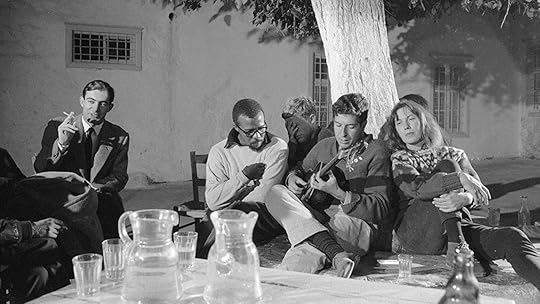
Who is that girl with a very young Leonard Cohen?
Charmain Clift the wife of George Johnston, the author of the outstanding My Brother Jack (https://www.goodreads.com/review/show...) who is also the author of this sequel Clean Straw For Nothing.
Johnson writes that this is a work of fiction, “a free rendering of the truth”. That begs the question as to why his wife, a talented writer in her own right, took an overdose of barbiturates on the eve of the publication of this novel by her husband.
Her wiki quotes her as saying
‘I do believe that novelists must be free to write what they like, in any way they liked to write it (and after all who but myself had urged and nagged him into it?), but the stuff of which Clean Straw for Nothing is made is largely experience in which I, too, have shared and ... have felt differently because I am a different person ...’
Clean Straw For Nothing is the second novel of a trilogy that tells the story of David Meredith (Johnston) and his wife Cressida (Clift) from the time they became a couple after WW2 through to an ill Meredith (Johnston) lying in a Sydney Hospital bed in the late 60's after a return to Australia after many years' absence.
Meredith was a journalist of some repute who really wished to be an author of more repute. This at times very sad story tells of that attempt and with that the consequences to him and his wife’s complex relationship, not only with each other but those that they come into contact with. Theirs is a story of displaced bewilderment, imposter syndrome and living outside the norms of respectable society, “jumping off the bus” as one protagonist acidly complained.
Meredith wanted to depart Australia desperately and with that had the support of Cressida who was a wanderer herself. They had witnessed the racism of Anglo Australians towards European refugees with much disgust, having witnessed war first hand. There was a feeling of not fitting into a staunchly conservative society that resented anyone different, for them there was a sense of displacement that they recognised in themselves. With that, they moved to London with children in tow. Working in London did not remove that sense of displacement, so they moved to a Greek Island. They were looked on by the locals with some bemusement, but this idyll was attractive to wandering expatriate kinds from all over the planet.
But the life of a writer can be burdensome if there is a lack of success, things can get difficult on the financial front and as to their own domesticity, Meredith an older husband and his beautiful young wife drank and partied too much, the consequences of that are a challenge. With illness eventually having an effect, after many years it is time to go home, the question of course is where is home?
Johnson has written a novel that joins its predecessor as very thematic; this one looks at the life of the outsiders who belonged neither in their homeland nor in the places that they escaped to. They were before their time in terms of dropping out, the fifties for goodness’s sake? They had experiences that few of their contemporaries had hitherto experienced, but it all came at a great cost psychologically and was destructive for them both, and in real life, their children.
As author Polly Sampson wrote, Cohen “… was inspired by married writers George Johnston and Charmian Clift when he visited the Greek island of Hydra in 1960. But their golden age came at a price” Indeed.
Highly recommended to anyone that has read My Brother Jack and to anyone that has an interest of Hydra’s “fabled colony”.

October 23, 2014
For those who don't know, the romance between Johnston and the beautiful Charmian Clift was a cause celebre in the 1960's. They ran away from philistine Australia to live on an idyllic Greek island. That was the myth.
But this is the reality - even though it's fiction it is like watching a slow-motion train-wreck. They drank; there are sexual adventures, real and imagined; and Johnston's character writes unremunerative pot-boilers.
Forced to return to reality, they have to pick up the pieces. The title of the book is from a 18th century ditty: Drunk for a penny, Dead drunk for tuppence, Clean Straw for Nothing.
It doesn't sound too hot, so why do I find it uplifting. First, it is a beautiful love story. Secondly, they did it. And third the book is exceptionally written. The character Meredith counts himself a failure. But that is not how he emerges from Clean Straw for Nothing. He was true to his values. He reveals an endearing humanness. And the couple's love, despite everything, endures. Johnston has an accurate eye for character- he is unstintingly harsh, not least on his own persona, Meredith.
The book reveals why most people choose to live their lives within the four rigid walls of conformity. It exposes the dangers of trying to escape. But it shows that it can be done- and for an artist, must be done: whether that escape is a physical one or only in the mind. As the artist character Tom Kiernan says:
"I fly with Icarus, not with Dacdelus"
"That's all very well for you," replies Meredith, " But I'm me not you."
"Balls! If you want to fly, if you think you can fly, then all you've got to do is jump off the twig and bloody well fly!"
And with this book Johnston flies 5/5
But this is the reality - even though it's fiction it is like watching a slow-motion train-wreck. They drank; there are sexual adventures, real and imagined; and Johnston's character writes unremunerative pot-boilers.
Forced to return to reality, they have to pick up the pieces. The title of the book is from a 18th century ditty: Drunk for a penny, Dead drunk for tuppence, Clean Straw for Nothing.
It doesn't sound too hot, so why do I find it uplifting. First, it is a beautiful love story. Secondly, they did it. And third the book is exceptionally written. The character Meredith counts himself a failure. But that is not how he emerges from Clean Straw for Nothing. He was true to his values. He reveals an endearing humanness. And the couple's love, despite everything, endures. Johnston has an accurate eye for character- he is unstintingly harsh, not least on his own persona, Meredith.
The book reveals why most people choose to live their lives within the four rigid walls of conformity. It exposes the dangers of trying to escape. But it shows that it can be done- and for an artist, must be done: whether that escape is a physical one or only in the mind. As the artist character Tom Kiernan says:
"I fly with Icarus, not with Dacdelus"
"That's all very well for you," replies Meredith, " But I'm me not you."
"Balls! If you want to fly, if you think you can fly, then all you've got to do is jump off the twig and bloody well fly!"
And with this book Johnston flies 5/5

April 29, 2020
Every bit as good as My Brother Jack. Sequential, though different in format, which works well. A book to return to in sections.

October 31, 2013
Phenomenal characters, exquisite writing, artful weaving of timelines of the main characters living in different locations that increase the emotional impact of their circumstances. But, how depressing!!!

February 25, 2025
My Brother Jack is one of the great Australian novels, a semi-autobiographical account of writer George Johnston’s childhood and early adulthood, clearly drawn from the contours of his own life but still unmistakeably a novel. It’s a disappointment that the sequel, Clean Straw For Nothing, is far more bluntly inspired by his real life – usually to its self-indulgent detriment.
In the years following World War II Johnston and his second wife Charmain Clift moved from Australia to London and then to the Greek island of Hydra, living there for years among a flourishing bohemian community of expats – and so, of course, does My Brother Jack’s David Meredith, though it’s now very difficult to think of him as David Meredith and not as George Johnston. (This isn’t helped by the fact that the book jumps back and forth between London in the ‘50s, Greece in the early ‘60s and Sydney in the late ‘60s, and back and forth between first person and third person.) Jack himself is never once mentioned – he may well be dead for all Johnston cares – and the gulf between My Brother Jack and Clean Straw For Nothing is so vast that when a despondent Meredith/Johnston wanders down the banks of the Thames to gaze out at the Discovery, and recalls seeing her in Port Philip Bay back when he was a cub reporter in the Melbourne of the 1930s, it’s a shock to remember this is even the same person. There are sometimes streaks of the same theme that made My Brother Jack so interesting – namely, the sense of being Australian, of not belonging, of the cultural cringe and the reactionary patriotic shame at feeling the cultural cringe – but these are largely subsumed by the torrid psychodrama of Meredith/Johnston’s relationship with his adulterous wife.
It is of course possible I read something that was not intended in My Brother Jack. I thought Meredith’s cultural cringe was countered, in Johnston’s eyes, by Jack’s unashamed and unabashed straightforward, working class, patriotic she’ll-be-right contentedness at his place in the world; that it made Meredith aware of and ashamed by his own pretentiousness. Perhaps I was wrong, and this was not the intended reading, but at any rate with the character of Jack entirely removed there is no longer any implicit rebuke to Meredith/Johnston’s contempt for the country of his birth. Note, however, that in all the years he spends on Hydra, there is one (1) named Greek character, with whom Meredith/Johnston shares perhaps a couple of pages of dialogue at the tail end of the book. Meredith/Johnston’s search in Europe for something more meaningful than Australia’s self-interested material prosperity never seems to extend beyond his circle of heavy-drinking bohemian expats, but – unlike My Brother Jack – there is little if any sense the author is aware of this hypocrisy.
Clean Straw For Nothing is not a bad book, per se – Johnston retains his excellent prose style and it’s a pleasure to read on a technical level. But while My Brother Jack was a perfectly-crafted novel with an overarching theme, Clean Straw For Nothing is an awkward and disjointed exercise which wanders all over Johnston’s thoughts and has only the lightest coat of paint to cover up the fact that it’s a plain memoir – one which, to boot, covers a far less interesting period of his life than its predecessor.
In the years following World War II Johnston and his second wife Charmain Clift moved from Australia to London and then to the Greek island of Hydra, living there for years among a flourishing bohemian community of expats – and so, of course, does My Brother Jack’s David Meredith, though it’s now very difficult to think of him as David Meredith and not as George Johnston. (This isn’t helped by the fact that the book jumps back and forth between London in the ‘50s, Greece in the early ‘60s and Sydney in the late ‘60s, and back and forth between first person and third person.) Jack himself is never once mentioned – he may well be dead for all Johnston cares – and the gulf between My Brother Jack and Clean Straw For Nothing is so vast that when a despondent Meredith/Johnston wanders down the banks of the Thames to gaze out at the Discovery, and recalls seeing her in Port Philip Bay back when he was a cub reporter in the Melbourne of the 1930s, it’s a shock to remember this is even the same person. There are sometimes streaks of the same theme that made My Brother Jack so interesting – namely, the sense of being Australian, of not belonging, of the cultural cringe and the reactionary patriotic shame at feeling the cultural cringe – but these are largely subsumed by the torrid psychodrama of Meredith/Johnston’s relationship with his adulterous wife.
It is of course possible I read something that was not intended in My Brother Jack. I thought Meredith’s cultural cringe was countered, in Johnston’s eyes, by Jack’s unashamed and unabashed straightforward, working class, patriotic she’ll-be-right contentedness at his place in the world; that it made Meredith aware of and ashamed by his own pretentiousness. Perhaps I was wrong, and this was not the intended reading, but at any rate with the character of Jack entirely removed there is no longer any implicit rebuke to Meredith/Johnston’s contempt for the country of his birth. Note, however, that in all the years he spends on Hydra, there is one (1) named Greek character, with whom Meredith/Johnston shares perhaps a couple of pages of dialogue at the tail end of the book. Meredith/Johnston’s search in Europe for something more meaningful than Australia’s self-interested material prosperity never seems to extend beyond his circle of heavy-drinking bohemian expats, but – unlike My Brother Jack – there is little if any sense the author is aware of this hypocrisy.
Clean Straw For Nothing is not a bad book, per se – Johnston retains his excellent prose style and it’s a pleasure to read on a technical level. But while My Brother Jack was a perfectly-crafted novel with an overarching theme, Clean Straw For Nothing is an awkward and disjointed exercise which wanders all over Johnston’s thoughts and has only the lightest coat of paint to cover up the fact that it’s a plain memoir – one which, to boot, covers a far less interesting period of his life than its predecessor.
April 2, 2026
Idyllic. The second in his autobiographical series. This one is most about him. The first about his brother. The 3rd about his country. This book was about his escape to his island in the northern hemisphere.
The story is about this idyllic life and his struggles to find meaning in life.
I remember reading it as a young married man and wanting to live that life. I always wondered how could he afford to live like this.
So I had to do what most do. The humdrum life of his parents in the first book.
This book made a powerful impression on me.
The story is about this idyllic life and his struggles to find meaning in life.
I remember reading it as a young married man and wanting to live that life. I always wondered how could he afford to live like this.
So I had to do what most do. The humdrum life of his parents in the first book.
This book made a powerful impression on me.

August 12, 2020
It was 3 1/2 stars but towards the end, the continuous timeline leaping, got on my nerves. I found myself wanting his interminable inner bleating to just TEL me how it all ended. Skimmed a lot of the final chapters. Sad, as it was a pity the final say 1/4 of the book, wasn't just done in a summarized, linear way. Didn't bother going on to read the offered 'Clay'...

January 20, 2022
sequel to Australian classic "My Brother Jack"; like lots of sequels a bit of an anti-climax, as though someone was looking to cash in; nevertheless a good insight into a different and changing Australia; worth reading

September 18, 2022
A brilliant descriptive book with a hefty serve of dialogue and analysis. A great record of Johnston and Clifts’ lives served up with the people who went along for the ride. Johnston’s exquisite writing keeps the pages turning in your mind long after the book has been put down.

August 28, 2025
so long as he was endorsed in his ownership, and reassured, for he was haunted always by an abiding fear that...she would slip away from him into some other man's possession.
'She loves you! She loves you very much, man!'
'But I don't want her. You've had her. So you keep her.'
'She loves you! She loves you very much, man!'
'But I don't want her. You've had her. So you keep her.'
June 19, 2025
A sad but interesting journey of a journalist and novelist, with insights into the Australian psyche.
March 13, 2018
Lyrical language, but a somewhat disjointed narrative of a love story between Cassandra and David Meredith. Cass is somewhat younger than David and a beautiful young woman. They have two children, but David keeps her in a possessive thrall.
As a journalist and then a writer, their life hangs by a thread quite often, waiting for his next cheque to arrive. They move between Sydney, London and the Greek Islands - which is where they are most happy. The narrative switches dates back and forth, which I found confusing. David succumbs to TB, is a smoker, has a lung removed, etc, etc, and is in poor health from then on.
Cass seems to have gone along with his dreams while caring for the children and with little of her own for fulfilment. Eventually she has an affair with Galloway in the Islands while David is in hospital and, although they end the affair when he returns, it has damaged the marriage.
The ending of the book is inconclusive as far as I can tell. It seems that David is returning to Australia after his latest treatment - to be with Cassandra yet again.
As a journalist and then a writer, their life hangs by a thread quite often, waiting for his next cheque to arrive. They move between Sydney, London and the Greek Islands - which is where they are most happy. The narrative switches dates back and forth, which I found confusing. David succumbs to TB, is a smoker, has a lung removed, etc, etc, and is in poor health from then on.
Cass seems to have gone along with his dreams while caring for the children and with little of her own for fulfilment. Eventually she has an affair with Galloway in the Islands while David is in hospital and, although they end the affair when he returns, it has damaged the marriage.
The ending of the book is inconclusive as far as I can tell. It seems that David is returning to Australia after his latest treatment - to be with Cassandra yet again.
This entire review has been hidden because of spoilers.

December 11, 2015
This book is definitely not for me. I absolutely loved My Brother Jack, which (I see now) was about the peak years of Johnston's life. It was filled with incredibly descriptive adventure and I was looking forward to the next chapter in Johnston's life. Many of us have experienced a great decade or so in our youth, followed by 30 or so fallow years where one settles into humdrum and just daily living. Who would seriously write about those fallow years? Well, I guess Johnston thought his would be interesting to his audience. Frankly this second book in the series is just pitiful aimless wandering and screwing. In all honesty, I had to jettison it before finishing - I was skipping through so much of it anyway, there was no point.
Displaying 1 - 13 of 13 reviews