

What do you think?
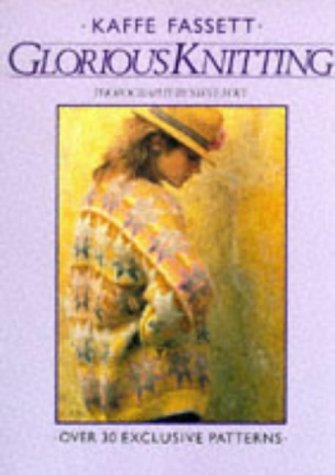
Glorious Knitting: Over 30 Exclusive Patterns
"Kaffe Fassett's garments sell from upwards of $1000 each, but for just a fraction of that price, GLORIOUS KNITTING offers over 30 exclusive patterns for jackets, coats, waistcoats, dresses, shawls and slipovers for men, women and children, plus lots of ideas for variations for the more adventurous knitter. The rich blend of yarns and inspirational use of colour give the illusion of complexity but the design themselves are all based on simple shapes and stocking stitch so are well within the capabilities of the average knitter. Accompanied by full-colour photographs, the patterns are written simply and clearly with large, easy-to-follow charts and advice on how to choose colours and yarns, as well as fascinating information on the background and sources of the designs."
(This edition published by Ebury Press, an imprint of Random House UK Ltd., London. GLORIOUS KNITTING has been the title for UK editions, while GLORIOUS KNITS has been the title for US editions. Content and page count are the same.)
(This edition published by Ebury Press, an imprint of Random House UK Ltd., London. GLORIOUS KNITTING has been the title for UK editions, while GLORIOUS KNITS has been the title for US editions. Content and page count are the same.)
160 pages, Paperback
Published January 1, 1992
Ratings & Reviews
Friends & Following
Create a free account to discover what your friends think of this book!
Community Reviews
Displaying 1 - 5 of 5 reviews

November 13, 2013
“Like many other crafts, knitting has the potential to create magic in our lives. Mosaic-making, woodcarving, tapestry, quilting and so on, are all capable of lifting everyday household objects out of the ordinary to brighten up our days. Instead, they are often responsible for drab, uninspired works that have the opposite effect…I want to convey that a sense of color is not something you automatically know about; you discover and rediscover its secrets by playing with it, and above all, constantly looking.” Fassett offers the eternal challenge and consolation that we learn most effectively by trial and error.
Contents include an Introduction (Knitting with colors, and abbreviations); chapters on Stripes, Steps & Zigzags, Diamonds, Stars, Squares & Patches, Circles, and Flowers; Yarn information, Hints for American knitters, Acknowledgements, and an Index.
I bought a used copy for all of 5€ recently, and evidently time has been gentle. This 1987 reprint is as fresh as it was hot from the press: colors are bright, and the binding holds firm. The font is sharp enough to make a clear photocopy—a necessity, of course, so as not to carry around this heavy book in one’s project sack.
What a joy to revisit this book almost thirty years later! By the time I first discovered it—Fassett’s ‘Carpet Pattern’ coat (glorious color-spread pp. 44-45) featured in an issue of “Vogue Knitting” circa 1986—his unique style was all the rage. I adored it, but didn’t pause to study his method. Thankfully, this book withstood the test of time, and is proving itself a classic. Written for pattern-followers, there are enough hints from our esteemed guide to entice more confident knitters into the process. Fassett leads without dictating…well, he does dictate, if you prefer to buy a kit or match his colors at your discretion, and that’s what’s so appealing about this book: it speaks to so many levels. I can learn from him as I learned painting from Cézanne—by turning observation into creation with a heady dose of trial and error.
My regret is that he’s not more dictatorial about color theory. The glossy photos explode with color—color that works! How does he do that? Fassett encourages us to experiment, acceding that nature is a great artist and marvelous teacher, yet he says nothing about shades and tones and hues and such.
This style does not appeal to everyone, (nor does everyone desire a Picasso over the fireplace), yet everyone interested in creation, history, and theory of art benefits from studying a master. Glorious Knitting has earned its place on any serious knitters’ shelf (right next to Itten’s The Art of Color.)
Contents include an Introduction (Knitting with colors, and abbreviations); chapters on Stripes, Steps & Zigzags, Diamonds, Stars, Squares & Patches, Circles, and Flowers; Yarn information, Hints for American knitters, Acknowledgements, and an Index.
I bought a used copy for all of 5€ recently, and evidently time has been gentle. This 1987 reprint is as fresh as it was hot from the press: colors are bright, and the binding holds firm. The font is sharp enough to make a clear photocopy—a necessity, of course, so as not to carry around this heavy book in one’s project sack.
What a joy to revisit this book almost thirty years later! By the time I first discovered it—Fassett’s ‘Carpet Pattern’ coat (glorious color-spread pp. 44-45) featured in an issue of “Vogue Knitting” circa 1986—his unique style was all the rage. I adored it, but didn’t pause to study his method. Thankfully, this book withstood the test of time, and is proving itself a classic. Written for pattern-followers, there are enough hints from our esteemed guide to entice more confident knitters into the process. Fassett leads without dictating…well, he does dictate, if you prefer to buy a kit or match his colors at your discretion, and that’s what’s so appealing about this book: it speaks to so many levels. I can learn from him as I learned painting from Cézanne—by turning observation into creation with a heady dose of trial and error.
My regret is that he’s not more dictatorial about color theory. The glossy photos explode with color—color that works! How does he do that? Fassett encourages us to experiment, acceding that nature is a great artist and marvelous teacher, yet he says nothing about shades and tones and hues and such.
This style does not appeal to everyone, (nor does everyone desire a Picasso over the fireplace), yet everyone interested in creation, history, and theory of art benefits from studying a master. Glorious Knitting has earned its place on any serious knitters’ shelf (right next to Itten’s The Art of Color.)

February 7, 2023
[Edit: I did encounter a couple mistakes in the one pattern I made, so I will deduct a point.]
I bought this book because I fell in love with the tumbling blocks sweater a reddit user made. I have never heard of Kaffe Fassett before, and boy did I not expect this explosion of colours and patterns. I loved browsing through the many pictures of knitwear and comparisons of every day structures, but I don't think I would feel quite comfortable wearing a lot of them. This may be due to how heavily patterned and colourful garments aren't quite as "in fashion" right now as they have been 40 (forty!) years ago.
And if I say "colourful" and "explosion of colour" this is exactly what I mean. Most of the garments in this book use at least 20 different colours, some up to 60 if it was up to Fassett. This is completely different from any patterns I have ever used or ever seen. Often times the used colours/yarns aren't directly named, because the real intention of this book seems to be to evangelise the reader into creative colour usage in knitting, and I'm beginning to be convinced. Fassett himself describes how this is not your usual knitting book very early on: "Although there are patterns, lots of them, I would be very disappointed if they were always followed word for word." He wants the reader to explore colour mixing and matching and not just do exactly what he tells you to do.
The patterns I am now currently interested in:
Tumbling blocks sweater - of course, this is what caught my eye and every colour variation I see makes me love it more
Small Steps ZigZag V-neck Sweater - I very much like how the steps compliment the v neck, I love puffed sleeves and it seems like something you could wear today. It also "only" requires "at least 10 colours" lol
Lattice Pattern V-neck Sweater - Definitely interested, especially like it with mixed background, but I think it looks best with loooots of colours
Floating Circles Crew-neck Sweater - Love the dark variant he shows, but you also need lots of colours to break up the monotony
Damask Flower Peplum Jacket/T-shirt - Very much like how the uni-colour flower looks on the gradient background, but again, lots of colours.
The reason I don't exactly want to buy 20 colours for one pattern is because I don't like having a large yarn stash. The patterns given are, from what I saw, fairly well made, I could follow along without knitting in the moment. I will update though, once I have made my first Finished Object.
I bought this book because I fell in love with the tumbling blocks sweater a reddit user made. I have never heard of Kaffe Fassett before, and boy did I not expect this explosion of colours and patterns. I loved browsing through the many pictures of knitwear and comparisons of every day structures, but I don't think I would feel quite comfortable wearing a lot of them. This may be due to how heavily patterned and colourful garments aren't quite as "in fashion" right now as they have been 40 (forty!) years ago.
And if I say "colourful" and "explosion of colour" this is exactly what I mean. Most of the garments in this book use at least 20 different colours, some up to 60 if it was up to Fassett. This is completely different from any patterns I have ever used or ever seen. Often times the used colours/yarns aren't directly named, because the real intention of this book seems to be to evangelise the reader into creative colour usage in knitting, and I'm beginning to be convinced. Fassett himself describes how this is not your usual knitting book very early on: "Although there are patterns, lots of them, I would be very disappointed if they were always followed word for word." He wants the reader to explore colour mixing and matching and not just do exactly what he tells you to do.
The patterns I am now currently interested in:
Tumbling blocks sweater - of course, this is what caught my eye and every colour variation I see makes me love it more
Small Steps ZigZag V-neck Sweater - I very much like how the steps compliment the v neck, I love puffed sleeves and it seems like something you could wear today. It also "only" requires "at least 10 colours" lol
Lattice Pattern V-neck Sweater - Definitely interested, especially like it with mixed background, but I think it looks best with loooots of colours
Floating Circles Crew-neck Sweater - Love the dark variant he shows, but you also need lots of colours to break up the monotony
Damask Flower Peplum Jacket/T-shirt - Very much like how the uni-colour flower looks on the gradient background, but again, lots of colours.
The reason I don't exactly want to buy 20 colours for one pattern is because I don't like having a large yarn stash. The patterns given are, from what I saw, fairly well made, I could follow along without knitting in the moment. I will update though, once I have made my first Finished Object.
October 21, 2015
Kaffe Fassett always uses glorious colors, and his Crosspatch "Sleeveless Pullover" (aka vest, for Americans) is a classic. I LOVE it and wish I were a better knitter so I could adapt for women. Apparently this design also appeared in Rowan Magazine 18 as a waistcoat (buttoned vest), but I've never seen that early magazine.
I would probably have given this a higher rating were it current, but it's 30 years old and the patterns quite dated, hence the 3 starts. I actually don't care for any of the other designs--only the Crosspatch vest.
I would probably have given this a higher rating were it current, but it's 30 years old and the patterns quite dated, hence the 3 starts. I actually don't care for any of the other designs--only the Crosspatch vest.

October 17, 2013
I have only made one sweater from this book, years ago. But it is still an inspiration.

August 11, 2023
Love these designs. Can't wait to knit one, or two.
Displaying 1 - 5 of 5 reviews