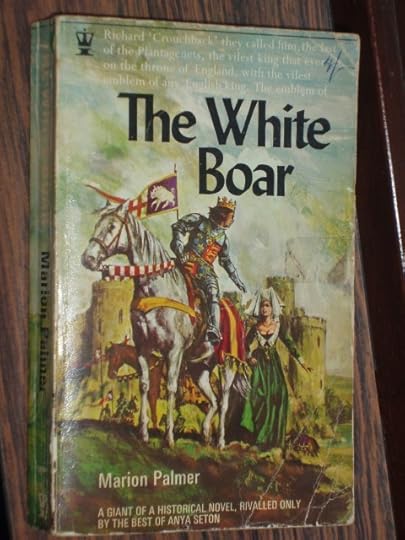
Richard III, last of the Plantagenet Kings, could condemn the author of that crude doggerel to a traitor's death but he could not stem the inevitable tide of history. Richard's emblem, the white boar, commanded the loyalty of able men like Lords Catesby (the Cat) and Ratliff (the Rat), and Francis Lovell (our Dog). It could not withstand the onslaught of the Tudor rose.
The White Boar is a dramatic historical novel that vividly recreates the life and times of England's controversial King Richard III. Shakespeare portrayed him as evil incarnate, a hunchback who gained the throne by murdering his two nephews. Conversely, many historians argue that he was an innocent scapegoat and might have been one of history's great monarchs had his reign not been so tragically short.
In this novel one issue concerning Richard's life is never in doubt - that he held the unfaltering devotion of two extraordinary men, Phillip and Francis Lovell. And it is through their eyes that the reader of this remarkable book sees the last Plantagenet - the man and the King.
Marian Palmer presents a striking chronicle of England in the last half of the fifteenth century: the pomp and pageantry of the royal court; the treason and the intrigue which were the death of the Plantagenet dynasty; and the bitter struggle between the Yorkists and the Lancastrians that was the War of the Roses.
The author does not offer a solution to the riddle of Richard III; rather she presents him as he might have appeared in his own lifetime to the two men who were, above all else, his friends. The character which emerges is as unforgettable as Shakespeare's misshapen monster.
Marian Palmer became interested in Richard III around 1958 and from this interest came The White Boar, her first novel. She is currently at work on a second novel concerning the same period of history. Mrs Palmer lives in Vancouver, Canada, with her husband and daughter.
This is a fictional narrative of Richard III through the eyes of two of his most trusted allies, Francis Lovell and his cousin Phillip. A fine read, rich with historical details and eloquent storytelling, although some parts read slow for me, and the wording is a bit archaic for my liking.
This was the first book I ever read about Richard III, and it was life-changing as it kindled my interest in the guy and I have been reading about him ever since. Many authors owe a small proportion of the royalties to Marian Palmer!
It's still a good read, although there are fictional characters in there (quite convincing ones) some historical errors and some bits that are just slightly 'odd'. It remains close to my heart despite its weaknesses, which for me are offset my the general quality of the story-telling and the memorable characters.
I think this is a 'marmite' book. I have known several people who positively hated it. So while recommending it, I must also warn that your mileage may vary, as the saying goes.
"The Cat, the Rat, and Lovell our Dog Ruleth all England under an Hog" (a nice little political ditty written by Tudor? Woodville? enemies of Richard III)
I wish someone had written a nice little political ditty about: Edward IV and his band of whoring friends/stepsons/Woodville relations. And his charming? wife Elizabeth Woodville and her leeching, numerous family - but ok - she would have had the person killed... (Really I'm trying to think of a political ditty - and if I do I'll post it- I don't have to worry about being beheaded...)
And really I do like Edward IV - even with all his faults
Richard had faults too - but I love Richard (and NO I DO NOT THINK HE KILLED HIS NEPHEWS)
(Really if you are interested in the War of the Roses (or even if you maybe are) read " Richard the Third" by Paul Murray Kendall - a biography of Richard III - and his older brother Edward IV's reign, the time period - swear to God you couldn't make this sh*t up if you TRIED. These were real people who lived, who loved, whose lives were shaped and informed by their loyalties to York or Lancaster - or who sat on the fence and waited to see who came out on top... Tudor)
"Loyalty binds me" - Device/Motto of Richard of Gloucester
Ok - I just finished reading this book ... and I liked it a lot. It was published in 1968 - and for the most part it is historically accurate. It is a story about Richard III of England and his friends - his companions from the time of their meeting as young men through Edward IV of England's reign when Richard was the Duke of Gloucester and in the care of the Earl of Warwick (the Kingmaker) and they (most of them) met as squires in the Earl's household. Phillip Lovell - cousin to Francis Lovell is a fictional character - as are some others - but for the most part the story is based on true people. It's a good story - and it follows their lives as they grow up and grow older and stay loyal to Richard. For all that Tudor history has tried to smear Richard III's life - again and again the character of the man stands out in SO many ways, in numerous fictional and biographical books. If you like historical fiction, if you like a good story, all I can say is read this book.
The story is told by the Lovell cousins Philip (pretty sure he’s fictional) and Francis. Francis is given is wardship to Warwick and goes to Middleham. There he meets Philip after long time and for the first time sees Richard, Duke of Gloucester. There’s lot more going on but I don’t even try to tell it. Wikipedia is your friend.
I did enjoy this but it was bit dry on points and some of the phraisings does show the book’s age. But I liked how the characters were described, especially Richard. He was neither too good or too bad. I loved how Anne Neville’s rescue was portrayed.
It was nice to read that Francis and his wife Anna had their happy moments. They are always portrayed hating each other and while this either didn’t end happily there was some good too.
This is surely a very well written book and well researched. The thing that perplexed me is that is not really a "story of the last Plantagenets" as the cover claims. It's rather the story of Francis Lovell, and above all of his fictional cousin Philip, and I wasn't really interested in them. Anyway a good book, though not at the top of the my list of Ricardian fictions.
This is a tale set during the reigns of Edward IV and his brother Richard III. At least according to the book jacket it is a "story of the last Plantagenets," but it is really a story of the the life and loves of Richard's friend Francis Lovell and his (fictional) cousin Philip Lovell. Their stories follow Richard's whom they both serve, but rarely do we see them interacting with Richard. As a result, I was left with wondering why they were loyal to this man. As the book begins, Francis is sent away to learn his knightly skills at Middleham Castle in the household of the Earl of Warwick. Philip is already there and we are told he is Richard's close friend. But almost as soon as Francis arrives, Richard goes off to live at court. So how did he develop a bond with Richard? Next thing we know Philip has gone off to secure his inheritance. Apparently, Richard has helped, but Philip wants to be beholden to no man. He saves Richard's life at Barnet but is severely wounded. He and Francis thus miss Tewkesbury, but they are appalled when they see the pile of headless bodies of traitors executed on Richard’s orders. Philip absents himself from London because he feels Richard doesn’t want him there. But he does come to London to meet Rob Percy. This is meeting is secret even from Francis in order to avoid awkward questions. My mind is not subtle enough--what is this all about? Anyway, the inn is the place were Anne Neville is hidden away as a scullery maid and Philip rescues her. Richard wants to shower Philip with gifts, titles, etc.--much to Philip's chagrin.
Meanwhile, Francis consummates his marriage to Anna Fitzhugh who is a dyed in the wool Lancastrian. They are happy until Francis mentions Richard and Anna goes cold as an iceberg. I never hear any defense of Richard by Francis or Philip. Francis is happy to receive honors from Richard, unlike Philip. In fact, I didn't see that they ever mentioned that Richard had any admirable qualities to explain the cousins' loyalty; they were loyal because he is a friend.
The writing is pretty good and the stories about Francis and Philip are entertaining, but for me the novel was just okay
This entire review has been hidden because of spoilers.
This is the story of Richard III, the last Plantagenet, as viewed by the cousins Francis and Phillip Lovell. As historical background we learn about the famous Wars of the Roses held in the last half of the fifteenth century in England.
Marian Palmer has an unique style of writing, quite different of some well known historical fiction authors.
For those who are interested on novels set during the War of the Roses, there is an interesting website on this subject: The War of the Roses. There is also further details on Richard's life at The Richard III Society.
This book was recommended by our dearest and missed friend Ikon. Thanks Ikon wherever you are.
As already said by other readers, in this book Richard is depicted neither as a saint nor as a devil, but a man with both hopes and regrets. After having read many books about his life, obviously all with everything but a happy ending, it was good having one ending with a ray of hope, at least for one of the characters. One of the main protagonists is Philip Lovell, a fictional cousin of Francis Lovell. He's a loyal friend to Richard III, and probably the best idea of the author was to have him refusing all honours from the king, so that his loyalty can not be tainted by the suspicion of personal interest and he remains distant from the life of the court (although living there) and closer to the life of common people.
"The cat, the rat, and Lovell the dog..." - just reread this book which I read for the first time 40+ years ago. Been awhile since I had read it but immediately remembered why I enjoyed this book so much. "The White Boar" tells the story of Richard III from his teen years until his death through the lives of the Lovell cousins - Francis and Philip. Francis is a real person and Philip is a fictional character created for the story. Both cousins become good friends and intimates of Richard III. The story stays true to history and at the same time it creates fictional scenes that attempt to shed some light on the bigger mysteries surrounding Richard. If you like history, the War of the Roses or have an interest in Richard III, I recommend this story.
This is a rather good read! It's one of 'my' periods so I know the story inside and out, so to speak, which makes it easy for me to get irritated or bored if the writer is either historically sloppy or not very good at....er....writing. Despite being a bit dated AND (cardinal sin in the Lexicon of Deborah) writing 'forsoothly', however, I remained effortlessly engaged and interested.
I thought it would be interesting to see events around Richard III from the point of view of Francis Lovell, but throwing in the fictional cousin Phillip as well blurs the focus too much. I liked the parts when Richard himself was in the room but I got bored when it strayed into several other plotlines that had almost nothing to do with main events.
Published in 1968, Marian Palmer gives her spin on the oft-told tale of Richard III but she tells it from the point of view of cousins Francis and Phillip Lovell (I believe Phillip is a fictional character). Phillip serves in Edward IV’s household, and a younger Francis is given in wardship to Warwick where he meets Edward’s younger brother Richard and as an adult faithfully served the future Richard III. This is one of those books where you either know the history and don’t need me rehashing it all over again, or if you don’t Wik can do it much better than I can – I’m just here to talk about my reading experience.
While this can be a bit dry on occasion, I did enjoy it and found it fitted nicely as my “treadmill book” and not my main read. The main historical facts seem to fit with other books I’ve read on the period, although I suspect those better versed on the period could find a few bones to pick clean. Refreshing, as always to have a Richard who is neither good as good can be nor the evil villain as Shakespeare portrayed him. I enjoyed seeing this through the eyes of the two cousins and despite the sad ending at Bosworth Field (just once, can someone change it?), there’s a bit more to the story with a somewhat happy ending for at least one of the cousins. The story continues in The Wrong Plantagenet and whick as I understand it concerns the mystery of the two Princes and Perkin Warbeck so stay tuned. 4/5 stars.
Condition: Used - Acceptable. Sold by: entertainmentcentre £0.01
PART ONE A Crimson Sky at Dawn January 1465. The women had left wax torches burning, and hung the chamber walls with tapestries of unicorns made tame, because the bride was a maid.
This is a great read for any fans of English history in general and of Richard III in particular. His story is told through the eyes of his closest friends. It reads very quickly and is a book I have enjoyed re-reading more than once. Richard and his closest friends are portrayed in a very realistic light, and I don't think you have to be very knowledgeable about the Wars of the Roses to understand and enjoy this book. Anyone who is interested in learning more about Richard should take the time to read this; you'll be glad you did.
I read this some years ago. It's extremely well written in a way that for the most part is dry and uninvolving. I can say that because it's something that others have said about my writing! There's a lot of narration as opposed to in-scene action. I didn't care about Francis Lovell or his cousin Philip (the latter an invented character). Richard III is intriguing and is by no means the naive (and boring) Mr. Nice Guy portrayed by some historical novelists, but you don't get inside his head or understand what makes him tick, and I don't think the author knew herself what she thought about him. The best thing in the book is the characterization of Edward IV. In this novel he is thoroughly the commanding leader, although he is shown as more cold and ruthless than I suspect he was in reality (he was no Mr. Nice Guy either, but I doubt he was as cold as he comes across here). If there had been more of him and Richard and their doings, I would have liked the book better. Elizabeth Woodville does not appear in the book at all (she's offstage, mentioned by other characters in the usual negative way), and to the best of my memory, Anne Neville doesn't appear either. Overall, the reader is kept at a distance, and given the author's obvious talent and the occasional strong moments in the book, I found it frustrating.
This entire review has been hidden because of spoilers.