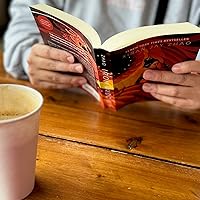
1975, mass market paperback reprint edition, Pyramid Books, NY. 159 pages. Extremely interesting science fiction novel by a master. This book first appeared in 1953. In 1956, the author published a "completely rewritten version" under the title The City and the Stars. He was said to have second thoughts about this work. Here is the original book, which received raves from critics. "Truly marvelous ... one of the most rewarding science fiction novels."
Stories, works of noted British writer, scientist, and underwater explorer Sir Arthur Charles Clarke, include 2001: A Space Odyssey (1968).
This most important and influential figure in 20th century fiction spent the first half of his life in England and served in World War II as a radar operator before migrating to Ceylon in 1956. He co-created his best known novel and movie with the assistance of Stanley Kubrick.
Clarke, a graduate of King's College, London, obtained first class honours in physics and mathematics. He served as past chairman of the interplanetary society and as a member of the academy of astronautics, the royal astronomical society, and many other organizations.
He authored more than fifty books and won his numerous awards: the Kalinga prize of 1961, the American association for the advancement Westinghouse prize, the Bradford Washburn award, and the John W. Campbell award for his novel Rendezvous with Rama. Clarke also won the nebula award of the fiction of America in 1972, 1974 and 1979, the Hugo award of the world fiction convention in 1974 and 1980. In 1986, he stood as grand master of the fiction of America. The queen knighted him as the commander of the British Empire in 1989.
Hundreds of thousands of years ago (millions of years after our own benighted age) the Earth suffered a tragic loss in battle with beings known only as "the Invaders" and the apparently last remnant of humanity sits behind the majestic walls of the final human city: Diaspar. Here they while away their immortal days, a society of lotus eaters tended by the greatest machines ever conceived by humankind, living in pleasure, but also fear. Fear of the unknown, fear of the wasteland outside their walls, fear of the future. From time to time there has arisen among them a mind not founded on this culture of fear and indifference, but rather one prone to curiosity, courage and insight. Such a mind belongs to Alvin of Loronei, the last child to be born in the city of immortals, and a young man who thirsts for knowledge and adventure.
Clarke crafts an exciting, and lyrically written, dying earth story in which young Alvin must overcome the obstacles of his own people and face even greater challenges in the wider world. Ultimately the fate of humanity and its future (should it have one) will rest on his decisions. I don’t want to give too much away and spoil the story, for much of the enjoyment comes from learning the truths, and falsehoods, of Alvin’s world through his own investigations. Suffice it to say that there is much humanity of the final eras has to learn about itself and its history and Alvin’s actions are likely to spell either a great new era in their development, or the final sputtering out of their dying life force.
I have never read anything by Arthur C. Clarke, but didn’t expect this. My impression was that he was a much more ‘hard sf’ kind of writer, more interested in true science and plausible extrapolations of it, but here we have a lyrically written fable of humanity’s far-future days of decline. True, elements of science (or super-science) are important to the story, but they don’t outweigh the emotional elements of the tale, which are really what carry it forward. There is also a significant smattering of pseudo-science elements that I found interesting. I enjoyed the story, but sometimes Alvin seemed a little too competent (perhaps a smattering of the John Cambellesque hero here?) and I’m not sure if I ever believed he wouldn’t overcome the obstacles placed before him, but the future history Clarke has painted for mankind is an interesting one and this is definitely a worthy entry into one of my favourite sub-genres of sci-fi.
Alvin had grown beyond the pleasures of his world, Diaspar. I expect he saw them as indolent, apathetic, soft, and disinterested. He may even have perceived them as pathetic. In any event, he certainly didn't share his people's terror of the world beyond their city. Lys was much more to his liking and, indeed, may have persuaded him to stay permanently had he not hatched the plan of stealing the machine to retain the memories that the Lysians wanted to wipe out.
As a pure hard-core science fiction entry, the tale was great - high speed mass transit using "sidewalks", faster-than-light travel, robots accepting voice and telepathic commands with built-in programming overrides and safety features, rocket ships, skyscrapers that are literally "sky scrapers", mass with properties different than the solid, liquid, gas paradigm of the day and so on. All of these speak to Clarke's vision and imagination. Some real vision on the soft sci-fi side as well - the obvious need for a reduction in birth rate to coincide with the reduction in mortality rates as health improves and longevity increases, the differing paths that evolution can take, the effect of isolationist policies, the inability of people to accept change in the face of long-standing tradition and "religious" ideas and so on.
That's it, though. Unfortunately, I give the book overall (at least, for me) a failing grade!
While the ideas are timeless and the book could easily have been written yesterday with only minor modifications in the science, I thought the overall plot was weak and watery - an obvious prelude to the Odyssey and Rama series. In my humble opinion, Clarke is perennially unable or unwilling to provide a real or hypothesized source to his artifacts and is equally unwilling to provide a real resolution to the questions posed by the artifacts. Where does Alvin go from here? What is he likely to encounter? Why would he choose to do what he does? There are also several plot questions that remained, for me, annoyingly unresolved - namely, where the heck did Alvin come from? Was he born - if so, how? Was he hatched - if so, how and perhaps even more important, why? Lys's belief that Rorden was somehow more trustworthy than Alvin in keeping the secret of their existence seems to me naïve at best, misplaced at worst and a feeble plot contrivance to allow the story to move forward. Who was Alaine of Lyndar and why did the story that unfolded with Alvin not happen with Alaine? If the climate of earth has evolved to the point that the hydrological cycle is so totally trashed and the oceans are non-existent, how does Clarke figure that humanity would survive that? With records as extraordinary as those to which Rorden had access, it seems impossible to conceive that Shalmirane, a weapon capable of destroying a moon whose orbit had decayed to the point it was "falling", would ever be relegated in history to a legendary battle with space invaders.
I've always been unable to figure out why Clarke is perceived as such an icon in the field of science fiction! Some fellow readers tell me that some of these questions get answered in THE CITY AND THE STARS. That may be so but it didn't help me out with this one, I'm afraid.
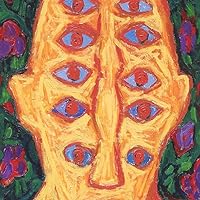
I think of this book, and I see something like this in my head:
I'm not joking. I read this and I imagined something that colorful and bright. Reading it was like being in a picture like that, you know, like smack in the middle of one of those retro-sci-fi covers. It was quite something.
The world-building is phenomenal. Everything stood out in vivid colors, the landscapes, the buildings, the cities. Yes, everything seemed extremely well-developed, except... the characters.
The characters fell flat. As if all the energy had been poured into imagining and describing the surroundings, and creating the story. Which is a shame, because it's a very interesting novel that digs into issues that are relevant today and will continue to be relevant for a long time to come. It's the divide of nations, of people, of cultures. In this book this divide has more far-reaching consequences than today, but it still serves to prove a point. However, stories are told through characters, and the characters in this book could have been much more interesting and complex. Especially considering some of the choices they're facing. It makes the whole thing seem a lot less important than it really is, and that's an awful waste, because it means we might not look upon it or ponder it as seriously as we should.
Still, I'm happy to have read it. Happy to have immersed myself into such a classic science fiction story. It's exactly the kind of story one might come up with, if one were looking at the picture above and trying to write something down. And I love that. I love that someone could write something that fits the picture I have of "classic" science fiction. And that a book could create as images as strong and colorful as this one has done. In that it's a very beautiful book.
This book is a coming-of-age story taking place on Planet Earth, 10 billion AD.
Slow, very naive and beautifully written. Having read a lot of Clarke as a kid, at least I remembered the writing correctly. Clarke's style wouldn't be out of place even today, which is very nice, and the way he tells the story does not age. The only problem is the story is a bit ... wrong.
The assumption that humans would still live on Earth in 10 billion (!) years is wrong to begin with. Everything about it, to say nothing of the evolutionary change of the species. And yet, they print on paper, even though the planet is desolate, and they talk about old times. But the thing is, Clarke chose a time frame that simply cannot support his otherwise (relatively realistic) sci-fi. He was always keen on not pushing it with technobabble, which is why airport-style walkways and underground trains traveling at only a few hundred km/h (the book uses imperial units, golly) sounds rather weird for such a distant future. Then, you have the concepts of language, culture and technology.
But that could be excused - except the plot is a bit slow. Like most books of this time, it takes too long to develop. Then, you get some rather Star Trek village-cum-planet retro-tech-tribe cultures added into the mix, which complicate the plausability of the story even more.
Not bad, really. Just not too exciting. Slow. Somewhat predictable.
Better than Ubik that I read in parallel and also reviewed just now, however, it's not a particularly engaging piece of work. Sort of average, and so I decided to stop. If you liked/loved Clarke at any point in your life, you might want to try this, but if your reading preferences have changed, like mine have, ergo less patience and a desire for faster, more complicated, character-driven plots, you won't enjoy this one too much.
An early effort by Arthur C. Clarke. An entertaining and fast read, but not a very complex story. Actually if Sir Clarke had written it just a little differently I would classify it as a Young Adult dystopian novel, but as it stands it's basically a Golden Age science-fiction story. Our hero is cut from the old pulp-fiction stories. Intelligent, brave, lucky and fortunate enough to come across technology that functions with no need for our protagonist to actually learn how to operate it or at least with just minimal effort (telepathy is always a popular one). Basically the tech functions like magic and with it our hero overcomes all obstacles. Interestingly enough advanced tech that works like magic is the third of Sir Clarke's three laws, but that's really not the point - though it is fun isn't it. So an interesting classic science fiction novella that will probably come across as being a bit simplistic to a reader in 2017.
A Bit of Trivia One last thing for fans of Sir Clarke's fiction. There are recurring themes through much of his work of the inevitably of time and the evolution of Humanity to a higher place. Those themes show up in this novella as well. Just a little bit of fun.
I likely read a Clarke novel long ago, probably because my father recommended it. It was not this novel. This novel, once I started it, turned out to be not one of Clarke's best. You don't have to take my word for it (nod to Levar Burton :-D): many others have also listed this as a not-so-great representation of the great Arthur C Clarke's work. It took me a month to get through this book, partly because in between, I read another book and a graphic novel, partly to simply break the monotony of Clarke's storytelling.
For one thing, there is very little action. Literally years can go by in the book with the characters only reading and talking. While this may sound like an introvert's happy place, it made for long draggy pages where you desperately kept hoping for something to happen, only to be disappointed over and over.
There is some world building though one find's themselves confused that the story takes place on an Earth many thousands of years into the future. There are long passages where the world is described and lofty recountings of history but because that history for the reader is the future, it was hard to fathom and picture sometimes.
When the book was about 80% over, some action happened. It got exciting. Things were found, space travel happened. Then it ground to a halt and frankly, the book ended but left me full of questions and confusion, not to mention an overall feeling of being incredibly cheated.
Maybe Clarke intended for the book to pose philosophical wonderings in the reader. They were lost on me, which may not be the case for everyone: I at times miss very subtle symbolism in stories, especially when the contents of the story overall are ponderous and prose-driven.
ilk yarısı tatlı tatlı giderken (iyi bilimkurgu=iyi edebiyat) ikinci yarıda olaylardan epey koptum maalesef. clarke’ın da pek içine sinmemiş olacak ki oturup tekrardan yazmış
Wow. This was my introduction to Arthur C. Clarke, and to say that it has piqued my curiosity in the author would be an understatement. More like kindled a fire using fuel that I never new I possessed.
2) This book was written in 1948. This blew me away -- it does not feel dated at all and reads like it could have been written today. Given the massive leaps forward in science since then, this is a remarkable achievement.
Now, onto the review.
Against the Fall of Night centers on Alvin, the youngest member of the city of Diaspar. Diaspar is the last remnant of human civilization on Earth, the lone oasis in a literal world desert. The city has been in an extended period of stagnation, with apparently no significant changes in hundreds of millions of years. This is largely due to the apathy of its citizens, who have lost all curiosity over their seemingly eternal lifespans. Alvin, however, is an exception, and his inquisitive mind pushes him forward, at great risk to the order of Diaspar.
Clarke's prose is delightful. It is not flowery or discernibly poetic, but it has a grace and vigor that is lacking in science-fiction. Consider the opening sentence:
"Not once in a generation did the voice of the city change as it was changing now."
Or a brief description of the Council of Diaspar's fear:
"He had put his finger on their secret fear, the fear that he had never shared and whose power he could therefore never understand."
Clarke's descriptions are brief straightforward (although this Classics major did appreciate the wonderfully appropriate reference to Odysseus, complete with Homeric epithets), but this merely proves Clarke's skill, since he evokes a sense of wonder and feeling with little recourse to extended similes. When they do occur, they are effectively used, and are often the perceptions of the characters themselves (e.g. ). Clarke's style possesses an elegance and beauty that is manifest even in his earliest work.
In Against the Fall of Night, we encounter questions of direction evolution, urbanity v. nature, intellectual curiosity, life in the universe, exploration, religion and philosophy, isolationism, cultural stagnation, the dangers of science, corporeality and consciousness, the immensity of the universe (spatial and temporal), history and the recording thereof, transitions in human history, and more. The themes of synthesis/the Golden Mean and the importance of human drive predominate, but all the others appear. This all occurs in around 200 pages. What makes Clarke's novella so successful is that none of these themes feels underdeveloped. While some are merely tangential to the primary story arc, they are discussed and contextualized in Clarke's future Earth, and so feel both integral and necessary components to his beautiful whole. The reader is left with a desire to know more about this world, but it is a positive desire: Clarke has so competently built this world that we want to know more about it (the negative alternative being that we want to know more because we know too little to enjoy the story). Clarke leaves much to the imagination, but never too much.
I have read in other reviews that a flaw of the book is the lack of character development. Even more egregious are the claims of nonexistent or inconsistent characterization. The second is simply absurd -- the characters are provided realistic personalities, and at no point was there an out-of-character moment. Alvin, for example, is driven, curious, but also arrogant, rash, and egotistical. Is this not an expected outcome of his singular inquisitiveness in an apathetic city without pain or suffering and thus with no need for forethought? I see no contradiction, no inconsistency.
On the subject of character development, it is true that development is not the point of Against the Fall of Night. But that is not an inherent problem. Do I read Milton in order to ponder issues of technology and human evolution? Do I read a Raymond Carver story in order to be taken on a fantastic voyage? Character development is not a requirement for every work; it is merely one element upon which the author may choose to focus. Furthermore, I would argue that development does occur -- Rorden, the Keeper of the Records of Diaspar, undergoes a remarkable change in outlook as he learns more about the history that is his job to guard, as does Jeserac, Alvin's tutor. While we are not privy to extended internal monologs about every decision, the characters are still people, not flimsy constructs. The fact that Clarke manages even this given the brevity of his story is astounding.
Against the Fall of Night is a remarkable achievement. It is full of wonder and hope. It is written beautiful. It is thought-provoking and visionary. The characters are realistic. It remains relevant. It leaves us wanting more, but it gives us enough. In brief, read it.
I found this in a random place in my school's reference room and jumped on it - English language books are difficult to find here unless they're well known classics, and sci-fi books are among the rarest to come across, so I was excited. I was especially excited to see it was a Clarke book I had discovered as I've previously read 2 of his books, Childhood's End and Rendezvous with Rama, and enjoyed both.
A couple comments on these previous encounters: Rama was seriously lacking in characterization, being primarily occupied with the exploration and understanding of the encountered craft and, through it, with what would be necessitated by deep space travel - I found this fascinating and so enjoyed reading it, but it didn't exactly touch my sensibilities. Childhood's End was a mix: it had fascinating ideas and characters who, although they weren't explored or revealed as much as they would have been under other authors' pens, were more real than Rama's. But it was... spooky: a collective memory for a species, haunted by the ghosts, specters, monsters of its future? And the reason for that haunting? I think maybe it was spooky because it showed a destruction, which in most stories would be a reason for fear and hatred, and yet, here we were to celebrate that destruction for the new birth it would allow - humanity as phoenix? and yet not, as the being birthed was so unlike, so truly alien, and had lost so much of what we would call human. It was humanity xed. This one left me with chills for a bit, but overall, I thought it was both a good example and an excellent member of the sci-fi genre.
These were both books that I had generally positive feelings about, but which were also so very different from each other that I didn't know what to expect from Against the Fall of Night, though I thought with a title like that, there must be some reward within. Clarke still isn't strong on characterization here, although his characters are distinct people. But they are neither mythological figures nor the well-developed actors of many modern works. As before, the ideas, the actions, the thoughts of future and past and their confusion with one another, these take center stage. It is described in places as a mystery novel, and I would agree with this in a way, although, in setting itself up in this fashion it is exploring the nature of humanity, its innate curiousity and desire to know, and asking who we would be if we were to lose this - in stagnation could we still be human? could we continue or would we wither away and die to our last member? But Clarke is showing us that this is indeed an innate trait, though often it is quelled, submerged in fear, and fear is often encouraged by tradition without knowledge of truth. In one way it is similar to Childhood's End, and that is in placing its trust for the future of humanity in children, or at least in youth. It is saying that youth is the time when curiousity trumps fear and tradition, to reach beyond the known into the possible or even into what we thought was impossible, and in this innate, ultimately unquellable curiousity, humanity has its hope.
In the end I am in complete disagreement with the materialist foundation of Clarke's philosophies, however, I enjoy his writing and find his explorations fascinating and inspiring. Against the Fall of Night is my favorite example of these so far.
"İnsan zəiflik və uğursuzluq hissini yox etmək üçün tarixi məhv etdiyi mövhumatçı barbarlığın içində batıb."
🌌Aberdindəki ikinci əl kitab mağazasında eşələnərkən (yeni videomda bu haqda ətraflı danışacam) xudmani bir klassik elmi-fantastika rəfində bir çox Artur Klark və Filip Dik ilə göz-gözə gələndə anladım ki, bu görüşü gecikdirməyin heç kəsə faydası yoxdu və əsl yolda oxunmalı, xırda bir Klark romanı (üz qapağını mükəmməlliyinin də məni yoldan çıxarması istisna deyil) "Gecənin gəlişinə qarşı" ilə mağazadan ayrıldım.
🌠 II Dünya müharibəsi dövründə Britaniyanın Planetlərarası Cəmiyyətində çalışıb bir çox elmi məqalələr və kitab yazan, fermer oğlu Artur Klarkın yalnız müharibədən sonra ilk romanı ilə elmi-fantastikada ulduzu parladı. Bu qısa romanı isə dərgidə nəşr olunsa da, 8 il sonra "Şəhər və ulduzlar" adı altında yenidən tam formada yazılıb nəşr edildi.
🏜 Dünyanın son şəhəri Diaspar qum səhrasının ortasında hər yerdən təcrid olunaraq, fəaliyyət göstərir. İnsanlar əbədi həyata qovuşub, nə doğulur, nə ölürlər, maşın və robotlar bütün ağır işləri görür, əziyyət yoxdur. Son 100 ildə doğulan yeganə insan Alvin isə Diaspardan kənar şəhər və dünyaların olduğuna inanır, bu bağlı dünyada nəfəsi çatmır, şəhərin künc-bucağında qalmış gizli qaçış yolları axtarır. Tapdığı cavablar isə onu gözləmədiyi bir macəraya aparır.
🔸️Kitab qısa olduğundan obrazları çox dərin işlənilməyən; hadisələrin çox sürətlə irəlilədiyi bir macəra oxumuş oldum. Hadisələr 100 milyon illik bəşəriyyət tarixinə uzandığından, minillik müharibələrdən bəhs etdiyindən heç cür beynimə oturmurdu. Əbədiyyətin bədəlini ödəyən bəşər oğlunun əslində tarixi gizlədərək özünü qəfəsə sıxışdırdığını, təkəbbürü sayəsində özündən fərqliləri yox sayması ilə müdafiə illuziyasını ilə özünü aldatmasını izləyirik. Bircə təhkiyəsi bu qədər quru və dağınıq, obrazları 2 ölçülü olmasaydı, biz başqa cür müzakirə aparmış olardıq. Niyə bu romanı yenidən yazdığını daha yaxşı anladım😁
Artur Klarkla yola davam. Növbəti dayanacaq: "2001: Kosmik Odissey"🚀
An earlier version of the critically acclaimed The City and the Stars, it feels far-fetched recommending reading this book when the other exists and a good question as to why one would even do so. Well, I liked the cover and didn't know about the connection, but ended up enjoying it more than I had thought even while reading it.
Partly it's the nostalgia for retro-futuristic visions of sleek minimalistic corridors and vastly advanced ephemeral humans floating through them (not literally). When we got to the forests, eh, I could be reading a fantasy book instead. But then the third grabbed me with such strength that it didn't matter that I had read The City and the Stars previously - I was hooked, floating myself through the pages, enjoying the proceedings.
I am not going to argue that this is not a more raw version of the tale, but while Clarke may fall victim to many habits of his time (for one, five important men to one important woman? At least not a love interest), he is formidable enough as a writer to add dimensions and psychological draw to his characters and fascination to his world. There is no utopia here, it is all built on deceitful myths and comfortable lies, and no civilization is perfect.
Even so, as apropos of its time, it is still filled with wide-eyed optimism that cannot imagine humanity totally disappearing up its own self-destructive ass and instead always coming back, stronger and wiser, even if it does take billions of years (remember when we used to be so hopeful?)
Taking place after a maddening span of time that didn't feel quite real, the original influenced me to base my Paranoia RPG campaign on it, no wonder then I still found something to enjoy here. My campaign wasn't nearly as good, but we had our fun. And just look at that cover!
This is classic Clarke and I was surprised that I hasn’t read this one. It takes place many millions of years in the future and considers questions about living forever, intellect waxing or waning over so much time, and complacency. I found the philosophical questions interesting and the writing is excellent as one would expect. Definitely for fans of Clarke.
The Prologue to Arthur C. Clarke's Against the Fall of Night is so mesmerizing I thought I might have another Childhood's End on my hands. The first page or two encapsulates all that is most poignant in the book: a child looks to the heavens and wonders if all that is best about his world has already past, lost forever in a desert of myth and apostasy.
However thought-provoking this novel may be, as an early outing by Clarke it seems underdeveloped. The grand technology-driven themes, the operatic flavor with which Clarke embues time and space, the profound puniness of humankind--all these are present and vibrant. Yet the novel as a whole feels shy of richness.
The premise is engrossing, if a bit conventional. A promising young man living in a stagnant society of the distant future finds evidence that Earth was once much greater...and may yet be again. The protagonist becomes something of a chosen one--a John the Baptist type, driven by a considerable ego to search for lost knowledge and a scientifically plausible messiah. It's quite intriguing.
As Clarke's hero delves deeper into Earth's mysterious past--read our present and near future--he develops a deepening conviction that a new age is about to begin--fueled by his discovery of highly convenient and hastily explained advanced technologies. The themes and notions which Clarke explores with such elegance in Childhood's End and 2001: A Space Odyssey resonate well here too. However, the plot languishes in a literal desert. Too much time is spent on diplomatic conversation, and also on summary explanation rather than action. It's pretty good storytelling, but not masterful.
So much of this novel works. There is an intriguing subplot about rival societies with profoundly different value systems. That may be the most relevant part of the book for contemporary American readers. The sometimes helpful, sometimes destructive, nature of ego plays out intriguingly through the protagonist. Will he do himself in like humanity once did? There are also wonderfully bittersweet explorations of knowledge being lost and/or suppressed--usually as a means to consolidate power and control the young.
My ultimate gripe gets back to that notion of richness. Against the Fall of Night is a thin volume filled with lots of summary. It depicts a young man's quest for the truth. Along the way, the author drops increasingly big hints about a dramatic history and the promise of a grand future. The end result for me was disappointment. As I realized in the final pages, I had read about the search for a great story, rather than reading the great story itself.
Having read 'The City and the Stars' during childhood and having forgotten most of it, I was interested in reading the 1948 original, 'Against the Fall of Night'.
“Quivering in the air above the base of the fall was the last rainbow left on Earth.”
A science fiction classic first published as a novella in 1948, revised and expanded several times in the 1950s. The opening scene was written in 1935. A good story, well written, and it stands up well despite it’s age.
“It was waiting, waiting for the veil of the past to be lifted again after … more than fifteen hundred million years.”
The biggest fallacy is the supposed setting billion years in the future, yet so little changes. These guys were big believers in evolution except when it interfered with their stories. Considering when it was written, the text contains few of the errors of modern SF.
“Already, in a few months, the Present had changed out of all recognition—and now they were going to lose the Past.”
Clarke explains: "I was also to discover the lines of A. E. Housman that not only described the locale perfectly, but also gave me the title of my first novel: 'Here on the level sand, between the sea and land, what shall I do or write against the fall of night?'" (Wikipedia)
“It is lovely to watch the colored shadows on the planets of eternal light.”
I first read this novel when I was ten years old. The protagonist, Alvin of Diaspar, immediately became my hero and model. I reread my copy until it physically fell apart.
Recently, something reminded me of the prologue of the book, a classic Clarkian prose-poem that, in three pages, perfectly establishes both the setting and the mood for the entire book. I obtained it on Kindle, read the prologue with fresh appreciation...and was once again hooked. I finished the book during a series of long plane trips shortly afterward.
This book is set a billion years in the future, when there is only one city left on a dying, desert Earth. Once, humanity roamed the stars; now, it is reduced to a tiny, inward-turned remnant. Alvin is the only person born for millions of years who has any curiosity about the world outside Diaspar, and it's that curiosity, combined with youthful brashness and risk-taking, that drives the plot.
Since it was written around 1950, some of the technological extrapolation has not aged well. But none of that is important to the plot, which is riveting. Clarke artfully builds up the scope of Alvin's explorations and ambitions through the course of the story. I mentioned above that the prologue is almost a prose-poem; there are many such pieces of lyrical description scattered through the novel. Clarke has a unique gift for conveying a sense of awe and wonder, and making you feel as if you are living inside the world he has created. There are scenes from this novel that I remember as experiences more than I do as narrative.
Clarke acknowledged his debt to Olaf Stapledon, whose style and themes clearly influenced his writing very deeply. _Against the Fall of Night_ is an obvious homage to Stapledon's _Last and First Men_; if you enjoy this novel, I highly recommend that you read that as well.
My first foray into this classic author, and his first novel. Later it was expanded into The City and the Stars.
It was a light and breezy read. The prose was simplistic, yet beautiful, and kept the story flowing. While the characters aren't the most developed, they serve their purpose for a highly imaginative Earth billions upon billions of years into the future where humanity seems on the verge of extinction if it wasn't for a faux immortality that lets humans live for thousands of years. They're confined to the final city of Diaspar and surrounded by desert on all sides as the world dried up and died around them.
While I might take slight issue with the timeframes and certain minor aspects of the plot, overall it holds up quite well. It's an imaginative story where science is a small backdrop, so unimagined technologies by the author don't hold it back. I'm quite impressed with Arthur C. Clarke's first novel and look forward to reading his more popular work.
" . . . he knew that it would be useless to visit the other worlds of the Seven Suns. Even if there was still intelligence in the Universe, where could he seek it now? He had seen the stars scattered like dust across the heavens, and he knew that what was left of Time was not enough to explore them all."
The brilliantly written loneliness and melancholy that permeates this end-of-civilization story is pure Arthur C. Clarke. Although the main character, Alvin of Loronei, a brash young man of daring ideas, rubbed me the wrong way with his contemptuousness for his elders, it was this very quality that, kinda sorta maybe saved the complete darkness of mankind and gave it a minor renaissance in its golden years. This is a brilliant little story, although very heavy at times.
Some books you just love and not knowing why. And I am not a big SF reader or fan either. Yet something in this long novella so vividly captured my imagination and it stayed lodged there somewhere...I was also recovering from a nasty bike accident, having trouble focusing and moving my neck, so this paperback somehow consoled me when I was despairing of recovering from the injury.
One should write a book on the history of one's emotional favorites (regardless of their, provided there is such a measurable quality, literary 'merit')...
Of course there are other great works in the A.C. Clarke's canon but this one touches the heart.
ایده کتاب مثل بقیه کتابهای آرتور سی کلارک نابه و مبهم. من همیشه این ابهام دنیاهای آرتورسی کلارک را خیلی دوست دارم فقط این کتاب اولین کتاب سی کلارکه کمی از لحاظ نگارش و بعضی جاها پخته نیست. اما خوندنش خالی از لطف نیست. سی کلارک بعدا این کتاب را با نام شهر و ستارگان بازنویسی کرد.
2.5 /5. I really didn't like this. For a short book it was a slog to get through. Parts were boring and for a story set 500 million years in the future it was really bland.
Civilization has grown complacent after mankind has evolved for millions of years, creating an utopia of sorts were humans live for leisure and nothing more. Alvin, the youngest member of said civilization, yearns to discover what is outside of this seemingly idyllic city.
The world building and story about Alvin discovering what is earth outside of Diaspar is interesting enough, and Arthur C. Clark had a very direct, but immersive way of writing in this book that made imagining the world and background very easy to me.
The characters were paper thin, though, and it made it hard for me to invest in a person like Alvin, that seemingly had no personality of his own besides having a desire to see more of the world for his own reasons.
It is not Arthur C. Clarke’s best work, but that doesn’t mean it is not worth reading. This is fun and short and I would recommend for anyone who enjoys Clarke’s work or more generally, science fiction. It is light on characters and doesn’t have the bookkeeping that great Space Operas do. Clarke is a world builder. In Against the Fall of Night, he hints here and there at great mysteries which are not always revealed. It shows a world of what could be, should we rise and fall as a species. The book reminds us that there are many important lessons in history and we would be wise to never forget them, no matter how far we climb beyond our origins. It makes me want to go and read The City and the Stars, and Rendezvous with Rama, again.
A story of a young man who wants to find out what's outside of the only city him and his people believed that it's the only one existing on the Earth after the Invaders pushed back the Man's Empire from all around the universe.
Quite interesting and a story you can finish within a day. I liked the main idea of high intelligence life going against the humans being because they wanted to explore the universe
Written in 1948 and it reads pretty much undated in 2017.
I think I liked his later rewrite of this novel "The City and the Stars" a little bit better. (especially his detailed description of daily life in Diaspar that we don't encounter in this novel) But still well worth a read like everything else by Arthur C. Clarke.
Arthur Clarke es una apuesta segura. Al empezar a leer esta novela me empecé a extrañar ya que me sonaban muchos detalles de lo que estaba leyendo, me recordaban enormemente a otra novela de Clarke llamada La ciudad y las estrellas. He descubierto ahora que Against the Fall of Night fue la Novella que luego Clarke revisó y reconvirtió en la novela La ciudad y las estrellas. Ambas son excepcionales y las recomiendo mucho. Al parecer luego otro autor, con el permiso de Arthur Clarke, escribió una secuela a esta novella llamada Beyond the fall of night. La leeré próximamente.