

What do you think?

The State #1
Свят извън времето
Имало едно време един мъртвец… Само че пред смъртта той предпочел вледеняващия студ на хибернационната камера. А когато отворил очи, рулетката на живота го запратила на шеметно пътешествие до центъра на галактиката.
Три милиона години по-късно Джеръм Корбел отново се връща на Земята, но светът, който му предстои да открие е прекроен от божията ръка. За Корбел — мъртвецът от далечното минало — това е само началото…
Три милиона години по-късно Джеръм Корбел отново се връща на Земята, но светът, който му предстои да открие е прекроен от божията ръка. За Корбел — мъртвецът от далечното минало — това е само началото…
272 pages, Paperback
First published September 1, 1976
About the author
Larry Niven
685 books3,385 followersLaurence van Cott Niven's best known work is Ringworld (Ringworld, #1) (1970), which received the Hugo, Locus, Ditmar, and Nebula awards. His work is primarily hard science fiction, using big science concepts and theoretical physics. The creation of thoroughly worked-out alien species, which are very different from humans both physically and mentally, is recognized as one of Niven's main strengths.
Niven also often includes elements of detective fiction and adventure stories. His fantasy includes The Magic Goes Away series, which utilizes an exhaustible resource, called Mana, to make the magic a non-renewable resource.
Niven created an alien species, the Kzin, which were featured in a series of twelve collection books, the Man-Kzin Wars. He co-authored a number of novels with Jerry Pournelle. In fact, much of his writing since the 1970s has been in collaboration, particularly with Pournelle, Steven Barnes, Brenda Cooper, or Edward M. Lerner.
He briefly attended the California Institute of Technology and graduated with a Bachelor of Arts in mathematics (with a minor in psychology) from Washburn University, Topeka, Kansas, in 1962. He did a year of graduate work in mathematics at the University of California at Los Angeles. He has since lived in Los Angeles suburbs, including Chatsworth and Tarzana, as a full-time writer. He married Marilyn Joyce "Fuzzy Pink" Wisowaty, herself a well-known science fiction and Regency literature fan, on September 6, 1969.
Niven won the Hugo Award for Best Short Story for Neutron Star in 1967. In 1972, for Inconstant Moon, and in 1975 for The Hole Man. In 1976, he won the Hugo Award for Best Novelette for The Borderland of Sol.
Niven has written scripts for various science fiction television shows, including the original Land of the Lost series and Star Trek: The Animated Series, for which he adapted his early Kzin story The Soft Weapon. He adapted his story Inconstant Moon for an episode of the television series The Outer Limits in 1996.
He has also written for the DC Comics character Green Lantern including in his stories hard science fiction concepts such as universal entropy and the redshift effect, which are unusual in comic books.
http://us.macmillan.com/author/larryn...
Niven also often includes elements of detective fiction and adventure stories. His fantasy includes The Magic Goes Away series, which utilizes an exhaustible resource, called Mana, to make the magic a non-renewable resource.
Niven created an alien species, the Kzin, which were featured in a series of twelve collection books, the Man-Kzin Wars. He co-authored a number of novels with Jerry Pournelle. In fact, much of his writing since the 1970s has been in collaboration, particularly with Pournelle, Steven Barnes, Brenda Cooper, or Edward M. Lerner.
He briefly attended the California Institute of Technology and graduated with a Bachelor of Arts in mathematics (with a minor in psychology) from Washburn University, Topeka, Kansas, in 1962. He did a year of graduate work in mathematics at the University of California at Los Angeles. He has since lived in Los Angeles suburbs, including Chatsworth and Tarzana, as a full-time writer. He married Marilyn Joyce "Fuzzy Pink" Wisowaty, herself a well-known science fiction and Regency literature fan, on September 6, 1969.
Niven won the Hugo Award for Best Short Story for Neutron Star in 1967. In 1972, for Inconstant Moon, and in 1975 for The Hole Man. In 1976, he won the Hugo Award for Best Novelette for The Borderland of Sol.
Niven has written scripts for various science fiction television shows, including the original Land of the Lost series and Star Trek: The Animated Series, for which he adapted his early Kzin story The Soft Weapon. He adapted his story Inconstant Moon for an episode of the television series The Outer Limits in 1996.
He has also written for the DC Comics character Green Lantern including in his stories hard science fiction concepts such as universal entropy and the redshift effect, which are unusual in comic books.
http://us.macmillan.com/author/larryn...
Ratings & Reviews
Friends & Following
Create a free account to discover what your friends think of this book!
Community Reviews
Displaying 1 - 30 of 382 reviews

February 4, 2021
Who starts their novel with a trip to the center of the universe? That’s how you end a novel! Well, not Niven, he starts out this novel with complex, incredible, hard sci-fi ideas (at least at the time), and then follows it up with a whole another series of imaginative and complex concepts including solar system engineering, artificial intelligence, terraforming, and immortality to name a few. It’s the hard sci-fi ideas that kept me turning pages, unfortunately not the plot or characters.
Niven wrote this novel in the mid-1970’s, which started in pieces and parts as a short story and a serial in ‘Galaxy’ magazine. He combined and published these as a novel in 1976. The book finished seventh in the novel category of the 1977 Locus awards. He went on to write two more sequels which are titled “The Integral Trees” and “The Smoke Ring.”
To me, the book felt like a collection of separate components, rather than a single cohesive story. There are enough ‘big ideas’ to support several novels, but unfortunately, while the book exceeds in ideas, it underperforms in character development and engaging prose. It might be a stretch, but I saw inspiration from H.G. Well’s “The Time Machine” and even J.M. Barrie’s “Peter Pan.”
The book starts strong with our protagonist, Jaybee Corbell waking from a cryogenic sleep only to find he is basically a slave to ‘The State.’ (Now I know where Dennis E. Taylor got his inspiration for “We Are Legion (We Are Bob).”) The State has awaked Corbell to become a starship pilot and embark on a mission to several distant star systems and seed worlds for future terraforming. Well, Corbell has other ideas and heads for the galactic center. Eventually, Corbell returns to Earth, only to find a reorganized solar system and a barely recognizable planet, due to the passing of millions of years from space travel time dilation. From here on, we follow Corbell as he journeys though a wonderous, yet hostile environment. There were also a few extremely ‘cringy’ sex scenes (an orgy and one that borders on violence), despite multiple descriptions of Corbell’s low sex drive. I could have done without those. Anywho, I enjoyed the future worldbuilding and the slowly revealed history of Earth and its inhabitants, but the storytelling itself was lacking.
A 1970’s hard sci-fi novel which, while starting strong and filled with big intriguing hard sci-fi ideas, eventually falls short on character building and storytelling. Three stars.
Niven wrote this novel in the mid-1970’s, which started in pieces and parts as a short story and a serial in ‘Galaxy’ magazine. He combined and published these as a novel in 1976. The book finished seventh in the novel category of the 1977 Locus awards. He went on to write two more sequels which are titled “The Integral Trees” and “The Smoke Ring.”
To me, the book felt like a collection of separate components, rather than a single cohesive story. There are enough ‘big ideas’ to support several novels, but unfortunately, while the book exceeds in ideas, it underperforms in character development and engaging prose. It might be a stretch, but I saw inspiration from H.G. Well’s “The Time Machine” and even J.M. Barrie’s “Peter Pan.”
The book starts strong with our protagonist, Jaybee Corbell waking from a cryogenic sleep only to find he is basically a slave to ‘The State.’ (Now I know where Dennis E. Taylor got his inspiration for “We Are Legion (We Are Bob).”) The State has awaked Corbell to become a starship pilot and embark on a mission to several distant star systems and seed worlds for future terraforming. Well, Corbell has other ideas and heads for the galactic center. Eventually, Corbell returns to Earth, only to find a reorganized solar system and a barely recognizable planet, due to the passing of millions of years from space travel time dilation. From here on, we follow Corbell as he journeys though a wonderous, yet hostile environment. There were also a few extremely ‘cringy’ sex scenes (an orgy and one that borders on violence), despite multiple descriptions of Corbell’s low sex drive. I could have done without those. Anywho, I enjoyed the future worldbuilding and the slowly revealed history of Earth and its inhabitants, but the storytelling itself was lacking.
A 1970’s hard sci-fi novel which, while starting strong and filled with big intriguing hard sci-fi ideas, eventually falls short on character building and storytelling. Three stars.

March 3, 2021
"If you hadn't taken me so damn seriously, we would've been home two million nine hundred and thirty thousand years ago"

Larry Niven's A World Out of Time starts out with a 'corpsicle,' our protagonist Jerome Corbell, trying to figure out his place in a near future now controlled by 'the state.' I definitely thought about Dennis Taylor's much more recent Bobiverse Series (a series I really really enjoyed) as well as an episode of 'Rick and Morty.' There's a lot in A World Out of Time that could provide inspiration for other works. Unfortunately, that doesn't include much of a plot or character development. Once Corbell returns to Earth from his three million year sojourn, the action-packed beginning starts to fizzle a bit. Despite some flaws, though, it's fun to speculate on the future on such a grand scale. 3.5 stars
Larry Niven's A World Out of Time starts out with a 'corpsicle,' our protagonist Jerome Corbell, trying to figure out his place in a near future now controlled by 'the state.' I definitely thought about Dennis Taylor's much more recent Bobiverse Series (a series I really really enjoyed) as well as an episode of 'Rick and Morty.' There's a lot in A World Out of Time that could provide inspiration for other works. Unfortunately, that doesn't include much of a plot or character development. Once Corbell returns to Earth from his three million year sojourn, the action-packed beginning starts to fizzle a bit. Despite some flaws, though, it's fun to speculate on the future on such a grand scale. 3.5 stars

February 28, 2009
First he flies around a huge black hole and narrowly escapes being sucked into it. Later on in the book, they stick a giant tube into Uranus, turning it into some kind of planet-sized rocket, and use it to rearrange the Solar System's architecture.
I know so little about Freudian psychology that I imagine these scenes tell us something about the state of Mr Niven's psyche. Marvel at my naïveté if you will!
I know so little about Freudian psychology that I imagine these scenes tell us something about the state of Mr Niven's psyche. Marvel at my naïveté if you will!

July 17, 2012
Too much of Brave New World to start off with and too similar to The Time Machine (with the 'master and slave races' thread) for the rest of the book. It is tough to keep a book together with only one interesting character, especially when it is not the main character, and sticks around for less than a third of the story. All in all, the book had me bored out of my senses waiting for something new to happen.
Maybe it was a mistake to not read Ringworld first. It is going to be hard for me to come back to Niven after this drudge-fest.
And no I did not get enough Future Shock to kill a whole city of Alvin Tofflers.
Maybe it was a mistake to not read Ringworld first. It is going to be hard for me to come back to Niven after this drudge-fest.
And no I did not get enough Future Shock to kill a whole city of Alvin Tofflers.

February 10, 2019
2190 AD.Two hundred years after he was frozen Jerome Corbell was revived into a new body. The State now owns him. His mission as a rammer star ship pilot is to discover new planets and seed them.
Only once in space Corbell has other plans

As he leaves the Solar System Corbell changes his flight plan for an entirely new deep space destination
He located the lunar base with his signal laser and began transmission.
“This is Corbell for himself, Corbell for himself. I’m getting sick and tired of having to find you every damn time I want to say something. So I’ll give you this all at once.
“I’m not going to any of the stars on your list.
“It’s occurred to me that the relativity equations work better for me the faster I go. If I stop every fifteen light-years to launch a probe, the way you want me to, I could spend two hundred years at it and never get anywhere. Whereas if I just aim the ship in one direction and keep it going, I can build up a ferocious Tau factor.
“It works out that I can reach the galactic hub in twenty-one years, ship’s time, if I hold myself down to one gravity acceleration. And, Pierce, I just can’t resist the idea. You were the one who called me a born tourist, remember? Well, the stars in the galactic hub aren’t like the stars in the arms. And they’re packed a quarter to a half light-year apart, according to your own theories. It must be passing strange in there.
“So I’ll go exploring on my own. Maybe I’ll find some of your reducing-atmosphere planets and drop the probes there. Maybe I won’t. I’ll see you in about seventy thousand years, your time.
about seventy thousand years, your time. By then your precious State may have withered away, or you’ll have colonies on the seeded planets and some of them may have broken loose from you. I’ll join one of them. Or—”
Corbell thought it through, rubbing the straight, sharp line of his nose. “I’ll have to check it out on the computer,” he said. “But if I don’t like any of your worlds when I get back, there are always the Clouds of Magellan. I’ll bet they aren’t more than twenty-five years away, ship’s time.”
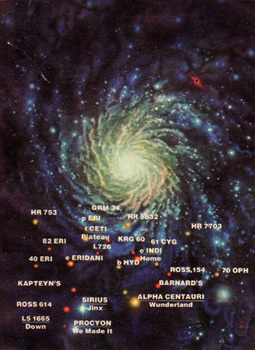
The center of the Galaxy
His ship’s drive flame had become a blood-red fan of light facing intergalactic space. Peerssa was thrusting laterally to bend their course back into the plane of the galaxy.
“Give me a corrected view,” Corbell instructed.
Now Peerssa worked a kind of fiction. From the universe he perceived through the senses on Don Juan’s hull, he extrapolated a picture of the universe seen at rest, and he painted that picture around the wall of the Womb Room.
The galaxy was incomparably beautiful, a whirlpool of light spread out across half the universe. Corbell looked ahead of him for his first view of the galactic core. It was there, just brighter than the rest, and hazy, without definition. He was disappointed. He had thought the close-packed ball of stars would flame with colors. He could pick out no individual stars; only a vague glow around a central bright point. Behind him the stars were similarly blurred.
Is this home?
“That is Saturn. And that is Earth!”
“Corbell, is it not possible that State citizens settled a moon of a Jovian world? Might they have recreated Saturn’s rings for nostalgia and the love of beauty? You tell me. Is the love of beauty that powerful?”
It was a strange concept. It had its attractions, but…“No. It doesn’t hold up. They’d have put the rings around the Jovian for a better view. And why would they build another Mars?”
“Why would the State destroy the topography of Mercury? What removed two-thirds of the atmosphere of Venus and changed its chemistry? Uranus is missing. Ganymede is missing: a body bigger than Mercury. A gas giant more massive than Neptune orbits nearer the sun in a skewed orbit.”
“That hotter sun could have burned away part of Venus’s atmosphere. Mercury…hmmm.”
“What changed the sun? How could the Earth have been moved at all? Corbell, I can’t decide!” There might have been agony in the computer’s voice. Indecision was bad for men, but men could live with it. A man’s memories could fade and grow blurred. But not Peerssa’s…
“They moved the Earth because the sun got too hot,” Corbell speculated.
“What do you imagine? Did the State moor huge rocket motors at the North moor huge rocket motors at the North Pole and fuel them with Venus’s atmosphere? The ocean would have flowed to cover the northern hemisphere! The Earth’s surface would have ripped everywhere, exposing magma!”
“I don’t know. I don’t know. Maybe they had something besides rockets. But that was Mars you showed me, and that’s Saturn, and that’s Earth.
Now three million years in the future Corbell has the power to decide the fate on humanity
Enjoy!
Only once in space Corbell has other plans
As he leaves the Solar System Corbell changes his flight plan for an entirely new deep space destination
He located the lunar base with his signal laser and began transmission.
“This is Corbell for himself, Corbell for himself. I’m getting sick and tired of having to find you every damn time I want to say something. So I’ll give you this all at once.
“I’m not going to any of the stars on your list.
“It’s occurred to me that the relativity equations work better for me the faster I go. If I stop every fifteen light-years to launch a probe, the way you want me to, I could spend two hundred years at it and never get anywhere. Whereas if I just aim the ship in one direction and keep it going, I can build up a ferocious Tau factor.
“It works out that I can reach the galactic hub in twenty-one years, ship’s time, if I hold myself down to one gravity acceleration. And, Pierce, I just can’t resist the idea. You were the one who called me a born tourist, remember? Well, the stars in the galactic hub aren’t like the stars in the arms. And they’re packed a quarter to a half light-year apart, according to your own theories. It must be passing strange in there.
“So I’ll go exploring on my own. Maybe I’ll find some of your reducing-atmosphere planets and drop the probes there. Maybe I won’t. I’ll see you in about seventy thousand years, your time.
about seventy thousand years, your time. By then your precious State may have withered away, or you’ll have colonies on the seeded planets and some of them may have broken loose from you. I’ll join one of them. Or—”
Corbell thought it through, rubbing the straight, sharp line of his nose. “I’ll have to check it out on the computer,” he said. “But if I don’t like any of your worlds when I get back, there are always the Clouds of Magellan. I’ll bet they aren’t more than twenty-five years away, ship’s time.”
The center of the Galaxy
His ship’s drive flame had become a blood-red fan of light facing intergalactic space. Peerssa was thrusting laterally to bend their course back into the plane of the galaxy.
“Give me a corrected view,” Corbell instructed.
Now Peerssa worked a kind of fiction. From the universe he perceived through the senses on Don Juan’s hull, he extrapolated a picture of the universe seen at rest, and he painted that picture around the wall of the Womb Room.
The galaxy was incomparably beautiful, a whirlpool of light spread out across half the universe. Corbell looked ahead of him for his first view of the galactic core. It was there, just brighter than the rest, and hazy, without definition. He was disappointed. He had thought the close-packed ball of stars would flame with colors. He could pick out no individual stars; only a vague glow around a central bright point. Behind him the stars were similarly blurred.
Is this home?
“That is Saturn. And that is Earth!”
“Corbell, is it not possible that State citizens settled a moon of a Jovian world? Might they have recreated Saturn’s rings for nostalgia and the love of beauty? You tell me. Is the love of beauty that powerful?”
It was a strange concept. It had its attractions, but…“No. It doesn’t hold up. They’d have put the rings around the Jovian for a better view. And why would they build another Mars?”
“Why would the State destroy the topography of Mercury? What removed two-thirds of the atmosphere of Venus and changed its chemistry? Uranus is missing. Ganymede is missing: a body bigger than Mercury. A gas giant more massive than Neptune orbits nearer the sun in a skewed orbit.”
“That hotter sun could have burned away part of Venus’s atmosphere. Mercury…hmmm.”
“What changed the sun? How could the Earth have been moved at all? Corbell, I can’t decide!” There might have been agony in the computer’s voice. Indecision was bad for men, but men could live with it. A man’s memories could fade and grow blurred. But not Peerssa’s…
“They moved the Earth because the sun got too hot,” Corbell speculated.
“What do you imagine? Did the State moor huge rocket motors at the North moor huge rocket motors at the North Pole and fuel them with Venus’s atmosphere? The ocean would have flowed to cover the northern hemisphere! The Earth’s surface would have ripped everywhere, exposing magma!”
“I don’t know. I don’t know. Maybe they had something besides rockets. But that was Mars you showed me, and that’s Saturn, and that’s Earth.
Now three million years in the future Corbell has the power to decide the fate on humanity
Enjoy!

November 29, 2009
(Re-read this as part of summer-long nostalgia trip of Larry Niven's Known Space books. Although A World Out of Time, takes place in a different fictional universe, I had good memories of the book and this felt like the right time to revisit.)
There is one major difference between this book and any of the Known Space series that you should know about --- no FTL --- hence no hyperspace, no Outsider drive, no instantaneous communication. What we have is the lightspeed-observing Buzzard ramjet - on a trip to the core of the galaxy. With this key limitation, Niven's narrative has to work with centuries of transit time, long stretches crossing the empty gulfs of space, and all the arcane physics dealing with astrogation, cosmology and time dilation. Is the master up to the challenge?
In A World Out of Time, the protagonist, Jerome Corbell, travels to the core of the galaxy and back, over an external elapsed time of 3 million years and Corbell's body clock of about a century and a half. He returns to a solar system that is drastically changed, with the sun cooler and red, and Earth in orbit around a warmed-up Jupiter. Then the action shifts groundside as Corbell explores the plate-shifted continents. Niven sprinkles this with antagonists/allies, including the digital entity, Peerssa, the aging dowager, Mirelly, and a troop of the human post-genitors, the immortal Boys.
The narrative is sequential; each change in time and setting is essentially a stand-alone story. The first half of the book is fast-paced and unpredictable; all about the physics, with vintage hard SF story-telling from Niven. The second half, taking place on Earth, is more tourist-y with some emotional impetus from Corbell-chasers. Though the tale still moves fast, it is oddly thin without the heavy science. It can only end one way, and does.
The expected Niven themes are here: immortality, highly intelligent, rational characters, logical development and framework, sexual motives. If I stopped halfway, this would have been 5 stars, but the balance of the book really didn't work as well and so my updated rating. I think Niven used what he learned from this book to write better books later in his career. He also learned to avoid the slower-than-light backstory and embrace hyperspace. He must have liked FTL so much because he later made up Hyperspace II.
Post-script: Notwithstanding the challenges, writers still try galactic space opera without FTL. One such is Alastair Reynolds with his Revelation Space series and the recent House of Suns. It does require a real nerdy writer though.

September 11, 2012
As always Larry Niven is better at coming up with great story ideas than actually writing them.
This one starts out feeling like a short-story, and as such it is fantastic. Without giving away too much of the plot, the first part of the story is a grand adventure of galactic proportions. Then the reader, along with the protagonist, comes back to a well-worn Niven cliche of blazing fast scene changes, obscure science and an ultimate adherence to the law of Chekhov's gun.
Some parts are fun, action scene/chase movie fun. The hard science gets in the way of the writing at times--it would be better if the story followed the rules of hard science, and had less plot driven by pounding the math into our heads.
A great deal of it feels like The Pak Protectors reversed. And the characters might as well be lifted from any number of other Niven novels, they speak with the same voice, they have the same sudden insights into math/stellar mechanics/population genetics/electro-chemical theory/deus es machina to move the plot along or back to where ever it is supposed to be going.
If you enjoyed The Ringworld novels this won't disappoint, but it also won't amaze.
This one starts out feeling like a short-story, and as such it is fantastic. Without giving away too much of the plot, the first part of the story is a grand adventure of galactic proportions. Then the reader, along with the protagonist, comes back to a well-worn Niven cliche of blazing fast scene changes, obscure science and an ultimate adherence to the law of Chekhov's gun.
Some parts are fun, action scene/chase movie fun. The hard science gets in the way of the writing at times--it would be better if the story followed the rules of hard science, and had less plot driven by pounding the math into our heads.
A great deal of it feels like The Pak Protectors reversed. And the characters might as well be lifted from any number of other Niven novels, they speak with the same voice, they have the same sudden insights into math/stellar mechanics/population genetics/electro-chemical theory/deus es machina to move the plot along or back to where ever it is supposed to be going.
If you enjoyed The Ringworld novels this won't disappoint, but it also won't amaze.

June 18, 2018
"Свят извън времето" не е награждавано произведение. Има само едно пето място за Локус през 1977 г. Майната му на това!
Темпото на написаното варира, като перфектно отразява случващото се. Главният герой преминава през много, променя се и еволюира. Интересни второстепенни герои.
Писан преди над четиредесет години, всеки съвременен фантаст би могъл да завижда! Сюжетът започва през 1970-а и завършва три милиона години по-късно (!!%№*!!!)!
Лари Нивън не е сред най-популярните фантасти у нас. Това е странно, при положение, че е печелил всички най-големи литературни награди (повечето - по няколко пъти). В България са издадени десетина книжки с неговото име, което е голяма загуба. Макар и скромно да съм прочел около половината, и то преди над десет години, все още успявам да си спомня по нещо за всяка от тях (рядко явление за мен).
Винаги интересен и оригинален, способен да опише свят не - а цяла вселена в сравнително малко страници. Мащабността - пространствено и времево, му приляга като момченце на католически свещеник! 6*!!!
Темпото на написаното варира, като перфектно отразява случващото се. Главният герой преминава през много, променя се и еволюира. Интересни второстепенни герои.
Писан преди над четиредесет години, всеки съвременен фантаст би могъл да завижда! Сюжетът започва през 1970-а и завършва три милиона години по-късно (!!%№*!!!)!
Лари Нивън не е сред най-популярните фантасти у нас. Това е странно, при положение, че е печелил всички най-големи литературни награди (повечето - по няколко пъти). В България са издадени десетина книжки с неговото име, което е голяма загуба. Макар и скромно да съм прочел около половината, и то преди над десет години, все още успявам да си спомня по нещо за всяка от тях (рядко явление за мен).
Винаги интересен и оригинален, способен да опише свят не - а цяла вселена в сравнително малко страници. Мащабността - пространствено и времево, му приляга като момченце на католически свещеник! 6*!!!

December 20, 2013
I think I'm going to have to give up on Niven. I thought I'd read one or two of his books that I really liked, but maybe I'm thinking of some other writer.
A World Out of Time started off pretty well, with the very intriguing concept of bringing cryogenically frozen patients back to life by transplanting their personalities into convicted felons whose punishment is essentially being turned into empty vessels for other personalities to take over.
It continues to be an interesting read during the main character's journey into the future on a spaceship. But when he returns to earth 3 million years in the future to a very changed Earth, that's when the story falls apart. The two halves of the book really have nothing at all to do with each other, and I found myself just wanting to get through to the end so I could go on to something else.
Didn't like the characters, the plot was disjointed, choppy and often felt like some kind of science fiction keystone cops with people racing around all over the place searching for something they weren't even sure really existed.
Wouldn't recommend it.
A World Out of Time started off pretty well, with the very intriguing concept of bringing cryogenically frozen patients back to life by transplanting their personalities into convicted felons whose punishment is essentially being turned into empty vessels for other personalities to take over.
It continues to be an interesting read during the main character's journey into the future on a spaceship. But when he returns to earth 3 million years in the future to a very changed Earth, that's when the story falls apart. The two halves of the book really have nothing at all to do with each other, and I found myself just wanting to get through to the end so I could go on to something else.
Didn't like the characters, the plot was disjointed, choppy and often felt like some kind of science fiction keystone cops with people racing around all over the place searching for something they weren't even sure really existed.
Wouldn't recommend it.

August 20, 2023
It seems like Niven is either all on or just weird af. This falls in the latter category. While the idea of life around Jupiter is interesting (and strangely similar in some ways to Titan), the initial ideas get weighted down with the implausible (and oh-so-70s) notion of a genocidal sex war which wipes out all the Girls in favor of the Boys. It just gets a bit stranger from there. I still gave it 3 stars because of the initial ideas and only read it because it is part of The State series by Niven which includes Locus winner The Integral Trees that I enjoyed far more than this first one.

January 15, 2014
Charting humanity's future history
20 January 2014
There are a number of science-fiction books around where the author attempts to chart the future history, in a speculative manner of course, of humanity. Isaac Asimov does that in his Foundation universe (which begins with the Robot stories and ends with Foundation and Earth) and Larry Niven does the same thing with A World Out of Time. The theme that I see in this idealistic setting is how humanity can create the perfect society in the perfect world. This is the ultimate goal of the Asimov books, however it seems to have turned out differently with Niven. What we have is the development of humanity to three million years in the future, and with every step forward they take at least two steps backwards.
The story is based around a man named Corbell. He died of cancer in the 70s and before he died he had his body frozen in the belief that in the future, when they found a way to cure him, they could unfreeze him. Unfortunately the technology of the 70s (and even now) meant that that was never going to happen because as soon as you unfreeze the body the cells are irrevocably destroyed (actually the act of freezing the body inevitably destroys them). What they have managed to do is to extract his personality and implant it into the body of a criminal, whose mind has been wiped, and then send him on a mission to seed potential worlds with the anticipation of colonising them in the future. However, Corbell has different ideas, and deciding that he doesn't like the world in which he has awoken, turns the ship around and flies into the centre of the galaxy.
The scene where he travels through the centre of the galaxy is by far my favourite, even though it is highly speculative. The descriptions of the 'flattened stars' caused by a massive black hole, and a ring of fire light years in diameter is extraordinary. However, Corbell then turns around and heads back to Earth to discover that everything has changed (which is not surprising because he has travelled three million years in the future). When he arrives he discovers that Earth now orbits Jupiter (which has become a star) and there are planets missing. Also Earth is mostly a barren desert, with the exception of the Antarctic, which is a lush rain forest. The inhabitants of the Earth have also changed, which I will get too. However, when he arrives, he meets a woman who captures him, tells him of an immortality that had been developed by the 'dictators' and sends him on a quest to find this immortality.
Anyway, I want to talk about the future that Niven has developed, because through the book we gradually learn how Earth arrived at this situation. Basically after Corbell died Earth descended into chaos in what is known as the Brush Wars. From what I gathered civilisation collapsed and the various countries ended up warring with each other in limited wars. In the aftermath a technocracy known as the state developed. It was seen that the democratic states that we have at the moment do not lead to order, and thus the concepts of freedom and liberty where shelved to be replaced with a totalitarian state which created a form of order. This state will dictate people's lives, and to rebel against the state is the highest crime, punishable by death. I see this developing at the moment, which is the danger of what I call the technocracy. Where I work is a classic example of the technocracy as the computer decides when we start, when we finish, and when we take our break. In many cases we are chained to our desk. Why? Because the corporation knows that it cannot trust its employees. Even my managers are chained to their desks.
What happened after is that a ruling class developed, when became to be known as the dictators, and the dictators developed a form of immortality (which is the subject of the quest, that he ends up discovering). As the dictatorship entrenches itself, a two class system develops, and as the classes become ever more separate (remember, in our world today we can still move between classes, but as the ruling class becomes ever more entrenched, it becomes ever harder to move between it) the dictators become like gods, especially since the have immortality and the lower classes do not. All the while, the state is sending out ships and colonising worlds.
During the story they discuss the idea of the 'water empire': that is that the state that controls the water is indestructible. However, as the state grows stronger, it becomes ever more decadent, to the point where a single push from an outside force can topple it, but it can never be toppled from within because the state controls the water (which is like where we are because the state, which includes our corporate masters, control the electricity production and water collection and distribution, among other things, which means that they provide us with the means of life and to overthrow the state means that we will destroy the means of our survival and thus we will perish).
Yet things did not go well for the state because it turns out that this idea did not work. As they colonised the worlds, and as the colonies became strong, they were able to fight back against the state which meant that the water empire was actually not all that powerful. We saw that with Britain who had the United States rebel and declare independence, and has in turn become the powerful state with Britain a shadow of its former glory.
Niven goes further though because as technology progresses, the means of reproduction increases to the point that one does not need sex. As such humanity does not need to grow to puberty, and thus humanity remain as children, and while they may grow in wisdom, they do not grow in age, which ends up creating another division: a division between the boys and the girls. When the sexes no longer need each other, the sexes end up becoming tribes in themselves and, surprise, surprise, end up going to war with each other because, well, they are different.
So, what we see in this book is that technology does not necessarily offer us hope, or freedom, or even peace. Humanity, at its heart, will desire to war against that which is different. Humanity, at its heart, will also sacrifice order for freedom. In fact the struggle between order and freedom is one that is deep within our modern conscience. We seek to live in an ordered society, free from fear and from hurt, but to have that freedom we must sacrifice our freedom of thought, which we do not want to do, thus conflict will arise. In the end, three million years will not bring peace, happiness, and a heavenly existence, it will simply return us to a barbaric state where we are still at war with one another.
20 January 2014
There are a number of science-fiction books around where the author attempts to chart the future history, in a speculative manner of course, of humanity. Isaac Asimov does that in his Foundation universe (which begins with the Robot stories and ends with Foundation and Earth) and Larry Niven does the same thing with A World Out of Time. The theme that I see in this idealistic setting is how humanity can create the perfect society in the perfect world. This is the ultimate goal of the Asimov books, however it seems to have turned out differently with Niven. What we have is the development of humanity to three million years in the future, and with every step forward they take at least two steps backwards.
The story is based around a man named Corbell. He died of cancer in the 70s and before he died he had his body frozen in the belief that in the future, when they found a way to cure him, they could unfreeze him. Unfortunately the technology of the 70s (and even now) meant that that was never going to happen because as soon as you unfreeze the body the cells are irrevocably destroyed (actually the act of freezing the body inevitably destroys them). What they have managed to do is to extract his personality and implant it into the body of a criminal, whose mind has been wiped, and then send him on a mission to seed potential worlds with the anticipation of colonising them in the future. However, Corbell has different ideas, and deciding that he doesn't like the world in which he has awoken, turns the ship around and flies into the centre of the galaxy.
The scene where he travels through the centre of the galaxy is by far my favourite, even though it is highly speculative. The descriptions of the 'flattened stars' caused by a massive black hole, and a ring of fire light years in diameter is extraordinary. However, Corbell then turns around and heads back to Earth to discover that everything has changed (which is not surprising because he has travelled three million years in the future). When he arrives he discovers that Earth now orbits Jupiter (which has become a star) and there are planets missing. Also Earth is mostly a barren desert, with the exception of the Antarctic, which is a lush rain forest. The inhabitants of the Earth have also changed, which I will get too. However, when he arrives, he meets a woman who captures him, tells him of an immortality that had been developed by the 'dictators' and sends him on a quest to find this immortality.
Anyway, I want to talk about the future that Niven has developed, because through the book we gradually learn how Earth arrived at this situation. Basically after Corbell died Earth descended into chaos in what is known as the Brush Wars. From what I gathered civilisation collapsed and the various countries ended up warring with each other in limited wars. In the aftermath a technocracy known as the state developed. It was seen that the democratic states that we have at the moment do not lead to order, and thus the concepts of freedom and liberty where shelved to be replaced with a totalitarian state which created a form of order. This state will dictate people's lives, and to rebel against the state is the highest crime, punishable by death. I see this developing at the moment, which is the danger of what I call the technocracy. Where I work is a classic example of the technocracy as the computer decides when we start, when we finish, and when we take our break. In many cases we are chained to our desk. Why? Because the corporation knows that it cannot trust its employees. Even my managers are chained to their desks.
What happened after is that a ruling class developed, when became to be known as the dictators, and the dictators developed a form of immortality (which is the subject of the quest, that he ends up discovering). As the dictatorship entrenches itself, a two class system develops, and as the classes become ever more separate (remember, in our world today we can still move between classes, but as the ruling class becomes ever more entrenched, it becomes ever harder to move between it) the dictators become like gods, especially since the have immortality and the lower classes do not. All the while, the state is sending out ships and colonising worlds.
During the story they discuss the idea of the 'water empire': that is that the state that controls the water is indestructible. However, as the state grows stronger, it becomes ever more decadent, to the point where a single push from an outside force can topple it, but it can never be toppled from within because the state controls the water (which is like where we are because the state, which includes our corporate masters, control the electricity production and water collection and distribution, among other things, which means that they provide us with the means of life and to overthrow the state means that we will destroy the means of our survival and thus we will perish).
Yet things did not go well for the state because it turns out that this idea did not work. As they colonised the worlds, and as the colonies became strong, they were able to fight back against the state which meant that the water empire was actually not all that powerful. We saw that with Britain who had the United States rebel and declare independence, and has in turn become the powerful state with Britain a shadow of its former glory.
Niven goes further though because as technology progresses, the means of reproduction increases to the point that one does not need sex. As such humanity does not need to grow to puberty, and thus humanity remain as children, and while they may grow in wisdom, they do not grow in age, which ends up creating another division: a division between the boys and the girls. When the sexes no longer need each other, the sexes end up becoming tribes in themselves and, surprise, surprise, end up going to war with each other because, well, they are different.
So, what we see in this book is that technology does not necessarily offer us hope, or freedom, or even peace. Humanity, at its heart, will desire to war against that which is different. Humanity, at its heart, will also sacrifice order for freedom. In fact the struggle between order and freedom is one that is deep within our modern conscience. We seek to live in an ordered society, free from fear and from hurt, but to have that freedom we must sacrifice our freedom of thought, which we do not want to do, thus conflict will arise. In the end, three million years will not bring peace, happiness, and a heavenly existence, it will simply return us to a barbaric state where we are still at war with one another.

September 1, 2025
Sadly I just did not find this particularly engaging. My mind wandered and while I found some parts imaginative, other parts decidedly were not. I wanted to like it more. I had to listen to some of it as an audiobook. I found it a bit more interesting that way. So I'm going to try the next book in this series as an audiobook. We'll see what happens.

April 21, 2021
Едно от не толкова добрите произведения на Нивън, но само спрямо другите му творби. Идеите засегнати вътре все пак са доста амбициозни и сериозни. Преустройството на слънчевата система е чук. Смели и мащабни идеи, които някак ми липсват в съвременната фантастика. Има и доста сериозни заигравки с теория на относителността и времевите парадокси покрай нея. Не ми хареса чисто социалната страна на романа. На прага между златните години на научната фантастика и новата вълна Нивън се пробва, но набутва прекалено много Хайнлайн(ар)щини, за да ми хареса.
Корбел е наш съвременник, който е предпочел да замрази тялото си, пред леталната алтернатива. Събуждат го в едно доста мрачно бъдеще, където Държавата е постигнала тотален тоталитарен режим. Авантюрист по душа (макар архитект по призвание и образование) Корбел успява да излъже наблюдателите си и да предприеме пътуване до центъра на галактиката. Завръща се след три милиона години реално време. Слънччевата система е прекроена от човешката наука, но човечеството е затънало в един уелсов социален сценарий. Дали и как ще успее да се намести в него нашия архитект? И най-вече ще открие ли забравената тайна на вечната младост?
Книгите за завръщане от космоса на Земята след много време се броят на пръстите на едната ръка (Плът на Фармър, Завръщане от звездите на Лем, имаше още една, не си спомням в момента...). Този сегмент от времевата фантастика винаги ме е радвал с такива малко популяризирани теми в научната фантастика, но не му се е получило точпровокативността си. Нивън, верен на себе си не се бои да се впусне дори в но както трябва.
Корбел е наш съвременник, който е предпочел да замрази тялото си, пред леталната алтернатива. Събуждат го в едно доста мрачно бъдеще, където Държавата е постигнала тотален тоталитарен режим. Авантюрист по душа (макар архитект по призвание и образование) Корбел успява да излъже наблюдателите си и да предприеме пътуване до центъра на галактиката. Завръща се след три милиона години реално време. Слънччевата система е прекроена от човешката наука, но човечеството е затънало в един уелсов социален сценарий. Дали и как ще успее да се намести в него нашия архитект? И най-вече ще открие ли забравената тайна на вечната младост?
Книгите за завръщане от космоса на Земята след много време се броят на пръстите на едната ръка (Плът на Фармър, Завръщане от звездите на Лем, имаше още една, не си спомням в момента...). Този сегмент от времевата фантастика винаги ме е радвал с такива малко популяризирани теми в научната фантастика, но не му се е получило точпровокативността си. Нивън, верен на себе си не се бои да се впусне дори в но както трябва.

March 24, 2022
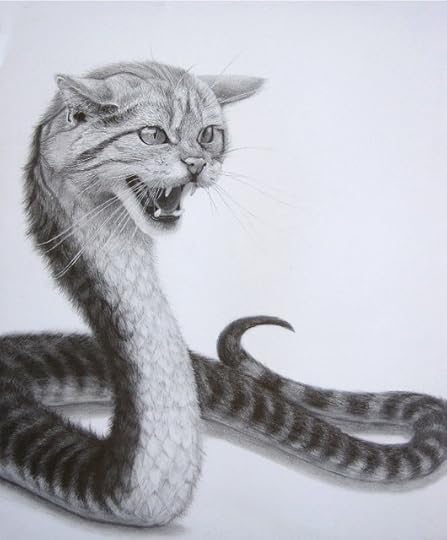
I found this book last summer at the annual Newtown Library book sale. Having enjoyed Niven's Ringworld series, I thought that I'd give it a try. I didn't notice that cat-snake thing on the cover right away. I think my mind blocked out the head because you look at that thing and think, "WTF?"
The book blurb covers the events that transpire over the first third of the book. The remaining two-thirds deals with Corbell alternating between figuring out how to stay alive—he's well over a century old and not long for the world—and figuring out how the hell Earth got so screwed up while he was away.
Published in 1976, it has a lot of the literary elements common to sci-fi during this period (New Wave): sex, the end of civilization, alienation, social isolation, and class discrimination. Throw in a dose of libertarian distrust of the state and you're good to go. Niven also spends a good deal of time playing with physics puzzles to convince the reader that this is hard sci-fi and not space fantasy. I don't think it was necessary, but maybe he felt the need to placate that crowd.
It was an entertaining story despite the warts: The sex scenes were totally male fantasy, and women were reduced to the maiden/mother/crone trope. Corbell isn't the best person to be a protagonist—he could be annoying at times—but he occasionally shows promise. Ultimately, he's all we've got. We have to root for him so that we can find out why things got to be the way they are. The explanation was worth the ride, though I wouldn't blame women for disagreeing.
The book blurb covers the events that transpire over the first third of the book. The remaining two-thirds deals with Corbell alternating between figuring out how to stay alive—he's well over a century old and not long for the world—and figuring out how the hell Earth got so screwed up while he was away.
Published in 1976, it has a lot of the literary elements common to sci-fi during this period (New Wave): sex, the end of civilization, alienation, social isolation, and class discrimination. Throw in a dose of libertarian distrust of the state and you're good to go. Niven also spends a good deal of time playing with physics puzzles to convince the reader that this is hard sci-fi and not space fantasy. I don't think it was necessary, but maybe he felt the need to placate that crowd.
It was an entertaining story despite the warts: The sex scenes were totally male fantasy, and women were reduced to the maiden/mother/crone trope. Corbell isn't the best person to be a protagonist—he could be annoying at times—but he occasionally shows promise. Ultimately, he's all we've got. We have to root for him so that we can find out why things got to be the way they are. The explanation was worth the ride, though I wouldn't blame women for disagreeing.

March 25, 2013
Okay boys and girls, are you ready for the ultimate water-controlling state? No? Well tough, because other boys and girls have become immortal and have misplaced the Earth next to Jupiter and you're a corpsicle and you're a LONG way from home. Or at least a short hop to the center of the galaxy and back can be considered a long way, if only in relativistic time.
Sure, the characters are sometimes spotty, but as a fantastic idea-generator, Niven excels. I think I might enjoy the novels even more because I like to use my own imagination while I read and fill in the blanks as I go, giving more depth to the worlds I see. There's plenty to add, and they're always a fun ride. When I was younger I absolutely adored them, and as I am now, I'm tempted to say I still adore them. Don't get into these expecting a great artistic masterpiece, but if you don't mind coloring in a few lines yourself, you'll be richly rewarded.
Sure, the characters are sometimes spotty, but as a fantastic idea-generator, Niven excels. I think I might enjoy the novels even more because I like to use my own imagination while I read and fill in the blanks as I go, giving more depth to the worlds I see. There's plenty to add, and they're always a fun ride. When I was younger I absolutely adored them, and as I am now, I'm tempted to say I still adore them. Don't get into these expecting a great artistic masterpiece, but if you don't mind coloring in a few lines yourself, you'll be richly rewarded.

December 22, 2012
I have always enjoyed a good Niven story. IMHO this is no exception. (I'll get to the 3 star rating).
I've often said nobody does aliens like Niven. Well this story takes a different turn. He shows us an alien earth after millions of years of evolution and genetic engineering. I think his use of relativistic time and it's effect on deep space travel is fascinating. He can take hard science and big ideas and write a story that is easy and enjoyable to follow.
Reasons for 3 star and not 4 or 5
This unique plot turns into typical Niven. While enjoyable I couldn't help but think it could have developed into something different, something better. Everything got wrapped up in a nice package in the end but with such a great concept he could have really blown our minds. Maybe I'm being too critical.
Ok, something that's not pleasant for me, that I kind of feel compelled to mention. Niven is accused from time to time as being sexist. Now in past stories I have always given him the benefit of the doubt. I've read the Fleet of Worlds series and never got the idea. However, in this story it seems to come across boldly. Don't know how else to say it but it's there. Anyways, I'm still a fan and believe he has plenty of material wherein this is not an issue.

November 27, 2012
This is my third Niven book and I just can't get enough. My favorite book so far as been Ringworld but I also found this one to be very interesting. It involves plenty of space travel, some AI, and plenty of dystopia. I loved how the novel technically takes place over a huge time period because the main character goes into cryo so often. This book encompasses so many theories of how the world could go in the future: What if girls ruled the sky and boys ruled the earth? What if adults were just used to make children? What if there was immortality? What if you could move planets? Plus there's a whole Les Mis kinda part where a government official is obsessed with bringing to justice the main character. Lots of action and plenty of interesting science.

June 24, 2010
Larry Niven is one of the grandmasters of science fiction. He knows how to weave hard science, characterization, and plot into an interesting and compelling tapestry. A World Out Of Time is rich in hard science but a little light in the plot and characterization areas. However, it is an entertaining blend of hard science and adventure story.
The Plot
A man named Jaybee Corbell was frozen in the late 20th century due to incurable cancer. Since the freezing process destroys cells, Corbell is revived by implanting his consciousness into the body of a felon convicted of a capital crime. This takes place in the 25th century.
Corbell is conscripted by the autocratic government into flying a seedship to other planets. This ship would drop terraforming pods to the planets to prepare them for colonization by humanity. Subjectively, only 30 years would pass for Corbell, while 40 thousand years would pass for earth.
Corbell agrees to this but ends up stealing the ship and taking it to the center of the galaxy; a trip that will take him about 120 years subjectively, but over 3 million years according to earth's time.
Corbell goes on this joyride and, through shipboard medical treatments and suspended animation, he makes the trip successfully, although he is an old man by the time he gets back to earth.
Earth meanwhile, has changed drastically and Corbell has to adapt, as he and his ship can't make another trip.
The Good
First of all, the physical science is sound in this book. I really liked that. The foolishness of cryonics is explained well (water in the cells of the body will expand when in reaches 0 degrees C and cause the cells to burst...therefore irrevocably destroying the tissues of the body). The relativistic consequences of interstellar travel are well addressed. There's no convenient sci-fi faster-than-light travel or communications in this book.
Secondly, some of the speculative science was interesting. The usage of teleportation devices was well thought out and the usage of specially tailored RNA imprinting to enhance the learning process was particularly intriguing.
The political discussion of "water governments" (totalitarian governments that possess total and complete control of all available natural resources) was also interesting.
The physical/environmental description of Earth 3 million years in the future was pretty cool. I really enjoyed that part of the story.
The Not-So-Good
The characters were not very well-fleshed-out. They were all kind of two-dimensional and throw-away. That's pretty much expected for an adventure tale, but I can't help but think that, with better characters, this novel would have perhaps appealed to a wider audience.
Also, the political/sociological description of the Earth 3 million years in the future was rather disappointing. Perhaps that wasn't supposed to be part of the book. I can't help but think, though, that, even if homo sapiens exists 3 million years in the future, the society, art, and architecture would be so different that it would be like meeting an alien race. I freely admit I could be wrong about this.
Conclusion
A World Out Of Time is worth a read if you're wanting a good old sci-fi adventure with some hard science thrown into the mix. If you're not a sci-fi fanatic, then you'll want to give this one a pass, though.
The Plot
A man named Jaybee Corbell was frozen in the late 20th century due to incurable cancer. Since the freezing process destroys cells, Corbell is revived by implanting his consciousness into the body of a felon convicted of a capital crime. This takes place in the 25th century.
Corbell is conscripted by the autocratic government into flying a seedship to other planets. This ship would drop terraforming pods to the planets to prepare them for colonization by humanity. Subjectively, only 30 years would pass for Corbell, while 40 thousand years would pass for earth.
Corbell agrees to this but ends up stealing the ship and taking it to the center of the galaxy; a trip that will take him about 120 years subjectively, but over 3 million years according to earth's time.
Corbell goes on this joyride and, through shipboard medical treatments and suspended animation, he makes the trip successfully, although he is an old man by the time he gets back to earth.
Earth meanwhile, has changed drastically and Corbell has to adapt, as he and his ship can't make another trip.
The Good
First of all, the physical science is sound in this book. I really liked that. The foolishness of cryonics is explained well (water in the cells of the body will expand when in reaches 0 degrees C and cause the cells to burst...therefore irrevocably destroying the tissues of the body). The relativistic consequences of interstellar travel are well addressed. There's no convenient sci-fi faster-than-light travel or communications in this book.
Secondly, some of the speculative science was interesting. The usage of teleportation devices was well thought out and the usage of specially tailored RNA imprinting to enhance the learning process was particularly intriguing.
The political discussion of "water governments" (totalitarian governments that possess total and complete control of all available natural resources) was also interesting.
The physical/environmental description of Earth 3 million years in the future was pretty cool. I really enjoyed that part of the story.
The Not-So-Good
The characters were not very well-fleshed-out. They were all kind of two-dimensional and throw-away. That's pretty much expected for an adventure tale, but I can't help but think that, with better characters, this novel would have perhaps appealed to a wider audience.
Also, the political/sociological description of the Earth 3 million years in the future was rather disappointing. Perhaps that wasn't supposed to be part of the book. I can't help but think, though, that, even if homo sapiens exists 3 million years in the future, the society, art, and architecture would be so different that it would be like meeting an alien race. I freely admit I could be wrong about this.
Conclusion
A World Out Of Time is worth a read if you're wanting a good old sci-fi adventure with some hard science thrown into the mix. If you're not a sci-fi fanatic, then you'll want to give this one a pass, though.

August 14, 2016
It puzzled me for a while; when you look at the listing for the audiobook of Larry Niven's wonderful 1984 novel
The Integral Trees
on Amazon, it has a parenthetical comment, (The State series, Book 2). The Kindle and print listings note this same novel as (The Smoke Ring series Book 1). I began to get paranoid. Was there a pre-
IT
novel written about a powerful State for that ominous year?
Yes, there was. It turns out that reading the first novel last is a good thing.
In 1976, well ahead of building the world of The Smoke Ring, Niven published a far-future novel that included many of the cultural building-blocks of the SR series: AI personalities super-loyal to the State, slave corpsicles, and evolutionary, adaptive changes to the human body and mind.
A World Out of Time begins long before Discipline arrives at the gas-torus smoke ring. Jaybee Corbell had legally died long ago from the cancer that led him to be cryogenically preserved, but RNA from his frozen cells retained enough of his personal memories to be harvested and implanted in an empty body. The predecessor in Corbell's new corpus had been a brain-wiped criminal.
Corbell is not a citizen. As a corpsicle, he owes the State his life. He can repay his debt with thirty or forty years of slave labor, and become a citizen in the end. But the only job he's suited for is ramjet driver, and that's a life sentence alone in space. The State has strict plans for his tasks and journey aboard the starship he will command, and they program his loyalty with suitable additional RNA doses.
Unfortunately for the State, Corbell has his own plan, to travel to the galactic core, and he manages to overcome his programmed State loyalty to steal the ramjet on its way out of the Solar System. In a last-ditch effort to bring him back, a minion of the State remote-programs his ship's computer with his own personality, but to no avail. Eventually, Corbell's 200+ years of ship-time bring him back to an Earth nearly 3 million years advanced. Changed. Moved to orbit Jupiter after something made Sol run hotter.
It is not only the planet that has changed. Humanity has split again; once corpsicles and citizens, now it is divided between immortal—but sexless—Boys and Girls, and normally aging and dying—but reproductively active—adults. There is even at least one survivor (via a "zero-time" prison) from the time of Corbell's State.
Then there's the AI ship, Perssa, who might yet, at last, have something to say about Corbell's fate.
Wide-ranging, epic even when the world-building is restricted to the Solar System, this novel deserved to be resurrected and included with the SR novels. I'm glad the cryptic Amazon label on an audiobook sent me looking for it.
Yes, there was. It turns out that reading the first novel last is a good thing.
In 1976, well ahead of building the world of The Smoke Ring, Niven published a far-future novel that included many of the cultural building-blocks of the SR series: AI personalities super-loyal to the State, slave corpsicles, and evolutionary, adaptive changes to the human body and mind.
A World Out of Time begins long before Discipline arrives at the gas-torus smoke ring. Jaybee Corbell had legally died long ago from the cancer that led him to be cryogenically preserved, but RNA from his frozen cells retained enough of his personal memories to be harvested and implanted in an empty body. The predecessor in Corbell's new corpus had been a brain-wiped criminal.
Corbell is not a citizen. As a corpsicle, he owes the State his life. He can repay his debt with thirty or forty years of slave labor, and become a citizen in the end. But the only job he's suited for is ramjet driver, and that's a life sentence alone in space. The State has strict plans for his tasks and journey aboard the starship he will command, and they program his loyalty with suitable additional RNA doses.
Unfortunately for the State, Corbell has his own plan, to travel to the galactic core, and he manages to overcome his programmed State loyalty to steal the ramjet on its way out of the Solar System. In a last-ditch effort to bring him back, a minion of the State remote-programs his ship's computer with his own personality, but to no avail. Eventually, Corbell's 200+ years of ship-time bring him back to an Earth nearly 3 million years advanced. Changed. Moved to orbit Jupiter after something made Sol run hotter.
It is not only the planet that has changed. Humanity has split again; once corpsicles and citizens, now it is divided between immortal—but sexless—Boys and Girls, and normally aging and dying—but reproductively active—adults. There is even at least one survivor (via a "zero-time" prison) from the time of Corbell's State.
Then there's the AI ship, Perssa, who might yet, at last, have something to say about Corbell's fate.
Wide-ranging, epic even when the world-building is restricted to the Solar System, this novel deserved to be resurrected and included with the SR novels. I'm glad the cryptic Amazon label on an audiobook sent me looking for it.

March 1, 2017
Storyline: 3/5
Characters: 2/5
Writing Style: 2/5
World: 3/5
Niven was one of those talented authors that focused more on quantitative output than qualitative depth, and it was evident here.
A World Out of Time had a lot of great ideas. It dabbled in hard science fiction, politics, near-future prediction, far-future speculation, as well as sociological questions. Each element, however, read as a placeholder. It was if Niven had intended to go back and fill in the details and develop the sections but published rather than follow through with the edits.
I particularly liked the ideas and the setting of the first chapter, but it deserved to be a complete novel - the first of what could have been a trilogy. The full novel would have been a dystopian, near future, psychological thriller. It had the potential to frighten in that way that good dystopias do - to make one realize that these terrible events truly could come about. It had creative science fiction elements that were more than trappings and pointed out some thoughtful ethical problems around scientific advance. Those threads were all present, but they were the threads of an imaginative mind too undisciplined to untangle, sort, and develop the processes and implications for the reader.
The second chapter, too, was deserving of its own volume. This would have been much more of a psychological thriller and fun AI and space story . Here too the author raced through the story.
The rest and bulk of the story was more of a single, coherent novel. In fact, I think the book could have started with chapter three and would have been better for it. Though the best sections were the first two chapters, Niven devotes so much more attention, detail, and space on the less interesting later events that the marked imbalance taints the last two-thirds of the novel. Still, Niven hasn't run out of interesting ideas, and there's fun to be had, particularly if you don't mind that he basically copied over these same ideas into other books of his .
This story would have made for a great graphic novel, I think. It is definitely bad science fiction writing, but I think well of creative ideas, however poorly presented.
Characters: 2/5
Writing Style: 2/5
World: 3/5
Niven was one of those talented authors that focused more on quantitative output than qualitative depth, and it was evident here.
A World Out of Time had a lot of great ideas. It dabbled in hard science fiction, politics, near-future prediction, far-future speculation, as well as sociological questions. Each element, however, read as a placeholder. It was if Niven had intended to go back and fill in the details and develop the sections but published rather than follow through with the edits.
I particularly liked the ideas and the setting of the first chapter, but it deserved to be a complete novel - the first of what could have been a trilogy. The full novel would have been a dystopian, near future, psychological thriller. It had the potential to frighten in that way that good dystopias do - to make one realize that these terrible events truly could come about. It had creative science fiction elements that were more than trappings and pointed out some thoughtful ethical problems around scientific advance. Those threads were all present, but they were the threads of an imaginative mind too undisciplined to untangle, sort, and develop the processes and implications for the reader.
The second chapter, too, was deserving of its own volume. This would have been much more of a psychological thriller and fun AI and space story . Here too the author raced through the story.
The rest and bulk of the story was more of a single, coherent novel. In fact, I think the book could have started with chapter three and would have been better for it. Though the best sections were the first two chapters, Niven devotes so much more attention, detail, and space on the less interesting later events that the marked imbalance taints the last two-thirds of the novel. Still, Niven hasn't run out of interesting ideas, and there's fun to be had, particularly if you don't mind that he basically copied over these same ideas into other books of his .
This story would have made for a great graphic novel, I think. It is definitely bad science fiction writing, but I think well of creative ideas, however poorly presented.

June 1, 2016
A man with a terminal illness in the modern day has himself frozen as a last-ditch attempt to survive. He awakens hundreds of years in the future, in a completely new body and told that he must be in service to the State... or else. Soon, though, he gets a chance to escape and flee into Earth's far far future where many things have changed and survival is even more complicated.
This is 70s-era science fiction, and it shows. The science, while treated with a fair amount of rigor, doesn't really seem realistic anymore as it relies too much on ideas that are no longer en vogue, and much of the rest is handwaved to the point where mind-boggling feats like moving planets is done fairly easily. And as for the social exploration? Well, aside from the results of a few different types of eternal youth, about the most imaginitive the story gets in terms of social development is a loosening of sexual mores and a return to a more primitive lifestyle. There's no wow factor of humans who have become alien in a myriad of different ways. Even gender politics either stay more or less the same or are exaggerated to ridiculous degrees.
The book started fairly well, actually, but before too long the book became a slog for me, and I found I wasn't really even following the more scientific parts of the plot, not because it was above my head but just because I wasn't invested enough in anything happening. There's an extended sequence where the main character runs from an old woman in the ruins of the Earth hundreds of thousands of years in the future that just seemed to drag on endlessly, and although it got briefly better around that, it circled back to that plot in a particularly annoying way. All in all, I've seen much better "trips into the far far future" tales than this.
About the only thing I took away from this book was the description of a far distant genetically altered version of a cat that looked pretty much just a head and tail with no limbs, which proved to me that I would still "awww" at a kitty even if you made it into something like a snake.
This is 70s-era science fiction, and it shows. The science, while treated with a fair amount of rigor, doesn't really seem realistic anymore as it relies too much on ideas that are no longer en vogue, and much of the rest is handwaved to the point where mind-boggling feats like moving planets is done fairly easily. And as for the social exploration? Well, aside from the results of a few different types of eternal youth, about the most imaginitive the story gets in terms of social development is a loosening of sexual mores and a return to a more primitive lifestyle. There's no wow factor of humans who have become alien in a myriad of different ways. Even gender politics either stay more or less the same or are exaggerated to ridiculous degrees.
The book started fairly well, actually, but before too long the book became a slog for me, and I found I wasn't really even following the more scientific parts of the plot, not because it was above my head but just because I wasn't invested enough in anything happening. There's an extended sequence where the main character runs from an old woman in the ruins of the Earth hundreds of thousands of years in the future that just seemed to drag on endlessly, and although it got briefly better around that, it circled back to that plot in a particularly annoying way. All in all, I've seen much better "trips into the far far future" tales than this.
About the only thing I took away from this book was the description of a far distant genetically altered version of a cat that looked pretty much just a head and tail with no limbs, which proved to me that I would still "awww" at a kitty even if you made it into something like a snake.

May 26, 2009
Jaybee Corbell, his cancer-ridden body frozen in 1970, is revived 200 years later in a body that is not his own. Stripped of his own free will, as well as his body, he is a servant to the all-powerful State. His one chance at remaining alive is to rise to the task set before him: pilot a one-way mission out into the universe to seed planets for future population. A last ditch effort at rebellion propels Corbell on a journey through space that will eventually lead him back to Earth…an Earth three million years older than when he left it. It is there, on a world that has reverted to a more primitive state, that Jaybee Corbell’s true adventures begin.
Characterization is not very deep. This is hard/SF (science based) adventure story with interesting characters, but not a deep character study with a few deus ex machina moments.
Not part of Niven’s Known Space universe, 'A World Out of Time' shares a number of similar ideas: devices that provide instantaneous between various locations, the knowledge of how to move planets, fountain-of-youth substances and deep sleep tanks for long space voyages. Even though it's a good introduction to hard/SF, at its heart there is a lot of Edgar Rice Burroughs adventure in it.
Characterization is not very deep. This is hard/SF (science based) adventure story with interesting characters, but not a deep character study with a few deus ex machina moments.
Not part of Niven’s Known Space universe, 'A World Out of Time' shares a number of similar ideas: devices that provide instantaneous between various locations, the knowledge of how to move planets, fountain-of-youth substances and deep sleep tanks for long space voyages. Even though it's a good introduction to hard/SF, at its heart there is a lot of Edgar Rice Burroughs adventure in it.

May 10, 2014
Devo dire che ho avuto molte difficoltà ad attribuire un punteggio univoco a questo eterogeneo, composito e discontinuo romanzo di hard SF. Due i motivi principali: in primo luogo più che un singolo romanzo, Niven ha scritto tre o quattro romanzi incompleti che ha poi cercato di suturare insieme, con risultati analoghi a quelli di Victor Frankeinstein (e per analoghi intendo fallimentari); in secondo luogo Niven ha una buona conoscenza dell’astronomia e delle altre scienze esatte (vantando anche un BA in matematica), ma non riesce a tradurle in materiale narrativo autoconsistente, finendo per mettere insieme intuizioni futuristiche interessanti, applicazioni narrative tecnico-scientifiche stimolanti, irritanti banalità e qualche grossolano errore. Ma il difetto principale del libro è proprio l’eccessiva mole di tematiche fantascientifiche messe insieme in modo confuso e farraginoso, che alla fine mi ha fatto optare per un voto mediocre, anche se mi riprometto di dargli sicuramente altre possibilità, perché penso che le meriti seriamente.
Negli anni Settanta del XX secolo, l’architetto Jerome Corbell, 44 anni, malato terminale di cancro, si è fatto crioconservare nell’attesa che venga scoperta una cura. Si risveglia più di due secoli dopo, nel 2190 e scopre che l’intero Sistema solare è soggetto al potere dello “Stato” (the State), un governo totalitario e impersonale, interessato alla colonizzazione di altri mondi. Corbell scopre anche, con orrore, che il suo corpo è ormai morto e che la sua mente è stata trasferita nel cervello di un galeotto, nel quale gli scienziati hanno fatto tabula rasa (vi ricorda niente?). In questo nuovo corpo Corbell non fa tempo ad ambientarsi perché riceve l’incarico di guidare un astronave - un ramjet di Bussard, capace di viaggiare a velocità relativistiche grazie alla fusione termonucleare di idrogeno tratto dal mezzo interstellare e confinato per mezzo di intensi campi elettromagnetici. Scopo della missione: cercare nuovi mondi adatti ad essere colonizzati dallo Stato, ricorrendo anche a modifiche radicali dei parametri planetari e alla fecondazione artificiale tramite sonde biologiche. Dopo un rapido indottrinamento a suon di iniezioni di RNA (?), Corbell è pronto per partire. Il condizionamento mentale a cui è stato sottoposto si rivela subito inefficace e il nostro protagonista decide di dirottare la nave per compiere una sorta di ultimo viaggio al centro della Galassia per scoprire che cosa c’è laggiù.
Ha termine così il primo capitolo, che in realtà costituisce un racconto pubblicato a sé in altra occasione, e inizia una seconda linea narrativa, incentrata sul viaggio di Corbell verso il buco nero supermassivo al centro della Via Lattea, durante il quale il nostro esploratore alterna lunghi periodi di animazione sospesa a duelli logici con il supercomputer di bordo, Peerssa, diviso tra l’obbedienza allo Stato e quella al pilota del ramjet. Questa è la parte più confusa e noiosa del romanzo: come già nel primo capitolo, sembra che Niven abbia fretta di passare oltre, e in poche pagine condensa eventi e spiegazioni che meritavano un romanzo intero (dal progetto di panspermia dello Stato alle complicate manovre relativistiche del ramjet, dalla crioconservazione al trapianto di “mente”). La storia si fa disordinata, sconclusionata, illogica: non si comprende perché lo Stato si fidi di Corbell (che dirotta l’astronave dopo pochi minuti dalla partenza), né perché il computer di bordo si faccia mettere nel sacco dalle cervellotiche argomentazioni dell’architetto. Al risveglio dall’ibernazione Niven non dedica neanche due pagine… mentre ne dedica forse troppe ai calcoli relativistici che dopo un po’ sembrano emissioni di numeri random. Il viaggio verso il buco nero dovrebbe essere qualcosa di estremamente affascinante, ma anche qui l’autore, e il lettore suo malgrado, non vedono l’ora di passare oltre.
E infatti a un certo punto Corbell e Peerssa decidono alla fine di fare ritorno a “casa”: Corbell è ormai ultracentenario, ma per effetto della dilatazione temporale relativistica sulla Terra sono trascorsi oltre tre milioni di anni! Quando la nave giunge nei pressi del Sistema solare, Corbell fatica a riconoscerlo: il Sole si è ingigantito, facendo evaporare l’atmosfera dei pianeti più vicini, e qualcosa ha alterato la normale successione dei pianeti, facendo finire la Terra nell’orbita di Giove, che ha perso le sue lune e aumentato la sua temperatura. A causa dell’intenso calore irradiato da Giove, le temperature sulla Terra sono elevatissime e su quasi tutto il pianeta ci sono scarse tracce di vita vegetale e animale. Corbell scende sul pianeta e qui inizia il terzo romanzo, della cui trama mi limito a fare solo pochi cenni. Dopo aver scoperto i resti di una civiltà umana avanzatissima, ma ormai decaduta, Corbell incontra un’altra viaggiatrice spazio-temporale, molto anziana come lui, che cerca il segreto dell’immortalità. Costei rivela che molto tempo prima, dopo la fine della civiltà industriale, gli umani si sono differenziati in tre raggruppamenti: due di adolescenti che non invecchiano, i Ragazzi e le Ragazze, e un terzo gruppo che discende dal ceto dirigente dello Stato (i dittatori, ora noti come dikta). Ad un certo punto è scoppiato un conflitto tra i primi due gruppi, che si è concluso con l’estinzione delle Ragazze e la completa desertificazione di quasi tutto il globo terracqueo. I Ragazzi sopravvissuti si sono spostati ai poli, dove il clima è più gradevole e dove vivono anche i dikta, ridotti in schiavitù dai Ragazzi e incaricati di fornire loro nuove vite per consentire il ricambio (per quanto siano congelati nell’adolescenza, i Ragazzi non sono immortali). Corbell decide di recarsi presso i Ragazzi per capire che cosa è accaduto alla Terra, e inizia così un altro romanzo, quello del superstite a un naufragio (aerospaziale) che deve cavarsela da solo in un mondo ostile e sconosciuto. Molti sono gli enigmi che Corbell dovrà sciogliere, prima di approdare a un insolito e un po’ piccante happy end: esiste una sorgente di immortalità? come ha fatto la Terra a finire ad orbitare intorno a Giove? come sono stati creati i coda-gatto e perché? e soprattutto, perché diavolo il pianeta Urano sta puntando diritto verso la Terra?
La psicologia dei personaggi è piuttosto elementare: l’antipatico e insopportabile Corbell è quasi protagonista assoluto, e in quanto uomo di azione, raramente si mette a riflettere su ciò che sta facendo, né avverte mai un senso di profonda solitudine, come dovrebbe visto che spesso si trova solo contro il resto dei viventi. La narrazione gli dà una mano con il suo procedere discontinuo ed ellittico: in alcuni punti sembra quasi di leggere non un romanzo finito, ma una specie di abbozzo che avrebbe bisogno di una buona revisione per ricostruire quei nessi narrativi necessari a rendere più fluidi i ripetuti cambi di prospettiva che si producono spesso all’interno dei singoli capitoli tra un paragrafo e il successivo. Gli altri personaggi importanti (Peerssa, il supercomputer “statale”, la viaggiatrice Mirelly-Lyra, il leader della comunità dei Ragazzi e quello dei dikta) non sono particolarmente profondi e hanno consistenza narrativa solo in contrapposizione al protagonista.
Insomma, Niven ha voluto strafare, mettendo troppa “carne al fuoco” e finendo per bruciarne parecchia. Sebbene Corbell riesca a chiarire molti interrogativi, ne rimangono altrettanti insoluti. Per esempio è piuttosto strano che a livello geologico la superficie terrestre si presenti quasi invariata dopo tre milioni di anni. Altrettanto strano è che di tutte le specie animali ne sia sopravvissuta una semiaddomesticata e dotata di pelliccia (il codagatto, in originale cattail), poco adatta a sopravvivere a quelle temperature. La civiltà industriale che è scomparsa ha lasciato notevoli tracce, soprattutto di natura domotica, ma è difficile pensare che tutti quei congegni che Corbell usa siano ancora ben funzionanti (lo sono ogni volta che servono a far procedere la trama e salvare il nostro) senza una qualche forma di AI che ne permetta il mantenimento in assenza di tecnici “umani”, tanto più che i Ragazzi e i dikta vivono, per necessità o per convinzione, un’esistenza tecnologicamente primitiva. Verso la fine si scopre che i Ragazzi fanno manutenzione sui trasportatori, ma per il resto? Altro elemento che rimane davvero poco chiaro è l’uso delle iniezioni di RNA per potenziare le capacità intellettuali (né si capisce perché i leader dei Ragazzi decidano di dare quest’opportunità a Corbell, per loro un nemico sospetto). L’idea di usare l’attrazione degli altri pianeti come fionda gravitazionale per spostare la Terra e quella di far “muovere” Urano con una propulsione a reazione usando alternativamente fissione e fusione sono molto affascinanti (come del resto il ramjet di Bussard, sulla cui realizzabilità c’era più fiducia ai tempi in cui scriveva Niven), ma forse presuppongono che le Ragazze, che dominavano il cielo con le loro conoscenze di astrofisica, siano state in grado di risolvere il problema dei tre corpi, altrimenti difficilmente sarebbero riuscite a dirigere il viaggio della Terra verso Giove… Niven non ne parla, e del resto nemmeno parla del fatto che gli effetti mareali di Giove avrebbero dovuto rallentare la rotazione della Terra fino a bloccarla in rotazione sincrona, mentre invece afferma che la Terra ruota ancora intorno al proprio asse (pg. 133). Faccio queste osservazioni non per pedanteria, ma perché il nostro autore tiene molto agli aspetti tecnico-scientifici e quindi mi sembra doveroso notare che non sempre riesce a sbrogliare la matassa in modo credibile e coerente. Lo dimostra anche il fatto che c’è una certa confusione tra i concetti di immortalità ed eterna giovinezza, e che le riflessioni politiche sull’essenza dello Stato totalitario e dell’evoluzione della società umana postindustriale vengono continuamente iniziate e poi lasciate a metà, senza mai approfondire abbastanza.
Tantissime sono le suggestioni provenienti da altre opere: da Robinson Crusoe al Signore delle mosche (le comunità primitive di adolescenti), alla Macchina del tempo di Wells (il viaggiatore che va troppo avanti nel futuro e scopre un’umanità divisa in schiavi e padroni, ritornati all’Età della Pietra) etc. Nella gestione della suspense Niven non se la cava male, anche se gli nuoce un po’ la mancanza di coordinazione tra le varie parti della storia. E’ possibile cogliere un certo divertimento ironico dell’autore nel mettere in scena vari episodi di voyeurismo (il romanzo risale al 1976, in piena rivoluzione sessuale) e nell’attribuire allo Stato, pg. 64, l’uso dei gradi Celsius (molto meglio gli anglosassoni gradi Fahrenheit, che diamine!). A pg. 54 Niven riedita con ironia il famoso messaggio ideato da Carl Sagan e Frank Drake e contenuto nelle sonde Pioneer e Voyager, anch’esse risalenti agli anni Settanta.
Nella breve introduzione di Riccardo Valla si accenna al desiderio di Niven di cambiare registro rispetto ai suoi romanzi precedenti e di scrivere un libro che raccontasse di una quest, una ricerca dal sapore medioevale, che “ha per oggetto l’immortalità perduta […] e la promessa della ricostruzione dell’Eden in Terra”, e che si svolge attraverso una serie di prove di iniziazione del protagonista: solo resistendo alle tentazioni e superando le prove, egli raggiungerà il Graal. Questa interessante interpretazione consentirebbe di legare la fantascienza contemporanea al romanzo fantastico.
Consigliato per i seguaci di Archimede di Siracusa ("Datemi una leva e ...").
Sconsigliato per chi ama viaggiare in compagnia.
Negli anni Settanta del XX secolo, l’architetto Jerome Corbell, 44 anni, malato terminale di cancro, si è fatto crioconservare nell’attesa che venga scoperta una cura. Si risveglia più di due secoli dopo, nel 2190 e scopre che l’intero Sistema solare è soggetto al potere dello “Stato” (the State), un governo totalitario e impersonale, interessato alla colonizzazione di altri mondi. Corbell scopre anche, con orrore, che il suo corpo è ormai morto e che la sua mente è stata trasferita nel cervello di un galeotto, nel quale gli scienziati hanno fatto tabula rasa (vi ricorda niente?). In questo nuovo corpo Corbell non fa tempo ad ambientarsi perché riceve l’incarico di guidare un astronave - un ramjet di Bussard, capace di viaggiare a velocità relativistiche grazie alla fusione termonucleare di idrogeno tratto dal mezzo interstellare e confinato per mezzo di intensi campi elettromagnetici. Scopo della missione: cercare nuovi mondi adatti ad essere colonizzati dallo Stato, ricorrendo anche a modifiche radicali dei parametri planetari e alla fecondazione artificiale tramite sonde biologiche. Dopo un rapido indottrinamento a suon di iniezioni di RNA (?), Corbell è pronto per partire. Il condizionamento mentale a cui è stato sottoposto si rivela subito inefficace e il nostro protagonista decide di dirottare la nave per compiere una sorta di ultimo viaggio al centro della Galassia per scoprire che cosa c’è laggiù.
Ha termine così il primo capitolo, che in realtà costituisce un racconto pubblicato a sé in altra occasione, e inizia una seconda linea narrativa, incentrata sul viaggio di Corbell verso il buco nero supermassivo al centro della Via Lattea, durante il quale il nostro esploratore alterna lunghi periodi di animazione sospesa a duelli logici con il supercomputer di bordo, Peerssa, diviso tra l’obbedienza allo Stato e quella al pilota del ramjet. Questa è la parte più confusa e noiosa del romanzo: come già nel primo capitolo, sembra che Niven abbia fretta di passare oltre, e in poche pagine condensa eventi e spiegazioni che meritavano un romanzo intero (dal progetto di panspermia dello Stato alle complicate manovre relativistiche del ramjet, dalla crioconservazione al trapianto di “mente”). La storia si fa disordinata, sconclusionata, illogica: non si comprende perché lo Stato si fidi di Corbell (che dirotta l’astronave dopo pochi minuti dalla partenza), né perché il computer di bordo si faccia mettere nel sacco dalle cervellotiche argomentazioni dell’architetto. Al risveglio dall’ibernazione Niven non dedica neanche due pagine… mentre ne dedica forse troppe ai calcoli relativistici che dopo un po’ sembrano emissioni di numeri random. Il viaggio verso il buco nero dovrebbe essere qualcosa di estremamente affascinante, ma anche qui l’autore, e il lettore suo malgrado, non vedono l’ora di passare oltre.
E infatti a un certo punto Corbell e Peerssa decidono alla fine di fare ritorno a “casa”: Corbell è ormai ultracentenario, ma per effetto della dilatazione temporale relativistica sulla Terra sono trascorsi oltre tre milioni di anni! Quando la nave giunge nei pressi del Sistema solare, Corbell fatica a riconoscerlo: il Sole si è ingigantito, facendo evaporare l’atmosfera dei pianeti più vicini, e qualcosa ha alterato la normale successione dei pianeti, facendo finire la Terra nell’orbita di Giove, che ha perso le sue lune e aumentato la sua temperatura. A causa dell’intenso calore irradiato da Giove, le temperature sulla Terra sono elevatissime e su quasi tutto il pianeta ci sono scarse tracce di vita vegetale e animale. Corbell scende sul pianeta e qui inizia il terzo romanzo, della cui trama mi limito a fare solo pochi cenni. Dopo aver scoperto i resti di una civiltà umana avanzatissima, ma ormai decaduta, Corbell incontra un’altra viaggiatrice spazio-temporale, molto anziana come lui, che cerca il segreto dell’immortalità. Costei rivela che molto tempo prima, dopo la fine della civiltà industriale, gli umani si sono differenziati in tre raggruppamenti: due di adolescenti che non invecchiano, i Ragazzi e le Ragazze, e un terzo gruppo che discende dal ceto dirigente dello Stato (i dittatori, ora noti come dikta). Ad un certo punto è scoppiato un conflitto tra i primi due gruppi, che si è concluso con l’estinzione delle Ragazze e la completa desertificazione di quasi tutto il globo terracqueo. I Ragazzi sopravvissuti si sono spostati ai poli, dove il clima è più gradevole e dove vivono anche i dikta, ridotti in schiavitù dai Ragazzi e incaricati di fornire loro nuove vite per consentire il ricambio (per quanto siano congelati nell’adolescenza, i Ragazzi non sono immortali). Corbell decide di recarsi presso i Ragazzi per capire che cosa è accaduto alla Terra, e inizia così un altro romanzo, quello del superstite a un naufragio (aerospaziale) che deve cavarsela da solo in un mondo ostile e sconosciuto. Molti sono gli enigmi che Corbell dovrà sciogliere, prima di approdare a un insolito e un po’ piccante happy end: esiste una sorgente di immortalità? come ha fatto la Terra a finire ad orbitare intorno a Giove? come sono stati creati i coda-gatto e perché? e soprattutto, perché diavolo il pianeta Urano sta puntando diritto verso la Terra?
La psicologia dei personaggi è piuttosto elementare: l’antipatico e insopportabile Corbell è quasi protagonista assoluto, e in quanto uomo di azione, raramente si mette a riflettere su ciò che sta facendo, né avverte mai un senso di profonda solitudine, come dovrebbe visto che spesso si trova solo contro il resto dei viventi. La narrazione gli dà una mano con il suo procedere discontinuo ed ellittico: in alcuni punti sembra quasi di leggere non un romanzo finito, ma una specie di abbozzo che avrebbe bisogno di una buona revisione per ricostruire quei nessi narrativi necessari a rendere più fluidi i ripetuti cambi di prospettiva che si producono spesso all’interno dei singoli capitoli tra un paragrafo e il successivo. Gli altri personaggi importanti (Peerssa, il supercomputer “statale”, la viaggiatrice Mirelly-Lyra, il leader della comunità dei Ragazzi e quello dei dikta) non sono particolarmente profondi e hanno consistenza narrativa solo in contrapposizione al protagonista.
Insomma, Niven ha voluto strafare, mettendo troppa “carne al fuoco” e finendo per bruciarne parecchia. Sebbene Corbell riesca a chiarire molti interrogativi, ne rimangono altrettanti insoluti. Per esempio è piuttosto strano che a livello geologico la superficie terrestre si presenti quasi invariata dopo tre milioni di anni. Altrettanto strano è che di tutte le specie animali ne sia sopravvissuta una semiaddomesticata e dotata di pelliccia (il codagatto, in originale cattail), poco adatta a sopravvivere a quelle temperature. La civiltà industriale che è scomparsa ha lasciato notevoli tracce, soprattutto di natura domotica, ma è difficile pensare che tutti quei congegni che Corbell usa siano ancora ben funzionanti (lo sono ogni volta che servono a far procedere la trama e salvare il nostro) senza una qualche forma di AI che ne permetta il mantenimento in assenza di tecnici “umani”, tanto più che i Ragazzi e i dikta vivono, per necessità o per convinzione, un’esistenza tecnologicamente primitiva. Verso la fine si scopre che i Ragazzi fanno manutenzione sui trasportatori, ma per il resto? Altro elemento che rimane davvero poco chiaro è l’uso delle iniezioni di RNA per potenziare le capacità intellettuali (né si capisce perché i leader dei Ragazzi decidano di dare quest’opportunità a Corbell, per loro un nemico sospetto). L’idea di usare l’attrazione degli altri pianeti come fionda gravitazionale per spostare la Terra e quella di far “muovere” Urano con una propulsione a reazione usando alternativamente fissione e fusione sono molto affascinanti (come del resto il ramjet di Bussard, sulla cui realizzabilità c’era più fiducia ai tempi in cui scriveva Niven), ma forse presuppongono che le Ragazze, che dominavano il cielo con le loro conoscenze di astrofisica, siano state in grado di risolvere il problema dei tre corpi, altrimenti difficilmente sarebbero riuscite a dirigere il viaggio della Terra verso Giove… Niven non ne parla, e del resto nemmeno parla del fatto che gli effetti mareali di Giove avrebbero dovuto rallentare la rotazione della Terra fino a bloccarla in rotazione sincrona, mentre invece afferma che la Terra ruota ancora intorno al proprio asse (pg. 133). Faccio queste osservazioni non per pedanteria, ma perché il nostro autore tiene molto agli aspetti tecnico-scientifici e quindi mi sembra doveroso notare che non sempre riesce a sbrogliare la matassa in modo credibile e coerente. Lo dimostra anche il fatto che c’è una certa confusione tra i concetti di immortalità ed eterna giovinezza, e che le riflessioni politiche sull’essenza dello Stato totalitario e dell’evoluzione della società umana postindustriale vengono continuamente iniziate e poi lasciate a metà, senza mai approfondire abbastanza.
Tantissime sono le suggestioni provenienti da altre opere: da Robinson Crusoe al Signore delle mosche (le comunità primitive di adolescenti), alla Macchina del tempo di Wells (il viaggiatore che va troppo avanti nel futuro e scopre un’umanità divisa in schiavi e padroni, ritornati all’Età della Pietra) etc. Nella gestione della suspense Niven non se la cava male, anche se gli nuoce un po’ la mancanza di coordinazione tra le varie parti della storia. E’ possibile cogliere un certo divertimento ironico dell’autore nel mettere in scena vari episodi di voyeurismo (il romanzo risale al 1976, in piena rivoluzione sessuale) e nell’attribuire allo Stato, pg. 64, l’uso dei gradi Celsius (molto meglio gli anglosassoni gradi Fahrenheit, che diamine!). A pg. 54 Niven riedita con ironia il famoso messaggio ideato da Carl Sagan e Frank Drake e contenuto nelle sonde Pioneer e Voyager, anch’esse risalenti agli anni Settanta.
Nella breve introduzione di Riccardo Valla si accenna al desiderio di Niven di cambiare registro rispetto ai suoi romanzi precedenti e di scrivere un libro che raccontasse di una quest, una ricerca dal sapore medioevale, che “ha per oggetto l’immortalità perduta […] e la promessa della ricostruzione dell’Eden in Terra”, e che si svolge attraverso una serie di prove di iniziazione del protagonista: solo resistendo alle tentazioni e superando le prove, egli raggiungerà il Graal. Questa interessante interpretazione consentirebbe di legare la fantascienza contemporanea al romanzo fantastico.
Consigliato per i seguaci di Archimede di Siracusa ("Datemi una leva e ...").
Sconsigliato per chi ama viaggiare in compagnia.
This entire review has been hidden because of spoilers.
June 20, 2013
Jerome Branch Corbell awakens from cryonic freeze to find himself cured of the cancer that had begun to ravage his body two centuries ago. To his dismay, the reason for his cure becomes quickly apparent--his mind had been transferred to an entirely different body, that of a young felon whose memory had been wiped as punishment for his crime.
Corbell quickly finds himself a stranger in a strange land where the only human who speaks English is his caretaker, a harshly detached man known only as Pierce. Corbell must badger Pierce for any information about modern society. Finally, Pierce relents and informs Corbell that Earth is ruled by a merciless governing body known only as the "State" and that they have ordered Pierce to oversee Corbell's training as a starship pilot. His mission: to fly a preset course through interstellar space and deploy canisters containing genetically modified algae onto planets that have been targeted as life-sustaining, thereby planting the seeds for future human expansion.
Corbell need know nothing else about the world. He won't be staying.
However, shortly after leaving the solar system, Corbell changes course and decides to flee to the galactic core, hoping to return to Earth 70,000 years later after the State would likely be long dissolved. No sooner does he reveal his plans than Pierce uploads his consciousness into the ship's computer just before the vessel is out of range. Pierce, revealing his true name as Peersa, attempts to bully Corbell into continuning the State's mission, but fails when it becomes apparent that he must obey Corbell's orders.
Corbell extends his life through long periods in cryonic sleep, but is an elderly man by the time they reach the galactic core. There is no way he will ever see Earth again...or is there? Calculating the result of skirting the accretion disc of a nearby black hole, Peersa indicates that they could return to Earth's solar system, but it would be three million years in the future!
Upon arrival, what they discover is a solar system completely out of order. Planets that resemble Saturn, Earth, and Uranus are far from their normal orbits. Earth now orbits Jupiter! How could the planets have been moved? Corbell and Peersa determine a way to convert an algae canister into a one-way landing craft which would allow Corbell to explore the Earth's surface. Before departing, Corbell informs Peersa that he will be released from Corbell's authority upon his arrival on the surface--dead or alive.
After surviving the descent to the Earth's surface, Corbell remains in contact with Peersa for a short time while he explores what appear to be the abandoned ruins of an advanced civilization and a drastically altered climate. It is not long before Corbell realizes that he is not alone when he is captured by an elderly woman named Mirelly-Lyra who is convinced that Corbell has knowledge of a substance known as "dictator immortality", a solution developed by the State eons ago to extend the life of its leaders.
Mirelly-Lyra reveals herself to have been a traitor to the State who, like Corbell, fled in a starship and returned approximately a century ago. The State no longer existed, but the childlike members of modern society arrested her for treason, tried her based on the laws of her time, and imprisoned with other criminals in a zero-time jail. They had only recently been released.
With no further help from Peersa, who had taken the ship elsewhere in the solar system, Corbell escapes in a stolen air car and flees across the ocean to another continent only to find a bizarre society where former State dictators, also freed from zero-time prison, are ruled by the same intelligent children mentioned by Mirelly-Lyra.
Taken prisoner yet again, Corbell explores this new world with wary wonder. As he learns about Earth's past, will he unlock the secrets of dictator immortality and discover who moved the planets?
Of the three Larry Niven books I read over the past few months, A World Out Of Time was the one of the more enjoyable and imaginative stories. Niven adroitly employed a mix of science and conflict to drive the plot. The relationship between Peersa and Corbell, initially antagonistic then progressively cooperative, was well-developed during their interstellar journey to and from the galactic core. I was fascinated by Niven's vision of a primitive post-war society not only as a consequence of a devastating conflict after the State's fall, but also by the displacement of the planets and the resulting drastic climate change.
I wasn't entirely convinced by the mechanism used to move the planets and there was much detail missing regarding exactly how Earth's society evolved as a "battle of the sexes" schism, hence the three star rating. Overall, though, it was a fun read.
Corbell quickly finds himself a stranger in a strange land where the only human who speaks English is his caretaker, a harshly detached man known only as Pierce. Corbell must badger Pierce for any information about modern society. Finally, Pierce relents and informs Corbell that Earth is ruled by a merciless governing body known only as the "State" and that they have ordered Pierce to oversee Corbell's training as a starship pilot. His mission: to fly a preset course through interstellar space and deploy canisters containing genetically modified algae onto planets that have been targeted as life-sustaining, thereby planting the seeds for future human expansion.
Corbell need know nothing else about the world. He won't be staying.
However, shortly after leaving the solar system, Corbell changes course and decides to flee to the galactic core, hoping to return to Earth 70,000 years later after the State would likely be long dissolved. No sooner does he reveal his plans than Pierce uploads his consciousness into the ship's computer just before the vessel is out of range. Pierce, revealing his true name as Peersa, attempts to bully Corbell into continuning the State's mission, but fails when it becomes apparent that he must obey Corbell's orders.
Corbell extends his life through long periods in cryonic sleep, but is an elderly man by the time they reach the galactic core. There is no way he will ever see Earth again...or is there? Calculating the result of skirting the accretion disc of a nearby black hole, Peersa indicates that they could return to Earth's solar system, but it would be three million years in the future!
Upon arrival, what they discover is a solar system completely out of order. Planets that resemble Saturn, Earth, and Uranus are far from their normal orbits. Earth now orbits Jupiter! How could the planets have been moved? Corbell and Peersa determine a way to convert an algae canister into a one-way landing craft which would allow Corbell to explore the Earth's surface. Before departing, Corbell informs Peersa that he will be released from Corbell's authority upon his arrival on the surface--dead or alive.
After surviving the descent to the Earth's surface, Corbell remains in contact with Peersa for a short time while he explores what appear to be the abandoned ruins of an advanced civilization and a drastically altered climate. It is not long before Corbell realizes that he is not alone when he is captured by an elderly woman named Mirelly-Lyra who is convinced that Corbell has knowledge of a substance known as "dictator immortality", a solution developed by the State eons ago to extend the life of its leaders.
Mirelly-Lyra reveals herself to have been a traitor to the State who, like Corbell, fled in a starship and returned approximately a century ago. The State no longer existed, but the childlike members of modern society arrested her for treason, tried her based on the laws of her time, and imprisoned with other criminals in a zero-time jail. They had only recently been released.
With no further help from Peersa, who had taken the ship elsewhere in the solar system, Corbell escapes in a stolen air car and flees across the ocean to another continent only to find a bizarre society where former State dictators, also freed from zero-time prison, are ruled by the same intelligent children mentioned by Mirelly-Lyra.
Taken prisoner yet again, Corbell explores this new world with wary wonder. As he learns about Earth's past, will he unlock the secrets of dictator immortality and discover who moved the planets?
Of the three Larry Niven books I read over the past few months, A World Out Of Time was the one of the more enjoyable and imaginative stories. Niven adroitly employed a mix of science and conflict to drive the plot. The relationship between Peersa and Corbell, initially antagonistic then progressively cooperative, was well-developed during their interstellar journey to and from the galactic core. I was fascinated by Niven's vision of a primitive post-war society not only as a consequence of a devastating conflict after the State's fall, but also by the displacement of the planets and the resulting drastic climate change.
I wasn't entirely convinced by the mechanism used to move the planets and there was much detail missing regarding exactly how Earth's society evolved as a "battle of the sexes" schism, hence the three star rating. Overall, though, it was a fun read.

April 5, 2013
The core science nugget in this book--which can be guessed at from viewing this edition's cover--has to do with celestial mechanics, and an advanced future-Earth civilization that manipulates the Sol system using such mechanics. Secondary elements include an essential kick off of the plot using time-displacement via near speed of light travel, biological explanation of immortality, conscience-transfer via RNA extraction and injection, and evolution. For these elements I rate it 3 of 5, firmly in the "liked it" department. The rest of it is a bit of a mess. The State, the all-controlling force of the future Earth, launches the main protagonist into space on a solo mission without any reasonable assurance that he'll stick to the plan, which of course, he doesn't. Hijinks involving the ship's computer, the residents he finds on the planet he eventually lands on, and his main adversary once he makes it to the planet, then fill in the rest of the story.
I would almost place this in the category of pulp scifi. It's not a terribly long book, and the plot isn't exactly complex. I shall try to summarize the book this way: Niven came up with some really creative science fiction elements, and tried to wrap a story around them that would compel readers. I give him a B for the story effort--parts of it were just.... nonsensical. Then again, I'm grounded in 21st century thought (despite 24th & 25th century Star Trek knowledge which admittedly takes up a big part of my brain) so maybe I was supposed to be challenged by some of what happened in this story.
Another way to put it might be this: there were several passages where I got to the end of the paragraph, or sentence, and thought, "What? That made no sense?" But due to my tenuous devotion to the story itself, subservient to the desire to just finish the darn book, I did not always go back and try to figure them out. Instead, I just slogged on, hoping it would make sense eventually. Sometimes it did, sometimes it did not.
I've heard that this isn't regarded as Niven's best book, so I shall not think too ill of him as an author or his works, given that this was the first book of his I've read. I initially picked it up on a whim, after rescuing it from a work colleague's box of "books I don't want any more--someone take them or I'm donating them!" I won't hold on to it either, but I'm glad I got at least one Niven under my belt. A reader of my reading resume would be curious without him on my list, given my self-professed science fiction nut label!
I would almost place this in the category of pulp scifi. It's not a terribly long book, and the plot isn't exactly complex. I shall try to summarize the book this way: Niven came up with some really creative science fiction elements, and tried to wrap a story around them that would compel readers. I give him a B for the story effort--parts of it were just.... nonsensical. Then again, I'm grounded in 21st century thought (despite 24th & 25th century Star Trek knowledge which admittedly takes up a big part of my brain) so maybe I was supposed to be challenged by some of what happened in this story.
Another way to put it might be this: there were several passages where I got to the end of the paragraph, or sentence, and thought, "What? That made no sense?" But due to my tenuous devotion to the story itself, subservient to the desire to just finish the darn book, I did not always go back and try to figure them out. Instead, I just slogged on, hoping it would make sense eventually. Sometimes it did, sometimes it did not.
I've heard that this isn't regarded as Niven's best book, so I shall not think too ill of him as an author or his works, given that this was the first book of his I've read. I initially picked it up on a whim, after rescuing it from a work colleague's box of "books I don't want any more--someone take them or I'm donating them!" I won't hold on to it either, but I'm glad I got at least one Niven under my belt. A reader of my reading resume would be curious without him on my list, given my self-professed science fiction nut label!

February 27, 2022
A World Out of Time started off interesting but the more I read the more it lost me. Basically, architect Jaybee Corbell wakes up after 200 years in cryogenic sleep in a new body and is forced to pilot a starship for a State (current authoritarian government) terraforming mission. He rebels and is able to escape the control of the State and using the suspended animation capabilities of the ship is able to stave off aging and return to Earth 3,000,000 years in the future. Three million years! You'd think that technology and the planet's inhabitants would be unrecognizable after all that time but not quite. Hell, the earth isn't even in the same in the solar system and most of the planet is in habitable but humans act like knuckleheads just like normal. And the technology, while advanced, isn't that far advanced from what we have now or out of the realm of possibility.
I've always thought that so many of the societal norms of the 1970s were unappealing and frankly pretty gross and since our protagonist is modeled after a a guy from the early 1970s (when most of this book was written) the way he thought about things was kind of a turn off. This really comes through at the end of the book which I really didn't like. Much of the book and especially the last chapter felt like it was set in the actual 1970s rather than the 3,001,970s.
I'm guessing this would've been more of a good read had I read it 40 years ago. I don't know. At least there were cool future cat creatures in it.
I've always thought that so many of the societal norms of the 1970s were unappealing and frankly pretty gross and since our protagonist is modeled after a a guy from the early 1970s (when most of this book was written) the way he thought about things was kind of a turn off. This really comes through at the end of the book which I really didn't like. Much of the book and especially the last chapter felt like it was set in the actual 1970s rather than the 3,001,970s.
I'm guessing this would've been more of a good read had I read it 40 years ago. I don't know. At least there were cool future cat creatures in it.

February 4, 2009
Very intriguing book.... What would happen if found yourself landing on earth. You have traveed about 30yrs your time, but, 1 million years has pssed on earth!!!

April 3, 2022
Classic Larry Niven.

July 16, 2025
Barely a 2.5? Absolutely wild and heavy on the sci-fi, and yet it all came down to hetero sex.

September 8, 2026
Great book with H.G Wells "Time Machine" vibes. Beware the cat snakes! 😸🐍
Displaying 1 - 30 of 382 reviews