Jessi knows a secret language! She learned it from Matt Braddock, the BSC's newest charge. Matt's been deaf since birth, and he uses sign language to speak. Since Jessi is Matt's baby-sitter, she has to use sign language, too.
Soon all the kids in Stoneybrook want to learn to sign... which keeps the members of the Baby-sitters Club busy. Jessi's the busiest of all: she's working on another super secret, just for Matt.
Will Jessi be able to keep the secret and pull off her special event? Of course she will - she's a member of the Baby-sitters Club!
Ann Matthews Martin was born on August 12, 1955. She grew up in Princeton, New Jersey, with her parents and her younger sister, Jane. After graduating from Smith College, Ann became a teacher and then an editor of children's books. She's now a full-time writer.
Ann gets the ideas for her books from many different places. Some are based on personal experiences, while others are based on childhood memories and feelings. Many are written about contemporary problems or events. All of Ann's characters, even the members of the Baby-sitters Club, are made up. But many of her characters are based on real people. Sometimes Ann names her characters after people she knows, and other times she simply chooses names that she likes.
Ann has always enjoyed writing. Even before she was old enough to write, she would dictate stories to her mother to write down for her. Some of her favorite authors at that time were Lewis Carroll, P. L. Travers, Hugh Lofting, Astrid Lindgren, and Roald Dahl. They inspired her to become a writer herself.
Since ending the BSC series in 2000, Ann’s writing has concentrated on single novels, many of which are set in the 1960s.
After living in New York City for many years, Ann moved to the Hudson Valley in upstate New York where she now lives with her dog, Sadie, and her cats, Gussie, Willy and Woody. Her hobbies are reading, sewing, and needlework. Her favorite thing to do is to make clothes for children.
To start, I want to mention problems that don't have to do with deafness:
The author is a white woman writing from a Black girl’s perspective, so the racial aspect is already problematic, especially with the way she describes racialized girls: e.g., having skin the color of cocoa and describing Japanese American Claudia as “exotic.” Martin writes at one point that two girls are not like twins, but “Siamese twins,” etc.
Kristy explains to Jessi’s little sister that “everyone has trouble fitting in sometimes.” Then cites Matt as an example, as well as herself (middle class moving into a wealthy neighborhood). So the author brings up three instances of institutional, systemic discrimination/oppression and dismisses all of them.
Also, Jessi's ballet peers bully her, and the author hammers the reader over the head with the idea that they bully her ONLY because they are jealous that she is the newest and youngest girl in class—not because she is Black. That is, Martin intentionally works to erase racialized aspects that would and do play a role in how Black girls in particular are treated. Then her ballet peers randomly stop bullying Jessi after teacher says “good job” to her. Like?
Now let's get into the problematic representations of deafness and [signed] language.
First of all, the cover image shows Jessi signing SEE (Signed Exact English), with the “I” handshape coming off the chest, rather than the ASL "I/me" pointing toward the chest. Granted, the author might not have anything to do with the cover design, but it's worth pointing out because I'm fairly certain that at this time period, what the adult and teen characters in this book would be using is SEE, not ASL (or Ameslan, as it was called).
From the get-go of the story, Martin proves that she doesn't understand language acquisition. She has 11-year-old Jessi go to Mexico for one week on vacation and then claim fluency in Spanish. Children might be linguistic sponges, but even they would need more than a week of language exposure to become fluent, don't you think? I might have found this more believable if Jessi had been described as a polyglot, but it doesn't seem to be the case.
The club gets a call to babysit a deaf child twice a week, and the parents offer training and a trial run to see how the sitter handles Matt, who uses Ameslan (an older term for ASL that I will be using throughout this review). Jessi takes the job because: “Working with a handicapped child sounded really interesting.” That's why many hearing people get involved in the deaf community--curiosity, benevolence, inspiration, etc. But replace "handicapped" with any other descriptor/identity and you'll understand why I rolled my eyes on reading that. For examples: "Working with a Honduran child sounded really interesting," or "Working with a Muslim child sounded really interesting," or "Working with an intersex child sounds really interesting." It's fetishizing/exoticizing a child based on their identity, and interacting with them for your own gain (satisfying your curiosity, stroking your ego as you prove to yourself and others you treat them as you would any other person, learning about how hard they have it to become more grateful about your own life circumstances, etc. as these types of narratives usually go).
Before meeting the family, Jessi looks up Ameslan in her encyclopedia, which also explains signing is easier than lipreading. I'm curious to know if Martin references an actual encyclopedia entry here, but I have no way to check this. The entry was good, but then Martin goes on to incorrectly equate signing with gesturing while speaking. That is, Jessi thinks of the way her father punctuates the air as he speaks passionately, and essentially assumes that if he made these movements without speaking it would be signing. Gestures and signs are NOT AT ALL the same.
When Jessi goes to meet Matt's family, we learn that the hearing family members (Mom, Dad, and older sister Haley) all sim-com. "Sim-com" is short for Simultaneous Communication (also called contact signing), which means speaking and signing at the same time, following English word order. This is never true Ameslan because ASL and English word order is different. This practice of sim-comming also prioritizes English over signing, mixing the two languages unequally in a way that leaves signing deaf people at a disadvantage. This is a large reason why I assume the characters in this book are using SEE, not Ameslan.
Mom teaches Jessi some deaf education politics, i.e., oralism (speech and lipreading only) vs signing. Matt is profoundly deaf, so “there’s almost no hope for speech from Matt,” Mom says. She explains that many hearing professionals want deaf people to speak and read lips “because if they could, they’d be able to communicate with so many more hearing people.” This again misses deaf perspectives on the issue. While Martin clearly supports signing over oralism, she never actually incorporates any of the deaf community's rhetoric on these issues. It's always filtered through the hearing characters, who think signing and sim-com are just the easiest (and therefore best) routes of communication between the deaf and hearing, totally ignoring the fact that Ameslan means *access to a full language* rather than just a tool to facilitate inter-group communication.
Mom also educates Jessi about fingerspelling and name signs. She says “we” make up name signs, including herself in the deaf community—another swing and a miss from Martin. Only deaf people are allowed to create sign names for hearing people. Jessi later comes up with her own sign name (J + dance), and no one corrects her on this, which is disappointing.
Upon first meeting Matt, Jessi is surprised that he can read, and then disappointed that he would prefer to read over “getting to know” her, a hearing girl who can’t sign. Hearing people often feel entitled to deaf people's attention and praise for even "attempting" to socialize with them. In this context, Jessi is training to become his sitter, yes, but because she cannot effectively communicate with him and he plans to quietly read (and therefore not make any trouble), Jessi ought to take this time to study from the Ameslan book provided to her before trying to engage Matt in conversation.
Now we come to what was the most traumatizing part of the novel for me. I use that word because I have, in fact, read part of this book when I was a child (around 9/10 years old). I had to stop reading on page 36. I remember slamming the book shut, horrified, placing it back on the shelf, and asking the librarian if I could go to the restroom, where I hid and cried in the stall for the rest of the free period. What had prompted such a reaction?
So in this scene, Jessi takes Haley and Matt on a walk, and run into another sitter walking with four-year-old Jenny. As they stop to chat, obviously Matt is being excluded from the conversation, so he entertains himself elsewhere. Specifically, he spots a bug on the sidewalk, then crouches next to it to watch and laugh at it. Why was he laughing at the bug? No clue. I can only assume Martin is following the trend of infantilizing deaf children. But anyway, his voice is “a cross between fingernails on a chalkboard and a goose honking. I had to admit, it was one weird sound.” Jenny is frightened of him, so she and her sitter beat a quick retreat.
Now for the trauma: Matt is still crouched, watching the bug on the sidewalk, and Haley, who is standing behind him, screams at him: “You stink, Matt! You STINK!” Matt, of course, remains oblivious to everyone’s reaction to his laugh and to his sister’s resentful scream.
Before this scene, I had never, not once, considered that my own family might hate me. I couldn’t stop thinking of all the sighs and groans of frustration and resignation when I couldn’t understand them, all the clear-as-day never-minds, the being left behind, left out, left alone. Did they scream at me when I wasn’t looking? Did they think my voice, which they forced me to use, was a mix of nails on a chalkboard and wild animal calls?
As I cried in the toilet stall, I resolved to never let anyone know that I was different, to never let anyone know that all I saw when they spoke to me was flapping lips and flashing teeth accompanied by an occasional stream of audible gibberish. I wasn’t deaf. Deafness did not—and could not—exist in me.
I worked hard to avoid being perceived as deaf. But my eyes betrayed me: When a boy asked, once, why I was staring so hard at his mouth when he spoke, I replied that I wanted to kiss him—even though I didn’t and never would want to kiss him. But I let him press his wet lips against mine, still wondering what in the world he had been talking about.
Over the years, my memory of this scene became distorted through a lens of self-hatred. What is in reality a feel-good, white-revisionist, inspoporny children’s book quickly became a torturously vivid scene of an unwitting burden vituperated by his own family. In this metamorphized scene, Haley looms over Matt, who is obliviously crouched to examine a bug on the ground, and shrieks: “I hate you, Matt! I HATE YOU!” In my mind, her fists are balled up at her sides; she is red-faced with unbridled fury that such a creature as her brother even exists. She wishes not that he wasn’t deaf, but that he had never been born.
After reading this book in full as an adult, I’m glad I never finished it. Somehow I think the ableism and inspoporn throughout the book would have had more long-lasting damage than the thought that my family hates my guts.
It's clear to me that Martin was writing this book for hearing children. She probably never thought a deaf child would read this book. But I did, and it terrified me.
But enough about my 15 years of self-hatred catalyzed by p. 36 of BSC #16. Let's keep on keepin' on with the rest of the book.
A few days after this, Matt is getting off the bus at home, where Jessi and Haley are waiting. Martin exhibits the mythconception that deaf people are silent: Matt chats in signs with deaf friends, who are all children, and author pretends that it is possible that they are not making any noises--no laughing, shouting, grunting, clapping, etc. Come on. Except later, when Jessi visits Matt's classroom, Martin makes a note about how loud the children are! The inconsistency makes me want to tear my hair out.
Martin describes a couple of signs in the book. She writes that the Ameslan sign for “applause” is GOOD + clapping?? Unfamiliar to me. She also has Matt sign “great” but from the description of the sign, he actually signs “cool.” Martin says the sign for apple is eating your thumb??? Not even close! She is not describing Ameslan, and I can find no reference for any signed system that uses this sign for apple. The closest I can find to her description is the British Sign Language for "apple," but it's still not at all the same.
Jessi tells the other children in the neighborhood that Matt knows and uses a “secret language. He can talk with his hands. He can say anything he wants and never make a sound.” Other children immediately want to learn it, not to communicate with Matt, but to co-opt the language for themselves. Haley begins to teach them and serve as interpreter. Jessi takes Matt home but Haley wants to stay and teach the kids how to namecall in signs—why doesn’t Matt stay? No explanation. But it's likely that Matt was aware that the hearing children were only talking to him so they could learn dirty/bad signs and so got bored of teaching rather than playing with them.
Once the Braddock siblings have gone, the hearing children begin to make their own signs for insults like witch, banana-brain, stupidhead, etc. This isn't particularly problematic in itself, but it is when it comes to actually learning and communicating in a signed language. What's happened here is that no one has explained to these children that Matt's "secret language" is in fact a REAL language, with its own grammar, conventions, idioms, etc. The children have treated Ameslan like a game, or a code (not a language) in order to be mean to each other "out of earshot" of adults who would reprimand them. They don't care about communicating with Matt--and never did.
This is where the title of the book comes into play: "Jessi's Secret Language." It's not called "Matt's Secret Language," even though he's the one who uses Ameslan. It's Jessi's secret language. She is the one who introduces the concept to the hearing children and begins to teach it to them. What Martin has done is removed deafness from the equation. It's no longer Ameslan, a full language on its own, it's a "secret language" that no one but the children using it understand--because someone who uses Ameslan would not understand these children at all. They might be using a few ASL signs, but in English order--making it SEE, again--but with a bunch of made-up signs that do not exist in the ASL lexicon. That might be where Martin's incorrect sign descriptions mentioned above come in. She seems to have made up a couple of signs and called them Ameslan for this story.
After ballet practice one day, Jessi meets a girl named Adele, who is deaf, wears bilateral hearing aids, and signs Ameslan. It turns out to be the little sister of one of Jessi's bullies, and this sister also bullies Adele, looking at her "like a cockroach." Jessi steps in and signs to Adele. The older sister doesn’t know Ameslan because Adele goes to the Mass. school for the deaf, which means she only comes home for holidays and summers, and the parents don’t sign either. According to older sister, Adele could but won’t speak, and she can lipread a little. This is very realistic, as the majority of hearing family members never learn to effectively communicate with their deaf member.
But here's where I get extremely annoyed: Jessi teaches the sister a few signs, and she suddenly wants to learn to communicate with Adele. So, you've lived at least seven years with this deaf child and treat her like one of nature's most abhorred insects, never bothering to learn even one sign for her, but the second the Black girl you bully at ballet can communicate with your sister you decide signing is for you, after all? Get out.
So the story isn’t about Matt or Adele. It’s about hearing children learning a "secret language" as a gimmick and/or for their own benefit. They primarily learn from a nonsigning hearing person (Jessi, who is far from fluent) and make up their own signs. It’s literally TikTok!!! Hearing people are beyond infuriating.
But is the story over yet? Hell no.
Later, Haley and Jessi have a heart to heart. Haley explains she feels responsible for protecting Matt and making sure he had friends, etc., and that she resents him, and wishes he had never been born. She wishes he didn’t make “wild-animal noises” and talk with his mouth instead of his hands. Fine, this is realistic for hearing children who have deaf siblings, right? I'm sure my hearing siblings felt the same about me. It definitely hurts a lot in the soul, but it happens.
But what I absolutely cannot abide: Haley says, “You know, if Matt had to be handicapped, I’m glad he was made deaf. If he was crippled or blind he probably wouldn’t be playing baseball right now. I think he’d be able to do a lot less. Being deaf, well, maybe he can’t talk well or hear, but think what he can do. Almost anything.”
Haley is essentially establishing a hierarchy of disability here. Deafness is better than blindness so he can see a baseball well enough to hit it with a bat, and deafness is better than having a mobility disability so he can run around the diamond. But if Matt were blind, these conversation would have been something like, "I'm glad Matt was made blind. If he were deaf, he probably wouldn't be able to communicate" or something.
Jessi is about to disagree with Haley, based on Helen Keller’s quote about blindness separating you from things and deafness separating you from people, but she gets distracted. So there is no reckoning with Haley’s ableist statement here, which is highly disappointing. I'm certain Martin wrote it this way so she wouldn't have to do the research on and the work into teaching her abled readers how disabled people actually think about themselves and their (dis)abilities.
I'm so tired but there's still more to discuss about this book.
So Jessi gets the bright idea to invite Matt to her ballet recital, with his mother and sister serving as volunteer Ameslan interpreters. Back in the days before the ADA, this would be realistic, but still unethical, especially with Haley, who is a child.
Anyway, Mrs Braddock takes Jessi to the school for the deaf to sim-com a presentation about ballet and invite the class to her recital. The teacher also sim-coms, again reinforcing for me that they are using SEE, not Ameslan. I'm not sure why the teacher wouldn't just organize a field trip, and instead saw the need for a child who barely knows basic ASL to come and tell them. And also, ONLY Matt’s class (8 children) were invited, rather than the whole school/grade. They could easily have organized this as a field trip, advertising to the parents that the children had the opportunity to see an interpreted ballet, and many parents probably would have shelled out the cash for tickets if their kid(s) wanted to go--which many deaf children wouldn't want, anyway. I hated going to the cinema and school plays both growing up since I never understood the stories, and the few interpreted plays I've been to were boring to me.
Mrs Braddock interprets onstage as Jessi announces how "special" the recital is, on account of 8 deaf children in the audience. Haley voices summaries of each act as her mother interprets. Matt brings roses onstage for Jessi as a thank you, and Adele brings flowers for her sister, and it becomes even more of an inspoporn spectacle.
Jessi sees Matt and Adele sign and FINALLY realizes she has a lot to learn before she can be fluent in sign.
Afterword, Martin writes: “Although I don’t know much sign language myself, it has always interested me. And after meeting several hearing-impaired BSC fans, I wanted to include a hearing-impaired character in the series, so I created Matt Braddock.” Notice that here she uses "hearing impaired" instead of deaf as throughout the book! Why?
This is the 16th book in the Baby-Sitters Club series. I read most of the Baby-Sitters Club books when I was in Middle and high school, and I am now rereading them. This one I did not read when I was younger, and I am glad to finally reading it. I have three special needs kids, and my twin boys where non-verbal until this year (They are 6 years old now). So, As you can guess sign language is a big part of our live. One of my twin still only has about 20 words, He as CP and talking is very hard for him. I love them a middle grade book talk about the different ways people are different. I listen to this book audiobook.
I am looking at my calendar and realizing that with the exception of one day, it has been nearly 5 weeks since I have read a page from any book. The exception was when I read all of Perfume: The Story of a Murderer in one sitting, which required an iron will. But other than that: nothing. Like not even a comic book. What the hell???
When I first read Jessi’s Secret Language back in early April, I thought it was weak. Bereft of conflict, it tells a milquetoast story about Jessi learning sign language for the benefit of a new babysitting charge who is hearing impaired. All the neighborhood kids get excited about it and start learning sign language too so that little, ostracized Matt can fit in. It’s all very sweet and heart-warming and dull. It probably got some young girls to join their local sign language clubs, so no complaints there, but surely this could have been accomplished with a higher-quality story and not this yawnfest after-school special.
But the more I reflect, the more I realize there is a connection here to some of the psychological effects of stay-at-home and my reading drought.
Jessi is passionate about two things in this book: learning sign language and dancing. (In the B-plot, Jessi is cast as the lead in her studio’s ballet performance.) Dance has always been the center of Jessi’s attention. She does it because she has an intense personal love for and drive to succeed in it. Tellingly, Jessi’s social life is separate from her dancing. Other kids might make their studio their primary social outlet or even participate in dance strictly because they like their dance friends, but Jessi always comes home to Mallory, the Baby-sitters, and her family. The dancing is the only point.
Sign language is rather the opposite. Although Jessi has an inclination towards learning languages and a degree of personal interest, the motor propelling that boat is how it allow’s Jessi to form a social connection with Matt and help others to do the same. If Matt left the picture, it’s hard to say whether Jessi would continue studying sign language unless some other obvious reason presented itself.
I’ve always considered my reading to be an interest like Jessi’s dance: self-motivating and driven by a passion for the act itself – even when all I’m reading is drecky 70s erotica and children’s books. I also thought it was something I did to relax and escape.
I was wrong on both counts.
I’ve been attributing my inability to focus on a book (or to even try) to the exhaustion of being isolated and losing most of my social and professional outlets, and to the fact that the world just sucks in general. If reading a book is such an escape, shouldn’t I be doing it even more? I’ve certainly played a lot of 100-hour video games and watched a lot of TV series I’ve already seen before.
It turns out, reading isn’t something I do to relax. It’s something I do when I’m already relaxed. When I’m reading a book – even a stupid one – I can’t shut off my brain. When I’m reading interacts with the thoughts in my head in a way that watching Buffy for the 1,000th time doesn’t. If those thoughts are about how people willfully ignore how science works or how this weekend opportunists burned down an iconic Chicago camera store and undermined the most important protests of my lifetime, then no amount of Dark Brotherhood vampire romance melodrama will push that aside… unless it’s on a screen for some reason.
This has also taught me how social my reading is. Even the act of it. I used to get my best reading done in public – at a park or coffee shop or quiet bar. I didn’t realize how often I went out specifically to read somewhere until I wasn’t going out at all anymore. Also my book club went on hiatus for a while. I lost the small social interactions at work where we’d discuss books or scan the staff holds shelf to spy on what our coworkers were requesting from our libraries. I also have 6 Gail Carriger books on loan to various friends because I am forcing everyone to enjoy her like I do, but it’s been 3 months since any of that happened. I miss bragging about how fun those are.
For years now, it’s been trendy for unoriginal internet comedians to joke about fake social anxiety and staying home on weekends and eating 2 whole pizzas by yourself. It used to annoy me because I was unoriginal about that stuff before it was cool. Everyone likes to sit on the couch, Brenda! In my real reality, quarantine has felt like a genuinely good experience in a lot of ways. I like being alone, and I don’t mind every day being the same. But my failure to read a book for over a month is, I think, more sinister than it seems.
So I’m going to deal with it somehow. I dunno how. I do know that the world will start getting better, which will help. The library I volunteer at is opening next week, so my Saturday mornings will be spent getting back in touch with that. We have three book club meetings scheduled for this month. But most importantly, understanding your habits is the only way to take control of them and re-prioritize. So I’d like to thank Jessi and this mediocre novel for being the slow, time-release catalyst I needed.
************************************* Homework: Don't let it get to you.
jessi gets a regular job baby-sitting job (twice per week) with a new family, the braddocks. matt braddock is profoundly deaf and uses ASL (and doesn't lip-read or verbally speak), so jessi learns about deafness and she starts learning ASL. meanwhile, jessi is cast as the star of a ballet (Coppélia) performed by her ballet school, in spite of the fact that she is both the youngest and newest member of her class. see the plot highlights section for why I loved this book.
plot highlights: -the neighborhood kids' acceptance of the braddocks and interest in learning ASL. there's a scene where matt is playing football with nicky pike and buddy barrett, and they all exclusively sign and don't even verbally speak at all. it's so sweet. -jessi's inclusion of the kids in matt's class at the deaf school in her ballet performance. she has haley braddock (matt's sister) and mrs. braddock (their mom) narrate the premise of the ballet in spoken english and ASL so the kids can follow along. -certain topics in deafness are handled so well. for instance, katie beth, a kid in jessi's ballet class has a sister who is deaf (adele). katie beth and her parents have not learned ASL and adele has not learned to verbally speak or lip read, so they can't communicate within their family at all. jessi narrates that some people attempt to immerse their deaf kids in hearing culture by teaching them to lip read and speak but not teaching them ASL. she doesn't really seem to think any way is any worse than any other way, as long as the parents are able to communicate with their kid. -once katie beth sees jessi signing with adele, katie beth stops being so embarrassed by her deaf sister and starts learning to sign. SO SWEET. -in general, this book taught so much ASL without seeming educational. there's a scene where jessi describes the sign for matt's afternoon snack, and then has the reader guess what it is. it sounds more blue's clues than it is, I swear. -haley has some seriously awesome believable harsh words about matt. being the hearing sister of a deaf kid, she is forced to translate and finds herself feeling like the weird one too. at one point she even says she sometimes wishes matt had never been born because it would be easier. this is pretty brutal, but it's absolutely believable that she would feel that way and I appreciate that ann went there.
silly highlights: -jessi's charmingly 11-year-old, matter-of-fact way of describing this: "if we were white, I wouldn't have to [announce it], because you would probably assume we were white. but when you're a minority, things are different." -dawn announces at a bsc meeting that if you are able to touch your nose with your tongue, it means you will need a very big bra "eventually (like when you [are] eighteen)" -haley braddock has a rat tail and jessi thinks they're "very in".
lowlights (just a couple): -haley says she can't fit in because of matt. jessi narrates that in stonybrook, being black isn't any easier. really? I feel like once people get used to the fact that there are officially black people in this town, things will get much easier. but matt will never be able to communicate with the majority of people. -when haley is talking about the problems she faces (mostly socially) being matt's sister, jessi kind of makes that whole thing about her. she says things about how she resents her little brother and little sister, but it's like, you have no idea what haley's experience is. it's SO different from yours. -I was following along trying to find the signs that were described in the book, and some of the ones described in the book were called outdated and it was highly recommended that people don't use them. this ties in with the fact that ASL is called ameslan in this book, even though that word was considered obsolete after the 1960s.
no outfits. it's okay though. this book is still good.
two snacks in claudia's room: -ring dings (n.s.) -double-stuf oreos (n.s.)
i always thought this book was a real yawn, & my opinion hasn't really changed much in the last twenty years. it's the first jessi book, but jessi is, sadly, not exactly the most compelling character in the series. i was never into horse stories, ballet, baby brothers, or whining about being eleven, so jessi never really captured my imagination.
anyway--the A-plot involves jessi being hired on as a regular sitter for matt & haley braddock. the sitters haven't worked with the braddocks before, & there's a complication: matt is profoundly deaf. mrs. braddock coaches jessi on american sign language so that she can communicate with matt while she's sitting for him. haley is fluent & can help out, but apparently jessi is awesome at languages (much has been made in the fandom of her claim that she became "practically bilingual" after spending a week in mexico) & picks up ameslan right away. she likens it to dancing, because it is communicating through movement.
this segues into our B-plot--jessi is auditioning at her ballet school for a role in their production of "coppelia". she hopes to land a townsperson role, if nothing else, but shockingly enough, she instead is cast as swanilda, the female lead. a few of the other girls in her class are jealous haters at first. jessi feels bad, because she's the newest student at the school, & the youngest en pointe student, & she knows that there weren't a whole lot of black people wandering around medieval europe (when/where the play is set), so jessi being cast as swanilda is historically questionable. but she dances her ass off & the jealous girls in her class eventually have to concede that jessi is a great dancer (even though she claims, repeatedly, that she's not interested in being a professional ballerina).
the two stories come together when jessi meets a ballet classmate's sister, who is also deaf. jessi signs & asks if the sister is also a dancer. the girl says no, because she can't hear the music. jessi realizes that matt braddock has never been to the theatre or anything. she talks to mrs. braddock & matt's teacher at his special school for deaf children, & arranges for matt & his classmates to attend the opening night of "coppelia," with haley narrating each act & mrs. braddock translating in american sign language for the deaf students. the entire babysitters club, plus jessi's family, including her cousin, keisha, from new jersey, all attend the performance & it's a big hit. mr. & mrs. ramsey take everyone out for dinner after & jessi is sure to say that she orders ambrosia (sliced fruit covered in cocnut--ugh) instead of cherry cheesecake because she has to watch her weight for ballet. it seems really sad for an eleven-year-old to deny herself a slice of cheesecake after a huge, taxing ballet performance. but whatever. the babysitters are always doing things that have no relationship with their ages.
oh, the whole secret language thing--okay, haley is sometimes upset that hearing kids in their neighborhood make fun of matt or think he's weird because he's deaf. she gets sick of defending him. so jessi spreads the word that american sign language is like a secret language, & the kids around town get excited about learning it. that way, matt makes friends who can sign with him, freeing haley up to make friends of her own without having to constantly look out for matt. the pikes all want to learn how to sign, & the triplets & nicky become friends with matt, while haley makes friends with vanessa. when shit like this happens, i imagine these kids filling out their college applications in ten years. knowing ameslan isn't a bad thing to have on your CV.
This was one of my favorite books in this series because I thought Jessi was a neat character and I loved that she was willing to learn sign language to be able to communicate with a deaf sitting charge, though there were some inaccuracies and even some faux pas in how it was presented. We also get to see Jessi in her dance classes, dealing with not fitting in herself (because she's new, because she's the youngest, and because--of course--she's black, and no one else is). And I liked the information that filtered in about the actual plot of the ballet that Jessi auditioned for, and the peek into the dance class. I took some dance when I was a kid but not ballet, so this was pretty neat to see. I was very interested in naming trends when I was a kid--actually, I still am--and I think this is the book that made me think "Haley" was a cool name. (It was the name given to the sister of Matt, Jessi's deaf charge.) Even though it bothered me that they suggested her name-sign was a flying H "like Halley's Comet," because that insinuated that "Halley's Comet" is pronounced "Haley" and it isn't. (It rhymes with "Alley," kids.) There was also a deaf girl named Adele in this book. That was the first time I heard that name and I liked it. I used both "Haley" and "Adele" as character names in future original works of fiction, and still remember that I got the names from this book. Anyway, I actually think that getting hearing kids to be interested in communicating with a deaf boy by calling it "A Secret Language" was kinda clever--I don't know if it would work, but maybe. And I liked that Matt's whole existence and personality didn't center around being deaf. He loved reading and playing baseball, and was able to play sports with the neighborhood kids without a significant amount of special treatment.
I feel almost embarrassed admitting this but every now and then, when I'm tired of reading my "adult" books or I'm just not feeling the books on my bedside table, I'll wander over to the stack of paperbacks that I have up for trade on PaperbackSwap.com and pull off one of those to read. Nearly all of them are BSC books. I grew up reading these stories and loving these characters. I've read almost the entire series and amassed quite a collection of books over the years. After going to the ballet with Mom this weekend, I just kept thinking of this particular book in the series and needing me some Jessi. The thing I love most about these books as an adult is that i can read them in under an hour. They're popcorn books, just a few bites and it's gone. Try saying that about Game of Thrones!
When you see the title of the book, you think the secret language must be some made up thing, right? Of course, it’s clear by the cover that it’s about sign language and because of that I wish the book would have had a different title. I feel it does an injustice to those who need sign language to communicate. Especially when at the end of the book, you learn the author (because she was still writing the books at this point) stole the title from another book.
Besides that one little gripe, I really enjoyed rereading this book. As an introduction to Jessi, I felt Martin did a great job making her a likable character and even better, it allowed you a different point of view than that of always being in the halls of Stoneybrook Middle School or only at meetings. Even better, I never realized that Jessi didn’t have any real aspirations to be a ballerina when she grew up. She has a real love and joy for dance and I liked that. I suppose this is partly because this was created in the mid-80’s when people first started trying to educate young girls about the importance of being a healthy dancer vs a skinny one.
As for her plot with learning sign language in order to care for the new family in town, it was nice to be introduced to some fresh faces. As much as I loved the families/kids that are featured so prominently throughout the series, the Braddocks were a breath of fresh air to the series. Even better, though I read this book before and most of the series, I completely forgot about the kids. So it was like I was being introduced to them for the first time. All in all, this is probably one of the better books from the beginning of the series. Not only does it help bring awareness of the need for tolerance for everyone, it wasn’t so heavy handed on the “we’re the best baby-sitters ever.” Besides Jessi is probably one of the best characters from the series because she’s different and yet, she shares a lot in common with so many of the other girls.
This was my first Jessi Babysitters Club book and it was so lovely. She's a junior member of the club and I remember her being introduced in Hello Mallory! She's a young Black girl and expresses very gently the racism her family experiences in the predominantly white town of Stoneybrook, CT. I thought it was a very progressive and brave thing to feature in a children's series in the 80's. Way to go, AMM (and her ghost-writing team). Jessi was a very sweet girl who just loves to dance. This book featured one of her recitals where Jessi gets the lead in the production at the same time where she babysits a Deaf boy and his Hearing sister. I took three years of American Sign Language in high school and ASL is such a soft spot for me. It was wonderful to see it portrayed in the book like the descriptions of signs, the oralism vs. manual signing discussion, and difficulties the sister experienced with her brother's disability. The way Jessi wanted to learn more about this family and include him in the neighborhood was so sweet. The ending almost had me in tears and just shows the importance of kindness and how inclusion is vital to this world. I'm excited for more Jessi books in my future reading!
I used to love the babysitters club books as a kid, but now reading them as an adult, I see a lot of problems. I like how the author tries to destigmatize being black and being deaf, but it felt pretty forced. Also while she was trying to address prejudice regarding deafness and race, she simultaneously encouraged prejudices against only children. There is also a lot of disordered eating talk. The 11yo main character is constantly watching what she eats because she’s a dancer and “junk food will make you fat.” Even for her celebratory dinner, she chooses fruit with coconut because it’s the “healthiest option.” She also refers to another girl as being “addicted to junk food.” This not only sets little girls reading this up for a future eating disorder, but also puts a lot of judgment and prejudice against people who eat “junk food” and people who are fat.
What a cute novel. The Girls in the Babysitters Club are still at it! Life is going great with school, babysitting, and after school activities. When a new family moves into town with their deaf child , Jessi is asked to learn basic sign language so she can watch him and communicate with him. While learning all this she is also asked to play the LEAD part in an upcoming ballet show! With her hands full can she do both at the same time?
this was probably pretty progressive for the 80’s but it’s a little eh today. the way they talk about the Deaf characters and community isn’t always the best and also it was uhhhhhhh more than a little gross how they made sure to mention numerous times how Jessi has to watch what she eats when she’s dancing in a show because ballerinas have to be “slender” or whatever, like a: she’s 11 and b: the audience is also like 11 and I’m guessing more than one little kid took that to heart in a bad way.
Ik heb het idee dat deze boeken hun magie helemaal verloren hebben - al kan ik me trouwens niet herinneren ooit echt fan van ze geweest te zijn. op mijn 11e was ik echt niet verantwoordelijk genoeg om op kinderen te gaan passen, hallo dat is zesde leerjaar?! ik ontdekte per toeval dat alle namen in de reeks (die oorspronkelijk Engelstalig is) werden verhollandst, wat me niet ongewoon lijkt voor een kinderreeks, maar het is heel spijtig dat ze dan niet hetzelfde hebben gedaan met de gebarentaal, die niet de Nederlandse is. Ik kan me voorstellen dat als een kind dit leest, dat misschien de gebaren wil nadoen of er ook enkele leren, en die in het boek beschreven worden (en dat zijn er best wel wat), zijn dan voor een Nederlands kind nutteloos . Het knaagt ook ergens dat dove kinderen door de andere personages opzij worden geschoven als ‘gehandicapt’ - maar dat woord was in de jaren 80 natuurlijk nog normaal om te gebruiken en het steekt me mss harder omdat ik zelf slechthorend ben - en dat sommige handicaps als minder erg of juist erger worden beoordeeld dan andere vond ik ook maar raar, kort door de bocht en klonk nogal bevoorrecht, uit de mond van twee ‘gezonde’ kinderen komend. en o ja het hoofdpersonage is zwart, maar de schrijfster is dat niet en dat blijkt uit hoe racisme gemakkelijk van tafel wordt geveegd en zelfs geen rol lijkt te spelen wanneer Jessie bv wordt gepest door twee meisjes uit de balletles. komt gewoon niet geloofwaardig over. Ik denk dat ik meer nadenk dan 25 jaar geleden, te veel bij iets wat een eenvoudig, leuk verhaal had moeten zijn. nuja.
The first book in the series to be told from Jessi's point of view, although she had to wait a few books to do so. I guess Little Miss Stoneybrook and Dawn just couldn't wait another book, to give Jessi a chance to get her story rolling.
Things I remember from reading this as a kid: I actually remember thinking this was one of the boringest BSC books, and I'm sure I only read it because it was the first book to be narrated by Jessi, a sitter I liked a lot later on. In fact, I think this was one of the books in the series I read only to say that I had read everything that had been printed at that point.
Things I've considered since reading this as an adult: I'm surprised that my younger self disliked this book so much, considering how much of it reminded me of growing up in Santa Fe. Prince Ballet would perform at the James A Little Theater, which is part of the New Mexico School for the Deaf. The students at the school could see the ballets for free. I loved (and still love) going to see ballet performances. I took ballet classes with Prince Ballet until I was about ten years old, and I always enjoyed them. I had small parts in The Nutcracker and Sleeping Beauty. My friend's mother was a teacher at the School for the Deaf, and she always tried to teach us sign language. I just can't imagine why I didn't like this book.
Because I took ballet lessons until I was just about the age Jessi is in the book I know that her getting the part of Swanilda in Coppelia is ridiculous. There is no way an eleven year old who probably went en pointe less than a year ago is better than the other girls in her class who have been en pointe for more than three years. It sounds like there were other classes trying out also. Even assuming that Jessi is in the very most advanced class I can't imagine giving the youngest member of that class a role as big as Swanilda. Even suspending my disbelief over this fictional story it doesn't make sense. I can't imagine that giving Jessi a much smaller part in the ballet wouldn't have let the story progress as it does. Even with a small part she could have approached her ballet teacher about letting the deaf kids come to the ballet. She could have still bonded with her ballet classmates.
Since one of my best frenemies in elementary school had a mother who taught at the New Mexico School for the Deaf, I heard a lot about the controversy of teaching deaf people to read lips, vs teaching them only sign language (which I thought was referred to ASL, not Ameslan). This book barely mentions this contentious debate, probably because it's much too much of a complex issue for Scholastic to tackle. It is interesting that much the way the issue of race is simplified in these books, so is the issue of a deaf child being raised by a family that can all hear perfectly. Everything is presented as shiny, and the obstacles are always easy to overcome. The black girl is saved from the close minded bigots of Stoneybrook by the white BSC, and then she in turn saves the deaf child by helping him make friends with the kids in the neighborhood who don't share his handicap. All it takes is teaching everyone the "secret language" that is actually the basis of Matt's communication. Interestingly, I reread this book right after I read We Love You, Charlie Freeman by Kaitlyn Greenidge, which is a novel about a black family that helps out with an experiment, signing to a chimpanzee. In We Love You, Charlie Freeman, the mother, Laurel, is made fun of by black deaf people because she signs in white vernacular, instead of black vernacular. That was an interesting parallel I hadn't considered, and I wondered if Jessi would someday use her language skills to study sign language at a university level some day, and if she would run into this "white" signing verses "black" signing business.
Later in the book Kristy dismisses Becca's frustrations about dealing with the racism she encounters in Stoneybrook by telling her that "Everyone has trouble fitting in sometimes." When Becca points out that Kristy doesn't really understand what she means since Kristy is white, Kristy counters with "But I'm not rich. . . what I'm saying is that everyone is the odd one out sometimes." As if Kristy's difficulties dealing with her rich neighbors is the same as the institutional racism Becca faces in Stoneybrook. I want to shake Kristy in this scene, although you can chalk her stupidity up to her youth, and her sheltered upbringing. She doesn't understand, and Becca is too young to help her understand, and very nicely tells Kristy that her ridiculous speech helps a mere "scooch".
I performed in a lot of theater when I was growing up, and even when I had leading roles I was never given 10 free tickets for my friends and family. I can understand arranging free tickets for deaf students to enjoy a ballet performance (like James A Little Theater does) but giving EVERY cast member 10 free tickets will put a huge dent in the box office.
I don’t remember why but didn’t like Jessi when I read the books as a kid; I always skipped hers. I didn’t miss anything. What’s up with this 11 year old? She starts the book by talking about how great she is at everything and how long her legs are. Then she tells us she’s “cocoa colored.” Okay I thought we described colors as coffee but you’re 11 and not used to caffeine. I’ll buy that. But then she clarifies, “dark cocoa.” The hell is “dark cocoa?” Isn’t cocoa always like, one color?
If someone woke me up by putting a baby on top of me, my response would NOT be laughter.
Jessi explains the plot of Coppelia to Becca, and to us. I feel superior bc I already knew about Coopelia from Sweet Valley Twins 2: Teacher’s Pet.
“Claudia wears the most up to date fashions” since WHEN??? That’s the second time I’ve seen them say that and is it the Mandela effect or didn’t Claudia buy things from vintage shops and decorate and sew her own clothes so she’d be totally unique??
I know what “introspective” means and I knew what it meant when I was 11. Stop explaining words to me; it’s condescending. (That means you talk down to people.)
Mal’s mom volunteers for Meals on Wheels? That’s super nice of her but shouldn’t she be home taking care of her EIGHT children??? Tend your own garden, Mrs. Pike.
The author clearly doesn’t know anything about ballet beyond the basics. I’m gonna start doing a shot every time she says “tour jete.”
So the 12 year old girls in the class are jealous of Jessi bc she got the part of Swanilda. Which she’s really happy about even though she doesn’t want to be a professional ballet dancer. Which is fine, and she’s totally not wasting everyone’s time and money on something she’s not super serious about. It’s totally fair to the girls in the class that are super serious about dance. Jessi can’t help it if her and her long long legs got the part. She’s probably just totally amazing even though with baby sitting she doesn’t have the time to focus on ballet the way the other girls do. Anyway Hillary and Katie Beth whisper about how Jessi only got the part bc she’s black. Oh, wait, no, that would make sense for tween dancers in a suburban town of rich white kids in 1988; they’re just mad she’s “teachers pet.” So they’re kind of jerks but at least they’re not racist.
Jessi goes to the Braddock’s house to learn Ameslan. (I’ve never heard it called that; we say ASL, but this is the 20s and we love our acronyms). The chapter reads like a textbook.
The handwriting in the beginning of the chapter about Mary Anne sitting Jenny is off. It’s not Mary Anne’s handwriting. That is obnoxious. Also since when does MA not like Jenny?? Is this ghostwritten already or does it just suck?
Why is Mary Anne calling Jenny “Jen” all of a sudden? She’d never do that. She calls her “Jenny bunny.” Anyway she also forgets how to babysit and out of characterly shoves Jenny into her coat so they can run into the Braddocks. Jenny behaves like a four year old and Jessi equates being born deaf to being black. I don’t want to try to equate the two bc I’m not either one of them but that seems a little off to me.
Jessi introduces Matt to the Pikes and they accept him immediately bc they’re just so great. They also all learn sign language bc of course they do.
In a shocking turn of events, Katie, one of the girls that called Jessi a teachers pet, has a deaf little sister! Jessi signs to the kid and Katie is super impressed and never calls her teachers pet again.
Matt’s never been to a theater? Wow. I wonder if that’ll coincide with Jessi’s star turn in Coppelia.
Surprise! Jessi invited Matt’s whole class to the performance. At the end, Katie’s deaf sister Adele hands her flowers and everybody cries. Backstage, Adele signs to Katie (with Jessi translating, since she’s fluent now) that Katie had never invited her to a performance before. Katie cries some more but she’s learning sign to be closer to her sister and it’s all bc of Jessi. She’s just this magical, dancing force of Storybook.
“I just love being in a restaurant and not sitting with the grown ups.” Really? Seriously? I hated having to sit with the other kids when I was a kid. Really I just hated being a kid. But why wouldn’t you want to sit with the adults? That’s weird to me. Jessi wants cheesecake but, in the classic tradition of women and ballerinas everywhere, chooses the healthier option of fruit with some whipped cream on top (so her friends wouldn’t think she’s a nerd.) She also turns down Claudia’s offers of junk food. Actually very glad I didn’t read this one as a kid.
I feel like this book was more to introduce Jessi and teach kids about ASL than anything else. All the characterization seemed off and I got the sense the author felt self conscious writing from the POV of a black girl. It didn’t work for me.
This entire review has been hidden because of spoilers.
Poor Jessi...apparently the book artists didn't know how to draw "darkish cocoa" people because this cover is not flattering at all. And her first book too! Anyway, Jessi gets assigned a special baby-sitting gig for some new kids in the neighborhood, Matt & Haley Braddock. Matt is completely deaf and uses American Sign Language. My sister taught me the alphabet and the colors over the summer; we like to practice them in the swimming pool lol.
So Jessi is apparently super awesome at learning different languages. Once, my family and I went to Mexico on vacation, and during the week we were there, I practically became bilingual. Okay. She picks up Ameslan pretty quickly (like, stringing full paragraphs together) and decides to start teaching some of the other neighborhood kids the "secret language" too, in the hopes that it will help Matt and especially Haley get some new friends. Of course, the Pike kids are all for it and start making their own language too. Those Pike kids are awesome, they'll just pick up any stray kids that come along lol.
In between teaching children new languages and helping them make friends, Jessi is also dancing the lead in a ballet called Coppelia. Since she's the newest and youngest (and only black) girl in her school, of course she gets some snarky comments and dirty looks from the other girls in her class. But she proves she can handle it all by dancing her skinny little butt off. She also decides to invite Matt & his class at school to the ballet, because most of them have never seen a ballet or even heard/felt music. I can't even begin to imagine that. This whole book is sickeningly nice and helpful, but it works! :)
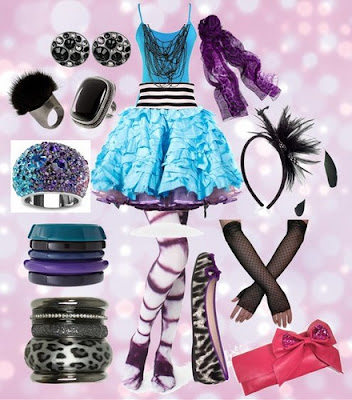
And I'm happy to bring you another "What Claudia Should Have Worn" to Jessi's ballet, which the entire BSC was invited to: Claudia was channeling her inner-ballerina, in a short, high-waisted, flouncy blue & purple skirt with black tulle underneath and a wide black-and-white striped band on the waist. She had paired it with a blue silk tank-top and purple batik print tights that she had dyed herself. Around her neck she had a purple, animal-print scarf and a big chain necklace she had made...going with the animal-print theme, she had black & purple, zebra-print ballet flats. Her jewelry consisted of black shiny earrings, tons of black & jewel-toned bangles and huge shiny rings over long, black, fish-net, fingerless gloves. Her hair was loose and super straight, with a feathery headband that surely annoyed anyone sitting behind her. To top it all off, she was carrying a bright pink clutch purse with a large bow and purple jewels on the front.
I think this is probably my favorite of the series so far, and I remember loving it as a kid, as well. I appreciate Martin for discussing what it's like for Jessi and her family as one of very few Black families in Stoneybrook, and how not everyone has been welcoming to them and the discomfort that causes. This book had a much more focused plot than most of the others, and even the couple of side-story babysitting jobs from other sitters still tied into it. I'm not deaf so I can't speak to how well that was represented here, but it did feel respectful and I liked that while at first, some of the neighbor kids weren't polite to Matt, Jessi's new deaf babysitting charge, they were brought around to understanding him and it was cool to see all the kids get excited about learning sign language.
I liked Jessi's idea to bring Matt and his classmates to her ballet recital, too, pointing out that even though some of them wouldn't be able to hear any of the music, and others would only hear it a little, ballet is specifically a story told without words, so it's something that they could still enjoy as much as anyone else. That kind of inclusion is so important for kids who are marked as "different" and who might feel left out of things other kids get to do.
Obviously, this book is fairly surface-level when it comes to issues of racism and marginalization, but for the time it was written, it was forward-thinking, and I think it's one that young kids could still really benefit from reading. And I appreciated what a tighter story line it had and that we stayed with Jessi for most of the book.
I’ve been rereading this series this year and unfortunately this one didn’t work as well for me as the previous ones have. Jessi comes across a lot more neurotic than I remember her being, generally assuming the worst intentions of everyone around her. She has a tendency to assume that everyone thinks the worst of her, even down to worrying that the other BSC members will look down on her for being late to meetings because of her ballet classes. They never do. And yet she worries.
I also had issues with how they portrayed deaf culture. For example hardly anyone signs and speaks simultaneously. I’m fairly sure that would be considered rude to not do.
Also nobody seemed to have heard of fingerspelling the alphabet. Did none of them watch Sesame Street? Cuz I know for a fact that they had deaf characters on the show during this era.
Overall it felt more like an afterschool special “very special episode”, instead of a Babysitters Club book. There wasn’t a lot of time on the page with any of the other characters. Instead we were just stuck in Jessi’s neurotic head the entire time. I’m really hoping that her character gets fleshed out more in the future because I remember liking her when I look back on my memory of the series. But sadly this book was not a great start to her character arc.
I didn't really read the French version of this novel but for some reason it's the only one listed on either Good Reads or Amazon. Ann M. Martin is not so good at naming her books. There is no "secret" language, in actuality it is just sign language which she uses to communicate with one of her charges. Although Jessi was my favorite baby-sitter's club character this was due more to the fact that I wanted to be like her than it was to her actual characterization. She was more contrived and less dimensional than most of Martin's other players. This story reads like a "very special" episode of a television show. Oh, so magnanimous of Martin, she teaches her readers about how "special" a deaf boy is. Heads up folks: Kids don't need to be told "special" kids are just like them. Kids are generally more accepting and have less preconceived notions than adults.
While I actually started reading around age 3 (thank you, my Granny's Dick and Jane books!), this series is what I remember most about loving to read during my childhood. My sister and I drank these books up like they were oxygen. I truly think we owned just about every single one from every one of the series. We even got the privilege of meeting Ann M. Martin at a book signing, but of course little starstruck me froze and could not speak a word to my biggest hero at that time. Once in awhile if I come across these at a yard sale, I will pick them up for a couple hour trip down memory lane, and I declare nearly nothing centers and relaxes me more!
First of all, they did Jessi so dirty on this cover. She looks like a 35-year-old.
Overall, I really enjoyed this book, but I'll hold out forming an opinion on Jessi. She toed the line between extremely smart and kind of unbelievable—seriously, she become "fluent" in sign language in just a matter of weeks? I'm definitely 0% interested in reading about ballet to this level of detail, but I did appreciate what it brought to the book in this specific instance.
I guess what I didn't like about this book (aside from the ballet) is that once again, we don't hear about how Jessi experiences the racism in Stoneybrook from Jessi, even in her own fucking book.
Jessi babysits sibilings, one of whom is a deaf boy and she's got to learn ASL to watch him. This is a great book in the Baby-Sitters Club series even though Jessi learns ASL in an unrealistic amount of time. I loved seeing the group again, they're all wonderful and I've missed them.
Loved it so much only complaint is wish it would say who is starting chapter more clearly ..is second book in series I've read looking forward to reading even more
Alright, this is definitely the last BSC book in the batch I'll be reading. I have book 17, but I started reading it and it was going to be about some stupid chain letter and I gave up. (Unrelated, is it possible they took out the "almond eyes" description out of these reprints? I don't think I've read it once, and we're already in book 17.)
So far, Mallory and Jessi really are the least obnoxious of the bunch. Jessi didn't disappoint in this one (not sure if the sensitivity reader helped), and I couldn't help but notice that they capitalized Deaf but not Black.
At this point I've actually seen the ballet they're doing in the book, although I really did think the doll was going to turn into a human and end up with the man. (I've seen that 80s movie. And Pinocchio.) I still think it's weird that the only thing we all remember about Jessi is that she dances when she's the most well-rounded 11-year-old I know (she babysits, she tells jokes, she likes to read, she loves languages, and she's learning ASL--how does she find the time to do anything?).
As far as her family, so she's basically a bougie right? (Her taking ballet should've been a tip-off, although I wondered if AMM was trying to subvert the trope or whatever). I'd be curious about what her cousin secretly thinks of her. With a name like Keisha (already subject to discrimination when she starts sending out her resume) and the apparent fact that her grandparents are the ones who bought her the ticket to Jessi's show, she probably is more likely to embrace being Black than Jessi ever will.