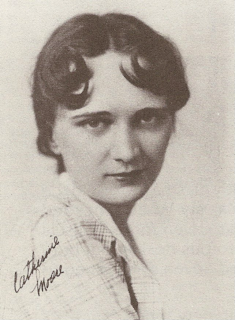
Excerpted from Wikipedia: Catherine Lucille Moore was an American science fiction and fantasy writer, as C. L. Moore. She was one of the first women to write in the genre, and paved the way for many other female writers in speculative fiction.
Moore met Henry Kuttner, also a science fiction writer, in 1936 when he wrote her a fan letter (mistakenly thinking that "C. L. Moore" was a man), and they married in 1940. Afterwards, almost all of their stories were written in collaboration under various pseudonyms, most commonly Lewis Padgett (another pseudonym, one Moore often employed for works that involved little or no collaboration, was Lawrence O'Donnell).
Here we find C.L. Moore's Northwest Smith character sitting around with his cherubic Venusian pal Yarol having drinks at an outdoor cafe under the buzzing and dazzling lights of a futuristic New York. They see an old man getting robbed of a package by a mugger, and Yarol, who recognizes the old man as being part of an ancient race of lunar origin, retrieves the mysterious package in exchange for "The Secret."
Well, Yarol gets the package and now the old man is sitting at their table, obliged to tell this "Secret," whatever that is. The rest of the story is experienced by Smith under hypnosis.
This one starts off promising, but fizzles out and makes little sense. The "Secret" really isn't all that fascinating, yet the old man says anyone who hears it must die. Why? Because it tells of how the Moon became a desert? So what? What kind of dangerous power does this hold over anyone? And also, Yarol was the one who asked for the secret. Yet the old man tells it to Smith under hypnosis. Why? Smith didn't help the old man or even ask for anything. He's the all important hero, I guess, but then why have Yarol in the story at all?
To me, it seemed Moore was starting to get sloppy by this point in the series. Even her prose was not as refined. Overall, the story made little sense, but not because it was supposed to be mysterious. Rather, it just seemed rather quickly slapped together for the editor to get some content in the next edition if "Weird Tales."
Not the strongest entry of the Northwest Smith series.
The basic structure of this story is kind of the same as the first three but with some key elements (the damsel, the monsters and the acid trip) changed for the first time too. Northwest isn't here to rescue a damsel and you might be tricked into thinking that he's here to rescue the lost paradise but really he's only here to save himself. He gets himself into a mess and he's gotta get out of it.
The otherworldly monster is there in the form of a holy-trinity-esque being known as the "Three who are one". Not as instantly frightful as previous episode monsters but certainly up there in terms of the devastation it could manifest.
The acid trip takes a different form too, in this tale it's a journey through time. Moore gets a bit philosophical at times.
“In the fourth dimension, which is time, man can travel only with the flow of its stream. In the other three he can move freely at will, but in time he must submit to the forward motion which is all he knows. Incidentally, only this dimension of the four affects him physically. As he moves along the fourth dimension he ages."
Moore's rich prose was present but not as predominant as in the first three Northwest adventures. In a previous adventure I noted that the word "black" was repeatedly used to convey the eerie and unknown. In 'Lost Paradise' the word of the day is "queer", which Moore employs with great frequency to describe the oddities she has placed in her narrative.
Vertiginous was a new word for me, which apparently means either "extremely high" or "steep". As in "I'm going to get vertiginous this weekend". (Actually I'm not doing that this weekend, and I'm also not sure that my sentence is an appropriate use for my new word).
“Is a lifetime of nostalgia and grieving, with you, not better than paradise without you?"
I was chuffed to recognise this quote in the story which is a modified take on the very crudely translated ~"a lifetime of torment with you is better than a lifetime of contentment without you"~ from Luigi Rossi's "Orfeo" (1647). One of about one quotes that has stuck in my head the last few years.
I am wayyy to tired to make sense of what I'm writing right now. I'll check if it makes sense in the morning.
Another installment of the Pulp Classics Reading Club.
Not my thing. Just didn't grab my attention and found myself bored.
Northwest Smith and his companion are people watching. A chance meeting with someone of an ancient race sparks interest and Smith's companion asks a question. The answer comes in a trance visualizing the Moon's last day.
If the rest of the Northwest Smith stories are like this I may not want to read them.
A story from the Northwest Smith series. Northwest Smith is a forerunner character to interplanetary heroes. In this story set sometime in Earth's future, a small pale fragile boned man with a big secret helps Smith learn more about ancient Lunar history and the ancestry of a little-known race called the Seles that dwell only in the mountainous regions of Tibet.
C.L. Moore (1911-1987)
Stories from the Northwest Smith Series printed in Weird Tales magazine. Shambleau (Nov. 1933)-Northwest Smith Black Thirst (Apr. 1934)-Northwest Smith Scarlet Dream (May 1934)-Northwest Smith Dust of Gods (Aug. 1934)-Northwest Smith Julhi (Mar. 1935)-Northwest Smith The Cold Gray God (Oct. 1935)-Northwest Smith Yvala (Feb. 1936)-Northwest Smith Lost Paradise (July 1936)-Northwest Smith The Tree of Life (Oct. 1936)-Northwest Smith Quest of the Starstone (Nov. 1937) with Henry Kuttner-Northwest Smith & Jirel of Joiry Nymph of Darkness (Dec. 1939) with Forrest J Ackerman-Northwest Smith