A Swiss woman, Anna, walks the paths of a cemetery in present-day Algiers. She is searching for two names, those of her children, murdered more than 40 years previously by the FLN, the organization that fought for Algerian independence from the French in the early 1960s and whose leaders were convinced that the children's father, Nassreddine, was a traitor to their cause.
Anna has returned to an Algeria rife with terrorism and the excesses of fundamentalism. "The devil has entered our country, and his footprints are everywhere," her friend Majid tells her as she sets out, undaunted, disguised in Muslim dress, on a perilous quest to find out whether the man she once loved is still alive. She is guided through the harsh and beautiful landscape by Jallal, a boy who sells peanuts in the Place des Martyrs. Captured by the militant "forces of Allah", the woman and boy must witness and endure all manner of brutality and degradation before Anna's and Nassreddine's destinies can finally converge.
Anouar Benmalek's courageous novel confronts the tragedy of Algeria, its immediate past and present, as no other writer has done since Albert Camus, and in the process he tells a love story of immense tenderness.
The story is set during the war for Independence by the Arabs against France in the 1950s. That’s a bad time for a French-Swiss woman, a circus acrobat touring Algeria, to fall in love and marry an Arab man.
They will both be under suspicion and hated by both sides in the conflict. (I’m reminded of another book I reviewed, The Painter of Battles, where a Serbian-Croatian couple doesn’t survive the Serb-Croat conflict).
Of course it happens: he is captured and tortured by the French under suspicion of Arab terrorism (even though he was not involved in the conflict). Their two children are brutally killed and she is deported from Algeria. Assuming her husband is dead, like her children, she flees back to Europe, begins a new life, remarries and has a son.
That’s where our story really begins. Years later, now a widow in her sixties with an adult son, the woman returns to Algeria. There is still unrest in the country. It’s unsafe for women, especially a European woman, traveling alone. She asks herself: Am I insane? She tells her son that she is ‘vacationing in Egypt.’
In Algeria, she seeks out her former husband to find out if he is dead or alive. She dons a burka as a disguise and finds a partner to help her navigate the conflict and move among the rural villages. That partner is a ten-year-old street urchin with whom she develops a grandmotherly relationship.
The book is translated from French and there is lots of local color of rural and urban Algeria. A good read.
The author was born in Casablanca (1956) to a Moroccan mother and an Algerian father. He has written about 15 novels although only three appear to have been translated into English: this book, Child of an Ancient People, and Abduction.
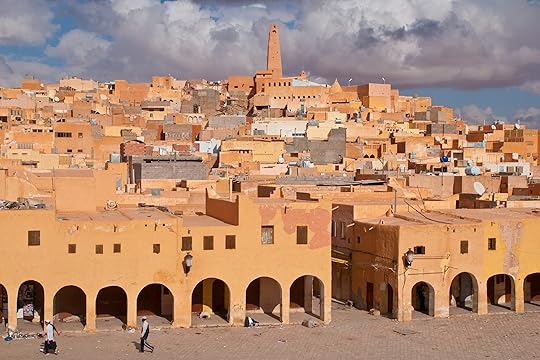
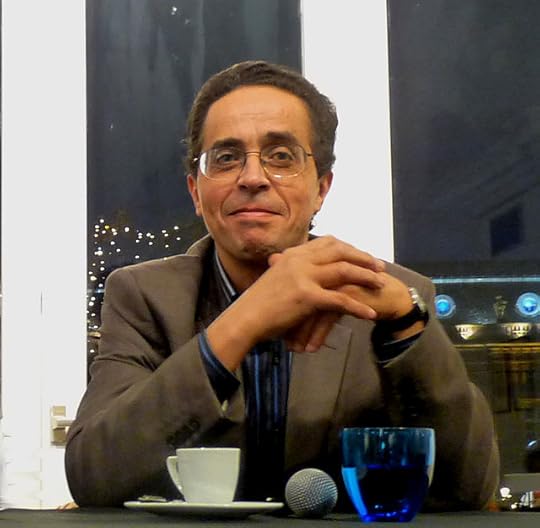
Top photo of the town of Ghardaia in Algeria from nationalgeograhic.com The author from Wikipedia
The Lovers of Algeria is a horrifyingly vivid, achingly tragic novel with, at its core, a fragile and imperfect love story spanning decades of loss, relocation, and hopeful discovery in its North African setting. The story, told in overlapping flashbacks and contemporary (1997) scenes, is too involved to recite, but it should be enough to say that Anna, a Swiss gaouria, and Arab Nassreddine have an unconventional love affair that begins when they are young adults and continues, or tries to continue, amid four decades of war between European, Algerian, and religious interests. The scenes of conflict are intensely graphic, but Benmalek’s skill as an author is equally as true in crafting scenes of memorable, albeit sad beauty for his cautious but passionate pair; these are the scenes that may — and I am not sure they do — transcend two lives brimmed with disappointment. Love, we hope, can outlast everything, but the scars of destruction this story undresses for us do not fade from memory so easily.
It's hard to say I "liked" this book, because there is a lot of violence in the book (not so much to the personal characters, as political and religious violence that takes place in Alergia in the background to the story and swirling around and in and out of the story), but, well, it's a good book. The main story of the book of a love story that starts in the 1940s and involves the unexpected charcaters of a very poor Berber living in Algiers and a displaced French woman no longer in a traveling circus. It's an odd love story, because they're very poor throughout the whole story, and even in the story, Anna (the main female) mentions that she's not even sure she finds her husband, Nassredddine, attractive. It's a very non-wetsern book. In a good way, I think. Poetic, unexpected. You follow their love story, back and forth through time, through past and present (1990s). There is good, and a lot of bad (not unexpected given the history of Algeria).
And perhaps what I appreciate is that despite knowing the general political history of Algeria, I really did now KNOW the extent of the violence that tortured that country. Yes, I knew about the French occupation, and an quite aware of the mess that the French left many of their former colonies (and wow does this book show that Algeria was not an exception!)... And I knew about the fight for independence, and the fight against the mujahadeen. And the terrorist attacks. But this book REALLY brings to life just how violent the history of Algeria is, and just how caught in between the civilian population was in everything that happened (between the French and the local resistance, then between the state apparatus and the mujahadeen). It's quite devastating that see what happens to the civilians over and over again. Reading this really plays with your head.
Spanning multiple timelines, this novel follows a Swiss woman, Anna, and her Algerian husband, Nassreddine, as they are thrown together and torn apart several times by the violent conflicts plaguing Algeria during WW2, the Algerian war of independence from France, and the terrorist activities in the 90s.
The descriptions of life under these incredibly volatile circumstances – uncertain, constantly under threat, snatching moments of grace where you can – were vivid and unsparing, and clearly the labour of someone who is very clear-eyed about how thoroughly broken their country is and loves it anyway. The landscapes of Algeria rise vividly from the page, creating a canvas of austere beauty upon which the author then splatters all the blood and gore of decades of violent colonisation and horrific conflicts, sparing no detail. It’s a striking effect I wasn’t quite prepared for, but it’s sure to leave an impression.
Despite the powerful story, I found something lacking in the relatability of the main characters' relationship (revealed, in the earlier timeline, to have started as more of an arrangement of convenience and/or a case of two scared young people falling madly in bed than the grand love story we’re meant to see). I think this was in part due to the writing, especially the dialogue, which felt stilted and had a distinctly translated flavour, in that way where you can tell you’re missing stuff that the translation can’t quite convey. The novel is absolutely brimming with epithets, which is much more common and accepted in the original French, but looks incredibly awkward in English, and there are so many idioms and jokes that felt lost in translation. The tenses switch around from present to past tense at random, sometimes within the same paragraph. (Also, these were some of the most off-putting sex scenes I have ever read, lol.)
I also struggled with the apparent carelessness regarding the accuracy of the timelines: Anna’s age vacillates wildly over a 5 to 10-year margin, which normally wouldn’t matter much but in this case does – she is referred to as 30-35 in the 1955 timeline, but then as 65 in the 1997 timeline, which would make her having a 25-year-old son just about plausible and place her birth year around 1932. However, she is then referred to as a roughly 5-year-old in the 1928 storyline, which would make her closer to 74 in the future timeline and place her having her son in her very late 40s, not impossible but definitely unusual. The 1997 timeline is later chronologically continued… in 1996. And in the 1928 timeline, people talk of the Reich police as if they were currently in power (the Nazis didn’t get into government until 1933) and as if the war is about to start (it was 11 years away); very much as if it was meant to be 1938 instead. I actually enjoyed the structure of the three timelines but these inaccuracies were glaring and annoyed me, mostly because they would have been incredibly easy to fix.
Ultimately, although the titular lovers’ story was tragic, I was more captivated by side characters (Jallal and Jaourden especially) and the glimpses into various native cultures at war within themselves and with the long-term effects of colonisation and genocide. I need to read more about it.
Although rather brutal in certain parts (though historically accurate I believe), the language and plot in this book were exquisite. I especially liked the beginning of the book, and the ending which pulled all of the threads together into a wonderful tapestry. The development of the main characters, their at times quirky, sometimes unusual, and close relationships was excellent.
Το παραδέχομαι. Εδώ και χρόνια δεν διαβάζω μυθιστορήματα. Είναι που λίγο ως πολύ όλα έχουν ειπωθεί, είναι που τα περιθώρια στενευουν και αν πρέπει να διαλέξεις πού θα αφιερώσεις τον ελάχιστο χρόνο που εμβόλιμα, μέσα στην μούρλα της καθημερινότητας ,θα χαρίσεις στον εαυτό σου-πρέπει να σταχυολογήσεις τί είδους βιβλίο θα ξεχωρίσεις να σου κάνει παρέα και όλο και κερδίζει το πολιτικό κείμενο και οι μελέτες τον άνισο (;) αυτόν αγώνα ... Οι όποιες παρεγκλίσεις, συμβαίνουν το καλοκαίρι : ανάλαφρη η διάθεση ,επιτρέπει να "ελαφρύνει " και το ανάγνωσμα. Και έτσι ,και πολύ συμπτωματικά ,έπεσα πάνω στο "ΕΡΑΣΤΕΣ ΔΙΧΩΣ ΑΥΡΙΟ." Μα πως μπορεί και περιγράφει έτσι την αγάπη ,μιλωντας τόσο πολύ για θάνατο ,τόσο απίστευτα για βαναυσότητες και την απίστευτα σκληρή και πολλές φορές αδιέξοδη ζωή αυτός ο ΜΠΕΝΜΑΛΕΚ; Και πως γίνεται η επίγευση από ένα σκληρό σε κάθε του σελίδα βιβλίο , να είναι γλυκεία σαν γλυκό τριανταφυλάκι; Οι γάλλοι αποσύρονται από την Αλγερία που καλείται να αυτοδιαχειριστεί , στραγγισμένη και ανέτοιμη να μάθει να ισορροπεί ανάμεσα στην υποχρεωτική της επαφή με τον ευρωπαικό νεωτερισμό , και την μακραίωνη ιστορία της .Το ισλαμικό στοιχείο θέλει να επιβληθεί -το νεοσύστατο κράτος δεν του αφήνει περιθώρια, ο εμφύλιος αναπόδραστα ξεκινά και κατακερματίζει έναν λαό του οποίου ήδη η ζωή έχει δείξει το πιο σκληρό της πρόσωπο. Οι ηρωες : ένα παιδί -παρίας , που γενναία βρίσκει τρόπους να επιβιώνει , προσπαθώντας να μην χάσει την ψυχή του , ένας Αλγερινός και μιά Ελβετή ,ο καθένας με το φορτίο του ( που ξεδιπλώνεται βαθμιδών στον αναγνώστη ).Θα γνωριστούν , θα αγαπηθούν και θα ζήσουν μόνο κάποιες στιγμές μαζί. Αδιανοήτες πρακτικές που ασκούνται και από τις δυο πλευρές που αντιμάχονται , ανέχεια και μια ζωή που μοιάζει αδιέξοδη , περιγράφονται σε κάθε σελίδα και πλαισιώνουν τους ήρωες για να οδηγήσουν σε μια κορύφωση στις τελευταίες σελίδες του βιβλίου. Ο ΜΠΕΝΜΑΛΕΚ ,έγραψε ίσως ένα από τα σπουδαιότερα βιβλία για την χώρα του -και μια ιστορία αγάπης ,λειτουργεί μόνο ως αφορμή. 4 ,8 * ( χάνει πόντους από την επιλογή του τίτλου στην ελληνική απόδοση - δεν ξέρω αν είναι 'πιασάρικος ' , αλλά εγώ παρολίγο να μην το ξεκινήσω καν ,ακριβώς λογω του τίτλου. Επίσης θεωρώ άκυρο εντελώς το εξώφυλλο .Με την θεματολογία που έχει το βιβλίο , οι επιλογές πραγματικά μοιάζουν να τείνουν στο άπειρο-δεν καταλαβαίνω λοιπόν γιατί επιλέχτηκε το συσκεκριμένο στην ελληνική έκδοση ,από τις εκδόσεις ΨΥΧΟΓΙΟΣ )
In a 2007 interview with BookForum.com’s Suzanne Ruta, Benmalek stated that what he “reproaches most in the Arab world is the failure to denounce its own crimes” and that “No one is more racist toward the Arab world than Arabs themselves [because of their] refusal to impose standards on [them]selves." Benmalek himself now lives in Paris, France due to death threats he received after founding the Algerian Committee against Torture. It is therefore not surprising that this novel about Swiss Anna and her husband Algerian Nassreddine focuses on the effects of Algeria’s bloody war of independence from the French (1954-1962) and the more recent civil war (1990s). The novel starts in 1955 when the husband is imprisoned and tortured because he is suspected by the Algerian Liberation Front of being an informer. When he is finally allowed to go home, his mother and children have been murdered brutally, while his wife was deported. Forty years later, his wife, Anna, defies an unwelcoming Algeria and its Islamic terrorists to visit her children’s graves and to search for her husband. She enlists the help of Jallal, a homeless street urchin in Algiers. Together they travel to the Aurès Mountains, where they ultimately find Nassreddine, a lonely, worn out man.
Warning: This novel is not for the faint of heart because before the spouses finally meet again, they as well as Jallal have to endure and witness many horrors - tortures, a beheading, rape- amply illustrating that violence begets violence. Benmalek’s horrifically cruel Algeria is like a severely abused victim (of the French oppressor), who instead of breaking the cycle of violence, perpetuates it and in turn abuses those it is closest to (-its own people during the Civil War-).
Well what a book!! I have to be honest, this book was nothing like I imagined. I was lulled into a false sense of a happy love story. Yet after only a few pages in those happy thoughts were torn from my brain Replaced with a horrific gut wrenching "oh my God!". Based around a story of two people who fall in love, the majority of the story takes place in Algeria during and after the occupation. This book is so graphic that at times I literally felt sick. It shocked me how little I really understood what happened during that time. I loved the way the book went back and forth in time. Weaving the stories of the different characters together. I know some reviewers didn't like that. Have you ever watched a film (or even soap) where one of the story's is so engrossing you hate it when it goes to a different scene? Well this book could have been like that except every new scene had a new story just as interesting! Truthfully I really thought I would be giving this book 5 stars. But the ending really let the book down. I can live with the ending (I have no choice), however it left too many unanswered questions. The main one being...HANS!!! If only the author had written one more chapter, or even a few more paragraphs this would've got a five star. Nevertheless this book I highly recommend.
I hesitated reading a book about Algeria, because I know of so many real horror stories that happened there. But trying to follow the Middle East Reading Challenge, I had to dare.
Wow, that was quite a book! Very heart-breaking with beautiful human characters focused on loving, come what may, with in the background yes the all too common horror stories and what’s going on there: terrorism, relationships between white people and natives, government corruption, dealings between Algerian and French governments.
While the book does highlight an unfortunate and heart breaking story, however Benmalek does not do justice in describing the emotional turmoil experienced by the protagonists. There are many moments when the reader wanting more clarity on the situation is simply abandoned midway. On the brighter side, it was interesting to see how war affects the lives of the indigenous people. Violence is committed not only by the oppressors but in equal measure by the rebel groups as well.
From Reading the World List. I didn't know anything about the war of Independence in Algeria. The cruelty of the people both from the government forces, the French and the rebel groups was disturbing to me.
Last night I finished this book. I simply had to digest it a bit before summarizing my views. I have chosen three stars, but pay attention when I say this is definitely a book to read! It does have faults. These weighed in when I reduced the four to three stars. The book very well describes the pandemonium of Algerian life during the 1900s from the pov of Arabs. This is how life was for those down and under. In this is thrown a Swiss who loves an Arab and she is too drowned in the horrors perpetuated by the French, WW2 and the Islamic jihad terrorists at the end of the century. This is how life was - so it is not a comfortable read by any means! The reader is THERE, living those, but don't look for tons of historical facts. They facts are sparse. What you get is how life was then for those there, living in Algeirs. Another reason why I loved the book was its portrayal of friendship. Utterly magnificent. One such relationship is between two wives married to an Arab! Really, really this was very well done. Another is between an elderly woman and a young boy, who were not family, but who chose each other to be family. Love between a man and a woman is also beautifully drawn. (Does love lead to disaster? - Another thing to ponder while reading this book.) In addition some of the lines were just so funny or sad or sardonic that I wanted to frame them and put them up on the wall.
So why only three stars? Parts made me so uncomfortable due to the brutality and filthy language. The book had to be this way, but still I was uncomfortable. The time-line is jumbled. Sometimes I had to go back and reread sections to figure out how to get the story straight.....to understand the order of events. Maybe that is just my feeble brain. OK, and the end was too neatly tied up. I thought the end was bad, but I cannot say anything b/c that would be a spoiler. These three negative characteristics prevented me from giving the book 4 stars. I want a 4 star book to be VERY, VERY GOOD. Still, most of the time I WAS thoroughly absorbed in the book. A bad ending on a good book isn't that important. A confusing book doesn't mean a bad book. Sometimes really disgusting events must be given to correctly depict what was going on in real life. See, I can argue with myself on and on..... Since I award the stars on my reviews, seen as a clump, the tree minusues bring down the total of stars awarded - BUT READ THE BOOK (if you have a strong stomach). I am always like this - I never really can make up my mind..... There are so many ways of looking at a question.
Through page 165: Remember the title? The LOVERS of Algeria - yes it is a love story too. Why do I like it? Well because the people are emotional and real and tempermental, and they do crazy things just like real people really do. How can people be calm and practical and sane when the world they live in is in such a horrible mess?
Through page 132: Now I ssimply cannot put the book down. I enjoy it so very, very much. It is perhaps confusing in the beginning, but if you are a little patient all becomes clear. There are even dates mentioned. Life in Algeria under the French colonial forces and afterwards during the civil war are wrenchingly depicted. But the story is far from being horrible - there are relationships that are so wonderful that the rest seems just like like life, something you have to get through. Some of the lines are stunning:
"Life isn't the best thing ever invented, little brother, as you'll soon find out...." (page 129)
"His mother, to prevent herself from crying, had resorted to shouting at him...." (page 129)
And here is a longer passage starting on page 105:
"she wonders, stupidly, how does one set about dying?"
She senses the full moon watching her, hateful with its prying glare. She retches from breathlessness. A thread of saliva runs down her chin, a drop of sweat down her forehead. The prespiration quickly freezes. She is barefoot. Suddenly she is aware that her feet are huring abominably and, to her surprise, although determined to die, she finds herself wishing she could die with her feet in a pair of warm slippers...."
"She is delirious, but she can't fight it. She has lost control of her mind. Little by little, the dam holding back her memories is giving way. She is immersed in the past, and its warmth is even more lethal than the cold. Now she understands what is meant by 'to die': it is the sharp wrench of losing all those little things that one has lived through."
And there is such friendship . It is worth reading this book just to see this friendship grow between two women. You must read the book to see whom I am speaking of.
Through page 87: Please read comment 2 below. To give you a taste of the writing style here follows a quote. This quote from page 87 also exemplifies what I said in comment two.
"Don't cry son."
"I'm not crying. I'm just sniffing. Jallal protests between sobs. "you can see that I am not crying....."
And he began to shed hot tears. Anna, heartbroken, takes the boy in her arms and, quite unselfconsciously, dissolves into tears herself. Hugging one another, each strives to comfort the other. Jalla hiccups: "But Grandma, crying won't help!," and Anna, her tears flowing more copiously than ever, responds : "I'm not crying....what gives you that idea? You're the one who's crying.... I'm just blowing my nose!"
At last, the little guide's two black eyes focus on the Swiss woman's kohl-streaked face.
"Shit, what a sight! Your face ....it's all black!"
"And what about yours, my little pirate, do you think you look any better?"
Suddenly, they burst out laughing. Jallal puts a hand to his nose: "Ow, ow! That arsehole, that fucker of his mother's lover! Ow, ow, just wait till I catch him."
Anna, startled, says wickedly: "I shouldn't say such things at my age, but ... arsehole, fucker of....how did you put it?"
"...his mother's lover..."
"That's it....dam him, he has certainly taken us for a ride! What do we do now?"
There is a real friendship growing. There is alot of filthy language, but most often most it is just talk. So far at least.
This one was a pleasant surprise. It's not great literature, but it proved to be an enjoyable story with some redeeming social value, and my expectations were not high (you just never know with obscure translations).
The Lovers of Algeria follows a star-crossed couple--Anna, a Swiss acrobat who initially travels to Algeria in the early 1940s, and Nassreddine, an Algerian man--through most of the 20th century. The timeline jumps back and forth, and while I was at first annoyed when I'd been reading about the 1990s, reached page 90 (where it jumps to the 1920s) and realized most of the rest of the book was backstory, it actually works out pretty well and turned out to be a more compelling story than I expected. The characters themselves are all right--adequate for their roles, and there's some complexity to their relationships (the central romance is imperfect), but they're not especially memorable.
Aside from telling a good story, this book is most memorable for its portrayal of the upheaval and violence in 20th century Algeria--a country struggling with first colonialism, then terrorism, not to mention poverty and a lack of resources to deal with its problems. It's from the perspective of average people, so it doesn't provide a high-level explanation of policy; instead we get an on-the-ground view of what life is like for civilians just struggling to get by amidst the unstability and violence. And Benmalek manages to do this without being simplistic or too sentimental; the world of the book feels three-dimensional. It's an ugly place, so readers just looking for romance may want to skip this one, but it gives real beyond-the-headlines insight into what people caught between terrorists and an ineffective government have to deal with.
While I found it a worthwhile read, though, and sped through most of it in a single day, there were a lot of little annoyances that together bring it down to 3 stars. The timeline doesn't add up (Anna apparently ran off with the circus four years before she was born). The use of the present tense is inconsistent, and even more jarring in a book that jumps back and forth in time. There are a lot of exclamation points in the narration, and sometimes it's unclear who is speaking. Benmalek obsessively describes women's sexual characteristics, even when writing from their own perspectives. The ending almost seems to be missing a paragraph or two--it just ends, without telling us what the characters plan to do next.
And, perhaps most unfortunate of all, two or three major character decisions struck me as terribly implausible. For instance, Anna and Nassreddine's relationship begins with a contrived romance-novel-style scenario, in which even though he's a virtual stranger and she has no intention of having a sexual relationship, she decides to leave the circus and move into his one-room hut (just the two of them) so she can be available for a friend. Um, right.
That said, if you can put up with a few eyebrow-raising scenarios, it is an engaging story, and the translation is fluidly written. Recommended for those interested in learning more about Algeria, or those who love decades-long odds-defying love stories.
While the theme of this book (how love endures over the years despite horrible conditions) might sound a little shop-worn, the way Benalek handled it certainly was not! And although I was often frustrated trying to keep up with the various plot lines that kept back tracking and over-lapping (making me wish the author would have simply told his story chronologically) I kept reading because I was both fascinated and horrified by what I was discovering about life in war-torn Algeria and how badly it has been scarred by a history of colonialism, political uncertainty, extreme poverty and vicious terrorism. At the center of the novel were the two “lovers” - Swiss born Anna who ran away as a young woman to join a traveling circus and eventually is forced to leave resulting in her decision to live with Algerian born Nasreddine. It seemed a bit too contrived for my liking – as did the fact that for most of their lives Anna and Nasreddine were being separated and then re-united and then separated again only to finally get together in old-age after once again narrowly missing each other. Nevertheless I was drawn to the major characters as well as to many of the minor ones because they were colorful and well developed. Benalek is a good writer with a gift for vivid description and compelling dialogue. But that’s exactly what made much of the novel excruciatingly painful to read because of the violence which was graphically described in scenes of unthinkable brutality. Difficult as it was to stick with this book, I was glad that I did – if only as a sober lesson in what it is like to live in a country where violence is a way of life.
What I really liked about this book is the story of Algeria during the second world war, the French occupation, its liberation and the years of terrorism that followed, all of it seen through the eyes of the average Algerian. The characters feel real, but the set up for the love story did not quite work for me. Anna would go live with a total stranger (that she does not know, does not even like) in a foreign country just in hope to see and help her "adoptive" mother, hard to believe. There is also a mention of her second marriage at the beginning of the book, I think this should have been left out since it was not going to be developed anyway. We just get the feeling that Anna did not like her second husband the least, which leaves me with questions (why did she marry?) and makes me dislike her at the start of the book (I find her very cold and sarcastic also at the beginning). The end was also a little disappointing, but no big deal, the rest of the book is interesting enough, and definitively worth reading. In the end, the love story to me was really secondary. I must mention that at time, I found the story difficult to follow, having to go back, the flashbacks are not always easy on the reader. But overall, I would definitively recommend that book (but if you want a love story, skip it).
So I am incredibly ignorant to this period in history. I am grateful to learn more about the war, The French's involvement in Algeria, and the aftermath. I started the read the world challenge for this very reason, to learn a lot more apart from my own perspective.
However, as a book this was not very good. In the same chapter we got a VARIETY of POVs, all in third person and many different perspectives. Every chapter, right after a "cliffhanger" we went through a VARIETY of time periods back and forth and forward again. This choppy formatting made it very difficult to stay engaged with the characters and very difficult to follow the storyline.
Anna's past with the circus I thought was brought in way too late in the book. By the time we went allll the way back and explored Anna's childhood and her life in the circus I felt like it was a bit too late to get her backstory? Or to care about it?
And finally, I find that almost everytime a male author tries to write a graphic sex scene (or even semi graphic) from the female POV --even in third person!-- it is disturbing moreso than sensual or romantic. This really took away from the love story for me and I never really got it.
I kept reading this book for the history, what I was learning, the little boy Jallal.
Maybe I am too driven by the Rodney King line, but the fact that this book is a best seller in Algeria is good enough reason as any to spend some time with it. It’s a fast read, and if hard pressed to come up with a one liner to best describe the story the sentence would include something about combining Dr. Zhivago with Water for Elephants and then setting the whole thing in North Africa with one disclaimer “The Squeamish Need not Apply”.
Then I keep coming back to my favorite paraphrased quote from The World is Flat, “An Indian man once described the difference between hope and despair to his young son like this: There is a rich man living on a hill, the hopeful man says one day I will be him, the other says one day I will kill him."
La novela narra la historia de amor entre Anna y Nassreddine, en el contexto de la Argelia colonial. Es una historia conmovedora y triste a la vez que desgarradora, por el momento histórico convulso en el que sucede, donde no descansan la violencia, los conflictos, los enfrentamientos y las cruentas luchas por la independencia de Argelia, y donde los distintos bandos pueden resultar ser crueles y sanguinarios. De la novela me ha gustado no sólo la historia en sí, sino también la forma de redactar del autor, por sus personajes, muy bien definidos y con los que es fácil empatizar, el contexto histórico en el que se enmarca, ya que nos muestra esa pequeña parcela de acontecimientos históricos, entre otros. Señalar que tiene escenas bastante duras y crudas que, por desgracia, siguen siendo reflejo de la realidad actual en muchas zonas de conflicto. Recomiendo su lectura.
This was a huge bestseller in Algeria and I desperately crave a movie version. Unbearably romantic. The story begins with an old Swiss woman in search of... something... in Algeria. It turns out she was an acrobat in a traveling circus during the Algerian War of Independence (late 1950s) and ended up stranded in that nation, where she fell unexpected in love. This story is told parallel to the old lady's story; a parallel is drawn between revolutionary violence and modern terrorism. But more than anything it's an unbearably beautiful love story, at turns tragic, at turns epic, at turns the happiest thing ever. The characters whirl through history and huge swaths of world geography so it's fun for that, too.
I have to admit that at some point, I was hoping to get a bit of a history lesson on Algeria here. That's not to say I was disappointed though. What transpired in this book is the story of ordinary people living through difficult circumstances as politics and history play out in the background. You get a snapshot without being too tangled in a macro-narrative -- which works very well if you don't want all that history to begin with.
I liked how the different relationships formed and grew here, especially that between the old Swiss woman and the young boy. I thought it was beautiful. What I didn't necessarily like was the ending. It felt a little too neat, a conclusion too quickly reached. Nevertheless, it's still a novel worth reading.
Story of Algeria after Independence through that of a couple, Anna, a Swiss circus performer and Nasreddine, an Algerian, who meet, marry, and are separated by Anna's deportation back to Switzerland after Independence. Decades later, after the death of her Swiss husband, she returns to Algeria, and with Jallal, a street urchin, journeys to find the graves of her children and hopefully find her husband. She sends him a telegram saying that she will be at his mother's house in the mountains. They journey to find each other through harrowing, horrific incidents. Indeed the whole story is shot through with inhumanity, brutality, and cruelty by both French and Algerians, but the story shows the tenacity of a lifelong love.
The violence in this book was almost overpowering at times; with so much of it just sheer cruelty. That was not a turn off for me, in spite of it the people's ability to endure is what spoke to me, whether motivated by love, revenge or just survival. Jallal's story in particular; it was almost easy to forget he is just a child, you could see him turning into one of the young militants. And yet at story's end there seems to be hope for him. The love story was a bit contrived at times, and I found the time changes a bit confusing. Overall, though this was a very interesting even informative read about a time period in a place most of us don't know much about.
This is a love story, but it's set in Algeria during the war between the French and the FLN in the 1950's and in the 1990's - marked by horrific violence resulting from the GIA and GSPC war against the government. The terrible things that happen to and around the main characters cause the reader to be thankful for small acts of kindness and success in their travails. Overall, this book is well worth reading, and has certainly inspired me to start investigating other books (fiction and non-fiction) and films which focus on the history and people of this region.
This story is heartbreaking. It’s romantic and tragic and cruel, but comforting. All hopes are not lost even through years and wars, there’s always a possibility for the impossible. It came to me at a time that was special and will always have a unique place in my heart for the hope that I was lingering too.
More history to learn about this country and what its people have suffered through French occupation and WWII. You'll love the characters and can't wait to find out what happens in the end, and how they got there in the first place.
The book tells an engaging and human story set amidst the unspeakable horrors of wartime brutality, scars of colonialism, racism, hypocrisy and fundamentalism, yet ends with hope. (Rather like the foil to Camus).
I just could not get into this. I had it with me during a cross-country trip, and it didn't do it for me. It's possible that it was more a result of the circumstances that I was dealing with as opposed to the book itself.
On doit admettre que l'histoire trace un chemin peu probable...ce qui n'a pas du tout m'empêchait de le dévorer. Une belle histoire, bien racontée et en même temps assez éducatif pour l'Algérie des deux époques.
I learned so much about the history and culture of Algeria even though this book is fiction. Parts of the story were a little drawn out but the author writes so that you really get to know and care about the characters. Highly recommend it!