THE COUNTRY CHILD is a semi-autobiographical story about a girl growing up in the country. Alison Uttley has drawn on her own youth to produce memories so vivid and nostalgic that you can almost smell the honeysuckle and hear the owls calling at dusk.
She writes about the small intense joys and sorrows of life on a small farm: the fun of haymaking, the sadness of favourite animals being slaughtered, and the close sweetness of Christmas celebrations in the farmhouse kitchen.
Alison Uttley (17 December 1884 – 7 May 1976), née Alice Jane Taylor, was a prolific British writer of over 100 books. She is now best known for her children's series about Little Grey Rabbit, and Sam Pig.
And what’s more it is meant to be a children’s book! 😮 But I don’t care — anyway I think I fit in because it’s a children’s book for “older readers”. 🙃
As I recall when reading reviews of Elizabeth von Arnim’s book, Elizabeth and Her Enchanted Garden, many GR reviewers enjoyed her description of her garden, the flowers and such. Well, you’re in for a feast with this book! Uttley describes the landscape of the farm in vivid detail — I found the descriptions to be evocative and never found them to be boring or dry or long-winded. Descriptions of flowers, trees, apples, the mowing of a field and the making of hay (being a city boy I never thought much about hay or what it was or how important it is on a farm). And one of my favorite seasons even with the commercial bent, is Christmas. I guess as I get older and older more memories of Christmases past fit across my brain and it’s just something I treasure. Anyway, Uttley presenting to the reader an old-fashioned Christmas in England in a rural area in the mid-1800s (Susan was born in 1840), with a chapter devoted to Christmas Eve and a chapter devoted to Christmas Day, made me a happy camper. The father surprises Susan by bringing in a tree from outside…her first Christmas tree.
There is no plot. This is written more like a memoir and when googling Uttley and her life the book is listed in the category, “Memoir and Essays”. The reader is immersed into “life on the farm” as seen through the eyes of a 9-year-old girl, Susan Garland. She lives with her mother (Margaret) and father (Tom) and a family servant (Becky) and several farmhands. The overall sense I get from this book after having just read it is that it was not written in a Pollyannish way like “life on the farm was perfect and easy and nothing went wrong…”, in that there were droughts and rains that Susan and her family had to endure…she was nearly killed by a huge tree branch falling feet away from her…she had to walk 4 miles to school and part of it was through a forest that scared the b’jesus out of her…her parents clearly loved her but she did a lot of work on the farm. She was late for school one day and the teacher caned her hand and later her friends inspected the weals (OMG!)…a cow falls in the ditch and the men can’t save it and it dies…she overhears an old rich lady calling her ugly (and the woman says it in a loud voice so that she will hear it)…the family loses some of their income because the man they sell their milk to (from the cows) goes bankrupt…I could go on and on. But the overall tone of the book is one of quiet optimism…that’s a weird term I guess but I approached each chapter with a sense of well-being, not with a sense of “damn, I wonder what bad thing happens now”?
Biography of Alison Uttley (I guess she is best known from her children’s book, A Traveler In Time, about the imprisoned Mary, Queen of Scot, which I read and loved and gave it 4 stars) and her oeuvre (good God, was this woman prolific!): https://en.wikipedia.org/wiki/Alison_...
Alison Uttley, author of the Little Grey Rabbit picture books, was more than just a writer of sweet (some might say ‘twee’) tales of anthropomorphised animals for children. As well as a celebrated novel for older children A Traveller in Time she wrote a prolific number of non-fiction titles, as a glance at a list of her publications shows. Halfway between fiction and autobiography is The Country Child, which is in effect a true depiction of the author’s childhood but with the names changed.
Alison was born Alice Jane Taylor, daughter of Henry and Hannah, at Castle Top Farm near Cromford in Derbyshire, overlooking the Derwent Valley. Here she lived until, having secured a scholarship, she went to Manchester University to read physics, graduating with honours in 1906. In this book Castle Top Farm is lightly disguised as Windystone Hall, dating from Tudor times. The protagonist is Susan Garland, daughter of Tom and Margaret, and we largely see life at the farm through her eyes, growing up in the early 1890s. She struggles with imaginary creatures in the woods on her return home from school; worries that her doll contravenes the First Commandment; gets teased at school; interacts with farm hands and visitors; and has The Arabian Nights confiscated when she clandestinely reads it in bed. But we get to see the bigger picture as well.
The Country Child follows a year in the life of the farm, from September — when Susan goes to the village school aged seven (Alison herself was born in 1884) — through Christmas, Easter and harvest and on to Wakes week, not long before the end of the summer holidays and the beginning of the next school year. Not much happens in the way of plot but Uttley’s story vividly brings the day-to-day, season-to-season activities and moods of a late Victorian uplands farm alive for the reader.
As a city boy experiencing country life only in the last ten years it brought home to me how much and yet how little that life has changed in over a century. Yes, the work is more mechanised — tractors and quad bikes now for example where horse, cart, wagon and Shank’s pony used to be the norm — and farms are now more likely to be treated as agribusinesses rather than a vocation or inherited responsibility. But the vagaries of weather, livestock, supply chains and the rest are still constants in the effort of making a living from the soil. And for many farmers, as was the case for Tom Garland, there is an emotional attachment to the land, its creatures and the labourers in the fields and house, and that sentiment is clearly there for the author too: regardless of the fact that she went on to be a physics teacher and subsequently a writer, her love for the Derbyshire hills of her childhood remained with her till her death in 1976.
This is a book to be savoured and not hurried: it would have meant little to the younger, impatient me. I could manage only one chapter, two at most, at a time, meaning it took a while to complete this. What strikes me most is the sheer poetry of the descriptions: every page has at least one passage over which I had to linger, the more to enjoy the moment. The closing paragraphs of the twenty-first and final chapter illustrates this well, as Susan, her mother and Becky the maid return from the Wakes fair.
“Like a lighthouse on an island, they saw the farm shining down on them, with its lamp among the planets. Susan walked with her head in the air watching the light and the mass of chimneys which stood out against a cluster of stars.
Everything seemed to move. The chimney-stacks swept across the Great Bear, the Pleiades were entangled in the elm’s boughs, a shooting star fell with a trail of gold, the trees dropped lower and lower as they climbed above them.
Windystone floated in the air.
‘It’s all moving,’ whispered Susan, ‘moving on and on,’ and she felt as if wings were behind her which would carry her away, too.”
The mid-August Perseid meteor showers, the dark star-spangled skies away from the artificial lights of towns and cities, the feeling of wanting to float off into the vastness of the universe, Uttley has caught all this well, and it’s as true now as it was then, and before then and will be after now.
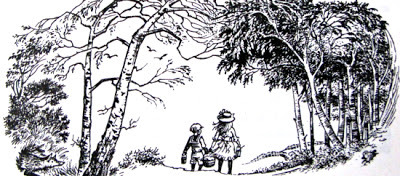
A poll of visitors to the Alison Uttley Society’s website at present indicates that, out of seventy-seven respondents, The Country Child was the most popular book with just over a third voting for it, followed by the Little Grey Rabbit Stories and A Traveller in Time. Most editions after 1945 of The Country Child are enhanced by the illustrations of Charles Tunnicliffe, and though author and artist never met Tunnicliffe reportedly did his homework, providing faithful reproductions of the farm and neighbourhood. The illustrations utterly complement Uttley’s words, but even without them the book is one which twinkles in the firmament, a literary Pleiades.
There's no need to write a review for such a beautiful, lyrical book. Although written from a child's perspective, the thoughts are sensitive, clear and full of feelings. To lure you to read the book, I've reproduced sample texts from Chapter 1 on a little girl's fears, and Chapter 2 on the charm of the English countryside.
Chapter 1 walking alone through the dark wood (reading it gives me the shivers)
The dark wood was green and gold, green where the oak trees stood crowded together with misshapen twisted trunks, red-gold where the great smooth beeches lifted their branching arms to the sky. In between jostled silver birches – olive-tinted fountains which never reached the light – black spruces with little pale candles on each tip, and nut trees smothered to the neck in dense bracken.
The bracken was a forest in itself, a curving verdant flood of branches, transparent as water by the path, but thick, heavy, secret, a foot or two away, where high ferny crests waved above the softly moving ferns, just as the beech tops flaunted above the rest of the wood. The rabbits which crept quietly in and out reared on their hind legs to see who was going by. They pricked their ears and stood erect, and then dropped silently on soft paws and disappeared into the close ranks of brown stems when they saw the child.
No one ever knew Susan’s fears, she never even formulated them to herself, except as “things”. But whether they were giants which she half expected to see straddle out of the dark distance, or dwarfs, hidden behind the trees, or bears and Indians in the undergrowth, or even the trees themselves marching down upon her, she was not certain. They must never be mentioned, and, above all, They must never know she was afraid.
It was no use for her to tell herself there were no giants, or that bears had disappeared in England centuries ago, or that trees could not walk. She knew that quite well, but the terror remained, a subconscious fear which quickly rose to consciousness when she pressed back the catch of the gate at the entrance to the wood, and closed it soundlessly, as she entered the deep listening wood on her way home from school in the dusky evenings.
Chapter 2, on the English countryside (not sure if England still looks like this today):
Little flowery fields of every shape and size, square fields, triangles, fish-shaped fields with odd corners, rhomboids, bounded by green hedgerows and black walls, linked arms and ran up hill and down dale, round the folded hills out of sight into countless valleys beyond where the sun set. Woods sprang up everywhere, little fairy woods of silver birches in the dells, bouquets of beech trees, neat and compact on the small round hills, witch woods with streaming hair on the hilltops, and hundreds of acres of great oak and beech woods which followed the curves of the land and spread up to the sky.
Everywhere green ribbons of lanes and paths threaded the fields and woods, joining valley to valley, tying farm to farm, creeping over the high hills and loitering by the river. Many of these lanes that ran along the crests of the land were the old pack roads; some of them had been traversed by the Romans when they worked the mines which honeycombed the more distant hills, and some were older still, as the savage monoliths and green tumuli in the upland fields attested.
As one looked across the valley, the far villages, hidden among trees in the hollows, could only be distinguished by the faint blue smoke which hung above them, a soft mist against the rolling green. Mellow lay like this, lost in the creases of the hills, until one turned a sudden corner, and found the little stone houses clustering round the duck pond, climbing up the steep rocks and sleeping huddled together about the old market square.
Halfway through the book, it occurred to me that this is totally a British version of Laura Ingalls Wilder’s Farmer Boy. There are so many similarities between the two. Both Almanzo Wilder and Susan Garland’s family farms were prosperous and comfortable, but farming, especially pre-mechanization in climates with harsh winters was HARD.
And yet being a child from a farming family sounds magical. It’s hard work, but nature comes alive. Nature is a friend, a guide, a terror, a delight. Susan’s relationship with the natural world is deep and rich. She’s an imaginative and sensitive child and the farm she lives on is several miles from a town so she is often on her own. The English have a wonderful way of writing about nature too. It’s hard to distinguish exactly how it’s different from nature writing in American books except to say that the English seem more open to magic and mystery.
There were parts of this book that moved more slowly and my attention wandered but on the whole it was a treat. This would be a wonderful book to return to by dipping into it seasonally.
"In the fields life went on, under the moon's white light. Field mice ran along their tiny green tunnels under the bending grass, to their nests, hollowed out among the roots, just below the level of the cruel scythe. Rabbits, unconscious of the morrow, played in the mowing grass, sitting up to bite sweet juicy blades, listening for the fox who stole along by the edge of the wood. Little winds blew the sorrel and swept over the tightly closed silky seeds of dandelion and hawkweed. Then the moon hid behind a rainbow cloud and the world fell asleep."
I loved this book from beginning to end. The very best of its kind, I think. For combining descriptions of nature and the changing seasons with old country ways and the wonder of childhood - it has yet to be surpassed. I am so full of praise I don't know where to start. I'm just going to list what I love.
1. The child, Susan. She's the only child on the farm, so her friends are the animals, trees, furniture, shadows, the moon. Everything is personal and subjective, has a voice, is aware of her, and talks. I can't even begin to say how charming this is - everything comes alive with meaning and interest. This would be a fantasy, except that it's true. Susan has a relationship with her world in a way that is both magical and terrifying (a tree makes two attempts on her life). The grown-ups around her have a relationship with the world around them, too, enough to feel responsible and protective. "It was a world of air like daggers, stabbing the thin human skin, freezing the heart on the high hillside. Little birds dropped numb, and Tom picked them up with his gentle little fingers and brought them into the house to see if their was any life in them. Susan nursed them in a basket and let them loose in the barn if they recovered. The great doors of one barn were left open for birds to take shelter, and Joshua chopped the wood with little wings fluttering and tiny eyes of robin and tit watching him. They slept on the hooks and beams of the walls, on the pile of forks and rakes, and ate the grains of corn fallen from the bins."
2. Interesting words and phrases. (I only recently realized that this might be why I find most modern books unreadable - mundane, boring words. So little colour and texture.) I looked up almost every one of these, and it was a treat, a treasure hunt, a little experience. Beastings Red-shantered Scye the milk Slattering A spate As he brashed Joshua cut spelds Jugged hare A pancheon of hot water Scuttering Stirk Staddles Hurried and mithered The kissing crust Oatcakes and pikelets The tedders were tossing The tea which swaled in the jug Starnels Wake's Cakes Trinklements
3. Skill + Love. Uttley is an incredible writer. It seems to me that, as with painting, writing is seeing, and the things she sees, the details, the attention and focus, the word choices - seem suffused with appreciation. I could not praise her more.
"Susan felt anything might happen in that garden, and she had planted pennies and date-stones, and upside down buttercups. Her mother ripened cream-cheeses in the soil, buried deep in their little muslin cloths, the place marked with a stick. Often Susan had been sent to dig them up after the correct two or three days. Once the stick was lost and Dan spent half an hour digging for the missing cheese."
This is a fictionalized memoir of a young woman who grew up on an English farm at the turn of the 20th century. The author pens lush nature descriptions, which for me comprised both the best and the worst aspects of this book. The best because they were so evocatively beautiful, the worst because there were too many. I alternated between enjoyment and boredom, as the nature scenes were layered one upon another.
All of this formed the backdrop for the 9 year old Susan's activities, and the book catalogs a year in her life. One of the biggest milestones was going to country school, which required the child to walk 4 miles each way, through deep, dark woods. I marvel at the strength of body and spirit this daily walk required.
Susan's father played the concertina, and it reminded me a little of Pa's fiddle playing in _Little House on the Prairie_:
"Tom got out the concertina from its octagonal box and he dusted the tiny ivory keys and the flowered and berried sides with his silk handkerchief, gently, as if it were a child’s face he was touching. Becky in great excitement gave out the hymn-books, for she dearly loved a bit of music. . ."
The family was quite religious, and I laughed at Susan's tender conscience. She was convinced her wooden doll was a "graven image" and buried it in the ground!
The family prayers were so sweetly portrayed, I could almost hear the old clock ticking and feel the peace.
Having read a lot of Victorian novels set in the city, I enjoyed this wholesome history from the perspective of one who lived on a farm. Although it did not have an actual plot, it meandered from season to season very pleasantly, and there were enough shining moments to outweigh the boring passages.
Alison Uttley grew up in the country in Victorian England. The Country Child is a semi-autobiographical novel, but it's not so much factual as it is a record of childhood sensations, and significant memories. In that way, the style reminded me of Susan Hill's Lanterns Across the Snow, or Dylan Thomas' A Child's Christmas in Wales. The novel begins with Susan going on her four mile walk to school everyday that included a journey through a dark woods; her daily nightmare of a scary walk is the first chapter and one surmises that memory haunted Uttley all her life. The chapters chronicle a year in the life of a Victorian rural farm from the perspective of highlighted childhood memories - Christmas day, the harvest that brings the lively Irish crew to the farm with the resulting singing and dancing at the end of the harvest, the trees that she talks to as friends, the day she brought her whole class home for tea without warning her mother. The novel is a quiet delight of pleasures that are made more intense by the hard times - winter storms, the death of animals on the farm, the loss of a market for their milk, when the buyer went bankrupt. One is left with a clear sense of a hard but good life, a life of small pleasures, and daily challenges. I loved this novel, and will keep it to read it again.
Susan Garland is growing up on the edge of the moors in rural England. In a series of sketches Alison Uttley introduces us to Susan's bucolic world. It has the sentimentality of a protected and innocent childhood. It's very sweet and in places has echoes of Little House on the Prairie.
The book is without plot and the sketches are as often as not also plotless. This gives the book a dreamy, languid quality reminiscent of the eternity of time that is childhood. This however, coupled with Uttley's penchant for description, does make this otherwise charming book drag in places.
This book has sat on our shelves since I-don't-know-when. I think we must have inherited it when my mother died 35 years ago. And I hadn't read it, so I started it after finishing a library book, and found it unexpectedly delightful, a slice of childhood, obviously based on the author's own childhood memories, yet some of them overlapped with mine.
Susan Garland is nine years old, and lives with her parents in a farm on a high hill. She walks to school in a village, she helps on the farm, and she reads her books. It seems to be set in the late Victorian period, somewhere in England. Susan is an only child, so a lot of the time she amuses herself, talking to the farm animals, the trees , the birds and the flowers. There is no plot, the book is just a slice of Susan's life, following her through the seasons of the year, and the changing life of the farm during that period.
And so we are given a picture of what it was like to grow up on a farm in a less complicated age. Some parts were unfamiliar to me. Though I spent two years in the UK, and learned what some English trees looked like, the flowers and the bushes were beyond me, but the picture the book draws is so vivid that it almost feels as though one is there.
And though the environment was in some respects unfamiliar, being a child is not, and Alison Uttley manages to capture the essence of being a child. Beeches and elms and ash trees may be unfamiliar, but the fears one feels on walking home from school are much the same, and the book captures these childish fears and joys quite well, and so, even though the environment was unfamiliar, it took me back to my own childhood at that age -- the fear of being bullied at school, the fear of walking home alone through menacing trees, the excitement of going to the circus.
And some things were exactly evocative: having one's fingers sucked by a young calf, the feeling of butter beginning to form as one turned the handle of the butter churn, the hens and the chickens. It brought back other memories that weren't described in the book. When it described the churning of butter, I also pictured my mother stirring cream in a bowl before we got a proper butter churn. And before making butter one had to separate the cream from the rest of the milk, and the turning of the handle of the separator with its steady ringing of a bell, and then taking the skim milk down to feed the calves.
The book describes the running of the farm and the worries of the farmer -- will it rain at the wrong time and spoil the crops? The man who comes in to catch the rats, the others who come to mow the meadows and help make hay. The origins of certain phrases, like "making hay while the sun shines" comes to life when one reads about them in this book.
So it's a simple book about simple pleasures, pains and fears, yet quite delightful for all that, and perhaps it could give urbanised people an insight into the life of a country child.
This is a slow, bucolic book, describing a way of life that has all but disappeared now. Indeed it is almost a fantasy to many, but a lot of the childhood fears and imaginings can be related to. Given its slow pace I'm not sure how easy it is to dip into, one needs a long, languid winter afternoon to slow down to the pace of the book and be transported into the countryside with her poetic descriptions. I found it hard to get into to start with, but once I got further in and used to it, it was enjoyable. This is not totally a nostalgic, twee view of the countryside and forgotten lifestyles as darker elements are touched upon, such as the death of a cow (although not in great or gruesome detail).
This modern Puffin edition includes trivial extras such as a few facts and a quiz. What would actually have been more interesting would have been a some pages that explained some of the activities described (scying the milk, pricking green walnuts) and some of the words (speld, lerky, giant kex, lading can, etc.). Some can be found with a search, but some words such as 'aiges' I have yet to find a definition and can only infer from the text that it is a word for the berries of the hawthorn. To try list descriptions for all these words and phrases would probably get a bit lecturey and patronising for a children's book, but some further explanations would be nice, especially if they are wanting to add all these extras anyway. To be fair, one of their extras was a glossary page, but it only consisted of seven words, one of them being 'sweetheart'. In all honesty, if a child does not know, or cannot infer enough understanding of the word 'sweetheart' from the context in the text, then this book is well beyond their reading level. Given the historical setting of the book, and most children's lack of knowledge of the countryside, I feel a more in-depth glossary of some of the more unusual words would help them engage with this book. A new word I learnt from this book and really liked - trinklements!
I also paused to look up the word 'chlorodyne'. She is given chlorodyne lozenges once when she is not feeling so well, and later to 'keep out the night air'. I was not entirely surprised to find the historical medicine's main ingredients were laudanum (an alcoholic solution of opium), cannabis, and chloroform. This is one area of their lifestyle that I'm very glad has been left behind to the past!
A poignant, beautiful and evocative semi-autobiographical memoir of growing up as a young girl in the country. Tangible and magically crafted. Uttley remembers exactly how it is to be a child and invokes the sights, smells and tastes along a kind of awe and respect for the natural world that we have lost. Along with this knowledge and understanding of nature we have also lost the ability to appreciate the smaller things - Susan relishes the tiny details and fleeting moments, the light reflecting, dust settling, the smell of fresh milk, the colours and images evoked from her rich and lyrical imagination.
She peoples her world with her own collection of personalities and friends which she makes among the animals, trees and plants she comes across. The dark walk home four miles through a wood becomes a terrifying race against time to escape from sinister creatures lurking within the trees. Jinny Greenteeth lurks in the nearby pond ready to drag children down into her weed knotted depths.
At every turn the world around her comes alive, and her own primitive almost pagan style worship of the natural world is liberating and magical. Trees especially have a special significance in her pantheon, and she leaves vibrant floral offerings for them in holes in their trunks, observing as they come alive during the seasons and adopt their own personalities and behaviours.
This book is a treasured glimpse into the past; full of rich poetic language, rural custom and folkloric belief. Viewed through the eyes of a young girl, it becomes imbued with childlike significance and deeper meaning. Highly recommended reading.
The Country Child by Alison Uttley is a roman à clef. It follows the life of a girl named Susan Garland who lives on a remote farm. She has four books which she delights in re-reading and she comes of age over the course of the novel
The book has a similar episodic approach to its chapters as Anne of Green Gables. It's pacing and tone though is slower and more meditative.
While I appreciated the glimpse into a rural life that has pretty much vanished from the developed world, I wanted more. Uttley's A Traveller in Time has a tight plot and fascinating characters. Here the emphasis is on the landscape and on the fleeting aspect of memories. It was nice but not what I was expecting.
First published 1931 by Faber; republished 2000 by Jane Nissen Books
Alice Jane Taylor was born on the 17th December 1884, at Castle Top Farm near Cromford in Derbyshire, the model for Windystone Hall in The country child. She married James Arthur Uttley, who died in 1930 after years of ill health resulting from his service in the First World War. Alice turned to writing to support herself and her son, producing the Little Grey Rabbit and Sam Pig series as well as A traveller in time and several books about country life and Derbyshire.
I first read The country child over thirty years ago, when I was already in my twenties, and have since remembered it with fondness as representing a kind of country life that, at that time, seemed not very far removed in time or space. My grandmother was born in 1897 and lived a remote farm life in Devon, which I felt Uttley’s childhood memories reflected.
In preparation for reading the new edition, I looked at some reviews by anonymous “Guest” contributors to the Amazon website, one of which almost put me off trying it again. “The author tried too much [sic] to write in a “literary”/ poetic style. Her attempt to recreate a childish point of view doesn't ring true. - - seems forced - - basically it makes tiresome reading.”
Two other reviews were kinder, but both spoke of “fascinating accounts of life in another age, social history, rural life”, in terms that made me wonder whether I would be able to recommend this book for reading by today’s children. However, the book was chosen as a title for older children in last year’s Summer Reading Challenge in public libraries; yet when I borrowed my local library’s copy I found that only two readers had checked it out since March 2002 in spite of the summer promotion. With these anxieties in mind, I plunged into Chapter 1 and found that by the end of its eight densely written pages I had fallen back under the book’s spell. The upper level of my mind was saying there’s a lot of social history and description and a wide vocabulary to grasp, how would it appeal to Bengali children in Tower Hamlets? The reading part of me was saying, what happens next? Susan Garland, from whose point of view the story is told, is an only child and the remoteness of her farm from other dwellings has led her to rely on the life of the farm, the adults around her, the minute details of animal and plant-life in the fields and woods and hedges, for her amusement and education. Taught by her mother until she is seven, Susan does not fit easily into school life, being at once odd, old-fashioned, and clever. Here the autobiographical element is plain, and not even the most carping critic could claim that Uttley has failed to evoke the experience of being the odd new child in the playground and classroom, the dreamer, the reader, the one who will one day write. This is a third-person narrative, and although we see through Susan’s eyes, we are also seeing Uttley’s memories and an adult overview of a time long past, and regretted. While Susan is living through the delights and sorrows of country life in her present time, Uttley is looking back on them in elegiac pastoral mood, and preserving them for us. Thirty years on, the “now” of the book seems more remote to me than when I first read it, by far more than those intervening years. There is no question of the value and importance of this book, even if we now decide that we should consider it as a work for adults. Uttley takes us through the cycle of one farming year in late Victorian England, when the new-fangled Christmas Trees had not replaced the holly kissing-ball; when farm-work was done by men and horses and seasonal Irishmen; when the servants sat below the salt and the farm-hand at the dresser; when the squire might take over your land and house for a day while he and his guests hunted. At night one lamp was lit in the kitchen, while all other light was provided by candles. Water came from clean-flowing streams and larders were full of home-brewed, home-preserved, home-baked and home-bottled foods. House and farm are charged with life, almost with their own personalities, and the child feels around her the presences of her ancestors and of the Saxons and Romans who preceded them. But what of the child reader? The prose style of The country child is what came naturally to Uttley, who was herself that oddly-educated child, old-fashioned even in her own time, brought up on the Bible and a few approved story-books, listening to the talk of adults who were born in the early-to-mid nineteenth century. It is good, literate prose, reminiscent of Ransome, Sutcliff, Tolkien, Defoe and Andersen. The descriptions are long and detailed; “Then she walked down the tunnel of beech trees, for the oaks were left behind and the character of the wood had changed. The trees thinned and the beeches rose clear of undergrowth with massive smooth grey trunks from the carpet of golden leaves. Susan breathed naturally again, and walked rapidly forward, heeding neither rock nor tree, her eager eyes fixed on the light ahead. The evening sunshine streamed through the end of the path, a circle of radiance, where a stile and broken gate ended the wood.”
The book is filled with similar paragraphs in which almost nothing is happening. Susan is breathing and walking, but nothing else is happening. This would seem to suggest that the book would not appeal to contemporary children, who are represented in the media as creatures with falling attainment in reading, short attention spans, and a desperate need for “relevance,” “action” and “accessibility”. Has The country child passed through a transition unforeseeable to its author and become an adult’s book? In J.R.R. Tolkien’s essay On fairy-stories, he says of those tales, “The taste for them is a natural one, at any age.” This of course is true of many genres, and of many individual books. We do not all like the same things, and it is odd that this should need such frequent restating. The recent “Harry Potter” fervour and its attendant revelation that some adults read children’s books, was strange to those of us who have always seen books as just – books. So, while The country child may not appeal to all young readers, it will appeal to many of them. For those who like to share with their family, it would be an ideal book to read with a grandparent, who might still be able to say, “My grandparents told me about that.” For those who like details - the long list of picnic food of The wind in the willows, the minute descriptions of stores and ropes in Ransome’s books, the contrivances of Robinson Crusoe - this book will be a delight. For those who like history, this is history relived. For readers of fantasy, there is almost as much magic in The country child as there is in A traveller in time; both reveal the closeness of the past within ancient buildings where a traditional way of life has gone on unchanged for centuries. For those who love the feeling of travelling to somewhere different when they read a book, this one will carry them over many miles as well as many years. And in spite of the intervention of the adult viewpoint, it is the life of Susan, a nine-year-old child, that provides the central focus for the book. The details of her life are fascinating, the incontestable fact that she feels loved and safe and secure in this strange environment with switches behind the door, compulsory church and the cane at school – she is a child like us – all these will draw in any good reader, whatever their age. A further delight of the reprint that should be mentioned is its reproduction of Tunnicliff’s illustrations. Less old-fashioned than they are timeless, these are perfect in their evocation of the scenes Uttley describes. He renders the delicacy of a single flowering plant and the breadth of the landscape with equal skill. Buy this for your child; but don’t make the mistake of failing to read it yourself when she has finished.
This novel first published in 1931 is the story of a young girl growing up in the country. She is nine years old, an only child who lives on a farm, and has a four mile walk to and from school, part of which takes her through the fearsome Dark Wood. In her introduction Nina Bawden says “There are some happy books that are neither “children’s books” nor “adult books” but books that given a reasonable measure of literacy, can comfortably span the generations…The country Child is one.” The story takes place in the first half of the nineteenth century, and describes a country life that was probably still recognisable to people reading this book in the years before WW2, but which has all but disappeared now. Susan’s family home is remote, she has four books in her library which she delights in re-reading, and along with her parents in the farmhouse, there lives, Becky the milkmaid, and Dan the cowman, and old Joshua a farmhand. Each harvest the Irishmen come, and Susan loves the smell they bring with them. The descriptions of the English countryside, the changing seasons and the landscape around the farm are beautiful, this novel is as much about that as it is about a young girl growing up on a remote farm.
I can't think of a book I've enjoyed more. First, Uttley's writing is gorgeous, in fact it's perfect for what she's doing. There is absolutely no plot. She introduces us to a small family living at Windyhill Farm (on a hilltop of course) somewhere in rural England before the arrival of electricity. They have a serving girl and a farm helper and a mother and a father and Susan, the nine year old we follow as we tour her world. We follow Susan for about one year, through four seasons, and each is described in manner to make it live and breathe. I love this book.
In fact I am re-reading this wonderful book that charts a year in the life of the child of a reasonably prosperous farmer in late 19th century England. It's a charming window, not only on the thoughts, feelings and behaviour of a young girl of her time, but also on the social condition & mores of a country community where the knowledge of your 'place' in the scheme of things was paramount. It's the social detail of the era that make this book so fascinating.
It's been long time to meet such a great book. Susan, country child lives with her family in the farm. It's almost 100 years ago. Her life is filled with imagination and peace. This book describes country life through Susan's eyes. I wanna give more than 5 stars.
4,5, hay cosas que no he comprendido totalmente al no dominar completamente el idioma y se me quedan algunas lagunas. De otra forma le hubiera dado 5 estrellas porque es un placer para los sentidos leer este libro. Me ha parecido una lectura relajante, de esas que te conectan con la naturaleza y lo que era vivir en la campiña en la primera mitad del siglo XX. Costumbrismo, naturaleza, la imaginación de la joven Susan y un estilo muy poético y evocador. Esta novela es una especie de relato autobiográfico, la autora se inspiró en su propia infancia para escribirlo y me ha parecido una auténtica joyita. Ojalá alguna editorial nos la publique por aquí.
Not so much a story as a memoir, this is a beautiful record of the English countryside through the seasons, through the eyes of a young girl on a farm. It’s the kind of cycle that has been around for centuries, and is only just disappearing from view, to our great loss. Not necessarily recommended but rather wonderful nonetheless.
This is the same author that wrote The Little Grey Rabbit books that I read as a child so when I was lent this book I had great expectations. I was not disappointed. This is listed as a non-fiction book, being based on Alison Uttley's chlldhood which was written so beautifully. There is no plot, no story, just individual chapters describing her farm life. My particular favourite was Trees. This is a book to enjoy deep description and marvel at her wonderful, isolated life growing up on her own on the farm, with nature as her constant companion.
For the books that I have given a perfect 5-star rating, there is no need for a review, just some excerpts so readers can judge for themselves the quality of the writing. Here is a selection from Chapter 1 which always sends a tingle down my spine whenever I read it:
The dark wood
The dark wood was green and gold, green where the oak trees stood crowded together with misshapen twisted trunks, red-gold where the great smooth beeches lifted their branching arms to the sky. In between jostled silver birches – olive-tinted fountains which never reached the light – black spruces with little pale candles on each tip, and nut trees smothered to the neck in dense bracken...
She walked along the rough path, casting fearful glances to right and left. She never ran, even in moments of greatest terror, when things seemed very near, for then They would know she was afraid and close round her. Gossamer stretched across the way from nut bush to bracken frond, and clung to her cold cheeks. Split acorns and beech mast lay thick on the ground, green and brown patterns in the upside-down red leaves which made a carpet. Heavy rains had swept the soil to the lower levels of the path, and laid bare the rock in many places. On a sandy patch she saw her own footprint, a little square toe and a horseshoe where the iron heel had sunk. That was in the morning when all was fresh and fair. It cheered her to see the homely mark, and she stayed a moment to look at it, and replace her foot in it, as Robinson Crusoe might have done. A squirrel, rippling along a leafy bough, peered at her, and then, finding her so still, ran down the tree trunk and along the ground.
Her step was strangely silent, and a close observer would have seen that she walked only on the soil between the stones of the footpath, stones of the earth itself, which had worn their way through the thin layer of grass. Her eyes and ears were as alert as those of a small wild animal as she slid through the shades in the depths of the wood. A misstep made her iron heel catch a stone, and the sharp ring alarmed a blackbird dipping among the beech leaves, but it frightened the child still more. She gasped and held her breath, listening with all her senses, her heart beating in her throat. A little breeze rustled, lost among the trees, seeking its parent wind, fluttering the leaves as it tried to escape. Then it flew out through the treetops and was gone, and she was alone again.
Every day she had this ordeal, a walk of a mile or more through the dense old wood, along the deserted footpath. A hundred years ago, before the highway was made, it was a well-worn road between the villages of Raddle and distant Mellow. Now it only went to Windystone Hall, and everyone walked or drove along the turnpike by the river, deep in the valley, two hundred feet below.
No one ever knew Susan’s fears, she never even formulated them to herself, except as “things”. But whether they were giants which she half expected to see straddle out of the dark distance, or dwarfs, hidden behind the trees, or bears and Indians in the undergrowth, or even the trees themselves marching down upon her, she was not certain. They must never be mentioned, and, above all, They must never know she was afraid...
Published in 1931 and set in the late 19th century, this is a memoir about a child growing up on a working farm in England. Uttley became known as a writer for children, and this book is accessible to children, but an adult will find it just as interesting. Readers who know her only for Little Grey Rabbit and A Traveller In Time will enjoy finding out how much else Uttley could do.
Some passages in The Country Child read like poetry. Uttley is always creating a sensual image of growing up in agricultural England. There are rhythms throughout. The daily rhythms of caring for animals and getting to school and doing school work. The yearly rhythms of seasons, crops and weather.
Susan, the girl at the center of the memoir, lives on a working farm. Her family is neither hardscrabble nor gentry but part of the vast middle. There are minimal if any references to aristocracy, and this lets a contemporary child relate to Susan. The Country Child is definitely set during Victoria's reign, yet it does not have the almost campy quality of Victoriana. Susan is just growing up on her farm, and Uttley tells us what that was like. Uttley based the book on her own childhood, making it a hybrid between autobiography and novel.
I picked this up knowing the name Alison Uttley from childhood and the added bonus of Tunnicliffe's illustrations which I always love. Now I've finished it I'm yearning for that idyllic time in my youth when I had no responsibilities and could dream and talk to trees! This - what looks to be autobiography is so detailed one wonders how the author remembered not just the local names of all the plants that grew around her but also the changing seasons and their impact on the hill-top farm. The book describes beautifully how Susan can feel sinful avoiding work and how she atones, repents but also the "dangerous" journey home from school up the hill through the woods holding a lantern! The harvest time with Irish labourers, the joy and the excitement of a country fair, the details of how milk is chilled in a trough before being taken down the hill to the station, all the pictures are so vivid. My failing is reading this book is not knowing some of the trees and plants mentioned. maybe this will inspire me to research them! This is a rural book which despite the above description contains a few dark moments as is proper for the setting.
3.5🌟 I’ve realized that I have a difficult time with Alison Uttley’s writing style. I tried to read another one of her books (Traveler in Time) and the historical information really got in the way of my enjoyment of the story. In this case, it was more of a roller coaster ride of loving certain passages (or chapters) and then finding others incredibly tedious, boring or just not very clear.
I believe that a knowledge of the English countryside - (such as terms about landscape and the names of plants and flowers) is essential to truly understanding and getting the most out of this story. Sadly, I had to look up many plants and flower names because I had no idea what they looked like, even though there is a mini glossary in the back. (Strangely enough, I knew all of those words!)
I’m not sure if I’ll ever read another book by this author, but this story stirred something in me that may prompt me to give it another shot at some point. There were a few chapters about Susan, her family and their lovely country home that were rich in domestic details and simple conversations. I may revisit this story just for those special parts.
This is the story of a girl growing up on a reasonably prosperous farm in the late nineteenth century, and is based on Alison Uttley's own childhood. It is arranged as a series of vignettes through the farming year rather than a continuous story and there is very little in the way of plot, but it is delightful. I was the same age as 'Susan Garland' when I read this and I felt a bond with her. I didn't grow up on a farm, but I did live in the countryside and some of the family were still farming then (and had been when this is set), so I could easily imagine her life. There is a wealth of description, so 'townies' could probably imagine it too, but the connection I felt with Susan means that I will always remember the book fondly.
I really love stories about the countryside and the simple life, especially if they're historical. I would love to have lived like that; maybe I did in a previous life! I adored Alison Uttley's Sam Pig stories as a child and although this book is meant for "older" children it can still be enjoyed by adults too. It's so special to come across words that are no longer used or were of a local nature and from now on "mithering" will be a word I make use of when I can; it means moaning or complaining, and doesn't it sound just right. So if you feel like a gentle read that will take you back to a bygone era then this will appeal to you.
I read this when I was 9 years old and for some reason it really resonated with me. It is set in a time and describes a way of life that had long disappeared, so perhaps it was the child and her discomfort in the woods or her delight at Christmas time that engaged my attention. When I read it again much later, I wondered at some of the vocabulary and how I must have skipped over such detail and just concentrated on the story. Some of the descriptions were so arresting that, when we later spent a few months in England and I had to walk home through a wooded area, I felt I had already experienced it. I still have the copy - I really cannot think of parting with it.
My version of this book is published by Messrs Faber & Faber Ltd in 1936. It has 356 pages but not found on goodreads.
It's my favourite book to date this year. For me, it felt like a massive hug and the perfect book to escape into. I was very sad to finish it.
Alison's descriptions of the characters and scenes are so descriptive and beautifully written. It feels as though you are there!
This book takes you on a journey throughout the seasons and really opens your eyes to the amount of hard work that was required when working and living on a farm and highlights what life was like around the 1800s.
The best 50p charity shop find EVER! I will most definitely be reading it again. 🌽🐄🌾