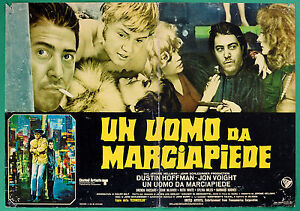
Quando nel 1969 John Schlesinger portò sul grande schermo la storia del giovane texano Joe Buck, aspirante cowboy che si trasferisce nella grande metropoli sperando di fare fortuna come gigolò, e del suo compagno, il vagabondo Rizzo che vive di espedienti, le interpretazioni indimenticabili di Jon Voight e Dustin Hoffman confermarono la straordinaria potenza del romanzo, uscito quattro anni prima, che aveva ispirato il film. Lo strepitoso successo della pellicola (vincitrice di tre premi Oscar, come miglior film, miglior regia e migliore sceneggiatura non originale – caso unico nella storia del cinema, per un un’opera vietata ai minori di 18 anni) ha trasformato il romanzo in un vero e proprio libro di culto. Le disavventure rocambolesche e drammatiche dei due protagonisti si susseguono nella New York degli anni Sessanta fra alberghi squallidi e appartamenti lussuosi, ragazzi di vita e signore viziose, predicatori strampalati e pseudo artisti pop, ma soprattutto una galleria di personaggi lacerati più o meno consapevolmente da una solitudine feroce. La rappresentazione arguta e compassionevole di un mondo popolato di outsider si affianca a una penetrante e poetica comprensione del «grottesco umano», per la quale Herlihy è stato accostato ad autori come Sherwood Anderson, Nathanael West e J.D. Salinger.
James Leo Herlihy was an American novelist, playwright and actor best known for his novel Midnight Cowboy, one of three of his works adapted for cinema. He attended Black Mountain College in North Carolina and was a friend of Tennessee Williams who became his mentor.
Bookended between the ivory tower academic solitude of "Stoner" and the desperate plight of the forgotten poor of Mumbai in "A Fine Balance" I have discovered another kind of loneliness between the pages of James Leo Herlihy. It is the loneliness of a Forest Gump unrelieved by the sort saccharine, fairytale happy endings that pulled this particular movie down for me. Instead of a box of chocolates, Life has given Joe Buck only sour lemons.
One night he dreamed a dream that would become recurrent, a dream of an endless chain of people marching across the side of the world. From his vantage point in some chill and dark and silent corner he could see them coming up from over the eastern horizon, all joined at the bellybutton by a golden rope of light and walking to a rousing march beat, and he could see them moving along until they had gone out of sight behind the western horizon. There were people of all kinds, bus drivers and nuns, musicians and soldiers and ten-cent-store girls; there were chinamen and pilots, hillbillies and fat men and red-headed women; you could find miners and bank clerks there, millionaires, store detectives, swamis, babies, grandmothers, thieves; look for any kind of person in this golden rope and there would be one, a whore, a dwarf, a saint, a crazy man, cop, teacher, reporter, pretty girl, bookkeeper, shortstop, ragpicker. There seemed to be every kind of person but his own. He made many attempts to join them, running up close to the marching stream of golden people, hoping to discover an opening big enough to slip into; but just as he would find one there would be a rapid closing of the ranks, the chain would become tight and exclusive and impossible to break into, and the dreamer was forced to remain always on his chill and dark and silent edge.
Joe is not very smart. Abandoned early in life by three hookers, one of whom may have been his mother, sent to be raised by a self-centered and round-heeled grandmother, bullied by all the other school kids for his slowness, rejected by the army, betrayed by the only young man that seems to want to spend time with him, Joe needs to reinvent himself if he is to escape the dead-end life as a dishwasher in Atlanta.
Now at this time in which Joe Buck was coming out of the West on that Greyhound bus to seek his fortune in the East, he was already twenty-seven years old. But he had behind him as little experience of life as a boy of eighteen, and in some ways even less.
Joe Buck, as we first make his acquaintance, is the poster boy of the American Dream. Tall, blond, handsome, dressed in brand new boots, jeans, leather coat and cowboy hat, he is ready to set out for New York in pursuit of happiness. This confident and decisive persona is a glamour he sets on himself with rousing speeches in front of a mirror, a disguise born from a childhood spent glued to a TV screen watching John Wayne, Gary Cooper and Jimmy Stewart fight out the bad guys and always winning.
And he felt most of all the possession of himself, inside his own skin, standing in his own boots, motivator of his own muscles and faculties, possesor of all that beauty and hardness and juice and youngness, box-seat ticket holder to the brilliant big top of his own future, and it was nearly overwhelming to him.
In the very next scene, of Joe handing in his resignation as a kitchen boy, we find out about the tragic disconnect between the inner fantasies and the harsh reality outside ("That was the way Joe imagined it. This is what actually took place ..."). Joe has few talents to build his future on, and from this meagre supply he picks on his early sexual conquests to pave the way to a life of luxury and contenment:
A lone, lonesome childhood had taught him that today, whatever day he was in, was barren as a wasteland with nothing in it worth looking at, and it had made his mind an inveterate wanderer, nearly always gypsying about in places and situations in which a worthwhile tomorrow might take place. Even while laboring over some lady in the hope of pleasuring her so keenly he would win her devotion forever - for this was what he sought in these early acts of love - even at such moments his mind would trot on ahead somewhere, perhaps savoring a future time in the life he would have made with her.
This disconnect will accompany our fake cowboy to New York, where his dreams of becoming a highly paid gigolo for the rich ladies of the metropolis come face to face with the predatory nightlife of Times Square:
They wove their way through the traffic of people whose complexions appeared never to have seen the real sun, only this topsy-turvy daylight of neon and electricity, a kind of light that penetrated the first layer of skin, even cosmetics, illuminating only the troubled colors under the surface: weary blue, sick green, narcotics gray, sleepless white, dead purple.
Yet, even as he loses all his money and all his possessions, as his brand new cowboy outfit gets stained and torn, as he is ignored not only by the rich ladies but even by the midnight lurkers after illicit affairs, Joe Buck finally finds someone to share his loneliness with. After smoothly swindling Joe of his diminishing cash, crippled and diminutive Rico 'Ratso' Rizzo takes the big and naive cowboy under his wing.
Ratso knows all about loneliness too. Bullied for his physical deformities, orphaned at a young age and forced to survive on the street, one step ahead both crooks and police, Ratso is as quick witted as Joe is slow. Also like Joe, Rico Rizzi is a victim of the gilded promise of the American Dream. In his case, it is the hope to escape the cold and the wind of the asphalt jungle and go to Florida:
In this splendid place (he claimed) the two basic items necessary for the sustenance of life - sunshine and coconut milk - were in such abundance that the only problem was in coping with their excess.
Even as both the dreams of rich and randy women with money to burn and of a dolce farniente on tropical beaches are proving elusive for Joe and Rico, an unlikely friendship develops as the two share an abandoned room in a condemned building and roam the streets in search of a way to earn their daily meal.
The pair of them became a familiar sight on certain New York streets that fall, the little blond runt, laboring like a broken grasshopper to keep pace with the six-foot tarnished cowboy, the two of them frowning their way through time like children with salt shakers stalking a bird, urgently intent on their task of finding something of worth in the streets of Manhattan.
Herlihy casts his net wider later in the novel, expanding his theme of loneliness to the whole social scale, from the bottom feeders to the high flying socialites in their penthouses. In a party set piece he brings Joe and Ratso finally in contact with the affluent world, only to shout out loud that the Emperor's new clothes are an illusion:
One couple - boys of college age, one white, one brown - sat in the middle of the floor holding hands, but it wasn't so much an interracial romance as a marriage of two shades of despair; they were joined at the hands but not at the eyes; each of them frowned into some distance of his own. Many of the lone persons, male and female alike, seemed to be ashamed of their solitary condition. You could see them casting about for a place to lose it, a way to camouflage it or for something to attach it to: a drink, a cigarette, a corner, a conversation, a smile, a stranger, an attitude.
I have written a lot about the events in the book, but I don't consider them spoilers, since this here is a social and character study, and not an action thriller. (Plus, there's the excellent movie version with Jon Voight and Dustin Hoffman that everybody should be familiar with). It's a modern disease, at least to my eyes, the way we are driven to judge people by impossible standards of beauty and success, in endless publicity shots and reality shows and glamorous big budget movies, and look with shame or indifference or disgust at the homeless, the elderly, the crippled, the not so smart, as if it is somehow their fault that they are not living a life of fun and plenty. Joe and Rico deserve our compassion and our understanding, as they didn't have the blind luck of affluent parents or a solid social safety net to keep them away from a life of crime and humiliation.
"They's no Beautitude for the lonesome. The Book don't say they are blessed."
= = =
Talking of the movie, I have seen it several times before realizing there is a novel of the same name that inspired it. The screen version is one of my all time favorites, but I would still recommend reading James Leo Herlihy original story, for the incredibly effective prose, (comparisons with Carson McCullers are not as far fetched as you might think) and for the extra insights into the characters backgrounds and motivations.
This was hard to read. Really hard. Authors like Cormac McCarthy seem to want to sink into and wallow in depressing and disheartening; Herlihy was just handing me a world and saying, "here. here is how it is." and something about that was cutting me on every. single. page. I actually took a break from this book for a day or two because I wasn't ready to be brought back into Joe Buck's mind.
Herlihy demonstrated a great ability to write compact straightfoward prose. I was amazed by the way he showed me Joe Buck's helplessness and confusion without suggesting I look down on him or pity him. It's obvious that Joe is not intelligent but Herlihy doesn't say he's dumb, or even show him doing stupid things, he just gives us a character that's unable to process the world, to make contact with anything real.
Having seen the movie - which is remarkably faithful to the book - I knew what was coming at the end, but as always the book contained so much more. I wanted to stop reading. I wanted to escape the inevitable. The last line made me cry. The book is a relentless assault of loneliness and confusion and hurt.
Do you remember back then to the 60s? Do you remember the splash made by the film based on Herlihy’s book of the same name? The film was released in October 1969. It was at the start X-rated; only adults could see it. Later, the restriction was lessened to R. It is the only X-rated movie to receive and Academy Award for best picture!
Recently this was on sale at Audible.co.uk for £2,99. What luck! I picked it up! I wanted to compare the book and the movie. I have not been disappointed.
But do pay attention--I had trouble with the book at the beginning. I wondered why, why, why I was reading this! The stupidity of certain persons shocked me. I was not enthused, at the start. You may react similarly. Be patient. Once Joe Buck and Ratzo Rizzo meet up, you won’t want to put the book down. I am a sucker for close, movingly drawn relationships! Do NOT throw in the towel too soon!
This book is about the tight bond, the friendship between two friends.
Yeah, both are male, but the bond is not sexual. It is a bond of love.
The beauty of the book is found in observing the wretched lives and desperate friendship of two transients.
If you cannot stomach anything but the proper, clean and neat, look elsewhere. Not everyone is healthy. Not everyone is smart. Not everyone has enough money to cover the bare minimum. Many aren’t and don’t. I say, “Don’t shy away from that which is grueling and unpleasant but real."
Pay attention to where Buck starts and where he ends, not geographically but mentally.
Michael Urie narrates the audiobook magnificently, perfectly, wonderfully. Yes, he dramatizes, but not too much. There is a section where a guy called Townsend cannot keep his trap shut. He blabs on and on. It’s hysterical. This has got to make you laugh, and Urie’s rendition of this is superb. Five stars for the narration.
There are also VERY good lines.
Are you up for an emotional rollercoaster ride? Yes? Read, no listen to this book.
Sure, everyone knows the movie. But I didn't even know it was originally a novel until quite recently. That is unfortunate because the novel is a brilliant portrayal of down-and-outers. Herlihy's tale of dreams and struggles in unforgiving New York is as relentless as it can be but there is a certain poetry in the characters of Buck and Ratso. The biggest difference in book from film is that we find a out a lot more about Buck; his upbringing, his torments, and why the likable but not-so-bright kid is so easily manipulated and trusting. He doesn't even make it to New York until the second third of the novel and Ratso doesn't appear until close to the middle of the book.. Buck and Ratso are certainly one of the oddest and most interesting couples in either novel or film. I highly recommend this book whether you seen the film or not.
The 1969 film version of Midnight Cowboy is an absolute classic & one of my favourite films ever, so I approached James Leo Herlihy's original story with a little trepidation. However, his novel made me smile & feel for the characters right from the opening paragraph when Joe Buck walks out of a shop wearing his new boots. The prose is wonderful, although I did find it impossible to get Jon Voight & Dustin Hoffman out of my mind as I read. A superb book that became a classic film.
There was no way I could relate or even care about the tale of a naïve guy in the 1960s with rose-colored dreams of taking New York City by storm as a male prostitute. I mean those aren't shoes I walk in or have even come close to walking by. Yet, James Leo Herlihy makes me walk in them, makes me become involved as after being sucked into Joe Buck’s lonely, seedy and reckless world, meeting the depressing little lump that is Rico “Ratso” Rizzo, thrown about the underworld of New York’s shivering and starving nights, and then being released from all of that confusion and soil with a hard shove out the door by novel’s end --- I was nodding my head. I got it. I understood. I formed compassion, and in a lot of ways, I related. I got it all completely and now I’m left feeling numb and consumed by this classic tale of friendship, hard lessons, and isolation.
This is an extremely H-E-A-V-Y story. Sorry for the caps, but it has to be emphasized that this isn't an easy, breezy sunshine of a read. I hadn't seen the notorious X-rated movie before reading the book as all I did know of the film was that it won a Best Picture Oscar, starred Jon Voight and Dustin Hoffman, and from the poster, these dudes looked shaaady as all get out.
My vagueness on the story and the movie helped me to enjoy being kind of shaken out of my plush environment. I’ll admit this isn't the type of book that I would immediately pick up, and I wasn't sure about it when I began reading, but within a few pages I became charmed at how Herlihy has written what is the ultimate tome of isolation and the irony of being surrounded by people and still feeling as insignificant as possible as he takes us through every cracked sidewalk step into a man’s reluctant and brutal coming-of-age.
All of Midnight Cowboy is written with clarity and ease, yet Herlihy has some wonderful lyrical moments that make this a smart and complex character study. He even writes the sex scenes (and there are a few) as far from trashy as possible and when the scenes are hard to partake the tension and stickiness is felt. Placing us into the thought process of such a simpleton and making it easy for us to understand and even sympathize also shows Herlihy’s talent with words as its difficult to root and sympathize for Joe Buck and even find empathy for the sniveling and pathetic Ratso. I wouldn't say Joe Buck is ‘stupid’, he’s more so ‘ignorant’ and ‘naïve’ as Joe lives in a fantasy world. He would be since he lacked a solid father figure, his guardian was an irresponsible grandmother, and he was raised by the glorious lie that is television.
I always find it fascinating that there is someone out there worst off than you. As bad off as you can be, you could even be living in the same house as someone and they are having a worst time than you. Midnight Cowboy had that aspect. Ratso had been living, was living this world that Joe Buck saw as a playground of opportunity, and Joe Buck, bless his heart, he is just so eager to belong and be integrated into something after being neglected and abused all his life that he doesn't realize that he has fallen into friend’s private hell and side-by-side the hell is shared. But oddly at the core of this personal hell is a friendship, and that is between Joe and Ratso. What's really sad is that as opposite and lopsided they are this is probably the only friendship that these two have ever had, and their reliance on each other, while not conventional is valid.
Another thing that fascinated me is that there isn't really a villain/antagonist in this story, at least in human form. Ratso appears to be the villain as he leads Joe on in the beginning, but I felt sorry for him most of the time because his life had just been one fail after another and crazily, Joe was the tangible bright spot in his life.
I've read my share of writing books and they emphasize a lot about there being some sort of “bad guy” in a story. Midnight Cowboy made me realize that that concept is quite silly and narrow-minded. Sometimes one’s enemy is not a person or even a person who is tangible. In the case of this story, almost everyone is deplorable in some shape or form. All are greedy for money and recognition, all do each other in, and will stoop to the lowest of ways to get it, yet New York City itself can be viewed as the monster that plagues our main and secondary characters. The city makes them this way. Herlihy paints a New York that is unforgiving, malicious, and has its occupants huddling in doorways, stealing, lying, tossing morals and pride aside. Doing just about any and everything to survive and it’s all too real, as even the city I live in, while not as huge, still has its occupants that are in the throes of seedy survival.
I have come to understand that New York City from the late '50s into the late '80s was not the swankiest, commercialized glittering place we see today, as all that's shown now is pretty much a veil over its past. Some fantastic movies came out in the ‘70s and early ‘80s to show NYC as wicked place. At the moment, Taxi Driver and The Warriors come to mind with these seedy, rooting for the downtrodden fables, and Midnight Cowboy shows the same murky, vicious, and soul crushing NYC. The movie (which I finally got around to seeing and ended up loving too) especially shows that aspect well, as when the characters became dirty, cold, and hungry, I became so as well. Especially Dustin Hoffman’s portrayal of Ratso, as with every cough and shudder I felt it, and it was unsettling (Side note: Hoffman is fucking fantastic in the role, by far one of my all-time favorite performances by an actor, if you want to see the movie see it for that performance).
Another villain is actually Joe Buck himself. He’s his own worst enemy as his nativity just does him in at every turn, and as much as he tries to (naively) make a 'clean, honest' break into the world of prostitution, by book’s end he has become soiled and directionless.
So if you want to be shaken out of your shoes and walk in the stench and pain of Joe Buck's cowboy boots, then by all means, read it. It's a tough book, but don't let that discourage you, it's an excellent story that is guaranteed to make you think differently about the people you may pass by in the street and about how isolation and loneliness can take us down dark alley ways.
Everybody's talking at me / I don't hear a word they're saying/ only the echoes of my mind 🎶
Midnight cowboy non è una storia di marchette. Non è una storia di trasgressioni ,popolata da disinibite signore danarose. È la storia di un ragazzo ,Joe Buck , spavaldo e inesperto , che parte dal Texas ,dove faceva il lavapiatti in una caffetteria, per New York ,con il disperato desiderio di far fortuna ,che vedrà il suo ingenuo ottimismo violentemente sopraffatto. Tante dure lezioni per Joe, la vita di strada , i giri a vuoto ,tra alberghetti squallidi e attici di lusso, incontri con bizzarri personaggi , anche pericolosi, feste con droga e pseudo artisti pop,fino ad incrociare Rico-Ratso ,un piccoletto, zoppo,parecchio furbo ,uno che sta sempre a trafficare e sa cavarsela ,in un modo o nell'altro (nel film , un bravissimo Dustin Hoffman,che lo rende in un modo straordinario! )
È una storia di outsider , di solitudini feroci .
I'm going where the sun keeps shining/ Through the pouring rain / Going where the weather suits my clothes 🎶 🎶
PS. La scena finale, sull'autobus , è una di quelle che ti restano dentro 4 stelle piene!
I have never seen the film of 'Midnight Cowboy' and I was happy that I had not seen the film when I started reading the book, I could see the characters as I would see them as opposed to two actors on a screen. 'Midnight Cowboy' is the story of two very different but ultimately lonely men who become to depend on each other, both Joe and Rizzo grew up in families where they were forgotten, so they are both looking for something, Joe, for someone to love and someone to love him, Rizzo to be accepted, he has always survived on his wits and shows Joe all the tricks of the trade, and Joe shows Rizzo friendship and compassion.
The book is also about a ever changing America and what the America dream is for both characters, a sad book in so many ways but also funny at times especially the bickering between Joe and Rizzo. Joe's naiveness and personality shines through the book and you can not help but like him and Rizzo too, they are characters you will care about.
Midnight Cowboy is one of those books that has not profited from the reputation of its far-better-known movie version. Almost everyone has seen the great John Schlessinger movie of the sixties but very few have read the source novel, also called Midnight Cowboy. And what a shame! Herlihy’s novel is so beautifully written and executed that you fall into its spell with the first sad story of the Texan loner Joe Buck and his long voyage to the mean streets of New York City. Every incident and characterization is perfectly rendered and the reader instantly forgets that he or she is reading a novel. That is the highest praise a novel can receive. Herlihy’s reputation as one of America’s finest novelists would probably have been better served if the movie had been less successful and more people had read the book. There’s still time to change all that.
I love this book for its unflinching portrayal of a platonic love story between two men. And what men! Outcasts, misfits, what ever you want to call them, Joe Buck and Ratso Rizzo have the same hearts, hopes, and longings all of us do. This is poignant, serious stuff and the best work from this particular writer.
As promised, our hero is young, dumb and full of cum. He may not be a real cowboy, but he's certainly from Mishima Country. But the rest of the story was a bit of a disappointment. There's not as much sex as you'd think, the violence is weird, there's a really boring scene at Warhol's Factory (or similar) and I found it hard to care about Ratso.
Having seen, and loved, the movie "Midnight Cowboy," I was curious to read the book on which it was based. This is a terrific novel about an amazingly neglected man-child trying to find his way in the world. The whole first part of the novel was left out of the movie, which begins with Joe Buck's arrival in New York City, and it is important to make real sense of some of the character's ideas (like that he could make a living off of grateful women since NYC is filled with "faggots"). In the movie, he was played as just plain dumb, but in reading the book I had the sense that he was a person who had received so little guidance from or connection with other human beings, that he knew very little except for what was in his own head.
Like "Of Mice and Men," this book is a story of unlikely -- and profound -- male friendship. I wish there were books of the same caliber portraying such bonds between women.
This is not exactly a spoiler alert, but I did find it interesting that the ending of the novel was less bleak than that of the movie. I came to have real affection for Joe Buck, and I hope he found his place in the world and lived out his dreams of love and domestic bliss.
Wielkim odkryciem jest dla mnie “Nocny kowboj” James’a Leo Herlihy’ego (tłum. Tomasz Mirkowicz). Powieść z 1965 roku o młodym Teksańczyka, który porzuca pracę pomywacza w stołówce, wsiada do autobusu i jedzie do Nowego Jorku, gdzie ma nadzieję zarobić jako uliczny żigolak obsługujący zamożne, starsze kobiety. Na miejscu okazuje się, że źle oszacował potencjalną klientelę. Usługami Joe Bucka zainteresowani są mężczyźni.
Herlihy skupia się na tym, co doprowadziło Joe'go Bucka do tego miejsca w życiu, a także związku teksańskiego pomywacza z nowojorskim ulicznym oszustem, Ratso Rizzo.
Książkę warto przeczytać choćby dlatego, że - jeśli znacie film - odkryjecie, że homoerotyczny wątek został tu potraktowany o wiele obszerniej i odważniej. To również książka, która zdaje się prowadzić spór z ówczesną tendencją, by homoseksualność widzieć jako chorobę, czy - to dzięki Freudowi - efekt delikatnie mówiąc kiepskich relacji rodzinnych. Co ciekawe sama - powstała w 1965 roku - powieść Herlihy'ego nie odniosła sukcesu, być może było na nią po prostu za wcześnie. Dzisiaj czyta się ją jako tekst proto-queerowy, trochę amerykańskie "Lubiewo". Cieszę się, że nadrobiłem ten tytuł.
Although comparisons are odious, Midnight Cowboy is similar in tone to City Of Night and unfortunately I think the latter work is a superior novel. I think John Rechy conveys the feeling of hustling as an escape from loneliness a lot more subtly than Midnight Cowboy, which never fails to remind us page after page that Joe Buck is lonely.
The book is also facile in its use of stereotypes, most notably in the Lower East Side hipster party scene. That part was almost embarrassing in its Charlton Comics view of the beautiful people. Not a terrible book but you'd do a lot better watching Jon Voight breathe life into this one-dimensional character.
The movie is better, one of the great movies of all time. But this is still a great story about loneliness and friendship. It is a fitting tribute to the lives of those destitute people we would rather not know too much about.
I loved this movie, and the book is a pretty direct piece of source material, so I knew I wasn't in for any major revolutions to the story. I am a bit of a sucker for reading the books of movies I've already seen. I think I just like to start a story knowing that I'm already invested in the characters.
But I was amazed by how much I enjoyed Midnight Cowboy as a novel, and what a pleasure the text itself was to read through. A lot of books I've read recently either seem forced (like you can feel the author trying to sound as clever or "difficult" as possible) or so proudly focused on such a narrow slice of everyday life that's hard to even care about the insights it presents. I was hungry for a piece of writing that takes on an honest and sweeping human topic--like friendship--and captures it without showy or self-conscious writing.
I'm not sure that this is a popular view, but I think the best novels are the ones where you can't hear the author in the story. That's a completely different skill than speechwriting, for instance, where precisely what you want is to convey a persona behind the words. Reading Midnight Cowboy felt like entering a world of just me and the characters, with no intermediary storyteller between us.
Herlify's prose was a pleasure to read... I lost myself entirely in the story despite knowing exactly where it was headed. I loved it and I can't wait to read another of his books--one where I haven't already seen it put to film.
I remember seeing the movie on New Year’s Day in 1966. I went home and wrote in my diary about the profound effect it had on me. So profound was that effect that I couldn’t help reading the book through the movie, and so I’m not sure how to judge it as a book. Both covered the same ground, and yet to be honest, the movie selected the better parts of story, and managed to leave out those parts that were boring or strayed from the central theme. The movie probably did put the material to best use, but the book got me closer to the Joe Buck character, and it’s him alone, and not him and the Ratso Rizzo character, that is central. A good read.
Very interesting read. The book was much different in tone than I was expecting (I have not seen the movie but knew the bare bones of the plot from various clips of the film I had seen on TV). The characters were very relatable, the various settings were very well done, and I felt it was very well written (the author's style did not overwhelm the story).
This time I rewatched the movie (had not seen it in many years) then read the book. The book and movie are very similar. There is a lot more backstory about Joe Buck’s life in the book. I really got more of what he was thinking.
I recommend seeing the excellent award-winning movie and reading the well-written book also. 🤠🤠🤠🤠🤠5 out of 5.
I took much too long to appreciate this lovely tale of human passion and devotion. This work caught the reality of street life in Manhattan at an especially poignance moment in our history. As fine as the movie is, this is finer.
Another depressing novel made into a movie of which I found both the book and the film bringing me down from a pleasant state in life; but it accurately depicted what I remember of New York City of that time.
Fantastic little novel, but very bleak. An unsentimental & harrowing piece that confronts the meaning of love, loss and identity. A good book to read if you are also feeling dirt poor.
It feels like it takes FOREVER for Joe Buck to get to New York in this -- more than half -- and even longer to meet Rico. Since their friendship (or, *ahem*) is the emotional core of the story, with less time spent on this, the impact is lost.
Wild to think about the cultural atmosphere that would lead to this being made into a hit movie.
I loved how Joe Buck's character is portrayed as completely naieve, vacuous even, without alienating the reader. He is completely lovable, even though utterly one dimensional, his character could be boiled down to his own simple understanding of who he is, (of which he keeps having to remind himself, by looking in every reflective surface); a cowboy and a hustler, two tokens of identity he has gleaned along the way from a failed father figure, and a case of mistaken identity in a nighttime cafe. Joe is confounded again and again by the conniving nature of other humans, whom he soon realizes are just out for what they can get, which always seems to be a considerable amount from the trusting Joe Buck. However, Joe's alienated life in New York causes him to fall in with his betrayer (the cripple Ratzo Rizzo) with whom he forms a farcical, (but profoundly touching) kind of family. Joe eventually takes care of Ratso like a son and finds a meaning for his life through this relationship.
The crux of this story is isolation from others, and the intense desire to bridge the gap and belong in society. This book could only have been written by someone who knows what it feels like to be an outsider in some respect; someone who understands how it is possible to prefer the company of an enemy to the prospect of being alone again.
Joe has a recurring dream of a marching line of people stretching around the globe dressed in the uniform of their profession, with a great chain of golden light connecting them, while he watches from some dark corner. This is the way we are given insights into Joe's character and past; through images, dreams, feverish imaginings which he is not capable of rightly processing as thoughts. Through reading the book we get the impression we know Joe Buck just about as well as he knows himself.
The type of isolation portrayed in the book is special kind of postmodern isolation. Joe's own isolated and sad life is contrasted to the dream he thinks he should be living, his clues on the meaning of life are images copied to his mind from billboards, movies and magazines, his life he feels, is about to happen any minute, but always seems to be just out of reach. He reminds himself of his own value by being a recognizable image himself (a cowboy, a hustler, although really he is neither), by constructing an identity he feels will fit in with his dream of people tied together by light. When he feels challenged or saddened, he reminds himself that he is worhty of his place in society by looking in mirrors. However it is not for a long time that he realises he cannot sustain himself as a human by just being an image.
My favourite quote from the book is a piece near the start, which describes Joe's fear of silence:
"he kept that TV going from noon til long past midnight. Away from it for any length of time he actually became confused and disoriented. he urgently required the images it gave out, and especially the sound it made. his own life made very little noise of its own, and he found that in silence there was something downright perillous: It had enemies in it that only sound could drive out"
This entire review has been hidden because of spoilers.
“’Hopeless. I’m hopeless.’ Oh Jesus Christ! he thought, the truth is an ugly sonofabitch.”
Poor Joe Buck. No friends, no family, no education, and not much there to educate. But he is somehow optimistic, despite all the defeats the author sends his way. Optimistic, and naive, and lonely – and “there’s no Beatitude for the lonesome. The Book don’t say they are blessed.”
We know, even if Joe doesn’t, that dressing up as cowboy won’t turn him into a high-earning stud in Houston or New York City. The boy can’t hustle. But at least in New York he finds a friend in a fellow loser, Rico ‘Ratso’ Rizzo.
My distant memories of the film suggest a New York setting and more or less equal billing for Joe and Rico. But the book takes its time getting to New York and is more than half way through before Rico puts in an appearance as a lightly sketched accomplice. The whole thing works well enough. The writing is pretty simple, but effective. The only problem I had is that Joe is so thoroughly hopeless, it’s difficult to have much fellow-feeling for the character – but possibly that doesn’t matter. The book is a study of loneliness and the New York streets are mean enough.
This book is painful. Herlihy has achieved a significant achievement in Midnight Cowboy. He has invented and brought to life two of the most maladjusted, helpless and fascinating derelicts ever to grace the streets of New York City. Not only does he create these street people, but he brings them to life with his writing and often leaves you with sympathy for their ignorance and childlike decisions. The part of the story that raised my attention was that Herlihy was able to bring to life the cultural chaos of the late sixties in a way that brings this novel to life at a time that included Viet Nam, mass introduction of drugs, assasinations, integration, moon landings, cold wars and eventually Watergate. Do not read this book to be entertained or informed, but rather to explore your levels of compassion, sympathy, ambivalence, apathy or disgust.
Midnight Cowboy - both the book and the film - give me such a strong sense of alienation. Joe Buck and Ratso are not just the outcasts of society, but the rejects too. They are not wanted around by others, they are living in poverty, and there is this constant failure to communicate; additionally they both come from quite dysfunctional families, and thus suffered a loneliness through childhood, which continued into adulthood.
They are two isolated and nihilistic figures, but they form some kind of kinship - and for a time that kinship survived they were, for the first time ever, genuinely not alone.
Life had not turned out as they had planned, and it certainly was not ideal - but at least (for a little while) they were able to forget that constant clinging loneliness.
Alienation, affinity and abandonment - my 3 favourite themes - all run rampant through this novel.
I never really cared much for the movie as I always figured it was one of those 'guy' films that I just don't get--like The Magnificent Seven The book fixes this--and fixes it beautifully. There is much more about Joe Buck: who he is, why he's like he is, why he takes up with Rico so quickly and completely.
This is some of the best writing I've read in a long time (not counting Sherman Alexie). But did it make me like the story? Not really. The story is still not one of my favorites, but the story-telling....now that's a different thing entirely.
I saw a clip from the movie version on a YouTube video, the hilarious scene where Dustin Hoffman bangs the hood of a taxi, “Hey! I’m walk-in’ he-ah!” So I downloaded the book and read it in three days. This is a beautiful story, but heartbreaking. The writer has some simple passages that reveal so much. Very well-written.
My wife and I watched the movie last night. Books are always better than movies, but this movie was done so well, through the acting and the video montages. I enjoyed both the book and movie.