I thought of life's many bounties, to have known the extremities of joy and sorrow, love, crossed love and unrequited love, success and failure, fame and slaughter, to have read in the newspapers that as a writer I was past my sell-by date, yet regardless, to go on writing and reading, to be lucky enough to live in these two intensities that have buttressed my whole life.
Born in Ireland in 1930 and driven into exile after publication of her controversial first novel, The Country Girls, O'Brien has created a body of work which bears comparison with the very best writers of the twentieth century.
In Country Girl we come face to face with literary life of high drama and contemplation. And along the way there are encounters with Hollywood giants, pop stars and literary titans -- all of whom lend this life, so gorgeously, sometimes painfully remembered here, a terrible poignancy.
In prose which sparkles with the effortless gifts of a master in her ninth decade, Edna O'Brien has recast her life with the imaginitive insight of a poet. It is a book of unfathomable depths and honesty.
Edna O’Brien was an award-winning Irish author of novels, plays, and short stories. She has been hailed as one of the greatest chroniclers of the female experience in the twentieth century. She was the 2011 recipient of the Frank O’Connor Prize, awarded for her short story collection Saints and Sinners. She also received, among other honors, the Irish PEN Award for Literature, the Ulysses Medal from University College Dublin, and a lifetime achievement award from the Irish Literary Academy. Her 1960 debut novel, The Country Girls, was banned in her native Ireland for its groundbreaking depictions of female sexuality. Notable works also include August Is a Wicked Month (1965), A Pagan Place (1970), Lantern Slides (1990), and The Light of Evening (2006). O’Brien lived in London until her death.
After a recent read of Edna O'Brien's Country Girls trilogy I was not ready to leave her world and so started on this memoir. O'Brien paints herself as a woman searching for her identity as a person and as a writer. At the time, there were very few women novelists so she had no role model/mentor to guide her; she had to forge her own path.
“I was ravenous. For food. For life. For the stories that I would write, except that everything was effervescent and inchoate in my overexcitable brain.”
As she begins to find her way and her first novel is published, her marriage begins to disintegrate. Her husband tells her, 'You can write and I will never forgive you.'
I find the first half of this memoir gripping. O'Brien narrates her life, her reflections, her feelings. Then comes the middle and I am no longer under her spell. I feel like she's reciting a list of activities--places, people, actions. The intimate, personal touch is missing.
Eventually the O'Brien I am looking for returns, perfect sentences and paragraphs shimmer. She tells of writing a novel about The Troubles after multiple visits to Belfast and the surrounding area. Describing one incident that occurred there, after speaking to a guard who just killed an IRA member:
" 'What did you feel?' I asked him.
'When you're shootin' it's fifty-fifty, but when you've shot him it's a different story, because we're all Irish under the skin.'
He said it with such gravity that it spoke more to me of the complexity and pathos of that war than all the reams and reams of newspaper invective and television coverage."
Having "escaped" to London early on, as O'Brien matures she finds herself drawn back to Ireland over and over again. While she never finds that life partner she seeks, she lives a full and colorful life. On these pages she sets her record straight and lets me share in her life journey.
"At home, I turned on all the lights, including the red lamp in the upstairs room, and it did not seem empty at all, it waas full ofl ight, like a room readying itself for a last banquet."
Edna O Brian has led a fascinating life and was quite the woman. Well 'is' quite the woman as she is still with us. What did I like about this book? The charm, the beautiful prose, the stories of her childhood, the early years of her marriage and the obvious pride and love she has for her children. So why didn't I rate it higher? Well, I would have. If the book had continued in the same vein as the early chapters, I would have given it 5 stars, but it develops into continuous name dropping, some of which was interesting (I liked the story of her night with Robert Mitchum) but most of which was dull, detracted from the story and was just a little tedious. The name dropping of Jackie O for instance seemed to serve no purpose apart from to ensure that the reader was aware of the exalted circles that the author mixed in. There seemed no context to it and it detracted from the rest of the book. However, I did like the writing enough, that at times, I felt I could hear the writer's speaking voice and loved both the simplicity and complexity of her relationships with her family.
I picked this book up because of the many rapturousreviews, not because I knew anything about O'Brien herself. Indeed, I'm shamed to admit I'd never heard of her. Nor am I particularly drawn to memoirs (I don't remember the last one I read). But whatever impulse pushed me to pick up this book did not lead me astray. O'Brien does not even really attempt to present a linear description of her life; rather, it's a rather impressionistic pastiche of various experiences and thoughts. The writing is beautiful, and her musings on topics as diverse as Hollywood parties and the strife in Northern Ireland are equally wonderful to read. She knew a lot of people (and criticism of her "name-dropping" seems unfair and possibly sexist - rarely is Hemingway hassled for writing about Fitzgerald, Dos Passos, and Stein) and her portraits of these famous people are quite incisive and interesting. A worthwhile and quick read for anyone who's in the mood to read a lyrical book by and about a defiant and charismatic woman.
Deludente biografia, che, tranne nella parte iniziale in cui la scrittrice parla della sua infanzia nella campagna irlandese e del suo forte legame con la madre e poi del rapporto con il marito geloso dei suoi successi letterari, per il resto non ha suscitato in me alcuna emozione particolare. L'elenco degli incontri con attori, registi, cantanti e personaggi del jet set internazionale, come Jackie Kennedy Onassis, può incuriosire ma, appunto, è solo un elenco e nulla più. E' stata una scrittrice trasgressiva? Dal libro lo si può immaginare soltanto per le feste a tema alcool e droga cui si accenna. Due stelle e mezzo, direi.
Down a Blue Road A review of the Back Bay Books paperback (May 6, 2014) of the Faber & Faber hardcover (October 4, 2012).
I saw the World Premiere of the documentary film Blue Road: The Edna O'Brien Story at the 2024 Toronto International Film Festival and found it to be a wonderful encapsulation of the Irish writer's life story. O'Brien did not get to see the completed film but had provided several filmed interviews for it before her final illness and passing on July 27, 2024. I had the book in hand as well, but didn't get a chance to finish it until now.
I previously only knew Edna O'Brien's (1930-2024) writing from her first book The Country Girls (1960). Although it was a breakthrough novel at the time of release, it also met with book banning, burning and condemnation in its native Ireland due to its frank depictions of female sexual desire and its mockery of the Catholic Church. Her further success as a writer brought conflict into her marriage with failed novelist Ernest Gébler, eventually leading to their separation and divorce.
Her later independent life in London reads like a whirlwind jaunt through the Swinging Sixties and afterwards. There is a considerable amount of name-checking and funny anecdotes throughout the book about the various celebrities she met and entertained at parties. There are background stories to the later novels and her other writing of plays and screenplays. There is the rather wonderful quirky encounter with later crime & mystery writer Walter Mosley whom O'Brien mentored in a writing course back in the day. Mosley tells the story in the film as well.
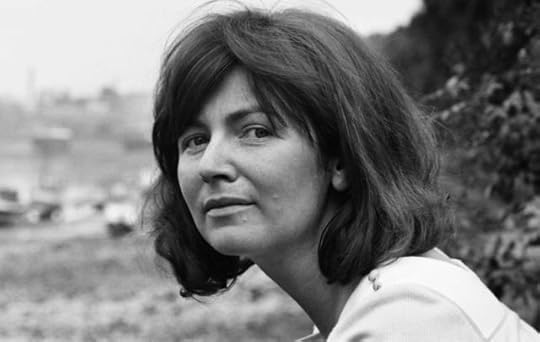
Edna O'Brien in the early years of her career. Image sourced from IrishCentral.com.
Why not a 5-star? The book perhaps rather fizzles out in the end, stopping in 2012 when O'Brien still had further years of writing ahead. The final section talking about Werner Herzog's film Cave of Forgotten Dreams (2010) didn't provide a proper sense of closure. That impression of non-closure was probably due to my having seen the film which showed O'Brien in her later years and her funeral on Inis Cealtra (Holy Island) off the coast of Ireland.
While on the road in September and October 2024, I also toggled reading the paperback with listening to the audiobook which was read by the author herself.
Trivia and Links The various obituaries provide an overview of Edna O'Brien's life and career. You can read some of them at The Irish Times, The BBC and The Guardian.
There is a short documentary film about Edna O'Brien's funeral and burial which you can see on YouTube here.
Edna O’Brien, la grande scrittrice irlandese che fu messa al bando quando nel 1960 uscì il suo primo libro, “Ragazze di campagna”, decide di avventurarsi nell’autobiografia.
Nel prologo Edna racconta di essere appena stata definita “un pianoforte rotto” dalla ragazza che l’aveva sottoposta al test dell’udito e prescritto un apparecchio acustico che lei non riuscì a mettere mai. “ ‘Un pianoforte rotto’ mi ronzava di continuo nelle orecchie, nelle sue varie accezioni, e malgrado ciò mi fece pensare ai tanti doni della vita: aver conosciuto gli opposti di gioia e dolore, amori incrociati e amori non corrisposti, successo e fallimento, fama e biasimo […] eppure, ciononostante, continuare a scrivere e a leggere, essere tanto fortunata da riuscire a immergermi in quelle due intensità che fanno da contrafforte a tutta la mia vita”.
Fu così, che una volta a casa, mentre l’aroma del pane caldo, “portatore di ricordi”, si diffondeva intorno, “nel mio settantottesimo anno di vita, mi sedetti e incominciai a scrivere l’autobiografia che avevo giurato di non scrivere mai.”
Edna ritorna al tempo dell’infanzia a Drewsboro, villaggio agricolo immerso nella contea di Clare, “luogo sacro” per eccellenza, la cui intima essenza coinciderà per sempre con il nome incancellabile di “Casa”. La cornice naturale e la vocazione alla scrittura si intrecciano. “Mi piaceva scrivere all’aperto, nei prati. Le parole correvano insieme a me. Scrivevo storie immaginarie, ambientate nella nostra torbiera o nell’orto, ma non mi bastava, perché volevo entrare dentro le storie nello stesso modo in cui tentavo di ritornare nel ventre di mia madre”.
Poi la fanciullezza nel convento di suore dove riceverà la sua istruzione, l’educazione religiosa rigidamente cattolica, e conoscerà soprattutto i turbamenti del suo primo amore adolescente. L’ambiente asfittico e bigotto trattiene la giovinetta tra le sue grinfie e misura la sua forza di opposizione e resistenza. Ma “il mondo con tutti i suoi peccati e le sue malizie e le lusinghe, mi stava chiamando”. E sarà Dublino ad aprirle gli occhi sul mondo e su se stessa. “Ero affamata come un lupo. Di cibo. Di vita. Di storie che avrei messo per iscritto, ma ogni cosa era effervescente e in divenire per il mio cervello sovraeccitabile.”
Edna ha vent’anni e la collaborazione a una rivista le fa conoscere il suo futuro marito Ernest Gebler, molto più vecchio di lei, acido e platealmente invidioso del suo talento, dal quale avrà due amatissimi figli e una grande parte di infelicità. Negli anni Cinquanta è a Londra dove ferve la vita, la musica e la cultura e nel 1960 scriverà il suo primo romanzo. “Piansi parecchio scrivendo ‘Ragazze di campagna’, ma quasi non mi accorgevo delle lacrime, e comunque erano lacrime buone. Cadevano su sentimenti che non sospettavo nemmeno di avere.” Il libro sembrava scriversi da solo aprendo lo scrigno dei ricordi dal quale usciva un mondo di memorie amare e ardenti. Quel libro (non meno che il suo trasgressivo matrimonio) le valse la rottura definitiva con la sua famiglia e con il suo ambiente di origine.
Poi la tormentata separazione, la gloria effimera e la ricaduta nell’indigenza, gli incontri e i viaggi a New York, la ricerca dell’amore e gli inevitabili naufragi. L’attaccamento alla scrittura e il tormento per la sua periodica assenza. E i brevi folgoranti ritratti. R.D.Laing, Jackie Kennedy, Philip Roth, John Houston… E anche il genio irlandese incarnato da Joyce (autore di culto) e da Beckett, statuario nel suo impenetrabile silenzio. L’Irlanda, sempre. Sentiamo Beckett (un altro espatriato) dire: “ ‘Non c’è alcun bisogno di tornare’, ma io sapevo [dice Edna]che non avrebbe potuto scrivere dei fossi e delle margherite e della terra coperta di rovine se non l’avesse amata, quella terra, nella sua splendida e triste e immortale solitudine.”
E infine il ritorno a Drewsboro, la ricerca vana della casa ideale, del luogo ideale, dell’amore vero.
“Ma io ero tante persone.”
Delle diverse anime di Edna O’Brien qui si può avere un assaggio. Del suo talento innegabile una ulteriore conferma.
Ah, I made the decision last night to finally give up on this book. I tried and tried and tried to like it. I really did. I am not sure why it was such a difficult slog for me; I should have easily finished this thing over the weekend and just couldn't make any headway in it. No doubt my failing more than Edna's, but nonetheless I am calling it done with a hundred pages left.
Después de leer las memorias de O'Brien saco como conclusión que Edna ama y a su vez es Literatura. Ella estaba en cierto modo destinada a ser unas de las grandes escritoras Irlandesas y de la literatura en general a pesar de los muchos obstáculos que se fue encontrando: Unos padres que tenían reservada para ella un futuro como farmacéutica, un país de nacimiento, Irlanda, extremadamente católico donde se quemó y prohibió su novela " Las chicas de campo", siendo definida como las aventuras de dos ninfómanas irlandesas, y un marido, Ernest Gebler, que lo único que podía hacer era envidiar en secreto el talento para la escritura de su mujer.
Estas Memorias vienen cargadas de recuerdos, de flashes que nos llevan de un acontecimiento a otro en la vida de Edna. Estas memorias huelen a Irlanda, a personajes históricos de su país, a canciones tradicionales... Por aquí pasean Yeats, Joyce, O´casey, Beckett, Margarite Duras..
Esta chica de campo, viene a recordar que a pesar de todo, sigue aquí.. con numerosas publicaciones a sus espaldas y con el reconocimiento que se merece.
[Anne Enright, the Guardian. " Es la única, la gran superviviente de unas fuerzas que silenciaron y destruyeron a quién sabe cuántas otras escritoras irlandesas]. Qué pena y qué injusto.)
A quote on the back of the edition I read says "Flashes of prodigious beauty and power." Yes, I agree. But the flashes were few and far between.
I just don't 'get' her as a writer. This book was all over the place, and the last few chapters, I had to force myself through and mostly skimmed them.
If you love Edna O'Brien's writing, as I do, you will love her memoir. Though I have only so far read her Country Girls trilogy and her 1999 Wild Decembers, she has been a shero to me for many years. She belongs to the sisterhood of women from my generation who braved the patriarchy in so many ways. We made our mistakes, we suffered our losses, and hopefully created a better world for women. Her memoir creates for her readers how she did it, what she won and what she lost. She got to keep her kids but she never found lasting love with a man and she was almost always lonely.
I especially loved learning just how autobiographical The Country Girls novels are. She wrote the first one in three weeks while her boys were in school, while still married to the man who was so jealous of her talent that he did his best to kill her spirit. She says the novel just came pouring out. Then she had to sign over the check from the publisher to that man. But she escaped, she got revenge, she had a lot of fun, she wrote many novels. She is still alive.
Of course, Edna O' Brien drops names! She's a country girl who became a celebrated writer. She made a success of herself despite childhood persecution and rural small-mindedness (not only did her parents not have a library, but they burned her books). She lived through a time that post-feminists like to think never existed--she had to flee her marriage because her husband's jealousy of her talents threatened to strip her of her sons. Her success was hard earned, and one of the components of exploring life outside the constraints she had known were parties in London and New York, sometimes with other thoughtful writers, sometimes with people by whom she was just as starstruck as would be us ordinary folk. In my humble opinion, the quality of her writing overcomes any qualms I might have about name-dropping; her storytelling charmed me throughout. I loved this book; after borrowing the kindle edition from the public library I bought it to have it in my library.
One night in their [her sons'] bedroom with all their clutter and paraphernalia, painted soldiers laid out on trays for battle yet to be, Paul McCartney entered. This is just one of the wonderful examples of understated prose found in Edna O'Brien's memoir The Country Girl, published last year. Many lesser writers would have changed the order of words in the anecdote to put the emphasis on McCartney rather than banal domestic details. But such was Edna's life while in Swinging Sixties London; a life so replete with encounters with the great and the good that she can treat individual episodes with nonchalance.
There are many examples of this nature in the middle of the book as famous names from stage, screen and the literary world flit into her world and onto the pages. She cooks dinner for Len Deighton, Richard Burton recites Shakespeare in her kitchen, Lee Marvin is a guest at her son's birthday party and she dances with the then-Prime Minister Harold Wilson.
The names are not there to impress. These people were simply part of an ever-extending circle of friends and acquaintances who gravitated to her home in Chelsea and more particularly gravitate to this vivacious young woman from southern Ireland. A party girl she may have been but The Country Girl is no kiss and tell memoir. In fact she is remarkably silent on the identity of some of the men who played a part in her life, including someone who seemed to have been an eminent British politician.
The memoir is instead a warm and frank account of a life that was anything but carefree. O'Brien's early years in County Clare, Ireland were lived in fear of a father who had drunk away the family's wealth and in the stultifying atmosphere of a strict Catholic community serviced by the church and 27 pubs but no library. "There was only one book in the village apart from the Bible — du Maurier's Rebecca," she told an audience at the 2013 Hay Literary Festival. "We used to share it around but you only got one or two pages at a time and they didn't always come in the right order."
It wasn't until she broke away and moved to Dublin to work as an assistant in a pharmacist's shop that she discovered literature along with pierced earrings and men. Finding T. S. Eliot’s “Introducing James Joyce” in a quayside stall marked the beginning of what she calls the “two intensities” of her life — writing and reading. Freedom came at a price — her family tried to kidnap her when they learned of her affair with a married man, forcing the pair to flee the country. In London, married to a poet and the mother of two boys, she began to write. The Country Girls was completed in just three weeks. Her tale of two girls who leave their small Irish village and convent education for the bright lights of Dublin met with critical acclaim everywhere except in Ireland and by everyone except her mother and her husband.
In Ireland it was considered immoral and its publication banned. "Filth" proclaimed the Archbishop and the Minister of Justice. Even the local postmistress in her home village weighed in - she should be made to run naked through the street as a punishment she claimed. O'Brien was summoned to a public meeting in Limerick to defend her book against accusations that it was little more than hard-core pornography.
Her husband's response was more personal: "Yes he had to concede that despite everything, I had done it, and then he said something that was the death-knell of the already-ailing marriage —You can write and I will never forgive you."
What follows is one of the darkest periods of Edna O'Brien's life. Separated from her children, she finds herself portrayed in a custody battle as a harlot, the writer of obnoxious and obscene literature and an uncaring mother.
Country Girl was a book O'Brien swore she would never write. She did so at the age of 78 in order to set the record straight about this and other episodes in her life including a published interview with Gerry Adams the Sinn Fein leader which led to accusations she was promoting the cause of the IRA.
There is a sense though there is much more to this memoir than simply recording the truth for posterity. There is a sense that in turning to the past, she found a reconciliation not just with the land of her birth, the land that never rated her as greatly as Joyce or Yeats and fought her attempts to build a home on its shores, but with herself. After a return visit to her childhood home that is now in ruins behind a screen of ivy and bramble she reflects on "... for ever the need to go back,the way animals do, the way elephants trudge thousands of miles to return to where the elephant whisperer has lived. We go back for the whisper."
My verdict: Elegaic, moving and funny. A perfect example of how memoirs should be written.
Libro che ho trovato in biblioteca per puro caso e, dato che con il gruppo di lettura di febbraio si andava in Irlanda, mi è sembrata una buona idea prenderlo in prestito. Non conoscevo Edna O'Brien e non ho mai letto niente di suo, ma ciononostante la sua autobiografia mi è piaciuta tantissimo. Non credo sia indispensabile aver letto i suoi libri per poter apprezzare l'autobiografia. Sì, accenna ai suoi libri e ai problemi che ha dovuto affrontare dopo la loro pubblicazione, ma non è necessario averli letti per conoscere questa scrittrice. Nell'autobiografia si impara a conoscerla a 360°: i ricordi dell'infanzia in Irlanda; della fuga in Inghilterra e del matrimonio fallito; la lotta per riuscire ad ottenere l'affidamento dei figli dovendosela vedere con un ex marito manipolatore e mezzo psicopatico; la povertà che ha dovuto affrontare in alcuni periodi della sua vita. Poi si passa alla seconda parte del libro in cui ci racconta di quando era una scrittrice affermata: le feste a casa di personaggi famosi, i party organizzati a casa sua; i viaggi in Francia o a New York dove teneva dei reading all'università. Ha conosciuto chiunque fosse famoso in quel periodo: da Samuel Beckett a Jacqueline Kennedy Onassis e molti altri. La sua vita è stata ricca di incontri sia di scrittori che di attori e registi perché oltre a scrivere libri si dedicava anche a sceneggiature di film. Ha conosciuto molti altri artisti (scultrici, fotografi, etc.) e anche personaggi politici. Nonostante avesse avuto una vita piena e ricca di amici, le è sempre mancato non aver trovato l'anima gemella, l'amore grande che tanto desiderava. Questa sensazione di solitudine arriva anche al lettore. Un altro motivo di sconforto per Edna O'Brien è stato quello di non riuscire a tornare a vivere in Irlanda. Per un po' ci ha provato, ma l'Irlanda non era ancora pronta ad accogliere una scrittrice "immorale" come lei; inoltre, erano gli anni dei conflitti nell'Irlanda del Nord, lei aveva trovato casa nell'Irlanda nord-occidentale, e andando nell'Irlanda del Nord ha avuto un paio di disavventure perché dal suo accento la gente capiva subito che era del sud e quindi cattolica. Un altro elemento di tristezza nella sua vita è stato il rapporto con i genitori, rapporto che non è mai riuscita a vivere serenamente: del padre ha sempre avuto paura e con la madre aveva un legame forte ma conflittuale perché il suo desiderio di libertà e indipendenza andava a scontrarsi con il lato ultra-cattolico della mamma. Edna O'Brien ha avuto una vita piena di amicizie, conoscenze, affetto, incontri, avvenimenti e viaggi; ma dall'altro lato si percepisce anche una vena sottile di malinconia.
Edna O’Brien to jedna z najważniejszych irlandzkich pisarek XX wieku, która odważnie i bezkompromisowo przedstawiała perspektywę kobiet. Za swoją bezpośredniość w niektórych kręgach była wręcz wyklęta. Po wydaniu pierwszej książki rodzinne miasto autorki uznało ją za plugawą, a najbliżsi sąsiedzi byli oburzeni i zniesmaczeni zawartymi w niej historiami. Podobnie było z rodziną autorki, z matką na czele, która w podarowanym przez córkę egzemplarzu zaczerniła wszystkie obelżywe według niej fragmenty. Słów nie szczędzili jej nawet najwyżsi przedstawiciele kościoła czy politycy, a mąż po przeczytaniu manuskryptu powieści powiedział jej „Umiesz pisać i nigdy ci tego nie wybaczę”.
Do napisania swojej autobiograficznej książki „Irlandzka dziewczyna” usiadła w wieku siedemdziesięciu ośmiu lat i jak sama pisze w prologu to książka ze wspomnieniami, których przysięgła sobie niegdy nie napisać. Jak wspaniale, że jednak to zrobiła!
To absolutnie fascynująca historia życia kobiety skandalistki, która odegrała ogromną rolę w przemianach feministycznych w irlandzkim społeczeństwie. Piekielnie inteligentna, bezczelna, bezpruderyjna i pełna charyzmy. Kocham takie emancypacyjne historie, uwielbiam czytać o pisarkach, o ich drodze do pisania czy procesie twórczym. A tutaj oprócz życia pełnego książek, w dodatku na tle ogromnych zmian społecznych w Irlandii, zaglądamy też (dla mnie nieoczekiwanie) w świat śmietanki towarzyskiej szalonych lat sześćdziesiątych i siedemdziesiątych. W jej domach odwiedzały ją największe gwiazdy takie jak Sean Connery, Richard Burton, Marlon Brandon czy Jackie Kennedy. Znajdziecie tu masę anegdotek i naprawdę osobliwych doświadczeń, jak to, kiedy Edna bierze LSD na sesji ze swoim ekscentrycznym psychiatrą (!). No i jak to jest fantastycznie napisane.
Nie będę wam więcej zdradzać, mam nadzieję, że to co napisałam zachęci was do sięgnięcia po ten tytuł. A ja mam ogromną nadzieję, że wydawnictwo Czarne lub jakiekolwiek inne zdecyduje się na ponowne wydawanie jej książek u nas :)
Fascinating read. Provides insight into the complex, febrile mind of the author. While there was much too much name-dropping throughout, the book was very moving in places, especially when one realises the author has spent her whole life searching for the great love of her life. And at 82 years of age, she searches still.
Edna O'Brien's "Country Girls" trilogy were definitive books devoured in my far distant youth. Very racy and dogged by controversy at the time, especially in Ireland. They spoke to me at a time of confusion - a Uni student who struggled with pursuing studies or marrying young. Consequently, I looked forward to this auto bio. It is a curious book. The wonderful, lucid, descriptive writing style is there but emotionally, it feels most detached - just like an old woman viewing her life at a distance. True facts - but not expected of Edna O'Brien! You never get a real feel of her motivation for writing or why so many people found her charismatic.
Still it has motivated me to read her son, Carlo Gebler's work on his tortured father, "Father and I". A much more passionate book written in a lucid style. An underrated author.
My Two mistakes, most probably, are the reasons for the three stars.
The Mistakes No 1: I had started this book immediately after the reading another memoir by one of Edna O'Brien's sons (Father & I: A Memoir). Her son's memoir contained most of the scenes narrated in Edna's memoir. There were, certainly, the differences. Still the feeling of repetition and the dullness that known details bring to the reading mind could not be avoided.
The Mistake No 2: I had not read any of Edna O'Brien's earlier books. This is her latest work and I read it first. In the memoir, the reader finds lot of references to her own earlier works and the situations in which a particular book was written and the situations that the book had to endure after the publication. These all would be very engaging to the one who had already equipped himself with the adequate knowledge of her books. Otherwise one may find himself/herself lost in the empty whiteness till he/she finds a hold after few pages in which her normal life is narrated.
I love her fiction, and I'm fascinated by people who transform themselves--moving from one social milieu into one vastly different, or what you might call "social class jumping." I'm also fascinated by the UK in the late 1950-1960s,the rapid changes in manners and customs just after WWII. But halfway through, this book just turned into a name-dropping account of famous people she met once she became a published author living in London. It started out as a very literary memoir--capturing time and place and complex psychological states--and turned into a celebrity memoir in the fashion of "and this one time I met Mick Jagger for 10 minutes." For all the name-dropping, these famous-people cameos don't add to the story at all. The 2nd half becomes a list of parties she went to with famous people at them. I wanted to love this book, but it derailed itself halfway through.
Very rich memoir -- the period it evokes and the life struggles of an emerging woman writer. It's gorgeously written,confirming that O'Brien is truly a great writer. Inspires me to read more of her work and re-read The Country Girls Trilogy.
This started out as 3 stars for me but in the end was 4 stars. It is probably a book for those who are already O'Brien fans. I don't think others would find her life story in itself that interesting.
Warning: if you begin reading Edna O’Brien’s Country Girl: A Memoir, you will not want to put it down! Her early fiction, which began at age 28 with The Country Girls, broke all kinds of taboos not just about what Irish novelists could write, but what young Irish women novelists could write! If her fiction was bold, brash, and scandalous for a young Irish Catholic woman, her memoir is unflinchingly honest, beautifully written, and will leave readers breathless, for O’Brien appears to have packed enough living into one life that could easily suffice for two or three!
Though Country Girl covers O’Brien’s life from birth, through a convent boarding school, and then night study to become a licensed pharmacist, things changed with her “introduction to literature,” when she read Introducing James Joyce and awakened her muse. She carried the book everywhere so that she “could read it at will and copy out the sentences, luminous and labyrinthine as they were.” At 22, O’Brien married Ernest Gébler, a man 18 years her senior, and quickly had two sons, Carlo and Sasha. In fact, Carlo was conceived out of wedlock, but was born to hastily-wedded parents.
The family moved to London, and early hairline fractures in the marriage erupted into gigantic crevasses, especially when O’Brien skyrocketed to fame (albeit scandalous fame) with publication of her novel trilogy between 1960-63: The Country Girls, The Girl With Green Eyes, and Girls in Their Married Bliss. Her husband’s sinister jealousy skyrocketed in parallel with her fame and the marriage ended acrimoniously in 1964, a decade after it began.
But it was the heady sixties in London, and O’Brien’s amazing life intersected with all manner of celebrities—movie stars, pop stars, and literary stars, a veritable Who’s Who of famous names, even though it’s fair to say that, in many cases, these were people on their way to becoming famous. Paul McCartney once showed up at O’Brien’s home, picked up her son’s second-hand guitar and sang “Those Were the Days,” then popularized by singer Mary Hopkins. He also composed an impromptu song about Edna O’Brien. O’Brien was given a tour of New York by Norman Mailer; she had a one-night dalliance with Robert Mitchum, Richard Burton came calling on her, and she met up with Marlon Brando and John Huston more than once. Among her female acquaintances, she numbered Marilyn Monroe, Jackie Onasis, Marianne Faithful (then Mick Jagger’s girlfriend), Hillary Clinton, and many others.
In the early years, the books came quickly and fluently—eight novels in less than a dozen years. But she also writes of the times when “the words won’t come,” the nightmare of all writers. She never despaired: she kept on journaling and note-keeping, always believing that something would come of random written scraps. She nevertheless produced a respectable body of work that drew recognition on both sides of the Atlantic.
This is a dazzling, entertaining, richly-packed memoir. Her elegant prose may have cost her effort, but it makes for effortless reading. Page after riveting page, her words are as mesmerizing as the pleasure of watching one spot in a flowing stream, knowing that new water will pass through a fixed gaze continuously, endlessly. The seductive sense that one could watch forever creates a similar yearning to continue reading about this country girl forever.
I had read the Country Girls trilogy a few years ago, but knew next to nothing about Edna O'Brien's life; I was inspired to read her memoir when I read a feature on her and the book in Vanity Fair a few months ago (and a pretty solid chunk of the chapter about her marriage was quoted in the article). And I liked the book, but it left me a little cold--or rather, the writing left me a little cold and distant, not the content. I vaguely remember a similar sensation from reading The Country Girls. It's the kind of writing that is so beautiful that I feel like I've missed something if I get wrapped up in the story, so I'm continually flipping back or reading back a few paragraphs to just look at what was going on with the writing.
I'm glad I picked this up, and Ms. O'Brien has had a truly fascinating life (all of those famous people! I had no idea she was such a big deal!), but I'm not sure I could really say that I enjoyed it. But then, I didn't totally enjoy The Country Girls either.
A self-indulgent stroll through the cluttered memories of expatriate Irish writer Edna O'Brien. Her childhood years are interesting enough but she quickly grows up, marries young to the wrong man, of course, and becomes part of the London swinging sixties set. Then we are treated to page after page of which movie stars she slept with, which movie stars gave gifts to her children and what a cool mummy she is for having them serve drinks at her parties and smoking pot in front of them. Even Paul McCartney makes a midnight appearance, waking them up and singing to them so they can boast about it at school. Complaints from the neighbours, her ex-husband and her sons' schoolmaster are all dismissed. The impression is of a very tiresome person. I haven't read anything by Edna O'Brien and now I don't think I ever will. Note to self, stop reading memoirs.
I barely knew who Edna O'Brien was going into this book, which may have put me at a disadvantage. It's not a structured biography, it's more like a series of vignettes from her life. She's a good writer and the beginning is promising, but much of this book is, well, plodding. And it shouldn't be like that when the author was one of Jackie Kennedy's besties, and had Paul McCartney serenade her, am I right?
I loved the section in Ireland, her childhood right up to her marriage and when she leaves her husband and finally gains custody of her two boys (the first half of the book). Then the memoir loses some of its richness...gets caught up in social circles, brief stories. There are again moments of beauty and richness but...never in the same way. This is a memoir by a very private person, so...that shows.