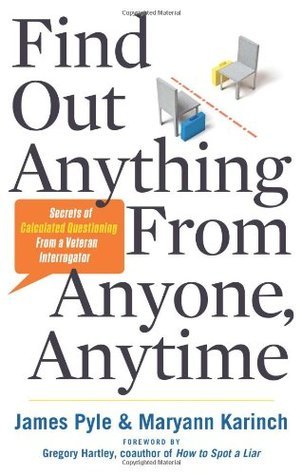
"With his style of questioning alone, Jim Pyle can get more information than most other interrogators using multiple techniques." --Gregory Hartley, coauthor of the best-seller How to Spot a Liar The secret to finding out anything you want to know is amazingly simple: Ask good questions. Most people trip through life asking bad questions--of teachers, friends, coworkers, clients, prospects, experts, and suspects. Even people trained in questioning, such as journalists and lawyers, commonly ask questions that get partial or misleading answers. People in any profession will immediately benefit by developing the skill and art of good questioning. Find Out Anything From Anyone, Anytime will give you the power to: Identify and practice good questioning techniques
Recognize types of questions to avoid
Know the questions required when hearing unconfirmed reports or gossip
Practice good listening techniques and exploit all leads
Determine when and how to control the conversation
Gain real expertise fast Within professional interrogation circles, Pyle is known as a strategic debriefer--meaning there is no one around him more skilled at asking questions and getting answers. He has been training other interrogators in questioning techniques since 1989.
If you've read books about interviewing for information to write an article or for lawyers discovery, this is a very similar. I believe I've also seen some TED talks that cover some of the same ground in the same way. I found this a great review of ways to ask questions. I can vouch for the guidance to ask about one topic at a time - I often test this by texting my daughter two questions, and I have yet to have any second question answered. This went more into leading, or criticizing questions than I had seen. These are the kinds of questions you hear quite often zinging between political enemies on talk shows. A quick read, and a worthy review of questioning techniques.
Great book. Requires a second read if you don't go through it carefully, or if you really want to get anywhere with the content. Essentially, always use interrogatives; keep your questions simple (one at a time); always ask "what else?" to your interviewee before going asking your next planned question; and that's all I remember off the top of my head...like I said, I'd like to review it again to get more out of it.
Really liked this! It followed Malcolm Gladwell's What The Dog Saw well. Ultimately, asking questions is something that's natural to us, but as we grow up, we're trained to ask bad questions. James Pyle gets us back to good, solid questions in all aspects of life: academic, parenting, professional, etc. As someone who has studied rhetoric, I enjoyed this quite a bit.
Absolutely the worst audiobook for me in 2018. Horrible, mono-tone almost computer read. The strategy and questions are sound, but he covers everything you need to know (and quite frankly already knew, but you just needed to be reminded) in the first ~3 chapters. All content past that are examples. Only picked this up as it was recommended by sales leadership in a 'book of the month' kind of thing.
Buen libro para aquel que quiera ahondar mas en el arte de hace preguntas. Los últimos capítulos fueron los más útiles para mi ya que el autor dabe ejemplos e ideas sobre hacer preguntas en el día a día, recalcando que las preguntas en el nivel personal son para generar conexión con la gente (a diferencia de hacer preguntas en el nivel profesional que es el caso del auto como interrogador militar.) Les dejo la formula para una buena pregunta: 2 x 6f x 4 =
2: Curiosidad de un niño de 2 años
6: Who/ quien What /que Where /donde When /cuando How/ como Why/ porque Huh?
F: Follow up questions
Sobre estas areas: 4 People Places Things Events in time
This review is based on the Blinkist version of the book...thus a summary and my review needs to be qualified as such. Presumably the original full text has much more details and research.....but it also takes much longer to read. If I like the Blinkist version, I might seek out and read the full book. Meantime here are a few nuggets that particularly struck me: To encourage a person to respond with full, illuminating answers, you need these six magic words: who, what, why, where, when and how. Let’s call them W-words. Questions that begin with W-words are excellent because they don’t allow for simple yes/no answers ..... Questions that employ W-words are better because they’re less leading and confrontational. 1. The first type of bad questions, then, are leading questions. The next three are: vague questions, negative questions and compound questions.... 2. Vague questions have no focus and are often too broad for the respondent to answer effectively. A prime example of a vague question would be: “What do you think about the modern world?”... 3. The next type is negative questions, which are confusing. If you run too many negatives or double negatives together in a question, you’ll make it too difficult for the person you're asking to answer. 4. The fourth type is compound questions–which are multiple questions disguised as one. Compound questions rarely receive an answer to both parts because the respondent forgets one half of the question! A better interviewer will ask one question so that the person being questioned can remember it and easily address the topic at hand......“ Here’s another question that tends to yield particularly informative answers: “What else?” If there’s one golden nugget of advice to retain from these blinks, it’s to remember to use this phrase when you’re questioning someone. What else?” is often the best question you can ask. Imagine a scenario where your computer just won’t resize an image.....In this situation, the tech support worker was able to quickly discover that it’s not just the process of resizing images that isn’t working; it’s your image-editing software that’s the real problem...They were able to work all of this out by simply asking, “What else?” The best way to get the fullest answers is to delve deeper into your current question rather than rapidly moving from one to the next. And one of the most effective techniques for going deep is to reframe your question......Let’s say you ask, “How many players will be playing in the next World Cup game against Brazil?” And you get this response: “Eleven, last time I counted.” But this isn’t what you need; you want to know how many people are involved in the tournament, so you go deeper, asking, “And how many hotel rooms have you booked?” And you get this reply: “Twenty-three for the squad and ten for the management team.” It’s also a good idea to ask for the same information twice in order to uncover the truth. Say you’re putting on a trade show in three months’ time, and you speak to a client who has an innovative new product. You ask: “When do you think it will be ready for release?,” to which she replies, “Within three months, definitely.” You then decide to press her further and ask, “So can I book you in for a stand in June to launch your product?” She replies, “We might not be out of beta testing by June, and we’re still waiting on the patent confirmation.” Remember that a conversation is a two-way exchange. Therefore, to get the most information out of someone, it’s best to put yourself in their shoes. When asking questions, determine whether the respondent has something to lose or to gain. Different respondents will have varying motives for either answering or refusing to answer certain questions. Another key aspect to consider is your respondent’s personality type. Some people are naturally private and evasive, while others are open and talkative. There are even those who are overconfident and dish out their opinions as if they’re hard facts. People who like to deliver personal opinions as though they’re facts tend to have a dictatorial personality. This is the category that many politicians fall into;.......Certain people–let’s call them “evaders”–avoid questioning and don’t like to be interrogated. They may have been raised by very strict parents whose cultural views differed from their own. In general, evaders tend to hide a lot from their families....Generally speaking, a person’s profession can tell you a lot about what kinds of questions they’ll ask......Teachers tend to ask penetrating questions to get their students thinking. The most effective practice is to ask questions that encourage students to discover the facts and then to meaningfully engage with them. Another profession to consider is medical practitioners; their questions will vary, depending on their role.....If you call the general health hotline, you’ll be asked a list of scripted questions. Scripts are a fantastic diagnostic tool because they allow the nurse to reach a probable diagnosis fairly quickly. If they discover that you’re not bleeding, have no problems breathing and that the pain you’re experiencing is sporadic, they’ll know that your condition is probably not urgent. However, if you call 911 and can hardly speak, the scripted questions are forgotten and an ambulance is sent When a big news event breaks, you’ll notice that the journalists covering the live event focus on what’s happening in real time, rather than speculating about motivations or trying to provide explanations. The reason for this is because journalists are trained to ask “What?” and “Where?” rather than “Why?” Look at it this way. If you only witness one tower collapse, you might think that it’s an awful accident. If you then see the other collapse, you’ll think it’s deliberate. If you take the initiative to ask “What else?” and are informed of the Pentagon, you’ll have a fuller picture when it comes to understanding the motivations behind the attack. By continuing to ask “What else?” you’ll begin to notice similar attacks in the years leading up to 9/11–and, gradually, you’ll be able to put two and two together and realize that this was the work of Al-Qaeda. The key message in this book: Whether you’re interviewing formally or chatting with a colleague, guide people to provide detailed, informative answers to your questions by asking W-words; “What,” “Where,” “When,” “Why” and “How.” Moreover, using the invaluable question “What else?” and reformulating your questions will garner additional information and paint a fuller picture of the topic at hand. I’d thought, from the title, that this was going to be a set of smart ways to get information from people about their product needs and to work through the minders for top executives but it’s rather more broad than that. It really does just come down to asking “W Questions” and then asking “what else?”. Actually, it’s pretty limited in scope but it probably does what the title suggests and it’s certainly simple enough to apply the techniques. Four stars from me.
"What else?" Whenever there might be additional information - e.g. who hires you to DJ? who else hires you to DJ?
Ask questions that can't be answered with yes/no
Ask about only one thing at a time
1. Direct - interrogative (where did you go last night?) 4. Repeat - same question in different ways (what else?) Verifying accuracy 2. Control - are they answering correctly ( you already know the answer); non-pertinent (not what you want to know, but something they won't lie about) 3. Repeat - same information, different questions E.g. when will it be ready for launch? how many units at the trade show? E.g. Do you know what a footprint looks like? can it be seen with the naked eye? did you know that some footprints can't be seen until shown with an oblique light? have you ever heard that in your training at the homicides you've been at? 5. Summary - let them revisit their answer E.g. So let me see if I got this right. I hear you want a red, full-size car in the luxury class. How does this description fit what you want?
Leading Q Would you prefer to live in Canada, where the health care is first-rate, or in the United States? (implied criticism)
Negotiating by questions What do you need to give me a better price? How much commission will you lose if....?
This was a very good effort, but the author missed an opportunity here by making the book follow his classroom exercises. The book, intended for people outside his classroom setting, should have explored exercises that do not make use of role-players. There are more than a few exercises that can be completed by regular people. It is made obvious that the Author believes in the classroom learning model however. This doesn't make the book bad, in fact I learned a lot. The Author was able to make me curious about the topic and excited to try out some of the ideas. I have already used a few of these ideas, and I am certainly more aware of my questioning style having read this book. I think that your average reader, if not employed in one of the professions detailed in these pages, can gain some very valuable techniques with a little practice and some self-reflection. For those who ask questions everyday, it is worth examining your questioning style to determine if these techniques can benefit you and those you deal with daily. I would recommend this book. It isn't life-changing, not for me at least, but it was worthwhile.
A great book for an overview of asking the proper questions for discover and revealing information held by another person. The only problem with this book is that most of it applies to interrogation techniques and approaches. The fundamental question, "What next?" facilitates exploration of key topics and works well for an investigation but it does not work well with technical personnel or those that work in the security world. The issue with "What next?" is the fact that the owner of information may set up a wall thinking that you are probing to much into information that they don't want to reveal. Other then this focus the idea of asking simple and direct questions followed by active listening and attention to our goals provides the foundation for strong conversations and critical thinking. Highly recommended for those that attend meetings on a regular basis.
I enjoy reading or listening to books like this one. Many years ago, I read Spy the Lie to help improve my skills from when I worked for a staffing agency. In that role, I frequently had conversations with candidates with a smattering of things on their backgrounds. Believing in 2nd chances (or even 3rd) and understanding people can change, my goal was to hear their story and try to determine the risk of hiring them. Am I being told the truth, or are they saying what they think I want to hear?
This book is a bit different in that its focus is ore about how to ask questions. It is not just the words in the question, though the words definitely matter, but the order you ask them. I love trying to craft good questions! It helps when interviewing candidates, performing a workplace investigation, and generally learning what drives people.
Avoid asking compound questions - I am definitely guilty of that and have experienced the results.
Another big thing I learned was to avoid following the thread that is most common. Here's an example. Tech support rep asks "what is going on with our laptop?" I cannot upload images. By instinct, the tech might then want to ask "what kind of images?" When a better question would be "what else?" and keep asking for all of the issues because each one might be an additional clue and also, you might solve on thing but they don't have all of their needs met.
What upset you about the meeting? After they answer, ask what else and keep going until you have the full picture. I have learned to do this when one of my children is upset - I write everything down and then we go back and solve it - many times there is a theme. But do I do that at work? Now I will.
Another tip - keep extraneous information out of the question. Did you go take the blue bowl to dishwasher and put it on the top shelf after finishing your homework? No. No you didn't take a blue bowl? No you didn't put it on the top shelf? No, you didn't put it in the dishwasher? Focus on what you specifically want to know. What did you do with the blue bowl? might be the best question depending on the circumstances.
Last one I liked - stay with the question until it is answered. You might want to ask the same question in a different way but don't be pulled away from your goal.
When I first saw this book it immediately came to mind horrible images of torture, waterboarding and such practices. But knowing how to interrogate doesn’t mean you're going to coerce someone (most of the time). We are all interrogators since early childhood, and to continue to learn we must keep the curiosity alive…and to know how to question is essential to acquire valid information. Now you can become a better interrogator.
Knowing how to question is truly a vital skill to master in all aspects of life. And reading this book you will learn this skill through two specialists that devoted most of their professional lives to this subject. Veteran interrogator James Pyle and the prolific writer Maryann Karinch will lead you through good and bad questions, lots of examples, lines of questioning, areas of discovery, how to organize and analyze data, how to search for signs of deception or discomfort, etc.
With information and specific examples dedicated to several different professional circumstances, personal life, parenting, exercises and good practices, you will soon start to make better questions…and getting better answers. Truly remarkable and simple to use (although tough to master, but it will come with time).
If you've already read extensively about the subject, this book might not be that useful, but as a starters guide it is awesome.
As someone who works in educational and collaborative spaces I added a number of books to my 2025 reading list to help me improve as a communicator. In particular, I wanted to be better at asking questions. I’ve read a number of titles this year on the topic, a few much longer and more detailed than this one. FIND OUT ANYTHING, FROM ANYONE, ANYTIME stands out, similarly as Chris Voss’s NEVER SPLIT THE DIFFERENCE for taking complicated ideas and reducing them to easy to follow, easy to understand, and easy to employ tactics and strategies.
Literally, I read the first two chapters of FIND OUT ANYTHING, FROM ANYONE, ANYTIME and was able to test out behaviors the next day and they worked.
I saw this in the gift shop of the DC Spy Museum and thought it looked interesting. So I got the audiobook version when I came home. It was an interesting topic that I’d never thought much about before. The audiobook version was kind of rough, I had to slow it down to .85 speed. If I were really looking to deep dive and apply this info, I’d probably want the hard copy of the book and to read it slowly a chapter at a time taking a break between chapters to a sort and apply. But it was an interesting overview of an interesting topic.
_Find Out Anything From Anyone, Anytime: Secrets of Calculated Questioning From a Veteran Interrogator_ by James O. Pyle receives four stars from me.
The information is well organized and easy to follow. I found this really helpful to me in my professional life already. Simply understanding how to present questions was a big help and how the follow up with "What else?" is useful. This is a book I will read again, and read in often.
Recommended: do you work in a field where getting information is important, like Social Work, Police Work, Sales? then this is a good book for you.
Excellent and thought-provoking book. My husband and I both enjoyed this. Pyle’s methods are straightforward but take lots of practice to master. I’m already viewing personal and business conversations in a new light. Talking with others requires more intentionality when you truly want to learn about them and their interests.
I will definitely give this a second read and take more detailed notes.
Questions that start with who, what, where, why, when, how, and what else produce the best answers. Bad questions are leading questions, vague questions, negative questions and compound questions. The best way to get the fullest answers is to delve deeper into your current question rather than rapidly moving from one to the next.
I listened to the audio book and it’s pretty good. I learned some new questions, new questioning techniques and also to be leery of sharing too much information when being asked a question in an elevator or a grocery store line for example.
The title is way over the top, but it actually is quite a useful book for improving the way you ask questions. The author points out that this isn't just useful for interviews and interrogations, but in connecting with people and getting to know them. I think it would be useful for any library staff who does reader's advisory or reference interviews.
An excellent and informative source on learning effective questioning techniques.
I found this book an excellent guide on how to question people from children to adults in various situations. In it you are provided with a how to and not to question effectively. By using a well thought out practice involving listening your chances of success are guaranteed.
A more sophisticated approach than dale Carnegie’a books on the subject.. I enjoyed reading it but understand how it could be received as dry by some readers who are used to the flare of novels and such!.
Great read about how to ask questions. Communication is a crucial part of our life and a big part of our work regardless of our job, so naturally knowing how to ask questions is a superpower that is often overlooked.
Excellent in how to ask questions to gather the most information, in the richest format, and in the shortest amount of time. Teaching my kids to learn this skill.
I appreciated Pyle's straightforward and fairly rigorous approach to asking questions. Definitely a useful guide for anyone who has to do interviews (or anything like them) for a living.
Information was well presented but I have heard most of this information in other courses I've taken on this subject. They should have gotten a better narrator though for the audiobook.