What do you think?
Rate this book


336 pages, Paperback
First published January 1, 2013

"...In other words, unlike in other areas of medicine where a doctor can conduct a blood or urine test to determine whether they have reached the correct diagnosis, in Psychiatry’s early breakdown and the rise of the DSM psychiatry no such methods exist. And they don’t exist, as Pardes also intimated, because psychiatry has yet to identify any clear biological causes for most of the disorders in the DSM (this is a pivotal point that I’ll talk about more fully in coming chapters). So the only method available to psychiatrists is what we could call the ‘matching method’: match the symptoms the patient reports to the relevant diagnosis in the book.
These facts, although at first glance appearing innocuous, are crucial for understanding why psychiatry, in the 1970s, fell into serious crisis. They help us explain why psychiatrists were not only guilty of branding sane people as insane (as the Rosenhan experiment revealed), but also guilty of regularly failing to agree on what diagnosis to assign a given patient (as the ‘diagnostic reliability’ experiments showed). Psychiatry was making these errors because it possessed no objective way of testing whether a person was mentally disordered, and if so, precisely what disorder they were suffering from. Without such objective tests, the diagnosis that a psychiatrist would assign could be influenced by their subjective preferences, and as different psychiatrists were swayed by different subjective factors, it was understandable that they regularly disagreed about what diagnosis to give. This is why these early experiments were so dramatic for the profession: they produced for the first time clear evidence that psychiatric diagnosis was at best imprecise, and at worst a kind of professional guesswork. And so without any objective way of testing the validity of a diagnosis, psychiatry was in peril of falling far behind the diagnostic achievements of other branches of medicine..."
"According to a study published in the journal Psychiatry in 2007, for instance, which asked a group of psychiatrists whether they thought psychiatric diagnosis was now reliable, a full 86 per cent said that reliability was still poor.9 It was not only their clinical experience that led them to this conclusion, but also presumably their familiarity with existing research, including work undertaken by Spitzer himself to find out whether his reforms had worked. Its conclusions were not reassuring. For example, you’ll remember that I said before Spitzer’s DSM-III two psychiatrists would give different diagnoses to the same patient 32 per cent to 42 per cent of the time. Well, Spitzer found that after his reforms psychiatrists were now disagreeing around 33 to 46 per cent of the time – results indicating the very opposite of diagnostic improvement.* And these disappointing figures are consistent with other more recent studies also implying that reliability is still poor. For example, another study published in 2006 showed that reliability actually has not improved in 30 years..."
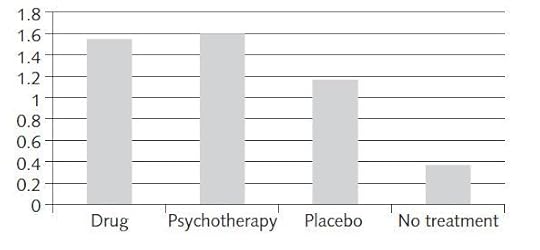
"What we expected to find’, said Kirsch lowering his teacup, ‘was that people who took the antidepressant would do far better than those taking the placebo, the sugar pill. We couldn’t have been more wrong.’ And if you look at the graph below you’ll see exactly what Kirsch means.3
The first thing you’ll notice is that all the groups actually get better on the scale of improvement, even those who had received no treatment at all. This is because many incidences of depression spontaneously reduce by themselves after time without being actively treated. You’ll also see that both psychotherapy and drug groups get significantly better. But, oddly, so does the placebo group. More bizarre still, the difference in improvement between placebo and antidepressant groups is only about 0.4 points, which was a strikingly small amount. ‘This result genuinely surprised us’, said Kirsch leaning forward intently, ‘because the difference between placebos and antidepressants was far smaller than anything we had read about or anticipated..."
"In recent years such disproving research has begun to erode the profession’s faith in the chemical imbalance theory. This has led increasing numbers of prominent figures in the mental health profession to declare their defection publicly. To pique your interest in this sea -change, here are a few quotations I’ve managed to gather:
‘Many neuroscientists no longer consider a chemical imbalance theory of depression and anxiety to be valid.’ (Dr David D. Burns, Professor of Psychiatry, Stanford University)
‘Chemical imbalance is sort of last-century thinking. It’s much more complicated than that.’ (Dr Joseph Coyle, Professor of Neuroscience at Harvard Medical School)
‘After decades of trying to prove [the chemical imbalance theory], researchers have still come up empty-handed.’
(Marcia Angell, former editor of the New England Journal of Medicine)
‘Despite pseudoscientific terms like “chemical imbalance”, nobody really knows what causes mental illness. There’s no blood test or brain scan for major depression.’ (Dr Darshak Sanghavi, clinical fellow at Harvard Medical School)
‘We do not know the aetiology of really any of the mental disorders at the present time.’ Dr Carl Regier, previous Director of Research at the American Psychiatric Association)
‘Research has yet to identify specific biological causes of any of these [mental] disorders.’ (US Congressional Report entitled: ‘The biology of mental disorders, new developments in neuroscience’)
‘The results of decades of neurotransmitter-depletion studies point to one inescapable conclusion, low levels of serotonin, norepinephrine or dopamine do not cause depression.’
(Professor Irving Kirsch, Harvard Medical School)
‘We still don’t know the relationship between biology and the mental disorders.’ (Carol Bernstein, previous president of the American Psychiatric Association)
‘Patients have been diagnosed with chemical imbalances, despite that no test exists to support such a claim, and that there is no real conception of what a correct chemical balance would look like.’ (Dr David Kaiser, Psychiatric Times)
‘As a scientific venture, the theory that low serotonin causes depression appears to be on the verge of collapse. This is as it should be; the nature of science is ultimately to be selfcorrecting.
Ideas must yield before evidence.’ (Dr Jonathan Rottenberg, Psychology Today)
‘A simplistic biological reductionism has increasingly ruled the psychiatric roost … [we have] learned to attribute mental illness to faulty brain biochemistry, defects of dopamine, or a shortage of serotonin. It is biobabble as deeply misleading and unscientific as the psychobabble it replaced.’ (Andrew Skull, Professor of History of Psychiatry, Princeton University, in The Lancet)
There is no point piling up more quotations. By now you get the picture: the public defections continue to mount because, after nearly 50 years of investigation into the chemical imbalance theory, there is not one piece of convincing evidence that the theory is actually correct..."