History is not something that happened to other people. History is a memory.
August A.D. 1120 Dijon. A headless corpse is found in a room with shuttered windows and the door locked from the inside. The man's name was Salonius and he was the Duke. His young heir's grasp on the throne is precarious, yet a new alliance is made to safeguard his position.
November A.D. 1120 Barcelona. Alexander, the Prince, learns that the emperor Enmerkar is looking to add Barcelona to his territories.
January A.D. 1121 London. Julian, the Governor, finds that Enmerkar has turned his hungry gaze toward England.
April A.D. 1121 York. Medb, the Queen, discovers that Enmerkar hungers for the whole Isle.
Many now recognize the threat posed by Enmerkar's continued expansion, so a game of politics begins to spin a web of alliances and treaties that will thwart Enmerkar. But this is not a web of humankind. These men and women are Algul, a race that lives, unseen, alongside humanity. They are rulers and warriors, storytellers and shapeshifters, magicians and politicians. Each was human once. None is human now. Their learning is far deeper than that of humans, their strength far greater, their lives not curtailed by illness or by age – the price a life lived in the shadows and sustained by blood.
Yet while all others are entangled in their political machinations, only one man can see that Salonius's murder was but the first move in a deeper plot, one that even he cannot fully piece together.
For, in a world where history is a memory, the greatest danger comes from what has been forgotten.
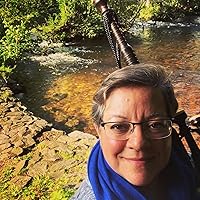
Irene is based in the UK and Greece. She was born in Greece, but grew up in England. Then she went to Greece. Then England again. Then Germany. Now she’s back in England -- but can frequently also be found in Greece. She gets about. She has a B.A. in English and a Master’s and Ph.D. in Musicology.
So, what did I think? I thought it was great. It reminded me very strongly of the classic literature that I love so much. I didn’t put everything together until the very end, which I always enjoy. It’s nice to be kept guessing. And I dearly hope there will be a sequel. :D
This was a great book. Elaborate, complex, with a sweeping plot and compelling characters. It ticked so many boxes of the things I like in books, even though it had some issues, which I will address later on.
I wasn’t quite sure what I was getting into when I started this book, at first I thought I was reading a historical novel. But it’s actually historical fantasy and it’s fascinating. It’s set in the Middle Ages all over Europe and we get to see various cities through the adventures of the characters. Who are vampires. O-M-G. So, to recap: this is a historical novel set in the Middle Ages with vampires and political intrigue and mystery. If you’re not fascinated by that, this book is not for you.
Firstly, I was very impressed with the historical detail and presentation of the time period. I’m a sucker for good historical novels and I love reading about how people went about their lives in different historical periods. Another thing I love is reading about smart people going about their lives, writers, scientists, etc. The characters here are extremely intelligent and they pursue and safeguard knowledge, so there is a lot of descriptions of alchemical processes, libraries and books (pre-printing press!), philosophical and scientific discussions.
The plot around which the book wraps is incredibly compelling. It keeps the reader guessing up until the last minute when it clicks into place and the mystery is revealed. Along with the more mundane points of everyday life and history of the characters, this overarching unsolved issue keeps the reader’s interest and propels the action. It was like eating an excellent and balanced meal. I was sated and satisfied, but not feeling full and heavy.
The characters! There’s too many of them, I’ll get to that later, but the main characters of which we see the most of are so interesting and compelling. The way Soldatos has devised for her taxonomy of vampires is refreshing and so clever. In short, different families of vampires, depending on who sired them, have different abilities and gifts, which they learn to develop and use accordingly. I don’t want to give too much away, one of the things I found fascinating in the book was slowly learning about the vampires and what they can do. Amarante is a formidable woman, reading about her and her achievements gave me life. The rest of her house is equally compelling and the way we see the characters slowly revealing themselves and their history lends feeling and drama to the book, even though the vampires are almost always cool-headed and distant, difficult to identify with. Another thing I really liked regarding the characters is that they can have meaningful, passionate relationships without a sexual aspect.
The book is so long and sprawling, like those victorian novels where at the end you feel like you know the characters like the back of your hand and they feel like friends/family members in your head (or is it just me?).
Now, on the flipside. All the things I mentioned above are good and not-so-good in the context of this book. Too many characters is one of the problems. We get introduced to so many different people in different places with different roles to play in the plot, that it’s a bit hard to keep track of who’s who. And I have a good memory for details. Names that sound similar (eg. Verus and Perus), or names that are Roman (eg. Fidelia, Agrippina, Livia) had me conflating characters and doing double-takes when I thought I was reading about one character and it turned out to be another. That was only in the beginning though, once the characters were established it was easier to keep track of them. I admit I wasn’t so interested in some of them and preferred to read about others, maybe with tighter pacing this would have not been an issue.
It’s very, veeeeeery slow going. For a good chunk of the book (and it’s a huge book) it felt like nothing was happening and I felt like I was making no progress (the percentage indicator on my e-reader moved painfully slowly). I liked what I was reading and kept on, though I found myself drifting from the book for periods of time to read other things and then came back to it. I wanted to read it, I liked it, but at some points I felt like it couldn’t keep my interest for long periods of time. It took me a long while to finish it. The plot takes a long time to get going, but once the action picks up, wheew boy! It’s so good! There are fights and chases, drama and suspense, feeling and intensity that kept me on the edge of my seat. I even stress-paused the book for a while to read the final chapters when I had a little quite time to myself. It’s worth sticking with it for these action-packed sequences and I have a feeling the re-read will be even better, now that I know the characters and the plot and I will be able to pick out details and put puzzle pieces into place.
All in all, despite its problems, it’s a fascinating, well-written, painstakingly researched book, with historical detail, overarching philosophical issues and discussions, all tied up in a compelling plot.
A secret history and epic tale of intrigue and aguls in Europe, this is set in the early 1100’s. I’m not a fan of any sort of vampire fiction or of period pieces that are so meticulously written that historians are impressed but this held my interest, start to finish. Those who are of a more historical novel bent, fans of vampiric fiction, or both, add a star: you're in for a rare treat in Bad Bishop.
The bishop in the tile is a chess piece as befits the main character, Amarante, a widow who remarks to herself that she might one day get married again; it would be good to have someone to play chess with. There is a great deal of chess in the story, both with real chessboards and human and agul chess pieces that are moved by an unseen hand by wily opponent. The stakes are more than life and death. The magic and alchemy in this book ring true and the scholarship is impeccable.
A word of caution: this is no easy beach read. Bad Bishop requires the same sort of absorption you’d need for a good chess match to read it, to keep track of the fascinating characters and their moves and the millennially-long histories and their implications. Soldatos provides a lot of book for your money, too: it’s 486 pages.
My one quibble was that I’d hoped for more closure in the end, but Soldatos set things up for a sequel. But if this sort of thing is what you crave that’d be a plus.
It was well-enough written in terms of literary style, but sorry, it wasn't for me. Too much effort in making it a literary novel, and not enough attention paid to providing any sort of reasonable plot, or anything else to hold interest. I must have got about 20% through it and nothing had happened, apart from some sub-Rice vampire lore. Others will love it, I'm sure, but it wasn't for me.
got a great sense of the time and the intrigue, but got a bit bogged down trying to keep the Genus, Sanctuary, and Lodge lineages all straight. A little crisper editing and some clearer differentiation may have helped. Overall I did enjoy it though!
A fascinating book with rich in depth characters and a gripping intellectual story. I was worries I would not enjoy this book or that I would find the prose to hard to follow. I did find my brain kept bringing sentences into modern English, but this does not lessen the story in any way or my enjoyment of it. I can't wait to see what the author releases next. I shall keep eyes out for future books for sure.
This book had the potential to be so good. There is a very good story here. Sadly, it is buried under pages and pages of overdone writing and barely-explained details. The parts about Amarante, Kyrus, and Atreus were interesting, and if the book had focused on them I would have loved it. But the author turned what could have been an interesting personal story into a politics-driven, overblown mess.
I read this as a reviewer for the Historical Novel Society. Review posted via their website at: https://historicalnovelsociety.org/re... APPEARED IN: HNR Issue 77 (August 2016)
1120 AD: A political chess game is begun when the Duke of Dijon is found murdered. Quickly, alliances are forged as the threat of invasion from a powerful emperor sweeps across nations. These political leaders are not humans, either. They’re Alguls/vampires who have lived unseen alongside humanity. In a time when book production is costly and time-consuming, Alguls have studied and protected history’s documents. Could these old tomes reveal a more sinister ulterior motive behind the Duke’s murder? One Algul intends to find out.
If you like languid political debates, this is your book. For me, there was too much time spent telling versus doing. Every character’s pattern of speech is identical, with their nature utterly monotone during the book’s first half. Despite new characters being given an expanded multi-page backstory, because characters express no emotions or personality traits, it is hard to differentiate between them.
Regarding the writing style, many conversations trail off forebodingly, with an overuse of ellipses ending sentences. Also, the author seriously overuses commas. One sentence has 68 words, and it “ends” with a semicolon. With ambivalence running rampant, plot development is scant. Whenever a significant event occurs, the what is kept secret. Instead, Soldatos’s narration involves ambiguous after-the-fact debates.
This novel reads like a tedious college lecture instead of an intriguing literary story. The last quarter of the book finally involves some face-to-face conflict and action, which is very intriguing. Otherwise, it’s vampires sitting around desks having polite discussions. The book I read was a second edition, which added 138 pages to the original release. Why? The book is too dense with unnecessary, overly complex exposition detrimentally watering down the plot. Cut out the first 200 pages, and you’d have a much more focused and compelling adventure with a unique twist on the origins of vampires.