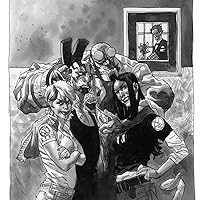
From Today's Best Authors and up and coming writers comes BLACK PULP from Pro Se Productions! BLACK PULP is a collection of stories featuring characters of African origin, or descent, in stories that run the gamut of genre fiction! A concept developed by noted crime novelist Gary Phillips, BLACK PULP brings bestselling authors Walter Mosley and Joe R. Lansdale, Gary Phillips, Charles R. Saunders, Derrick Ferguson, D. Alan Lewis, Christopher Chambers, Mel Odom, Kimberly Richardson, Ron Fortier, Michael A. Gonzales, Gar Anthony Haywood, and Tommy Hancock together to craft adventure tales, mysteries, and more, all with black characters at the forefront! "Literature for the masses kindled the imagination and used our reading skills so that we could regale ourselves in the cold chambers of alienation and poverty. We could become Doc Savage or The Shadow, Conan the Barbarian or the brooding King Kull and make a difference in a world definitely gone wrong."--Walter Mosley from his introduction. Between these covers are 12 tales of action, adventure, and thrills featuring heroes and heroines of darker hues that will appeal to audiences everywhere! BLACK PULP! From Pro Se Productions!
New Pulp, of course, is modern fiction inspired by the style and ethos of the fiction published in the pulp magazines of the early decades of the 20th century (on into the 1950s, in some cases). Editor Hancock (who also contributes a story) is CEO of Pro Se Press, the publisher of this collection, a small press that focuses on New Pulp, and at least some of the dozen authors represented here have published with Pro Se before. The organizing theme here is that all of the stories have black protagonists, though not all are by black authors. (Joe R. Lansdale and Mel Odom, the two biggest names among the twelve, are white, as is Hancock; but the short, appended write-ups on the authors don't provide any information about their race, being mostly just lists of writing credits. I know that Kimberly Richardson is black, as was the late Charles R. Saunders.) All twelve of the stories were copyrighted in 2013, and apparently written for the collection. Saunders and Hancock are the only authors in the group whose work I've sampled before.
Eminent black crime fiction writer Walter Mosley provides a short (less than two pages) but very solid introduction, which explains what pulp fiction was/is and makes a cogent case for why it's a very worthwhile and legitimate part of our literature. (Among his meaningful observations is this line, with which I agree: "Movies and TV are okay but it is only reading and storytelling that allows our inner imagination to soar.") Interestingly, though, given the nature of this collection, he doesn't discuss the historic under-representation of black protagonists in pulp venues (which Hancock is obviously seeking to redress).
The stories are a mixed bag in several ways. As to quality, two I didn't finish, and if I could rate them individually, I'd give two more a single star. A couple of others would get two stars, and two selections easily deserve five stars. (Or more if Goodreads offered them!) The remaining ones would command three. Where genre is concerned, I'd characterize one story, Derrick Ferguson's "Dillon and the Alchemist's Morning Coffee" (featuring his series character Dillon, who's a sort of free-lance James Bond type) as science fiction, though the main SF element is essentially just a MacGuffin. Three are straight-up crime or espionage fiction, one is a Western, and one is supernatural fiction. Genres are mixed in the others. Some are set in the author's present, others in the past decades when pulp magazines were still publishing, and a couple even earlier than that. Geographically, two-thirds of the selections are set, or at least start, in the U.S.; three of the others in Africa (including North Africa), and the remaining one in Japan and its neighboring waters.
There's no explicit sex in any of the stories, but some implied or stated references to illicit sex in some of them. Some have a certain amount of bad language, including profanity; but Lansdale's selection has the worst language, and as I recall only that one and Crockett's has obscenity and/or crude sexual references. Crashed black aviatrix Enid Brown is basically a co-protagonist in Saunders' "Mtimu," but otherwise only one main character is female. A few other stories, though, have butt-kicking female characters who ably second the heroes in physical combat (at least one of whom I wouldn't mind seeing as a story protagonist in her own right).
One of the stories I didn't finish was Hancock's contribution, "The Hammer of Norgill," which for its first four pages is actually a very powerful, realistic and evocative fictionalized account of the death of the legendary John Henry (https://en.wikipedia.org/wiki/John_He... ). It lost me when it then jumps (for the remaining 13 and 1/2 pages, which I skimmed) into the afterlife, which it presents as a weird fantasy world. The juxtaposition just didn't work for me. The other was "Jaguar and the Jungleland Boogie" by Michael A. Gonzales, which is supposedly set in Harlem in 1988. I say "supposedly," since our hero Coltrane Jones (who got out of the Marine Corps in 1985) is said to be a veteran of the first Gulf War, which was waged in 1991. (Yes, my eyes were rolling!) He's improbably tasked by his mother with the finding and rescue of an aging kidnapped torch singer. But the story seems to be mostly a celebration of rap and hip-hop (Coltrane owns a nightclub that features both, and the putative kidnapper is a vigilante on an also improbable crusade to stamp them out). Since these are musical forms which I find as melodious as a combination of a dental drill's whine and the banging of a jackhammer, I was not the target audience; and the (mostly incomprehensible, to me) pop-culture references that salt the text as thickly as nuts and candied fruit in a fruitcake had me glassy-eyed enough to bail after six pages. (And did I mention that, by way of role modeling, this tale features a pothead protagonist and blacks calling each other the n-word?)
Agnes Viridian is an occult detective series character (created by Kimberly Richardson), who was adopted at the age of three by a French occultist who subsequently mentored her and became her lover. (He's also an opium user, and she possibly is too, though the wording is ambiguous.) Set in Memphis, Tennessee in 1925, "Agnes Viridian and the Search for the Scales" is a sort of origin story for the character, describing her first case. But besides the "ick!" factor, this is an extremely shallow, thinly-plotted tale, with no real challenge for the heroine, no convincing sense of danger or menace, and no texture or sense of place. There's also no mystery; I knew almost immediately who the "mysterious" clients were. Such plot as the story has is also compromised by logical problems of gargantuan proportions (and the attempt to explain away one of them falls flat.) Lansdale's "Six Finger Jack" is purely nihilistic noir set in modern Texas. It has zero moral vision; the protagonist is a lecherous, foul-mouthed thug planning to score big bucks through a murder-for-hire (and to cheat his accomplice out of her half of the cash), but absolutely none of the characters has any likability or decency. I was morbidly curious enough about the outcome to finish it, but genuinely didn't care about anybody's fate.
In the "okay" range, the title character of "Rocket Crockett and the Jade Dragon" by Christopher Chambers is a Navy fighter pilot serving in the Korean War (President Truman had integrated the U.S. armed services by this time, but black officers/pilots were still rare) but whose penchant for high-stakes gambling gets him involved with gangsters and espionage in the mean streets of Tokyo and its suburbs. Crockett isn't a likable role model by a long shot, either --he's arrogant, regularly hires prostitutes, and uses marijuana, supposedly without any effects on his ability to operate heavy machinery in the air with quick reflexes under combat conditions (I was going to say this story has no fantasy elements, but that might be speaking too soon)-- though, unlike Lansdale's character, he actually does have some sense of right and wrong, and preference for the former. When he's in the air, the dialogue of this story is also heavy with military jargon and codes that frankly might as well have been in Choctaw, as far as my ability to understand it went. And while it's actually a well-written and tightly plotted story, in Gar Anthony Haywood's "A Seat at the Table" (wherein a high-stakes poker game for mobsters at a shady hotel in post-WWII Detroit goes terribly awry), there's not a single likable, appealing or decent character in the entire cast.
Four more stories in this collection are pretty much of a piece with each other in quality: workmanlike and entertaining, but not really outstanding. I'd rank the Ferguson story in this group. While "Black Wolfe's Debt" by D. Alan Lewis is mostly a gritty tale of a black P.I. in a modern metropolis in the Carolinas ("Port Victoria," but probably patterned on Charleston or Wilmington), it has a significant SF component that's revealed effectively near the end, as well as a thought-provoking supernatural element. Both "Decimator Smith and the Fangs of the Fire Serpent" by Gary Phillips and Saunders' "Mtimu" have minor SF elements, but those are peripheral to the plots; I'd say that both tales are primarily descriptive fiction. The title character of the Phillips selection is a black boxer ("Decimator" is his ring nickname) investigating the brutal murder of his sister in the segregated Los Angeles of the 1950s. While Saunders wrote a significant body of sword-and-sorcery fantasy set in an alternate Bronze Age (or early Iron Age) Africa, "Mtimu" is set in the real-world Africa of ca. 1935, except that the unexplored jungle milieu he describes is the kind of stylized savage Africa Edgar Rice Burroughs imagined --and that isn't the only Burroughs influence here!
With the Odom story, "Drums of the Ogbanje," and "The Lawman" by Ron Fortier, however, we're in a vastly different league of literary quality altogether! Strictly speaking, the latter selection isn't a single narration, but a series of fictionalized episodes depicting key events, spanning the years 1875-1883, from the real-life career of Bass Reeves (d. 1910), the first African-American to serve as a U.S. Deputy Marshal. (As noted in the short Epilogue here, during his career Reeves brought in more than 3,000 felons, and was involved in 14 major gun battles, being wounded once.) This is quality Western adventure in the style and tradition of Louis L'Amour or Les Savage Jr. The Odom selection, set on and off the coast of West Africa in 1825, introduces us to Ngola Kilunaji, kidnapped and sold into slavery in Haiti as a young man, later impressed into the British Navy to fight in the Napoleonic Wars, and now captaining his own multi-racial crew on a vendetta to stamp out the still-continuing slave trade. It delivers not only historical action-adventure, but lost treasure, an ancient city, supernatural elements from Afro-Caribbean lore, and a Lovecraftian denouement. (I ate it up with a spoon!)
My middle-of-the road rating for this anthology considers it overall. I give editor Hancock, and Pro Se Press, credit for a constructive idea; and I hope this book stimulates more involvement by black writers in the genre, a better racial balance in its protagonists, and perhaps more publishing industry interest in searching out possible forgotten African-American contributions to the pulp tradition.
Turning on the radio, he listened to the iceberg coolness of Frankie Harper playing Soul II Soul’s ‘Keep On Moving.’ The smooth bass line served as the perfect soundtrack to Coltrane’s afternoon as he went to find his old friend Shep.
Like a psychotic Falcon to Coltrane’s calm Captain America, like Robin in need of Ritalin, like a crazy brother from another mother, Shep was always by his side when they were teenagers. With his wild-styled reddish brown ‘fro, Shep became his numero uno homeboy when they were students at George Washington High School.
Having an older blood brother who once worked for the notorious gangster Guy Fisher in the seventies, Shep was a scrapper who protected his friends and demolished his enemies.
Coltrane made a left on 151st Street, and sped down the hill. In front of a battered building, he stopped and laughed as an oblivious Shep rolled a thick spliff on the stoop, constructing the joint with the skill of a reefer engineer. If he wasn’t in jail, then the stoop was Shep’s spot. Turning down the radio, Coltrane yelled, “Can a brother get a hit off that?”
Shep glanced up angrily. “Boy, I was fixin’ to put your ass on the missing persons list,” Shep replied, slowly rising to his Adidas clad feet. His soft hair was cornrowed over his greasy scalp. “Never even visited a nigga in the joint or nothing.” Although he was only twenty-five, hard times had made him look older.
Dressed in burgundy from head to feet, Shep adjusted a cool Kagol cap with the precision of a player. At five-feet-six inches tall, Shep might not be the tallest brother in the world, but he was one of the baddest.
“I been trying to stay away from wild boys,” Coltrane laughed, unlocking the passenger door. “Get in.”
Shep slapped Coltrane five. “I’ve been out about a week now. I been meaning to make it over to the club, but you know how it is.” Looking at Coltrane’s sharp threads, Shep whistled. “Hey, you got a court date today or something?”
“More than likely a funeral. Let’s go get some grub and talk about the weather.”
Roaring over to 8th Avenue and 145th, he parked outside the literal shack that was Willie’s Burgers. They ate the best fried cow for miles. Between bites of his burger, Coltrane explained to Shep his mother’s insistent request to find the missing torch singer and bring down Jazzmatazz. The recently released convict laughed.
“So, what you saying? You saying we become superheroes or some shit?”
“Superheroes have super powers,” Coltrane corrected. “We’ll be just regular heroes, like Dick Tracy or Shaft. But, we can wear masks if you want. Like Batman.”
“Masks? Shaft didn’t wear no mask. Superman don’t wear no mask and most dummies still can’t tell he’s Clark Kent.”
“Maybe just something that covers our eyes, like The Spirit.”
“Fuck that, if I’m going to be a hero, I want people to see my face."
BLACK PULP is a collection of highly imaginative short fiction that captures the matinee style of the 1930-60s and the antique fantasies of the 19th and early 20th centuries. Each story, however, is the told from the perspective of African or African American heroes and heroines (though other races are featured). So, there are struggles not only against fantastic beings in often exotic situations, but against the very real obstacles of the segregated settings of most of the stories.
The volume begins with a well-done East Texas noir called "Six Finger Jack." It is the graphic, first person account of a 60's bounty hunter and the murder-for-hire contract that takes a twisted turn or two.
"Decimator Smith and the Fangs of the Fire Serpent" chronicles a 1930's L.A. boxer who moonlights as a private eye (in order to solve his sister’s murder).
Also set in the '30s, "Mtimu" explores what a black Tarzan and Jane might be like. Pilot Enid Brown, called “the Black Amelia Earhart,” crashes while attempting the first non-stop flight across Africa. She is saved by the strapping Mtimu, but the pair soon find themselves the prey of the great white hunter Clive Bailey.
Derrick Ferguson's "Dillon and the Alchemist's Morning Coffee" feels like a cross between "The Expendables" and a 1940's comic strip adventure. The title character "Dillon" is a covert op who teams-up with the beautiful Captain Edna Hartless on a mission to save a secret invention and "The Sun Palace" of a young African prince.
In D. Alan Lewis’s "Black Wolfe's Debt," a super hero-turned detective is hired by an aging former super heroine to solve what seems like an open-and-shut case. Of course, it isn't.
Christopher Chambers's hero "Rocket Crockett" is a Top Gun-type Korean War pilot who (when not dogfighting enemy MiGs) fights to save the coveted "jade dragon."
"Drums of the Ogbanje" features a former 19th century slave named Ngola who battles a ruthless Portuguese slave trader--both of whom are on a quest for treasure in a lost African city that is guarded by supernatural monsters.
Kimberley Richardson's "Agnes Viridian" is a refreshing female occultist-private eye in 1920's Memphis, TN who uses her superpowers to help an Egyptian deity recover a stolen heirloom.
"Jaguar and the Jungleland Boogie" highlights hip-hop crime-fighters "Jaguar" (a Gulf War vet-turned club owner) and Shep as they scour 1980's Harlem for a missing singer, but encounter the sinister plot of a supersonic trumpet-toting villain called "Jazzmatazz." While certainly vividly-told, it seems to be a token to those seeking a more modern tale mixed in with the predominantly older ones.
And rounding things out, Shamus Award-winner Gar Anthony Haywood offers a surprisingly pedestrian poker heist tale that is made somewhat colorful by characters with names like Jimmy, Eddie, Izzy, and Frank. And Tommy Hancock's take on John Henry has the 19th century folk hero in an epic afterlife battle with Talori warriors that has a John Carter flavor.
But out of all the stories, "The Lawman" is perhaps the most fascinating and potentially cinematic. The "Western" (though mostly centered around the Arkansas-Texas border region) details the 19th century exploits of the first African American U.S. deputy marshal, Bass Reeves. But unlike typical Wild West heroes, Reeves often uses his wits first and weapons last to rid the frontier of a variety of varmints. Interestingly enough, author Ron Fortier reveals that Reeves was a real person and that the story dramatizes portions of his life.
Overall, BLACK PULP is a very entertaining and enlightening literary experiment that successfully injects the African American perspective into classic-styled pulp fiction. But, the writers still keep the characters engaging and their adventures fresh and exciting, so as to appeal to a wide audience that is in search of creative writing from a different perspective.
“Black Pulp” had a little bit of everything for everyone. There was a man turned hitman turned concrete statue, a jungle lord, a crazy hip duo, criminal masterminds abound, and just about anything else you could think of it was there nestled between pages of smooth southern accents and twisted plots.
My favorite out of all the stories was the first one, “Six Finger Jack” by Joe R. Lansdale. The way the dialogue flowed and the story unfolded I couldn’t help myself, for one of the first times in my life I willingly read a story out loud, and then preceded to hunt down any living creature in my vicinity that could hear and reread the story. Again, and again, and again. Reading the way Lansdale’s wrote was like warm butter slipping off my tongue and such an enjoyable experience that I started looking for more of their work.
The rest of the anthology was a great collection all together. If there was one story that I didn’t enjoy the following one or the one after it would pick up my interest again.
Overall, my experience was an enjoyable one and I would recommend this book to anyone searching for short stories that are well written and diverse in their plots.
Disclaimer: I received a copy of this book for free in exchange for writing a review. I was not obligated to give a positive review, and all thoughts are my own.
This collection featuring ethnically diverse characters in neo-pulp and traditional pulp inspired settings and stories. Taking a modern day and at times tongue-in-cheek angle on a variety of genres with pulp leanings. From two fisted action to romance to fiction based yarns inspired by actual historical figures (The story featuring famed Old West bounty hunter Bass Reeves) this book delivers. While there were some stories that were not my cup of tea (which I won't name or go into to prevent coloring someone else's outlook of a story, singling out particular creators or creative teams, or passing my personal taste off as an absolute) each brings a welcome surprise and energy to the genre.
I've had this novel, a co!lection of short stories, for quite sometime and finally decided to read it. WHY did I wait so long?!!? This is such an interesting mix of stories--detective, scifi , fantasy, folk, etc.,-- written by African and African American authors. You meet some great characters and read some awesome stories. If you like short stories, even if you don't, One of my favorites lines, as a beautiful woman enters a private eye's office, she says, "I'm here for business not to be your fantasy." Most def a winner.
This collection contains 12 pulp fiction stories, with an introduction piece and author biography section. Each story varies in genre, with most containing action scenes or small plot twists.
While short stories are not my first choice to read, the story “Mtimu,” was my favorite among this collection. The writing style contained beautiful descriptions, especially the beginning. I could picture the jungle scenes and the animals involved in the story. Charles Saunders has a talent for writing and engages the reader through his details. Also, I enjoyed “Dillon and the Alchemist’s Morning Coffee.” While I didn’t care for the particular writing style in terms of the dialogue, the plot was action packed and kept my interest. The other stories weren’t awful; each writer has a unique style and plotline. However, they just weren’t for me.
While the stories didn’t all capture my interest, I really enjoy collections like this. Short stories are quick and get right to the action. If one catches your interest you can enjoy it. If it doesn’t, you don’t feel as if you’ve wasted your time reading it. And most of the time you can appreciate the writer’s efforts and ability to create their piece.
Disclaimer: I received a copy of this book for free in exchange for writing a review. I was not obligated to give a positive review, and all thoughts are my own
As is the case in most anthologies there are a couple of clunkers in here. But, the positives outweigh the negatives in the final evaluation.
Charles Saunders finally get to tell his jungle adventure story. What I remember most about Octavia Butler's Kindred is not her novel but Saunders' forward (which included a short bit about his reason for creating Imaro-basically a black man man who can kick Tarzan's ass). He creates such a characters in Mtisu
The creation of the Jaguar character felt like a near perfect mix of old pulp and the beginning of the 1980s Rap and Hip Hop Scene.
Joe Lansdale's short is very well written and has some excellent turns of language.
Ferguson's Dillon story was ok-and was really the main reason why I bought this book because I wanted to find out if I wanted to read more Dillon.
The Black Wolfe and Decimator Smith stories are well crafted and enjoyable.
Rocket Crockett falls way to much into cliches and stereotypes.
Unfortunately the stories about real life people John Henry and Bass Revees were slogs to get through.
The entire book, and all of it's parts could easily become a series that I for one would not only look forward to. I would look forward to and purchase for my own library. I have many of Mosley's books (well 12-14) , and really enjoy his whimsy. And the fact that he is introducing is to several new ( to me) authors is nothing short of amazing. Having said that I intend to purchase a few of their work as well. So should you!
Any anthology is a mixed bag and 'Black Pulp' is no exception. The stories range from the excellent, such as 'A Seat at the Table' and 'Six Fingered Jack' to the really quite poor: 'Jaguar and the Jungleland Boogie' has great potential, which is not realised. There are some great Black Pulp versions of Tarzan (Mtimu), Conan (The Hammer of Norgill) and Rider Haggard (Drums of the Ogbanje) which are a lot of fun. I am especially indebted to Ron Fortier for his true story 'The Lawman': Bass Reeves deserves to be immortalised.
These short stories feature Black heroes. They have diverse subjects. There is a variety of writing styles and some read easier than others. I recommend this book to serious readers who enjoy Walter Mosley .
Like any anthology, Black Pulp has its good stories and its bad stories. Unlike most though, I found only one story terribly difficult to read. Otherwise, this book is loaded with interesting and unique tales from voices both familiar and unfamiliar. Joe Lansdale and editor Gary Philips anchor the book, but new tales by Charles Saunders, Tommy Hancock, and Derrick Ferguson (among several others) also deliver. This is a great read, well worth a buy by any fan of great action and adventure.
I love pulp noir characters of the 20s & 30s: Conan the Barbarian (created by Robert E. Howard), Philip Marlowe (by Raymond Chandler), the Continental Op and Sam Spade (Dashiell Hammett). However, I detest the sexism, racism, and homophobia that plagued books of this era. Happily, Pro Se Press is producing “New Pulp” books that retain the compelling storytelling of the older works without the offensive bigotry.
Black Pulp, is a short story collection reminiscent of hard-boiled noir featuring Black champions. My favorite stories were: * “Mtimu” by Charles R. Saunders features a Black Tarzan-like character and two strong women who battle A big-game hunter trying to capture Mtimu. * “Dillon and the Alchemist’s Morning Coffee” by Derrick Ferguson is a rollicking tale of a mercenary and a spy who team up to thwart evil villains bent on world domination. The clever banter between these two characters is an absolute delight! * Gary Philips writes a face-paced tale of a boxer who gets entangled in a mystery involving a freakish cult in “Decimator Smith and the Fangs of the Fire Serpent.” * “Drums of the Ogbanje” is a rescue adventure by Mel Odom involving evil slave traders and eldritch sorcery. * Kimberly Richardson’s “Agnes Viridian and the Search for the Scales” features a female protagonist embroiled in a conflict involving Egyptian gods. * “The Hammer of Norgill” by Tommy Hancock is an imaginative tale of the legendary contest between John Henry and the steam drill, and John Henry’s after-death adventure.
Black Pulp is not a perfect anthology. Women are treated like disposable objects in the opening story by Joe R. Lansdale, and the overt anti-Asian prejudice in Christopher Chambers’ contribution was equally disappointing. Black Pulp is a fun romp despite these two stories, especially for anyone interested in reading “New Pulp.”
An entertaining collection of short stories in the pulp style focusing on black protagonists. There’s a lot to enjoy here, including a smattering of private eyes, a crusading pirate, a marshal in the Wild West and a Tarzan like jungle story. There’s also a superb introduction by the great Walter Mosley.
Though this anthology was more hard-boiled than I usually read, I enjoyed the action-packed stories, especially Derrick Ferguson's story with his character Dillon -- I'm off to check out his Dillon books.
Some of the stories were gems, others just on but there was a feeling of interest and nostalgia in reading them. The stories hearken to earlier eras of literature with a twist.
What I loved about this book is that the stories are very much from a black (African/African American) perspective while also being entertaining. Reading this was like watching a dope series.