

What do you think?

Resimdeki Kadın - Kadınlar, Sanat ve Bakışın Gücü
Kimdir “kadın”? Kadın Venüs’tür, “anne”dir, “bakire”dir; “canavar”dır, “cadı”dır, “femme fatale”dır, yani “felaketin ta kendisi”dir. Hepsinden öte, kadın bakılacak bir “imge”dir.
Tarih boyunca dehşet, şiddet, istismar, kadın düşmanlığı, eril bakış ve ataerkinin inşa ettiği kalıplar, sanatın maskesine gizlenerek görsel bir şölene dönüştürülmüş; telefon ekranlarında, sosyal medya paylaşımlarında, her türlü tüketim ürününün üstünde, herkesin erişebildiği dizi ve filmlerde, tarihimize ev sahipliği yapan müzelerde, meydanlarda hatta evimizin duvarlarında sinsice yerini almıştır.
Sanat tarihi profesörü Catherine McCormack, Resimdeki Kadın’da sanat kisvesi altında gözümüzün nasıl boyandığını, eril bakışın kadın imgesini nasıl şekillendirdiğini ve bunu günlük hayatımıza yerleştirip normalleştirdiğini anlatır.
Titian, Botticelli ve Picasso’nun eserleri gibi çok sevdiğimiz imgelerin aslında nasıl dehşet verici anlamlar taşıdığını, ataerkinin kadın deneyimini ve “öteki” olanı bastırıp yok etmek için sanatı nasıl kullandığını çarpıcı hikâyeler, anekdotlar ve kişisel görüşleriyle kaleme alır.
Yazar McCormack, Resimdeki Kadın’da Berthe Morisot, Judy Chicago, Kara Walker’dan Beyoncé’ye uzanan çeşitli kadın sanatçının çalışmalarını inceleyerek estetik bulduğumuz imgelere dair farklı bir bakış açısı sunar bize; inşa ettiğimiz kalıpları yıkıp kadını (veya insanı) gerçek benliğiyle kabullenmemiz gerektiğini fark etmemizi sağlar.
Tarih boyunca dehşet, şiddet, istismar, kadın düşmanlığı, eril bakış ve ataerkinin inşa ettiği kalıplar, sanatın maskesine gizlenerek görsel bir şölene dönüştürülmüş; telefon ekranlarında, sosyal medya paylaşımlarında, her türlü tüketim ürününün üstünde, herkesin erişebildiği dizi ve filmlerde, tarihimize ev sahipliği yapan müzelerde, meydanlarda hatta evimizin duvarlarında sinsice yerini almıştır.
Sanat tarihi profesörü Catherine McCormack, Resimdeki Kadın’da sanat kisvesi altında gözümüzün nasıl boyandığını, eril bakışın kadın imgesini nasıl şekillendirdiğini ve bunu günlük hayatımıza yerleştirip normalleştirdiğini anlatır.
Titian, Botticelli ve Picasso’nun eserleri gibi çok sevdiğimiz imgelerin aslında nasıl dehşet verici anlamlar taşıdığını, ataerkinin kadın deneyimini ve “öteki” olanı bastırıp yok etmek için sanatı nasıl kullandığını çarpıcı hikâyeler, anekdotlar ve kişisel görüşleriyle kaleme alır.
Yazar McCormack, Resimdeki Kadın’da Berthe Morisot, Judy Chicago, Kara Walker’dan Beyoncé’ye uzanan çeşitli kadın sanatçının çalışmalarını inceleyerek estetik bulduğumuz imgelere dair farklı bir bakış açısı sunar bize; inşa ettiğimiz kalıpları yıkıp kadını (veya insanı) gerçek benliğiyle kabullenmemiz gerektiğini fark etmemizi sağlar.
208 pages, Paperback
First published December 8, 2020
Ratings & Reviews
Friends & Following
Create a free account to discover what your friends think of this book!
Community Reviews
Displaying 1 - 30 of 467 reviews

March 23, 2022
This is good as a popular introduction to the ways in which feminist academics over the last 40 or so years have challenged established ways of understanding gender in primarily visual iconography. McCormack is accessible and passionate but the book is light on scholarly references so anyone wanting to follow up on sources and citations may well be frustrated.
I'd also say that the book is at its strongest when 'reading' art which is, after all, McCormack's specialisation. When the book branches out into history and literature, it can tend to the general and less nuanced. Which is sort of fine, though, again, it's these sections which lack the ballast of scholarly apparatus.
I'd say that anyone working in, or familiar with, this area won't find anything new here but it's always interesting to see how someone from an adjacent discipline tackles issues of rape, gender, sex and gendered bodies. What I enjoyed most is McCormack's discussions of how contemporary advertising, commercial photoshoots and popular culture reiterate, resist and reference 'high' visual art, thus perpetuating the kind of binary archetypes that privilege white, capitalist, passive and subservient women.
I'd also say that the book is at its strongest when 'reading' art which is, after all, McCormack's specialisation. When the book branches out into history and literature, it can tend to the general and less nuanced. Which is sort of fine, though, again, it's these sections which lack the ballast of scholarly apparatus.
I'd say that anyone working in, or familiar with, this area won't find anything new here but it's always interesting to see how someone from an adjacent discipline tackles issues of rape, gender, sex and gendered bodies. What I enjoyed most is McCormack's discussions of how contemporary advertising, commercial photoshoots and popular culture reiterate, resist and reference 'high' visual art, thus perpetuating the kind of binary archetypes that privilege white, capitalist, passive and subservient women.

June 10, 2022
*𝚆𝚘𝚖𝚎𝚗 𝚒𝚗 𝚝𝚑𝚎 𝙿𝚒𝚌𝚝𝚞𝚛𝚎* 𝙿𝚊𝚛𝚝 𝙸
This book is everything and more that I loved about one of my favorite classes in undergrad—art history. McCormack discusses the background and impact of famous artworks with how women are still perceived today and how modern artists are challenging the way we think about women’s identity, sexuality, race and power.
Engaging from the outset, the classic and limited set of female archetypes are explored from saintly mother and femme fatale, to sensuous pin-up and monstrous witch.
You don’t have to be an art history buff to enjoy this book. Stifling female ideals are found everywhere, from art history’s classics to advertising and of course, Instagram and social media.
Chapter one explores the archetypal Venus of Western art, starting with the 𝑹𝒐𝒌𝒆𝒃𝒚 𝑽𝒆𝒏𝒖𝒔, through Botticellis’s 𝑩𝒊𝒓𝒕𝒉 𝒐𝒇 𝑽𝒆𝒏𝒖𝒔, to 𝑻𝒉𝒆 𝑽𝒐𝒚𝒂𝒈𝒆 𝒐𝒇 𝒕𝒉𝒆 𝑺𝒂𝒃𝒍𝒆 𝑽𝒆𝒏𝒖𝒔 and examples of misogynoir (Kim Kardashian’s Paper magazine cover) and Gillette's “𝐼’𝑚 𝑌𝑜𝑢𝑟 𝑉𝑒𝑛𝑢𝑠” commercials.
Chapter two discusses one of the most prolific tropes in paintings, Madonna and Child. McCormack reviews and ties in examples from modern pop culture including Beyonce’s pregnancy photos by artist Awol Erizku, and Fergie’s 𝑴.𝑰.𝑳.𝑭. $ music video.
Venus, maiden, wife, mother, monster—women have been bound so long by these restrictive roles, codified by patriarchal culture, that we scarcely see them.
“𝘞𝘩𝘦𝘳𝘦𝘷𝘦𝘳 𝘸𝘦 𝘧𝘪𝘯𝘥 𝘵𝘩𝘦𝘮, 𝘱𝘪𝘤𝘵𝘶𝘳𝘦𝘴 𝘢𝘳𝘦 𝘯𝘰𝘵 𝘯𝘦𝘶𝘵𝘳𝘢𝘭; 𝘵𝘩𝘦𝘺 𝘤𝘢𝘯 𝘣𝘦 𝘱𝘦𝘳𝘯𝘪𝘤𝘪𝘰𝘶𝘴 𝘢𝘯𝘥 𝘱𝘰𝘸𝘦𝘳𝘧𝘶𝘭. 𝘛𝘩𝘦𝘺 𝘩𝘦𝘭𝘱 𝘶𝘴 𝘵𝘰 𝘧𝘰𝘳𝘮 𝘢𝘵𝘵𝘪𝘵𝘶𝘥𝘦𝘴 𝘵𝘰𝘸𝘢𝘳𝘥𝘴 𝘰𝘶𝘳𝘴𝘦𝘭𝘷𝘦𝘴 𝘢𝘯𝘥 𝘰𝘵𝘩𝘦𝘳𝘴, 𝘢𝘯𝘥 𝘴𝘶𝘴𝘵𝘢𝘪𝘯 𝘰𝘶𝘳 𝘶𝘯𝘥𝘦𝘳𝘴𝘵𝘢𝘯𝘥𝘪𝘯𝘨 𝘰𝘧 𝘩𝘪𝘴𝘵𝘰𝘳𝘺, 𝘤𝘶𝘭𝘵𝘶𝘳𝘦, 𝘳𝘢𝘤𝘦 𝘢𝘯𝘥 𝘴𝘦𝘹𝘶𝘢𝘭 𝘪𝘥𝘦𝘯𝘵𝘪𝘵𝘺, 𝘢𝘮𝘰𝘯𝘨 𝘮𝘢𝘯𝘺 𝘰𝘵𝘩𝘦𝘳 𝘵𝘩𝘪𝘯𝘨𝘴. 𝘔𝘰𝘴𝘵 𝘰𝘧 𝘵𝘩𝘪𝘴 𝘱𝘰𝘸𝘦𝘳 𝘪𝘴 𝘴𝘪𝘭𝘦𝘯𝘵 𝘢𝘯𝘥 𝘴𝘵𝘦𝘢𝘭𝘵𝘩𝘺, 𝘴𝘰𝘭𝘥 𝘵𝘰 𝘶𝘴 𝘶𝘯𝘥𝘦𝘳 𝘵𝘩𝘦 𝘨𝘶𝘪𝘴𝘦 𝘰𝘧 𝘭𝘦𝘪𝘴𝘶𝘳𝘦, 𝘰𝘳 𝘢𝘯 𝘢𝘱𝘱𝘳𝘦𝘤𝘪𝘢𝘵𝘪𝘰𝘯 𝘰𝘧 𝘣𝘦𝘢𝘶𝘵𝘺 𝘢𝘯𝘥 𝘢𝘤𝘩𝘪𝘦𝘷𝘦𝘮𝘦𝘯𝘵.”
*𝚆𝚘𝚖𝚎𝚗 𝚒𝚗 𝚝𝚑𝚎 𝙿𝚒𝚌𝚝𝚞𝚛𝚎* 𝙿𝚊𝚛𝚝 𝙸𝙸
Chapter 3 reviews 𝗠𝗮𝗶𝗱𝗲𝗻𝘀 𝗮𝗻𝗱 𝗗𝗲𝗮𝗱 𝗗𝗮𝗺𝘀𝗲𝗹𝘀 beginning with 𝑇ℎ𝑒 𝑅𝑎𝑝𝑒 𝑜𝑓 𝐸𝑢𝑟𝑜𝑝𝑎 and examples of enshrined female suffering, to modern performance art and Beyonce’s 𝐿𝑒𝑚𝑜𝑛𝑎𝑑𝑒.
In Chapter 4, Medusa, Lilith, Circe, and other 𝗠𝗼𝗻𝘀𝘁𝗿𝗼𝘂𝘀 women make appearances as well as 𝐾𝑖𝑙𝑙𝑖𝑛𝑔 𝐸𝑣𝑒’s Villanelle, moving on to the reclamation of female power and sexuality with Cardi B and Megan Thee Stallion’s 𝑊𝐴𝑃.
Chris Kraus’s book *𝗜 𝗟𝗼𝘃𝗲 𝗗𝗶𝗰𝗸* was covered in such a way—I ordered it on the spot.
McCormack is informative and insightful in her presentation and critique, making this my most annotated book so far this year.
*𝗪𝗼𝗺𝗲𝗻 𝗶𝗻 𝘁𝗵𝗲 𝗣𝗶𝗰𝘁𝘂𝗿𝗲* 𝗴𝗶𝘃𝗲𝘀 𝘂𝘀 𝗻𝗲𝘄 𝘄𝗮𝘆𝘀 𝗼𝗳 𝘀𝗲𝗲𝗶𝗻𝗴 𝘁𝗵𝗲 𝗮𝗿𝘁 𝗼𝗳 𝘁𝗵𝗲 𝗽𝗮𝘀𝘁 𝗮𝗻𝗱 𝘁𝗵𝗲 𝗳𝗮𝗺𝗶𝗹𝗶𝗮𝗿 𝗶𝗺𝗮𝗴𝗲𝘀 𝗼𝗳 𝘁𝗼𝗱𝗮𝘆 𝘀𝗼 𝘁𝗵𝗮𝘁 𝘄𝗲 𝗺𝗶𝗴𝗵𝘁 𝗳𝗿𝗲𝗲 𝘄𝗼𝗺𝗲𝗻 𝗳𝗿𝗼𝗺 𝘁𝗵𝗲𝘀𝗲 𝗿𝗲𝘀𝘁𝗿𝗶𝗰𝘁𝗶𝘃𝗲 𝗿𝗼𝗹𝗲𝘀 𝗮𝗻𝗱 𝗲𝗺𝗯𝗿𝗮𝗰𝗲 𝘁𝗵𝗲 𝗯𝗿𝗲𝗮𝗱𝘁𝗵 𝗼𝗳 𝘄𝗼𝗺𝗲𝗻’𝘀 𝘃𝗶𝘀𝗶𝗼𝗻.
“𝘈𝘵 𝘣𝘦𝘴𝘵, 𝘵𝘩𝘦 𝘮𝘢𝘪𝘥𝘦𝘯 𝘢𝘳𝘤𝘩𝘦𝘵𝘺𝘱𝘦 𝘩𝘢𝘴 𝘦𝘯𝘴𝘩𝘳𝘪𝘯𝘦𝘥 𝘧𝘦𝘮𝘢𝘭𝘦 𝘴𝘶𝘧𝘧𝘦𝘳𝘪𝘯𝘨 𝘢𝘴 𝘴𝘰𝘮𝘦𝘵𝘩𝘪𝘯𝘨 𝘯𝘰𝘣𝘭𝘦 𝘢𝘯𝘥 𝘣𝘦𝘢𝘶𝘵𝘪𝘧𝘶𝘭, 𝘢𝘵 𝘸𝘰𝘳𝘴𝘵 𝘪𝘵 𝘩𝘢𝘴 𝘤𝘰𝘯𝘵𝘳𝘪𝘣𝘶𝘵𝘦𝘥 𝘵𝘰 𝘵𝘩𝘦 𝘯𝘰𝘳𝘮𝘢𝘭𝘪𝘴𝘢𝘵𝘪𝘰𝘯 𝘰𝘧 𝘷𝘪𝘰𝘭𝘦𝘯𝘤𝘦 𝘢𝘨𝘢𝘪𝘯𝘴𝘵 𝘸𝘰𝘮𝘦𝘯, 𝘣𝘺 𝘵𝘶𝘳𝘯𝘪𝘯𝘨 𝘪𝘵 𝘪𝘯𝘵𝘰 𝘱𝘰𝘦𝘵𝘳𝘺, 𝘳𝘦𝘭𝘪𝘨𝘪𝘰𝘶𝘴 𝘥𝘦𝘷𝘰𝘵𝘪𝘰𝘯 𝘰𝘳 𝘣𝘦𝘢𝘶𝘵𝘺, 𝘰𝘳 𝘦𝘷𝘦𝘯 𝘫𝘶𝘴𝘵 𝘢 𝘩𝘪𝘴𝘵𝘰𝘳𝘪𝘤𝘢𝘭𝘭𝘺 𝘤𝘰𝘯𝘥𝘰𝘯𝘦𝘥 𝘪𝘯𝘦𝘷𝘪𝘵𝘢𝘣𝘪𝘭𝘪𝘵𝘺.”
This book is everything and more that I loved about one of my favorite classes in undergrad—art history. McCormack discusses the background and impact of famous artworks with how women are still perceived today and how modern artists are challenging the way we think about women’s identity, sexuality, race and power.
Engaging from the outset, the classic and limited set of female archetypes are explored from saintly mother and femme fatale, to sensuous pin-up and monstrous witch.
You don’t have to be an art history buff to enjoy this book. Stifling female ideals are found everywhere, from art history’s classics to advertising and of course, Instagram and social media.
Chapter one explores the archetypal Venus of Western art, starting with the 𝑹𝒐𝒌𝒆𝒃𝒚 𝑽𝒆𝒏𝒖𝒔, through Botticellis’s 𝑩𝒊𝒓𝒕𝒉 𝒐𝒇 𝑽𝒆𝒏𝒖𝒔, to 𝑻𝒉𝒆 𝑽𝒐𝒚𝒂𝒈𝒆 𝒐𝒇 𝒕𝒉𝒆 𝑺𝒂𝒃𝒍𝒆 𝑽𝒆𝒏𝒖𝒔 and examples of misogynoir (Kim Kardashian’s Paper magazine cover) and Gillette's “𝐼’𝑚 𝑌𝑜𝑢𝑟 𝑉𝑒𝑛𝑢𝑠” commercials.
Chapter two discusses one of the most prolific tropes in paintings, Madonna and Child. McCormack reviews and ties in examples from modern pop culture including Beyonce’s pregnancy photos by artist Awol Erizku, and Fergie’s 𝑴.𝑰.𝑳.𝑭. $ music video.
Venus, maiden, wife, mother, monster—women have been bound so long by these restrictive roles, codified by patriarchal culture, that we scarcely see them.
“𝘞𝘩𝘦𝘳𝘦𝘷𝘦𝘳 𝘸𝘦 𝘧𝘪𝘯𝘥 𝘵𝘩𝘦𝘮, 𝘱𝘪𝘤𝘵𝘶𝘳𝘦𝘴 𝘢𝘳𝘦 𝘯𝘰𝘵 𝘯𝘦𝘶𝘵𝘳𝘢𝘭; 𝘵𝘩𝘦𝘺 𝘤𝘢𝘯 𝘣𝘦 𝘱𝘦𝘳𝘯𝘪𝘤𝘪𝘰𝘶𝘴 𝘢𝘯𝘥 𝘱𝘰𝘸𝘦𝘳𝘧𝘶𝘭. 𝘛𝘩𝘦𝘺 𝘩𝘦𝘭𝘱 𝘶𝘴 𝘵𝘰 𝘧𝘰𝘳𝘮 𝘢𝘵𝘵𝘪𝘵𝘶𝘥𝘦𝘴 𝘵𝘰𝘸𝘢𝘳𝘥𝘴 𝘰𝘶𝘳𝘴𝘦𝘭𝘷𝘦𝘴 𝘢𝘯𝘥 𝘰𝘵𝘩𝘦𝘳𝘴, 𝘢𝘯𝘥 𝘴𝘶𝘴𝘵𝘢𝘪𝘯 𝘰𝘶𝘳 𝘶𝘯𝘥𝘦𝘳𝘴𝘵𝘢𝘯𝘥𝘪𝘯𝘨 𝘰𝘧 𝘩𝘪𝘴𝘵𝘰𝘳𝘺, 𝘤𝘶𝘭𝘵𝘶𝘳𝘦, 𝘳𝘢𝘤𝘦 𝘢𝘯𝘥 𝘴𝘦𝘹𝘶𝘢𝘭 𝘪𝘥𝘦𝘯𝘵𝘪𝘵𝘺, 𝘢𝘮𝘰𝘯𝘨 𝘮𝘢𝘯𝘺 𝘰𝘵𝘩𝘦𝘳 𝘵𝘩𝘪𝘯𝘨𝘴. 𝘔𝘰𝘴𝘵 𝘰𝘧 𝘵𝘩𝘪𝘴 𝘱𝘰𝘸𝘦𝘳 𝘪𝘴 𝘴𝘪𝘭𝘦𝘯𝘵 𝘢𝘯𝘥 𝘴𝘵𝘦𝘢𝘭𝘵𝘩𝘺, 𝘴𝘰𝘭𝘥 𝘵𝘰 𝘶𝘴 𝘶𝘯𝘥𝘦𝘳 𝘵𝘩𝘦 𝘨𝘶𝘪𝘴𝘦 𝘰𝘧 𝘭𝘦𝘪𝘴𝘶𝘳𝘦, 𝘰𝘳 𝘢𝘯 𝘢𝘱𝘱𝘳𝘦𝘤𝘪𝘢𝘵𝘪𝘰𝘯 𝘰𝘧 𝘣𝘦𝘢𝘶𝘵𝘺 𝘢𝘯𝘥 𝘢𝘤𝘩𝘪𝘦𝘷𝘦𝘮𝘦𝘯𝘵.”
*𝚆𝚘𝚖𝚎𝚗 𝚒𝚗 𝚝𝚑𝚎 𝙿𝚒𝚌𝚝𝚞𝚛𝚎* 𝙿𝚊𝚛𝚝 𝙸𝙸
Chapter 3 reviews 𝗠𝗮𝗶𝗱𝗲𝗻𝘀 𝗮𝗻𝗱 𝗗𝗲𝗮𝗱 𝗗𝗮𝗺𝘀𝗲𝗹𝘀 beginning with 𝑇ℎ𝑒 𝑅𝑎𝑝𝑒 𝑜𝑓 𝐸𝑢𝑟𝑜𝑝𝑎 and examples of enshrined female suffering, to modern performance art and Beyonce’s 𝐿𝑒𝑚𝑜𝑛𝑎𝑑𝑒.
In Chapter 4, Medusa, Lilith, Circe, and other 𝗠𝗼𝗻𝘀𝘁𝗿𝗼𝘂𝘀 women make appearances as well as 𝐾𝑖𝑙𝑙𝑖𝑛𝑔 𝐸𝑣𝑒’s Villanelle, moving on to the reclamation of female power and sexuality with Cardi B and Megan Thee Stallion’s 𝑊𝐴𝑃.
Chris Kraus’s book *𝗜 𝗟𝗼𝘃𝗲 𝗗𝗶𝗰𝗸* was covered in such a way—I ordered it on the spot.
McCormack is informative and insightful in her presentation and critique, making this my most annotated book so far this year.
*𝗪𝗼𝗺𝗲𝗻 𝗶𝗻 𝘁𝗵𝗲 𝗣𝗶𝗰𝘁𝘂𝗿𝗲* 𝗴𝗶𝘃𝗲𝘀 𝘂𝘀 𝗻𝗲𝘄 𝘄𝗮𝘆𝘀 𝗼𝗳 𝘀𝗲𝗲𝗶𝗻𝗴 𝘁𝗵𝗲 𝗮𝗿𝘁 𝗼𝗳 𝘁𝗵𝗲 𝗽𝗮𝘀𝘁 𝗮𝗻𝗱 𝘁𝗵𝗲 𝗳𝗮𝗺𝗶𝗹𝗶𝗮𝗿 𝗶𝗺𝗮𝗴𝗲𝘀 𝗼𝗳 𝘁𝗼𝗱𝗮𝘆 𝘀𝗼 𝘁𝗵𝗮𝘁 𝘄𝗲 𝗺𝗶𝗴𝗵𝘁 𝗳𝗿𝗲𝗲 𝘄𝗼𝗺𝗲𝗻 𝗳𝗿𝗼𝗺 𝘁𝗵𝗲𝘀𝗲 𝗿𝗲𝘀𝘁𝗿𝗶𝗰𝘁𝗶𝘃𝗲 𝗿𝗼𝗹𝗲𝘀 𝗮𝗻𝗱 𝗲𝗺𝗯𝗿𝗮𝗰𝗲 𝘁𝗵𝗲 𝗯𝗿𝗲𝗮𝗱𝘁𝗵 𝗼𝗳 𝘄𝗼𝗺𝗲𝗻’𝘀 𝘃𝗶𝘀𝗶𝗼𝗻.
“𝘈𝘵 𝘣𝘦𝘴𝘵, 𝘵𝘩𝘦 𝘮𝘢𝘪𝘥𝘦𝘯 𝘢𝘳𝘤𝘩𝘦𝘵𝘺𝘱𝘦 𝘩𝘢𝘴 𝘦𝘯𝘴𝘩𝘳𝘪𝘯𝘦𝘥 𝘧𝘦𝘮𝘢𝘭𝘦 𝘴𝘶𝘧𝘧𝘦𝘳𝘪𝘯𝘨 𝘢𝘴 𝘴𝘰𝘮𝘦𝘵𝘩𝘪𝘯𝘨 𝘯𝘰𝘣𝘭𝘦 𝘢𝘯𝘥 𝘣𝘦𝘢𝘶𝘵𝘪𝘧𝘶𝘭, 𝘢𝘵 𝘸𝘰𝘳𝘴𝘵 𝘪𝘵 𝘩𝘢𝘴 𝘤𝘰𝘯𝘵𝘳𝘪𝘣𝘶𝘵𝘦𝘥 𝘵𝘰 𝘵𝘩𝘦 𝘯𝘰𝘳𝘮𝘢𝘭𝘪𝘴𝘢𝘵𝘪𝘰𝘯 𝘰𝘧 𝘷𝘪𝘰𝘭𝘦𝘯𝘤𝘦 𝘢𝘨𝘢𝘪𝘯𝘴𝘵 𝘸𝘰𝘮𝘦𝘯, 𝘣𝘺 𝘵𝘶𝘳𝘯𝘪𝘯𝘨 𝘪𝘵 𝘪𝘯𝘵𝘰 𝘱𝘰𝘦𝘵𝘳𝘺, 𝘳𝘦𝘭𝘪𝘨𝘪𝘰𝘶𝘴 𝘥𝘦𝘷𝘰𝘵𝘪𝘰𝘯 𝘰𝘳 𝘣𝘦𝘢𝘶𝘵𝘺, 𝘰𝘳 𝘦𝘷𝘦𝘯 𝘫𝘶𝘴𝘵 𝘢 𝘩𝘪𝘴𝘵𝘰𝘳𝘪𝘤𝘢𝘭𝘭𝘺 𝘤𝘰𝘯𝘥𝘰𝘯𝘦𝘥 𝘪𝘯𝘦𝘷𝘪𝘵𝘢𝘣𝘪𝘭𝘪𝘵𝘺.”
August 7, 2024
This was utterly fascinating and also very depressing (men being sexist pigs throughout the centuries; same old usual stuff), until the author suddenly decided to make a quick detour into US politics. But that's equivalent to getting PMS zits these days, completely predictable yet absolutely intractable, so what can I even do? But would it stop me from using public-domain oil paintings of pretty and curvy nude women made by exploitative male artists on my Spotify playlist thumbnails because it suits my aesthetic? Probably no. I'm so sorry.
#PS# I also want to make a formal apology to the book for occasionally using it as an instant sorrow-inducer to muffle my random cackles during late-night Brooklyn Nine-Nine binge. That was not cool.
#PS# I also want to make a formal apology to the book for occasionally using it as an instant sorrow-inducer to muffle my random cackles during late-night Brooklyn Nine-Nine binge. That was not cool.

March 22, 2022
Women in the Picture offers a really interesting analysis of the treatment of women in the world of art. McCormack tackles this from several angles, considering female figures depicted in art, female artists, and the way that both these groups have been interacted with and analysed over time. There’s lots of really interesting stuff in here connecting classical art to pop culture and the modern world which is sure to challenge all of us to look deeper. For seasoned Art Historians I am not too sure that this book will add much to an understanding of women in art, but as a novice I found this educative and accessible.

February 26, 2022
This is a highly opinionated book. It examines how the female body has been portrayed over the centuries using themes like Venus (the seductive look), Motherhood (puritanical and housekeeping), Maidens (but this was more on rape), and Monstrous women (those who stray out of the norm – witches).
There were many good points brought up – for instance Titian “famous” painting “Rape of Europa” which is a prelude to a rape or the famous sculpture by Giambologna “The Rape of the Sabines” in the open square of the Piazza della Signoria in Florence, Italy. As the author states don’t these give off an adoration of the brutalization of women? Do they condone rape? The author never suggests that these statues and/or paintings be destroyed – but maybe they should be relegated to the back rooms of a museum.
Page 16 (my book) John Berger
That a woman “has to survey everything she is and everything she does because how she appears to others, and ultimately how she appears to men, is of crucial importance for what is normally thought of as the success of her life.”
I felt the author on less firm ground when discussing artistic interpretations of women which she referred to as the “male gaze”. She states:
Page 50
But it’s not sex and desire in art that is the problem here, on that I want to be very clear.
But I was wondering if she had an issue with nudity?
Page 50
The problem is that one form of sexual desire [male artists] has been chosen to represent sexual desire universally.
I find this simplistic – “one form of sexual desire” is lumping all artists together, as if their paintings of nude woman are all the same. Do all men (all people) appreciate the “same” paintings and sculptures? I like Renoir, and don’t care for Modigliani.
In a discussion of the nude portrait by Gauguin “Spirit of the Dead Watching” she writes (page 65) “her domination by him [Gauguin] inevitable.” Really – that’s an interpretation, perhaps she dominated him. The author seemed to see domination in many nude paintings. What about just an erotic portrayal of a nude body?
On mothers and paintings of the Virgin Mary.
Page 83
The more we consider this metaphor of the Virgin Mary, the more it starts to feel like sheer horror… Beneath the starched surface of Mary is a body that has been sealed shut from which only breast milk and tears escape.”
I feel she is critiquing Catholicism more than the paintings.
She does cover a lot of cultural ground. I was not very interested in her commentaries on current society such as Beyonce and sexism in advertising (hardly a new topic).
But I did agree with -
Page 86
As an ideological image for wives and mothers to emulate [motherhood in paintings and advertising], it couldn’t be more different to the messy, complex physical and emotional rewards and demands of the lived reality of motherhood.
The author also looked deep into the mythological background of paintings. She does so with “Birth of Venus” by Botticelli. I never felt this to be a realistic portrayal of women or femininity. Its’ more of a fantasy, rather than as the author suggests, a physical role model for women to emulate.
The author can pour on the rhetoric at times
Page 50-51
With its expansive, often interactive commissions in the Turbine Hall, grasping meaning at the Tate Modern is secondary to the overall experience – a fate which accompanies many blockbuster museums of modern art that capitalise on a notion of sexy-cool zeitgeist to draw in an audience. But that means that the often radical political message of many of the works that deal with the intersectional issues of gender, race and class within its walls gets diluted into the culture-as-leisure machine. And as long as we see art as leisure, we are losing its power to shape political change.
She makes an interesting point of the taboo of birthing.
Page 103
Yet as a topic of serious art it [birthing] has been consistently eclipsed by other compelling aspects of the human condition, such as sex, death and war.
I want to re-emphasize that the author raises a number of very valid issues. When reading I could not help thinking of the Confederate monuments that glorify those who wanted to preserve slavery – and are now in the process, in some States in the U.S., of being removed.
Page 141
If we start to see the separation between what we find intolerable in real life and what we lionize in monuments and works of art, then perhaps we can further the way in which we talk about systemic sexual violence against women… leads us to a burning question of what we do with the artworks and public sculptures that contradict our proudly held liberal values in real life.
And as she points out – what is it with all the dead and beautiful female bodies ever so present in art like “Ophelia” by John Everett Millais. Does this not send a message that women should be adorned and silent and demand nothing?
And there are occasions where she does present contrary points of view like “The Dinner Party” by Judy Chicago (currently at the Brooklyn Museum).
For those interested there is the “National Museum of Women in the Arts” dedicated solely to female artists in Washington DC.
Also, what is it with so many books today that don’t have an index?
And here is artwork depicting a powerful woman made by a man.
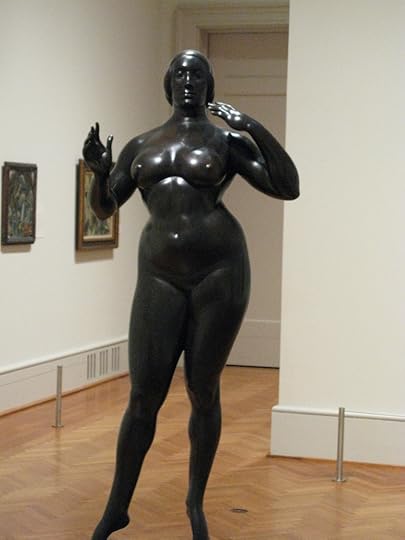
Gaston Lachaise – Standing Woman in the Art Institute of Chicago
There were many good points brought up – for instance Titian “famous” painting “Rape of Europa” which is a prelude to a rape or the famous sculpture by Giambologna “The Rape of the Sabines” in the open square of the Piazza della Signoria in Florence, Italy. As the author states don’t these give off an adoration of the brutalization of women? Do they condone rape? The author never suggests that these statues and/or paintings be destroyed – but maybe they should be relegated to the back rooms of a museum.
Page 16 (my book) John Berger
That a woman “has to survey everything she is and everything she does because how she appears to others, and ultimately how she appears to men, is of crucial importance for what is normally thought of as the success of her life.”
I felt the author on less firm ground when discussing artistic interpretations of women which she referred to as the “male gaze”. She states:
Page 50
But it’s not sex and desire in art that is the problem here, on that I want to be very clear.
But I was wondering if she had an issue with nudity?
Page 50
The problem is that one form of sexual desire [male artists] has been chosen to represent sexual desire universally.
I find this simplistic – “one form of sexual desire” is lumping all artists together, as if their paintings of nude woman are all the same. Do all men (all people) appreciate the “same” paintings and sculptures? I like Renoir, and don’t care for Modigliani.
In a discussion of the nude portrait by Gauguin “Spirit of the Dead Watching” she writes (page 65) “her domination by him [Gauguin] inevitable.” Really – that’s an interpretation, perhaps she dominated him. The author seemed to see domination in many nude paintings. What about just an erotic portrayal of a nude body?
On mothers and paintings of the Virgin Mary.
Page 83
The more we consider this metaphor of the Virgin Mary, the more it starts to feel like sheer horror… Beneath the starched surface of Mary is a body that has been sealed shut from which only breast milk and tears escape.”
I feel she is critiquing Catholicism more than the paintings.
She does cover a lot of cultural ground. I was not very interested in her commentaries on current society such as Beyonce and sexism in advertising (hardly a new topic).
But I did agree with -
Page 86
As an ideological image for wives and mothers to emulate [motherhood in paintings and advertising], it couldn’t be more different to the messy, complex physical and emotional rewards and demands of the lived reality of motherhood.
The author also looked deep into the mythological background of paintings. She does so with “Birth of Venus” by Botticelli. I never felt this to be a realistic portrayal of women or femininity. Its’ more of a fantasy, rather than as the author suggests, a physical role model for women to emulate.
The author can pour on the rhetoric at times
Page 50-51
With its expansive, often interactive commissions in the Turbine Hall, grasping meaning at the Tate Modern is secondary to the overall experience – a fate which accompanies many blockbuster museums of modern art that capitalise on a notion of sexy-cool zeitgeist to draw in an audience. But that means that the often radical political message of many of the works that deal with the intersectional issues of gender, race and class within its walls gets diluted into the culture-as-leisure machine. And as long as we see art as leisure, we are losing its power to shape political change.
She makes an interesting point of the taboo of birthing.
Page 103
Yet as a topic of serious art it [birthing] has been consistently eclipsed by other compelling aspects of the human condition, such as sex, death and war.
I want to re-emphasize that the author raises a number of very valid issues. When reading I could not help thinking of the Confederate monuments that glorify those who wanted to preserve slavery – and are now in the process, in some States in the U.S., of being removed.
Page 141
If we start to see the separation between what we find intolerable in real life and what we lionize in monuments and works of art, then perhaps we can further the way in which we talk about systemic sexual violence against women… leads us to a burning question of what we do with the artworks and public sculptures that contradict our proudly held liberal values in real life.
And as she points out – what is it with all the dead and beautiful female bodies ever so present in art like “Ophelia” by John Everett Millais. Does this not send a message that women should be adorned and silent and demand nothing?
And there are occasions where she does present contrary points of view like “The Dinner Party” by Judy Chicago (currently at the Brooklyn Museum).
For those interested there is the “National Museum of Women in the Arts” dedicated solely to female artists in Washington DC.
Also, what is it with so many books today that don’t have an index?
And here is artwork depicting a powerful woman made by a man.
Gaston Lachaise – Standing Woman in the Art Institute of Chicago

May 21, 2023
“ Who tells the story gets to decide who the monster is.”
I watched the horror film X from A24 not too long ago. As far as I know the this movie is critically acclaimed.
It did leave me horrified.
I was horrified not because of the violence and gore, but because its subject matter: the villainizing of woman’s aging body and elderly woman’s sexual desire, which was at the core of the film.
I couldn’t believe that it was the year 2022, and people were still vilifying aging in women and getting adulation for it.
I felt very alone in resenting this movie.
But now I think Catherine McCormack, the author of Women in the Picture, would agree with me.
As a matter of fact, she has written an entire chapter on the “ Monstrous Women” depicted in art: the witches, the Medusas and the Liliths, the Sphinxes, the women who “defy the archetypes of ideal womanhood”.
Those images of women have been historically used to denigrate and silence women who threatened the patriarchal order by being unapologetic about their sexual desire, by not submitting to their husbands, by being happy in their liberated independence and by possessing knowledge about life and death and reproductive power.
Medusa, who had been historically 'the protector of sex, death, divination, renewal and of dark moon mysteries', became nothing but a symbol of male victories in Benvenuto Cellini's bronze sculpture of Perseus with the Head of Medusa.
Lilith who is “sexually liberated, untethered from the restrictions of marital monogamy, erotically self-sufficient and has an unquenchable appetite for re-production” and who seduces Eve away from Adam in The Fall and Expulsion from Paradise by Michelangelo was later turned into a vehicle for “ the Victorians to express their anxieties over the so-called 'New Woman', who emerged out of burgeoning movements for female emancipation and suffrage.” In John Collier's 1889 painting Lilith, the bold Lilith was smothered and made to pose demurely, resembling the “ Venus “ and “ maiden”, the accepted representation of women in the patriarchal world.
The Sphinx, who “is the woman who perplexes with her questions and her intellect, and who emasculates those who don't understand her”, morphed into a fusion of nightmarish anxiety and erotic male fantasy under the paint brushes of Gustave Moreau , Edward Munch and Franz von Stuck.
And finally the witches, whose “archetypal figure as an old hag was spawned in the woodcut illustrations of the Malleus Maleficarum, a hugely influential treatise on witchcraft first published in Germany in 1486” are discussed. The Malleus Maleficarum became the main point of reference for inquisitors and focuses on its attack “on elderly women, independent women and women with opinions, and it reserved a special hatred for mid-wives, who were condemned as the most dangerous threat to the consecration of the Church.”
Later, Malleus Maleficarum influenced the German artist Hans Baldung Grien, whose grotesque wood prints of withes became wildly popular .
In Hans Baldung Grien’s painting The Ages of Woman and Death, there is a juxtaposition of a youthful “Venus “ type figure and her older self ( which is depicted very unfavourably ), which the author interprets as promoting the idea of “that women, no matter how lovely on the outside, are all hags in Venus' clothing, just waiting to be unmasked by the march of time.”
“Whereas once the elderly woman represented the wisdom and experience of old age and provided valuable knowledge to her community, by the sixteenth century, she reeked of death and was disenfranchised from her property and ostracised from the community.”
(Interestingly, in the movie X, there is also this pairing of the old murderous, sex-crazed fiend and the alluring and youthful woman, and …they are played by the SAME ACTRESS. It’s hard to not see it as a resurrection of the damaging Hans Baldung Grien painting.)
Despite all the dark history linked to the “monstrous women” , the women have been trying to re-claim the “ monsters “ and to have their own voices heard.
Notably, the powerful Sphinxes that are“ a perfect fusion of both sexes” painted by Italian surrealist Leonor Fini ; the sculpture A Subtlety (also known as the Marvelous Sugar Baby) by Kara Walker that filled the space with a 75-foot-long sugar-coated sphinx with the head of a black woman before the gargantuan Domino Sugar Factory in Brooklyn was demolished in 2014.
And Tremble Tremble by Jesse Jones which “establishes an empowering counter-myth that draws on the disruptive feminist power of the witch.”( part of it is on YouTube, I highly recommend checking it out, it is very powerful !)
Apart from the “ monstrous women”, McCormack also dissects three other major archetypes that the western culture views women through:
The “Venus “ archetype that sexualizes and objectifies women and sets the Eurocentric , unattainable beauty standards for women.
The “ Virgin Mary “ mother archetype that boxes mothers into the desexualized role of nurturing and sacrificing.
And the “Maiden and Dead Damsels” archetype that aesthetizes the suffering of women and perpetuates the ideal of “ purity”.
Another major takeaway for me is that through McCormack’s writing, I have gained so much more respect and appreciation for Berthe Morisot, whose works “allowed the instability and ambivalence of maternal experience to overflow those restrictive containers, making seemingly straightforward domestic images freighted with psychodrama and existential uncertainty. “
The author comments on the significance of her work that “ This was perhaps the first time that the mask had slipped since the Virgin Mother's debut in images in the fifth century CE, after the Council of Ephesus had decided in 431 that Mary was the Mother of God.”
This is a very accessible and informative read, and I highly recommend it to anyone who is interested in feminist art history.
I do wish the book contains more illustrations, as it references a lot of artworks.
4 ⭐️
I watched the horror film X from A24 not too long ago. As far as I know the this movie is critically acclaimed.
It did leave me horrified.
I was horrified not because of the violence and gore, but because its subject matter: the villainizing of woman’s aging body and elderly woman’s sexual desire, which was at the core of the film.
I couldn’t believe that it was the year 2022, and people were still vilifying aging in women and getting adulation for it.
I felt very alone in resenting this movie.
But now I think Catherine McCormack, the author of Women in the Picture, would agree with me.
As a matter of fact, she has written an entire chapter on the “ Monstrous Women” depicted in art: the witches, the Medusas and the Liliths, the Sphinxes, the women who “defy the archetypes of ideal womanhood”.
Those images of women have been historically used to denigrate and silence women who threatened the patriarchal order by being unapologetic about their sexual desire, by not submitting to their husbands, by being happy in their liberated independence and by possessing knowledge about life and death and reproductive power.
Medusa, who had been historically 'the protector of sex, death, divination, renewal and of dark moon mysteries', became nothing but a symbol of male victories in Benvenuto Cellini's bronze sculpture of Perseus with the Head of Medusa.
Lilith who is “sexually liberated, untethered from the restrictions of marital monogamy, erotically self-sufficient and has an unquenchable appetite for re-production” and who seduces Eve away from Adam in The Fall and Expulsion from Paradise by Michelangelo was later turned into a vehicle for “ the Victorians to express their anxieties over the so-called 'New Woman', who emerged out of burgeoning movements for female emancipation and suffrage.” In John Collier's 1889 painting Lilith, the bold Lilith was smothered and made to pose demurely, resembling the “ Venus “ and “ maiden”, the accepted representation of women in the patriarchal world.
The Sphinx, who “is the woman who perplexes with her questions and her intellect, and who emasculates those who don't understand her”, morphed into a fusion of nightmarish anxiety and erotic male fantasy under the paint brushes of Gustave Moreau , Edward Munch and Franz von Stuck.
And finally the witches, whose “archetypal figure as an old hag was spawned in the woodcut illustrations of the Malleus Maleficarum, a hugely influential treatise on witchcraft first published in Germany in 1486” are discussed. The Malleus Maleficarum became the main point of reference for inquisitors and focuses on its attack “on elderly women, independent women and women with opinions, and it reserved a special hatred for mid-wives, who were condemned as the most dangerous threat to the consecration of the Church.”
Later, Malleus Maleficarum influenced the German artist Hans Baldung Grien, whose grotesque wood prints of withes became wildly popular .
In Hans Baldung Grien’s painting The Ages of Woman and Death, there is a juxtaposition of a youthful “Venus “ type figure and her older self ( which is depicted very unfavourably ), which the author interprets as promoting the idea of “that women, no matter how lovely on the outside, are all hags in Venus' clothing, just waiting to be unmasked by the march of time.”
“Whereas once the elderly woman represented the wisdom and experience of old age and provided valuable knowledge to her community, by the sixteenth century, she reeked of death and was disenfranchised from her property and ostracised from the community.”
(Interestingly, in the movie X, there is also this pairing of the old murderous, sex-crazed fiend and the alluring and youthful woman, and …they are played by the SAME ACTRESS. It’s hard to not see it as a resurrection of the damaging Hans Baldung Grien painting.)
Despite all the dark history linked to the “monstrous women” , the women have been trying to re-claim the “ monsters “ and to have their own voices heard.
Notably, the powerful Sphinxes that are“ a perfect fusion of both sexes” painted by Italian surrealist Leonor Fini ; the sculpture A Subtlety (also known as the Marvelous Sugar Baby) by Kara Walker that filled the space with a 75-foot-long sugar-coated sphinx with the head of a black woman before the gargantuan Domino Sugar Factory in Brooklyn was demolished in 2014.
And Tremble Tremble by Jesse Jones which “establishes an empowering counter-myth that draws on the disruptive feminist power of the witch.”( part of it is on YouTube, I highly recommend checking it out, it is very powerful !)
Apart from the “ monstrous women”, McCormack also dissects three other major archetypes that the western culture views women through:
The “Venus “ archetype that sexualizes and objectifies women and sets the Eurocentric , unattainable beauty standards for women.
The “ Virgin Mary “ mother archetype that boxes mothers into the desexualized role of nurturing and sacrificing.
And the “Maiden and Dead Damsels” archetype that aesthetizes the suffering of women and perpetuates the ideal of “ purity”.
Another major takeaway for me is that through McCormack’s writing, I have gained so much more respect and appreciation for Berthe Morisot, whose works “allowed the instability and ambivalence of maternal experience to overflow those restrictive containers, making seemingly straightforward domestic images freighted with psychodrama and existential uncertainty. “
The author comments on the significance of her work that “ This was perhaps the first time that the mask had slipped since the Virgin Mother's debut in images in the fifth century CE, after the Council of Ephesus had decided in 431 that Mary was the Mother of God.”
This is a very accessible and informative read, and I highly recommend it to anyone who is interested in feminist art history.
I do wish the book contains more illustrations, as it references a lot of artworks.
4 ⭐️
July 8, 2025
mccormack, kitabını dört ana başlık altında inceliyor: anne, fahişe, müze objesi ve ikon.. bu bölümlerle birlikte, sanat tarihinde kadınların nasıl hep belli kalıplar içinde gösterildiğini ve bu temsillerin erkek egemen bakışla nasıl şekillendiğini anlatıyor. mesela madonna ve çocuk resimlerinde annelik ideali kutsanırken, venüs figürlerinde kadın bedeni daha çok arzu nesnesi olarak karşımıza çıkıyor. ve müze salonlarında sergilenen çıplak kadın bedenlerinin de aslında nasıl metalaştırıldığını görüyoruz.
mccormack’ın yaklaşımı yalnızca eleştirel değil, dönüştürücü de çünkü mesele yalnızca geçmişe bakmak değil.. bu noktada bakışın gücü devreye giriyor; kadınlar temsil edilmenin ötesinde, yorumlayan ve bakan özneler olarak da yer almalı. mccormack de bu yüzden günümüz kadın sanatçılarının işlerine yer veriyor ve eril sanat anlayışına alternatif bakışlar sunuyor.
resimdeki kadın, sanatla kurduğum bakışı fark etmemi sağladı. gördüğüm ve sevdiğim çoğu resmin alt metninin aslında ne olduğunu bilmek, biraz da hayal kırıklığı yarattı.
mccormack’ın yaklaşımı yalnızca eleştirel değil, dönüştürücü de çünkü mesele yalnızca geçmişe bakmak değil.. bu noktada bakışın gücü devreye giriyor; kadınlar temsil edilmenin ötesinde, yorumlayan ve bakan özneler olarak da yer almalı. mccormack de bu yüzden günümüz kadın sanatçılarının işlerine yer veriyor ve eril sanat anlayışına alternatif bakışlar sunuyor.
resimdeki kadın, sanatla kurduğum bakışı fark etmemi sağladı. gördüğüm ve sevdiğim çoğu resmin alt metninin aslında ne olduğunu bilmek, biraz da hayal kırıklığı yarattı.

Read
July 30, 2022Very clear, accessible and well-organised

July 18, 2021
A wonderful and well told book about women and feminism in art trough history. Very interesting and I loved the audiobook. Would definitely read more by this author for sure!

March 7, 2022
My first semester in college I took one of those general requirements, an art appreciation survey colloquially dubbed "Art in the Dark" because we sat in the dark while the professor showed slides and lectured. It was incredibly hard to take notes, by the way. For a class assignment, I made my first trip ever to an art museum. It seems incredible to me now that I had reached my late teens and never stepped foot inside this local treasure. My love of art began with this trip. In all the years since, I have not considered classic art from a feminist perspective. McCormack's book invites me to do so.
"The walls of our galleries have a sacrosanct charge that absorbs any censure. Oil paint is a soothing medium that smooths out the brutality and double standards of these narratives and turns them into lessons in culture and civilization for the general public. But what other alternative histories lie buried in plain sight beneath the gilded frames, the imposing ceilings, the tasselled ropes and the protective glass surfaces that deflect proper scrutiny?"
McCormack looks closely at female nudes in Western European art. She classifies them into 4 archetypes--Venus, Mothers (the Madonna), Maidens and Dead Damsels, and Monstrous Women (think women whom men might fear)-- and endeavors to show how they affect how our society views women in general. Because so much of this art was created by male artists for male clients, McCormack argues, we have become accustomed to viewing these images through male eyes. She asks us to look at the patron who commissioned the work, the time period, and it's original intent so that we can reinterpret the work in a modern framework. McCormack also points to women artists and encourages modern women to represent their own realities.
What I would like to see added is some color plates of all the works she mentions. Once I started, I read with my tablet open so that that I could look up the pieces McCormack talks about.
Women in the Picture is a very readable, thought-provoking work that asks its readers to consider how much of this artwork has been created in a society that normalized violence against women and how it influences our understandings of who/what women are and can be.
"The walls of our galleries have a sacrosanct charge that absorbs any censure. Oil paint is a soothing medium that smooths out the brutality and double standards of these narratives and turns them into lessons in culture and civilization for the general public. But what other alternative histories lie buried in plain sight beneath the gilded frames, the imposing ceilings, the tasselled ropes and the protective glass surfaces that deflect proper scrutiny?"
McCormack looks closely at female nudes in Western European art. She classifies them into 4 archetypes--Venus, Mothers (the Madonna), Maidens and Dead Damsels, and Monstrous Women (think women whom men might fear)-- and endeavors to show how they affect how our society views women in general. Because so much of this art was created by male artists for male clients, McCormack argues, we have become accustomed to viewing these images through male eyes. She asks us to look at the patron who commissioned the work, the time period, and it's original intent so that we can reinterpret the work in a modern framework. McCormack also points to women artists and encourages modern women to represent their own realities.
What I would like to see added is some color plates of all the works she mentions. Once I started, I read with my tablet open so that that I could look up the pieces McCormack talks about.
Women in the Picture is a very readable, thought-provoking work that asks its readers to consider how much of this artwork has been created in a society that normalized violence against women and how it influences our understandings of who/what women are and can be.
March 25, 2022
I am 100% the target audience for this book and I ate it up. Art history, pop cultural references, feminism, body image, the madonna-whore dichotomy, misogyny in Greek and Roman mythology and in our current society — it was all there, with attention for the ways Black bodies (and queer bodies to lesser extent) have been pictured or erased from art history.

July 23, 2022
In terms of content and writing style I'd divide this book into two parts:
1. History of art from a feminist perspective
Each of the four chapters, Venus, Mothers, Maidens and Dead Damsels, and Monstrous Women starts with an introduction to one or more classic paintings related to the topic. McCormack offers a new way of reading these paintings and argues that in addition to praising them for their artistic merit and historical value, we can, and should discuss the male gaze, limited and stereotypical representation of women and sexual objectification.
Here, the historical events and facts mentioned, were eye opening and insightful. It's interesting how knowing about, say, the owner of a painting can change your mind about the art.
This is the better, and my favorite part of the book as it gives you new tools for observing art and helps you interpret and criticize art independently.
I wish this part was more expanded.
2. A feminist book written by a feminist who happens to be an art historian
However, the book tries to draw connection between classical and contemporary art. This is the part where the text is not coherent and arguments suffer from oversimplification.
My assumption is that today, works of art influenced by culture and works of art influencing culture are not easily distinguishable. That's why discussions of sexism in modern art and media and pop culture, and blaming Renaissance artworks - which are mostly reflections of their own time and culture - without considering politics, economics and other intersectional topics, were not convincing.
While reading this part I kept thinking about how I would gladly sit next to McCormack for hours and 'rant' about the sexism but would not 'discuss' the issues.
This part didn't answer my questions and was repetitive, but here I was not the target audience anyway.
I recommend this book to those who don't know how their favorite artwork, movie or series could be problematic and hurt others in different ways, as long as they don't mind a radical tone.
1. History of art from a feminist perspective
Each of the four chapters, Venus, Mothers, Maidens and Dead Damsels, and Monstrous Women starts with an introduction to one or more classic paintings related to the topic. McCormack offers a new way of reading these paintings and argues that in addition to praising them for their artistic merit and historical value, we can, and should discuss the male gaze, limited and stereotypical representation of women and sexual objectification.
Here, the historical events and facts mentioned, were eye opening and insightful. It's interesting how knowing about, say, the owner of a painting can change your mind about the art.
This is the better, and my favorite part of the book as it gives you new tools for observing art and helps you interpret and criticize art independently.
I wish this part was more expanded.
2. A feminist book written by a feminist who happens to be an art historian
However, the book tries to draw connection between classical and contemporary art. This is the part where the text is not coherent and arguments suffer from oversimplification.
My assumption is that today, works of art influenced by culture and works of art influencing culture are not easily distinguishable. That's why discussions of sexism in modern art and media and pop culture, and blaming Renaissance artworks - which are mostly reflections of their own time and culture - without considering politics, economics and other intersectional topics, were not convincing.
While reading this part I kept thinking about how I would gladly sit next to McCormack for hours and 'rant' about the sexism but would not 'discuss' the issues.
This part didn't answer my questions and was repetitive, but here I was not the target audience anyway.
I recommend this book to those who don't know how their favorite artwork, movie or series could be problematic and hurt others in different ways, as long as they don't mind a radical tone.

May 24, 2026
Labai patiko. Pagauliai parašyta, kartu gili, kritiška, o ir aktuali knyga, keičianti žiūrėjimo kampą į meno kūrinius ir apskritai į kultūros istoriją. Autorė analizuoja žinomus meno šedevrus bei šiuolaikinės popkultūros pavyzdžius ir tiesiai šviesiai kalba apie moterų reprezentaciją juose. Vis dar drąsos reikalaujantis autorės požiūris apnuogina tai, kaip vizualinėje kultūroje šimtmečiais buvo formuojamas iškreiptas moters įvaizdis. Kartu ši knyga – tai labai garsus kvietimas matyti ir būti matomoms iš tikrųjų. Manau, kad šis tekstas labiau skirtas moterims: toms, kurios kuria, ir toms, kurios pačios yra kūrinio objektas. Labai man (pa)tiko, kaip autorė, apžvelgdama pavyzdžius nuo Renesanso Veneros iki šiuolaikinės reklamos, ardo nusistovėjusius mitus ir kviečia matyti moteris mene (ir ne tik) visai kitaip.
Labai rekomenduoju.
Labai rekomenduoju.

February 27, 2022
An excellent piece of criticism, which kept me engaged from the outset. The author explores different topics within the world of art wonderfully, and I learnt so much. Highly, highly recommended.

March 10, 2023
That was absolutely brilliant. Hands down one of the best nonfiction books I’ve ever read, I got so much out of it :)

September 7, 2024
This is such an important read!
I absolutely adored this book! The author did such a good job of introducing us to the idea that art has (historically) played an essential role in the propagation of patriarchal ideals. She masterfully showcases how visual media has shaped how we (as a society) view women, and illustrates the archetypes in which women are placed.
I've always had an interest in this topic (I also studied it in Uni). I love learning about what visual media analysis can tell us about society and the human condition.
If you are at all interested in this topic, this is a must read!
I absolutely adored this book! The author did such a good job of introducing us to the idea that art has (historically) played an essential role in the propagation of patriarchal ideals. She masterfully showcases how visual media has shaped how we (as a society) view women, and illustrates the archetypes in which women are placed.
I've always had an interest in this topic (I also studied it in Uni). I love learning about what visual media analysis can tell us about society and the human condition.
If you are at all interested in this topic, this is a must read!

September 11, 2021
To most people it will not come as a surprise that historically, most famous artists were men, that women were not allowed to study the fine arts, and that the few female artists that existed received little if any attention. The well-known exceptions are Artemisia Gentileschi and Berthe Morisot.
Yet seeing art historian Catherine McCormack list these societal misgivings and thus missed opportunities to celebrate brilliant female artists is daunting to say the least.
While traditional explanations are fine, a more socially enlightened explanation and interpretation should be available alongside it, so that particularly impressionable school children understand the art from within the time it was created and are conscious of historically antiquated values, while considering today’s society.
It has mostly been men who decide the restrictive roles women are assigned, confining them to be Venus, bride, wife, mother, child, or monster. Interpretations of classical art would be so much stronger if debate had previously been encouraged rather than dismissed. Debate about interpretations of classical art should be advocated not only in art history classes, offering a modern interpretation and view of the subject alongside viewing through the lens of the place and time during which it was created.
This book will not stop the misogynists who long for the discriminatory values of yesteryear. But it might provide hope that people develop a more encompassing understanding of art.
Many thanks to NetGalley, Icon Books, and Catherine McCormack for this ARC in exchange for an honest review.
Yet seeing art historian Catherine McCormack list these societal misgivings and thus missed opportunities to celebrate brilliant female artists is daunting to say the least.
While traditional explanations are fine, a more socially enlightened explanation and interpretation should be available alongside it, so that particularly impressionable school children understand the art from within the time it was created and are conscious of historically antiquated values, while considering today’s society.
It has mostly been men who decide the restrictive roles women are assigned, confining them to be Venus, bride, wife, mother, child, or monster. Interpretations of classical art would be so much stronger if debate had previously been encouraged rather than dismissed. Debate about interpretations of classical art should be advocated not only in art history classes, offering a modern interpretation and view of the subject alongside viewing through the lens of the place and time during which it was created.
This book will not stop the misogynists who long for the discriminatory values of yesteryear. But it might provide hope that people develop a more encompassing understanding of art.
Many thanks to NetGalley, Icon Books, and Catherine McCormack for this ARC in exchange for an honest review.

March 14, 2023
This is the second time I have listened to this audiobook in 2023, getting to 30% the first time I wanted to give this another chance.
This time I finished listening to the entire book, but the way this book presents information does not work for me.
I like the idea of this book more than how it presents its facts; where it takes a non-neutral stance, and where I thought it highlighted parts of a discussion to establish its own views. Having said this, independent of the way information is presented, it has a lot of interesting information.
If this was a work of fiction I would like it more, its provoking language that is littered with buzz words depicts wonderful, vivid scenes. This made it an enjoyable read, that is until I remembered this is a work of non-fiction. For my non-fiction reads I prefer to work things out for myself but this book, with its continual need to emphasise and spell things out, left me no room to do this.
This book raises important issues about women’s identity, but I am left with mixed feelings about it.
This time I finished listening to the entire book, but the way this book presents information does not work for me.
I like the idea of this book more than how it presents its facts; where it takes a non-neutral stance, and where I thought it highlighted parts of a discussion to establish its own views. Having said this, independent of the way information is presented, it has a lot of interesting information.
If this was a work of fiction I would like it more, its provoking language that is littered with buzz words depicts wonderful, vivid scenes. This made it an enjoyable read, that is until I remembered this is a work of non-fiction. For my non-fiction reads I prefer to work things out for myself but this book, with its continual need to emphasise and spell things out, left me no room to do this.
This book raises important issues about women’s identity, but I am left with mixed feelings about it.


August 25, 2023
...rethink the myths and images that have dupe us into believing that the woman who looks at the world is a monster, while the man who does so is an artist.
I really loved this book, I started to read it before I started my Masters at Gender studies and it has been really essential in shaping my thinking about the way female bodies are depicted in visual art and culture. This is a book that combines classical art and history of how some "visual tropes" evolved with contemporary uses of those figures and tropes - in pop-culture, adds etc. I loved this approach and I though it worked very well.
Some of my buddies complained that there were some mistakes in the research in relation to the modern parts - as a wrong publication date of one of Beyoncé's albums. I would usually be quite strict with factual mistakes in a non-fic, but I feel very forgiving in this case. First of all because all of the mistakes that were mentioned by other people weren't really related to any of her reasonings, definitely the publication date of that album wasn't really important, the accompanying images were. Second, I think some of those might not be actual mistakes? I didn't research any, so I might be wrong but publications dates are often a bit different in different parts of the world, so I am a bit reluctant to call this, especially since I myself don't really care enough to check.
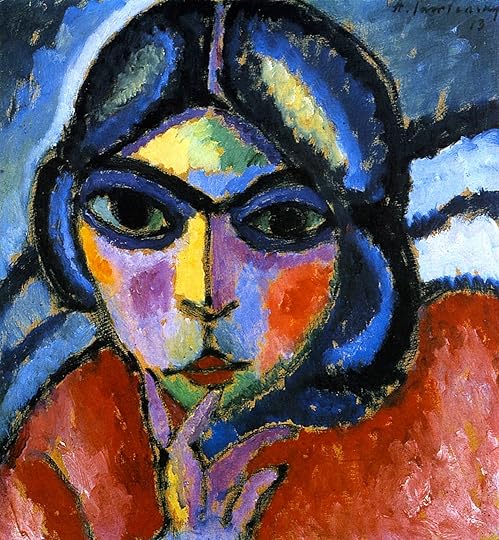
Pensive Woman by Alexej von Jawlensky
My point with this is mainly, this probably isn't a perfect book, but I found it very compelling and I read a big chunk of it twice and the classical part of scholarship in this is excellent. I'm thinking about buying this book, because I kind of want to have it physically, but... I only like this editions cover, which is only available in hardcover and much more expensive than the paperback that I would have preferred... oh, well, decisions...
I'm not really that much into visual art and visiting galleries and maybe that is the reason why I found this so fascinating, because I didn't know that much about it? Definitely a great entrance book if you want to learn more about feminism and art. This is one of those books that also forms a sort of crossroad, sending you in several different directions and I saw quite a few great documentaries as result of that, would recommend Mary Beard's The Shock of the Nude if you are interested in this topic, but don't want to commit to a book. It is very easy to get through read though and the audio is also great if you prefer that for your non-fics. Would recommend!
BRed at Radical Reading: https://www.goodreads.com/topic/show/...

My photo of Kneeling Woman Bathing by Giovanni Francesco Susini as it currently in Albertina Vienna. The way this statue is arranged really struck me, especially the mirrors, I was just really strongly reminded of this book when I saw that.

Read
January 8, 20235 stars, and it’s nowhere near enough
this book is everything:
feminist,
eye-opening,
magnificent,
informative,
nuanced,
integral, and
subversive
TRUTH.
did i mention it’s feminist?
it’s FEMINIST, too! 🙌🏼
this book is everything:
feminist,
eye-opening,
magnificent,
informative,
nuanced,
integral, and
subversive
TRUTH.
did i mention it’s feminist?
it’s FEMINIST, too! 🙌🏼

February 14, 2025
i rarely see books where the author urges the reader to not frame women artists within the male artists criteria, it’s so refreshing!
September 20, 2023
This is my Bible
I have never felt so invested and depressed about the history of women in art. McCormack addresses the different nuances of each subsection within each chapter and argues for each view there is, providing me with new thoughts and feelings on each page. I so thoroughly recommend it to anyone who’s interested in art history or the presentation of women.
I have never felt so invested and depressed about the history of women in art. McCormack addresses the different nuances of each subsection within each chapter and argues for each view there is, providing me with new thoughts and feelings on each page. I so thoroughly recommend it to anyone who’s interested in art history or the presentation of women.

July 23, 2021
The female form pervades art. Female bodies are consistently on display and have become a political, social and religious battleground. Whether it is Instagram banning female nipples or female characters appearing shaved, coiffed, and made-up in post-apocalyptic films, the way women are presented is always full of meaning. In Women in the Picture, McCormack addresses this clearly. Thanks to Icon Books and Netgalley for providing me with a copy of this book in exchange for an honest review.
The concept of the "male gaze" was first introduced by art critic John Berger, but the one who really "coined" it, and introduced it to a wider audience, was Feminist film critic Laure Mulvey. Her critique clearly analyzed how women, in art and film specifically, are consistently viewed in a way that highlights their desirability to a male audience. Once you see it, you can't unsee it. Whether it is classical art, paintings, photography, film and sometimes even theatre, women are displayed as objects, meant to be ogled, not understood as human beings. In Women in the Picture McCormack addresses the way in which women are posed, the way in which Women of Colour are judged and mocked, and how certain trends have evolved over time.
Women in the Picture starts with Classical Art, discussing statues of Venus and paintings by Titian and Botticeli. The way in which she is posed, hip cocked, one hand gently covering the vagina, eyes far away, she becomes an object. From there McCormack tracks trends through different centuries, looking at how female artists have tried to reclaim the female body, to infuse it with actual life, to have women represent a female experience and not a male desire. It is not an overly academic book, but strongly founded in McCormack's scholarship. While some of the connections or comments made in Women in the Picture didn't entirely resonate with me, I gained many new ideas and considerations from this book.
Catherine McCormack's writing is clear and uncomplicated, which means that Women in the Picture is accessible to a wide audience. Her intent is to inform and to start a conversation, to discuss how classical art influences everything from Instagram influencers to shaving commercials, how it directly impacts how young women see themselves. While there is no answer, per se, on how to "solve" this issue, since that requires much more than a single book, McCormack understands the importance of starting a conversation, of raising awareness, and Women in the Picture does that brilliantly. Her highlighting of the difference in which Women of Colour, and specifically African(-American) women, are portrayed, compared to white women, needs to be understood by everyone and I'm glad it was laid out as clearly as it was. I would have loved to see more images since so many amazing paintings and photographs are mentioned. However, I do appreciate that due to rights etc. it may have been difficult to include all of them.
Women in the Picture is a very informative and, despite its difficult topic, enjoyable read. For anyone interested in understanding the connection between art, culture, self-perception, race and much more, this is a crucial starting point.
URL: https://universeinwords.blogspot.com/...
The concept of the "male gaze" was first introduced by art critic John Berger, but the one who really "coined" it, and introduced it to a wider audience, was Feminist film critic Laure Mulvey. Her critique clearly analyzed how women, in art and film specifically, are consistently viewed in a way that highlights their desirability to a male audience. Once you see it, you can't unsee it. Whether it is classical art, paintings, photography, film and sometimes even theatre, women are displayed as objects, meant to be ogled, not understood as human beings. In Women in the Picture McCormack addresses the way in which women are posed, the way in which Women of Colour are judged and mocked, and how certain trends have evolved over time.
Women in the Picture starts with Classical Art, discussing statues of Venus and paintings by Titian and Botticeli. The way in which she is posed, hip cocked, one hand gently covering the vagina, eyes far away, she becomes an object. From there McCormack tracks trends through different centuries, looking at how female artists have tried to reclaim the female body, to infuse it with actual life, to have women represent a female experience and not a male desire. It is not an overly academic book, but strongly founded in McCormack's scholarship. While some of the connections or comments made in Women in the Picture didn't entirely resonate with me, I gained many new ideas and considerations from this book.
Catherine McCormack's writing is clear and uncomplicated, which means that Women in the Picture is accessible to a wide audience. Her intent is to inform and to start a conversation, to discuss how classical art influences everything from Instagram influencers to shaving commercials, how it directly impacts how young women see themselves. While there is no answer, per se, on how to "solve" this issue, since that requires much more than a single book, McCormack understands the importance of starting a conversation, of raising awareness, and Women in the Picture does that brilliantly. Her highlighting of the difference in which Women of Colour, and specifically African(-American) women, are portrayed, compared to white women, needs to be understood by everyone and I'm glad it was laid out as clearly as it was. I would have loved to see more images since so many amazing paintings and photographs are mentioned. However, I do appreciate that due to rights etc. it may have been difficult to include all of them.
Women in the Picture is a very informative and, despite its difficult topic, enjoyable read. For anyone interested in understanding the connection between art, culture, self-perception, race and much more, this is a crucial starting point.
URL: https://universeinwords.blogspot.com/...
August 18, 2021
This book looks at art history and its way of shaping contemporary constructions of femininity, female bodies, and sexuality.
The first chapter "Venus" looks at the creation of Venus as the idealisation of femininity and the intrinsic ‘purity’ of her creation being independent of female reproduction (she was born from the cut off testicle of her father Uranus). She is the model of beauty with her poses being emulated to this day in Instagram posts and media. Her depictions are of voyeurism and the ‘male gaze’ as well as the erasure and dehumanisation of non-white bodies.
The second chapter looks at mothers and the construction of motherhood through appearance (a mother who looks beautiful is a good mother). Not to mention iconic imagery of the ‘Madonna and Child’ and depictions of the Virgin Mary being in only two instances: the piety of Jesus’ birth and the grief of his death. This chapter also looks at the ‘angel of the house’ in which mothers care for everyone but themselves unless paid or enslaved workers take over the role. Mothers are then un-autonomous machines with no sexual availability as it highlights women as organic (unlike the inorganic venus) unless fetishised (e.g MILF's).
In "Maidens and Dead Damsels" McCormack looks at rape culture, the ‘pretty sad girl’ in pop culture, and the damsel in distress. This is explored through characters such as Ophelia who literally drowns in self-pity after getting rejected by a man, with this instance considered her most beautiful and perfect state. This is because a dead woman essentially encapsulates the patriarchal idealisation of femininity: one that is silent, submissive, and doll-like. This encourages violence towards women, especially in the plentiful scenes of women being raped and then shamed for it, as distress and suffering become synonymous with female beauty.
The final chapter looks at "Monstrous Women", which is used to depict women who display any sense of autonomy, intelligence, and authority. Women with power are the witches, the Medusa’s, the Lilith’s, the Sphinx’s because in the patriarchy a woman’s self-worth comes from youth and beauty and once those are taken away they are nothing. "The woman who looks at the world is a monster, while the man who does it is an artist".
The first chapter "Venus" looks at the creation of Venus as the idealisation of femininity and the intrinsic ‘purity’ of her creation being independent of female reproduction (she was born from the cut off testicle of her father Uranus). She is the model of beauty with her poses being emulated to this day in Instagram posts and media. Her depictions are of voyeurism and the ‘male gaze’ as well as the erasure and dehumanisation of non-white bodies.
The second chapter looks at mothers and the construction of motherhood through appearance (a mother who looks beautiful is a good mother). Not to mention iconic imagery of the ‘Madonna and Child’ and depictions of the Virgin Mary being in only two instances: the piety of Jesus’ birth and the grief of his death. This chapter also looks at the ‘angel of the house’ in which mothers care for everyone but themselves unless paid or enslaved workers take over the role. Mothers are then un-autonomous machines with no sexual availability as it highlights women as organic (unlike the inorganic venus) unless fetishised (e.g MILF's).
In "Maidens and Dead Damsels" McCormack looks at rape culture, the ‘pretty sad girl’ in pop culture, and the damsel in distress. This is explored through characters such as Ophelia who literally drowns in self-pity after getting rejected by a man, with this instance considered her most beautiful and perfect state. This is because a dead woman essentially encapsulates the patriarchal idealisation of femininity: one that is silent, submissive, and doll-like. This encourages violence towards women, especially in the plentiful scenes of women being raped and then shamed for it, as distress and suffering become synonymous with female beauty.
The final chapter looks at "Monstrous Women", which is used to depict women who display any sense of autonomy, intelligence, and authority. Women with power are the witches, the Medusa’s, the Lilith’s, the Sphinx’s because in the patriarchy a woman’s self-worth comes from youth and beauty and once those are taken away they are nothing. "The woman who looks at the world is a monster, while the man who does it is an artist".
This entire review has been hidden because of spoilers.

June 20, 2022
"The images that surround us contour a landscape that can be alienating for us to live in if they do not match up to our sense of ourselves."
In less than 250 pages, Catherine McCormack explains with a sharp eye and a passionate voice how classic paintings and statues of women shaped the visuals and views that we have of them today.
Even if your background isn't in art-history, you'll enjoy reading how The Birth of Venus inspired the Venus commercials, or why having a statue of The Rape of Europe outside the European Union Council's office in Brussels is a bad choice.
Because that is the novel's point: what Western culture appreciates and praises as high art, often has troubling, racist or misogynistic implications, which people in the past and today refuse to acknowledge or discuss.
Rarely seeing images about giving birth or experiencing sexual pleasure means that many women (still) are in the dark about their own bodies. And witnessing female 'monsters' as witches and Medusa (with great physical and intellectual power) being killed by men shaped societies on a larger scale that you might know.
This book is a blast, informative and fascinating, and introduced me to a collection of classic paintings and modern artworks that I had never heard about, but now definitely want to see in person. I recommend it to for art-historians familiar with (certain) paintings and people dipping their toes in.
"Sex tends to be taken as an automatically liberating theme in art, but we might ask ourselves how liberating the sex was for the women in these pictures."
In less than 250 pages, Catherine McCormack explains with a sharp eye and a passionate voice how classic paintings and statues of women shaped the visuals and views that we have of them today.
Even if your background isn't in art-history, you'll enjoy reading how The Birth of Venus inspired the Venus commercials, or why having a statue of The Rape of Europe outside the European Union Council's office in Brussels is a bad choice.
Because that is the novel's point: what Western culture appreciates and praises as high art, often has troubling, racist or misogynistic implications, which people in the past and today refuse to acknowledge or discuss.
Rarely seeing images about giving birth or experiencing sexual pleasure means that many women (still) are in the dark about their own bodies. And witnessing female 'monsters' as witches and Medusa (with great physical and intellectual power) being killed by men shaped societies on a larger scale that you might know.
This book is a blast, informative and fascinating, and introduced me to a collection of classic paintings and modern artworks that I had never heard about, but now definitely want to see in person. I recommend it to for art-historians familiar with (certain) paintings and people dipping their toes in.
"Sex tends to be taken as an automatically liberating theme in art, but we might ask ourselves how liberating the sex was for the women in these pictures."

May 22, 2023
Hieno, hieman johdantokurssimainen (hyvällä tavalla!) teos taidehistoriasta feministisestä näkökulmasta. McCormack avaa selkeällä ja silti ihanan innostuneella tavalla omaa asiantuntijuuttaan taiteen tulkitsijana, ja yhdistää länsimaista taidehistorian kuvastoa nykykuvastoon, löytäen mielenkiintoisia yhteyksiä ja toisaalta vahvoja uudelleentulkintoja. McCormack näyttää, mitä käy kun taide ja naisen kuvaus on ollut vuosisatoja ainoastaan miesten käsissä, ja toisaalta miten autonomisesta naisesta tulee hirviö tai noita myös taiteessa, kun hän ei suostu alistumaan patriarkaatin alle.
Erityisen vahvoilla McCormack olikin juuri noituutta ja lisäksi pulassa olevia neitoja kuvaavissa osuuksissa, näistä sain henkilökohtaisestikin eniten uutta. Hieman kokonaisuutta latistaa yllättävän heppoinen lähteistys. Yleensä nautin näissä tiedettä popularisoivissa teoksissa eniten juuri kirjoittajan ajatuksiin vaikuttaneiden ajattelijoiden seuraamisesta, mutta tämän kanssa se ei ole oikein mahdollista. Teoksen syvyyteen ja naisten tekemistä nostavaan luonteeseen nähden tämä on itseasiassa varsin isokin miinus.
3,5 tähteä, pyöristän nyt kuitenkin ylöspäin koska tämä todella sai myös omat ajatukset virtaamaan. Hieno perusteos.
Erityisen vahvoilla McCormack olikin juuri noituutta ja lisäksi pulassa olevia neitoja kuvaavissa osuuksissa, näistä sain henkilökohtaisestikin eniten uutta. Hieman kokonaisuutta latistaa yllättävän heppoinen lähteistys. Yleensä nautin näissä tiedettä popularisoivissa teoksissa eniten juuri kirjoittajan ajatuksiin vaikuttaneiden ajattelijoiden seuraamisesta, mutta tämän kanssa se ei ole oikein mahdollista. Teoksen syvyyteen ja naisten tekemistä nostavaan luonteeseen nähden tämä on itseasiassa varsin isokin miinus.
3,5 tähteä, pyöristän nyt kuitenkin ylöspäin koska tämä todella sai myös omat ajatukset virtaamaan. Hieno perusteos.

March 6, 2023
"When we change the way we see, the things we see also change"
Such an incredible book about feminist theory and how women's bodies are depicted throughout the history of art, which Catherine McCormack unravels beautifully. The book covers many theories, from historical feminist criticism to post-structuralism. Alongside over-sexualization, societal values, abuse (whether that be emotional, sexual, or physical), patriarchy, race, traditional gender roles, and just plain misogyny. Violence towards women's bodies is not a new phenomenon nor is it a serene topic to discuss, so I applaud McCormack for not putting it lightly. And although I try my best to watch, read, and listen to as much media created by women as I can, I never realized my love for artwork completely lacks all diversities. This is my first introduction to feminist theory and I highly recommend it as it doesn't make you feel negligent but informs you in an unpretentious way. I look forward to reading more books similar to this!!
Such an incredible book about feminist theory and how women's bodies are depicted throughout the history of art, which Catherine McCormack unravels beautifully. The book covers many theories, from historical feminist criticism to post-structuralism. Alongside over-sexualization, societal values, abuse (whether that be emotional, sexual, or physical), patriarchy, race, traditional gender roles, and just plain misogyny. Violence towards women's bodies is not a new phenomenon nor is it a serene topic to discuss, so I applaud McCormack for not putting it lightly. And although I try my best to watch, read, and listen to as much media created by women as I can, I never realized my love for artwork completely lacks all diversities. This is my first introduction to feminist theory and I highly recommend it as it doesn't make you feel negligent but informs you in an unpretentious way. I look forward to reading more books similar to this!!

February 22, 2024
(4.75) i really enjoyed this, and kind of read it insanely fast because it encapsulates so many points of interest for me such as greek mythology, art, religion, feminism, thank u maliaaa!!
so good and fun to read, taught me a lot about pieces of art that i already loved in a way that was refreshingly informative and well researched. mccormack deconstructs female archetypes in art, whether she be monstrous, muse-like, or a damsel. it was fascinating to feel so seen and not seen in art through her nuanced dissection. she is a great writer and this book fills me with rage but also with the power of self recognition. i feel i gained so much religious and mythological context for the ways in which culture has abstracted the body. this book makes me want to exist unflinchingly in my body. girls that love art and women will eat this tf up.
so good and fun to read, taught me a lot about pieces of art that i already loved in a way that was refreshingly informative and well researched. mccormack deconstructs female archetypes in art, whether she be monstrous, muse-like, or a damsel. it was fascinating to feel so seen and not seen in art through her nuanced dissection. she is a great writer and this book fills me with rage but also with the power of self recognition. i feel i gained so much religious and mythological context for the ways in which culture has abstracted the body. this book makes me want to exist unflinchingly in my body. girls that love art and women will eat this tf up.


November 29, 2021
A very informative book although definitely a lot of heavy subject matter and a bit hard to get through at times. I really liked how she looked at a broad range of different kinds of art ranging from classic paintings to present things like photography and advertisements and always took into account whether the women were being represented by men or by other women. Unsurprisingly, there is a lot of discussion of rape in this book - both in the art that's being talked about and in real women's lives - so definitely be prepared for that if you're going to pick this up but I think it's an excellent read if you're in the right headspace.
Displaying 1 - 30 of 467 reviews