I have lived the life of a princess since the day I was born. But it did not bring me what I wanted. I am still trapped.
My beloved Ned speaks of love, freedom, a future. To walk with him in the forest, our raven soaring above us, is my only joy. By my father plans that I shall be betrothed to the King and I am afraid. Queens of England have a habit of dying. I have no desire to take the throne; no wish to find myself in the Tower of London.
Wife. Queen- I fear it will bring me to my knees.
"Raven Queen" weaves a mesmerizing tale of love and tragedy based on the life of Lady Jane Grey, all too often remembered as just a line in an English history book.
I love books. I translated them when I lived in Africa – and I worked with them when I was a teacher and a librarian, but I never thought about writing them.
One day, about ten years ago, I decided to become a full-time writer.
My first books were for younger readers. In Drake’s Drummer Boy (1998), Will sails around the world with Sir Francis Drake; in Sam Stars at Shakespeare’s Globe (2006), Sam works with William Shakespeare.
As you can see, the sixteenth century fascinates me. A few years ago, I started to write for older readers, about people who faced very tough decisions in a world that was changing quickly: Lady Jane Grey, in Raven Queen; the lost colonists in A World Away; and the young Elizabeth in Traitor’s Kiss.
What is a typical writing day? I write very early in the morning in a coffee shop. Then I use my computer to re-write and to do my research at home in my study.
I am married with two grown-up children, and I live in Hertfordshire close to London and to Cambridge. I enjoy going to the cinema and the theatre – and anywhere where I can watch other people.
I came across this book by accident, searching for a different book on the library website. This was one of the "similar results". Upon seeing it was about Lady Jane Grey (better known as the Nine Days Queen), I figured I'd give it a try. You don't see a ton of books about her, sadly. Which is a shame because she's such an interesting historical person.
Anyways. Aimed at young adults, I feel like it would be a better fit for middle readers. There's a lot of major events that are just sort of skimmed over, if they're mentioned at all. I understand that you can't delve into more of the complexities if your target audience is so young, but when you're 33 and have read a number of historical YA fiction before, you start to expect at least a reasonable amount of information.
It wasn't terrible, but I'm not sure if I'd read another novel by this author. It was just too simplistic. Also, mentioning the tale of 'Beauty and the Beast' two hundred years before it was written really irritated me. If you want to reference another tale, at least make sure it's already created before putting it in your novel.
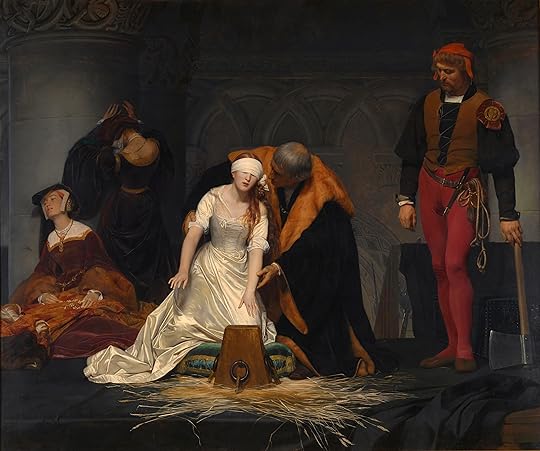
I've always been fascinated by the painting The Execution of Lady Jane Grey by Paul Delaroche but never really knew anything about her. This book, while fiction, does breathe some life into her and has made me want to learn more. The story is pretty bare bones and could have been fleshed out a great deal more, most notably when it comes to her connection to the ravens, but as a YA novel it works and it's a good, low threshold springboard to that particular time in British history.
3.5 stars rounded up. Raven Queen is a book I stumbled across by accident while looking for another audiobook in my library. It was an intriguing find as it centres around Lady Jane Grey. Somewhat embarrassingly my knowledge of English history is vague so while I knew of her and the Dudley plot I didn’t have much detail. This made this probably more interesting for me than it would have otherwise. The characterisation is realistic and I liked that while it was written as a narrative from two points of view there was still lots of wider historical context subtly dropped in throughout.
Delving into history.. Lady Jane Grey has often been delegated to only a couple of lines in a history book. But her life was so much more than what was contained in those texts. As Pauline Francis delves into the life of Lady Jane, she brings her to life in a way that has not been done before. Jane Grey is destined for great things. Her parents have been working tirelessly to ensure that she makes a good marriage, and one that will bring prestige to the family. They are looking for a royal connection. Jane on the other hand, would rather be left alone with her books and studies. No amount of beatings or berating from her parents can deter her. She has is completely wrapped up in her faith and education. Ned is just thankful to be alive. Lady Jane saved him from a terrible fate, and has shown him nothing but kindness in return. The only sticking point in their relationship is that he is Catholic and she is of the Protestant faith. While they secretly love each other, there are insurmountable differences that they know can never be over come. When Jane is proclaimed queen by her new father in law, shortly after the death of the King, she is shocked. She has no desire to become queen. She thought she had made that quite clear, however, her feeling are entirely put aside by those who are looking to advance themselves through her.When the Princess Mary gathers an army to reclaim her throne, she is met by thronging people who are enthusiastic that she has come back. Jane is not a popular queen, the people did not view her as the legitimate heir of their last ruler. Mary is met with open arms, and supplies by the people who are ready to see her in their rightful place. But now the question will become, what will happen to Lady Jane, the poor girl who reigned only nine days? This was an interesting read, but I cant pretend that I just loved it. I felt that it was a bit stretched in parts, and some of the scenes were entirely to out there for me. While this is a work of fiction based on real characters, I was just a little disappointed with it. I did however, enjoy the historical accuracy that was wound around the characters. While some scenes are entirely fiction, others really hit on the reactions and hopes of each of them. Ned is a made up character to add a dimension to the virtually unknown Lady Jane. I would recommend this for late Junior High to High School students for reading.
This is the fictional story of Lady Jane Grey as a young woman, before she became Queen of England. She saves the life of a boy who was about to be hanged and gets him a job on her family estate. They slowly and secretly become friends and fall in love.
This is an interesting look at a historical character I wasn't familiar with. I found it a bit hard to connect with both Jane and Ned. Everything seemed a bit too formal to truly get to know them. I really don't get how they developed a friendship and fell in love. That part is rather obscured and quick. Their relationship was easier to believe once they were separated and loved only from afar.
Jane's quirks were interesting. I don't know if they were real or not, but they did lend a bit of depth to her character. Not much because they weren't really explored or explained well. They were more like a touch of something more, which helped her character seem multi-dimensional.
I listened to this on audiobook. The narration was quite good. It was easy to follow along. The story itself switch viewpoints between Ned and Jane, but it was still easy to tell whose chapter it was in the narration. There weren't different voices, but there was a feeling of a different character.
Overall, this was a good read. It wasn't super special, but it wasn't bad either, more of a middle ground story. But the narration was good, and I would recommend the audio version.
I have come to realize that I actually enjoy Historical Fiction. Raven Queen is basically the story of Lady Jane Grey. The author did add a love interest for Lady Jane Grey in this story. I thought it really helped the story.....at least it kept me interested and intrigued. I do recommend it. www.kidswantbooks.com
I've always been intrigued by the Tudor's and this is just another chapter in their history. Lady Jane Grey was an unfortunate girl who was used by her parent's and the Tudor Monarchy after the death of Henry VIII's only son. Lady Jane Grey was the 9 day Queen who was then executed by Queen Mary, Henery VIII's oldest daughter. This is historical fiction in genre.
The prose of this book was simplistic, but I forgave it, seeing as it's a YA novel. Jane's journey pulled me in, and despite knowing how it would end, I still cried. Something that surprised me. I had not thought I was that invested, until I suddenly realized there was tears on my face. That is the mark of moving book. One that despite it's flaws, makes you care enough to feel deeply. Having said that, I nearing put it down, in the first few chapters, where the pacing was slow. Ned, and Jane fell in love quite suddenly without a by your leave, or a hint of warning. One line bothered me. When Jane says one day she will just be one line in a history book. I highly doubt Jane would have given thought to history books. That one sentence kinda jarred me out of my absorption. However, the rest of the book made up for it. I think it could have been phrased as "There will be a time, when I am forgotten." Or something like that. Mentioning history books, in nearly the exact sentence Pauline Francis used in the author note seemed slightly lazy, and to be honest unrealistic. Still I enjoyed the book as a whole, and it was just one sentence.
If you like: - YA historical fiction - Stories about the Tudors - Tragic love stories - Forbidden love - Poetic, lyrical writing - Doomed heroines / not a happy ending - Short and quick reads - Dual perspective romance ...then this book is for you!
What do you read when you're in a reading slump? This might be the perfect book to pick up if you're stuck in a rush and need something quick, beautiful, and simple to pull you out!
CW: 16th century hanging/beheading, forced marriage, character death, religious persecution
When teenage Jane rescues a young boy from hanging and employs him as a woodcutter, she has no idea how important he will become to her or the bond that they will share. The story follows Jane and Ned as they fall in love, as Ned hides his Catholicism from a nation and lover who are ardently Protestant, as Jane is forced into a loveless marriage to act as a pawn in a political game she neither cares about nor wishes to participate in.
While the doomed romance of Jane and Ned is at the center of the story, this book is really about fate, betrayal, loss of agency, prejudice, and what happens when we have no control over our circumstances. Your heart will break for Jane as those powerful around her use her for their political ends, and for Ned as he must hide who he truly is from everyone, including the woman he loves. The characters are deliciously tragic and woundingly hopeful.
The writing is incredibly poetic and fluid; no words are wasted. The lack of transitions from scene to scene can feel choppy at times, but I felt that Francis struck the perfect balance between succinctness and lyricism. I absolutely flew through this book. It could easily be finished in one sitting! While some books feel like floating along a lazy river, this feels like being a leaf whipped around in the wind. Gentle and soft at times, but sharp and twisty at others.
If you know the real Jane Grey's life, then you know how this story must end. The ending of this book was so beautiful, so gut-wrenching, so hopelessly sad. I didn't cry, because I saw it all coming, but I sat in silence for a while upon finishing it, thinking about how many young lives were - and are - torn apart due to circumstances beyond their control, and just how utterly, tragically sad it is.
(Some people have panned this for its lack of historical accuracy, but I think we can all agree that if you want faithful historical accuracy, you can read a history book. This is a work of fiction, after all.)
I will certainly be adding this to my favorites shelf. 💜 I know I'll want to give it a reread before I visit the ravens at the Tower of London again.
Writing fiction using historical people can work and be used as a learning tool. In this case the actual events were probably better than the fiction.
The book starts in 1552 with a fictional character which is added to events of the time. It ends in February 1554 with the death of Lady Jane Grey. Looking up that date afterwards made me realise how much the author wanted to cram into a short time period while sticking to existing events.
The romance and conflict elements of the story just didn't click for me. Especially due to the main protagonists being teenagers. Neither of which I particularly liked as characters based on the author's portrayal of them. The secondary characters were near enough all self-serving and cruel and yet I still felt indifferent to their actions.
I like the concept of this story more than the execution (pun acknowledged). It is something that I feel could have been so much better.
Dit boek kreeg ik cadeau van een lieve vriendin, we delen de liefde voor geschiedenis, Engeland en raven.
Ik heb het in het Engels gelezen wat ik niet zo gewend ben.
Het begin vond ik wat erg eenvoudig maar naarmate het verhaal vorderde kwam ik er meer in en ik heb er echt van genoten. Het is dan wel fictie maar het gaat wel over een echt 15 jarig meisje die moet trouwen en een pion werd in de geschiedenis en het slachtoffer. Ze werd koningin voor 9 dagen. De love story er omheen vond ik amusant maar meer een kapstok waar de geschiednis aangehangen werd. Ik had nog nooit van haar gehoord.
De genoemde kastelen en buitenplaatsen ben ik gaan opzoeken op internet. Dat gaf wat extra smaak.
This was an unbelievably tragic book, one about a moment in history I have been so interested in myself. How can a Queen be so unlucky to reign for 9 days then killed by her own people. Now I understand this story is one of betrayal, by the very people Jane thought would protect her and teach her how to live graciously, they were the very people who would essentially offer her up to the gallows. Even her own parents. The intertwining of a love story in this novel made it even more tragic but the ending was a symbolic gesture of the final moments of love
Terrible story, extremely corny writing, cheesy "love at first sight" kind of romance, she's willing to do everything for a person she just met once and has no idea what that person feels about her.
so bad that I DNF. sorry not sorry, I'm tired of wasting my precious time on books that I know will be terrible.
I came across this book in my school's library and since it sounded quite interesting I decided to read it. I can honestly say I'm glad I did. "The Raven Queen" is quite a short book but I loved every page of it. I do reccoemnd it to anyone who is interested in historical fiction. ❤
The author definitely tried to shorten a good story that I think would’ve been better if there was more detail. Another 50 pages would’ve been helpful- sometimes I thought it just moved too quickly But I liked the book overall
This was a brilliant book. I love history. I love books like this, they are so beautiful and I usually start feeling sad and happy and many more emotions.
This book was actually a gift and I really enjoyed this book the ending was crazy and totally didn’t expect it!!! I definitely recommend reading this book for sure!!! 💜💜
This was a good book! I read it as a child and I couldn’t remember the title. I searched for years until I finally found it again. It stuck with me all these years. Poor poor Jane.
*Worum geht's?* England im Jahre 1552: Der 16-Jährige Ned soll gehängt werden, da er aus Hungersnot Brot gestohlen hat. Im letzten Moment wird er von der 14-Jährigen Lady Jane Grey gerettet und als Holzfäller angestellt. Schon bald eröffnen die Greys, eine der bedeutendsten Familien Englands, ihrer Tochter, dass sie König Edward heiraten soll, sobald sie eine Frau geworden ist. Von nun an fürchtet sich Jane vor jedem neuen Tag, denn sie will keine Königin werden! Die Freiheit ist ihr höchstes Gut. Nur Ned gibt ihr Kraft. Die Beiden verlieben sich ineinander, doch die hoffnungslosen Gefühle müssen sich einer weiteren Schwierigkeit stellen: Ned ist Katholik - in einer Zeit, in der die Anhänger des alten Glaubens geächtet werden.
*Kaufgrund:* Durch Zufall habe ich dieses Buch entdeckt, als ich mir die Bücher von Mary Hooper angesehen habe. Das Cover hat mich sofort angesprochen! Außerdem liebe ich die englische Geschichte!
*Meine Meinung:* Endlich mal ein Buch über eine sehr interessante Person der Geschichte Englands, die immer nur nebenher erwähnt und insgesamt viel zu wenig beachtet wird: Lady Jane Grey, besser bekannt unter ihrem Beinamen "Neuntagekönigin". Wer sich mit ihr beschäftigt hat, weiß um ihr tragisches Schicksal. Um allen anderen jetzt aber nicht zu viel zu verraten, werde ich nicht weiter auf ihr Leben eingehen. Francis hat großartige Recherchierarbeit geleistet, während sie ihren ersten Roman schrieb: Alle Person, bis auf Ned, haben tatsächlich gelebt und machen die Handlung damit überaus authentisch! Als kleines Extra gibt es zusätzlich einen Stammbaum von Janes Familie; 'so ein Glück!' muss ich dazu sagen, denn bei den ganzen "Marys/Marias" verliert man den Überblick.
Die Geschichte, abwechselnd aus Neds und Janes Perspektive beschrieben, beginnt mit sehr viel Potenzial: Im allerletzten Moment wird Ned vor dem Tod durch den Strang von Jane gerettet. Obwohl beide wissen, dass ihre Liebe keine Chance hat, können sie ihre Gefühle nicht unterdrücken. Durch Neds Zuneigung verändert sich Jane stark: Sie wird selbstbewusster und setzt sich mehr und mehr für ihren eigenen Willen ein - zum Leidwesen ihrer Eltern, die das Leben ihrer Tochter schon geplant haben und nun mit allen (gewaltsamen) Mitteln erfolglos versuchen, Jane zu züchtigen. Die Gefühlsausbrüche Janes sind super gut und vor allem emotionsgeladen dargestellt! Als Leser kann man sehr leicht mit ihr mitfühlen. Bedauerlicherweise leidet das Buch unter dem Part von Ned und Jane, in dem sich ihre "Beziehung" aufbaut. Nach einigen Seiten trottet die Handlung nur noch langsam vor sich hin. Ab der Mitte wird es allerdings wieder mitreißend: Intrigen, Lügen, Machtkämpfe, Gier und eine große Portion Tragik mischen die Geschichte auf und steigern sich bis zum dramatischen Ende. Nach der letzten Seite musste ich erst einmal tief durchatmen, weil mich das Ende gleichzeitig geschockt und berührt hat.
Francis hat viel Wert darauf gelegt, den Konflikt zwischen Katholiken und Protestanten der damaligen Zeit deutlich zu machen. Dies ist ihr am Beispiel der beiden Protagonisten wunderbar gelungen. Auch die Symbolik des Raben fand ich klasse: Anfangs ist der Rabe für Jane noch ein Zeichen für Freiheit und Selbstständigkeit, doch im Handlungsverlauf wird er zunehmend ein Merkmal für Gefahr.
*Cover:* Ich finde das Cover einfach super. Es zeigt deutlich, in welcher Zeit die Geschichte angesiedelt ist und ist daher sehr passend gewählt. Durch die schwarze Feder wird zugleich der Bezug zum Titel als auch zum Schicksal Janes hergestellt.
*Fazit:* Die Geschichte über Lady Jane Grey hat mich sehr berührt. Die gesamte Situation der damaligen Zeit wurde sehr schön geschildert und lässt einen in die historischen Ereignisse Englands eintauchen. Bis auf das kleine Tief im ersten Drittel des Romans, das eigentlich gar nicht stört, finde ich doch noch einen Grund zu meckern: Janes Regentschaft wird einfach übersprungen! Man erfährt kaum etwas über ihre kurze Zeit als Königin von England. Meiner Meinung nach hätte das viel stärker ausarbeitet werden müssen. Deshalb im Großen und Ganzen 4 Sterne!
+ historischer Jugendroman + das Leben und der Aufstieg der Lady Jane Grey + erzählt aus ihrer Sicht und der Sicht ihres fiktiven Freundes + sensibel, einfühlsam erzählt
+ young adult historical fiction + about the life and rise of Lady Jane Grey + narrated from and a fictional friend's perspective + a sensitive and caring love story
Meine Meinung:
Als ich über diese Buch gestolpert bin, wusste ich nicht genau worauf ich mich einlasse. Ich hatte von der Autorin noch nichts gehört (ich bin auf dem Gebiet der historischen Romane allerdings auch nicht so bewandert), aber als ich mitbekam, dass es um England und Lady Jane Grey ging, war mein Interesse geweckt. Das Buch beginnt als Jane einen jungen Mann Ned vor dem Galgen rettet und mit auf die Burg ihrer Eltern bringt. Dabei stellt der Leser schnell fest, dass Ned ein überzeugter Katholik ist, während Jane sich dem neuen Glauben ihres Onkels Heinrich VIII verbunden fühlt. Das ist an sich schon eine spannungsgeladenen Mischung in einer Zeit der religiösen Unsicherheit. Zudem ist Ned auch noch ein einfacher Holzfäller während Jane direkt mit dem Königshaus verwandt ist. Während also Jane erfolglos versucht sich den zukünftigen Plänen ihres Vaters zu entwinden, ist sie mit den aufsteigenden Gefühlen für Ned überfordert, der wiederum seinen Glauben verheimlicht um zu überleben. Doch wie lange wird das gut gehen? Das Leben der Jane Grey ist an sich bekannt und die Autorin hält sich auch an die Geschichte, betrachtet den Verlauf aber aus der Sicht der jungen Jane. Pauline Francis stellt lebhaft dar, wie Jane zum Spielball der Macht wird, einer Macht die sie selbst nicht wollte und einer Rolle der sie sich nicht entziehen und der sie nicht entfliehen kann. Das Buch ist sensibel und einfühlsam geschrieben und bringt durch die beiden Hauptdarsteller die unsichere Zeit der religiösen Ungewissheit näher. Die Geschichte wir abwechselnd von Jane und Ned erzählt und gewehrt dem Leser dadurch Einblick in beide religiösen Gefühlswelten. Es ist in sich ein ruhiges Buch und wer Aktion und Kämpfe sucht, wird sicher ein wenig enttäuscht sein. Auch wenn der Titel irreführend scheint, ist der Rabe das immer wiederkehrende Symbol das Jane auf ihrer Reise begleitet und ihr eine gewisse Form der Ruhe und auch Sicherheit gewährt. Aber lest selbst:)
When I came across this book I had not idea what I was getting into. I had not heard about the author (though I am not very knowledgeable when it comes to historical fiction), but when I read that this was about Lady Jane Grey, I wanted to read it. The book begins when Jane save a young man from the gallows tree and takes him to the homestead of her family. We know that Ned is a catholic while Jane is raised in the new faith of her uncle Henry VIII. This in itself is loaded with explosive potential in a time of religious uncertainties. But Ned is also a poor commoner and Jane's bloodline is royal. While Jane tries to wrench from her father's future plans for her and is overwhelmed by her feelings for Ned, who keeps his faith a secret in order to survive. But when will he be discovered? The life of Lady Jane Grey is known and Pauline Francis sticks to the historical facts, but offers the reader the perspective of Jane (or the version that Francis' believes her to be). Francis creates a vivid picture of how Jane is a pawn in a game, confronted with power that she herself never wanted and forced into a role that she cannot escape. The book written beautifully and with a lot of care and familiarize us with a time of religious uncertainty through the main protagonists Ned and Jane. The story is narrated by Jane and Ned alternately and grants the reader access to both competing religious worlds. This is in itself a quiet book and of you are looking for action and fights, you will be disappointed.
Fazit:
Ein ruhige, sensible und an sich stimmige Geschichte über Lady Jane Grey auf ihrem Weg zum englischen Thron.
A quiet and sensitive story of Lady Jane Grey and her way to the thrown of England.
Raven Queen tells the tragic, true story of Lady Jane Grey, who’s life was cut short when she was just sixteen years old, from her beatings from her parents, to getting betrothed and married to Guildford, falling in love with her soul-mate, Ned, and eventually becoming Queen before Queen Mary took the throne after. Then, if follows her right up to her death, from Ned’s point of view.
I have always felt sorry for Jane – no one deserved to be beheaded, especially for not having committed a crime, and not for one so young. I liked Pauline Francis’ version of Jane – the spirited, witty girl, with a very devout love to her God. I am not a religious person myself too much – I do not know what I believe – but Jane’s love has showed me even more how and why religious people believe, and how much they will do for their love. Although the idea of loving a God that much scares me a bit, I think that it is divine to have someone whom people think they are looking out for them.
As the title suggests, ravens play a part in Raven Queen. At the start of the book, Jane saves a raven who is caught in a trap; ravens peck at the dead outside Traitor’s Gate; and, right at the end, not one raven comes to peck at Jane. Ravens are often thought of in bad luck and death, and I think that this book changed that – they are just birds, trying to survive, much like the rest of us.
Jane’s relationship with Ned was a heartfelt one – she loved him, but not his faith, as he was Catholic whereas she Protestant. But still, she loved him, and he her, more than his own faith. Their love was there until her death day, and I think that their love was a really astounding one.
The cruelty of Jane’s parents made me feel sorry for her – they were cruel, whipping her when she simply disagreed, and they gave her to Guildford when her greatest fear was being Queen. I do not know any parents who would do such a thing, and the idea of it scares me.
Jane knew – in the book, at least – that becoming Queen would ‘bring [her] to [her] knees’. Although she was young, she was not naïve, and I admired her for that. She was brilliant, really intelligent, and her teacher, Doctor Aylmer, was brilliant also, helping her with her studies and overcoming the shock of finding out Ned’s faith.
And the plot twist at the end *spoilers* – in which we discover that Ned is, in fact, the executioner for Lady Jane – nearly made me cry. Jane’s biggest fear of being executed was how many blows it would take for her head to be off – she was terrified of a botched death. And Ned knew that the final gift he could give her would be having a clean death, with one, simple swipe of the axe. Although it would be taking his one love’s life, it would also being saving her from a painful death, and I think that that is a great love – for, if you cannot be together in life, but one must die, you should live for the lost love.
Finally, I found the dual point of view very interesting - how Jane's side of the story was told in past tense, whereas Ned's in present. It brought even more feeling into the story, how Jane had written it down before she died she that she may be remembered as more than just a line, whereas Ned was still alive. However, I thought that, right at the end, when Jane says, "One day, I may just be sentence in a history book," it was a bit much. I understand Pauline's reasoning for writing this book, but I do not think that Jane would have said that, and it made it a bit cheesy, whereas the rest of the book had been brilliant. On the other hand, this is just a line, and I felt that the rest made up for it.
Overall, I really enjoyed Raven Queen. It has made me think, and I know that Lady Jane Grey and her fictional Ned will stay with me for a long time.
Raven Queen by Pauline Francis is about the life of Lady Jane Grey. The book is written from two different perspectives, Lady Jane Grey and the man she falls in love with Ned. The book begins from Ned's point of view. Ned was hung for stealing, but Jane come around on her horse in just enough time keep him from dying. Jane takes Ned back to her home and has the staff find a place for him. Most days Jane and Ned spent their time together walking through the forest. It hadn't been to long, when Jane was to marry the King, King Edward VI of England. Jane was very upset. They marriage was delayed many times and for quite awhile, that it was pushed to the side. Many months after the engagement, Jane found out that Ned was Catholic, and ignored him. Jane kept the secret, but her father caught them talking about it and ordered for Ned's arrest. This also led to Jane being engaged to Guildford Dudley, which Ned didn't know about because he fled to be with Mary I of England, the only freely living Catholic in England the time. Jane and Guildford were married and were manipulated into becoming King and Queen of England, by Guildford's father who wanted royal power in his family. Once coronated Jane was Queen for only 9 days, because Mary I took the throne back. Mary agreed to let Jane go so she could be with Ned, but Jane's father was arrested and executed for treason. Mary had suspicions, tried Jane, and found her guilty of treason also. She too was executed. Beginning with fictional, made up characters, Ned. Ned was created so story could be more romantic, interesting and exciting, especially since the story was told by his point of view off and on. The rest of the information such as Jane's engagement to the king, her engagement and marriage to Dudley, her 9 day rein, and execution are all true actual events that happened in the real Lady Jane Grey's life. I really enjoyed the book, and I believe the best part of it, was the way it was written. A story to be told from different view points. It is fairly historically accurate book, the only major unhistorical detail was one of the main characters Ned and his point of view, and of course there the few minor add in details, to add flare to a "boring" story. One point I didn't like, was the fact was that Jane had so very little contact with her parents or other family, in the story, that it was not quite as interesting, as I believe it could have been. I would highly recommend this book to someone who enjoys historical fiction, but isn't too much of a stickler for historical accuracy.
This entire review has been hidden because of spoilers.