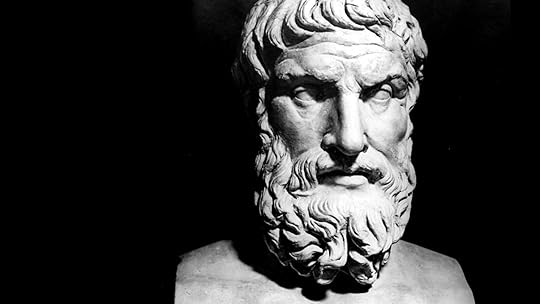
Ποια θα μπορούσε να είναι η θρησκευτικότητα ενός φιλοσόφου που κατηγορήθηκε από τους πάντες ως υλιστής, «άθεος» και «ηδονιστής»; Η θέση του Επίκουρου, «Ο θεός δεν έχει προβλήματα ούτε σε άλλους προκαλεί, κι έτσι ούτε οργίζεται με κανέναν ούτε χαρίζεται σε κανέναν, όλα αυτά είναι γνωρίσματα αδύναμου όντος» συνιστά αθεΐα; Αποτελεί αντίφαση το να πιστεύει κανείς στην ύπαρξη του θεού και συγχρόνως να το αποκλείει από τις ανθρώπινες υποθέσεις;
Το βιβλίο φωτίζει πολλές πλευρές της ελληνικής ιστορίας και θρησκείας και εξετάζει νηφάλια τις θέσεις της επικούρειας φιλοσοφίας απέναντι στο θρησκευτικό φαινόμενο.
"Le père André Jean Festugière (1898-1982) a été en France l'un des plus grands spécialistes de l'étude de l'Antiquité tardive. Entré dans l'ordre des Dominicains en 1924, après avoir appartenu à l'École française de Rome (1921) puis à celle d'Athènes (1922), il se consacre à l'analyse de la pensée grecque (« L'Idéal religieux des Grecs et l'Évangile », 1932
L'homme veut être heureux. Or, ce qui entrave son bonheur, c'est le désir et la crainte. Le désir, parce qu'il est infini et qu'il y a donc toujours un abîme entre l'objet qu'on se propose et celui qu'on atteint. La crainte, parce qu'elle trouble la paix de l'âme. Il faut donc éprouver nos désirs, distinguer ceux qui correspondent à des exigences foncières et les désirs adventices que la vie sociale a fait naître. de ce point de vue, on constate que les désirs naturels et nécessaires sont peu nombreux et qu'il suffit des biens les plus simples pour y satisfaire. ()
When Alexander the Great completed his father's conquest of Greece - by totally destroying Thebes, massacring most of its populace and selling the rest into slavery, thereby intimidating the other cities into (temporary) acquiescence - and then crossed the Hellespont to "liberate" the Greek cities in Ionia, never to return, he left behind him a Greece in crisis, a crisis that only intensified as Alexander's Macedonian regent tightened the screws to the breaking point. And the crisis was not just political. For centuries the Greek had found his laws, purpose, religion and identity provided by his polis, his city-state, and for a certain portion of that time had had the opportunity to speak out in public and to vote on decisions affecting those laws, purpose and identity. No longer. Now all had to evince obeisance to Alexander (through his regent) and then, when Alexander died in Babylon in 323 BCE, to the various Macedonian warlords who struggled to assert their personal control over the Greek peninsula. Some of these loosened the screws a little when they needed the Greek cities' help against one of their antagonists, but this was now a totally new world for the Greeks. So the question posed itself: what must one do now, disengage and find sources of happiness and purpose within oneself, or engage and somehow find a way to loosen the restraints imposed by imperial power sufficiently to do some good while carrying out the desires of that power, however repugnant they might be?
Epicurus, whose positions have been scurrilously misrepresented by his Sophist, Stoic, Cynic and, later, Christian competitors, came down strongly in favor of the former.
But first some more background.
Every citizen of a Greek polis was obliged to perform the rites associated with the particular polis' civic religion,(*) and this religion and these rites sufficed for the ordinary citizen. Towards the end of the 5th century BCE the Greek intelligentsia began to distinguish between the civic religion and a more private religion, and with this distinction the possibility of criticizing the civic religion arose. This was a dangerous matter; it was possible for one's fellow citizens to vote for the death of a "heretic", as was infamously demonstrated by Socrates' trial (though it seems clear from Plato's and Xenophon's reports on the matter that Socrates was condemned more for having stepped on too many Athenians' toes than for failing to observe the civic religion correctly). So the intelligentsia took pains to avoid proclaiming these criticisms in the agora (nonetheless, it seems to me that Euripides' critique in plays like Herakles must have been obvious to everyone in the audience; he did, however, build in deniability by placing the most flagrant criticism into the mouths of characters in the throes of emotional crisis).
Taught the ideas of Democritus as a teenager (which marked his later philosophy in a fundamental manner), circumstances made it impossible for Epicurus to study in any of the many schools of philosophy in Greater Greece. Thus it was after a decade of essentially solitary reflection and meditation that Epicurus began to teach in 311, first at Mytilene and then at Lampsacus in Ionia; he moved to Athens in 306 and founded his school, the Garden. (That he found his way to his truth more or less alone is borne out by the striking originality of his philosophy, at least within its Greek context.)
As this is already going to be a lengthy review, I won't recount here the elements of Epicurus' philosophy, though any readers who may be interested can find such a discussion in a review of all that is left of Epicurus' original texts here:
Instead I'll say a few words about André-Jean Festugière's Épicure et ses dieux (1946, available in English translation under the title Epicurus and His Gods), a charming little book that taught me some things I didn't know before. Like the estimable Félix Buffière, Festugière (1898-1982) was a Roman Catholic ecclesiastic who dedicated much of his life to the study of the Greco-Roman past as a directeur d’études at the École pratique des Hautes Études.
In a fairly informal style (supplemented by scholarly footnotes) Festugière reviews what is known of Epicurus' life, as well as its social and political context, and provides an insightful and sympathetic introduction to his philosophy with an overwhelming emphasis, as the title suggests, on his theology. Unlike most of the intelligentsia Epicurus did not just pay lip service to the civic religion, but his gods had little to do with those of the Olympian myths. For Epicurus reasoned that the gods had to be perfectly happy and hence, by his conception of happiness, could not be burdened with the cares of the world. So Epicurus' gods found themselves in a stasis of perfect bliss without concerning themselves with this world and its miserable inhabitants. By participating in the rites of the civic religion the celebrant could share a little in their bliss.
Of particular interest was Festugière's repeated contrast of Epicurus and Plato. Not only did Epicurus welcome female disciples (Plato wouldn't have them, probably because he hoped he was training future philosopher kings, but the Banquet suggests another possible reason); not only did Epicurus believe contra Plato that friendship is an end in itself; not only did Epicurus reject Plato's notion of an eternal soul (above all his very Indian notion of metempsychosis) and his (and Aristotle's) insistence on teaching the entire classical Greek paideia (Epicurus, whose education was somewhat limited, asserted that one should only learn what one absolutely needed to find ataraxia, the blissful state that accompanies avoidance of unnecessary worries, desires, pain, cold and hunger); but he also rejected what Festugière calls the "astral religion" developed by the intelligentsia to replace (in private) the civic religion and based primarily on Plato's metaphysics/theology (see e.g. the Timaeus). The details I'll leave for you to discover during the very pleasant read of this fine little book.
Festugière closes with a few suggestive pages that indicate the possibility that Epicureanism, Stoicism and Pyrrhonic Skepticism all were reactions to the ethical and social turmoil I briefly mentioned: all emerged at this time and all had some form of ataraxia at their core, even if there were distinct differences in emphasis and balance. Something for me to look into.
() Man wants to be happy. But what impedes his happiness are desire and fear. Desire, because it is infinite and so there is always an abyss between the goal one sets oneself and that which one attains. Fear, because it disturbs our peace of mind. We must then examine our desires and distinguish those which correspond to basic needs from the adventitious kind fostered by social life. In this way we ascertain that the natural and necessary desires are few in number and require only the simplest things to satisfy them.
(*) The same Olympic deities were recognized, in principle, by all Greeks and essentially the same myths concerning them were shared, but the local deities, though identified with various members of the Olympian pantheon, were all unique to the locality with their own local myths and rites. These local deities were, in fact, an essential part of the identity of the polis and hence of its citizens, and any perceived slight of the local gods by a foreigner - in other words, anyone not a citizen of the particular polis - was grounds for violence and even war. See, for example, Euripides' Children of Herakles.
Μ’ αρέσει που ένας παπάς, από τους πιο μορφωμένους και με ανυπέρβλητες εργασίες στην μη χριστιανική πνευματικότητα της ύστερης αρχαιότητας, αναλαμβάνει αμέσως μετά τον Β΄ Παγκόσμιο Πόλεμο να γράψει για τους θεούς του φιλοσόφου που κατηγορήθηκε περισσότερο από όλους σχεδόν σαν άθεος –του Επίκουρου. Κι είναι χαρακτηριστικό της αξίας του βιβλίου πως όταν ξεκίνησαν οι εκδόσεις «Θύραθεν» τη σειρά τους για τον επικουρισμό επέλεξαν ως πρώτο το βιβλίο του πατρός Festugière (ένας ακόμη ιερωμένος, μετά τον Gassendi, Γάλλος κι αυτός, στον οποίο οφείλουμε πολλά για την αναβίωση του νεότερου ενδιαφέροντος για τον Επίκουρο).
Είναι ένα πολύ καλό βιβλίο, όχι μόνο για την εποχή του. Γιατί ούτε όταν εμφανίστηκε συνόψιζε απλώς τα έως τότε πορίσματα της έρευνας. Ο Festugière προχωρά σε μια προσωπική σύνθεση. Στο πρώτο κεφάλαιο μας εισάγει στη θρησκεία της ελληνιστικής εποχής (που έχει ξεφύγει από τα στενά όρια της πόλεως και γίνεται ταυτόχρονα καθολική και ατομική) και έτσι καταλαβαίνουμε το ιστορικό πλαίσιο της ζωής και της σκέψης του Επίκουρου (κεφάλαιο 2). Καθώς η ἀταραξία προβάλλεται ως το ύψιστο ιδανικό του επικουρισμού, η απαξίωση της (έντονης) πολιτικής ζωής και η συμβουλή του λάθε βιώσας θα άφηνε εντελώς ξεκρέμαστο τον άνθρωπο εάν δεν εξισορροπούνταν από το ιδανικό και την εξάσκηση της φιλίας (κεφάλαιο 3). Η πραγμάτωση μιας κατά το δυνατόν θεϊκής ζωής ανάμεσα στους ανθρώπους είναι ο κύριος στόχος του σοφού και είναι εφικτός. Στην ερμηνεία του Festugière (κεφάλαιο 4) ο ρόλος της θρησκείας είναι σημαντικός για τα παραπάνω –και ίσως υπερτονίζεται, κάτι ίσως αναμενόμενο από τον πατέρα F. Είναι μια θρησκεία ορθολογική, χωρίς το δούναι και λαβείν που κυριαρχεί στη λαϊκή θρησκεία (όχι μόνο της εποχής του). Αν επιτίθεται ο Επίκουρος σε κάποιαν θρησκεία, αυτή είναι η αστρική (κεφάλαιο 5), που βρίσκεται μεν στον αντίποδα του αρχαίου ανθρωπομορφισμού, αλλά κηρύσσει την υποταγή σε μιαν αμετάτρεπτη κοσμική αναγκαιότητα, σύμφωνα με την οποία όλα, και τα αγαθά και τα κακά, (προ)καθορίζονται από τις κινήσεις των θεοποιημένων άστρων.
Δεν κατάλαβα από ποια έκδοση γίνεται η μετάφραση. Στη σελίδα ταυτότητας αναφέρεται η γαλλική έκδοση του 1945 (το σωστό είναι: 1946). Αλλά υπήρξε και δεύτερη γαλλική έκδοση, «διορθωμένη» του 1968, γιατί δεν μεταφράστηκε από αυτήν; Μια πρόχειρη αντιπαραβολή με την αγγλική μετάφραση του 1956 δείχνει ότι η ελληνική μάλλον έγινε από αυτήν.
Ασφαλώς το βιβλίο δεν αποτελεί μια γενική εισαγωγή στη σκέψη του Επίκουρου, αλλά ο τρόπος που την ανασυγκροτεί με άξονα τις ιδέες του περί θεών προσφέρει στον αναγνώστη θέαση και του συνόλου και του επιμέρους. Θέλω να πω δεν είναι τόσο ειδική μελέτη όσο ίσως υπαινίσσεται ο τίτλος της. Ο Festugière χρησιμοποιεί τα αρχαία κείμενα προσεκτικά και εξαντλητικά· το αποδεικνύουν τα πολλά παραθέματα και οι πάμπολλες αναφορές στις πηγές (δυστυχώς οι σημειώσεις μαζεύονται δύσχρηστες στο τέλος κάθε κεφαλαίου). Και, παρά τα χρόνια του και τον υπερτονισμό του θρησκευτικού (κοσμικού, πάντως) στοιχείου του Επίκουρου, το βιβλίο είναι όχι μόνο αξιόπιστο αλλά και ευκολοδιάβαστο. Αξίζει να διαβαστεί από όποιους ενδιαφέρονται για τη φιλοσοφία του Επίκουρου και την πνευματικότητα του αρχαίου κόσμου.
Μια επιτομή της Επικούρειας φιλοσοφίας με έμφαση στην στάση του Επίκουρου σχετικά με τους παραδοσιακούς θεούς της αρχαιότητας. Ο συγγραφέας επιχειρεί να αντικρούσει την αντίληψη περί δήθεν αθεΐας του μεγάλου φιλοσόφου. Στην πραγματικότητα η παραδοσιακή θρησκεία είχε από καιρό αποδυναμωθεί και ο Επίκουρος επιχείρησε να αποστασιοποιηθεί μη θέλοντας όμως και να ασκήσει κριτική στην παραδοσιακή θρησκεία.
ενα βιβλίο που απευθύνεται πιο πολυ σε γνωστές της φιλοσοφίας του Επίκουρο , όχι σε αρχάριους σαν κ μένα, θα έλεγα ότι δεν με κάλυψε αλλά μια ιδέα την πήραμε.
Ο Επίκουρος δεν απορρίπτει τους θεούς, αλλά τους αφαιρεί όσα χαρακτηριστικά τούς αποδίδει ο ανθρώπινος φόβος. Ο Φεστιζιέρ αναδεικνύει αυτή τη λεπτή διάκριση, εξετάζοντας πώς μια φιλοσοφία που συνδέθηκε με την αθεΐα μπορούσε να διατηρεί τη θεϊκή ύπαρξη, αποκλείοντας παράλληλα την παρέμβασή της στον κόσμο. Η μελέτη ξεπερνά τα όρια της επικούρειας σκέψης και φωτίζει την αρχαία ελληνική θρησκευτικότητα, τις αντιλήψεις περί θεότητας και τη σχέση πίστης και λογικής. Αντί να αναπαράγει στερεότυπα, προσφέρει μια νηφάλια προσέγγιση σε μια θέση πολύ πιο σύνθετη από όσο φαίνεται αρχικά.